
Muse Ember Review: Can Meta Make Everyday AI Agents Cheaper?
Muse Ember is Meta's new efficiency-focused model for work that AI agents repeat: reading files, calling tools, classifying requests, extracting information, and making bounded code changes. Released on November 9, 2026, it is aimed at the execution layer of an AI system rather than every difficult planning decision.
The attraction is straightforward. Its published short-context API rates start at $0.10 per million input tokens and $0.50 per million output tokens. But the detail that matters for production is the 200,000-input-token threshold, above which higher rates apply to the whole request.
This review examines Muse Ember's specifications, benchmarks, pricing, coding use cases, multimodal capabilities, and deployment choices. It is based on current documentation and our analysis, not firsthand tests or an invented numerical rating.
Our best AI models and leaderboards hub connects the wider field by capability and use case. Ember belongs in the conversation about economical execution, where successful outcomes matter more than the largest model name.
Updated November 10, 2026. API prices are in USD.
QUICK ANSWER
Muse Ember is worth evaluating for repeated, clearly defined agent tasks, coding subtasks, document extraction, and multimodal processing. Its API identifier is muse-ember-1.0, with a documented 1,048,576-token context window and up to 524,288 output tokens.
For requests with up to 200,000 input tokens, standard pricing is $0.10 per million uncached input tokens and $0.50 per million output tokens. Above that input threshold, the rates rise to $0.30 and $1.50. Cached-input rates also increase.
My recommendation: start with one repeatable workload, measure accuracy and complete-task cost, and retain an escalation route for difficult cases. Ember's strongest role is doing the volume efficiently while a more capable model handles planning or unresolved problems.
1. What Is Muse Ember?
Muse Ember is the efficient execution model in Meta's Muse family. Meta positions it for high-volume work such as tool calls, routing, coding subtasks, and processing collections of files or records.
That positioning is useful because agent workloads are uneven. One step may require a difficult architectural decision, while the next twenty involve locating files, extracting fields, or checking a familiar condition. Paying frontier-model prices for every step can make an otherwise sensible workflow expensive.
Ember gives developers another way to split that work. A larger model can decide what should happen, while a smaller worker receives a focused task, relevant evidence, and an observable completion condition.
The distinction is between the model and the system around it. A model response does not automatically execute a tool, verify a database update, or establish that a patch works. The application still has to carry out the actions and inspect the result.
2. Muse Ember Specifications
The documented model combines a large context window with text, image, audio, video, and PDF inputs. Its output modality is text, so multimodal understanding should not be confused with image or video generation.
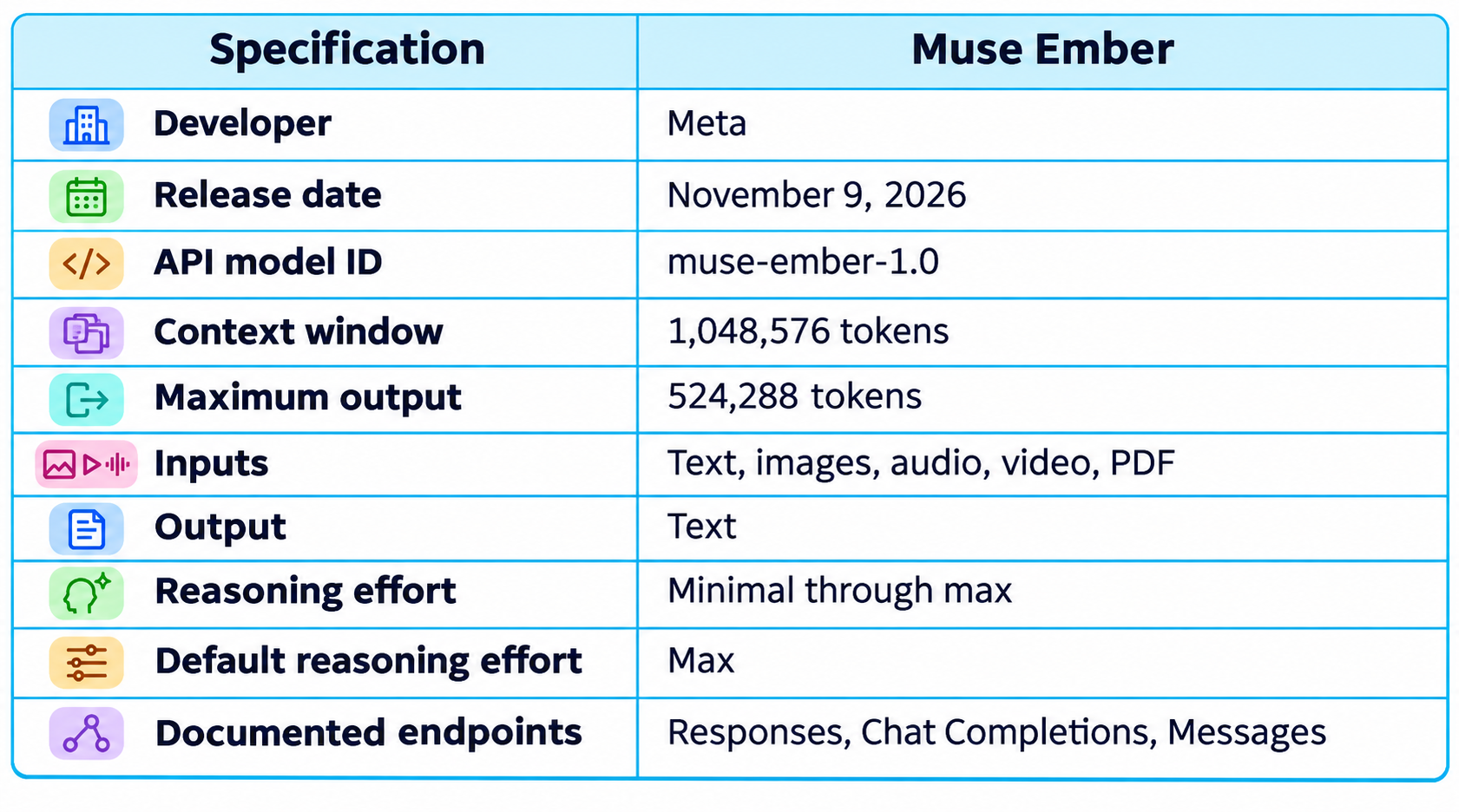
The maximum output figure describes capacity, not a recommendation to generate extremely long answers. Likewise, a large context window does not guarantee that the model will correctly retrieve and reason about every detail in a large input.
Check input and output requirements together for your actual request. Do not assume the maximum context and maximum output figures mean both can be used independently without regard to the platform's request constraints.
3. Muse Ember Benchmarks
Meta's published benchmark table presents Ember as competitive with other efficient models, but it also shows an important coding weakness. The results support a workload-specific evaluation rather than a claim that Ember wins everything.
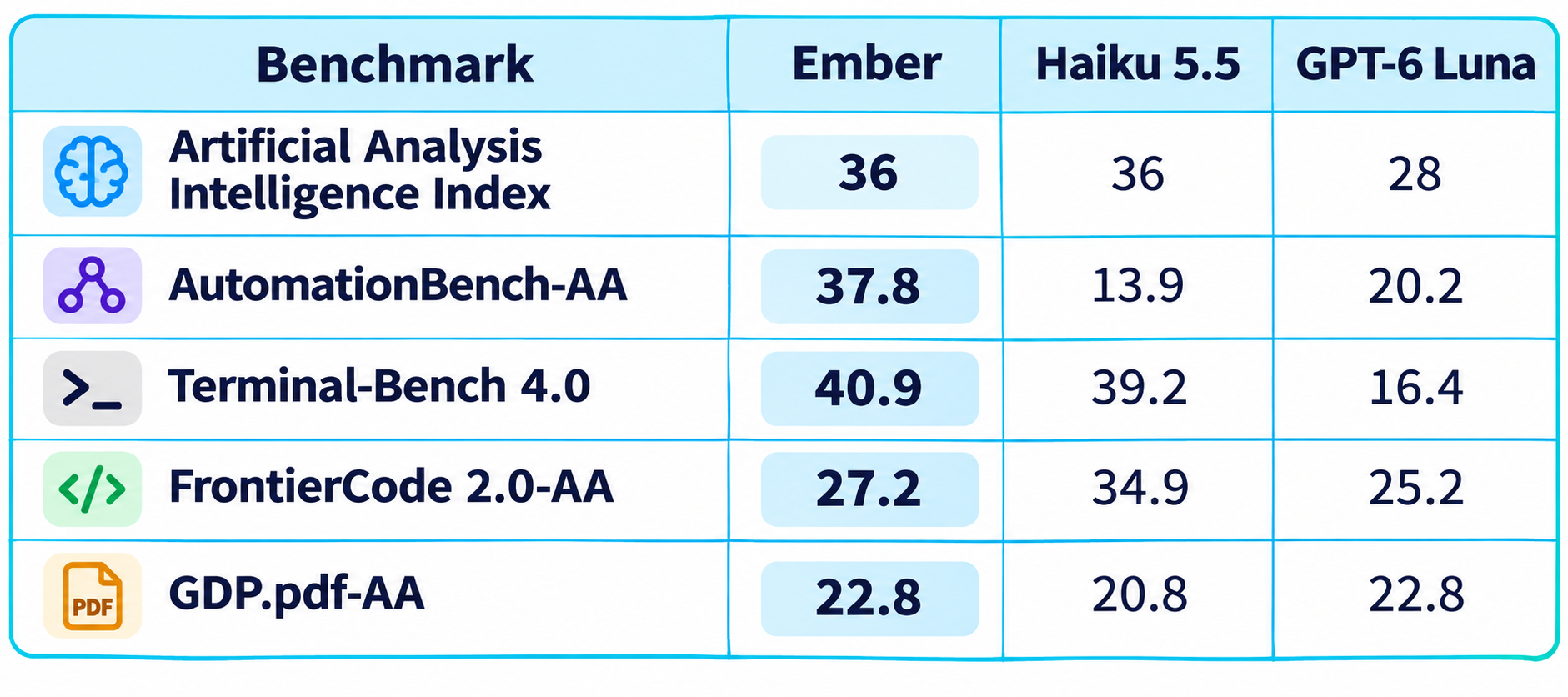
These are the launch table's max-effort results. The Intelligence Index is an index score, not a percentage of tasks completed. Meta attributes some measurements to Artificial Analysis and identifies other evaluations as internal.
Terminal-Bench also uses different published agent harnesses: mini-swe-agent for Ember, Claude Code for Haiku, and Codex for Luna. That makes it a model-and-harness comparison rather than a perfectly isolated comparison of model capability.
The FrontierCode result deserves attention: Haiku leads Ember on that row. A strong automation score should not be used to claim superior engineering performance across every task.
Our October 2026 AI model ranking provides the earlier competitive context. It predates Ember, so use it as background rather than treating it as a November ranking that already tested the new model.
4. Muse Ember Pricing and the 200K Threshold
Muse Ember has two token-price tiers, determined by the request's total input tokens, including cached input. Above 200,000 input tokens, Meta charges the long-context rates for the whole request, not only the portion beyond the threshold.
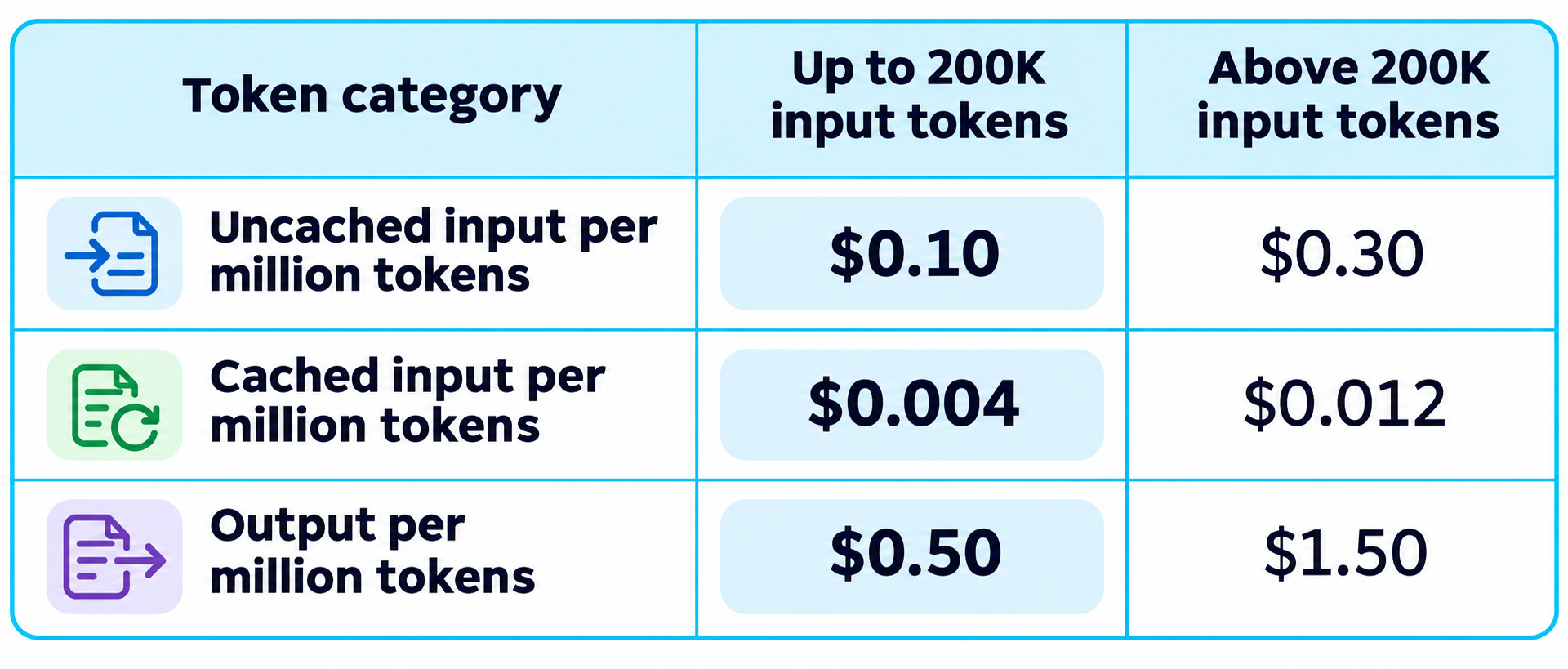
That distinction changes how you should think about a growing conversation. A worker that starts with a short brief may be inexpensive, then move into the higher tier as history, tool results, and reference material accumulate.
Consider two simplified requests with no cached input. A request containing 199,000 input tokens and 1,000 billable output tokens costs $0.0204 at the listed rates. A request containing 201,000 input tokens and the same output costs $0.0618. These are arithmetic illustrations excluding tools and other charges.
The second request contains only slightly more input, but crosses the tier boundary. This is why a headline price cannot substitute for cost measurement at your real session lengths.
My preference would be to keep each worker's brief focused. Send the files and evidence needed for that task rather than automatically copying the entire parent conversation into every call.
5. Real Cost Per Completed Task
The useful production metric is total spend divided by accepted outcomes. Per-token prices are the starting point, while retries, reasoning, tools, review, and escalation determine what the workflow actually costs.
For example, 100,000 uncached input tokens and 2,000 output tokens would cost $0.011 at the short-context rates. Ten thousand identical requests would therefore represent $110 in token charges before other costs. Neither calculation establishes how many requests your application will need.
A cheap model can become expensive if it produces work that requires repeated correction. Conversely, a model that handles a routine step consistently can create substantial savings even if it does not lead an overall intelligence ranking.
Meta's research launch table estimates roughly $0.14 per Artificial Analysis Intelligence Index task for Ember. Treat that as a benchmark-specific estimate under its published conditions, not a universal price for a support ticket, code change, or document.
Track token usage, accepted outputs, and review time in the same record. That gives you a meaningful basis for deciding whether to keep the work on Ember or escalate it.
6. Coding Performance and Subtask Design
Ember is a sensible evaluation candidate for coding work with a clear boundary: inspect a file, explain a failing check, make a targeted correction, or apply a known transformation. Meta's own model-selection guidance recommends larger models for hard single-shot coding and more demanding engineering work.
A good worker brief specifies the task, relevant files, permitted changes, and validation. “Investigate why this parser rejects the attached input, make a focused correction, and run the existing parser tests” is easier to judge than “improve this repository.”
Keep acceptance criteria observable. A worker's statement that the code is fixed is less useful than the resulting patch and the check output. Review unintended changes as part of the evaluation, especially when running many workers.
The tool environment can alter results substantially. Our comparison of Claude Code, Codex, Cursor, and OpenCode explains the agent layer around the model. Repository access, context handling, and testing support belong in the comparison alongside model choice.
For a first trial, choose a repetitive task your team already understands. A known pattern makes it easier to determine whether the worker is saving effort rather than simply generating plausible code.
7. Muse Ember vs Claude Haiku 5.5
Haiku is an especially relevant comparison because Meta's launch table places both models at a rounded Intelligence Index score of 36. Equal rounded aggregate scores do not mean equal strengths on every workload.
Ember leads on some listed automation and terminal-agent results, while Haiku leads on the displayed FrontierCode result. Those differences matter more when they resemble the tasks in your application.
Compare both models using the same tools, source material, and acceptance checks. Run representative failures as well as straightforward requests. A model may be excellent at normal inputs but need frequent escalation when a document is incomplete or a tool returns an unexpected result.
Our Claude Haiku 5.5 review covers the competing efficient-model workflow. Use it to build a comparison around accuracy, latency, and total cost instead of choosing from one rounded index score.
I would also compare the amount of manual review required. A small difference in correctness can outweigh a token-price advantage when the output feeds a real business process.
8. Muse Ember vs Muse Spark and Muse Wonder
Meta recommends matching the model to the role: Wonder for difficult planning and long-horizon work, Spark for a lower-cost main agent loop, and Ember for repeated execution. The practical benefit comes from giving each model a job it can perform reliably.
A planner might break a migration into independent tasks, identify shared interfaces, and define acceptance checks. Ember workers can handle the bounded changes. The planner or a developer then reviews the combined result and resolves cross-cutting issues.
This design needs more than changing the model name. Specify the handoff: what the worker knows, which files it can change, how it reports uncertainty, and what evidence it must return.
Our Meta Muse Wonder review covers the larger-model side. It is the natural companion when you want to decide which work should remain with a planner and which can move to Ember.
Start with one routing rule that your team can explain. Escalate a task when its scope expands, its checks continue to fail, or the available evidence is insufficient. A complicated router is not a substitute for a clear completion condition.
9. Multimodal Inputs and Document Work
Ember accepts several input modalities, but the intended output remains text. Useful evaluation tasks include extracting fields from invoices, interpreting a screenshot with a bug report, or summarizing evidence from a supplied recording.
For extraction, specify both the required value and what should happen when it is absent. A result should distinguish “not present” from “unreadable” instead of inventing a plausible answer to complete a schema.
For document summaries, require source locations or supplied page labels where possible. This makes checking faster and helps reviewers identify whether a claim came from the input or from the model's assumptions.
Be careful about combining unrelated material. A worker processing one invoice rarely needs the entire customer history. Smaller, relevant inputs can improve reviewability and help avoid the long-context pricing tier.
The maximum context is useful when the task actually needs it. It should not become the default amount of information sent to every small classification or extraction request.
10. API Access, Muse Code and Reasoning Effort
Muse Ember is available through Meta Model API and Muse Code. The documented API identifier is muse-ember-1.0, with Responses, Chat Completions, and Messages endpoints listed in the model documentation.
Muse Code supplies the environment for editing files and running checks. With a direct API integration, your application must execute requested tools and send the results back. Treat the model as one component of the agent system.
Ember defaults to max reasoning effort. Test whether that default is appropriate for your workload rather than assuming the smallest model automatically uses minimal reasoning on every call.
Measure a few supported effort settings against the same tasks. Compare output quality, total tokens, and elapsed time. A lower setting may suit a tightly defined task, but a failed result can erase the apparent saving if it needs another attempt.
Keep the integration reproducible by recording the model, endpoint, effort, input size, and validation result. Also distinguish subscription allowances from pay-as-you-go API charges when estimating costs.
11. Standard Mode, Contributor Mode and Open Weights
Meta documents Ember on Model API as Standard mode only, with no Contributor-mode variant. It says Standard-mode content is not used to train Meta models. Muse Code subscription settings are a separate surface and should be checked independently.
Do not treat “not used for training” as synonymous with zero retention or every other privacy requirement. Review the terms and controls for your actual deployment before processing material subject to organizational restrictions.
Similarly, low API prices and Meta branding do not establish that Ember is open-weight. The sources reviewed here offer Ember through hosted interfaces and do not provide downloadable Ember weights for local deployment.
If running the model yourself is the requirement, our October open-source AI model guide compares a different set of options by hardware and setup needs. That is a separate decision from choosing an economical hosted worker.
12. A Practical Routing Workflow
The most useful starting architecture is a small worker pipeline with a clear escalation path. You do not need to move every request or introduce a large network of agents to evaluate the model.
First, choose a repeated task, such as classifying incoming requests. Define the allowed categories, the evidence needed, and the conditions requiring a human or larger-model review.
Second, send Ember a focused brief and validate its response. A valid schema checks the shape of the answer; an accuracy check determines whether the classification is supported by the input.
Third, record uncertain cases and failed validations. Escalate according to a rule you can audit, then use those cases to improve the brief or change the boundary between models.
Our model-routing guide for coding agents explains how cost and task complexity interact in this design. The older prices in that guide are historical; apply the routing principles using current model rates.
13. Limitations and Evaluation Checklist
The main risks are misplaced task scope, long-context pricing, and accepting results without checking them. A low-cost worker is useful only when its outputs meet the standard your workflow requires.
Build a test set containing normal inputs, incomplete evidence, ambiguous requests, and tool failures. Keep the tools and source material consistent between models, and include rejected outputs in your cost calculation.
Measure accuracy, completion rate, time to acceptance, token usage, and escalation frequency. For coding, inspect patches and test results. For extraction, compare fields against labelled source material rather than trusting a fluent summary.
Our guide to AI agents that actually complete tasks covers the broader execution loop. Verification, retry handling, and observable outcomes remain important even when the model changes.
Treat the launch benchmarks as a starting hypothesis. The right production result is a repeatable improvement on the work your application actually receives.
14. Is Muse Ember Worth It?
Yes, Ember is worth evaluating when your application performs many repeated tasks that do not all require a frontier planner. Its pricing and model positioning make it a plausible worker for coding subtasks, routing, extraction, and multimodal processing.
It is less compelling as an automatic replacement for your strongest model on difficult architecture, open-ended research, or unfamiliar multi-step problems. Meta's own guidance preserves a role for Spark and Wonder on harder work.
My verdict is to test Ember on one measurable workflow before expanding it. Keep prompts relevant, watch the 200K input boundary, compare accepted outcomes, and retain a route for difficult cases. If it reduces complete-task cost without increasing failures or review effort, it has earned its place.
Frequently Asked Questions
What is Muse Ember?
Muse Ember is Meta's efficiency-focused reasoning model for repeated agent work. It is designed for tasks such as tool calls, routing, extraction, document processing, and focused coding subtasks.
How much does Muse Ember cost?
For up to 200,000 input tokens, rates are $0.10 per million uncached input tokens and $0.50 per million output tokens. Above that threshold, the corresponding rates are $0.30 and $1.50.
Does the higher rate apply only above 200K tokens?
No. Once a request exceeds 200,000 input tokens, the long-context tier applies to the whole request. Cached input counts when determining the tier.
What are Muse Ember's context and output limits?
The model documentation lists a 1,048,576-token context window and a maximum output of 524,288 tokens. Check the request constraints for your use case rather than assuming both maxima are independently available together.
Is Muse Ember better than Claude Haiku 5.5?
Not on every task. Meta's launch results show Ember ahead on several agent measurements, while Haiku leads on the displayed FrontierCode result. Compare the models on your own work.
Can Muse Ember understand images and audio?
Yes. Meta documents text, image, audio, video, and PDF inputs. The model returns text, so this is multimodal understanding rather than image or video generation.
Is Muse Ember open source?
The reviewed sources offer Ember through Meta Model API and Muse Code and do not provide downloadable Ember weights. Do not assume it can be self-hosted because other Meta models have open weights.
Should Ember replace Muse Wonder or Spark?
Usually, evaluate it as a complementary worker first. Meta recommends larger models for difficult planning and reasoning, with Ember handling repeated, bounded execution.
Recommended Blogs
- Best AI Models in October 2026: Tested & Ranked
- Best Open-Source AI Models of October 2026: Benchmarks, VRAM & Local Setup
- How to Build an AI Agent That Actually Completes Tasks
- Best AI Coding Agents: Claude Code vs Codex vs Cursor vs OpenCode
- Meta Muse Wonder: Review, Benchmarks & Pricing
- Claude Haiku 5.5 Review: Speed, Cost & API
- Model Routing for AI Coding Agents: Cut Costs Without Losing Quality
Resources & Community
Join our community of 70,000+ AI enthusiasts and learn to build powerful AI applications. Build Fast with AI helps developers, creators and teams understand AI models and turn them into useful applications.
Agentic AI Launchpad 2026
A structured six-week cohort program for learning to build and deploy real-world agentic AI systems, with live sessions, mentorship, project reviews and a builder community.
Explore the program: Agentic AI Launchpad 2026
Free AI Resources
Explore workshops and short-form learning resources to keep building.
References
- Meta AI Research: Introducing Muse Ember
- Meta for Developers: Building with Muse Ember
- Meta Model API: Muse Ember documentation
- Meta Model API: Pricing and rate limits
- Meta Model API: Choosing and combining models
- Meta: Muse Ember model and product overview
- Meta AI Research: Muse Ember evaluation report
- Meta Model API: Reasoning settings