



Claude Haiku 5.5 Review (2026): Speed, Cost & API
Anthropic just made its cheapest model a lot more capable. Claude Haiku 5.5, released on October 7, 2026, cuts API prices by up to 90 percent while posting benchmark jumps that would be impressive for a flagship, let alone a small model. I spent time running it on the kind of work small models actually do in production, high-volume agents, extraction, classification, and routing, and this review focuses on what matters there: cost-to-performance, latency, and how it behaves in a real API integration. If you run AI at scale and care about the bill, this is the release to pay attention to.
The short version is that Haiku 5.5 changes the maths for a lot of workloads. The headline is the price cut, but the more interesting story is that the cheaper model is also meaningfully smarter and faster than the Haiku it replaces. Let me walk through what it is, what it costs, how it performs, and where it fits, so you can decide whether to route your traffic to it.
What Is Claude Haiku 5.5?
Claude Haiku 5.5 is the newest model in Anthropic's small, fast model class, the tier built for speed and low cost rather than maximum intelligence. It sits below Claude Sonnet and Claude Opus in the lineup, and it is designed for high-volume, latency-sensitive work where you want a capable model that is cheap enough to call constantly. Think agent sub-tasks, data extraction, classification, summarisation, and routing, the jobs that run millions of times rather than once.
What makes this release notable is that Haiku 5.5 is the first Haiku with adjustable effort. You can set it from low to max, and thinking is on by default at medium effort, so the same model can be a fast, cheap responder or a more deliberate reasoner depending on the setting. That single control lets you tune the trade-off between depth, latency, and cost per request, which is exactly what production teams want. It is available on the Claude Platform as claude-haiku-5-5, and through AWS, Google Cloud, and Azure. For the wider family, see our Claude complete guide.
Key Specs at a Glance
Here is Claude Haiku 5.5 in one view before the detail.
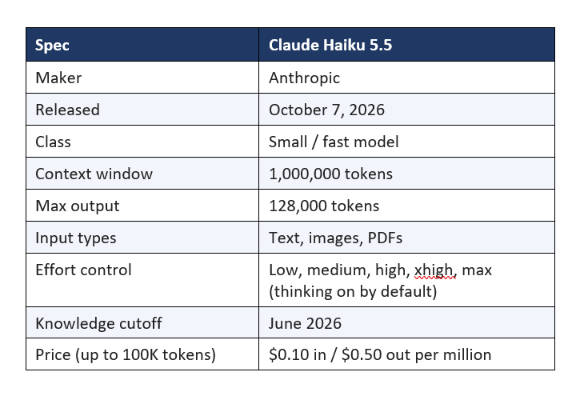
Two numbers stand out. The million-token context window is unusual for a small model and means Haiku 5.5 can handle long documents and large agent histories that used to need a bigger, pricier model. And the price, which we come to next, is the lowest Anthropic has offered for a model this capable.
Pricing: The Headline Story
Pricing is the reason this release matters most. For prompts up to 100,000 tokens, Claude Haiku 5.5 costs $0.10 per million input tokens and $0.50 per million output tokens. Longer prompts move to a higher tier at $0.50 input and $2.50 output. Cache reads, which carry most of the cost in agentic and repeated workloads, are just $0.01 per million tokens.
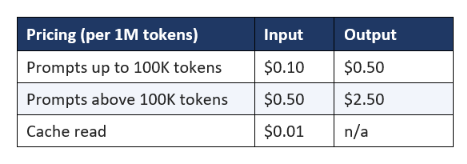
Against the previous Haiku 4.5, which listed at about $1 input and $5 output per million, Anthropic puts the saving at roughly 90 percent for requests up to 100,000 tokens and 50 percent above that, averaging around 75 percent in practice. That is a step-change for anyone running Haiku at volume: the same workload can cost a fraction of what it did, or you can afford to call the model far more often for the same budget. For the broader value picture, see our guide to the best AI coding models under $5 per million tokens.
Benchmarks & Performance
The surprise is that the cheaper model is also a much stronger one. On Anthropic's reported benchmarks, Haiku 5.5 does not just edge the previous Haiku, it leaps past it, and in several agentic tests it beats competing small models outright.
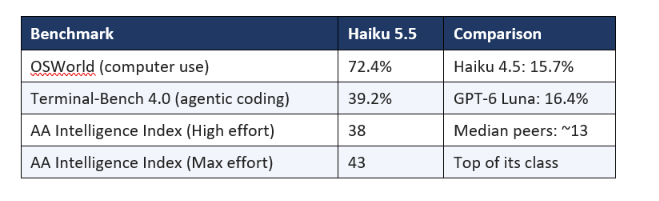
The OSWorld jump, from 15.7 to 72.4 percent, is the standout: computer-use and agentic tasks that the old Haiku simply could not do are now in reach for a small, cheap model. On the Artificial Analysis Intelligence Index, Haiku 5.5 at high effort scores well above the median for similarly priced reasoning models, and its max setting climbs higher still. The practical read is that Haiku 5.5 closes much of the gap to mid-tier models while keeping small-model pricing, which is exactly where the value lives. For the full field, see our best AI models 2026 ranked analysis.
Latency & Speed
For a small model, speed is half the point, so this deserves its own look. On raw throughput, Haiku 5.5 generates roughly 136 tokens per second at high effort and up to about 242 tokens per second at its fastest setting, both above the median for comparable reasoning models. Time to first token varies a lot by effort, from around 10 seconds at low effort to the mid-20s at high effort on some trackers, while one provider measured a sub-2-second median latency, so your real numbers depend heavily on effort setting and provider.
More telling are the customer reports. One large software company reported over a 30 percent reduction in task-completion latency and up to 2.5x faster inference per agent turn after moving to Haiku 5.5, and another found about half the latency of Haiku 4.5 while scoring 11 points higher in early testing. The pattern is clear and matches what I saw: for agentic loops that make many sequential calls, the combination of lower per-turn latency and lower cost compounds, and the effort control lets you dial latency down further when a step does not need deep thinking. The honest caveat is to measure median and p95 latency on your own workload, because effort and provider swing the numbers widely.
API Integration for Production
Where Haiku 5.5 earns its place is production integration, and here it is pleasant to work with. It uses the standard Claude API, supports text, image, and PDF input, and the new effort parameter slots in as a simple per-request control, so you can run the same model at low effort for cheap, fast steps and raise effort only where a task needs more reasoning. The million-token context means you rarely have to engineer around context limits for document or long-history workloads.
- Effort as a cost lever: drop to low effort for routing and classification, raise it for harder sub-tasks.
- Cheap cache reads at $0.01 per million make repeated-context agent loops far more affordable.
- Multimodal input (text, images, PDFs) covers most document-processing pipelines without a separate model.
- Available across Claude Platform, AWS, Google Cloud, and Azure, so it fits existing cloud setups.
The practical pattern that works best is a two-model setup: route the bulk of cheap, high-volume steps to Haiku 5.5 and escalate only the hardest calls to a larger model. Haiku 5.5 is strong enough and cheap enough that it can now carry much more of that load than the previous generation could. For how to split work by difficulty, see our guide to the best AI model per task.
Strengths & Weaknesses
No model is all upside. Here is the honest balance for Haiku 5.5.
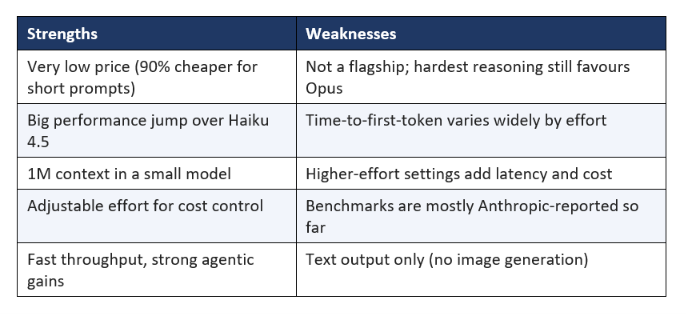
The weaknesses are the expected ones for a small model: it is not meant to replace Opus on the most demanding reasoning, and the effort control that gives it flexibility also means latency and cost depend on how you set it. None of these undercut the core value, which is that you now get much more capability per rupee than before.
Claude Haiku 5.5 vs the Alternatives
How does it stack up against the obvious comparisons: its predecessor and competing small models?
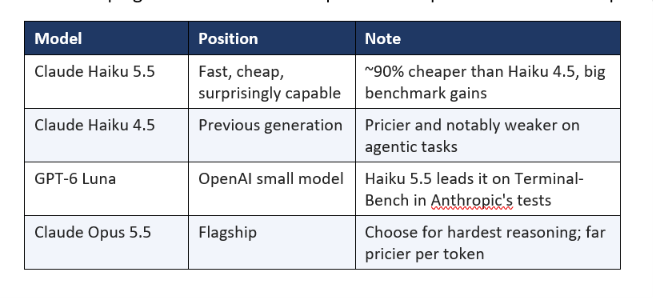
Against its own predecessor the upgrade is clear-cut: cheaper and stronger on nearly every axis. Against competing small models, the published numbers put Haiku 5.5 ahead on key agentic benchmarks, though you should validate on your own tasks. And against Opus 5.5, the choice is the usual one, Haiku for cheap volume, Opus for the hardest work, often both in the same system. For the premium tier, see our Claude Opus 5.5 review.
Who Should Use It
Claude Haiku 5.5 is the right pick for a specific, large set of workloads.
- Teams running high-volume agents or pipelines where cost per call decides viability.
- Classification, extraction, routing, and summarisation at scale.
- Latency-sensitive apps that need fast responses without flagship pricing.
- Document and long-context workloads that benefit from the 1M window on a cheap model.
- Anyone running a two-model system who wants a stronger, cheaper default tier.
If your work is the hardest reasoning, complex multi-step problem solving where a mistake is expensive, you will still want a flagship for those steps. But for the large middle of real production AI, Haiku 5.5 is now good enough and cheap enough to be the default.
My Verdict
Claude Haiku 5.5 is the most consequential small-model release of the year, because it moves the price-performance frontier rather than nudging it. A roughly 90 percent price cut would be notable on its own; pairing it with large benchmark gains and a million-token context makes it a genuine upgrade to how you can build. For production workloads judged on cost-to-performance and latency, which is the lens of this review, it is excellent, and it should be the first model you try for high-volume, latency-sensitive work in 2026.
My recommendation: route your cheap, high-volume traffic to Haiku 5.5, use the effort control to tune latency and cost per step, and keep a flagship like Opus 5.5 for the hardest calls. That combination gives you frontier quality where it matters and small-model economics everywhere else, which is exactly the setup this release is built for.
Frequently Asked Questions
Is Claude Haiku 5.5 good?
Yes, especially for the money. Claude Haiku 5.5 delivers large benchmark gains over Haiku 4.5, a 1 million token context, and adjustable effort, all at roughly 90 percent lower cost for short prompts. For high-volume, latency-sensitive production work it is one of the best value models available in 2026. For the very hardest reasoning you would still choose a flagship like Opus 5.5.
How much does Claude Haiku 5.5 cost?
For prompts up to 100,000 tokens it costs $0.10 per million input tokens and $0.50 per million output tokens. Longer prompts move to $0.50 input and $2.50 output, and cache reads are $0.01 per million. That is about 90 percent cheaper than Haiku 4.5 for short prompts and roughly 50 percent cheaper above the 100,000-token threshold.
What is the context window of Claude Haiku 5.5?
Claude Haiku 5.5 has a 1 million token context window with a maximum output of 128,000 tokens. That is unusually large for a small, fast model and means it can handle long documents, big codebases, and lengthy agent histories without the context engineering that smaller windows require, all at small-model pricing.
Is Claude Haiku 5.5 faster than Haiku 4.5?
Yes. It offers strong throughput, around 136 tokens per second at high effort and up to about 242 at its fastest, and customers reported over 30 percent lower task-completion latency and up to 2.5x faster inference per agent turn versus Haiku 4.5. Time to first token varies by effort setting, so measure your own workload, but in practice it is both faster and cheaper.
Claude Haiku 5.5 vs GPT-6 Luna: which is better?
On Anthropic's reported benchmarks, Haiku 5.5 leads GPT-6 Luna on agentic coding, for example 39.2 versus 16.4 percent on Terminal-Bench 4.0. Both are small, fast, low-cost models, so the right choice depends on your stack and your own testing, but Haiku 5.5's published agentic numbers and aggressive pricing make it very competitive in the small-model class.
Does Claude Haiku 5.5 support images and PDFs?
Yes. Claude Haiku 5.5 accepts text, images, and files such as PDFs as input and returns text. That multimodal input covers most document-processing pipelines, so you can often handle extraction and understanding tasks with Haiku 5.5 alone rather than adding a separate vision model, which keeps both cost and latency down.
Is Claude Haiku 5.5 good for coding?
For everyday and agentic coding sub-tasks, yes, it is much stronger than the previous Haiku, with a big jump on Terminal-Bench and OSWorld. For the hardest, long-horizon coding work you would still choose a flagship like Opus 5.5. A common pattern is to use Haiku 5.5 for the bulk of cheap coding steps and escalate only the hardest ones.
Where can I use Claude Haiku 5.5?
It is available on the Claude Platform as claude-haiku-5-5, and through major clouds including AWS, Google Cloud, and Azure. That means you can call it via the standard Claude API or through your existing cloud provider, which makes it straightforward to drop into most production stacks without new infrastructure.
Recommended Blogs
- Claude Opus 5.5 Review (2026)
- Best AI Models 2026: Full Ranked Analysis & Benchmarks
- The Best AI Model Per Task (2026)
- Best AI Coding Models Under $5 per Million Tokens (2026)
- Claude: The Complete Guide (2026)
References
- Introducing Claude Haiku 5.5 (Anthropic)
- Claude Haiku 5.5: features, benchmarks and pricing (DataCamp)
Anthropic launches Claude Haiku 5.5 with 90% price cut (VentureBeat)

