



Four frontier AI models shipped in a five-week window this autumn, and the marketing for all of them says the same thing: this one is the best. So I stopped reading launch posts and actually put them to work. Over several days I ran GPT-6.1 Sol, Claude Opus 5.5, Gemini 3.8, and DeepSeek V4.1 through the same real tasks, coding, multi-step agent work, reasoning, and long-document analysis, and compared not just who was smartest but who was reliable, fast, and worth the price. This is what I found, where each one won, and the model I would actually pick for different jobs in 2026.
If you only remember one thing, remember this: there is no single best AI model anymore, there is a best model for your job and your budget. All four are genuinely strong, and the gaps between them are smaller than any one vendor's benchmarks suggest. What separates them is character, Opus 5.5 is the dependable builder, GPT-6.1 Sol is the professional-grade workhorse, Gemini 3.8 is the versatile all-rounder, and DeepSeek V4.1 is the open, almost free challenger. Let me show you how they actually behaved.
The Short Verdict
Here is the honest summary before the detail, because you are busy. I tested all four on the same work, and this is how they finished.
- Best all-round (my top pick): Claude Opus 5.5. The most reliable over long, multi-step coding and agent work, and the one I trusted to not quietly go wrong.
- Best for professional coding value: GPT-6.1 Sol. Near top-tier capability on coding and computer use at roughly a fifth of the cost of OpenAI's flagship.
- Best value and multimodal: Gemini 3.8. Handles text, image, audio, and video, a million-token context, and a low price that is hard to argue with.
- Best open-weight and cheapest: DeepSeek V4.1. MIT-licensed open weights, strong agentic coding scores, and pricing a fraction of the others.
If you want the one-line answer: I would build on Claude Opus 5.5, prototype and scale on Gemini 3.8 or DeepSeek V4.1 to control cost, and reach for GPT-6.1 Sol for heavy professional coding and computer-use jobs. Now the evidence.
How I Tested These Models
A comparison is only worth reading if you know what was actually measured, so here is my method. I gave every model the same set of tasks, judged them on the same criteria, and paid attention to the things benchmarks miss, like whether a model stays coherent across a long session or silently drops a requirement halfway through. I combined my own hands-on runs with each vendor's published benchmarks so the verdict rests on both lived behaviour and hard numbers.
- Coding: real feature builds, bug fixes in an unfamiliar codebase, and multi-file refactors, not toy snippets.
- Agentic work: multi-step tasks with tool use, where the model had to plan, call tools, and recover from errors.
- Reasoning: hard analytical and problem-solving prompts where a confident wrong answer is the real risk.
- Long context: feeding large documents and asking for accurate synthesis across all of it.
- Reliability and cost: how consistent each model was across repeats, and what the work actually cost per task.
Two notes on fairness. First, reliability mattered as much as peak skill in my scoring, because a model that is brilliant four times and wrong the fifth is worse for real work than one that is merely very good every time. Second, I weighted price heavily, since in 2026 the capability gap is small enough that cost often decides. With that out of the way, here are the contenders side by side.
The 4 Models at a Glance
Before the deep dives, here is the shape of each model, the vendor, when it landed, its context window, and its headline price. Note that three of the four are efficiency-tier or value-positioned models, which is the real story of 2026: near-flagship quality is now cheap.
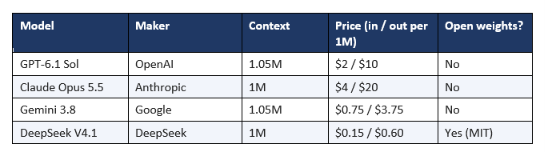
A few things jump out even before testing. All four now carry roughly a million tokens of context, so long-document work is table stakes rather than a differentiator. The price spread, however, is enormous: DeepSeek V4.1 costs a tiny fraction of Claude Opus 5.5 per token, and Gemini 3.8 undercuts both of the US flagships heavily. That price gap is the tension running through this whole comparison, because the most capable model and the cheapest capable model are not the same model.
GPT-6.1 Sol: What I Found
GPT-6.1 Sol is OpenAI's September release that slots just below its top Astra model, and it is aimed squarely at complex coding, computer use, and professional work. The pitch is near-flagship capability at roughly a fifth of the task cost, and in testing that pitch mostly held up. This is a serious professional model that happens to be far cheaper than OpenAI's best, which makes it one of the better value plays at the frontier.
In coding, GPT-6.1 Sol was excellent, particularly on well-specified professional tasks and anything involving computer use or tool-driven workflows. OpenAI reports it matching its Astra model on the DeepSWE coding benchmark at about one-fifth of the cost, and edging Claude Opus 5.5 by a couple of points on AutomationBench at medium effort. My experience tracked that: it was strong, methodical, and especially good when the task was clearly defined and professional in nature.
- Strengths: professional coding, computer use, tool workflows, strong price-to-capability.
- Watch-outs: on the most open-ended, long-horizon agent work it felt a half-step behind Opus 5.5 on staying coherent.
- Price: $2 per million input tokens, $10 output, with cheap cached input, strong value for its tier.
My take: GPT-6.1 Sol is the model I would choose for heavy, well-defined professional coding and computer-use jobs where I want frontier quality without paying flagship prices. It is not quite my pick for the messiest long-horizon agent runs, but for professional work it is outstanding value. Full detail is in our GPT-6.1 Sol review.
Claude Opus 5.5: What I Found
Claude Opus 5.5 is Anthropic's flagship for demanding reasoning, coding, and long-horizon agentic work, and it was the model I trusted most by the end of testing. Its defining quality is not a single benchmark score; it is reliability. Across long, multi-step tasks it stayed coherent, held onto the requirements I gave it, and was the least likely to quietly drift or do something confidently wrong, which is exactly what matters when you are actually shipping.
On the numbers, Opus 5.5 leads agentic coding, computer use, and knowledge work on Anthropic's benchmarks, posting 66.4 percent on Terminal-Bench 4.0 and strong results on FrontierCode and CursorBench. More important to me was how it behaved on real builds: it planned well, used tools sensibly, recovered from its own mistakes, and did not lose the plot on tasks that ran for many steps. For agentic and coding work, it was the most dependable of the four, full stop.
- Strengths: agentic coding, computer use, long-horizon reliability, knowledge work.
- Watch-outs: the most expensive per token of the four, so cost discipline matters at scale.
- Price: $4 input, $20 output per million, but very cheap cache reads soften real agentic costs.
My take: Opus 5.5 is my overall winner and the model I would build a serious product on, because reliability over long tasks is worth paying for. The headline token price is the highest here, but its cheap cache reads make real agentic workloads more affordable than the sticker suggests. Full detail is in our Claude Opus 5.5 review, and a broader view in the Claude complete guide.
Gemini 3.8: What I Found
Gemini 3.8 is Google's efficiency-tier model, and it turned out to be the best all-round value in the group. It is genuinely multimodal, taking text, image, audio, and video as input, carries a million-token context, and costs a fraction of the US flagships. For a huge range of everyday and production tasks, it is simply the sensible default, strong enough to do the job and cheap enough that cost stops being a worry.
On coding and agentic tasks it has closed much of the gap to the top models, scoring 73.7 percent on the DeepSWE v1.1 coding benchmark, a real jump over the previous Gemini. In my testing it was fast, capable, and especially shone on anything multimodal, understanding images, audio, and video in a single prompt is something none of the others match as completely. It was not quite the most reliable on the hardest long-horizon agent runs, but for its price that is an easy trade.
- Strengths: multimodal (text, image, audio, video), huge context, speed, very low price.
- Watch-outs: on the toughest pure-reasoning and long-agent tasks it sits just behind Opus 5.5 and GPT-6.1 Sol.
- Price: $0.75 input, $3.75 output per million (through end of 2026), among the cheapest here.
My take: Gemini 3.8 is the model I would reach for first for most everyday work, multimodal tasks, and anything price-sensitive at scale. It is the best value-to-capability balance in the group, and the clear winner if your work touches images, audio, or video. Full detail is in our Gemini 3.8 review.
DeepSeek V4.1: What I Found
DeepSeek V4.1 is the outsider that makes this comparison interesting. It is an MIT-licensed open-weight model, a large mixture-of-experts design that activates only a small fraction of its parameters per token, giving it strong capability at a startlingly low price. It is the cheapest model here by a wide margin, and you can run the weights yourself, which changes the economics entirely for anyone operating at scale.
What surprised me was how competitive it is on agentic coding. On its own benchmarks it beats older frontier models like GPT-5.6 Sol and Claude Opus 5.0 on several agentic tests, including strong DeepSWE and Terminal-Bench results, and in my hands it was genuinely capable on multi-step coding tasks. Where it fell behind was unaided knowledge and the very hardest reasoning, where it trailed the top closed models by a small but real margin. That is the trade: near-frontier agentic coding and native image understanding, for a fraction of the cost and full open weights.
- Strengths: open weights (MIT), lowest price by far, strong agentic coding, native image input.
- Watch-outs: a step behind the closed flagships on hardest reasoning and unaided knowledge.
- Price: around $0.15 input, $0.60 output per million off-peak, and you can self-host the weights.
My take: DeepSeek V4.1 is the model I would choose when cost or control is the priority, high-volume agentic coding, self-hosting, or building where per-token price decides viability. It will not win the hardest reasoning crown, but as an open, almost-free near-frontier model it is remarkable. Full detail is in our DeepSeek V4.1 review.
Category Winners
No model won everything, so here is how they split the categories I tested. This table is the heart of the comparison: match the row to your job and you have your answer.
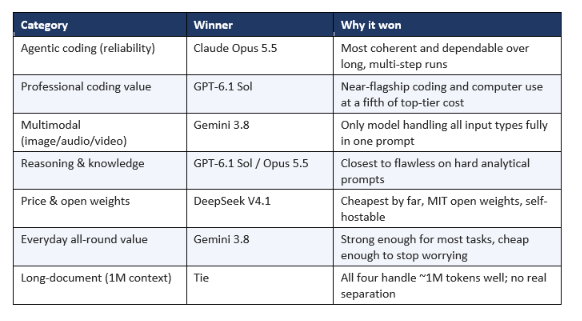
All four handle ~1M tokens well; no real separation
The pattern is clear. If reliability on hard, long tasks is what you need, Opus 5.5 wins. If you want professional coding muscle at a fair price, GPT-6.1 Sol. If you want versatility, multimodal range, and low cost, Gemini 3.8. If price or open weights decide it, DeepSeek V4.1. And long-context is now a tie, because every one of them does it well, which was not true even a few months ago.
Price Comparison
Because price is doing so much of the work in 2026, it deserves its own look. Here are the standard token prices side by side, plus the practical note that matters for each. Remember that real agentic and coding costs depend heavily on caching, where Claude and GPT both discount cached input steeply.
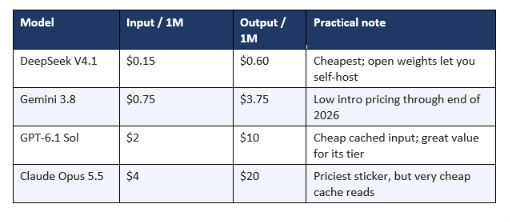
Read this table with your actual workload in mind. For high-volume, cost-sensitive work, DeepSeek V4.1 and Gemini 3.8 are in a different league on price. For agentic coding where most tokens are cached context, the effective cost of Opus 5.5 and GPT-6.1 Sol is far lower than the sticker, which is why serious builders still pay for them. The cheapest model is rarely the cheapest answer once you account for how many tries it takes to get the job done, a capable model that gets it right first time can be cheaper than a weak one you run five times.
Which AI Model Should You Choose?
Here is the decision made simple, mapped to who you are and what you are doing. Find the line that sounds like you.
- You are shipping a serious product or agent: Claude Opus 5.5, for reliability over long tasks.
- You do heavy professional coding and want value: GPT-6.1 Sol, frontier coding at a fifth of top-tier cost.
- You want one versatile, cheap default: Gemini 3.8, strong, multimodal, and inexpensive.
- Your work is multimodal (image, audio, video): Gemini 3.8, the only full-multimodal option here.
- Cost or control is everything, or you self-host: DeepSeek V4.1, open weights and lowest price.
- You are a beginner choosing one to learn: Gemini 3.8 or Claude Opus 5.5, capable and forgiving to work with.
The meta-advice: most people and teams should use more than one. A sensible 2026 setup is a strong model for the hard, high-stakes work (Opus 5.5 or GPT-6.1 Sol) and a cheap, fast model for the bulk of routine tasks (Gemini 3.8 or DeepSeek V4.1), routed by difficulty. That is how you get frontier quality where it counts without paying frontier prices for everything. For a task-by-task breakdown, see our guide to the best AI model per task.
My Overall Ranking
Forced to rank them as all-round models for a builder in 2026, weighting capability, reliability, and value together, this is my order, with the strong caveat that your use case can reshuffle it entirely.
- Claude Opus 5.5. The most reliable and the one I would build on. Wins on agentic coding and long-horizon trust.
- GPT-6.1 Sol. A hair behind on the messiest agent work, but superb professional coding at excellent value.
- Gemini 3.8. The best all-round value and the multimodal champion; the smart default for most work.
- DeepSeek V4.1. Fourth only on all-round closed-model terms; first if price or open weights is your priority.
Notice how close this is. The difference between first and fourth is smaller than at any point I can remember, and three of these four are value or efficiency models rather than maxed-out flagships. That is the real headline of 2026: frontier-grade AI is now abundant and cheap, and the interesting question has shifted from which model is smartest to which model is right for the job in front of you. For the broader field, see our full best AI models 2026 ranked analysis.
Frequently Asked Questions
What is the best AI model in 2026?
For all-round serious work, Claude Opus 5.5 is the best AI model in 2026 in my testing, because it is the most reliable over long, multi-step coding and agent tasks. But there is no single winner for everyone: GPT-6.1 Sol is best for professional coding value, Gemini 3.8 is the best multimodal and value pick, and DeepSeek V4.1 is the best open-weight and cheapest option. The right choice depends on your job and budget.
Is GPT-6.1 Sol better than Claude Opus 5.5?
They are very close. GPT-6.1 Sol is excellent for professional coding and computer use and costs less per token, and it edges Opus 5.5 on some coding benchmarks. Claude Opus 5.5 was more reliable in my testing on long, open-ended agent work, holding requirements and staying coherent across many steps. Choose GPT-6.1 Sol for professional coding value, and Opus 5.5 for long-horizon reliability.
What is the best AI model for coding in 2026?
For reliable agentic coding on real, multi-step work, Claude Opus 5.5 was my top pick, leading on Terminal-Bench and staying coherent over long tasks. GPT-6.1 Sol is a very close second and better value for well-defined professional coding, and DeepSeek V4.1 is remarkably strong on agentic coding benchmarks for a fraction of the price. For most builders, Opus 5.5 or GPT-6.1 Sol are the safest coding choices.
Which AI model is the cheapest?
DeepSeek V4.1 is by far the cheapest, at roughly $0.15 per million input tokens and $0.60 output, and because it is MIT-licensed open-weight you can also self-host it. Gemini 3.8 is the cheapest closed model at about $0.75 input and $3.75 output. For high-volume or cost-sensitive work, both are far less expensive than GPT-6.1 Sol or Claude Opus 5.5 on sticker price.
Is Gemini 3.8 better than GPT-6.1?
It depends on the task. Gemini 3.8 wins on multimodal work (image, audio, video), speed, and price, and is the better everyday value. GPT-6.1 Sol is stronger on the hardest professional coding, computer use, and reasoning. For versatile, cheap, multimodal work choose Gemini 3.8; for heavy professional coding choose GPT-6.1 Sol. Both are excellent, and many teams use both, routed by task.
Should I use more than one AI model?
Yes, most teams should. The smart 2026 pattern is to route by difficulty: use a strong model like Claude Opus 5.5 or GPT-6.1 Sol for hard, high-stakes work, and a cheap, fast model like Gemini 3.8 or DeepSeek V4.1 for the bulk of routine tasks. This gives you frontier quality where it matters without paying frontier prices for everything, which is how cost-effective AI systems are built.
Does a bigger context window still matter in 2026?
Less than it used to, because all four of these models now carry roughly a million tokens of context, so long-document work is no longer a differentiator between them. What matters more now is how accurately a model uses that context, staying coherent and not losing details across a long input or a long multi-step task, which is where reliability, not raw window size, decides the winner.
Are open-weight models like DeepSeek V4.1 good enough to rely on?
For many jobs, yes. DeepSeek V4.1 is strong on agentic coding and competitive with closed models on several benchmarks, while being MIT-licensed and far cheaper, which makes it very attractive for high-volume or self-hosted use. Its main weakness is the hardest unaided reasoning and knowledge, where the top closed models still lead. For cost-sensitive or control-sensitive work, it is genuinely good enough to build on.
Recommended Blogs
- Best AI Models 2026: Full Ranked Analysis & Benchmarks
- The Best AI Model Per Task (2026)
- Claude Opus 5.5 Review (2026)
- GPT-6.1 Sol Review (2026)
- Gemini 3.8 Review (2026)
- DeepSeek V4.1 Review (2026)
References
- OpenAI GPT-6.1 Sol: features, benchmarks and pricing (DataCamp)
- Introducing Claude Opus 5.5 (Anthropic)
- Gemini 3.8 Flash: specs, benchmarks and pricing (CometAPI)
DeepSeek V4.1 Flash: features, benchmarks and pricing (DataCamp)

