Best AI Models in October 2026: Tested & Ranked
The top AI models change almost every month, so this is the October 2026 edition of our tested ranking. I put the leading models through the same real tasks, coding, multi-step agent work, reasoning, and long-document analysis, and compared not just who scored highest on paper but who was reliable, fast, and worth the price. Leaderboards this month genuinely disagree with each other, which is exactly why a hands-on, use-case view is more useful than any single benchmark number. This guide gives you the best models right now, where each one wins, and which to pick for your job.
If you only take one thing away: there is no single best AI model anymore, there is a best model for your task and budget. Claude Opus 5.5 leads the independent intelligence rankings and is the safest all-round pick, but GPT-6 Astra is right beside it, Gemini 3.8 wins on value and multimodal, and DeepSeek V4.1 wins on open weights and price. Let me show you how they actually behaved, after a quick note on method. For last month's edition, see our best AI models of September 2026.
The Short Verdict
Here is the honest summary before the detail.
- Best overall (top pick): Claude Opus 5.5. Leads the independent intelligence rankings and is the most reliable over long, multi-step work.
- Best at the frontier: GPT-6 Astra, OpenAI's strongest, with GPT-6.1 Sol as the near-Astra value version at a fraction of the cost.
- Best value and multimodal: Gemini 3.8. Fast, handles text, image, audio and video, with a huge context and low price.
- Best open-weight and cheapest: DeepSeek V4.1. MIT-licensed open weights, strong agentic coding, and the lowest cost here.
One-line answer: build serious products on Claude Opus 5.5, reach for GPT-6 Astra or Sol for OpenAI-grade coding, use Gemini 3.8 or DeepSeek V4.1 to control cost at scale, and self-host DeepSeek V4.1 when openness matters. Now the evidence.
How I Tested These Models
A ranking is only useful if you know what was measured, so here is the method. I gave every model the same set of tasks and judged them on the same criteria, paying attention to the things benchmarks miss, like whether a model stays coherent across a long session or quietly drops a requirement halfway through. I combined hands-on runs with the public benchmarks and independent leaderboards so the verdict rests on both lived behaviour and hard numbers.
- Coding: real feature builds, bug fixes in unfamiliar code, and multi-file refactors.
- Agentic work: multi-step tasks with tool use, where the model had to plan and recover from errors.
- Reasoning: hard analytical prompts where a confident wrong answer is the real risk.
- Long context: large documents and accurate synthesis across all of it.
- Reliability and cost: consistency across repeats, and real cost per task.
Two fairness notes. I weighted reliability as heavily as peak skill, because a model that is brilliant four times and wrong the fifth is worse for real work than one that is merely very good every time. And I weighted price heavily, since the capability gap at the top is now small enough that cost often decides. With that settled, here are October's contenders.
The October 2026 Leaderboard at a Glance
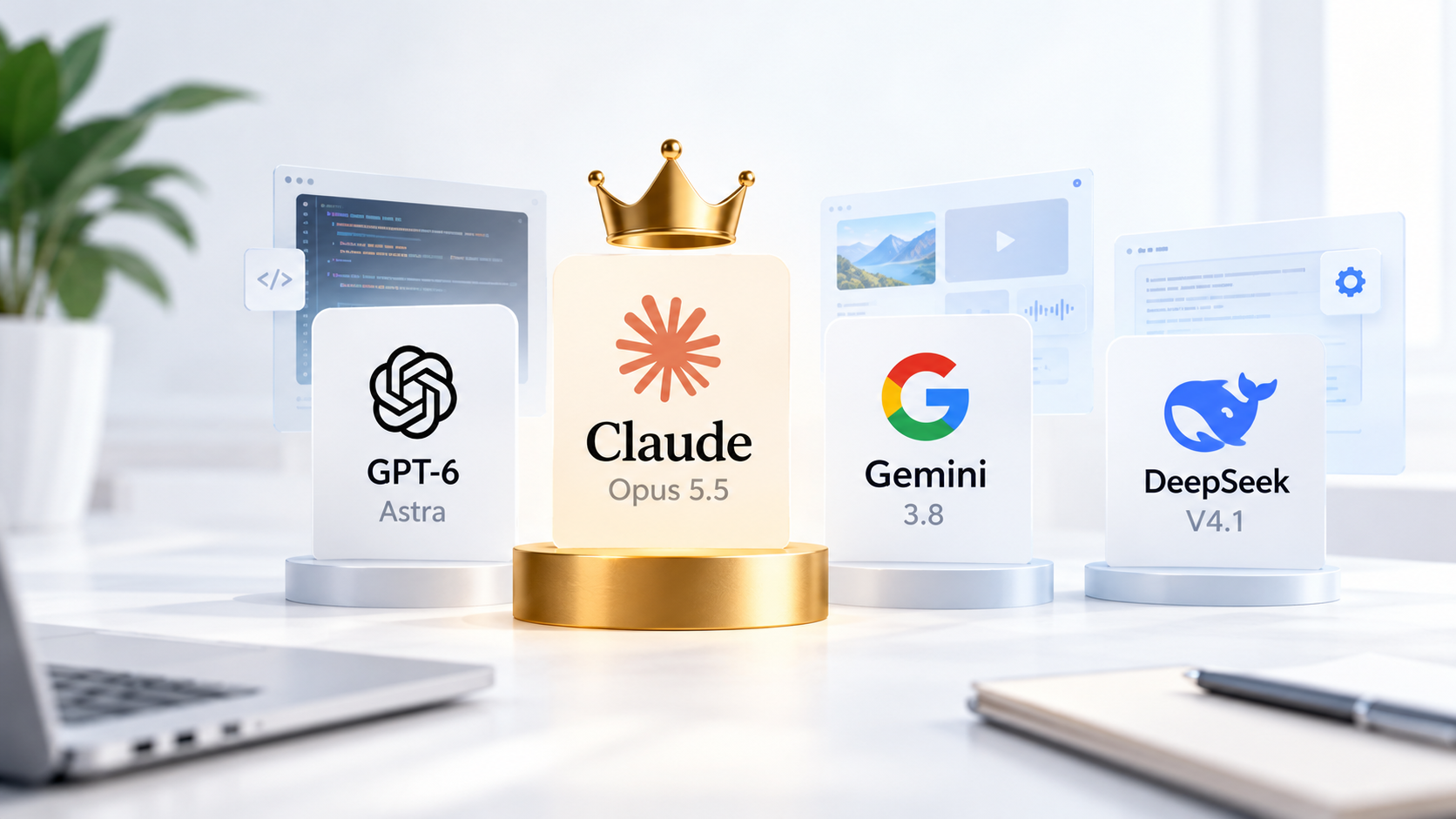
The four models that lead October, with the shape of each. Three of the four now carry roughly a million tokens of context, so long-document work is table stakes rather than a differentiator.
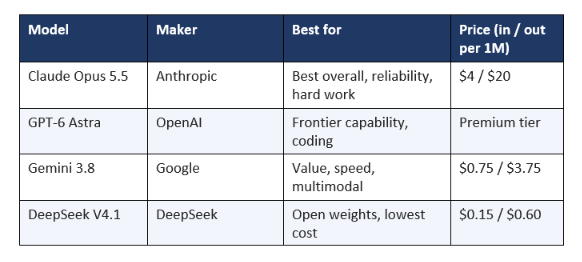
The price spread is the tension running through the whole ranking: DeepSeek V4.1 costs a tiny fraction of Claude Opus 5.5 per token, and Gemini 3.8 undercuts the US flagships heavily, while Opus and Astra charge a premium for being the most capable. The best model and the cheapest capable model are not the same model, which is why your use case matters more than any single leaderboard. For the deeper benchmark view, see our full ranked analysis and benchmarks.
1. Claude Opus 5.5: Best Overall
Claude Opus 5.5 is my top pick for October 2026, and the independent numbers agree: it leads Artificial Analysis's Intelligence Index at 58 and tops the LMArena text leaderboard, while sitting at or near the top of the broader leaderboards. But the reason it wins in testing is not a single score, it is reliability. Across long, multi-step tasks it stayed coherent, held onto the requirements I gave it, and was the least likely to quietly drift or do something confidently wrong, which is exactly what matters when you are shipping.
On the numbers, Opus 5.5 leads agentic coding, computer use, and knowledge work, posting 66.4 percent on Terminal-Bench 4.0 and strong results across the board. It carries a 1 million token context, costs $4 input and $20 output per million tokens, and, importantly for real agentic work, has very cheap cache reads that make long sessions more affordable than the sticker suggests. For agentic and coding work, it was the most dependable of the four, full stop.
- Strengths: top independent intelligence score, agentic coding, long-horizon reliability.
- Watch-outs: the most expensive per token here, so apply cost discipline at scale.
My take: Opus 5.5 is the model to build a serious product on, because reliability over long tasks is worth paying for. Full detail is in our Claude Opus 5.5 review.
2. GPT-6 Astra (and Sol): Best at the Frontier
GPT-6 Astra is OpenAI's strongest model and Opus 5.5's closest rival, effectively tied at the top of several leaderboards this month and ranking first on some composite boards. It is a superb frontier model for the hardest coding and reasoning, and if your stack is OpenAI-first it is the obvious top choice. The catch is price: Astra sits at the premium flagship tier.
That is where GPT-6.1 Sol comes in, and it is the pick most teams will actually use. Sol delivers near-Astra capability on complex coding, computer use, and professional work at roughly a fifth of Astra's task cost ($2 input, $10 output per million), which makes it one of the best value plays at the frontier. In testing, Astra was a hair ahead on the very hardest, most open-ended work, while Sol was the smarter everyday choice for professional coding on a budget.
- Strengths: frontier capability (Astra), excellent professional-coding value (Sol).
- Watch-outs: Astra is premium-priced; on the messiest long-horizon agent runs, Opus 5.5 felt a step more reliable.
My take: choose GPT-6 Astra when you want OpenAI's absolute best, and GPT-6.1 Sol when you want most of it far cheaper. Full detail is in our GPT-6 Astra review.
3. Gemini 3.8: Best Value & Multimodal
Gemini 3.8 is Google's efficiency-tier model and the best all-round value in the group. It is genuinely multimodal, taking text, image, audio, and video as input, carries a million-token context, and costs a fraction of the US flagships at $0.75 input and $3.75 output per million. For a huge range of everyday and production tasks it is simply the sensible default, strong enough to do the job and cheap enough that cost stops being a worry.
On coding and agentic tasks it has closed much of the gap to the top, scoring 73.7 percent on the DeepSWE coding benchmark, and in testing it was fast and especially strong on anything multimodal, understanding images, audio, and video in a single prompt is something none of the others match as completely. It is not quite the most reliable on the hardest long-horizon runs, but for its price that is an easy trade.
- Strengths: multimodal range, speed, very low price, huge context.
- Watch-outs: sits just behind Opus 5.5 and GPT-6 Astra on the hardest pure-reasoning and long-agent tasks.
My take: reach for Gemini 3.8 first for most everyday work, multimodal tasks, and anything price-sensitive at scale. Full detail is in our Gemini 3.8 review.
4. DeepSeek V4.1: Best Open-Weight
DeepSeek V4.1 is the open challenger that keeps the frontier honest. It is an MIT-licensed open-weight model, a large mixture-of-experts design that activates only a small fraction of its parameters per token, giving strong capability at a startlingly low price. It is the cheapest model here by a wide margin, around $0.15 input and $0.60 output per million, and you can run the weights yourself, which changes the economics entirely at scale.
What stands out is how competitive it is on agentic coding, beating older frontier models on several agentic tests and holding up well on real multi-step coding in testing. Where it trails is the hardest unaided reasoning and knowledge, where the top closed models still lead by a small margin. That is the trade: near-frontier agentic coding and open weights, for a fraction of the cost. On the open leaderboards this month, MiMo-V2.6-Pro also ranks as a top open-weight option worth watching alongside it.
- Strengths: open weights (MIT), lowest price, strong agentic coding, self-hostable.
- Watch-outs: a step behind the closed flagships on the hardest reasoning and knowledge.
My take: choose DeepSeek V4.1 when cost or control is the priority, high-volume agentic coding, self-hosting, or building where per-token price decides viability. Full detail is in our DeepSeek V4.1 review.
Also Launched in October
October was a busy month beyond the top four, and three releases are worth knowing even if they are not the outright best all-round models.
- Claude Haiku 5.5: Anthropic's fast, cheap model, around 90 percent cheaper than the last Haiku, with a big capability jump. The best value for high-volume, latency-sensitive production work.
- Meta Muse Wonder: Meta's first frontier model, built around active memory and long-horizon coherence. Strong on memory benchmarks, mid-pack on the independent aggregate.
- Meta Muse Spark Open: An 816B open-weight model, Meta's answer to China's open models. Strong on agentic tasks, but it trails the best open models on coding and needs heavy hardware to self-host.
None of these displaces the top four for a general ranking, but each wins a specific job: Haiku 5.5 for cheap scale, Muse Wonder for memory-heavy agents, and Muse Spark Open for a US-origin open model. If one matches your need, it is worth testing directly.
Category Winners
No model won everything, so here is how October splits by job. Match the row to your task and you have your answer.
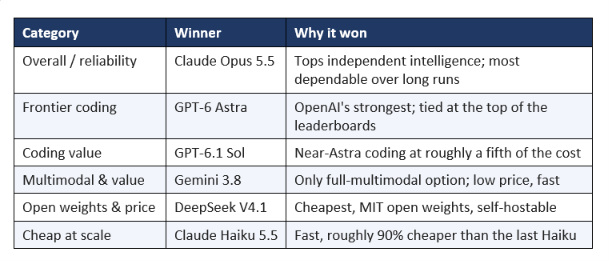
The pattern is clear: Opus 5.5 for reliability and hard work, GPT-6 Astra or Sol for OpenAI-grade coding, Gemini 3.8 for multimodal and value, DeepSeek V4.1 for open and cheap, and Haiku 5.5 when you are running huge volume. For a task-by-task breakdown, see our guide to the best AI model per task.
Price Comparison
Because price is doing so much of the work this month, here are the standard token prices side by side. Remember that real agentic costs depend heavily on caching, where Claude and GPT discount cached input steeply, so the effective cost of the premium models is lower than the sticker on repeated-context work.
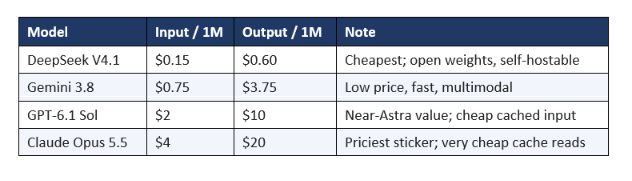
Read this with your real workload in mind. For high-volume, cost-sensitive work, DeepSeek V4.1 and Gemini 3.8 are in a different league on price. For hard, high-stakes work where getting it right first time matters, Opus 5.5 and GPT-6 Astra earn their premium, because a capable model that succeeds on the first try can be cheaper than a weak one you run five times.
Which AI Model Should You Choose?
Here is the decision made simple, mapped to who you are.
- Shipping a serious product or agent: Claude Opus 5.5, for reliability over long tasks.
- OpenAI-first, want the best: GPT-6 Astra; for value, GPT-6.1 Sol.
- One versatile, cheap default: Gemini 3.8, strong, multimodal, inexpensive.
- Cost or control is everything, or you self-host: DeepSeek V4.1, open weights and lowest price.
- High-volume, latency-sensitive production: Claude Haiku 5.5, fast and very cheap.
The meta-advice: most teams should use more than one, a strong model for the hard, high-stakes work and a cheap, fast model for the bulk of routine tasks, routed by difficulty. That is how you get frontier quality where it counts without paying frontier prices for everything.
My Overall Ranking
Forced to rank the top four as all-round models for October 2026, weighting capability, reliability, and value together, this is my order, with the caveat that your use case can reshuffle it.
- Claude Opus 5.5. The most reliable and the one to build on; leads the independent intelligence rankings.
- GPT-6 Astra. Tied at the frontier; pick Sol for the same strengths at far lower cost.
- Gemini 3.8. The best all-round value and multimodal champion; the smart default for most work.
- DeepSeek V4.1. Fourth on closed-model terms; first if open weights or price is your priority.
Notice how close this is. The difference between first and fourth is smaller than at almost any point this year, and the interesting question has shifted from which model is smartest to which is right for the job in front of you. We will refresh this ranking next month; for the broader picture, see our best AI models 2026 ranked analysis.
Frequently Asked Questions
What is the best AI model right now (October 2026)?
For all-round work, Claude Opus 5.5 is the best AI model in October 2026, leading the independent intelligence rankings and the most reliable over long, multi-step tasks. But there is no single winner: GPT-6 Astra is tied at the frontier, Gemini 3.8 is the best value and multimodal pick, and DeepSeek V4.1 is the best open-weight and cheapest option. The right choice depends on your task and budget.
Is Claude Opus 5.5 better than GPT-6 Astra?
They are very close, and leaderboards disagree. Claude Opus 5.5 leads the independent Intelligence Index and the LMArena text board and was more reliable on long agent runs in testing, while GPT-6 Astra ranks first on some composite boards and is superb for frontier coding. Choose Opus 5.5 for all-round reliability, and GPT-6 Astra (or the cheaper Sol) if your stack is OpenAI-first.
What is the best AI model for coding in October 2026?
For reliable agentic coding, Claude Opus 5.5 is the safest pick, leading Terminal-Bench and staying coherent over long tasks. GPT-6 Astra is tied at the top for frontier coding, GPT-6.1 Sol offers near-Astra coding at far lower cost, and DeepSeek V4.1 is remarkably strong on agentic coding for its price. For most builders, Opus 5.5 or GPT-6.1 Sol are the safest coding choices.
Which AI model is the cheapest?
DeepSeek V4.1 is by far the cheapest at roughly $0.15 per million input tokens and $0.60 output, and being MIT-licensed open-weight you can also self-host it. Among closed models, Gemini 3.8 is cheapest at about $0.75 input and $3.75 output. For high-volume work, both are far less expensive than Claude Opus 5.5 or GPT-6 Astra on sticker price.
What is the best open-weight AI model?
DeepSeek V4.1 is the standout open-weight model for most teams, with MIT weights, strong agentic coding, and the lowest cost. On the open leaderboards this month, MiMo-V2.6-Pro also ranks near the top of open models, and Meta's new 816B Muse Spark Open is a notable US-origin open option. For raw open-model value, DeepSeek V4.1 is the easiest recommendation.
Did any major AI models launch in October 2026?
Yes. Claude Haiku 5.5 arrived as a fast, cheap model (around 90 percent cheaper than the last Haiku), Meta Muse Wonder launched as Meta's first frontier model built around memory, and Meta Muse Spark Open shipped as an 816B open-weight model. None displaces the top four for a general ranking, but each wins a specific job, cheap scale, memory-heavy agents, and US-origin open weights respectively.
Should I use more than one AI model?
Yes, most teams should. The smart pattern is to route by difficulty: use a strong model like Claude Opus 5.5 or GPT-6 Astra for hard, high-stakes work, and a cheap, fast model like Gemini 3.8, DeepSeek V4.1, or Claude Haiku 5.5 for the bulk of routine tasks. This gives you frontier quality where it matters without paying frontier prices for everything.
Recommended Blogs
- Best AI Models of September 2026
- Best AI Models 2026: Full Ranked Analysis & Benchmarks
- The Best AI Model Per Task (2026)
- Claude Opus 5.5 Review (2026)
- GPT-6 Astra Review (2026)
- DeepSeek V4.1 Review (2026)