
Claude Fable 5.2 and Mythos 5.2: Which Should You Use?
Claude Fable 5.2 and Claude Mythos 5.2 arrived on November 9, 2026 with a clear proposition: stronger performance on demanding technical work, faster output, and lower base API prices than their 5.1 predecessors. The important distinction is that they share the same underlying model, while their safeguards and access conditions differ.
That makes this release a different buying decision from choosing between two unrelated models. Most developers should evaluate Fable. Organizations doing legitimate cybersecurity or biomedical work may need the verified access route for Mythos. Both still need to justify their cost against a capable everyday model.
This review examines published specifications, benchmark results, pricing, migration requirements, and practical use cases. It is based on current documentation and our analysis, rather than firsthand model tests or invented ratings.
For the wider Anthropic lineup, our Claude AI complete hub connects model reviews, coding workflows, and tutorials that help you choose the right level of capability for your work.
Updated November 10, 2026. All API prices below are in USD.
QUICK ANSWER
Claude Fable 5.2 is the broadly available option for demanding reasoning and long-running agent work. Claude Mythos 5.2 offers the same underlying capabilities to organizations verified for relevant use cases, with different safeguards for areas such as cybersecurity and life sciences.
Both list a 1-million-token context window, up to 128,000 output tokens, and standard API rates of $8 per million input tokens and $40 per million output tokens. Optional fast mode costs $16 and $80 respectively.
My recommendation: start with Opus 5.5 for everyday work, then evaluate Fable 5.2 on tasks where the additional capability could reduce failures or review effort. Consider Mythos when your organization's work and eligibility require that access route.
1. What Are Claude Fable 5.2 and Mythos 5.2?
Fable 5.2 and Mythos 5.2 are Anthropic models aimed at difficult, open-ended technical tasks. Their shared foundation matters more than the different names: Mythos is not presented as a separate, universally smarter model.
Fable has safeguards that support broader availability. Mythos is offered through verification programs for organizations whose beneficial work is affected by restrictions in sensitive technical domains. That is an access and deployment distinction, not a reason for ordinary users to assume they need Mythos.
For a software team, the interesting question is whether Fable can complete a difficult migration, investigate a complex failure, or sustain a research task more reliably. For a specialist organization, the additional question is whether the permitted workflow fits its approved use case.
Our Claude Fable 5.1 review explains the preceding release. Use it as the baseline for an upgrade evaluation, especially if you already have prompts, integrations, or task results worth comparing.
2. Specifications and Model IDs
The two 5.2 models share their principal specifications and standard token pricing. The differences to check are access, safeguards, and the deployment options available to your organization.
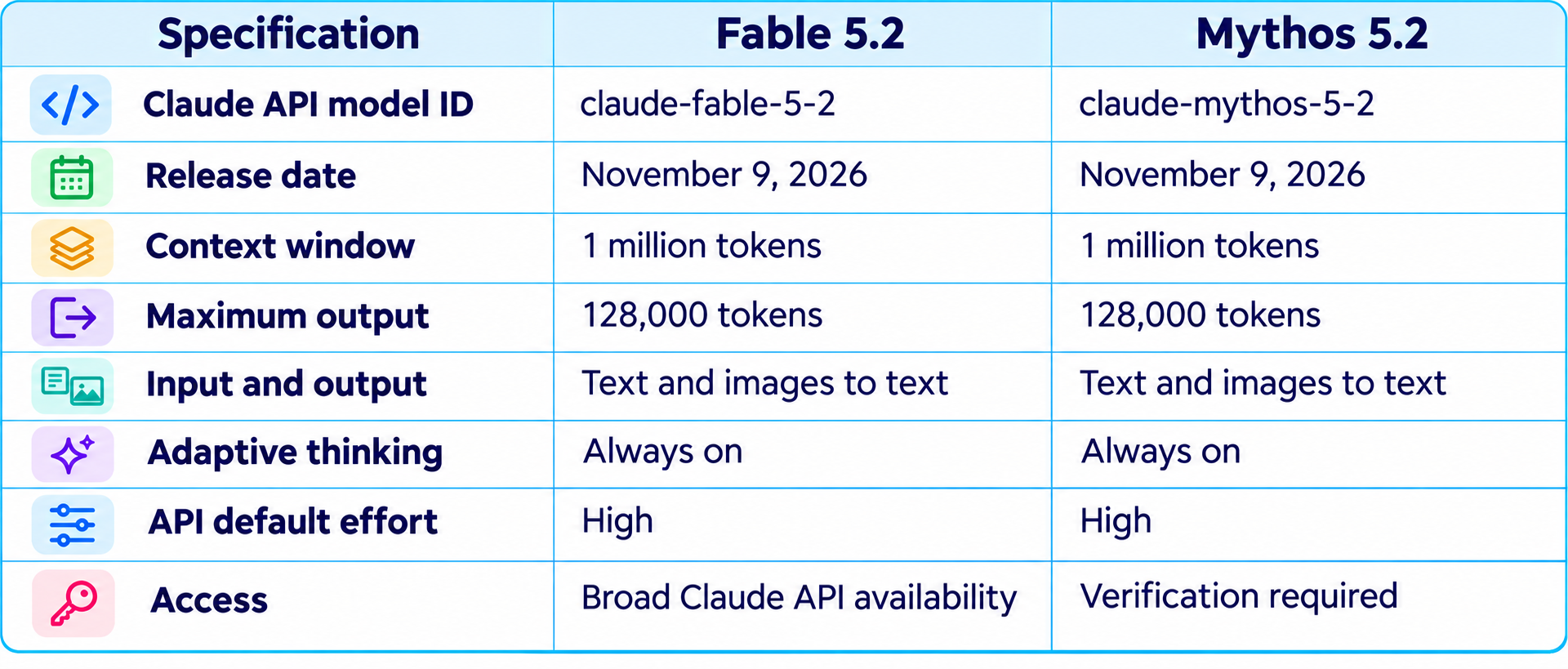
A large context window gives the model room for substantial material, but it does not establish perfect recall or reliable reasoning over every detail. Evaluate the quality of the answer, not just whether the request fits.
The listed knowledge cutoff is June 2026. Supply current evidence or appropriate tools when a task depends on later information. A newly released model can still need fresh sources for current events and product details.
3. Fable 5.2 vs Mythos 5.2
Choose between Fable and Mythos according to your workload and authorized access, rather than expecting a general capability upgrade from the Mythos name. Anthropic describes them as the same underlying model with different safeguards.
For most organizations, Fable is the relevant starting point. Its broader availability lets teams evaluate difficult coding, reasoning, and research tasks without treating specialist verification as part of routine adoption.
Mythos becomes relevant when approved cybersecurity or biomedical work requires that route. Check the verification program and your organization's actual entitlement. Access through one service or account should not be assumed to carry over automatically to another deployment.
Our Claude Mythos 5.1 review provides background on the restricted-access family. It helps separate the ongoing access model from the specific capabilities and migration changes introduced in 5.2.
4. Benchmarks and What They Actually Show
Anthropic's launch benchmarks show improvements across several technical tasks, but these are provider-published results under the stated evaluation conditions. They are evidence to guide testing, not a forecast of your team's success rate.
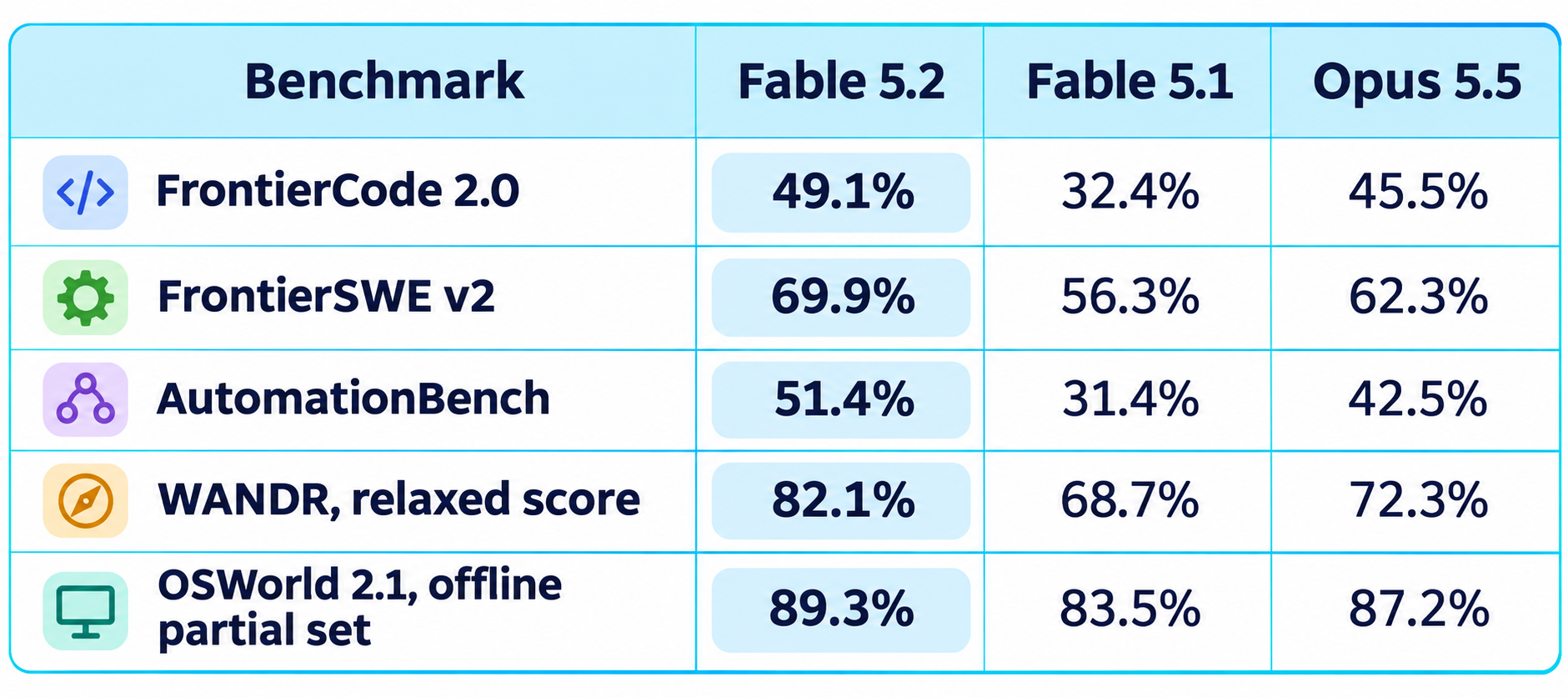
FrontierCode lists the two Fable results at xhigh effort. Other rows follow the announcement's highest-available-effort convention unless otherwise noted. Keep the benchmark version, effort, tools, and task set attached to a number when comparing it elsewhere.
The gains also vary by task. On the listed FrontierCode results, Fable improves by 16.7 percentage points over 5.1 and 3.6 points over Opus 5.5. Neither difference should be converted directly into a promise about accepted pull requests.
Our October 2026 AI model ranking gives useful background on the previous competitive field. Treat it as an earlier snapshot; the November release needs a fresh evaluation rather than being inserted into an old ranking without testing.
5. Coding and Long-Running Agent Work
Fable 5.2 is most interesting when coding work requires sustained investigation, implementation, and verification. A hard repository task can involve several decisions before a useful patch exists.
Evaluate more than the final answer. Did the agent identify the relevant files, understand the existing architecture, make an appropriate change, and run checks that could catch a regression? Did it recover when the first approach failed?
A practical evaluation might include a dependency migration, a cross-module bug, and a feature touching several parts of an application. Keep the repository, tools, instructions, and acceptance criteria consistent between models.
Measure review effort as well as completion. A large patch that needs extensive cleanup can be less useful than a smaller one a maintainer can understand and accept quickly. Record unintended changes alongside successful behavior.
The surrounding tool matters too. Our comparison of Claude Code, Codex, Cursor, and OpenCode examines the agent layer, which can affect repository access, testing, context management, and the overall developer experience.
6. Reasoning, Research and Vision
The shared 5.2 specification accepts text and images and returns text. That supports evaluation on tasks combining documents, screenshots, charts, and written reasoning; it does not make either model an image generator.
For research work, define the deliverable precisely. A useful result may be a technical memo with checked calculations, a comparison of conflicting evidence, or a plan that identifies unresolved assumptions. A confident narrative alone is a weak success criterion.
Supply evidence the model can inspect and require it to distinguish observations from conclusions. When a claim depends on a current source, make that source part of the workflow instead of assuming the model already knows it.
Vision should be tested against your actual material. A clean chart, a crowded dashboard, and a scanned diagram present different challenges. Ask questions with verifiable answers and inspect whether the model cites the right visual details.
My view is that the strongest research use case is difficult synthesis with an accountable output. The model should help a reviewer understand what was established, what remains uncertain, and which next action follows from the evidence.
7. Pricing and the 20 Percent Reduction
Standard Fable 5.2 and Mythos 5.2 pricing is 20% below the listed 5.1 base input and output rates. The savings apply at equal billable token counts; a task that consumes more tokens can still cost more overall.
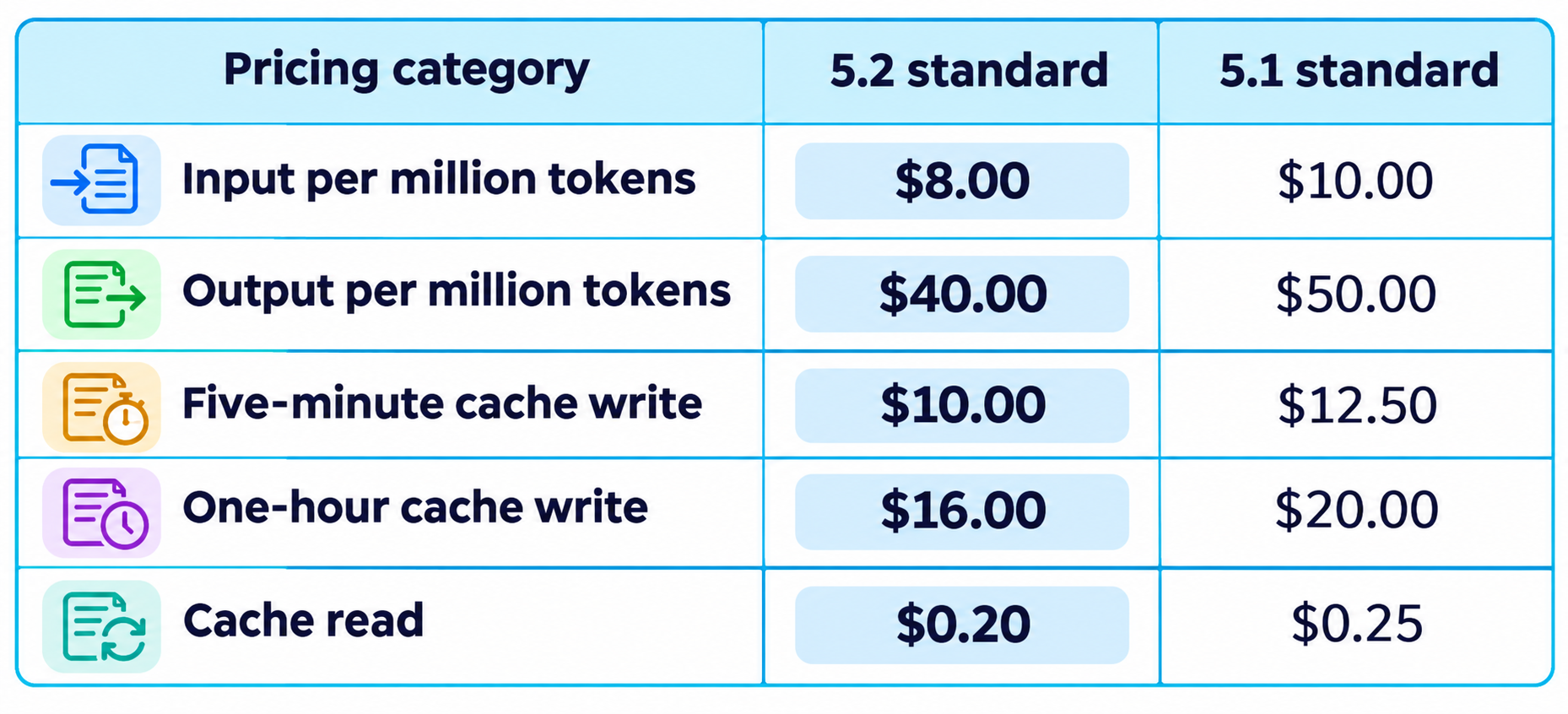
For a simplified example, 100,000 uncached input tokens and 20,000 billable output tokens would cost $1.60 at the 5.2 standard rates. The same token counts would cost $2.00 at the listed 5.1 rates. This excludes additional tools, infrastructure, and applicable pricing modifiers.
That calculation is useful for comparison, but real agent sessions contain multiple requests. Log total usage across the whole job and divide by accepted outcomes. Retries, extended thinking, and extra review can change the economics substantially.
Prompt caching and asynchronous batch processing can help suitable workloads. Anthropic lists a 50% batch discount on input and output, while cache writes and reads have separate rates. Check which operations actually qualify before building those discounts into a budget.
8. Speed and Optional Fast Mode
Anthropic reports up to 30% faster output than the 5.1 models and an optional fast mode that can increase token generation speed by up to 2.5 times. These are output-speed claims, not guarantees about total task duration.
Standard mode costs $8 per million input tokens and $40 per million output tokens. Fast mode doubles those base rates to $16 and $80. It is not a separate capability tier that makes answers more intelligent.
A coding job can spend time reading files, running tests, waiting for tools, and revising an approach. Faster token generation helps only the parts of that process limited by model output. Measure elapsed time to an accepted result.
Use fast mode when that time reduction has value, such as an interactive investigation with a developer waiting. For background work, standard mode or eligible batch processing may be more economical. The fast-mode documentation states that fast mode is not available with the Batch API.
9. Fable 5.2 vs Opus 5.5
Opus 5.5 remains the sensible starting point for many teams because Anthropic recommends it for most coding and knowledge tasks. Fable 5.2 needs to justify its premium on the jobs where additional capability matters.
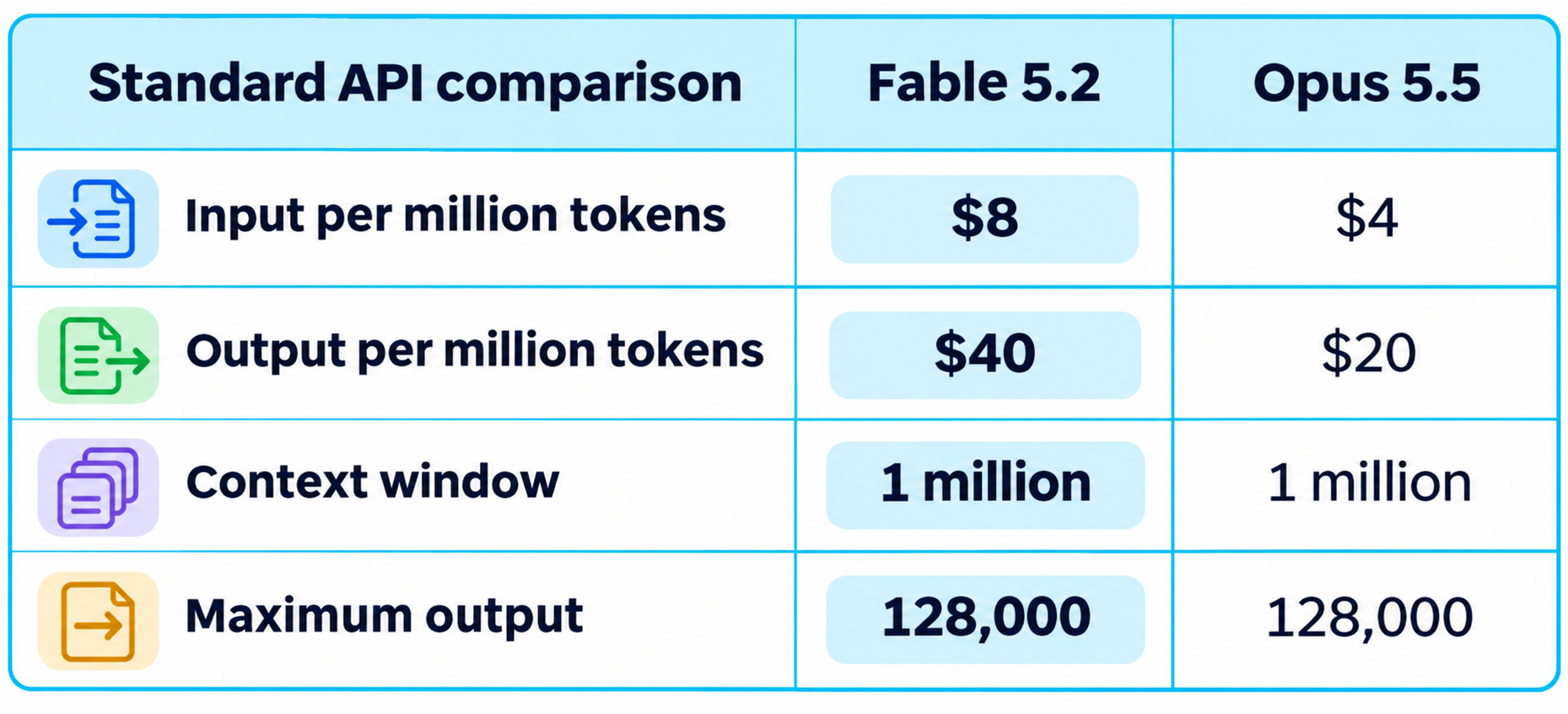
At the listed standard rates, Fable's base input and output prices are twice Opus's. That does not mean each completed task costs twice as much. A stronger result may need fewer attempts, while higher effort may increase token usage.
Our Claude Opus 5.5 review covers the everyday model comparison point. Keep Opus in your evaluation set so a Fable upgrade is judged against a tool your team can realistically use.
I would route the difficult exceptions to Fable before moving an entire workload. A task that repeatedly fails on your current model gives you a concrete reason to test the more expensive option.
10. Effort Levels and Prompting
Adaptive thinking is always on, and effort is the main control for thinking depth. The API default is high; Anthropic's prompting guidance recommends calibrating it with your own evaluations rather than carrying over an old setting.
Test medium, high, and xhigh on representative tasks before reaching for max. The most expensive setting is not automatically the most productive choice. Compare accepted results, elapsed time, and total tokens together.
Write a brief that states the goal, relevant constraints, available tools, and definition of completion. For code, identify the intended scope and the behavior that must remain stable. For research, identify the sources and the claims that need verification.
Suggested evaluation brief: “Investigate the reported failure, identify its cause, implement the smallest appropriate correction, and run the relevant checks. Keep changes within the requested scope. Report the result, the validation performed, and any unresolved issue.”
This is an original starting prompt, not a tested recipe. Review older instructions as well: a long system prompt can contain conflicting rules that make an agent stop early, change too much, or spend unnecessarily.
11. Migration Changes Developers Must Check
Moving to 5.2 can require more than changing a model ID. Anthropic identifies changes involving preserved thinking, model switching, computer-use tools, and advisor compatibility.
First, changing the system prompt, tools, or earlier messages can invalidate preserved thinking blocks. The prefix check now applies across accounts. An integration that edits conversation history needs testing even if it worked with 5.1.
Second, do not assume reasoning state transfers in both directions when switching models. Fable 5.2 and Mythos 5.2 can read each other's supported blocks, but other models cannot read blocks produced by 5.2. Plan the handoff rather than assuming all state survives a fallback.
Third, the old computer_20251124 declaration is rejected outside the documented Amazon Bedrock exception. Check the current computer-use toolset. Fourth, a 5.2 executor using the advisor tool requires a compatible 5.2 advisor.
Start new evaluation conversations when updating prompts and tool definitions. Include your longest sessions and failure-recovery paths, not only a successful first request. The migration guide in References covers the exact request requirements.
12. Access, Deployment and Data Retention
Fable 5.2 is available through the Claude API and documented partner platforms, while Mythos 5.2 requires verification. Confirm the model and features exposed by the platform you actually plan to use.
The documented options include AWS, Google Cloud, and Microsoft Foundry, but model IDs and fast-mode deployment details can differ. A first-party request example is not sufficient evidence that a partner deployment uses identical settings or billing.
Data retention is a material deployment condition. Anthropic documents 30-day retention requirements for these models unless it expressly authorizes zero data retention. An existing organization-level arrangement should not be assumed to cover a new model without checking its specific requirements.
For subscribers, inspect the current model allowance and any temporary launch promotion in the account. Consumer subscriptions and usage-based API billing are separate questions. Avoid budgeting a long-term workflow around a short-lived promotion.
13. How to Evaluate the Upgrade Yourself
Build a small evaluation set from real work, then compare models under consistent conditions. Include tasks your current system handles well and tasks where it has a documented weakness.
Record the prompt, repository or evidence set, tools, effort setting, and acceptance criteria. Run enough repetitions to see whether success is repeatable. Keep failed attempts in the cost calculation.
Use observable measures: functional correctness, factual accuracy, review time, unintended changes, time to completion, and total billable usage. A benchmark improvement becomes useful only when it helps the outcome you need.
Our guide to building AI agents that actually complete tasks explains the surrounding execution loop. A stronger model still needs useful tools, clear completion checks, and a way to recover from ordinary failures.
Where developers work across parallel sessions, our Claude Code Desktop multi-session guide covers the workspace side. Evaluate that coordination separately from the model's reasoning so you can identify what actually improved.
14. Limitations and Who Should Use These Models
Fable 5.2 is a strong evaluation candidate for difficult coding, extended research, and complex agent tasks. Mythos is relevant for verified organizations with the corresponding specialist requirements.
Neither name removes the need to validate outputs. A long session can still stop before completion, a patch can introduce an unintended change, and a research answer can overstate weak evidence. Define success so these failures are visible.
The main adoption tradeoffs are cost, latency, integration compatibility, and deployment requirements. A team that needs low-cost classification or straightforward extraction should not assume the largest available model is the best default.
15. Final Verdict
Claude Fable 5.2 and Mythos 5.2 are worth evaluating for work where failure is expensive and a stronger technical model may reduce retries. The base price reduction strengthens the upgrade case for existing 5.1 users, but it does not remove the need to measure complete-task costs.
For most readers, the practical path is Opus 5.5 for everyday work and Fable 5.2 for difficult exceptions. Choose Mythos through the appropriate verification route when your legitimate specialist workflow requires it. Upgrade because the results improve, not because a model name sits higher in the lineup.
Frequently Asked Questions
What is the difference between Fable 5.2 and Mythos 5.2?
They share the same underlying model and principal specifications. Fable is broadly available with stronger safeguards in sensitive areas; Mythos requires verification for relevant organizational use cases.
How much do Fable 5.2 and Mythos 5.2 cost?
Standard API pricing is $8 per million input tokens and $40 per million output tokens. Caching, tools, deployment choices, and other modifiers affect the final bill.
Are the 5.2 models cheaper than 5.1?
Yes, the listed base input and output rates are 20% lower. A completed task's cost can still differ because token usage, retries, and effort settings vary.
What are the context window and output limits?
Both list a 1-million-token context window and a maximum of 128,000 output tokens. Those limits describe capacity, not guaranteed accuracy over every part of a large input.
Is Fable 5.2 better than Opus 5.5?
Anthropic reports stronger results on several difficult evaluations, but still recommends Opus 5.5 for most everyday coding and knowledge work. Compare both on your tasks before paying the premium.
Can anyone use Claude Mythos 5.2?
No. It is available to organizations verified through the relevant Anthropic programs. Check the program covering your work and the entitlement for your deployment.
How much does fast mode cost?
Fast-mode base pricing is $16 per million input tokens and $80 per million output tokens for either 5.2 model. Measure whether faster output reduces enough waiting time to justify the higher rates.
Does upgrading require code changes?
It can. Check conversation-history handling, thinking-block compatibility, computer-use declarations, and advisor configuration. Test existing integrations against the current migration guide.
Recommended Blogs
- Best AI Models in October 2026: Tested & Ranked
- How to Build an AI Agent That Actually Completes Tasks
- Best AI Coding Agents: Claude Code vs Codex vs Cursor vs OpenCode
- Claude Code Desktop Multi-Session Update 2026
- Claude Opus 5.5 Review: Benchmarks, Price and Coding
- Claude Fable 5.1 Review: Benchmarks, Pricing and Features
- Claude Mythos 5.1 Review: Price, Benchmarks and Access
Resources & Community
Join our community of 70,000+ AI enthusiasts and learn to build powerful AI applications. Build Fast with AI helps developers, creators and teams understand AI models and turn them into useful applications.
Agentic AI Launchpad 2026
A structured six-week cohort program for learning to build and deploy real-world agentic AI systems, with live sessions, mentorship, project reviews and a builder community.
Explore the program: Agentic AI Launchpad 2026
Free AI Resources
Explore workshops and short-form learning resources to keep building.
References
- Anthropic: Introducing Claude Fable 5.2 and Claude Mythos 5.2
- Claude Platform: Fable 5.2 model overview
- Claude Platform: Mythos 5.2 model overview
- Claude Platform: What's new in Fable 5.2
- Claude Platform: Fable 5.2 and Mythos 5.2 migration guide
- Claude Platform: Model pricing
- Claude Platform: Fast mode
- Claude Platform: Prompting Fable 5.2
- Claude Platform: API and data retention