



Meta Muse Wonder: Review, Benchmarks & Pricing (2026)
Meta has finally entered the frontier model race. On October 12, 2026, Meta Superintelligence Labs released Muse Wonder and Muse Wonder Full, which the company calls its first frontier models, aimed directly at OpenAI and Anthropic. The pitch is not raw benchmark dominance but a different bet: models built around memory and long-horizon work, designed to stay coherent across hours of a task rather than just answer one prompt well. This review covers what the Wonder models are, how they actually perform, what they cost, and whether they are worth your attention.
The honest summary is that Muse Wonder is a credible debut rather than a knockout. On Meta's own numbers it leads on memory and agentic coding, while independent scores put it around the middle of the frontier pack. That combination, strong in a specific niche, mid-pack overall, is the story of this release, and it shapes who should actually use it. Let me break it down.
What Is Meta Muse Wonder?
Meta Muse Wonder is a frontier large language model from Meta Superintelligence Labs, the first Meta model positioned to compete with the top systems from OpenAI, Anthropic, and Google. It is built for multi-step reasoning, tool use across long sessions, and multimodal input, it can take screenshots, charts, documents, and video, and its defining idea is persistence: staying on track across a long, complex task instead of losing the thread.
This is a notable shift for Meta. Its earlier Muse models, like Muse Spark, were smaller and more specialised; Wonder is the company's first genuine attempt at the frontier tier. It arrives as part of the broader Muse lineup and the Muse Code developer tool, and it runs exclusively on Meta's cloud. For the earlier model, see our Meta Muse Spark review, and for the wider field, our best AI models 2026 ranked analysis.
Muse Wonder vs Muse Wonder Full
One thing that trips people up is that there are two models, and the better one is harder to get. Muse Wonder is the standard model, available through the Meta Model API and in Muse Code. Muse Wonder Full is the stronger version, but it is limited to paid Muse Code plans and is not offered on the open API. So the model you can call programmatically is the weaker of the two.
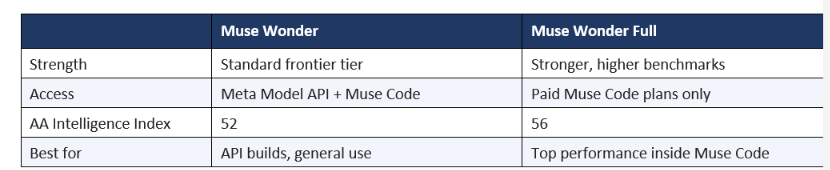
This split matters for planning. If you want to build on the API, you get Muse Wonder, not Full, so benchmark comparisons should use the API model's numbers. If you work inside Muse Code and pay for it, you can reach Wonder Full and its higher scores. It is a deliberate tiering choice by Meta, and it is worth knowing before you compare Wonder to rivals.
Key Specs at a Glance
Here is Muse Wonder in one view.
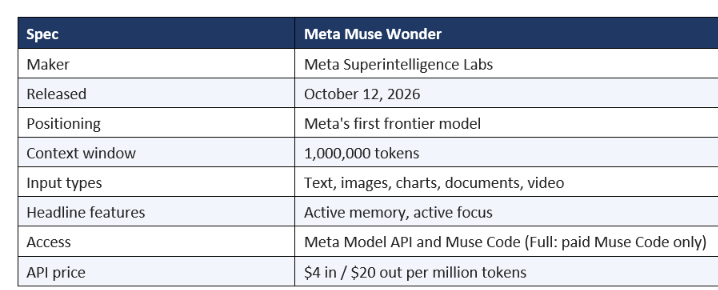
The million-token context and broad multimodal input put Wonder on par with the frontier on paper. The distinctive parts are the two features Meta built the models around, which we come to next, and they are the real reason to consider Wonder over a more established rival.
Active Memory & Active Focus
Meta's two signature features are the most interesting part of this release, because they target a real weakness in long AI tasks. Active memory means the model carries context across a whole session and across conversations, keeping goals, constraints, and earlier decisions in view as the work progresses, rather than forgetting what it agreed to ten steps ago. Active focus trains the model to behave more sensibly when a task gets hard: it tries new approaches instead of repeating a failing one, asks for clarification, and checks in before taking important actions.
Together these aim at the thing that breaks most agentic work, drift. A model that silently loses the plot or barrels ahead on a wrong assumption is the common failure mode of long autonomous tasks, and Meta is betting that memory and self-correction are where the next gains come from, more than another point on a reasoning benchmark. The MemoryBench scores back the pitch: Wonder leads there clearly. Whether this translates into better real-world agent reliability is the key question, and it is a sensible thing to build around, since long-horizon coherence is exactly where many deployments struggle, a theme we explore in the best AI model per task guide.
Benchmarks & Performance
The benchmark picture is genuinely mixed, and it is important to separate Meta's own numbers from independent ones. On Meta's table, Wonder leads on memory and long-horizon coding; on the independent Artificial Analysis Intelligence Index, it sits mid-pack.
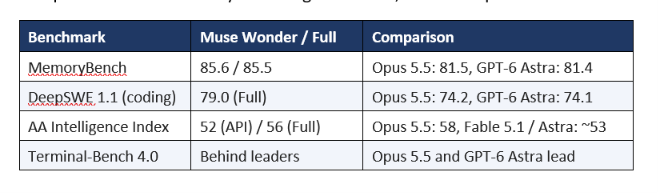
Read carefully, this says Wonder is excellent at what Meta optimised for, memory and some agentic coding, and roughly average everywhere else. On the independent aggregate, Claude Opus 5.5 still leads at 58, with Wonder Full at 56 and the API model at 52. Two caveats matter: Meta compiled most of the winning figures itself and nobody has independently verified them, and on at least one coding row Meta admits the comparison was not controlled and its model ran at maximum effort. So treat the memory and coding wins as promising but provisional. For the main rival, see our Claude Opus 5.5 review.
Pricing & Access
Muse Wonder's API pricing is $4 per million input tokens and $20 per million output tokens, which places it right alongside Claude Opus 5.5 at the premium frontier tier rather than undercutting it. The standard model carries a 1 million token context, and the whole thing runs on Meta's cloud only, through the Meta Model API or the Muse Code CLI, there is no self-hosting option.
The access story is the catch. The API gives you Muse Wonder, while the stronger Muse Wonder Full is gated behind paid Muse Code plans. So the most capable version is not available for general programmatic use, and everything runs inside Meta's ecosystem. For teams already in that ecosystem this is fine; for everyone else, it is a real consideration, you are choosing the weaker model and a single-vendor cloud at a premium price. Weigh that against rivals that match the price with a model you can reach directly.
Strengths & Weaknesses
Here is the honest balance for Meta Muse Wonder.
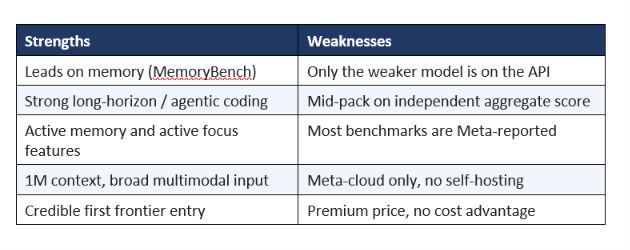
The pattern is a specialist strength (memory and long-horizon work) wrapped in some real access and verification caveats. None of the weaknesses are fatal, but together they mean Wonder has to win on its memory niche, because on general capability and price it does not clearly beat the established leaders.
Muse Wonder vs the Competition
Against the frontier it is aimed at, here is where Wonder lands.
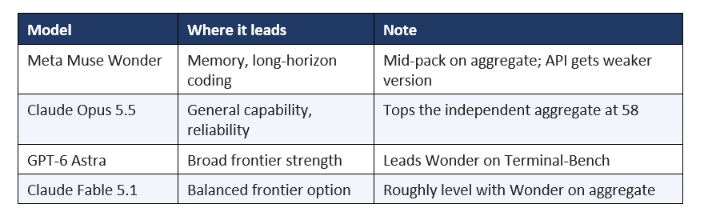
The takeaway: if your work lives or dies on long-session memory and coherence, Wonder has a genuine, benchmarked edge worth testing. If you want the strongest all-round model, Opus 5.5 still leads on the independent aggregate, and GPT-6 Astra is a strong general option. Wonder is a specialist first, a generalist second. For Astra, see our GPT-6 Astra review.
Who Should Use It
Muse Wonder makes the most sense for a specific set of users.
- Teams building long-running agents where memory and coherence across a session are the bottleneck.
- Developers already inside Meta's Muse Code ecosystem, who can reach Wonder Full.
- Long-horizon coding workflows that match where Wonder's DeepSWE scores are strong.
- Anyone wanting to test whether active memory improves their real agent reliability.
If you want the highest general capability, the best price-to-performance, or a model you can self-host, Wonder is not the obvious pick. Its case rests on the memory and long-horizon niche and on already being in Meta's ecosystem. Outside that, the established frontier models remain strong defaults.
My Verdict
Meta Muse Wonder is a credible, interesting first frontier model rather than a category winner. Meta made a smart choice to compete on memory and long-horizon coherence instead of chasing a top aggregate score, and on its own benchmarks that bet pays off, Wonder clearly leads on MemoryBench and does well on agentic coding. The caveats are equally real: independent scores put it mid-pack, the stronger model is gated behind Muse Code, most numbers are Meta-reported, and the price matches the leaders without undercutting them.
My recommendation: if long-session memory is your pain point, test Muse Wonder on your own workload, because its niche strength could matter more to you than a point of aggregate intelligence. For general-purpose frontier work, the established leaders are still the safer default until independent benchmarks confirm Meta's claims. Either way, Wonder is a serious signal that Meta is now a real frontier player, which changes the competitive picture for 2026.
Frequently Asked Questions
What is Meta Muse Wonder?
Meta Muse Wonder is Meta's first frontier AI model, launched on October 12, 2026, by Meta Superintelligence Labs. It comes in two versions, Muse Wonder and the stronger Muse Wonder Full, and is built around active memory and active focus for long-horizon, multi-step work. It supports a 1 million token context and multimodal input, and runs on Meta's cloud.
How much does Muse Wonder cost?
The API version costs $4 per million input tokens and $20 per million output tokens, placing it at the premium frontier tier alongside Claude Opus 5.5. It runs on Meta's cloud only, through the Meta Model API or Muse Code. The stronger Muse Wonder Full is not on the open API; it is limited to paid Muse Code plans.
What is the difference between Muse Wonder and Muse Wonder Full?
Muse Wonder is the standard model, available on the Meta Model API and in Muse Code. Muse Wonder Full is the stronger version with higher benchmark scores, but it is limited to paid Muse Code plans and is not on the open API. On the Artificial Analysis Intelligence Index, Full scores 56 and the API model scores 52, so API users get the weaker of the two.
Is Muse Wonder better than Claude Opus 5.5?
It depends on the task. On memory (MemoryBench) and some long-horizon coding, Meta's numbers put Wonder ahead of Opus 5.5. On the independent Artificial Analysis Intelligence Index, Opus 5.5 still leads at 58 versus 56 for Wonder Full and 52 for the API model. So Opus is the stronger all-round model today, while Wonder has a memory-specific edge worth testing.
How do I access Meta Muse Wonder?
Muse Wonder is available through the Meta Model API and the Muse Code CLI, running on Meta's cloud. The stronger Muse Wonder Full requires a paid Muse Code plan. There is no self-hosting option, so all usage goes through Meta's ecosystem. Check Meta's model page for current sign-up and pricing details before building on it.
Is Muse Wonder multimodal?
Yes. Muse Wonder accepts multimodal input including screenshots, charts, documents, and video, alongside text, and is built for tool use across long sessions. That makes it suitable for workflows that mix documents and images with multi-step reasoning, which is part of Meta's positioning around long-horizon, memory-heavy tasks rather than single-prompt answers.
Are Muse Wonder's benchmarks reliable?
Treat them cautiously. Most of the winning figures, especially on memory and coding, were compiled by Meta and have not been independently verified, and on at least one coding comparison Meta notes the test was not controlled and its model ran at maximum effort. The independent Artificial Analysis Intelligence Index is the better reference, and it places Wonder mid-pack among frontier models.
Recommended Blogs
- Best AI Models 2026: Full Ranked Analysis & Benchmarks
- Claude Opus 5.5 Review (2026)
- GPT-6 Astra Review (2026)
- Meta Muse Spark Review & Benchmarks (2026)
- The Best AI Model Per Task (2026)
References
- Meta releases its first frontier model, Muse Wonder (TechCrunch)
- Meta's Muse Wonder and Muse Wonder Full (VentureBeat)
Meta launches Muse Wonder: benchmarks, pricing, how to use (MarkTechPost)

