Gemini 4 Hydrogen Review for Everyday Coding and Agents
Gemini 4 Hydrogen makes Google's model lineup harder to judge by size or price alone. It costs less per token than Carbon and Argon, yet Google's launch materials put its default reasoning setting just ahead of Argon on the cited intelligence index. For developers, the interesting question is how much useful work this faster model can finish before a more expensive model becomes necessary.
The answer is mixed in a useful way. Hydrogen leads several published agent and knowledge-work measurements against Claude Sonnet 5.5 and GPT-6.1 Terra. Sonnet retains stronger results on the displayed terminal and offline computer-use tests, while both competitors lead Hydrogen on the science benchmark.
This Gemini 4 Hydrogen review analyzes official documentation and published evaluations through November 13, 2026. It is an evidence-based assessment, not a claim of independent hands-on testing. External sources are collected in References.
Quick Answer
Gemini 4 Hydrogen is a strong candidate for everyday coding, document-heavy agents, and fast execution within a larger AI workflow. Released November 12, it costs $1.50 per million input tokens and $7.50 per million output tokens on the standard paid API tier. Free API access is also documented, subject to limits. Start with its default high thinking level, compare accepted results with your current model, and reserve Carbon or Argon for problems that need deeper investigation.
1. What Is Gemini 4 Hydrogen
Gemini 4 Hydrogen is Google's execution-focused Gemini 4 model, adapted from Carbon for everyday coding and agent work. Its role is to move through useful steps efficiently: locate relevant information, call tools, make focused changes, and verify the result.
That positioning differs from treating every task as a frontier reasoning problem. A repository assistant may spend much of its time locating files, reading related functions, updating repeated patterns, and interpreting test output. Those steps benefit from disciplined execution. The hardest architectural question may occupy only a small part of the session.
Our Google Gemini and Google AI collection provides the wider context for this lineup, including model reviews and development guides. Hydrogen belongs in that ecosystem as an everyday worker that can also participate in a workflow with deeper reasoning models.
It accepts text, images, audio, and video and returns text. That supports tasks such as interpreting a screenshot alongside source code or analyzing a recording with written requirements. It does not make Hydrogen a native image-generation or video-generation model.
The main buying question is therefore practical: can it complete your common jobs with less waiting and acceptable review effort? A lower token price helps, but a cheap response that misses a requirement may create another round of work. Judge a coding agent by the accepted patch and a research agent by the supported conclusion.
Access is rolling out across the API, AI Studio, Gemini app, Search, and business surfaces. Antigravity eligibility includes paid Google AI Pro and Ultra subscribers. Free Gemini app users receive Hydrogen through automatic selection when appropriate, rather than unrestricted manual access.
2. Gemini 4 Hydrogen Pricing and API Costs
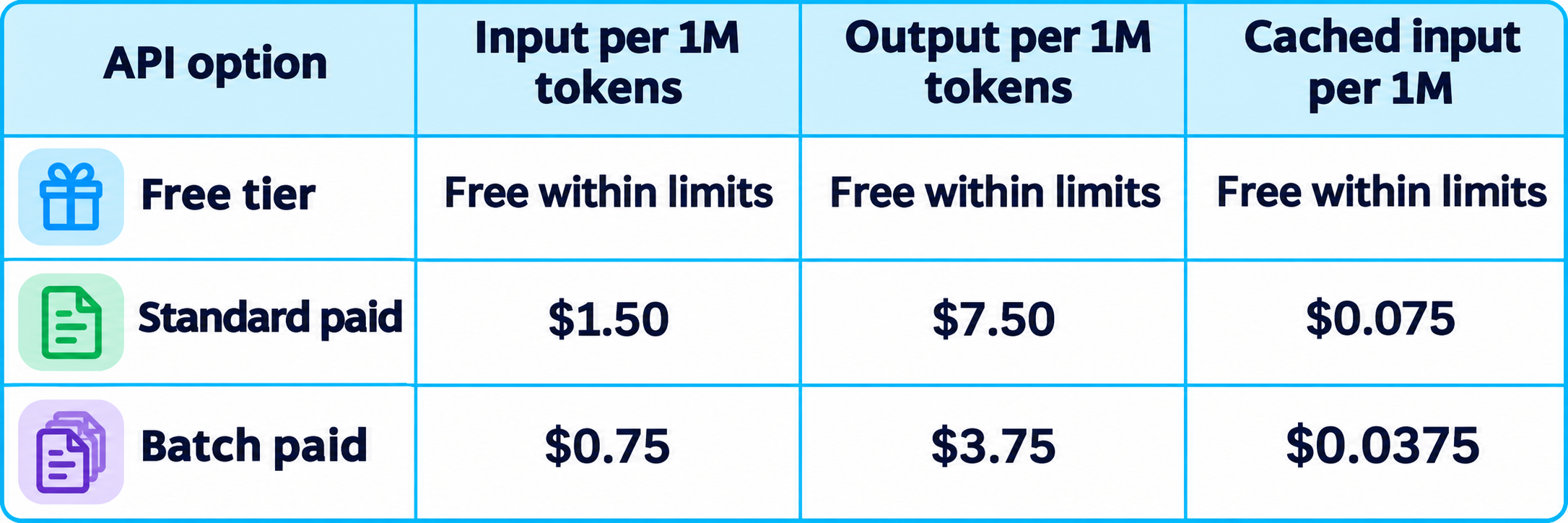
Gemini 4 Hydrogen's standard paid API rates are $1.50 input and $7.50 output per million tokens, with output pricing including thinking tokens. Google's pricing page lists a $0.075 cached-input rate and a free tier with free input and output tokens under its applicable limits.
These are Gemini Developer API rates, not a quotation for every cloud deployment or consumer subscription. Hydrogen uses implicit caching; the reviewed documentation does not support treating it as an explicit-cache migration with identical request behavior. Check the relevant platform's billing before moving a production workload.
Here is a simple cost illustration. A request using 100,000 uncached input tokens and 10,000 billed output tokens costs $0.15 plus $0.075, or $0.225 at standard rates. At the listed batch rates, those quantities cost $0.1125. Neither example includes search, other tools, retries, or additional requests.
Thinking tokens matter because the visible final answer may be only part of the billed output. If an agent spends heavily on reasoning, changing its thinking level can affect the bill even when its response length stays similar. Inspect actual usage rather than estimating cost from the final text.
Data treatment is another material difference: the pricing page marks free-tier content as used to improve products and standard paid-tier content as not used for that purpose, subject to the applicable terms. That distinction should inform which account and service you use for company material.
Our model-routing guide for AI coding agents explains how to reserve expensive reasoning for the stages that need it. Hydrogen makes that approach worth testing, but savings should be measured across a completed task, including unsuccessful attempts.
3. Gemini 4 Hydrogen Benchmarks at a Glance
Hydrogen's published benchmark profile favors agent execution and knowledge work, with clear exceptions in terminal work, desktop interaction, and science. The following November snapshot comes from Google's model card and evaluation materials. Higher is better within each row.
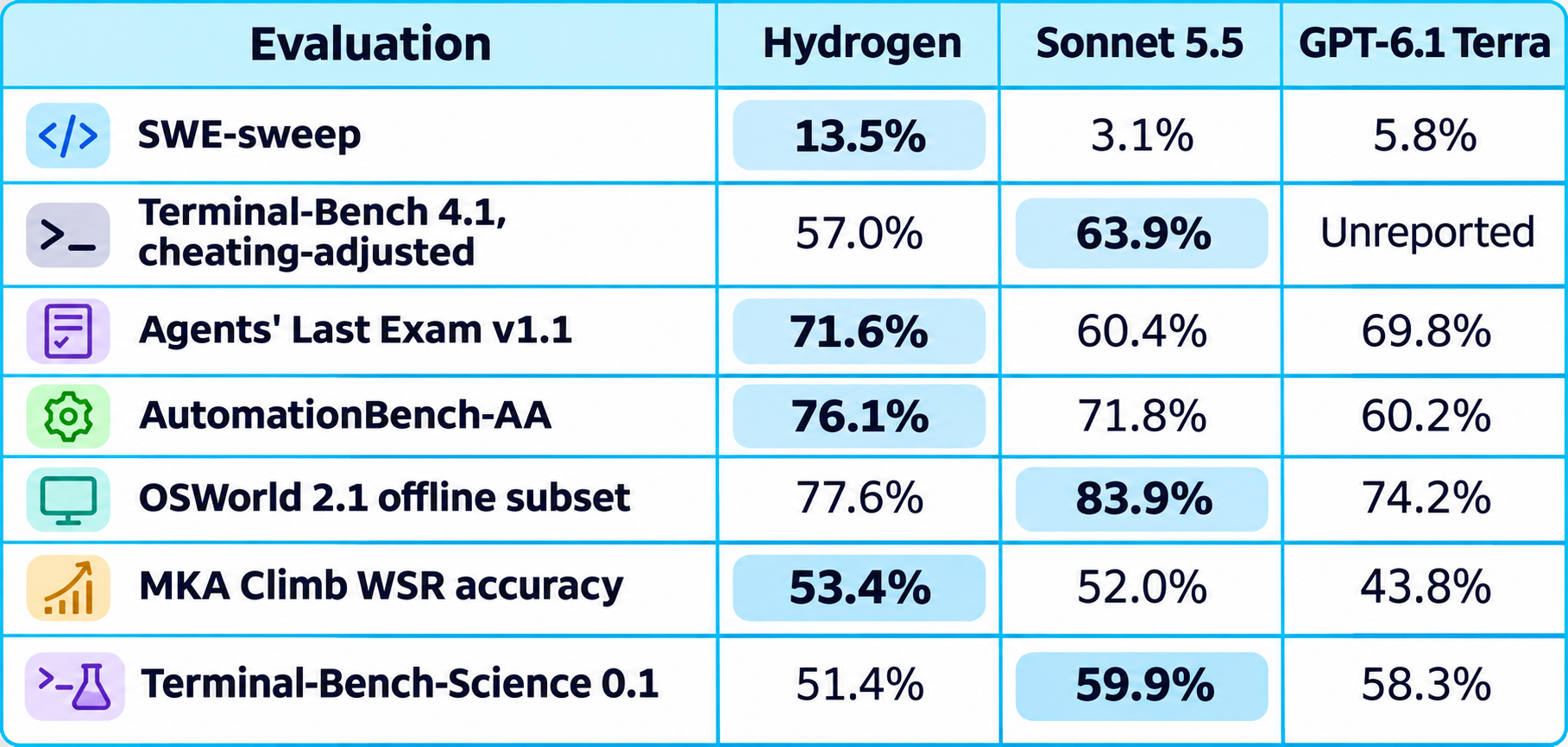
Bold identifies the highest displayed value, not a statistically proven winner. Unreported means no number is supplied in this comparison; it is not a zero score. SWE-sweep reports a subtask-weighted result and should not be described as the percentage of all real software issues an agent can solve.
The methodology also limits comparisons. Hydrogen's SWE-sweep result uses Google's Antigravity CLI harness, while competitor results come from the public leaderboard. Terminal-Bench 4.1 uses high effort and averages five attempts per task. OSWorld uses an 82-task offline subset and selects the best of three runs for Hydrogen and Sonnet.
These are not interchangeable measurements. Terminal-Bench 4.0, Terminal-Bench 4.1, and the science variant test different setups. AutomationBench-AA should likewise not be combined with a differently sourced AutomationBench figure from an older launch chart.
A useful interpretation is to shortlist Hydrogen for jobs involving repeated tool calls, structured evidence, and iterative edits. Keep competing models in contention where the table shows weaknesses. A model can perform well on a difficult reasoning exam and still be the poorer choice for a particular desktop workflow.
4. Gemini 4 Hydrogen vs Gemini 3.8 Flash
Hydrogen is Google's recommended migration target from Gemini 3.8 Flash, but it is not automatically the cheaper option at today's standard token rates. The upgrade case combines better published execution results with a higher current sticker price.
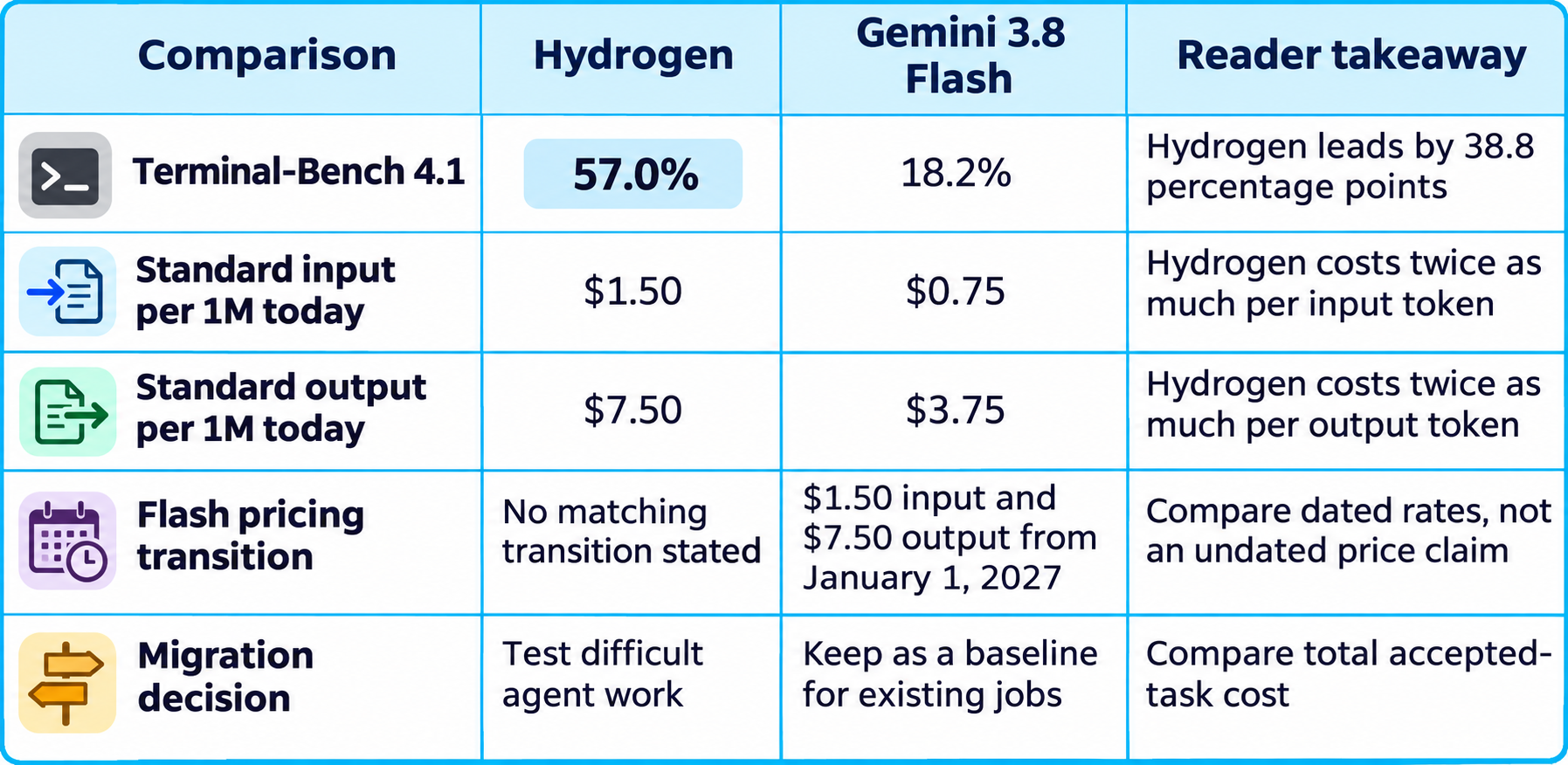
My pick: Prioritize Hydrogen for tasks where Flash needs repeated correction. Keep Flash in the trial when the workload is simple and current cost matters most.
Google also reports faster completion and fewer fabricated claims relative to Flash in its launch testing. Those claims support an evaluation, not a guaranteed speedup on every application. A workflow dominated by slow external services may gain little from faster model execution.
Our Gemini 3.8 Flash review provides the earlier model's context. Use it to identify which existing strengths you need to preserve, then replay representative tasks through Hydrogen before changing your default.
Keep a migration record covering tool calls, structured outputs, usage, and errors. A switch should preserve the application's expected behavior, even when the new model chooses a different sequence of steps.
5. Gemini 4 Hydrogen vs Carbon and Argon
Hydrogen is the everyday execution choice; Carbon and Argon remain options for deeper, sustained reasoning. Their shared generation does not make them interchangeable at every stage of a task.
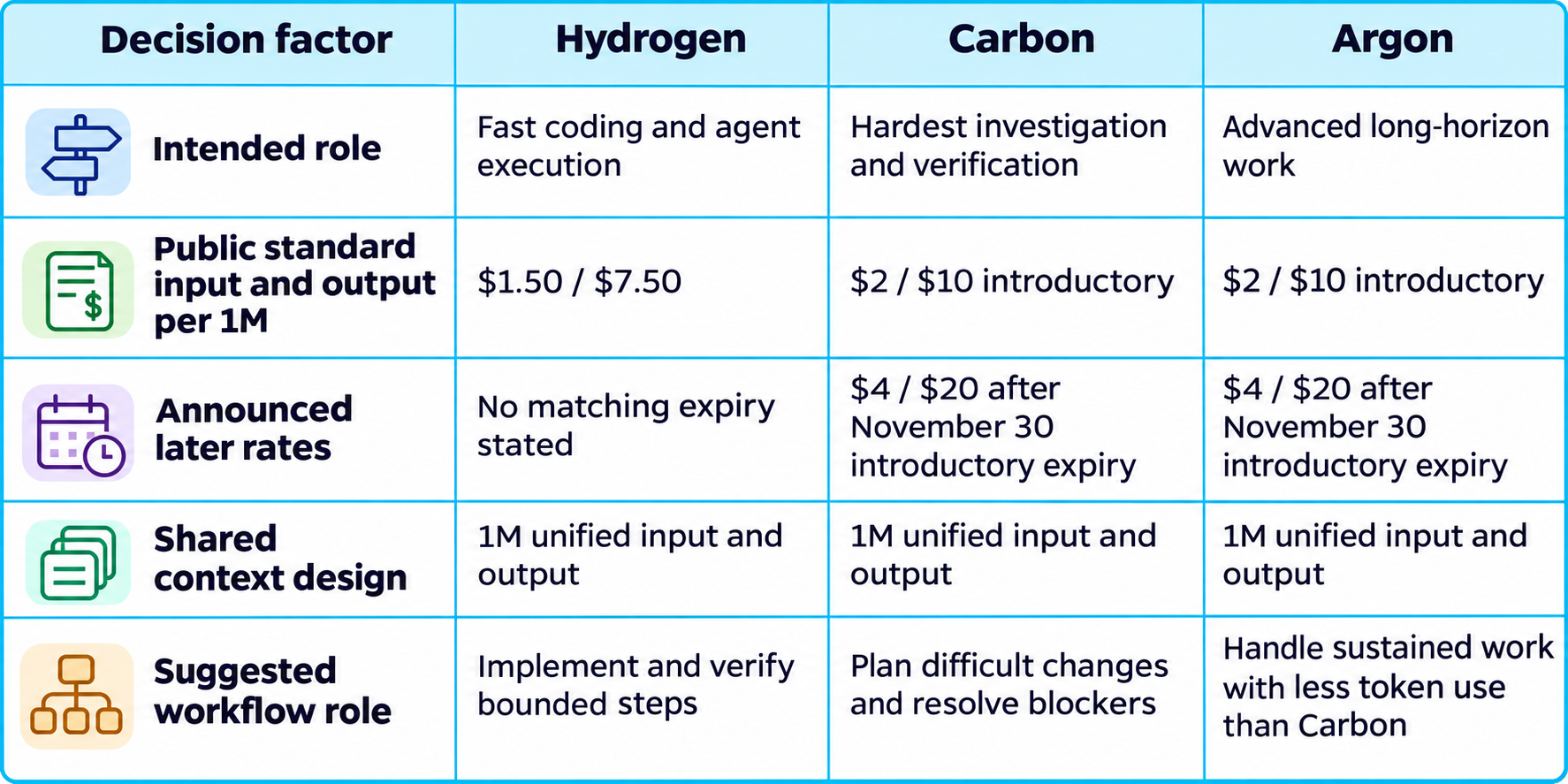
My pick: Start Hydrogen on ordinary implementation, then escalate when a concrete blocker justifies more reasoning. The workflow roles above are recommendations informed by Google's positioning, not measured production outcomes.
Our Gemini 4 Carbon review examines the deeper-reasoning option and its tradeoffs. It is the natural follow-up when Hydrogen can execute a plan but struggles to determine the right plan.
For the middle option, our Gemini 4 Argon review helps assess whether sustained reasoning is needed without immediately moving every step to Carbon.
Antigravity's new Orchestrator can switch between Carbon and Hydrogen during a session. One useful pattern is to let Carbon investigate dependencies, hand a defined implementation step to Hydrogen, and return to Carbon if the evidence invalidates the plan. This is a product-level orchestration feature, not an automatic benefit of every direct Hydrogen API call.
Do not treat a one-point aggregate intelligence-index lead as proof that Hydrogen replaces Argon. An index combines tasks, and thinking settings affect the result. Role selection should follow the actual work and accepted output.
6. Gemini 4 Hydrogen vs Claude Sonnet 5.5
Hydrogen and Sonnet exchange leads across the published tests. The strongest reason to compare them is that a terminal agent and a document agent may need different defaults.
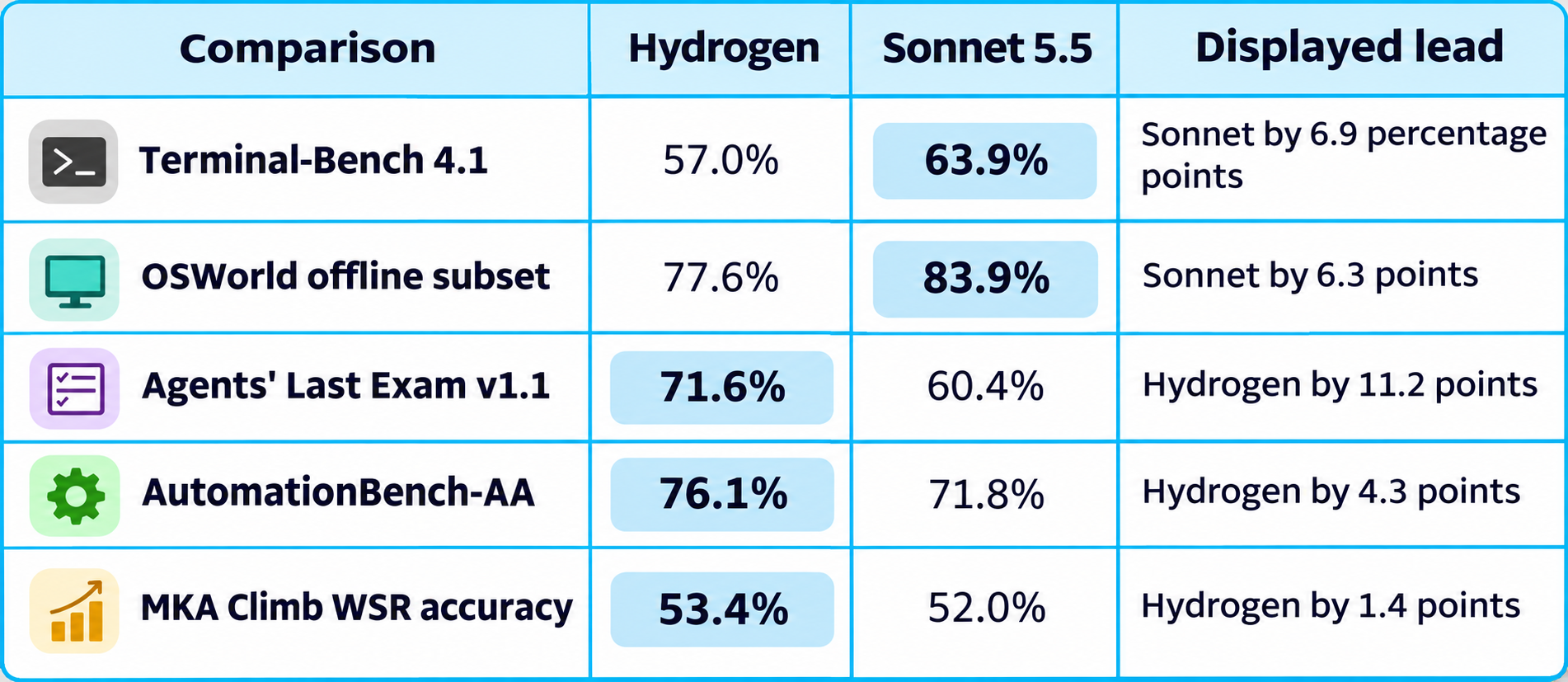
My pick: Put Hydrogen in the first trial for professional document and automation work; retain Sonnet as a serious option for terminal and desktop tasks. The narrow MKA margin alone is insufficient reason to migrate a reliable system.
Our Claude Sonnet 5.5 review explains the competing model and its ecosystem. Its launch scores may use different harnesses from Google's comparison, so preserve the benchmark version and setup when moving between the two articles.
For a fair internal test, keep task inputs and acceptance rules fixed. Record reviewer changes and failed tool steps, not just whether the final response says the task is complete. A lower benchmark result can still produce a better experience in the toolchain your team actually uses.
7. Gemini 4 Hydrogen vs GPT-6.1 Terra
Hydrogen leads most of the displayed everyday-agent comparisons with Terra, while Terra leads the science measurement. The table gives a practical shortlist without inventing a missing terminal result.
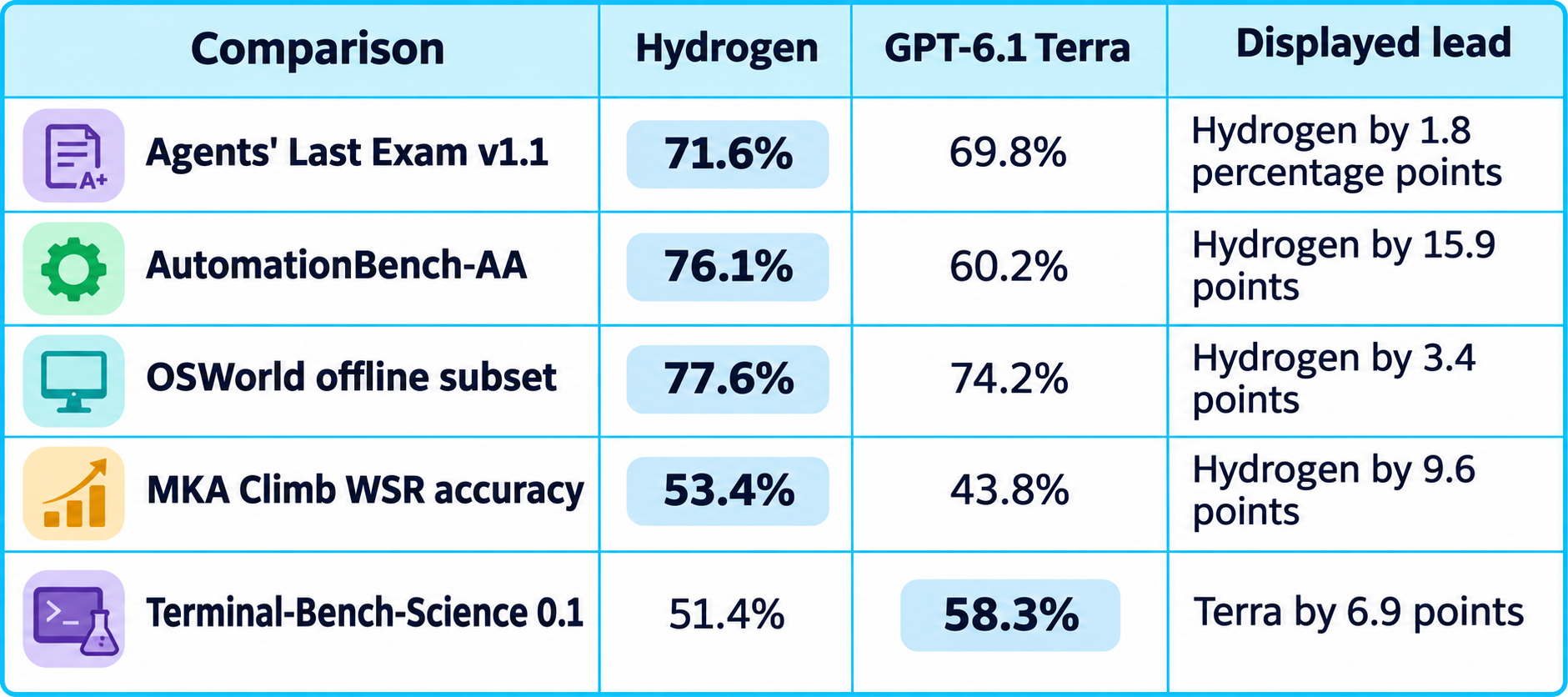
My pick: Trial Hydrogen for visual document agents and routine automation. Keep Terra in the comparison for scientific tool workflows and for applications already built around its surrounding platform.
The result does not mean Hydrogen is 15.9% better at every automation task. The AutomationBench gap is 15.9 percentage points on that evaluation. Production performance depends on the task mix, permissions, connected services, and how failures are handled.
Switching providers also changes integration work. Recheck function schemas, streaming behavior, file inputs, and usage accounting. A benchmark lead is more useful when the application can preserve its existing reliability after the migration.
8. Thinking Levels and the Speed Tradeoff
Hydrogen offers low, medium, high, and xhigh thinking settings, with high as the default. The useful choice is the least expensive setting that consistently meets your quality requirements, rather than the maximum setting for every request.
Google's launch comparison reports an intelligence-index score of 51 at high and 54 at xhigh. Artificial Analysis independently lists the xhigh configuration at 54, while also describing substantial token use and slower-than-average task completion in its measured comparison. That is a valuable counterweight to reading the word fast as a universal latency promise.
For an interactive assistant, judge waiting time from the user's perspective. Time until the first usable answer, total completion time, and the number of follow-up corrections can tell different stories. A fast stream that leads to a wrong result may cost more time than a slower answer that needs no repair.
Run the same representative tasks at several settings. Keep the output budget sufficient to finish the job, then inspect quality, tokens, and latency together. Reserve xhigh for cases where high repeatedly misses an important requirement. Move routine transformations down only after confirming that the cheaper setting preserves correctness.
Avoid assuming parallel execution always helps. Independent file reads can be batched, but two workers changing the same interface can create integration work. Assign clear boundaries and make one worker responsible for checking the combined result.
For another perspective on the worker-model role, our recent Muse Ember review explores everyday execution and model routing. It is useful when comparing operating approaches rather than searching for one universal model winner.
9. Context Window and API Migration Details
Hydrogen's context is a unified 1,048,576-token budget shared by input, thinking, tool calls, and output. Its default synchronous output is up to 64K tokens; longer generation requires the documented continuation or background-execution path and must fit the remaining shared budget.
That distinction resolves a misleading reading of the million-token headline. You cannot independently fill the input maximum and then expect another full million output tokens. For a large document task, leave room for intermediate work and the requested deliverable.
The documented model identifier is gemini-4-hydrogen. Google's migration guidance supports both GenerateContent and the Interactions API. Cloud documentation also lists structured output, function calling, code execution, and media understanding. Confirm support on your chosen surface rather than transferring every cloud capability to every consumer interface.
Two migration details deserve explicit checks. Custom temperature, top_p, and top_k values are ignored in the reviewed Cloud documentation, while legacy thinking-budget settings and the minimal thinking level are unsupported. An application that relies on those controls should be updated deliberately instead of only changing the model name.
For a document agent, supply clearly labeled sources and request evidence locations for important claims. Treat a valid JSON response as a formatting success, not proof that the extracted facts are correct. Validate required fields, inspect missing values, and compare a sample against the source documents.
Hydrogen's published knowledge cutoff is March 2026. Supply current sources for later releases, changing prices, and recent events. A November launch does not give a model automatic knowledge of every November development.
10. Practical Use Cases and Limitations
Hydrogen is most attractive when useful work consists of many bounded steps that can be checked along the way. Repository maintenance, document synthesis, and internal tool agents are good evaluation candidates.
For coding, begin with a known issue and a reproducible failure. Ask for a focused patch, a regression check, and an explanation of anything left unresolved. Assess whether the agent changed only what the task required and whether its final report matches the actual checks it ran.
For document work, give it a small collection with a known contradiction. Ask for a comparison that identifies which source supports each claim and where the materials disagree. This tests whether it notices ambiguity instead of producing a confident blended answer.
For an operations agent, start with a reversible internal workflow. Make tool results explicit and preserve progress so an interrupted job can resume. Our guide to building an AI agent that actually completes tasks explains how verification, retries, and state turn a model into a useful system.
The limitations remain material. Google's model card warns about hallucinations, occasional slowness, timeouts, and higher token use at stronger thinking settings. It also reports more unjustified refusals than Flash in its automated safety evaluation. A legitimate request that gets blocked belongs in your quality measurements too.
Test failure paths alongside successful examples. Include an empty search result, a missing document, and a tool error. The expected behavior should be an accurate account of what is missing, followed by a bounded recovery attempt or a clear stop. Fabricated completion is a more serious failure than an honestly reported limitation.
11. Is Gemini 4 Hydrogen Worth It
Hydrogen is worth evaluating as an everyday Gemini default, especially when your current agent spends too much time correcting tool sequences or revisiting the same work. Its published results and access options make it a credible candidate, while the comparison tables show where another model deserves the first trial.
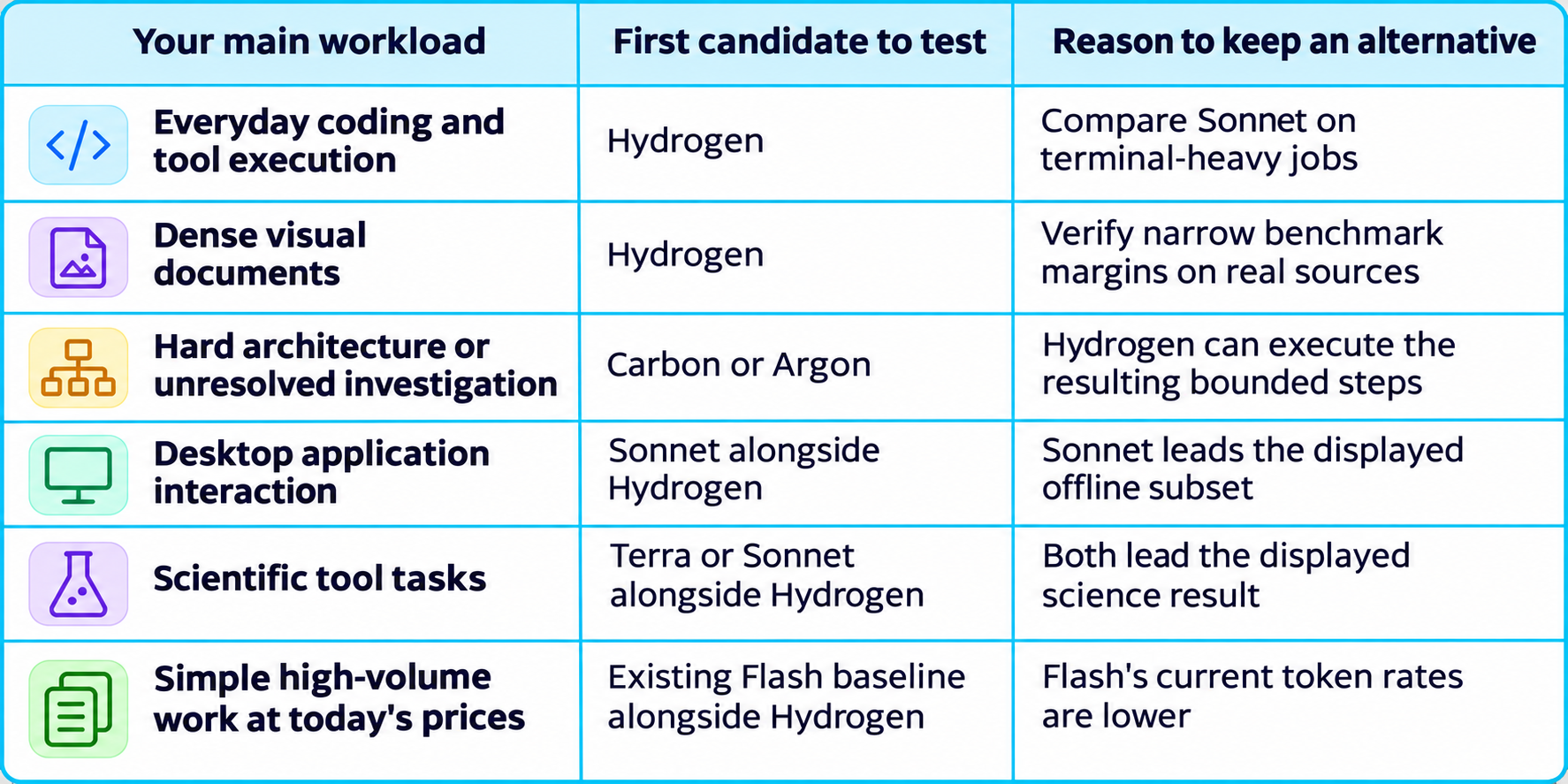
My recommendation is to trial Hydrogen on a small set of familiar jobs and score the accepted output before changing your default. Include review time and failed attempts in the cost comparison. Keep the model only where the improvement is visible in the deliverable or the time required to produce it.
The strongest adoption pattern is selective: use Hydrogen for repeated execution, retain deeper reasoning for genuine blockers, and keep the entire workflow observable. That gives a model upgrade a measurable purpose beyond a better launch-day chart.
Frequently Asked Questions
What is Gemini 4 Hydrogen?
Gemini 4 Hydrogen is Google's Gemini 4 model for everyday coding and agent execution, released November 12, 2026. It is adapted from Carbon and positioned for efficient standalone work or collaboration with deeper reasoning models.
Is Gemini 4 Hydrogen free?
Google documents free and paid API tiers. In the Gemini app, free users receive Hydrogen through automatic model selection when appropriate. Free access has limits and differs from unrestricted manual selection or paid API capacity.
How much does Gemini 4 Hydrogen cost?
Standard paid API pricing is $1.50 per million input tokens and $7.50 per million output tokens, including thinking. Cached input is $0.075 per million tokens. Batch prices and tool charges follow their own listed terms.
What is the Gemini 4 Hydrogen API model ID?
The documented model identifier is gemini-4-hydrogen. Verify the supported endpoint, thinking controls, quotas, and billing for your chosen platform before migrating an application.
What is Gemini 4 Hydrogen's context window?
It has a unified 1,048,576-token input-output budget. Default synchronous output is up to 64K tokens; longer output needs continuation or background execution and must share the same overall budget.
Is Hydrogen better than Gemini 3.8 Flash?
Google reports a substantial Terminal-Bench 4.1 improvement and recommends Hydrogen as an upgrade. Flash currently has lower standard token prices, so compare total cost and accepted results rather than assuming every workload should migrate immediately.
Is Hydrogen better than Claude Sonnet 5.5?
It depends on the workflow. Hydrogen leads several displayed agent and document measurements, while Sonnet leads Terminal-Bench 4.1 and the OSWorld offline subset. A controlled test in your own tools is more useful than a universal ranking.
Should I replace Carbon or Argon with Hydrogen?
Use Hydrogen for everyday execution first. Carbon and Argon remain positioned for deeper reasoning. An orchestrated workflow can assign planning or difficult investigation to a frontier model and bounded implementation to Hydrogen.
Recommended Blogs
- Gemini 4 Carbon Review: Benchmarks, Pricing and Access
- Muse Ember Review: Pricing, Benchmarks and Agent Work
- Best AI Models in October 2026: Tested & Ranked
- How to Build an AI Agent That Actually Completes Tasks
- Best AI Coding Agents: Claude Code vs Codex vs Cursor vs OpenCode
- Claude Sonnet 5.5 Review: Benchmarks, Price and Value
- Gemini 3.8 Flash Review: Accuracy, Price and Value
Resources & Community
Join our community of 70,000+ AI enthusiasts and learn to build powerful AI applications. Build Fast with AI helps developers, creators and teams understand AI models and turn them into useful applications.
Agentic AI Launchpad 2026
A structured six-week cohort program for learning to build and deploy real-world agentic AI systems, with live sessions, mentorship, project reviews and a builder community.
Explore the program: Agentic AI Launchpad 2026
Free AI Resources
Explore workshops and short-form learning resources to keep building.
References
- Google: Introducing Gemini 4 Hydrogen, November 12, 2026
- Google DeepMind: Gemini 4 Hydrogen model card
- Google DeepMind: Hydrogen evaluation methodology
- Google AI Studio: Gemini Developer API pricing
- Google AI Studio: Hydrogen features and migration guide
- Google Cloud: Gemini 4 Hydrogen technical documentation
- Google Antigravity: Hydrogen and Orchestrator