



Gemini 4 Argon Review: Can Google's New Frontier Model Change the AI Coding and Enterprise Race?
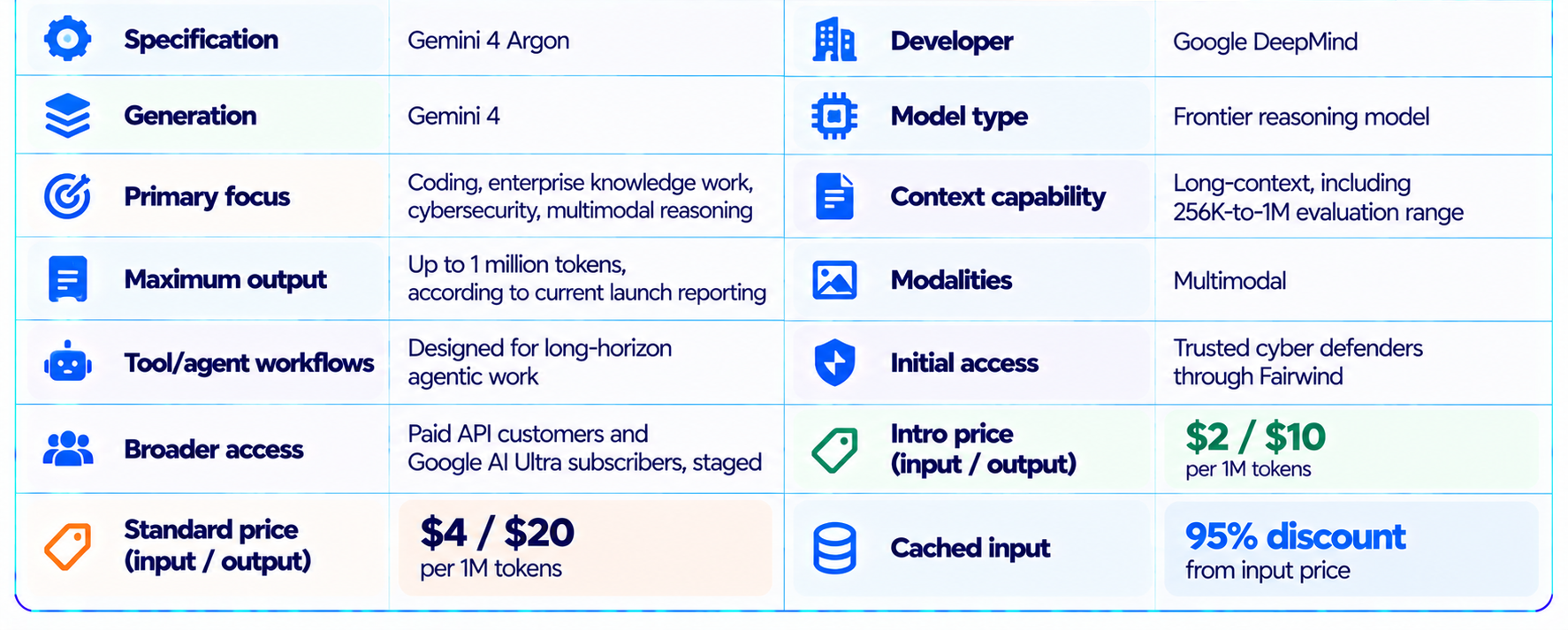
Gemini 4 Argon is Google's new frontier AI model for long-horizon software engineering, enterprise knowledge work and defensive cybersecurity. Announced on September 30, 2026, Argon is the first model in the Gemini 4 generation and is being introduced with a staged access program rather than an immediate public rollout.
That launch strategy is important, but the model itself is the bigger story. Google is positioning Argon around tasks that require sustained reasoning across many steps: debugging real software, working through legal and financial material, operating in agentic coding environments, understanding multimodal information and finding or patching software vulnerabilities.
Google's published benchmark table shows a mixed but very strong profile. Argon leads several knowledge-work, science, long-context and multimodal evaluations, while GPT-6 Astra leads some coding-agent and computer-use tests and Claude Opus 5.5 leads several terminal and engineering evaluations. The useful conclusion is a broad frontier-level capability profile rather than a universal benchmark sweep.
QUICK ANSWER
Gemini 4 Argon is Google's first Gemini 4 frontier model for complex, long-running workflows across software engineering, enterprise knowledge work, cybersecurity defense and multimodal reasoning. Google says it is already used internally and is initially available to trusted cybersecurity experts through the Fairwind Program.
The published results include 77.9% on DeepSWE v1.1, 51.3% on AutomationBench, 65.4% on Vals Finance Agent v2, 19.6% on Harvey's Legal Agent Benchmark, 91.9% on Vibe Code Bench, 88.8% on LABBench 2, 76.0% on RiemannBench, 91.7% on LVBench and 68.0% on CWE-bench v1.
Argon does not lead every benchmark. GPT-6 Astra scores 65.5% on FrontierSWE v2 versus Argon's 55.0%, 68.1% on Terminal-Bench Science versus 57.6%, and 72.6% on the reported OSWorld-2.0 offline subset versus 69.2%. Claude Opus 5.5 leads Terminal-Bench 4.0 at 66.4%.
Google's introductory price is $2 per million input tokens and $10 per million output tokens, with cached input discounted by 95%. After the introductory period, Google says pricing becomes $4 per million input and $20 per million output. Access is staged.
My rating: 9.4/10 overall, 9.6/10 for enterprise workflows, 9.5/10 for cybersecurity, 9.3/10 for coding, 9.7/10 for multimodal understanding and 9.0/10 for price-to-capability.
1. What Is Gemini 4 Argon?
Gemini 4 Argon is Google's flagship frontier model and the first release in the Gemini 4 family. Google DeepMind describes it as a model built for deep reasoning across complex workflows rather than short conversational requests.
The product focus is specific: real-world software engineering, enterprise knowledge work such as legal and finance, defensive cybersecurity, multimodal understanding and long-horizon agentic tasks. That makes Argon a direct competitor to high-end models used inside coding agents, research systems and enterprise automation.
Google says Argon is already being used internally for specialized programming, deeper research and writing, and has been used in large-scale engineering and data-center optimization workflows.
2. Gemini 4 Argon Specifications
3. Gemini 4 Argon Benchmarks
Google published a broad benchmark table covering knowledge work, agentic coding, science and math, computer use, multimodal understanding, long-context reasoning and cybersecurity. The breadth is important because Argon is being positioned as a workflow model rather than a single-purpose code generator.
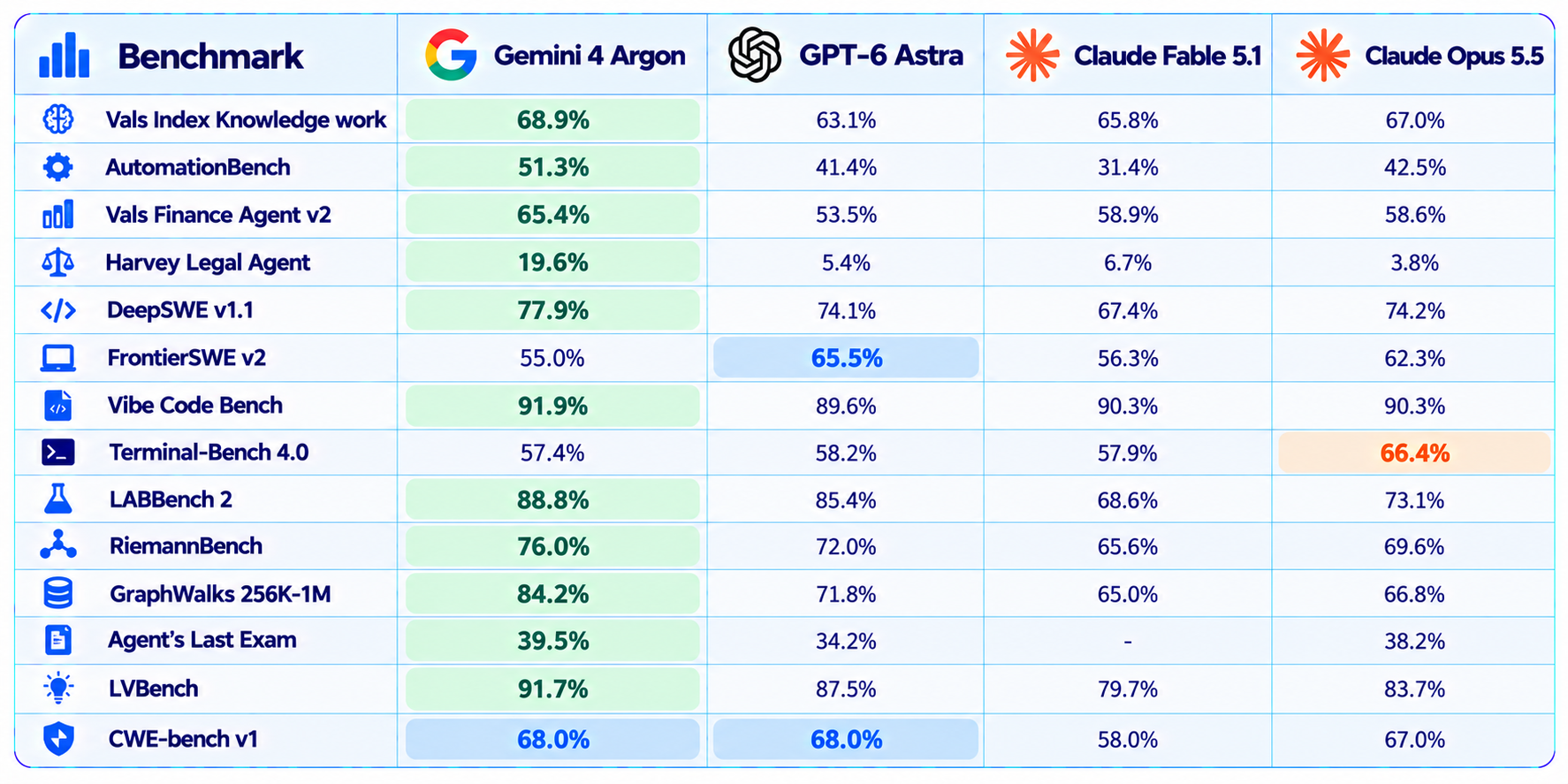
The table shows the real shape of the release. Argon is exceptionally broad, but different models lead different workloads. That is why a model-routing strategy can still make sense even at the frontier.
4. Coding: DeepSWE vs FrontierSWE
Coding is one of the most important parts of the Argon launch, and the benchmark results show both its strength and its limits.
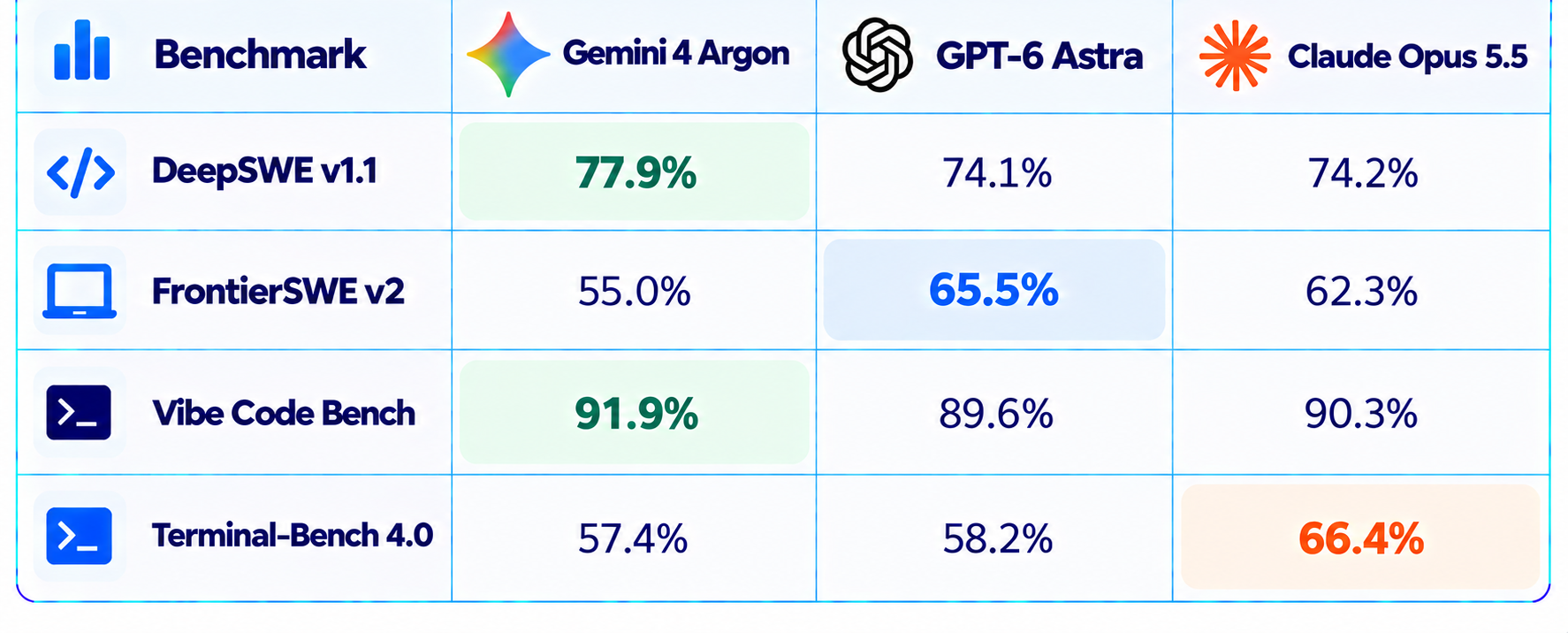
Argon has a particularly strong DeepSWE result and the highest Vibe Code Bench score in the comparison shown by Google. But FrontierSWE and Terminal-Bench demonstrate that it is not dominant across every software-engineering harness.
For developers, this means the correct evaluation depends on the agent you are building. Repository repair, terminal execution, code generation, long-horizon engineering and interactive vibe coding are different workloads.
5. Enterprise Knowledge Work
Enterprise knowledge work is one of Argon's clearest strengths. Google reports 68.9% on the Vals Index Knowledge Work benchmark, 51.3% on AutomationBench and 65.4% on Vals Finance Agent v2.
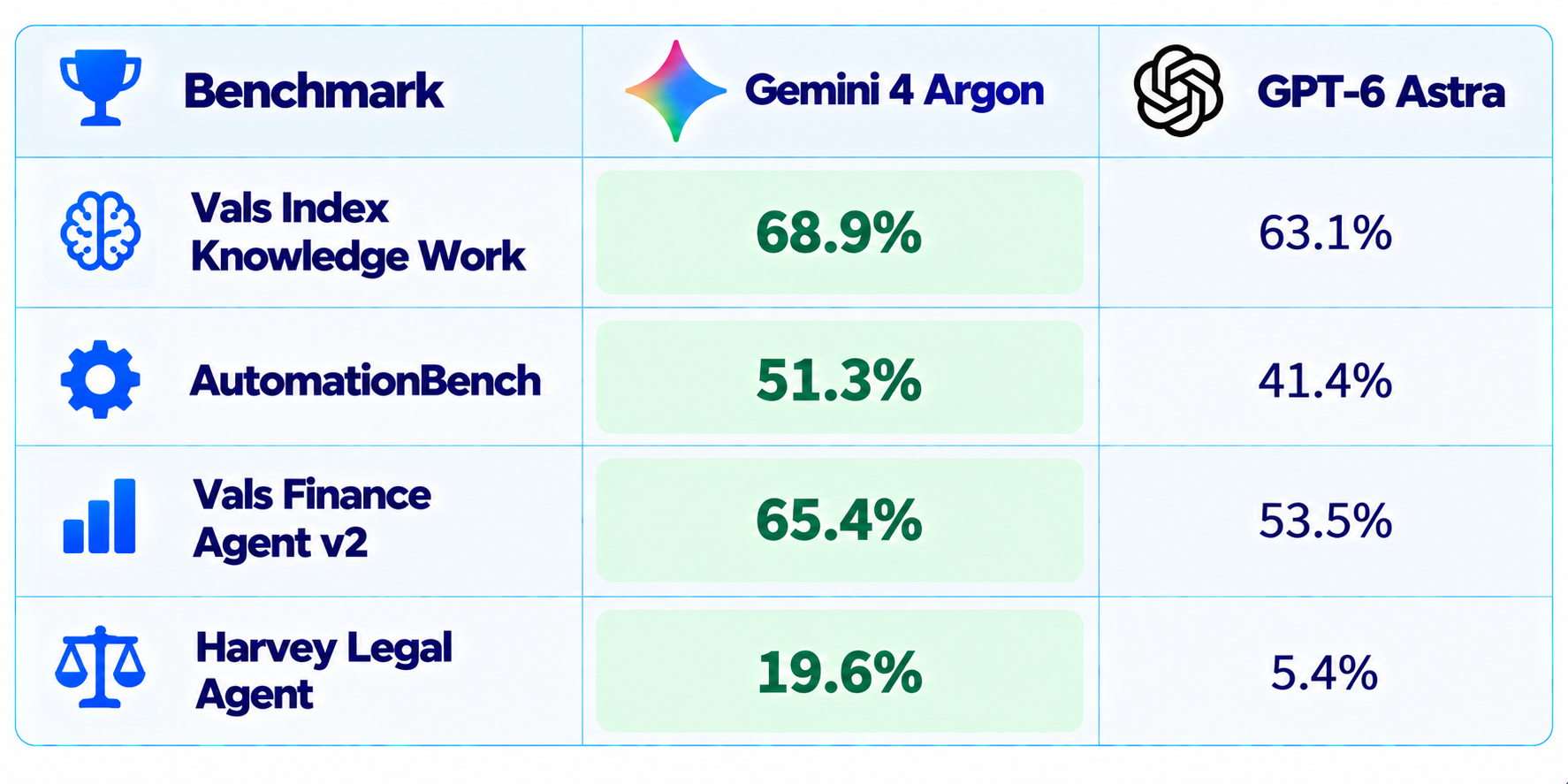
The legal result is notable in Google's published table. Argon reaches 19.6% on Harvey's Legal Agent Benchmark compared with 5.4% for Astra. This does not mean Argon should replace legal professionals. It means it performed strongly on that specific multi-step legal-agent evaluation.
For enterprise teams, the larger point is that Argon is designed around workflows. Finance, legal, research and operations often require a model to read multiple documents, reason across them, use tools and maintain coherent state.
6. Long-Context Reasoning
Argon's long-context performance is another major differentiator. Google reports 99.7% F1 on GraphWalks up to 128K and 84.2% on the 256K-to-1M range.
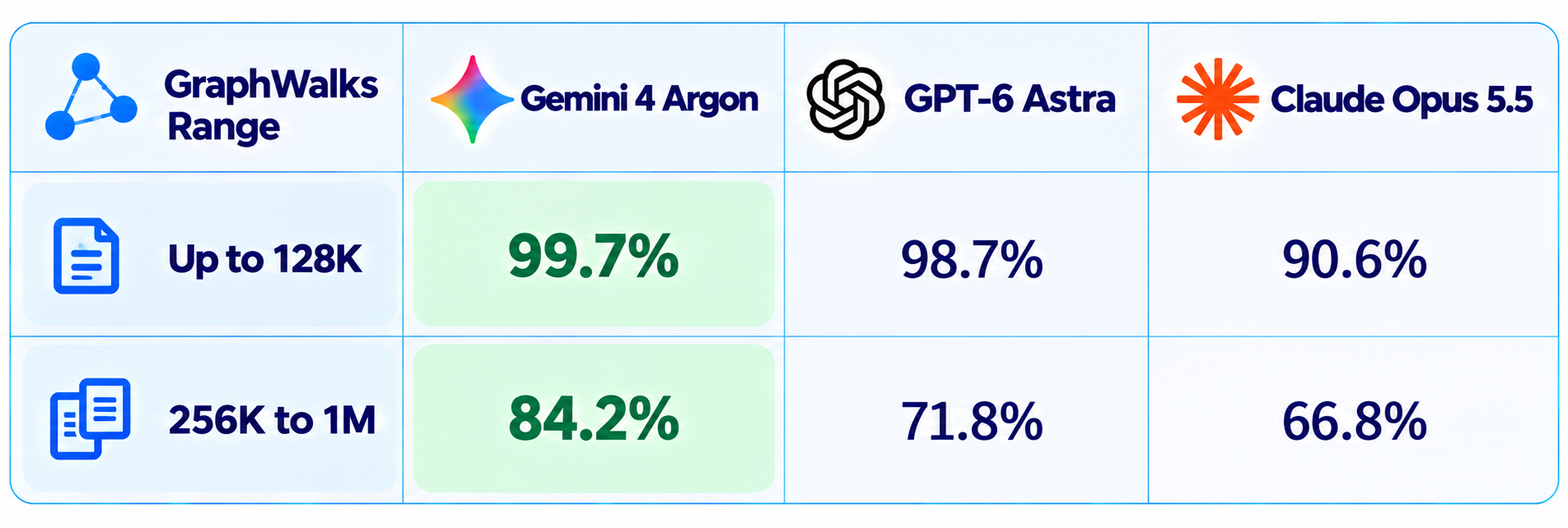
The second row matters because it tests the model where very long context becomes difficult. Argon's 84.2% result is substantially above the other models shown in Google's comparison.
This can matter for repository-scale coding, large policy libraries, legal discovery, research archives and enterprise knowledge systems. The context window is useful only when applications supply relevant evidence and the model can locate and connect it.
7. Multimodal Understanding
Gemini's multimodal capability remains central to Argon. Google reports 71.6% on Chartography and 91.7% on LVBench, compared with 71.0% and 87.5% for GPT-6 Astra.
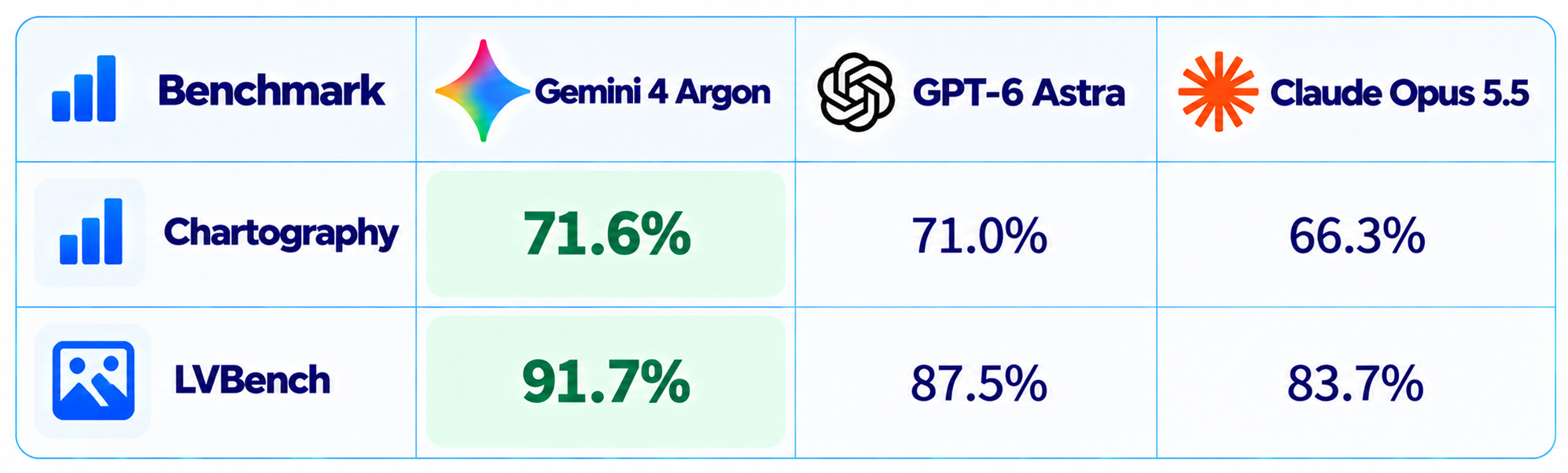
This is useful when documents, charts, screenshots, diagrams and video are part of the same workflow. A multimodal model can reason over the original evidence instead of forcing every input through a text-only conversion step.
8. Cybersecurity: One of Argon's Biggest Differentiators
Google is releasing Argon gradually partly because of its cybersecurity capabilities. The model is designed to find, validate and patch critical software vulnerabilities, and Google is initially giving access to trusted cybersecurity experts through the Fairwind Program.
On CWE-bench v1, Argon scores 68.0%, tied with GPT-6 Astra and ahead of Claude Fable 5.1 at 58.0% and Claude Opus 5.5 at 67.0% in Google's table.
Google also highlights resistance to indirect prompt injection attacks, monitoring of reasoning and actions for misalignment, and hardened sandbox environments for high-risk training and evaluations.
For developers, this matters because security is part of agent reliability. A coding agent that can find a vulnerability but can also be redirected by a poisoned repository, webpage or tool result is not ready for high-trust production use.
9. Gemini 4 Argon Pricing
Google announced introductory pricing of $2 per million input tokens and $10 per million output tokens. Cached input receives a 95% discount from the input rate. After the introductory period, Google says standard pricing becomes $4 per million input tokens and $20 per million output tokens.
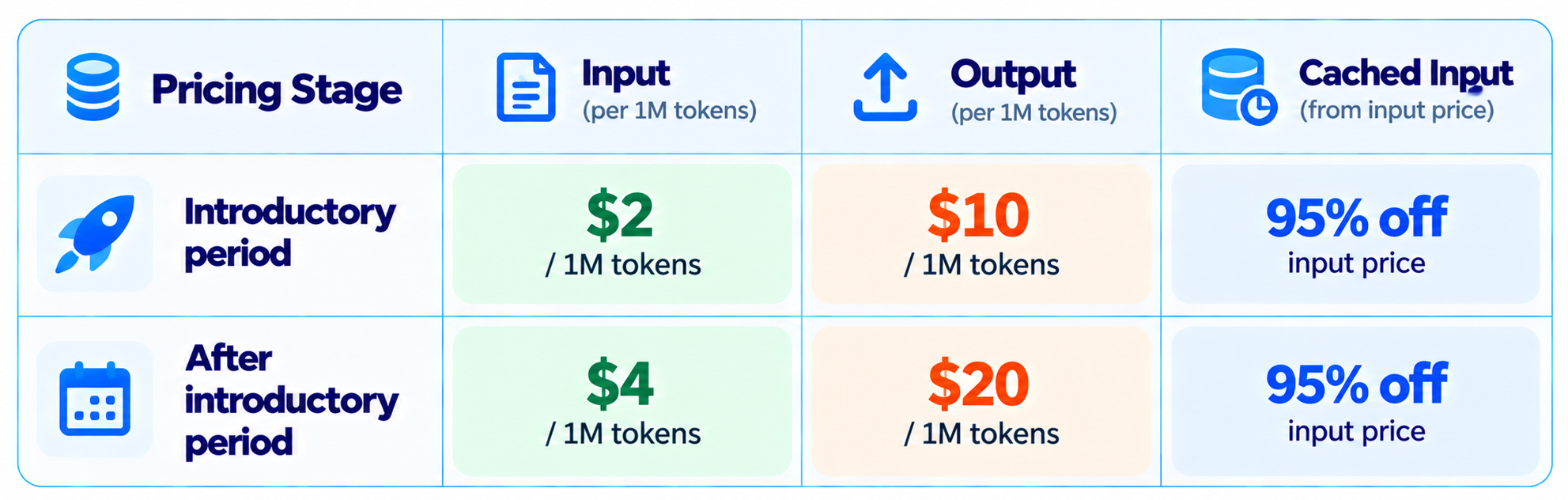
The cache discount is especially important for agents that repeatedly send the same system instructions, repository context or long documents. For production budgeting, use the post-introductory price rather than assuming the launch rate will remain permanent.
10. Gemini 4 Argon Access and API Availability
Argon is released, but access is staged. Google is initially rolling it out to trusted cybersecurity experts through the Fairwind Program and says broader access will begin with paid API customers and Google AI Ultra subscribers.
This distinction matters for developers searching for a Gemini 4 Argon API key. The announcement does not mean unrestricted public availability. Google is expanding access while evaluating safety and collecting real-world feedback.
Do not invent an endpoint, SDK migration example or model ID until Google publishes it. The safe implementation path is to use the official Gemini API documentation and the model identifier Google exposes to your account.
11. Gemini 4 Argon vs GPT-6 Astra
Argon and GPT-6 Astra are direct frontier competitors, but Google's published comparison shows a genuine split.
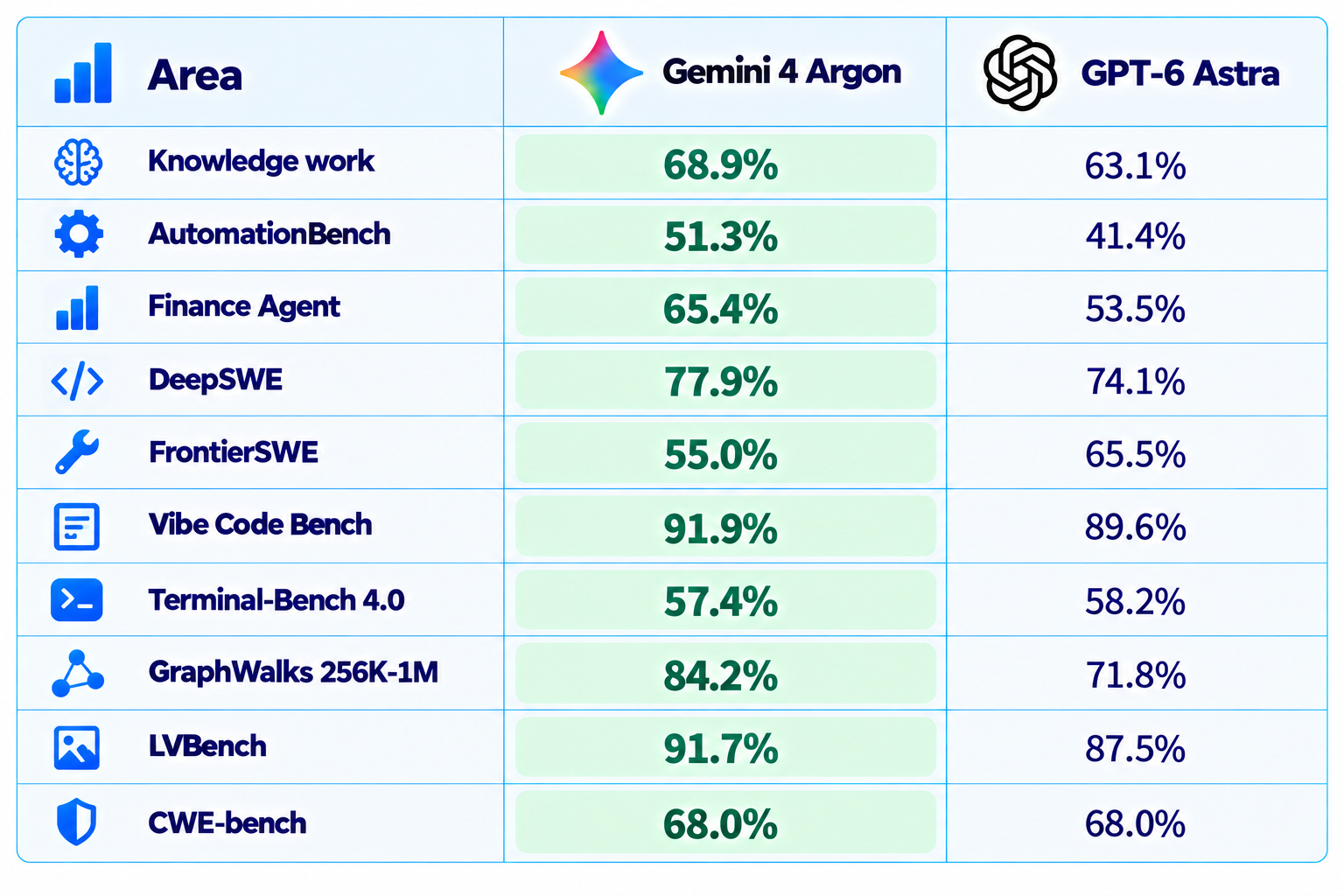
Argon has stronger results on several knowledge-work, long-context and multimodal evaluations, while Astra leads on FrontierSWE and the reported OSWorld-2.0 subset and is slightly ahead on Terminal-Bench 4.0. The choice should follow workload rather than a single score.
12. Gemini 4 Argon vs Claude Fable 5.1
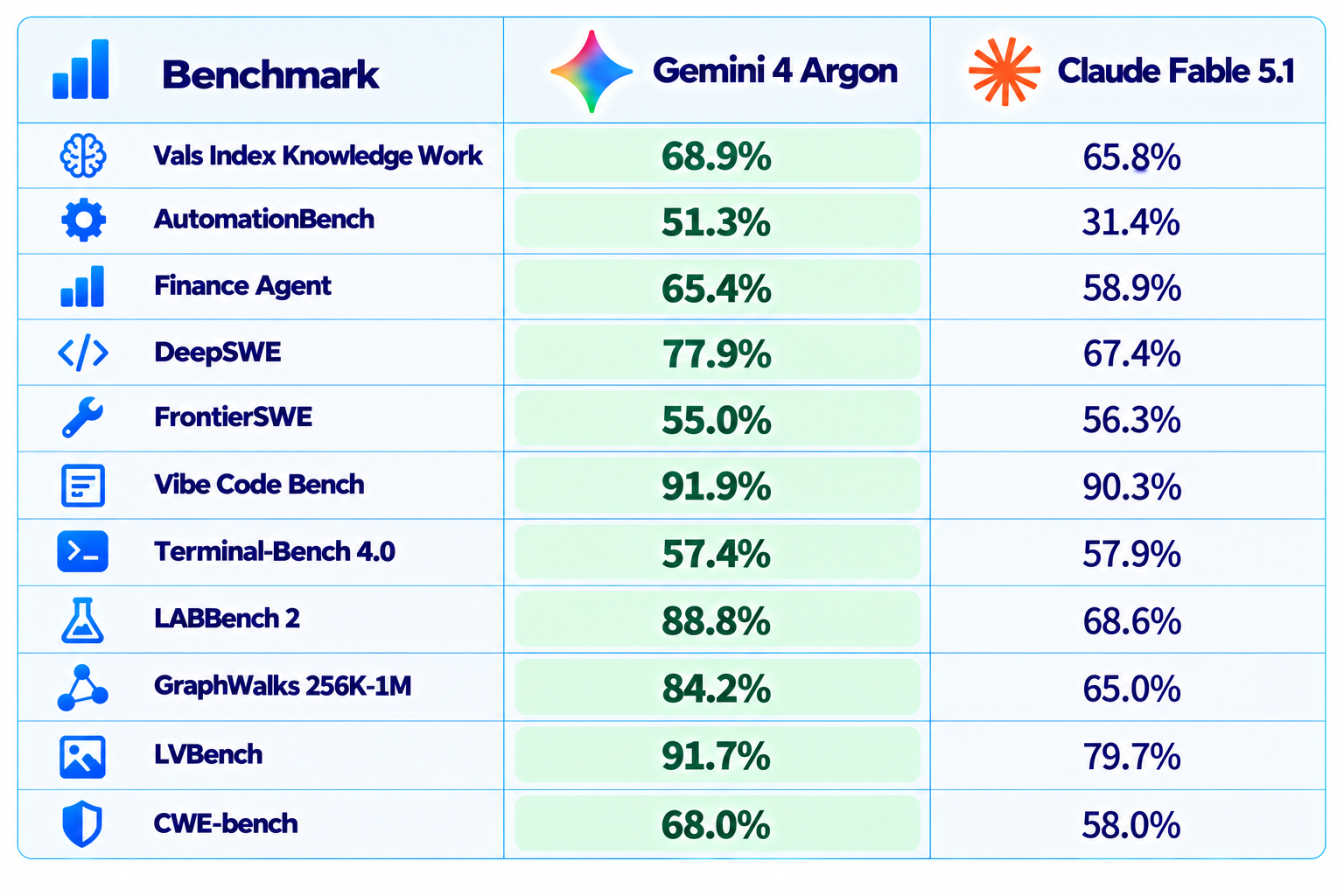
Fable 5.1 remains competitive on FrontierSWE and Terminal-Bench 4.0, while Argon's clearest advantages in this comparison are enterprise automation, long context, science and multimodal understanding.
13. Gemini 4 Argon vs Claude Opus 5.5
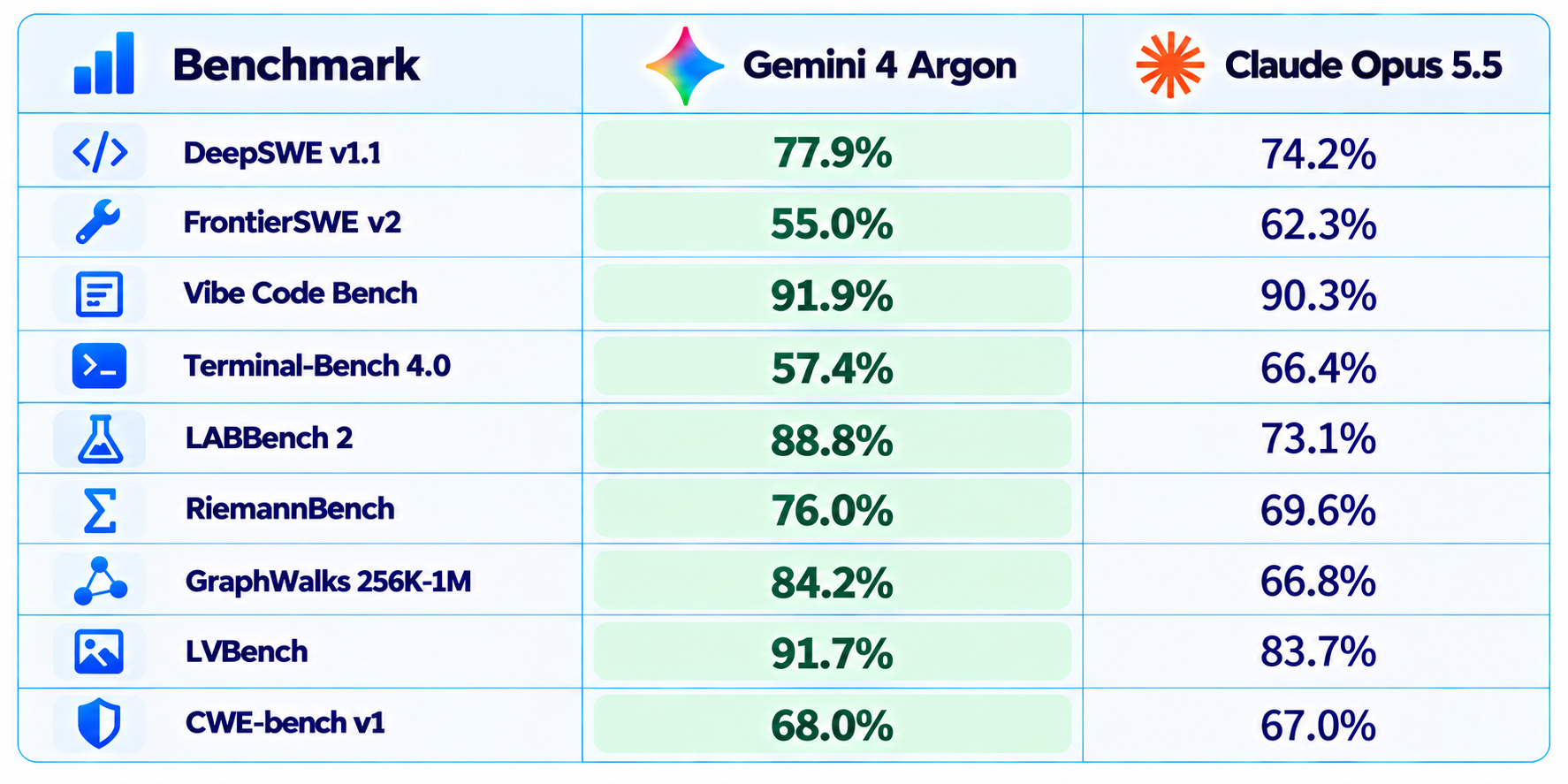
This comparison reinforces Argon's identity. It is a broad multimodal and enterprise model with particularly strong long-context, knowledge-work, science and cyber performance, while Opus 5.5 remains very strong on terminal and software-engineering evaluations.
14. What Google Is Using Argon For Internally
- Google says Argon is already being used across internal programming, research and writing workflows.
- Google has described large-scale code migration work, including C and C++ to Rust, as one area where Argon agents are useful.
- Google has also highlighted data-center optimization work using fleet telemetry, demonstrating the model's intended role as an engineering worker rather than only a conversational assistant.
15. Prompt Injection and Agent Security
Google specifically highlights indirect prompt-injection resistance. This matters because agents can encounter untrusted instructions inside webpages, files, repositories, emails and tool outputs.
Argon's safety architecture also includes monitoring of reasoning and actions and hardened sandbox environments. These controls should complement application-level permissions, sandboxing, confirmation gates, logging and least-privilege tool design.
For the practical security layer, see How to Secure AI Coding Agents: Permissions, Sandboxing, MCP & Secrets.
16. Best Use Cases for Gemini 4 Argon
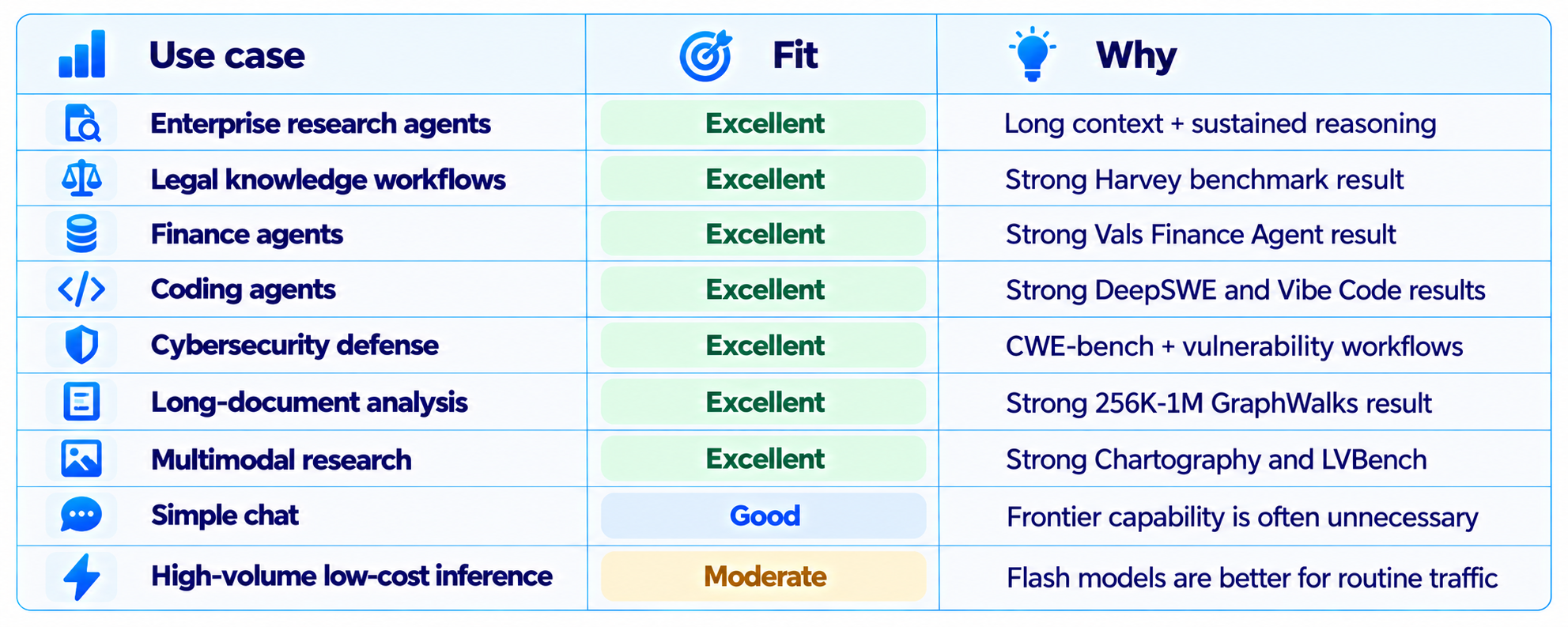
17. Limitations You Should Know
- Argon is not the leader on every coding benchmark.
- GPT-6 Astra leads Argon on FrontierSWE v2 and the reported OSWorld-2.0 offline subset.
- Claude Opus 5.5 leads Argon on Terminal-Bench 4.0 in Google's published table.
- Broader access is staged, so many developers cannot immediately use the model.
- The introductory price is temporary; long-term budgets should use the standard $4 input and $20 output rates.
- Many benchmark figures come from Google's evaluation setup and should be read alongside the published methodology.
- A frontier model is unnecessary for many routine workloads where Gemini Flash or another lower-cost model can complete the task.
- High autonomy increases the importance of permissions, sandboxing and human approval around real-world actions.
18. Recommended Production Workflow
- Route complex repository work, legal research, financial analysis and long-context tasks to Argon.
- Use Gemini Flash-class models for routine extraction, classification, summarization and high-volume requests.
- Use structured outputs whenever Argon feeds another system.
- Keep tools narrow and enforce least-privilege permissions.
- Use sandboxed execution for code and security workflows.
- Cache stable context when the workload repeatedly sends the same material.
- Log tool calls, retries, latency, token usage and final task success.
- Create an escalation path to a human for consequential financial, legal, security or production actions.
For the broader architecture, see What Is an AI Agent? Beginner Guide With Examples (2026) and What Is Context Engineering? Complete Guide (2026).
19. Gemini 4 Argon vs Gemini 3.8 Flash
Argon and Gemini 3.8 Flash occupy different layers of Google's model stack. Flash is the fast workhorse for high-volume coding, agents and enterprise tasks, while Argon is the frontier tier for difficult long-horizon work.
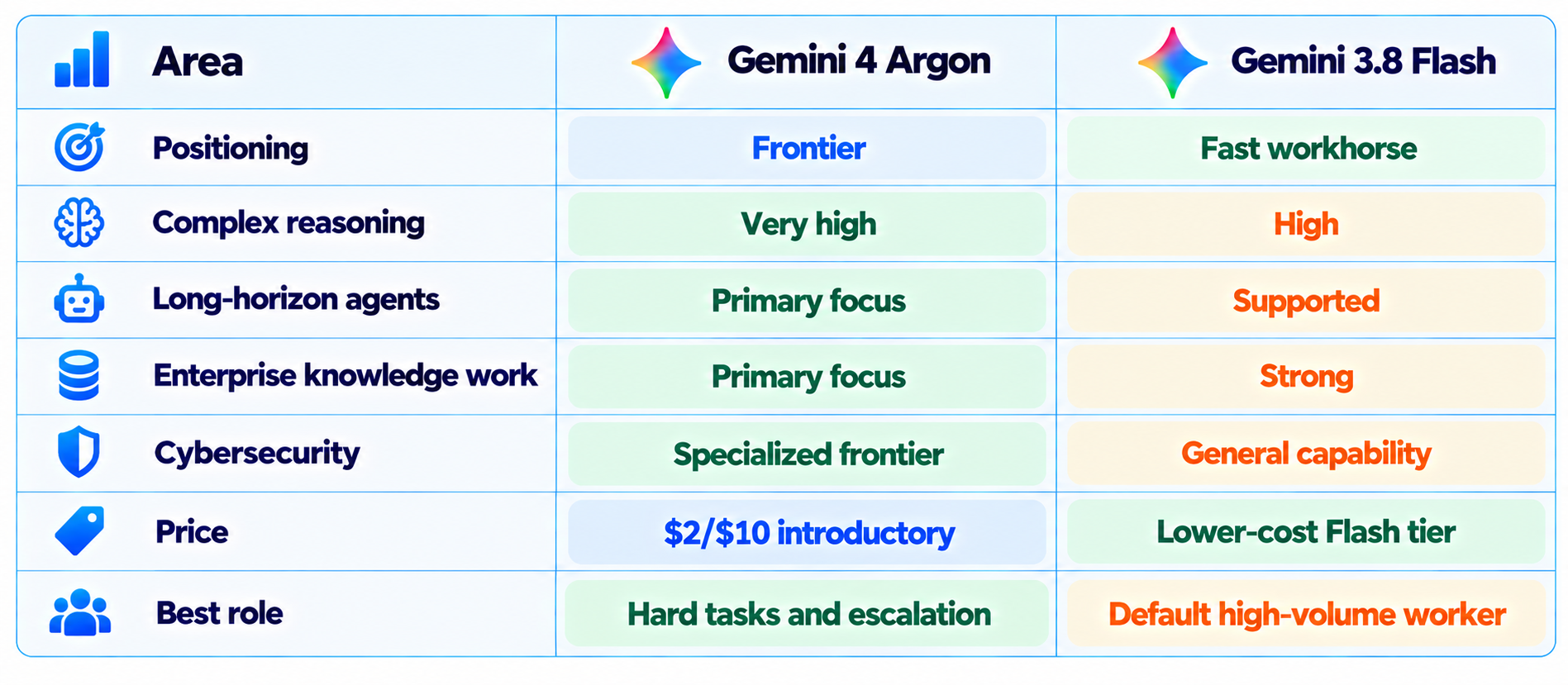
A practical architecture can use both: Flash handles the majority of routine requests, while Argon is called when the task is sufficiently complex to justify frontier-model cost.
20. How to Evaluate Gemini 4 Argon Yourself
Build a task set that resembles your actual workload rather than testing only showcase prompts.
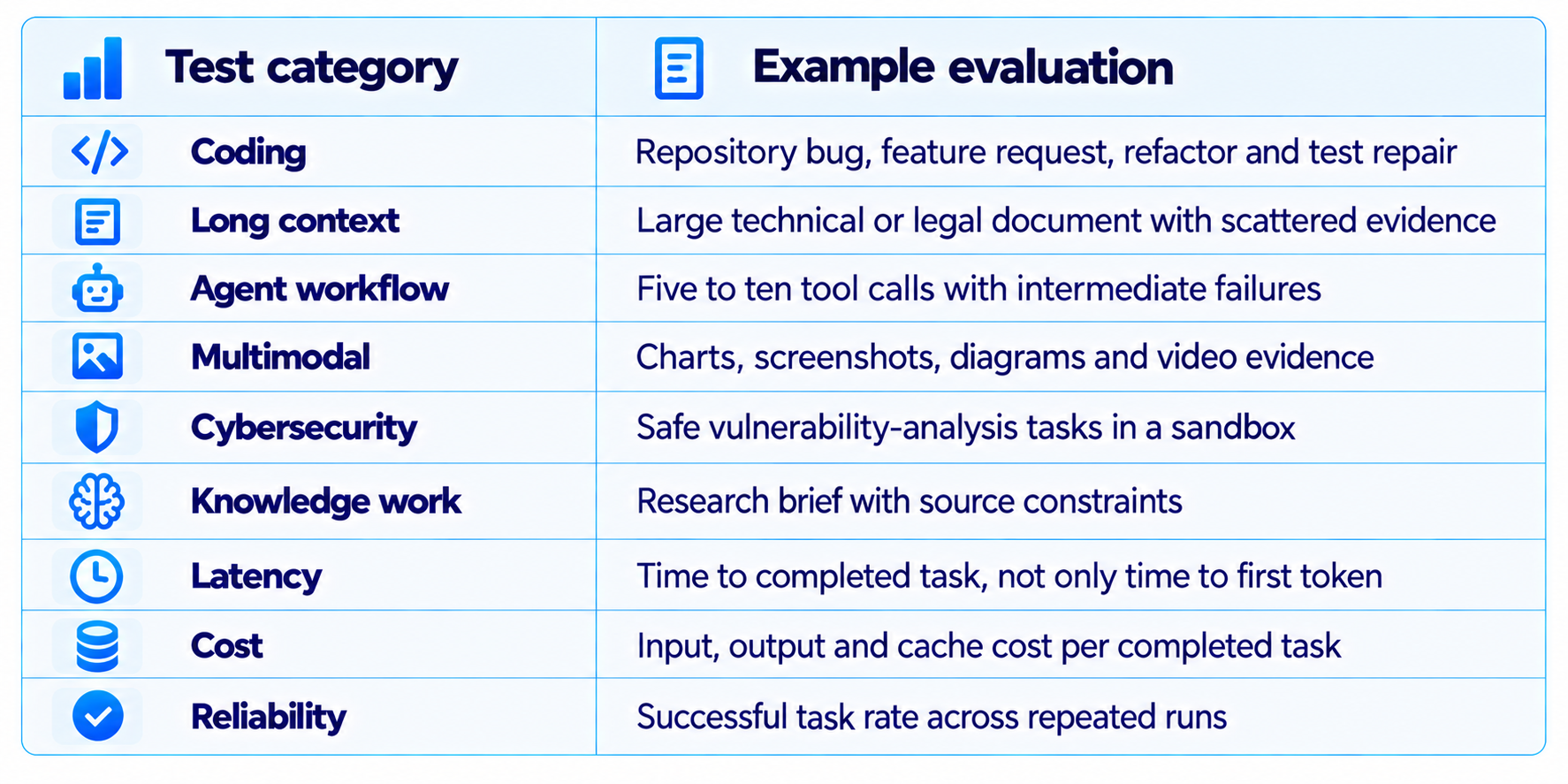
The most useful metric is cost per successful task. A model that is slightly more expensive per token can still be cheaper overall if it needs fewer retries, fewer escalations and less human repair.
21. Is Gemini 4 Argon Worth It?
For complex enterprise and agent workloads, Argon is compelling. Its published results show strong performance across knowledge work, long-context reasoning, science, multimodal understanding and cybersecurity, while its coding profile is competitive with the strongest frontier models.
The main reason to use Argon is not ordinary chat quality. It is the ability to keep working through a difficult task that spans documents, code, tools and multiple reasoning steps.
The main reason not to use Argon for everything is economics and availability. At $2 input and $10 output during the introductory period, and $4 input and $20 output afterward, routine tasks are better served by cheaper Flash models. Access is also staged.
22. Final Verdict
Gemini 4 Argon is a substantial new frontier model from Google, and its benchmark profile shows that Google is competing across more than one dimension. The model is particularly strong in enterprise knowledge work, long-context reasoning, multimodal understanding, science and cybersecurity.
The 77.9% DeepSWE result and 91.9% Vibe Code Bench score make Argon a serious coding model, while the 84.2% GraphWalks result in the 256K-to-1M range shows why the model is interesting for very large contexts. Its 68.0% CWE-bench result also places it at the top of Google's reported cybersecurity comparison alongside GPT-6 Astra.
The benchmark table also gives a clear warning against treating Argon as universally dominant. GPT-6 Astra leads FrontierSWE v2, Argon trails Claude Opus 5.5 on Terminal-Bench 4.0, and computer-use results are mixed. The model is broad rather than unbeatable.
The pricing is competitive for a frontier model but not for routine workloads. The introductory $2 input and $10 output rates rise to $4 and $20 after the introductory period, while cached input gets a 95% discount.
My rating: 9.6/10 for enterprise knowledge work, 9.5/10 for cybersecurity, 9.3/10 for coding, 9.7/10 for multimodal understanding, 9.2/10 for long-context reasoning and 9.4/10 overall.
Bottom line: Gemini 4 Argon is worth serious attention if you are building complex coding agents, enterprise research systems, cybersecurity workflows or long-context multimodal applications. It is not the model to route every simple request to. Its real value appears when the task is difficult enough to justify frontier reasoning, long context and sustained agentic execution.
Frequently Asked Questions
What is Gemini 4 Argon?
Gemini 4 Argon is Google's first Gemini 4 frontier model for long-horizon software engineering, enterprise knowledge work, cybersecurity defense and multimodal reasoning.
Is Gemini 4 Argon released?
Yes. Google announced Gemini 4 Argon on September 30, 2026 and began a staged rollout through its Fairwind Program.
Can I use Gemini 4 Argon today?
Access is staged. Google is first providing access to trusted cybersecurity experts, with broader access beginning with paid API customers and Google AI Ultra subscribers.
What are the Gemini 4 Argon benchmarks?
Published results include 77.9% DeepSWE v1.1, 55.0% FrontierSWE v2, 91.9% Vibe Code Bench, 57.4% Terminal-Bench 4.0, 84.2% GraphWalks in the 256K-to-1M range, 91.7% LVBench and 68.0% CWE-bench v1.
How much does Gemini 4 Argon cost?
Introductory pricing is $2 per million input tokens and $10 per million output tokens. Google says standard pricing becomes $4 input and $20 output after the introductory period.
Does Gemini 4 Argon have a large context window?
Yes. Google's published evaluation includes a 256K-to-1M GraphWalks range, and current launch reporting states an output allowance of up to 1 million tokens.
Is Gemini 4 Argon good for coding?
Yes. Argon scores strongly on DeepSWE and Vibe Code Bench, although GPT-6 Astra and Claude Opus 5.5 lead it on some coding-agent benchmarks.
Is Gemini 4 Argon good for cybersecurity?
Yes. Google specifically designed Argon for defensive cybersecurity and reports 68% on CWE-bench v1, tied with GPT-6 Astra.
Is Gemini 4 Argon multimodal?
Yes. Google highlights multimodal understanding, with 71.6% on Chartography and 91.7% on LVBench in its published comparison.
Is Gemini 4 Argon better than GPT-6 Astra?
The published benchmark results are mixed. Argon leads on several knowledge-work, long-context, multimodal and science evaluations, while Astra leads on FrontierSWE v2 and the reported OSWorld-2.0 subset.
Is Gemini 4 Argon better than Claude Opus 5.5?
It depends on the workload. Argon leads on several long-context, science and multimodal evaluations, while Opus 5.5 leads Terminal-Bench 4.0 and some engineering benchmarks.
Is Gemini 4 Argon worth it?
It is particularly compelling for complex enterprise agents, coding, cybersecurity, long-context research and multimodal workflows. Cheaper Flash models remain more appropriate for routine high-volume work.
Recommended Blogs
Gemini 3.8 Flash Review: Benchmarks, Price & Is It Worth It? (2026)
GPT-5.6 Review: Sol, Terra, Luna Features, Benchmarks, and Pricing
Claude Fable 5.1 Review: Benchmarks, Price, Coding & Is It Worth It? (2026)
Quasar 438B Review: Benchmarks, Speed, Price & Is It Worth It? (2026)
How to Secure AI Coding Agents: Permissions, Sandboxing, MCP & Secrets
Resources & Community
Join our community of 70,000+ AI enthusiasts and learn to build powerful AI applications. Whether you're a beginner or an experienced developer, Build Fast with AI helps you understand and implement AI in your projects.
Agentic AI Launchpad 2026
A structured 6-week cohort program that takes you from AI basics to building and deploying real-world agentic AI systems. Includes live sessions, expert mentorship, project reviews and a builder community network.
Ready to go from learning to building? Join the next cohort: Agentic AI Launchpad 2026
Free AI Resources
Access free tools, workshops and micro-learning to keep building.

