
Forward Deployed AI Engineer: Role, Skills & How to Become One
Most AI projects don't die because the model is bad. They die somewhere between a great demo and a Monday morning when real employees are supposed to use the thing. The data is messier than anyone admitted, the internal system has no clean API, security wants a review nobody planned for, and the person who championed the pilot just changed teams. The forward deployed AI engineer is the person companies now hire to stop that from happening. I want to walk you through what this job really is, why it's suddenly one of the most talked-about roles in tech, what skills you need, what it pays, and how you can realistically get there from where you are today. No hype, just how the work actually looks.
What Is a Forward Deployed AI Engineer?
A forward deployed AI engineer is a software engineer who gets embedded with a customer to make an AI system work inside that customer's real environment. "Forward deployed" just means you work at the front line, with the customer, instead of sitting back at headquarters building a general product for everyone. The "AI" part means the thing you're deploying is usually built on large language models: an assistant that answers questions from internal documents, an agent that processes claims, a tool that drafts contracts or reconciles invoices.
Think of it this way. A product engineer builds the hammer. A forward deployed AI engineer goes to the construction site, figures out what's actually being built, adapts the hammer to the wood they have, and stays until the wall is standing. You write real code, but the code serves one customer's outcome, not a feature roadmap.
The title comes from Palantir, which used forward deployed engineers for years to get its software running inside governments and large companies. What changed recently is AI. Every lab and AI startup discovered the same thing at once: selling access to a powerful model is easy, but getting a bank, a hospital or a logistics company to actually run it in production is hard. So they borrowed Palantir's playbook, and the role took off. If you want the broader background on the general role first, our guide on how to become a forward deployed engineer in India covers the fundamentals.
Why This Role Suddenly Matters So Much
Here's the uncomfortable truth about enterprise AI: a huge share of pilots never reach production. Companies spent the last couple of years running proofs of concept that looked impressive in a meeting and then quietly went nowhere. The model wasn't the bottleneck. Integration was. Ownership was. Trust was.
That gap is exactly where forward deployed AI engineers live, and the hiring numbers show it. One analysis of Indeed data found job postings for the role in January 2026 running at roughly 19 times the volume of a year earlier, and another tracked about 800 percent growth between January and September 2025. Those are vendor-reported figures, so treat them as directional, but the direction is hard to argue with. When the companies selling AI realise their revenue depends on customers actually using it, they hire people whose whole job is making that happen.
There's also a simpler reason the role matters. AI systems are probabilistic. A normal piece of software either works or throws an error. An LLM-based system can be right 92 percent of the time and confidently wrong the rest, and the wrong answers can look exactly like the right ones. Somebody has to design the guardrails, the evaluations and the human checkpoints that make that acceptable to a real business. That somebody is usually the forward deployed AI engineer. We wrote about this exact problem in the 3 layers of an AI system that survives real users.
What the Job Looks Like Day to Day
Job descriptions make this role sound glamorous. The reality is more interesting and a lot messier. Let me paint a realistic picture of a typical engagement, say, an insurance company that wants AI to help process claims faster.
Week one: understanding the real problem
You don't start by writing code. You start by sitting with the claims team and watching how they actually work. You'll usually discover that the problem they described in the sales call isn't quite the problem they have. Maybe the slow part isn't reading the claim, it's chasing missing documents. That insight alone can change what you build, and it only comes from being in the room.
Weeks two to four: building against reality
Now you build. You pull data out of systems that were never designed to share it, sometimes through a proper API, sometimes through an export someone runs manually every night, and occasionally through screen automation because there's no other way in (we covered those patterns in automating a system with no API). You set up retrieval over thousands of policy documents. You write prompts, then throw half of them away once you see real inputs.
Weeks four to eight: making it trustworthy
This is the part demos skip. You build an evaluation set from real past claims so you can measure accuracy honestly. You add fallbacks for when the model isn't confident. You log everything so that when a claims manager asks why the AI suggested something, there's an answer. You run the pilot with five users, then twenty, and you fix what breaks.
The parts nobody mentions
A surprising amount of the job is communication. You'll explain to a VP why accuracy is 88 percent and why that's actually good for this workflow. You'll talk security teams through data flows. You'll write the runbook so the customer's own team can keep the system alive after you leave. If you love pure heads-down coding and hate meetings, be honest with yourself about that before chasing this title.
FD AI Engineer vs AI Engineer vs Classic FDE
These titles get mixed up constantly, and job posts don't help. Here's how I'd separate them.
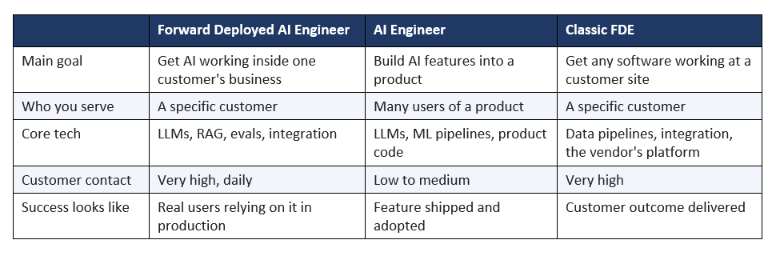
The short version: an AI engineer builds AI into a product, a classic FDE deploys software into customer environments, and a forward deployed AI engineer does the second job with AI as the thing being deployed. That combination is exactly why the role is hard to hire for. You need to be credible with LLMs and credible in a boardroom. If you're comparing it with sales-adjacent roles, our breakdown of FDE vs solutions engineer explains where the line sits.
The Skills You Actually Need
Let me split this into what you build with and what you work with, because both matter about equally in this job.
Technical skills
- Strong Python and APIs. You'll glue systems together constantly. Comfort with REST, authentication, async calls and reading other people's code is non-negotiable.
- Working with LLM APIs. Prompt design, structured outputs, tool calling, handling rate limits and cost. Knowing how models from different providers behave in practice helps a lot.
- Retrieval (RAG) done properly. Not just 'put documents in a vector database'. Chunking strategy, embeddings, hybrid search that mixes keyword and semantic matching, and reranking. Most real accuracy problems are retrieval problems.
- Evaluations. Building test sets from real data and measuring quality before and after every change. This is what separates engineers who ship from engineers who demo.
- Data and integration. SQL, messy exports, legacy systems, the occasional spreadsheet that runs a whole department.
- Deployment basics. Containers, a cloud platform, logging, monitoring, and enough security knowledge to pass an enterprise review.
Human skills
- Scoping. Turning 'we want AI for customer service' into a specific, measurable first workflow.
- Explaining trade-offs plainly. Telling a non-technical leader why 100 percent accuracy isn't the goal, and what is.
- Ownership. Staying with a problem until it's solved, even when the cause sits in someone else's system.
- Writing. Clear docs, handover notes and status updates. Underrated, and it shows up in hiring loops.
If you want a deeper checklist, we break down each one in our post on forward deployed engineer skills. The honest takeaway: you don't need to be a research scientist. You need to be a very good engineer who understands how LLMs fail and who people trust in a meeting.
Who Is Hiring Forward Deployed AI Engineers
The hiring market splits into three groups, and they offer quite different experiences.
AI labs
Anthropic and OpenAI both hire forward deployed engineers to help large customers build on their models. Scale AI hires for similar work. These roles carry the most prestige and usually the highest pay, and you'll work with the newest models before most of the world sees them. Competition is intense.
Established platforms
Palantir, where the title started, still runs a large forward deployed organisation. Salesforce and other enterprise software companies have added the role as they push AI features into their customer base. You'll get structure, big clients and good training, often with more travel.
AI startups and consultancies
This is the biggest and fastest-growing pool. Startups selling vertical AI products (legal, healthcare, finance, logistics) need people who can make the product work at each new customer. The pay can be a bit lower in cash but higher in equity, and you'll get far more ownership earlier. For people in India, this group is also where most opportunities show up first.
A quick tip when reading job posts: the same work hides under different titles. Look for 'AI deployment engineer', 'applied AI engineer', 'solutions architect (AI)' and 'implementation engineer, AI'. Read the responsibilities, not the title.
Forward Deployed AI Engineer Salary
Pay for this role is high because the skill combination is rare. Here's a realistic picture from US market data, with the caveat that most published figures come from recruiters and vendors with an interest in the numbers, so read them as ranges, not promises.
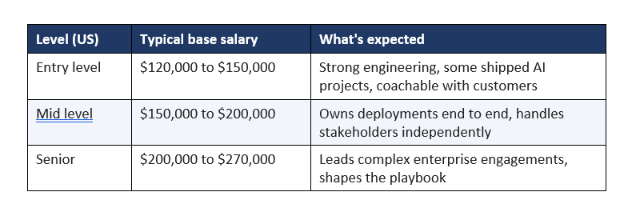
A few other data points help frame this. One firm puts the median forward deployed engineer base salary at around $174,000, another places the midpoint near $183,000, and Silicon Valley postings have been reported with median advertised pay above $188,000. AI labs generally pay at the top of these bands, and equity can add a lot on top. In India the numbers are very different but still well above typical software roles; we cover the full picture, with real bands, in our forward deployed engineer salary guide for India.
How to Become a Forward Deployed AI Engineer
There's no degree for this. Almost everyone in the role came in sideways, from backend engineering, data engineering, ML, solutions engineering or consulting. Here's the path I'd follow if I were starting today.
- Get genuinely good at backend engineering. If your Python, APIs and SQL are shaky, fix that first. Everything else sits on top of it.
- Build with LLMs every week. Not tutorials. Small real tools: a document Q&A over your own files, a script that classifies support emails, an assistant that drafts replies. Learn how models break.
- Ship one serious RAG project end to end. Use messy, real documents. Add chunking choices, hybrid search, reranking, and an evaluation set. Write down what accuracy you got and what moved it.
- Deploy it like a business would. Put it behind authentication, add logging, handle failures gracefully, and run it on a cloud platform. A deployed project beats three notebooks.
- Practice the customer side. Offer to build something for a small business, an NGO or a friend's company. Scoping a fuzzy problem with a real person is the skill hiring managers test hardest.
- Write about what you built. A short case study per project: the problem, the approach, the numbers, what you'd change. This becomes your portfolio and your interview script.
- Prepare for the interview loop. Expect coding, a system design round focused on AI integration, and a customer scenario where you scope a problem live. Our list of forward deployed engineer interview questions is a good place to practise.
If you're already a software engineer, realistically plan for three to six months of focused work on steps two to six. If you're starting from scratch, give it a year and be patient with the fundamentals.
Mistakes That Keep People Out
I see the same patterns over and over with people trying to break into this work.
- Only building demos. A chatbot that works on five friendly questions proves very little. Show what happened on real, ugly inputs.
- Ignoring evaluations. If you can't say how accurate your system is and how you measured it, you'll struggle in interviews.
- Treating it as a sales role. Recruiters say one common hiring mistake is bringing in consultants who can't code. Teams want engineers first, communicators second.
- Underselling seniority. Companies often wrongly post the role as junior, but the work needs judgment. Position yourself around decisions you made and why, not just tasks you did.
- Skipping the boring systems. Knowing how to pull data from an old ERP or a shared drive is a real advantage. Most candidates avoid it.
The pattern behind most of these is the gap between a demo and a production system. We listed the specific differences in 11 things that separate a real AI system from a demo, and it doubles as a decent self-check before interviews.
Is This Role Right for You?
I'll be straight with you: this job isn't for everyone, and that's fine.
It's a great fit if you like variety, enjoy seeing your work used by real people within weeks rather than quarters, don't mind ambiguity, and get energy from solving a problem with someone rather than for them. People who thrive here usually describe a specific satisfaction: watching a team that was drowning in manual work suddenly get hours back.
It's probably a poor fit if you want long stretches of deep, uninterrupted engineering, if travel or client calls drain you, or if you want to build one product and refine it for years. Product engineering or ML engineering will likely make you happier, and there's no shame in that.
If you're on the fence, try the smallest version first. Build something useful for one real person outside your team and see how the process feels. You'll learn more about whether you want this job from that one experiment than from any article, including this one.
Frequently Asked Questions
What does a forward deployed AI engineer do?
They embed with a customer to get an AI system, usually built on large language models, working in that customer's real environment. That means scoping the problem, integrating with existing systems, building retrieval and evaluation pipelines, deploying securely, and staying until real users rely on it in production.
Is a forward deployed AI engineer the same as an AI engineer?
No. An AI engineer usually builds AI features into a product used by many people. A forward deployed AI engineer works with specific customers to make AI work inside their business, so the role involves far more integration, stakeholder work and on-site problem solving.
How much does a forward deployed AI engineer make?
In the US, base pay typically runs from about $120,000 to $150,000 at entry level, $150,000 to $200,000 at mid level, and $200,000 to $270,000 for senior engineers, with AI labs paying at the top end and equity on top. These are vendor and recruiter estimates, so treat them as ranges.
What skills do I need?
Strong Python and API skills, hands-on experience with LLM APIs, retrieval (chunking, embeddings, hybrid search, reranking), evaluations, data integration and deployment basics. On the human side: scoping fuzzy problems, explaining trade-offs plainly and owning outcomes.
Can a fresher become a forward deployed AI engineer?
It's harder but possible, mostly at startups and consultancies. Freshers who get in usually have two or three shipped AI projects with real users or real data, plus a clear written explanation of each. Most people enter after a few years of backend or data engineering.
Do I need a machine learning degree?
No. You won't be training foundation models. You need to understand how LLMs behave, how to evaluate them and how to integrate them reliably. Engineering depth and good judgment matter far more than a research background.
Which companies hire forward deployed AI engineers?
AI labs like Anthropic and OpenAI, AI infrastructure companies like Scale AI, platforms like Palantir and Salesforce, and a large and growing number of vertical AI startups and consultancies. Many roles use different titles, so search for applied AI or AI deployment engineer too.
Recommended Blogs
- Forward Deployed Engineer Skills
- FDE Interview Questions
- FDE Salary in India
- FDE vs Solutions Engineer
- Building With LLMs: API Integration