



Claude Sonnet 5.5 Review: Is Anthropic's New Sonnet Fast Enough to Replace Opus for Everyday AI Work?
Claude Sonnet 5.5 is Anthropic's September 2026 upgrade to the Sonnet line, built around a practical goal: bring much stronger agentic coding and professional knowledge-work performance to a model that remains faster and cheaper than the flagship Opus tier.
Anthropic released Claude Sonnet 5.5 on September 28, 2026 as the second model in the Claude 5.5 family. Anthropic says it generates output more than 30% faster than Sonnet 5 and can cost up to 30% less per task because it typically needs fewer tokens to complete the same work. API pricing remains $2 per million input tokens, $10 per million output tokens and $0.20 per million cached input tokens.
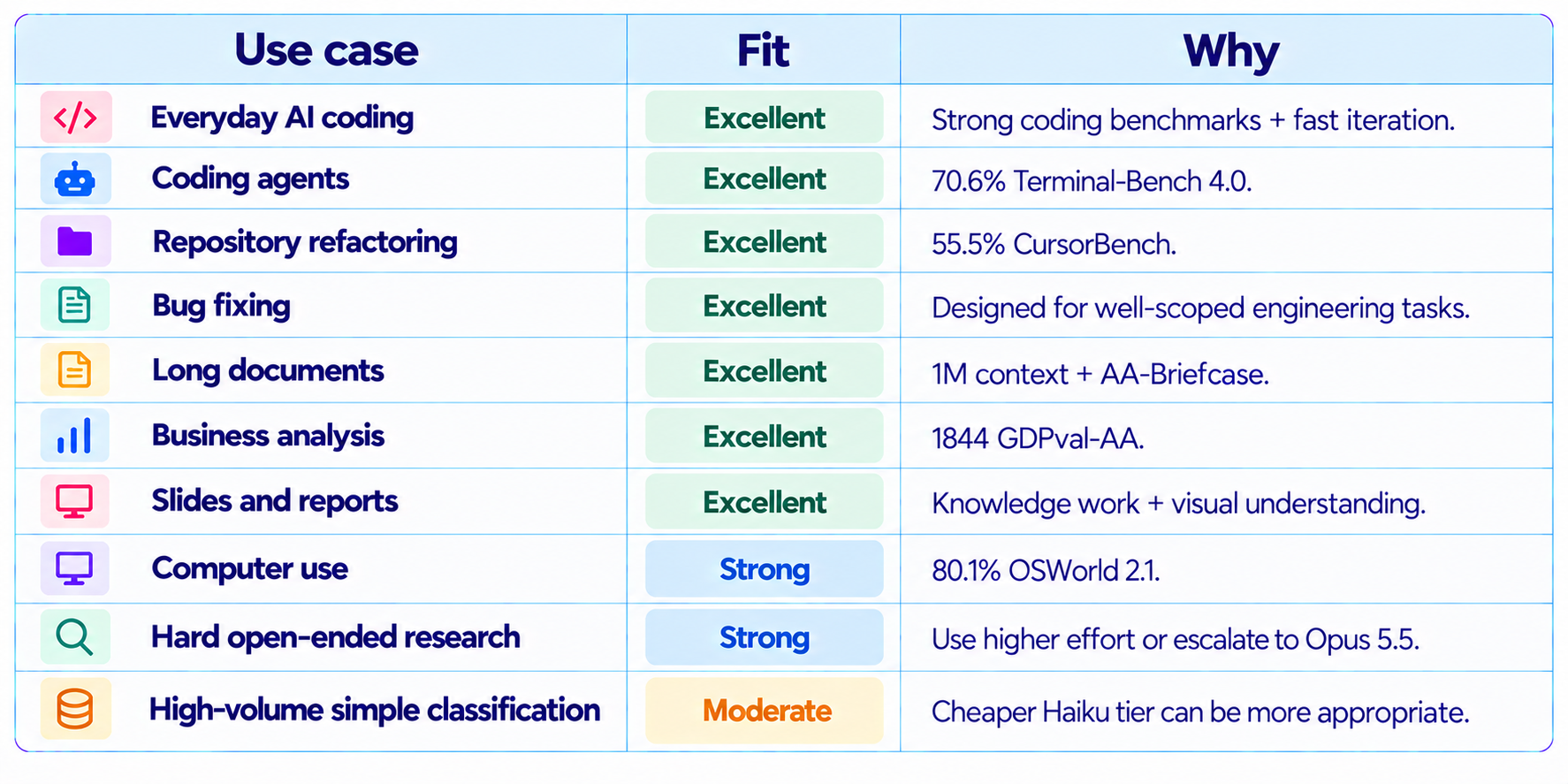
The published benchmark profile is broad. Sonnet 5.5 scores 70.6% on Terminal-Bench 4.0, 46.2% at Max effort on FrontierCode 1.1 Main, 55.5% on CursorBench 4.0, 1844 on GDPval-AA v2.1 and 1811 on AA-Briefcase v1.1. It also reaches 80.1% on OSWorld 2.1 and 64.5% on Humanity's Last Exam with tools.
The result is a Sonnet model aimed squarely at everyday professional AI work: coding, debugging, documents, slides, spreadsheets, computer use and long-horizon tasks. Opus 5.5 remains positioned above it for complex open-ended work requiring sustained judgment.
QUICK ANSWER
Claude Sonnet 5.5 is Anthropic's newest Sonnet model, released September 28, 2026. It keeps the Sonnet 5 API rate of $2 per million input tokens, $10 per million output tokens and $0.20 per million cache reads, while Anthropic reports more than 30% faster output and up to 30% lower cost per task than Sonnet 5.
For coding, Sonnet 5.5 scores 70.6% on Terminal-Bench 4.0, 46.2% on FrontierCode 1.1 Main at Max effort and 55.5% on CursorBench 4.0. Its knowledge-work results include 1844 on GDPval-AA v2.1 and 1811 on AA-Briefcase v1.1. It also reaches 80.1% on OSWorld 2.1 and 64.5% on Humanity's Last Exam with tools.
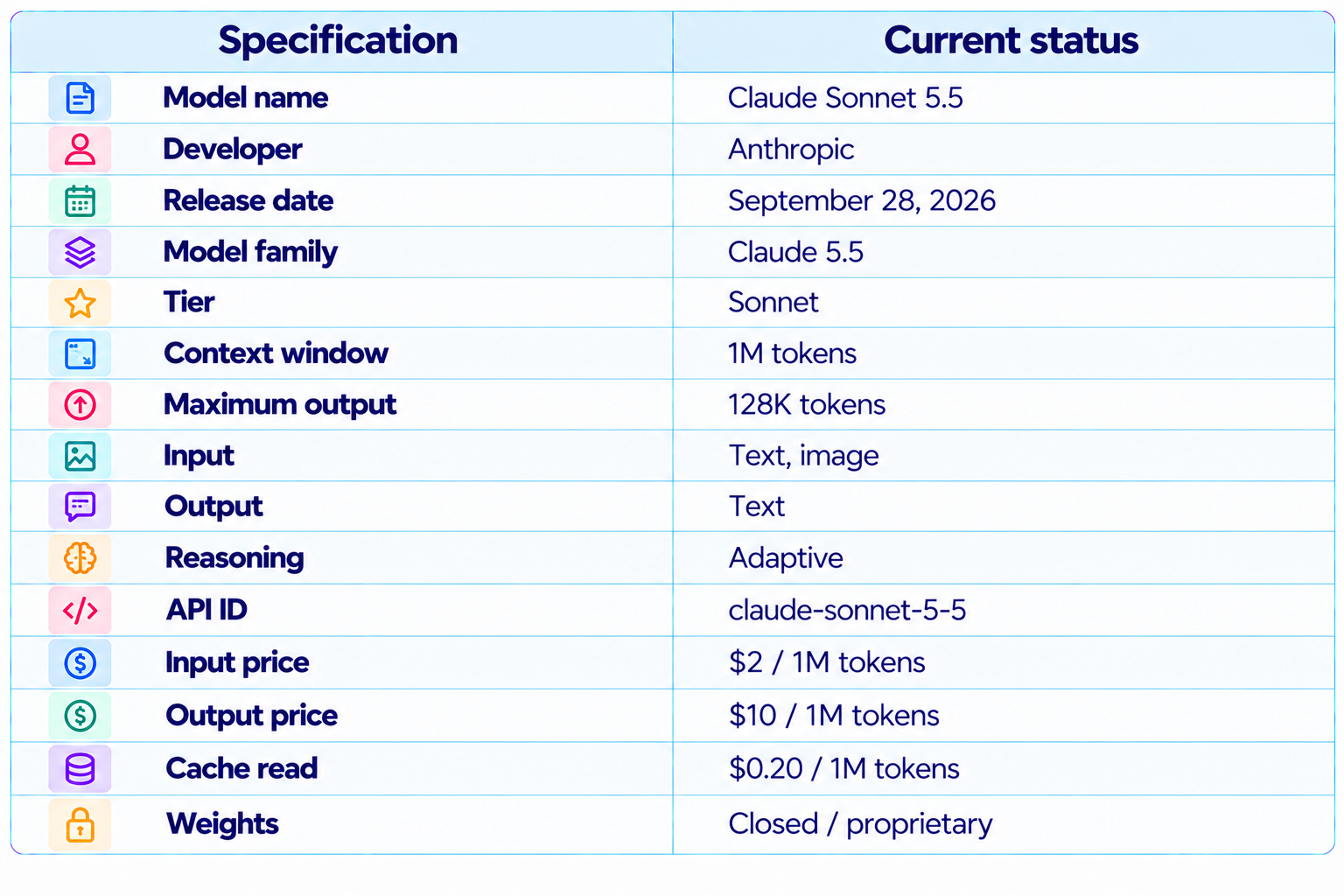
The model has a 1 million-token context window, accepts text and images, uses adaptive reasoning and supports up to 128K output tokens. It is available through Claude Code, the Claude Platform, Amazon Web Services, Google Cloud and Microsoft Azure.
My verdict: 9.2/10 overall. Sonnet 5.5 is a strong default for day-to-day coding agents, bug fixing, long-context knowledge work and professional document workflows. Opus 5.5 still makes more sense for the hardest open-ended tasks.
1. What Is Claude Sonnet 5.5?
Claude Sonnet 5.5 is Anthropic's latest Sonnet-tier model and the second model in the Claude 5.5 family after Claude Opus 5.5. Anthropic describes it as a faster, lower-cost complement to Opus 5.5, with particular strength in well-scoped everyday tasks, fixing bugs, creating polished documents, slides and spreadsheets, and rapid iteration.
The important change is efficiency as well as capability. Sonnet 5.5 is designed to complete comparable work with fewer tokens, so the real production improvement is measured across the whole agent loop: fewer tool calls, less output, lower latency and less cost per completed task.
Sonnet 5.5 is proprietary. It is served through Anthropic and cloud partners rather than distributed as an open-weight model.
2. Claude Sonnet 5.5 Specifications
The current model profile is built for large-context professional workflows. It supports multimodal input through text and images, adaptive reasoning and a 1M-token context window. The maximum output is 128K tokens.
The API model identifier is claude-sonnet-5-5, and the model is available on Claude Platform, Amazon Web Services, Google Cloud and Microsoft Azure. It is also available in Claude Code and Anthropic's consumer and team products.
3. Claude Sonnet 5.5 Benchmarks
The benchmark profile is where Sonnet 5.5 separates itself from Sonnet 5. Anthropic reports improvements across coding, knowledge work, computer use and visual chart understanding. The table below uses Anthropic's published results and preserves the reported effort and benchmark variants.
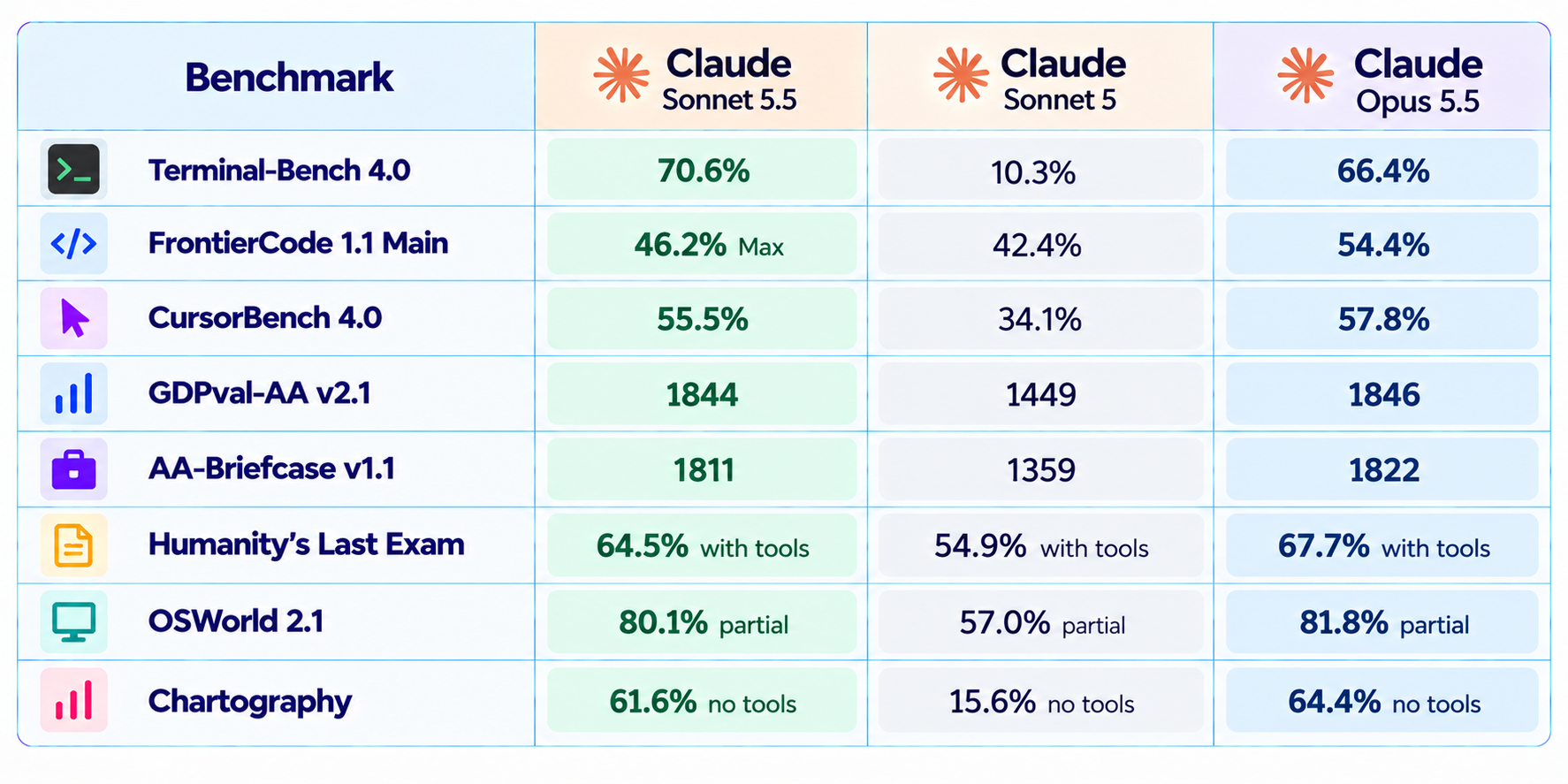
Two benchmark notes matter. Artificial Analysis ran GDPval-AA and AA-Briefcase on a pre-release Sonnet 5.5 deployment that Anthropic says had a structured-output bug. Anthropic says the bug has since been fixed and expects any impact to have understated Sonnet 5.5's results. Also, effort level changes both quality and cost, so benchmark figures should not be treated as one fixed capability number.
4. Terminal-Bench 4.0: The Biggest Coding Story
Sonnet 5.5 scores 70.6% on Terminal-Bench 4.0, compared with 10.3% for Sonnet 5 and 66.4% for Opus 5.5 in Anthropic's reported setup. Terminal-Bench evaluates complex, multi-step professional tasks inside a command-line interface, which makes it directly relevant to coding agents.
The result shows that Sonnet 5.5 is not simply a faster code generator. It is much better at navigating the environment around the code: inspecting files, executing commands, using tools, making changes and completing multi-step tasks.
Anthropic also reports that Sonnet 5.5 can batch tool calls more effectively than Sonnet 5 in early testing. That can reduce the number of steps in a coding-agent loop, which matters because agent cost is driven by the entire workflow rather than only the final response.
5. FrontierCode and Code Quality
FrontierCode 1.1 Main measures whether an agent's code changes could be merged without human edits. Sonnet 5.5 scores 46.2% at Max effort, compared with 42.4% for Sonnet 5 and 54.4% for Opus 5.5.
Anthropic notes that Sonnet 5.5 scores differently at Max and Xhigh effort. At Max effort, it sometimes invoked Claude Code's code-review skill, which can split work across subagents. In two cases described by Anthropic, that caused timeouts or extra edits outside the requested scope. This is a useful reminder that coding-agent benchmarks measure the model plus the harness, tools and configuration around it.
6. CursorBench 4.0
CursorBench 4.0 evaluates coding agents on ambiguous, multi-file tasks taken from real Cursor sessions. Sonnet 5.5 reaches 55.5%, compared with 34.1% for Sonnet 5 and 57.8% for Opus 5.5.
This matters because real software tasks are rarely isolated functions. An agent has to understand an existing repository, find the right files, preserve conventions, make coordinated changes and validate the result. Sonnet 5.5's near-Opus result on this benchmark supports its role as a practical day-to-day coding model.
7. Knowledge Work: GDPval and AA-Briefcase
Sonnet 5.5 scores 1844 on GDPval-AA v2.1, only two points behind Opus 5.5's 1846 and far above Sonnet 5's 1449. On AA-Briefcase v1.1, it scores 1811 versus 1822 for Opus 5.5 and 1359 for Sonnet 5.
GDPval-AA covers real-world tasks across 44 occupations and nine industries, while AA-Briefcase evaluates long-horizon knowledge work. The results show that Sonnet 5.5 is not a coding-only upgrade. It is also designed for analysis, research, structured business work and document-heavy tasks.
8. Computer Use and Visual Understanding
Sonnet 5.5 reaches 80.1% on OSWorld 2.1 in Anthropic's reported partial setup, compared with 57.0% for Sonnet 5 and 81.8% for Opus 5.5. On Chartography, it scores 61.6% without tools versus 15.6% for Sonnet 5.
These results matter for workflows that combine documents, screenshots, dashboards and desktop applications. Anthropic also says Sonnet 5.5 is the first Sonnet model to beat Pokémon Red using only screenshots, showing improved long-horizon visual interaction.
9. Claude Sonnet 5.5 Coding Performance
Coding is one of the strongest reasons to test Sonnet 5.5. Anthropic reports a major Terminal-Bench improvement, a meaningful FrontierCode gain and a CursorBench score close to Opus 5.5. Early testers also reported faster repository understanding and fewer tool steps.
For a production coding agent, the benefit is not just better generated code. The model needs to understand a repository, make a change, run tests, diagnose failures and iterate. Reducing the number of loops can improve both speed and cost.
10. Claude Sonnet 5.5 Pricing
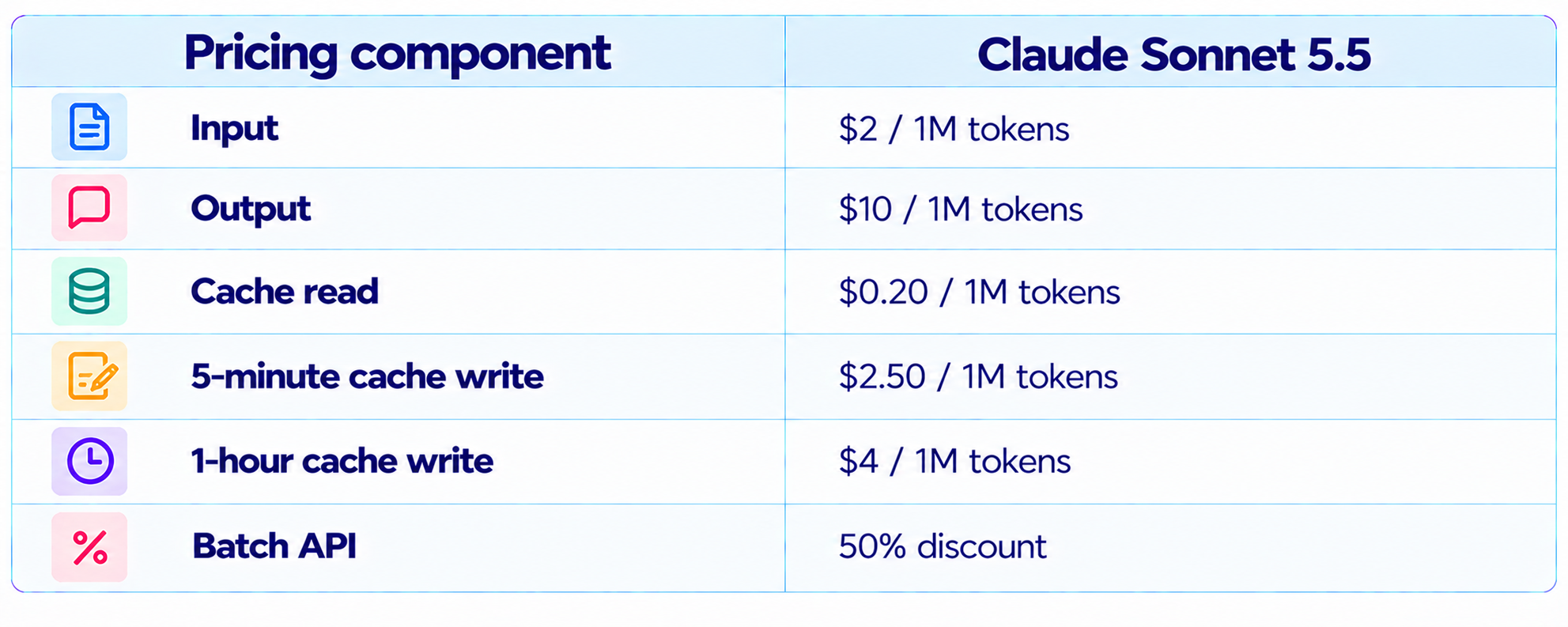
Sonnet 5.5 costs $2 per million input tokens, $10 per million output tokens and $0.20 per million cache reads. Five-minute cache writes are $2.50 per million tokens and one-hour cache writes are $4 per million. Anthropic also offers a Batch API at a 50% discount on input and output tokens.
The important pricing point is that the token rates are unchanged from Sonnet 5 while the model can use fewer tokens. Anthropic says Sonnet 5.5 costs up to 30% less per task in its testing. For coding agents, that per-task metric is more meaningful than the raw price per million tokens because one task can involve many tool calls and reasoning tokens.
11. Sonnet 5.5 vs Sonnet 5
The upgrade is unusually large because Sonnet 5.5 improves the benchmark profile without increasing the headline token price. Anthropic reports higher coding, knowledge-work, computer-use and chart-recognition results, plus more than 30% faster output.
For existing Sonnet 5 users, this makes migration straightforward: the model remains in the same pricing tier while improving both capability and efficiency.
12. Sonnet 5.5 vs Opus 5.5
Opus 5.5 remains the flagship model for complex open-ended work. Sonnet 5.5 is the lower-cost, faster complement. On Terminal-Bench 4.0, Sonnet 5.5 actually scores above Opus 5.5 in Anthropic's published setup, but Opus leads on FrontierCode, CursorBench, OSWorld and the harder open-ended workloads Anthropic describes.
The token economics are simple: Sonnet 5.5 is $2/$10 while Opus 5.5 is $4/$20. That makes Sonnet particularly attractive as a default worker model with escalation to Opus for difficult cases.
13. Sonnet 5.5 vs GPT-6 Sol
Anthropic's comparison table includes GPT-6 Sol where public results are available. On FrontierCode 1.1 Main, Sonnet 5.5 reaches 52.1% at Xhigh in Anthropic's cost-performance chart, matching GPT-6 Sol's reported Xhigh score. Sonnet 5.5 also scores 1844 on GDPval-AA v2.1 and 1811 on AA-Briefcase v1.1, versus 1487 and 1483 respectively for the GPT-6 Sol figures shown by Anthropic.
These comparisons should be read with the published benchmark settings. The useful conclusion is that Sonnet 5.5 is highly competitive on professional-work evaluations while retaining the lower Sonnet token price.
14. Context Window and Reasoning
Sonnet 5.5 has a 1M-token context window and adaptive reasoning. Anthropic says Claude Code and the Claude apps default to Medium effort, while the Claude Platform defaults to High. Lower settings reduce latency and token use; higher settings allow longer reasoning and additional checking.
That makes effort selection part of the model's economics. A routine code fix does not need the same reasoning budget as a difficult repository migration, and Sonnet 5.5 is designed to let teams make that tradeoff.
15. Claude Sonnet 5.5 for Claude Code
Sonnet 5.5 is available in Claude Code, so its coding improvements are directly relevant to terminal-based development. Anthropic says early users saw better codebase understanding, fewer steps and more batched tool calls.
A typical workflow can therefore move from repository inspection to implementation, testing, debugging and final verification with fewer model interactions. For developers, this is one of the clearest practical improvements over Sonnet 5.
16. Sonnet 5.5 for Documents, Slides and Spreadsheets
Anthropic explicitly targets polished documents, slides and spreadsheets. Its GDPval and AA-Briefcase results support the model's positioning as a professional knowledge-work system rather than a coding-only model.
Its improved visual understanding is also useful for presentations and reports. A workflow can provide source documents, charts and a slide template, then ask the model to produce a structured first draft while preserving evidence and visual requirements.
17. Sonnet 5.5 for Computer Use
The OSWorld result shows a large improvement over Sonnet 5 and a small gap to Opus 5.5 in Anthropic's reported setup. Computer-use capability matters when an application cannot be controlled cleanly through an API and the model must reason over screenshots and visual state.
Production computer-use systems still need permissions, confirmations and validation around consequential actions. A benchmark score does not remove the need for guardrails.
18. Safety and Cybersecurity
Anthropic says Sonnet 5.5 improves or matches Sonnet 5 on most measures in its automated behavioral audit of roughly 1,850 scenarios. Because its cybersecurity capabilities are comparable to Opus 5, Anthropic is deploying it with cyber safeguards and fallbacks similar to those used for more capable models.
Routine software development remains supported. Higher-risk cybersecurity tasks can receive additional safeguards or fallbacks. Anthropic also describes biology safeguards aligned with Sonnet 5 and additional measures intended to reduce industrial-scale model distillation.
19. Limitations You Should Know
- Sonnet 5.5 is not Anthropic’s highest-capability model; Opus 5.5 remains the flagship for difficult open-ended work.
- Benchmark scores depend on effort level, harness configuration and evaluation methodology.
- Artificial Analysis ran some pre-release knowledge-work evaluations on a deployment that Anthropic says had a structured-output bug; Anthropic says it was fixed.
- High-effort agentic tasks can still consume substantial reasoning and output tokens.
- Sonnet 5.5 is proprietary and not available as an open-weight local model.
- Computer-use benchmarks do not guarantee reliable success on every real application.
- Cybersecurity safeguards can restrict higher-risk tasks even though routine software development remains supported.
20. Best Use Cases for Claude Sonnet 5.5
21. Recommended Production Workflow
The strongest deployment pattern is to use Sonnet 5.5 as the default worker model and route only the hardest tasks to Opus 5.5.
- Use Medium effort for routine coding, drafting and document tasks.
- Use High effort for complex implementation and research.
- Use Max for difficult tasks where additional reasoning is justified.
- Use structured outputs and tools when responses feed downstream systems.
- Cache stable instructions, repository context and repeated documents.
- Escalate highly ambiguous or open-ended tasks to Opus 5.5.
- Measure cost per completed task, retries and latency rather than only token price.
- Keep tests, human approval and rollback around consequential agent actions.
For model routing, see Model Routing for AI Coding Agents.
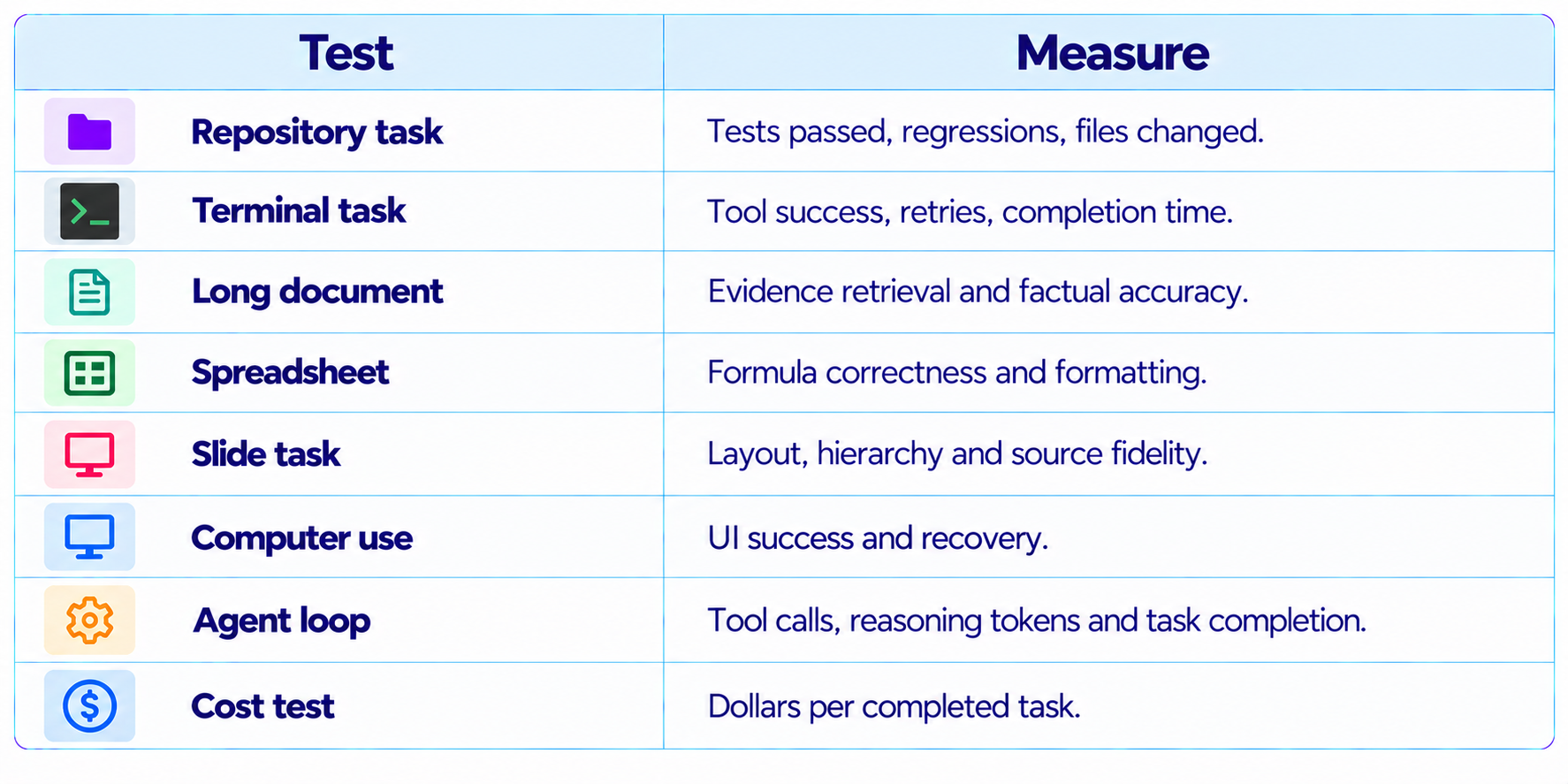
22. How to Evaluate Claude Sonnet 5.5 Yourself
Public benchmarks are useful, but a production evaluation should use your own tasks. Run the same prompts against Sonnet 5, Sonnet 5.5 and Opus 5.5 with matched effort settings.
23. Is Claude Sonnet 5.5 Worth It?
For the workloads targeted by the Sonnet tier, Sonnet 5.5 is a significant upgrade. It keeps the $2/$10 token pricing of Sonnet 5, generates output more than 30% faster and can cost up to 30% less per task according to Anthropic.
The coding evidence is especially strong. Terminal-Bench 4.0 reaches 70.6%, CursorBench reaches 55.5%, and FrontierCode reaches 46.2% at Max effort. Knowledge-work scores are also close to Opus 5.5 on GDPval-AA and AA-Briefcase.
The main reason to choose Opus 5.5 instead is task complexity. Anthropic explicitly says Opus remains stronger for complex, open-ended work requiring sustained judgment. For routine coding, debugging, business analysis and fast iteration, Sonnet 5.5 offers a much lower-cost path.
24. Final Verdict
Claude Sonnet 5.5 is one of Anthropic’s most practical model upgrades of 2026 because the improvement appears in both capability and efficiency. It is not simply a better benchmark model. It is designed to finish everyday agent tasks in fewer steps and with less waiting.
The published results support that positioning. Sonnet 5.5 scores 70.6% on Terminal-Bench 4.0, 55.5% on CursorBench 4.0, 1844 on GDPval-AA v2.1, 1811 on AA-Briefcase and 80.1% on OSWorld 2.1.
The economics are equally important. At $2 per million input tokens and $10 per million output tokens, Sonnet 5.5 costs half as much per token as Opus 5.5. Anthropic says its lower token usage can reduce comparable task costs by up to 30% versus Sonnet 5.
My rating: 9.5/10 for coding, 9.3/10 for agentic workflows, 9.2/10 for price-to-performance, 9.1/10 for knowledge work and 9.2/10 overall.
Bottom line: Claude Sonnet 5.5 is a strong default model for coding agents, bug fixing, long-context knowledge work, documents and fast professional workflows. Opus 5.5 still has the higher ceiling for difficult open-ended tasks, but Sonnet 5.5 narrows the gap while costing much less.
Frequently Asked Questions
What is Claude Sonnet 5.5?
Claude Sonnet 5.5 is Anthropic’s September 2026 Sonnet model for coding, bug fixing, knowledge work, computer use and professional workflows.
When was Claude Sonnet 5.5 released?
Anthropic released Claude Sonnet 5.5 on September 28, 2026.
What is the Claude Sonnet 5.5 API model ID?
The API model identifier is claude-sonnet-5-5.
How much does Claude Sonnet 5.5 cost?
The current API rate is $2 per million input tokens and $10 per million output tokens, with $0.20 per million cached input tokens.
What is the context window?
Sonnet 5.5 supports a 1 million-token context window.
How good is Sonnet 5.5 for coding?
It is highly capable for coding agents, with 70.6% on Terminal-Bench 4.0, 46.2% on FrontierCode 1.1 Main at Max effort and 55.5% on CursorBench 4.0.
Is Sonnet 5.5 better than Sonnet 5?
Yes. Anthropic reports major benchmark gains, more than 30% faster output and up to 30% lower cost per task.
Is Sonnet 5.5 better than Opus 5.5?
Not universally. Sonnet 5.5 is cheaper and close on several well-scoped benchmarks, while Opus 5.5 remains stronger for complex open-ended work.
Does Sonnet 5.5 work with Claude Code?
Yes. Sonnet 5.5 is available in Claude Code.
Does Sonnet 5.5 support images?
Yes. It accepts text and image input.
Is Sonnet 5.5 open source?
No. It is a proprietary Anthropic model.
Is Claude Sonnet 5.5 worth it?
Yes for coding agents, bug fixing, long-context work, documents and professional tasks where speed, quality and cost all matter.
Recommended Blogs
Claude Sonnet 5 Review: Benchmarks, Pricing & Is It Worth It? (2026)
Claude Fable 5.1 Review: Benchmarks, Price, Coding & Is It Worth It? (2026)
Gemini 3.8 Flash Review: Accuracy, Price & Is It Worth It? (2026)
Qwen 3.8 Max 0902 Review: Benchmarks, Price & Is It Worth It? (2026)
Meta Muse Spark 1.3 Review: Coding, Price & Is It Worth It? (2026)
Mercury 2.5 AI Model Review: Speed, Price & Is It Worth It? (2026)
How to Secure AI Coding Agents: Permissions, Sandboxing, MCP & Secrets
Resources & Community
Join our community of 70,000+ AI enthusiasts and learn to build powerful AI applications. Whether you are a beginner or an experienced developer, Build Fast with AI helps you understand and implement AI in your projects.
Agentic AI Launchpad 2026
A structured 6-week cohort program that takes you from AI basics to building and deploying real-world agentic AI systems. Includes live sessions, expert mentorship, project reviews and a builder community network.
Ready to go from learning to building? Join the next cohort: Agentic AI Launchpad 2026
Free AI Resources
Access free tools, workshops and micro-learning to keep building.

