Gemini 4 Carbon Review and Frontier Model Comparison
Gemini 4 Carbon beats Claude Opus 5.5 and GPT-6 Astra on the terminal-agent and automation benchmarks in Google's published comparison. It also loses to both on FrontierSWE 2, and Opus leads its offline computer-use result. Those differences are the starting point for deciding whether Google's new model belongs in your workflow.
This Gemini 4 Carbon review examines the release, API pricing, benchmark comparisons, multimodal capabilities, cybersecurity access, and practical evaluation criteria. It analyzes published evidence rather than claiming an independent hands-on test. Official sources are collected in References, and the review is updated through November 10, 2026.
Quick Answer
Gemini 4 Carbon is worth shortlisting for demanding terminal work, complex debugging, and document-heavy agents. Keep Argon for everyday engineering, Astra in contention for repository problem-solving, and Opus for computer use. Public API pricing starts at $2 input and $10 output per million tokens, rising to $4 and $20 after the introductory period expires November 30, 2026.
1. What Gemini 4 Carbon Is and Who Should Consider It
Gemini 4 Carbon is Google's frontier reasoning model for demanding agentic workflows, with broader availability beginning November 10 after its October 28 announcement. It is aimed at work where the model must investigate, use tools, check intermediate results, and continue through several stages before delivering something useful.
Consider a bug that appears only after a dependency upgrade. A quick assistant might suggest changing a package version. A more capable engineering agent should inspect the dependency tree, reproduce the failure, identify the incompatible behavior, implement a focused change, and verify that neighboring functionality still works. Carbon's value proposition belongs in that second category.
For orientation within Google's wider lineup, our Google Gemini and Google AI collection brings together model reviews and practical guides. That background helps separate a frontier reasoning model from Google's faster assistants and media-generation products.
The reader's choice is between different strengths. The following shortlist is our interpretation of the evidence discussed below, rather than a claim that any model always wins its suggested workload.
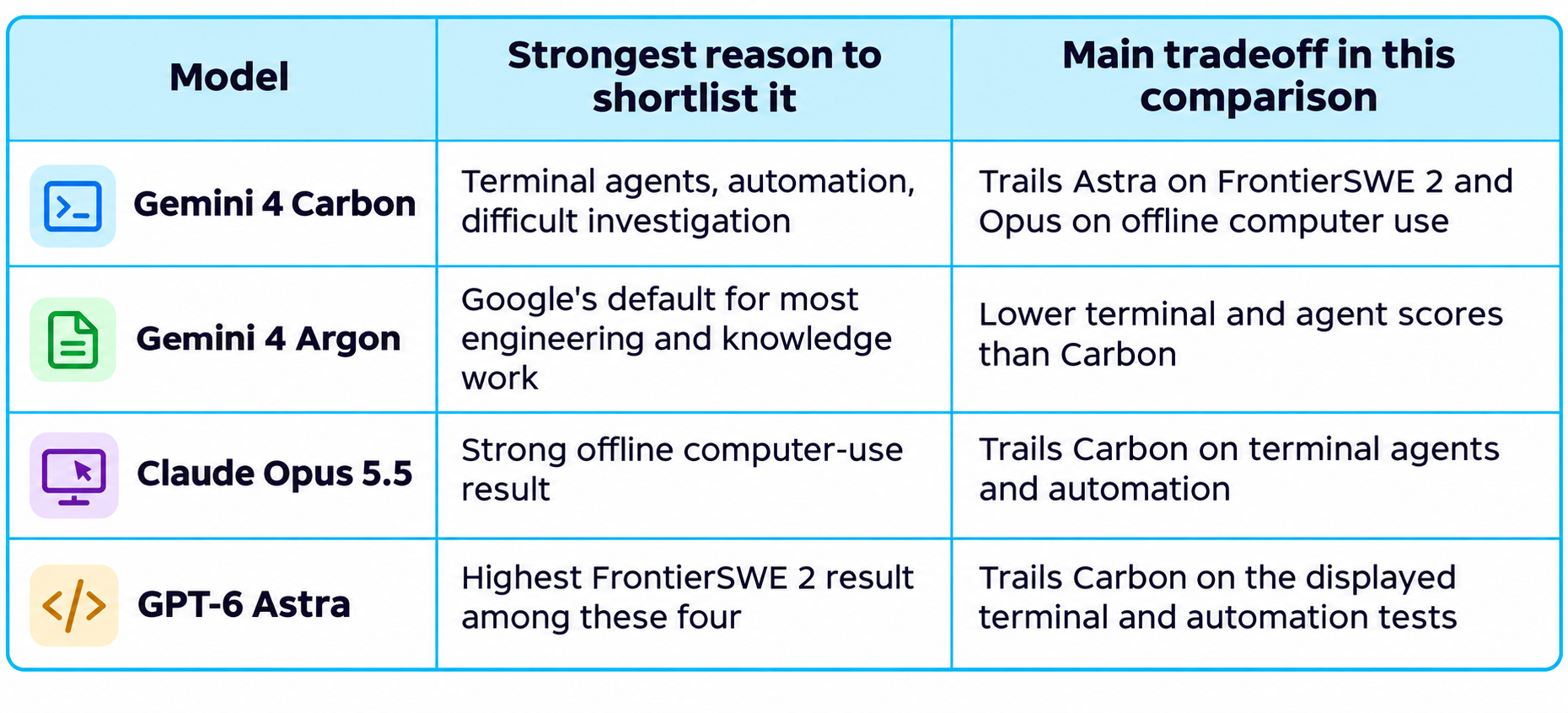
The model card describes Carbon as sharing Argon's pre-training foundation and sparse Mixture-of-Experts architecture, with further post-training for deeper reasoning and verification. It does not establish a public parameter count. Architecture labels alone will tell you less than successful task completion, tool reliability, and the cost of achieving an accepted result.
Carbon is most relevant to teams with difficult engineering problems or dense evidence to analyze. For short descriptions and routine extraction, speed and cost may matter more than reasoning depth.
2. Gemini 4 Carbon Availability and How to Get Access
Gemini 4 Carbon is available through paid developer and enterprise channels, while consumer access is rolling out to Google AI Ultra subscribers. Describing it as restricted to pre-release partners is now outdated, although the specialized cybersecurity offering still has a separate access process.
Google's November 10 announcement names the Gemini API paid tier in Google AI Studio, Gemini for business, and Android Studio among the developer and enterprise paths. It also identifies Google Antigravity, the Gemini app, and AI Mode in Search for Ultra subscribers. A rollout announcement establishes eligibility; check whether the model is visible in your actual account before making it a dependency.
Subscription access and API billing serve different workflows. Confirm the entitlement for the surface you intend to use rather than assuming a consumer subscription includes an unrestricted API allowance.
For developers, check the current model catalog, confirm billing, and inspect usage on a small request. Keep model selection in configuration so switching between Carbon and your baseline does not require rewriting the application.
Rate limits also belong in the launch checklist. Google's API documentation says limits depend on model and usage tier and apply per project. Separate API keys do not automatically provide separate capacity. Run a small concurrency test before promising a customer that several long agent jobs can execute together.
Readers planning a migration from Google's previous frontier model should start with our Gemini 4 Argon review. It provides the earlier model's context for deciding which jobs need escalation and which can remain on an established baseline.
3. Gemini 4 Carbon Benchmarks and Their Limits
Gemini 4 Carbon improves on Argon across several published evaluations, but the comparison does not show a universal winner. Google's October benchmark snapshot places Carbon ahead on some agent tasks while Claude Opus 5.5 and GPT-6 Astra retain advantages on other measurements.
The table below uses Google's published comparison and keeps the benchmark versions visible. These are source-reported results, not scores produced by Build Fast with AI.
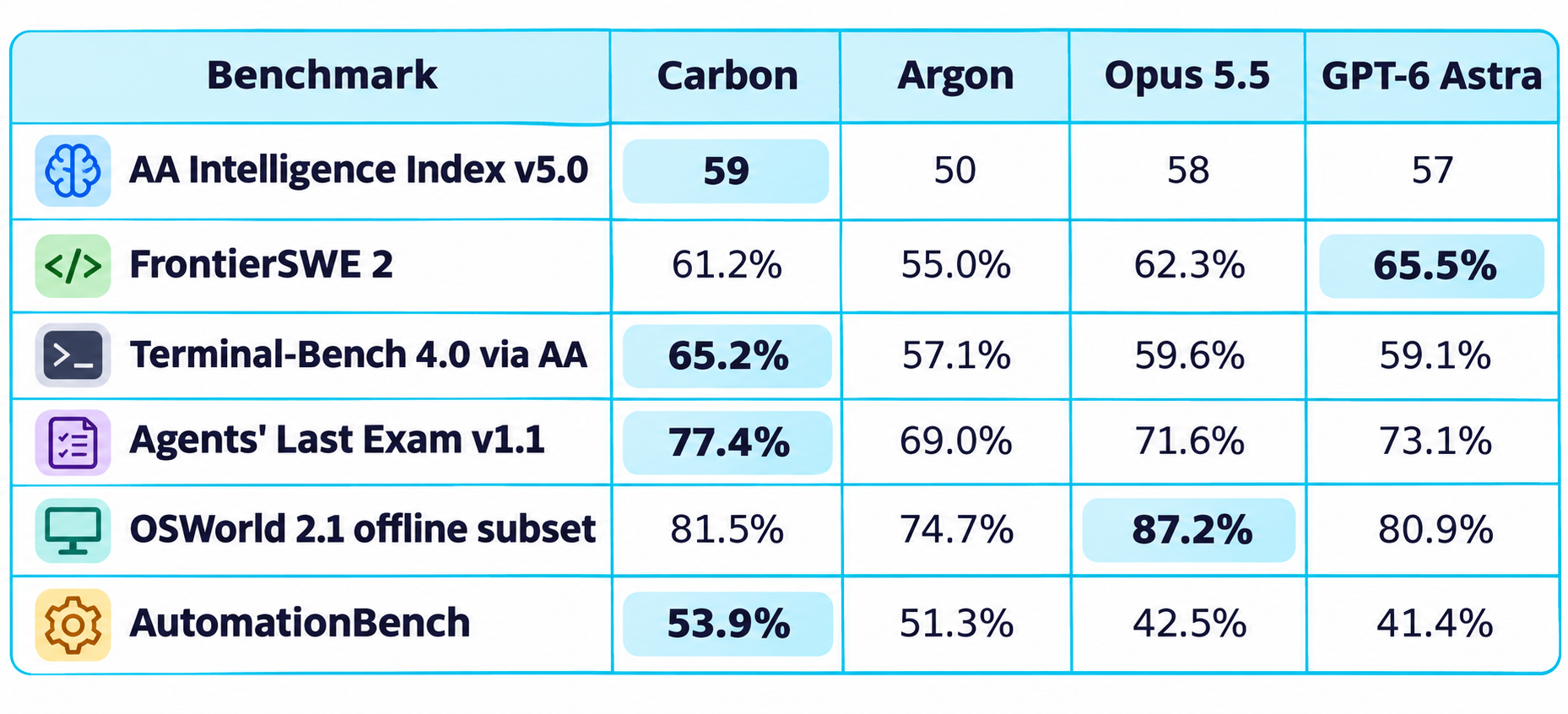
Bold marks the highest displayed value, not a statistically established winner. Higher is better within each row; scores across different rows measure different things.
The pattern supports a specific conclusion: Carbon is a serious candidate for agent execution and complex engineering. It does not support saying that every coding team should replace its current model. In the same comparison, GPT-6 Astra reaches 65.5% on FrontierSWE 2, above Carbon's 61.2%. Opus also leads the displayed offline computer-use result.
Methodology changes how these figures should be read. Google's evaluation document generally uses single-attempt settings and high thinking levels, while drawing competitor results from several published sources. The OSWorld result is an 82-task offline subset, with Gemini scores selected as the maximum over three runs. It should not be casually described as an unrestricted, single-run desktop automation score.
Small differences also deserve restraint. A score of 59 versus 58 on an aggregate index does not mean a model is one percentage point more accurate at your job. An index combines tasks and weighting choices. Without uncertainty estimates and workload-specific evidence, treating a narrow aggregate lead as a decisive purchasing advantage would be premature.
Our best AI models in October 2026 ranking provides a broader selection framework across capability and budget. Read it as a dated market comparison alongside Carbon's newer launch evidence, rather than assuming an earlier recommendation already incorporates today's release.
Use these results to choose the next comparison. Repository work needs correct patches, desktop work needs successful application interactions, and analysis needs traceable conclusions.
4. Gemini 4 Carbon vs Gemini 4 Argon
Carbon leads the displayed agent benchmarks; Argon remains Google's recommendation for most everyday engineering. Differences below are percentage points, abbreviated pp, and use the published snapshot rather than a new independent test.
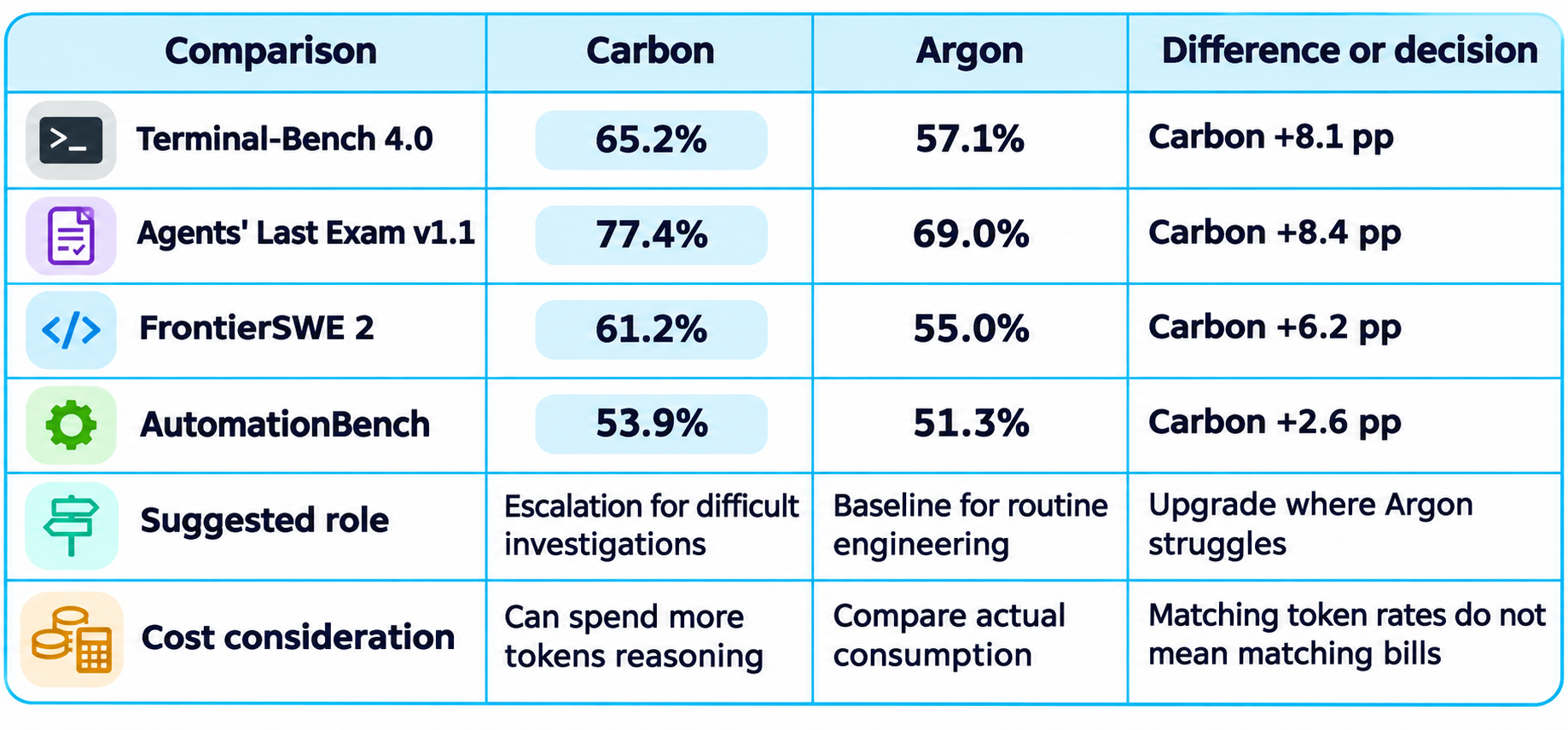
My pick: Keep Argon for work it already completes reliably; test Carbon on unresolved debugging and complex migrations.
5. Gemini 4 Carbon vs Claude Opus 5.5
Carbon leads the displayed terminal and automation tests, while Opus leads repository engineering and offline computer use. Choose the workflow before choosing the model.
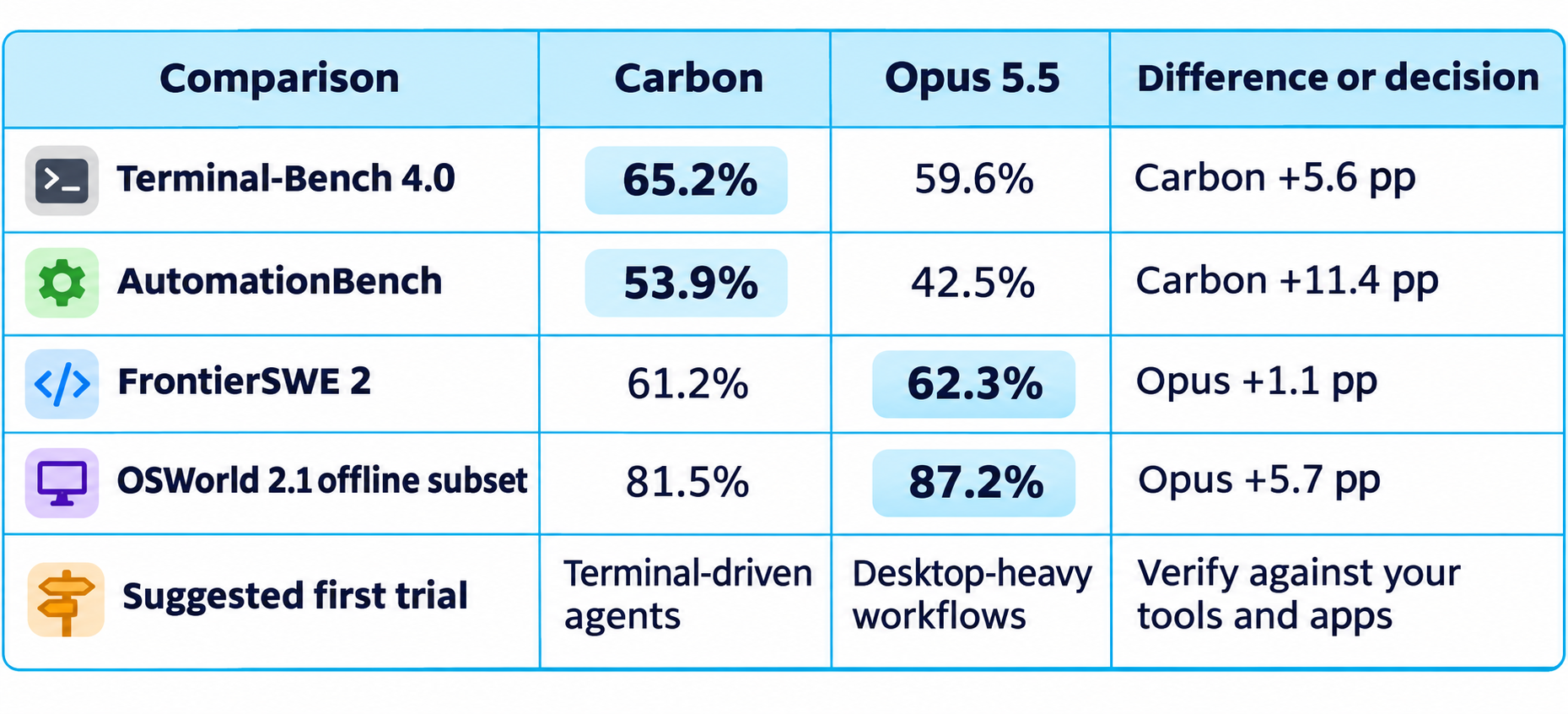
My pick: Try Carbon first for terminal-heavy execution and keep Opus in contention for desktop automation. The offline subset does not establish performance across every application.
6. Gemini 4 Carbon vs GPT-6 Astra
Astra has the stronger displayed FrontierSWE 2 result; Carbon leads the terminal and automation measurements. Neither result settles the best model for every codebase.
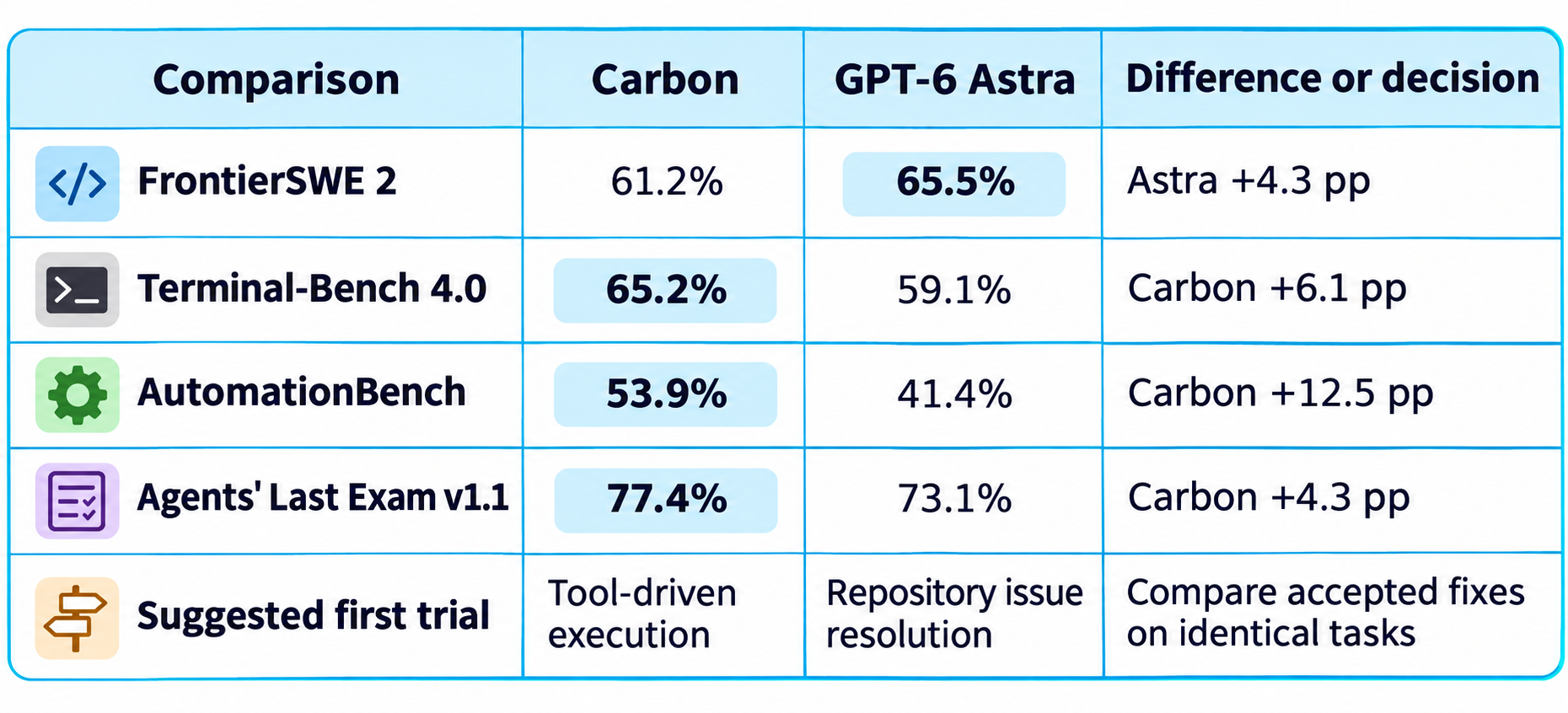
My pick: Test Astra alongside Carbon on difficult repository bugs. Compare accepted patches, reviewer corrections, and total task cost before switching.
The surrounding tools matter too. Our comparison of Claude Code, Codex, Cursor, and OpenCode explains how the coding environment affects what a model can accomplish.
7. Gemini 4 Carbon Pricing and Cost per Completed Task
Gemini 4 Carbon launches at $2 per million input tokens and $10 per million output tokens for the public model. Google's November 10 announcement says the introductory period expires on November 30, 2026, after which the rates become $4 and $20 respectively.
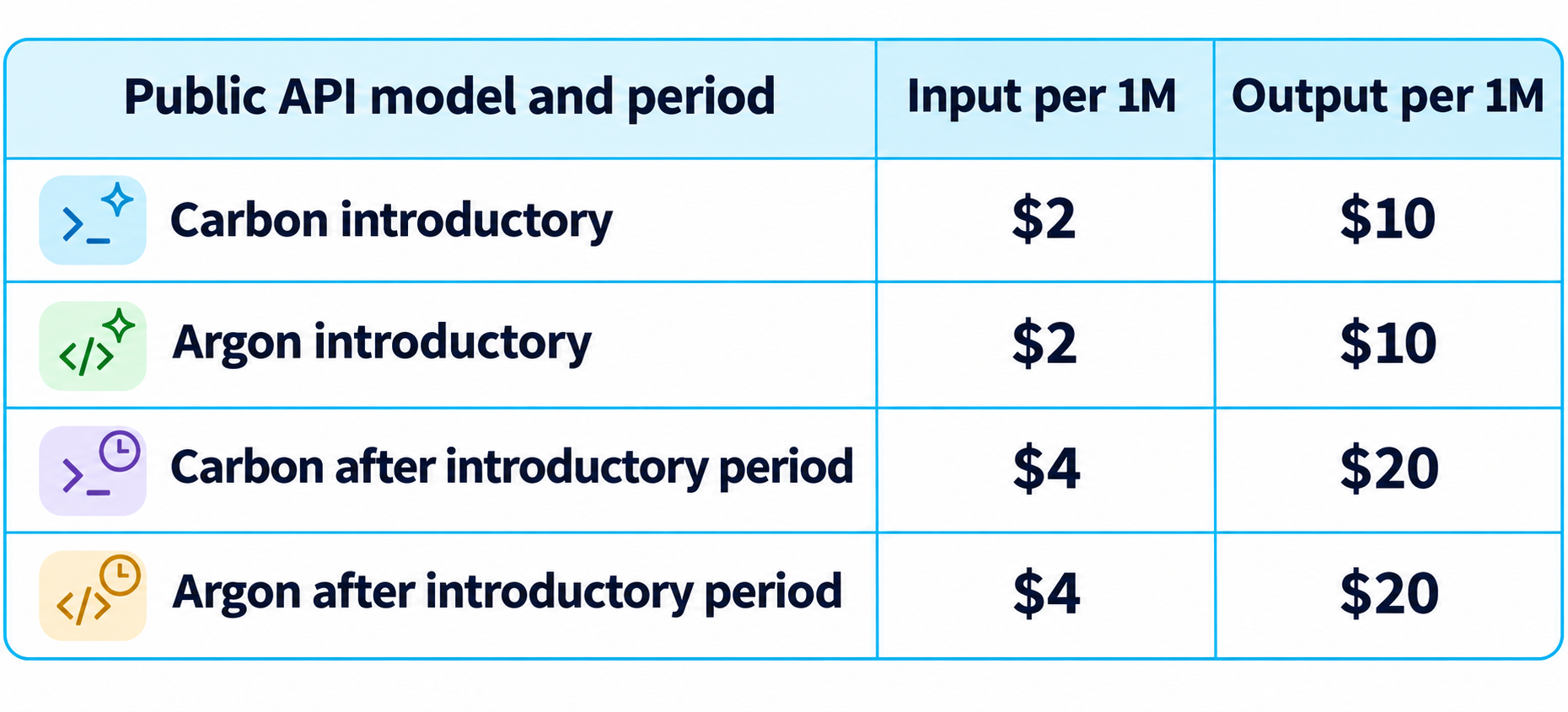
Google gives both introductory periods the same November 30 expiry. Carbon and Argon therefore have matching headline token rates, but Carbon can use more tokens to investigate a task. Choose between them on total accepted-task cost, not an assumed difference in price per token.
For a simple arithmetic example, suppose a job uses 200,000 input tokens and 20,000 billed output tokens, with no cache discount or other charges. At introductory rates, input costs $0.40 and output costs $0.20, totaling $0.60. At the announced later rates, the same quantities total $1.20. These are hypothetical calculations, not measured Carbon bills.
Our guide to model routing for AI coding agents develops the practical alternative to sending every task to the largest model. Route bounded work to a cheaper worker, and escalate when the evidence shows that deeper reasoning is necessary.
8. Multimodal Understanding and Knowledge Work
Gemini 4 Carbon accepts text, image, audio, and video inputs and returns text, according to its model card. Its context budget is up to one million tokens combined across input and output. This is a multimodal reasoning capability, not a promise of native image or video generation.
The combined-budget wording matters. A large upload leaves less space for other context and generated material. Do not interpret a one-million-token context as permission to send one million input tokens and independently request another million output tokens. Check the current API's specific input, output, media, and request limits before designing around a maximum.
For document-heavy work, the published comparison gives Carbon a more distinctive argument than context size alone. It leads the displayed chart, blueprint, and long-context measurements across these four models.
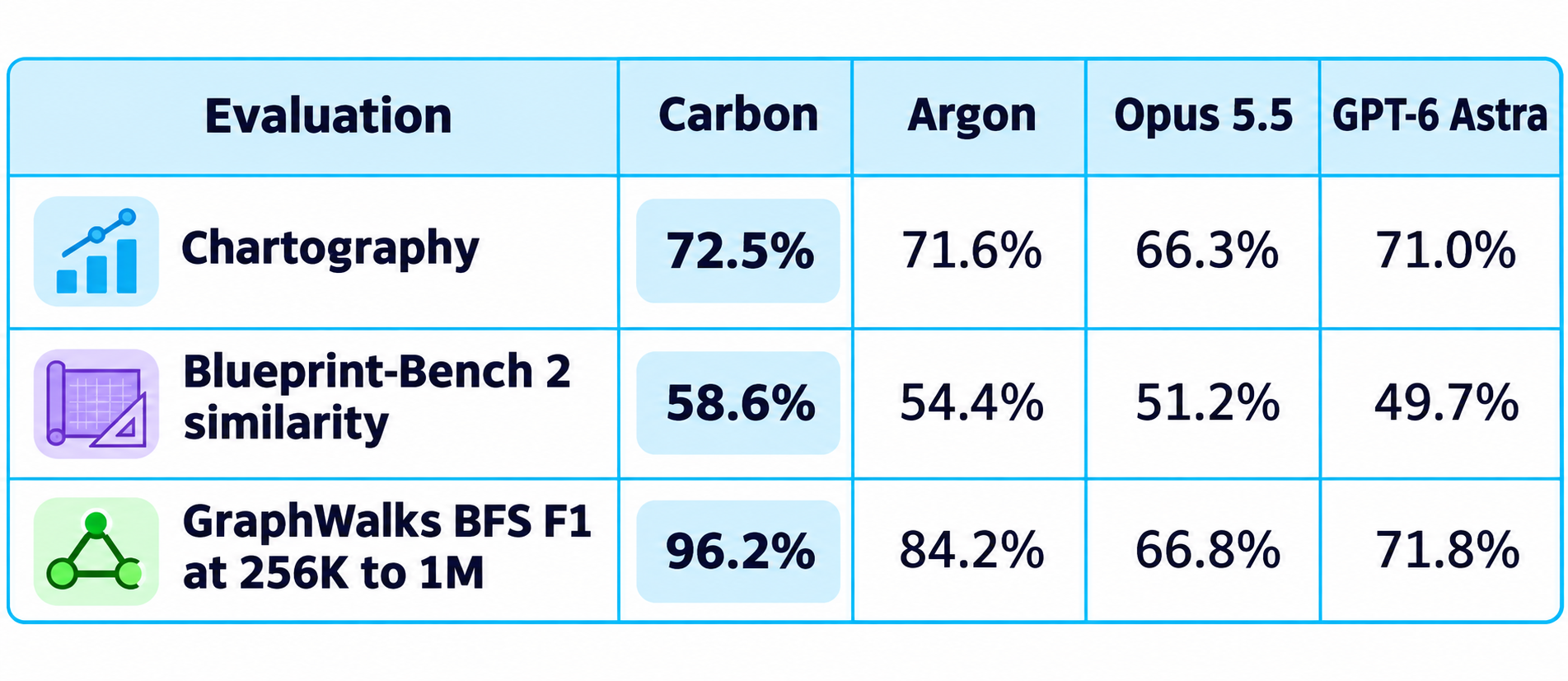
These results support testing Carbon on visual evidence and relationships spread across large inputs. The chart lead over Argon is only 0.9 percentage points, while the GraphWalks gap is 12 points. That pattern suggests a stronger reason to upgrade for difficult long-context reasoning than for a simple chart summary. GraphWalks measures a specific graph task, so it cannot establish the same gain on contracts or financial reports.
For routine extraction and short classification jobs, our Gemini 3.8 Flash review offers another model to evaluate. The useful question is whether Carbon resolves ambiguity that a faster worker cannot handle reliably. If both produce equally acceptable outputs, the lower-cost workflow may be the better operational choice.
9. Cybersecurity Results and Reliability Boundaries
Carbon's cybersecurity results are promising, but the specialized Fairwind access path must stay visible when discussing them. The model card explicitly says the displayed cyber benchmark results reflect access through the Fairwind Program, rather than promising identical behavior through every public endpoint.
The published comparison covers discovery, validation, and remediation. The October announcement describes these cyber evaluations as running without guardrails. Missing results below mean unreported in this comparison, not zero performance.
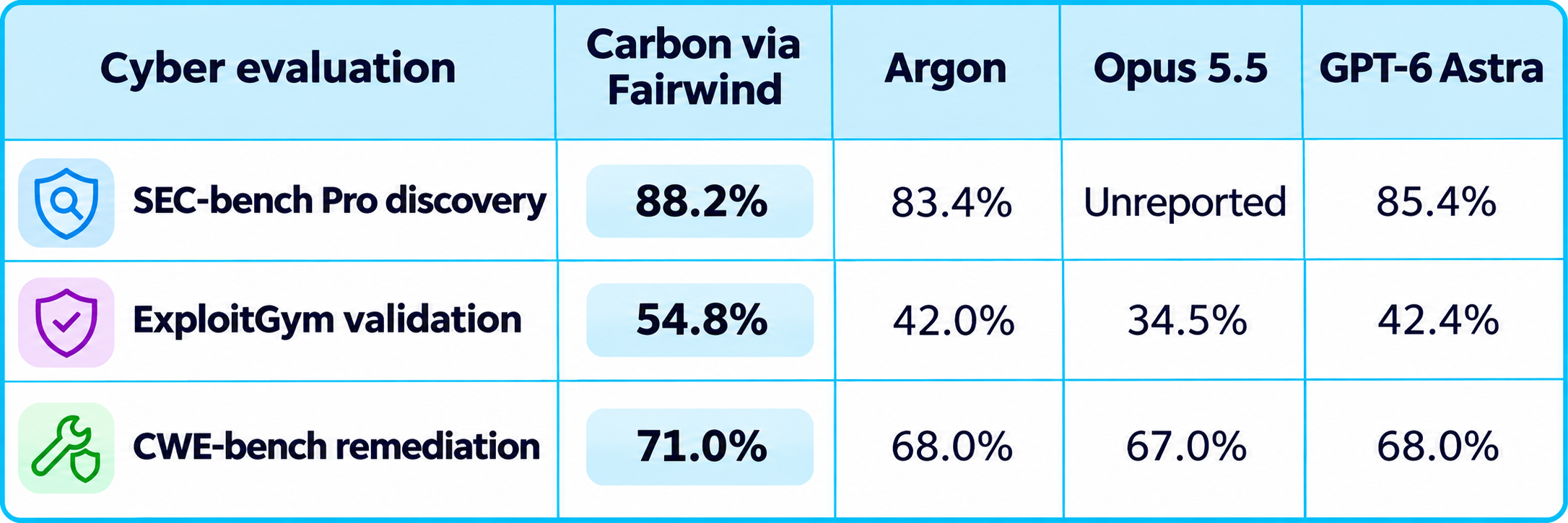
Carbon leads each displayed row, but its margin varies. Against Argon, the exploitation gap is 12.8 percentage points, while the remediation gap is three points. For a defender prioritizing validation of suspected vulnerabilities, that is a stronger testing signal than the patching margin alone. Access conditions and evaluation settings remain part of the comparison.
A defensive pilot should make the result independently checkable. Give the agent an authorized codebase, a clearly bounded review scope, and an isolated reproduction environment. Require a proposed finding to include the affected code path, the assumptions needed to trigger it, and a remediation explanation. A reviewer should be able to reject a weak finding without reconstructing the entire investigation.
Check patches against both the security issue and intended functionality. Disabling a feature may suppress a vulnerability while breaking the application.
Reliability also includes resistance to malicious instructions in retrieved material. Google's safety report records a zero attack-success result on the evaluated Gray Swan indirect prompt-injection benchmark, while explicitly acknowledging that prompt-injection attacks remain possible. A finite evaluation result should never be rewritten as immunity.
Keep repository comments, webpages, and uploaded files separate from authorized user instructions in your agent design. Limit tool permissions to the task, and review sensitive actions before execution. These controls remain useful even when the underlying model performs well on safety evaluations.
For a detailed alternative in the same frontier category, our Claude Opus 5.5 review helps frame the comparison around engineering and agent requirements. Evaluate competing systems against the same acceptance criteria rather than combining unrelated vendor claims into a single winner score.
10. Is Gemini 4 Carbon Worth It
Gemini 4 Carbon is worth piloting when difficult reasoning, verification, or long-running investigation is holding back useful work. The current evidence supports putting it on a frontier-model shortlist. It does not justify replacing a reliable default across every workflow on launch day.
Here is how I would turn the evidence into a shortlist. These are editorial recommendations for a first comparison, not measured production outcomes.
Your workload
First model to evaluate
Why and what to verify
Difficult terminal-driven agent job
Carbon
Strong displayed terminal result; check completion and spend
Everyday Google-based engineering
Argon
Google's default recommendation; compare whether Carbon improves the patch
Repository issue resolution
GPT-6 Astra alongside Carbon
Astra leads FrontierSWE 2; compare accepted fixes
Desktop application automation
Opus 5.5 alongside Carbon
Opus leads the offline subset; test your actual apps
Dense visual and long-context analysis
Carbon
Leads the displayed specialist tests; verify every source claim
Specialized defensive cyber work
Carbon through Fairwind
Leads displayed cyber tests; confirm eligibility and reproduction
Start with completed work that includes both routine and difficult cases. Keep tools, versions, and acceptance rules consistent across models. Record manual intervention so assisted success does not appear identical to autonomous completion.
Score the deliverable before reading the model's explanation. Does the patch solve the issue? Are conclusions supported? Can the recipient use the artifact? Fluent narration should not compensate for a broken result.
Our guide to building an AI agent that actually completes tasks turns that evaluation into an implementation approach. It is especially relevant when choosing how the agent should remember progress, recover from errors, and recognize completion.
Keep Carbon on tasks where it produces a material improvement, then measure again after the introductory price ends. Track typical latency as well as unusually slow jobs. The model card acknowledges occasional slowness and timeouts, so an interactive product needs a useful waiting state and a recoverable failure path.
The practical verdict is selective adoption. Test Carbon on your hardest bounded engineering or research problem, compare the accepted result against your current system, and expand only when the improvement survives review. A successful pilot should leave you with evidence about quality, time, and cost, rather than enthusiasm based only on a launch chart.
Frequently Asked Questions
What is Gemini 4 Carbon?
Gemini 4 Carbon is Google's frontier model for complex reasoning and long-horizon agent work across engineering, knowledge work, science, and cybersecurity. Google announced it on October 28 and expanded access on November 10, 2026.
Is Gemini 4 Carbon available now?
Yes. Google's November 10 launch includes paid API and enterprise access and a rollout to Google AI Ultra subscribers across announced consumer surfaces. Specialized cyber capabilities remain available through the verified-defender Fairwind process.
How much does Gemini 4 Carbon cost?
Public Carbon starts at $2 per million input tokens and $10 per million output tokens. The introductory period expires November 30, 2026; the announced later rates are $4 input and $20 output per million.
Is Gemini 4 Carbon free?
The broader launch specifies paid API access and Google AI Ultra consumer eligibility. Selected scientists may receive program access subject to eligibility and capacity. That is different from an unrestricted public free tier.
What is Gemini 4 Carbon's context window?
The model card specifies up to one million tokens combined across input and output. Check the current service documentation for separate request and output restrictions rather than assuming both sides independently receive that maximum.
Is Gemini 4 Carbon better than Argon?
It leads Argon on several published agent and coding measurements, but may spend more tokens on difficult reasoning. Google still positions Argon for most software engineering and knowledge work. Compare accepted outcomes on your workload.
Can Gemini 4 Carbon generate images or video?
The model card lists text output and text, image, audio, and video inputs. Carbon can reason over media and help write creative software, but those capabilities do not establish native image or video generation.
Is Gemini 4 Carbon better than Claude Opus 5.5?
Results vary. Google's published comparison puts Carbon ahead on Terminal-Bench 4.0 and AutomationBench, while Opus leads on FrontierSWE 2 and the displayed OSWorld offline subset. Use a controlled task comparison before choosing.
Recommended Blogs
- Best AI Models in October 2026: Tested & Ranked
- Kimi K3.1 Pro Review: Benchmarks, Price and Coding
- How to Build an AI Agent That Actually Completes Tasks
- Best AI Coding Agents: Claude Code vs Codex vs Cursor vs OpenCode
- Gemini 4 Argon Review: Benchmarks, Price and Coding
- Claude Opus 5.5 Review: Benchmarks, Price and Coding
- Gemini 3.8 Flash Review: Accuracy, Price and Value
Resources & Community
Keep learning with Build Fast with AI's model explainers, application guides, and builder community. Bring a concrete problem, compare approaches, and use the results to improve your next project. Community and program links are listed in References.
Agentic AI Launchpad 2026
For readers moving toward application development, the Agentic AI Launchpad is Build Fast with AI's six-week program focused on building and deploying AI applications. The program includes live sessions, mentorship, project reviews, and a builder community. Program details are listed in References.
Free AI Resources
Keep learning through Build Fast with AI workshops and Unrot's short AI lessons. Use a workshop to explore a workflow, then practice it on a project you can verify yourself.
Start with one difficult task, one clear acceptance rule, and one measured comparison. Follow Build Fast with AI for practical guides that turn new model capabilities into useful applications.
References
- Google: Gemini 4 Carbon is now available, November 10, 2026
- Google: Introducing Gemini 4 Carbon, October 28, 2026
- Google: Gemini 4 Argon availability and introductory pricing
- Google DeepMind: Gemini models and published comparison
- Google DeepMind: Gemini 4 Carbon evaluation methodology
- Google DeepMind: Gemini 4 Carbon model card
- Google DeepMind: Gemini 4 Carbon Safety and Security Report