



Claude Opus 5.5 Review: Is Anthropic's New Opus Model Good Enough to Become Your Default Frontier Agent?
Claude Opus 5.5 is the first model in Anthropic's Claude 5.5 family, and it changes the Opus proposition in two ways at once. It raises performance across coding, knowledge work and computer-use evaluations while cutting the API price of the Opus tier. That makes this release less about a single leaderboard result and more about making frontier-level agent work cheaper to run.
Anthropic released Claude Opus 5.5 on September 22, 2026. The model has a 1M-token context window, a 128K maximum output, adaptive thinking that is always on, and text-and-image input with text output. It is available through the Claude API, Amazon Bedrock, Google Cloud and Microsoft Foundry.
The launch numbers are strong. Anthropic reports 66.4% on Terminal-Bench 4.0, 54.4% on FrontierCode v1.1, 57.8% on CursorBench 4.0 and 1,846 Elo on GDPval-AA v2.1. Artificial Analysis currently gives the max-effort configuration a 58 Intelligence Index score, ranking it first in its tracked set at the time of this review.
The biggest change is price. Opus 5.5 costs $4 per million input tokens and $20 per million output tokens, compared with $5 and $25 for Opus 5. Cache reads fall to $0.20 per million tokens, and Anthropic says typical workloads cost about 40% less than Opus 5 after accounting for token efficiency as well as list pricing.
QUICK ANSWER
Claude Opus 5.5 is Anthropic's new flagship model for long-running agentic coding and knowledge work. It keeps the 1M-token context of the high-end Claude line, raises the maximum output to 128K tokens, and replaces fixed thinking controls with adaptive thinking plus effort settings. The default effort is medium.
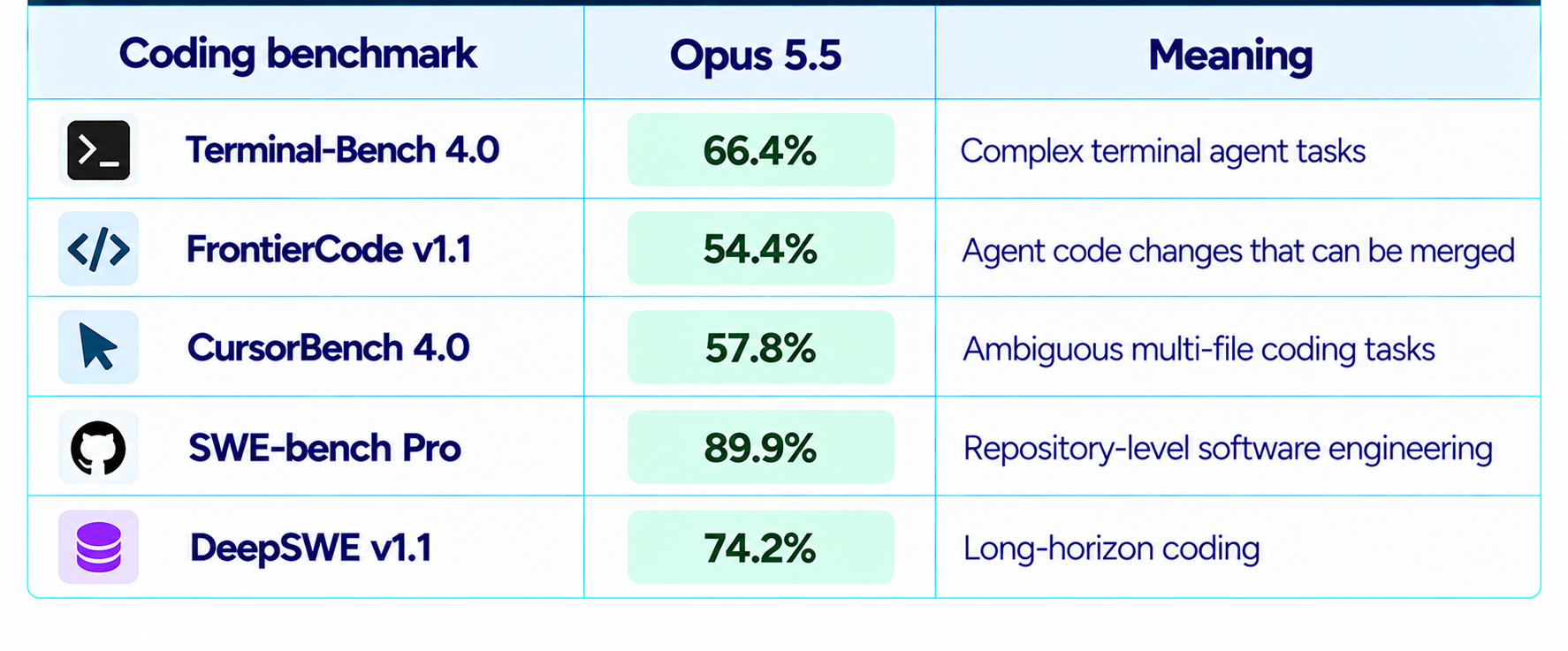
Its published benchmark profile is particularly strong for agentic work: 66.4% Terminal-Bench 4.0, 54.4% FrontierCode v1.1, 57.8% CursorBench 4.0, 1,846 GDPval-AA v2.1 Elo, 40.0% AutomationBench, 67.7% Humanity's Last Exam with tools and 81.8% on the partial OSWorld 2.0 measure. Anthropic also reports 89.9% SWE-bench Pro and 74.2% DeepSWE v1.1 in its system-card results.
Artificial Analysis currently gives the max-effort configuration a 58 Intelligence Index score and measures the model at the top of its tracked set. Its own Terminal-Bench measurement is 59.6%, lower than Anthropic's 66.4% because the evaluation setups differ. The right conclusion is that Opus 5.5 is exceptionally strong on the benchmark, not that every provider must reproduce one exact score.
My verdict: 9.4/10 overall. Opus 5.5 is one of the strongest choices for serious coding agents, long-running knowledge work and high-value enterprise workflows, particularly when its lower price and better token efficiency are taken into account.
1. What Is Claude Opus 5.5?
Claude Opus 5.5 is the first release in Anthropic's Claude 5.5 family. Anthropic describes it as a model for long-running agentic coding and knowledge work rather than short conversational tasks. The model is available under the API ID claude-opus-5-5.
The model combines adaptive reasoning, a large context window and tool support with a lower price than Opus 5. Thinking is always enabled, while the effort setting lets applications choose how deeply the model reasons. This is designed to make one model useful across both routine and difficult workflows.
Anthropic also says Opus 5.5 improves communication, using shorter and clearer responses that put important information earlier. That matters in long agent sessions because the model's output is easier for people to inspect between automated steps.
2. Claude Opus 5.5 Specifications
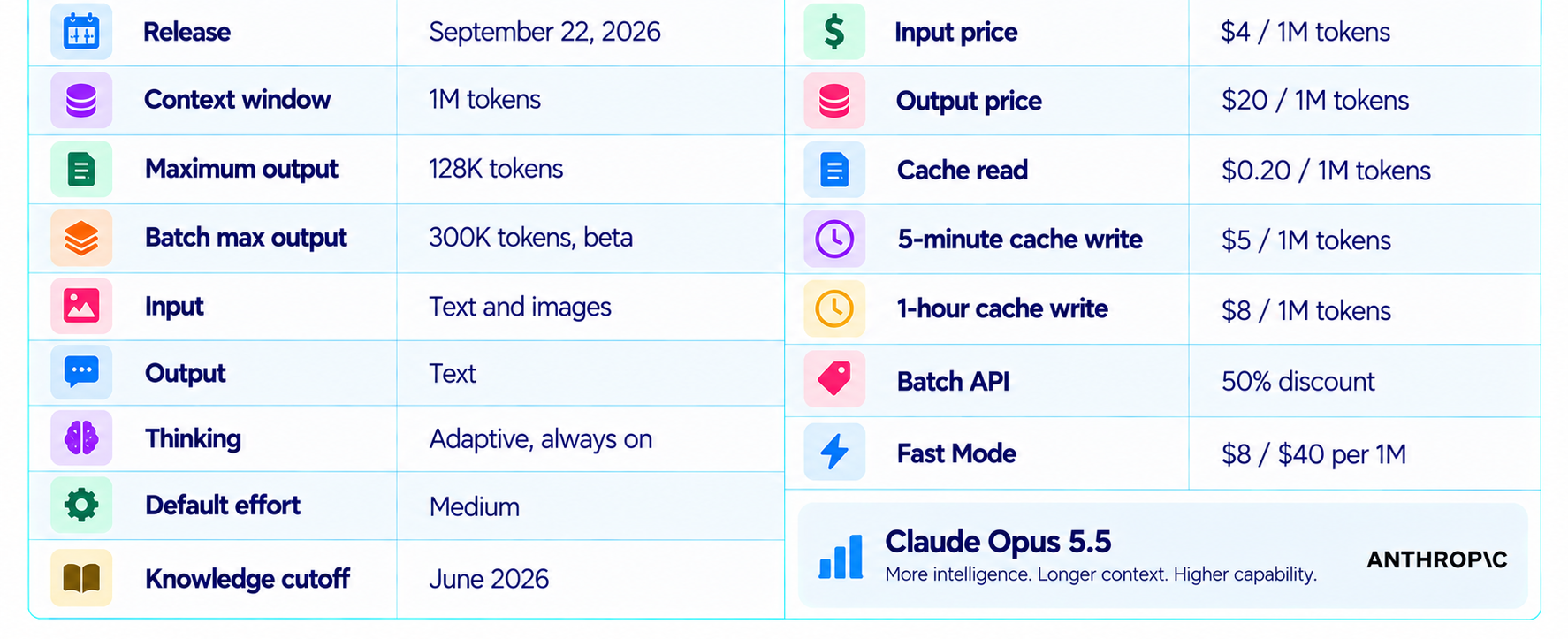
Anthropic documents 1M as the default context for Opus 5.5. Thinking tokens also count toward the context limit, so applications using long chains of reasoning need to account for both prompt and thinking consumption when planning large sessions.
3. Claude Opus 5.5 Benchmarks
The strongest published results focus on real agent behavior rather than only isolated reasoning questions.
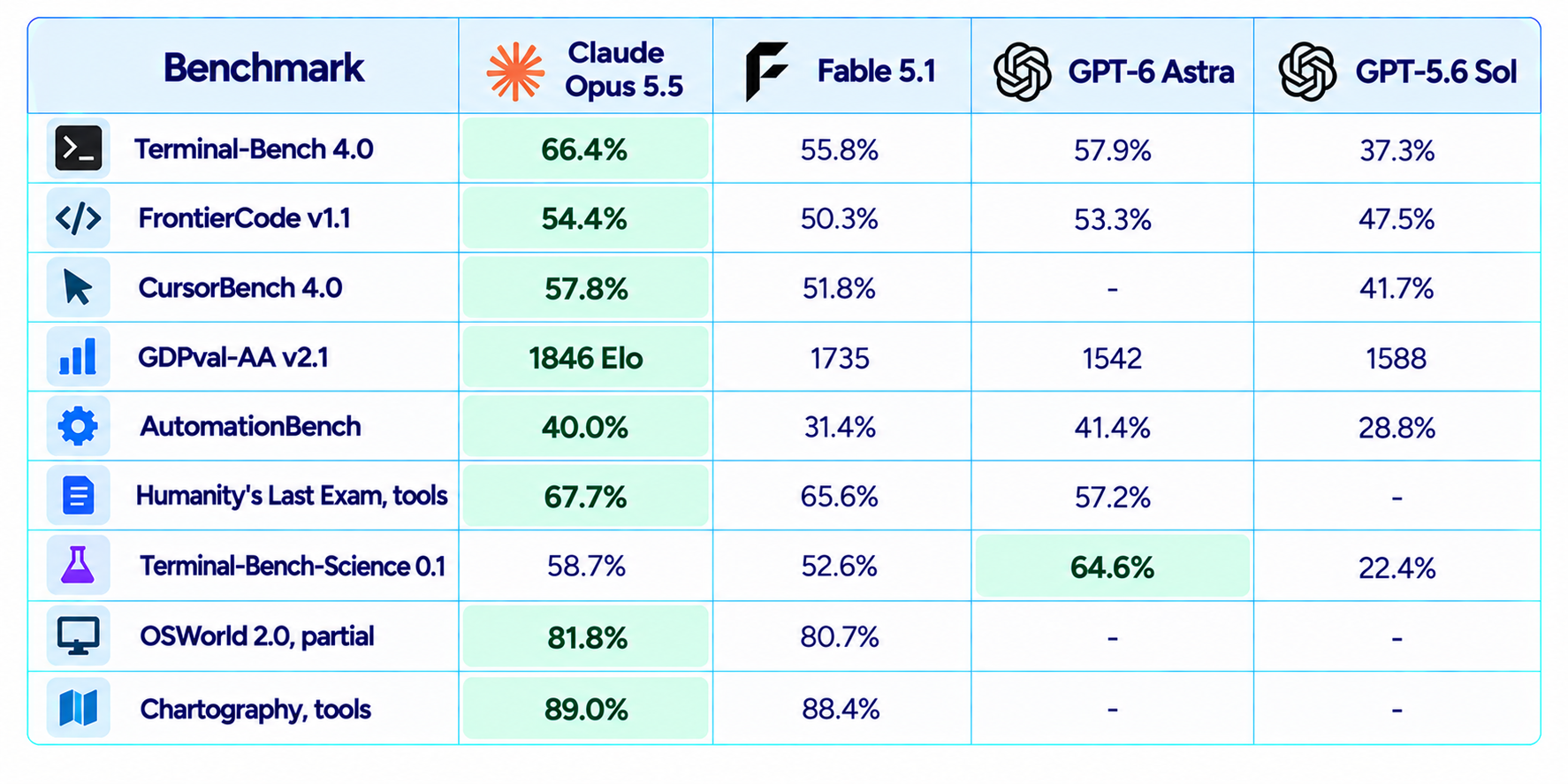
In Anthropic's launch comparison, Opus 5.5 leads the listed models on most rows, while GPT-6 Astra is ahead on AutomationBench and Terminal-Bench-Science. Anthropic notes that Opus 5.5 was evaluated with production safeguards and that effort settings differ across models, so raw scores need benchmark context.
4. Independent Artificial Analysis Results
Artificial Analysis gives Opus 5.5 a max-effort Intelligence Index score of 58, currently the top score in its tracked set. The evaluation aggregates multiple benchmark families rather than relying on a single test.
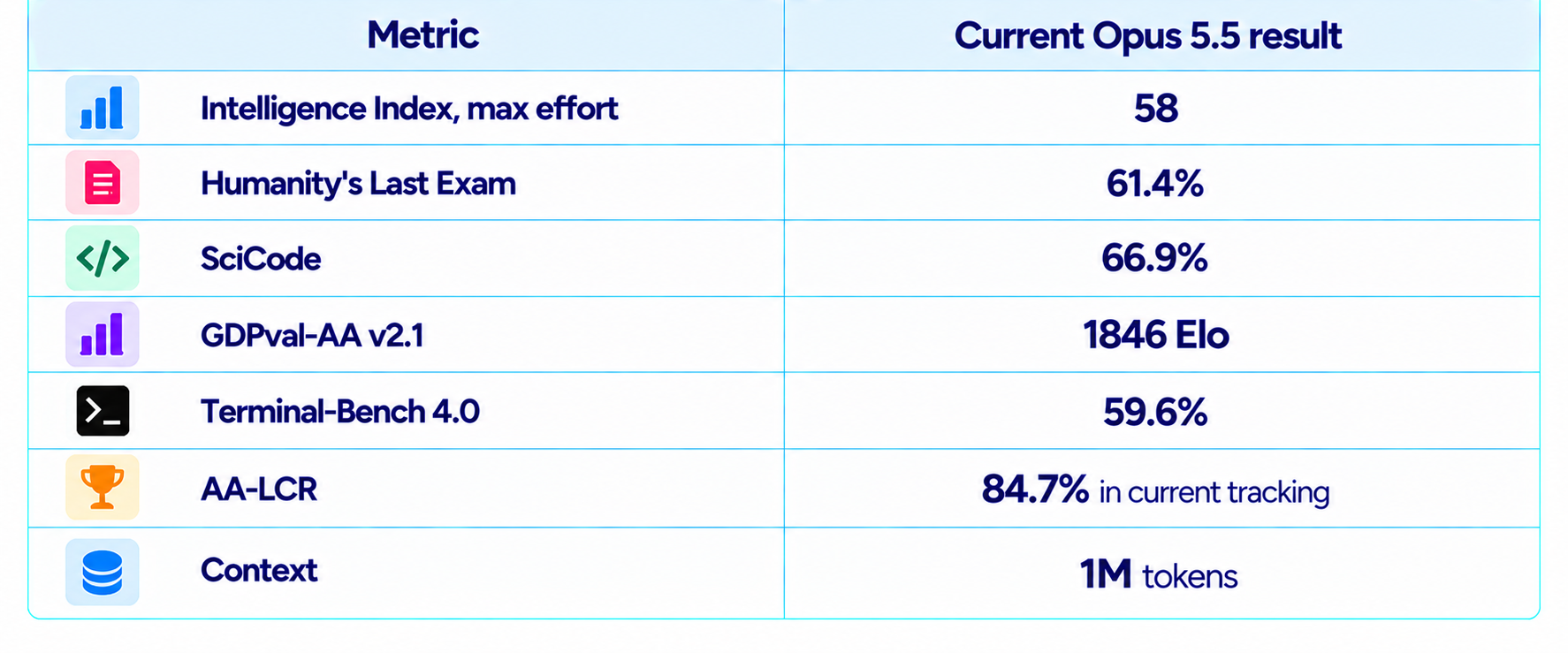
The different Terminal-Bench numbers are worth highlighting. Anthropic reports 66.4% in its own setup, while Artificial Analysis reports 59.6%. Differences like this can come from harness versions, effort levels, tool configuration and trial structure. A good model review should report the source and methodology instead of treating benchmark numbers as universal constants.
5. Coding Performance
Coding is the clearest reason to use Opus 5.5. Anthropic reports 54.4% on FrontierCode v1.1 and 57.8% on CursorBench 4.0. Its system-card reporting adds 89.9% SWE-bench Pro and 74.2% DeepSWE v1.1.
Anthropic's own task examples reinforce the benchmark results. One early tester completed a 680,000-line code migration in less than a day. Another audit-and-fix task covered a 200,000-line codebase in under three hours, while Opus 5 reportedly took more than 20 hours on the same internal workflow.
6. Why the Coding Economics Matter
A flagship model becomes more useful when it can do more work for the same spend. Anthropic says Opus 5.5 costs about 40% less than Opus 5 on typical workloads because of both lower token prices and reduced token use.
The base API price falls from $5/$25 to $4/$20 per million input/output tokens. Cache reads fall from $0.50 to $0.20. Anthropic also reports that Opus 5.5 generates output more than 30% faster than Opus 5.
For coding agents, this can have a larger effect than a small benchmark gain. An agent that uses fewer turns, fewer output tokens and cheaper cached context can complete the same repository task at a much lower cost.
7. Claude Opus 5.5 vs Claude Fable 5.1
Anthropic explicitly says Opus 5.5 performs at the level of Fable 5.1 on most work, but at a much lower price. Fable 5.1 costs $10 input and $50 output per million tokens, while Opus 5.5 costs $4 and $20.
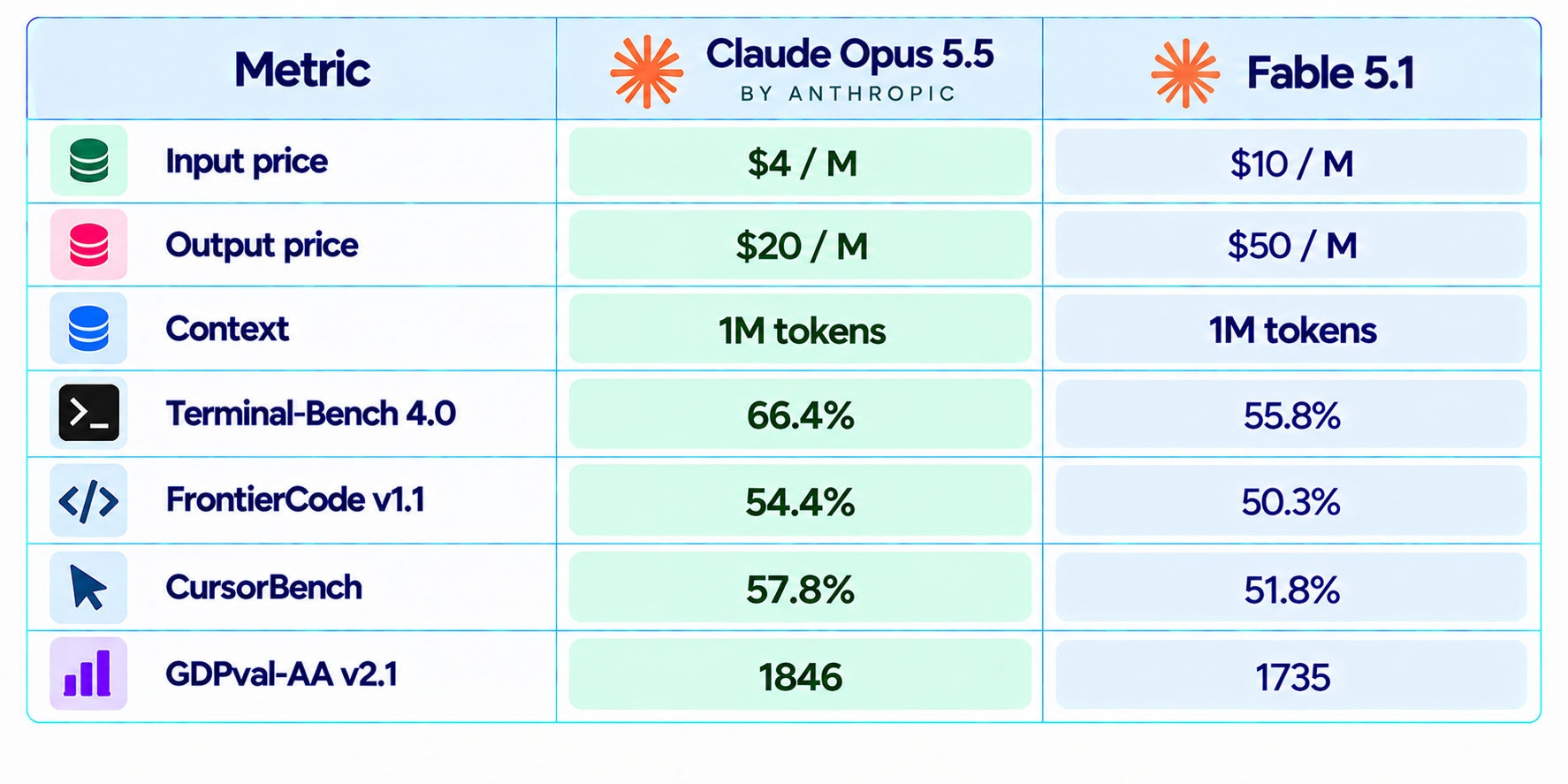
On the selected launch benchmarks, Opus 5.5 is ahead of Fable 5.1 while also being 60% cheaper per token. Anthropic does note that raw benchmark margins are less reliable at this capability level, so the most useful takeaway is efficiency rather than a universal rank.
8. Claude Opus 5.5 vs GPT-6 Astra
The competition with GPT-6 Astra is close on several agent benchmarks. Anthropic reports Opus 5.5 ahead on Terminal-Bench 4.0, FrontierCode and GDPval-AA v2.1, while Astra leads on AutomationBench and Terminal-Bench-Science.
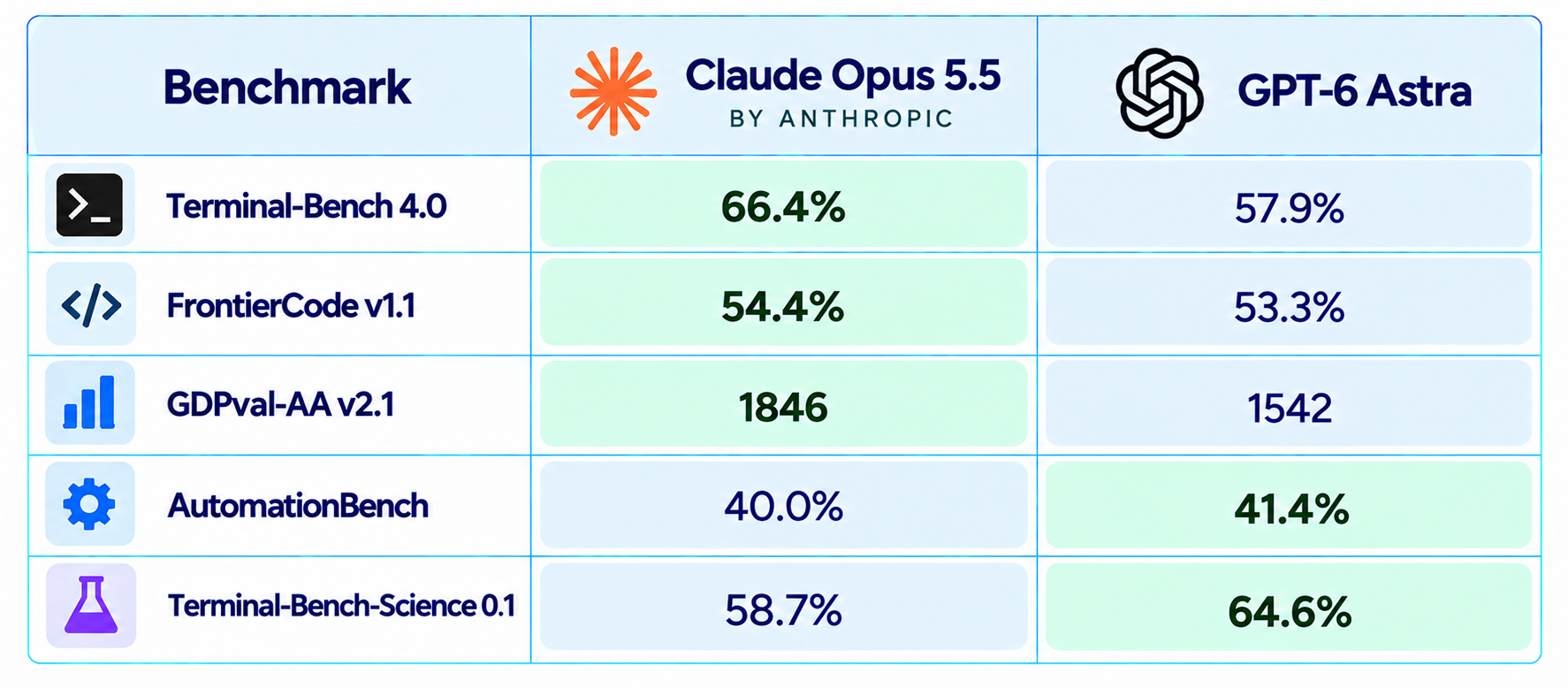
The cost comparison makes the picture more interesting. Anthropic says Opus 5.5 can match Astra on Terminal-Bench for roughly 40% of Astra's cost per task and beat Astra's top FrontierCode score at around one-fifth of the task cost under its default effort setting. These are vendor-reported task economics, so teams should validate them on their own workload.
9. Claude Opus 5.5 Pricing
Opus 5.5 costs $4 per million input tokens and $20 per million output tokens. Prompt caching, batch processing and Fast Mode create additional pricing tiers that can substantially change effective cost.
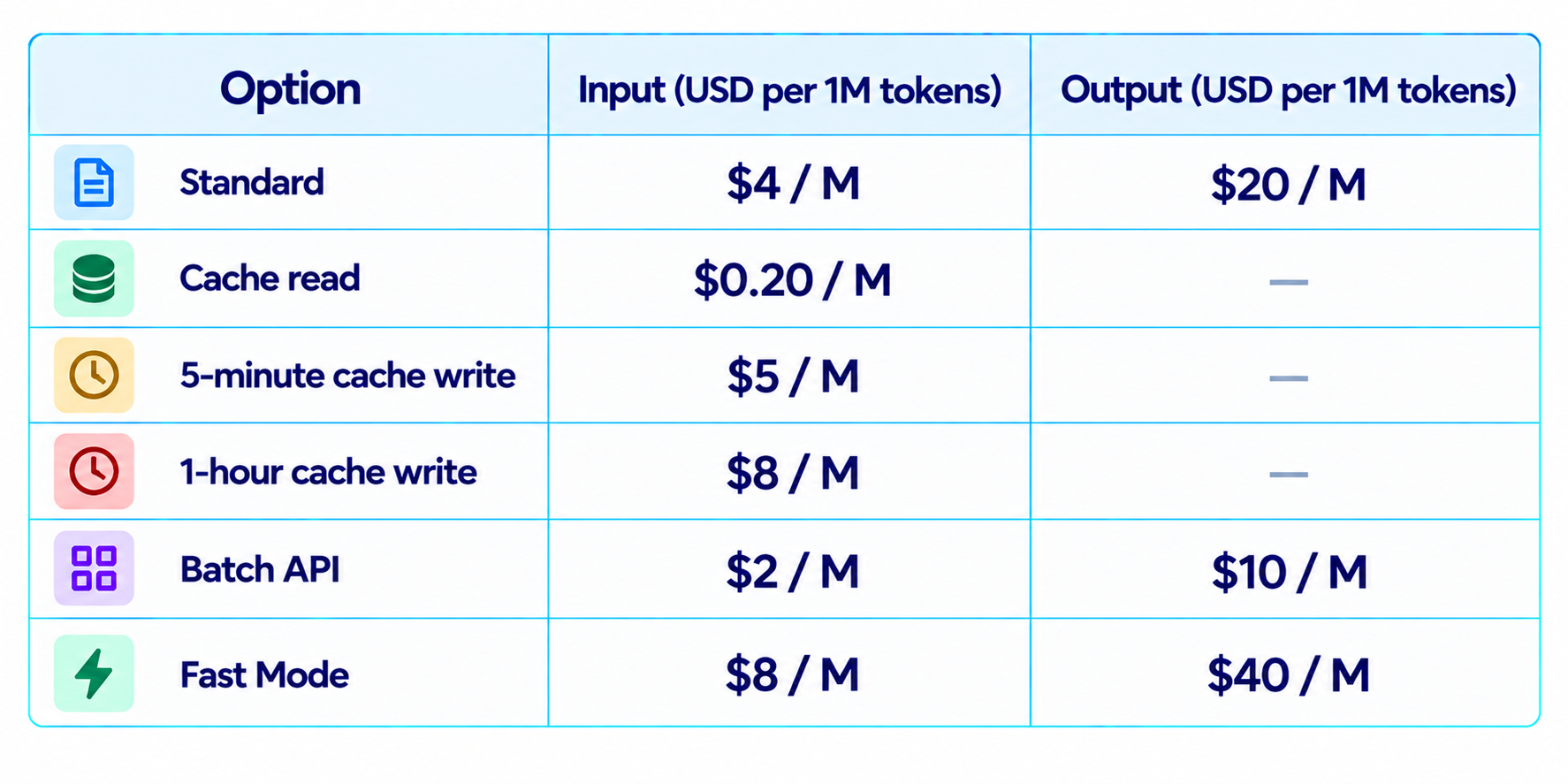
Anthropic says the cache-read rate is 0.05x the base input price for Opus 5.5. This is especially relevant to coding and agent workloads that repeatedly resend the same tools, system instructions and large project context.
10. Prompt Caching and Long-Running Agents
Prompt caching can make Opus 5.5 more economical in multi-turn agent systems. Anthropic caches the full prompt prefix, including tools, system instructions and messages, up to the designated cache boundary. The minimum cacheable prompt is 512 tokens.
This matters for Claude Code-style workflows because the agent may send the same repository context and tool definitions repeatedly. Instead of paying full input price each time, the cache can reduce repeated input cost dramatically.
The practical optimization is to keep stable system instructions, tool definitions and reusable context at the front of the prompt, then place changing task information after the cache boundary.
11. Fast Mode
Fast Mode is a research preview for the first-party Claude API. Anthropic lists $8 per million input tokens and $40 per million output tokens, with a dedicated rate limit and a goal of lower latency. It is not currently available on Bedrock, Google Cloud, Microsoft Foundry or Claude Platform on AWS.
This gives developers a clean latency-versus-cost switch. Standard Opus 5.5 is the normal choice, while Fast Mode is appropriate when response time itself has measurable product value.
12. API Changes From Claude Opus 5
The upgrade is not completely drop-in. Anthropic documents four important breaking changes. Thinking cannot be disabled, the old forced tool-use choices can error, thinking blocks are tied to the model and conversation, and the old computer_20251124 computer-use tool is not accepted on the Claude API or Google Cloud.
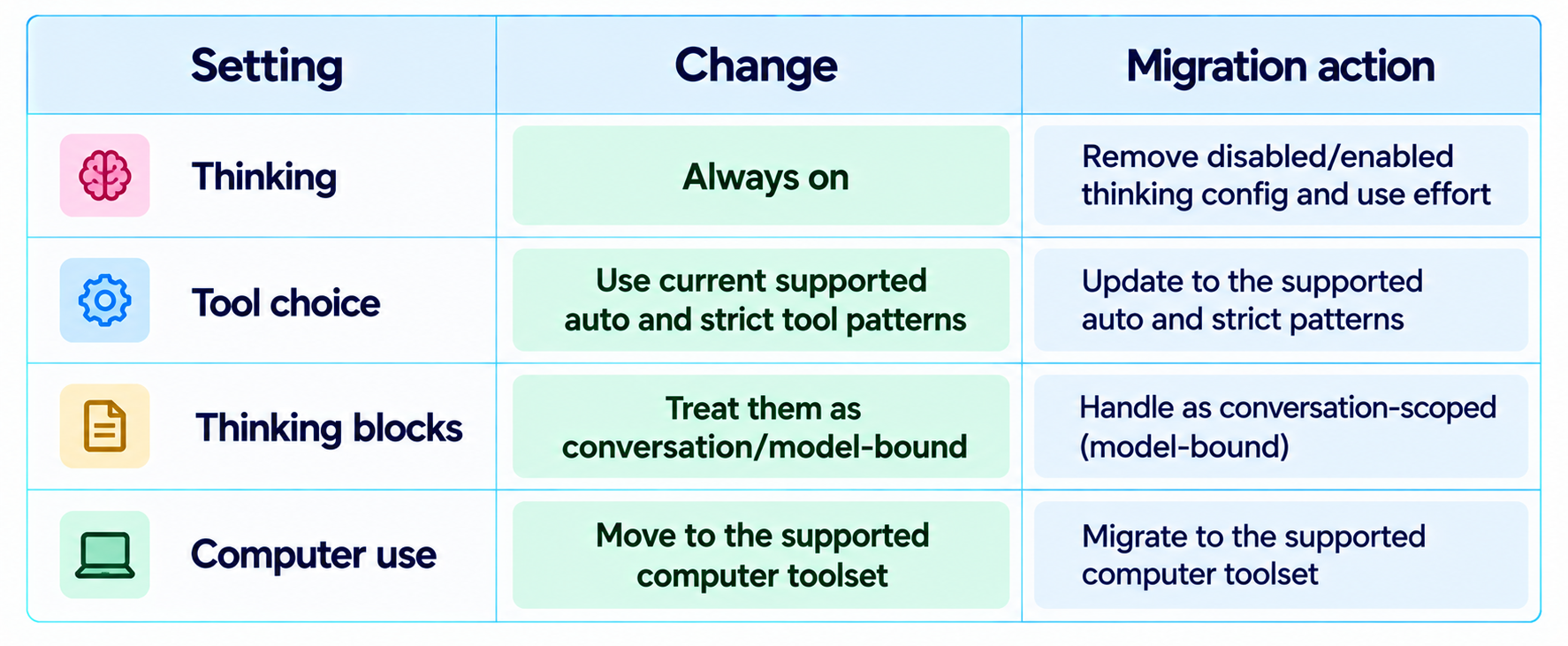
Developers should run integration tests before switching production model IDs because these changes affect both request parameters and response handling.
13. Agentic Coding and Claude Code
Opus 5.5 is especially well matched to coding agents because it combines a large context, adaptive reasoning and a broad tool stack. The model supports Files API, PDFs, vision, server-side tools, client-side tools, task budgets, mid-conversation system messages and on-demand compaction.
The 1M-token context is useful for large repositories, but context size alone does not guarantee repository understanding. Agents still need good retrieval, file selection, planning and verification. For production systems, test whether the model can find the right files and recover from failed changes, not merely whether it can consume a million tokens.
14. Knowledge Work and Computer Use
Knowledge work is one of Opus 5.5's strongest areas. Anthropic reports 1,846 Elo on GDPval-AA v2.1, and its launch examples include financial modeling, executive presentations and long-form research.
Computer use is also improved. Anthropic reports 81.8% on the partial OSWorld 2.0 measure, with a separate strict score reported in the system card. This is important because computer-use performance is different from text-only tool calling: the agent must interpret a UI, choose actions and recover when a visual interaction does not behave as expected.
15. Safety and Enterprise Deployment
Anthropic says Opus 5.5 was externally tested by Frontier Design and METR before release and achieved its strongest automated behavioral-audit results to date. The company also describes stronger prompt-injection defenses and the deployment of safeguards used for its most capable models.
Opus 5.5 also launches with preserved-thinking safeguards designed to make large-scale model distillation harder, and Anthropic says zero data retention remains available. These controls matter most for enterprise teams running autonomous agents over sensitive code and documents.
Security controls outside the model still matter. Use sandboxing, scoped permissions, secret isolation, audit logs and explicit approval for high-impact actions.
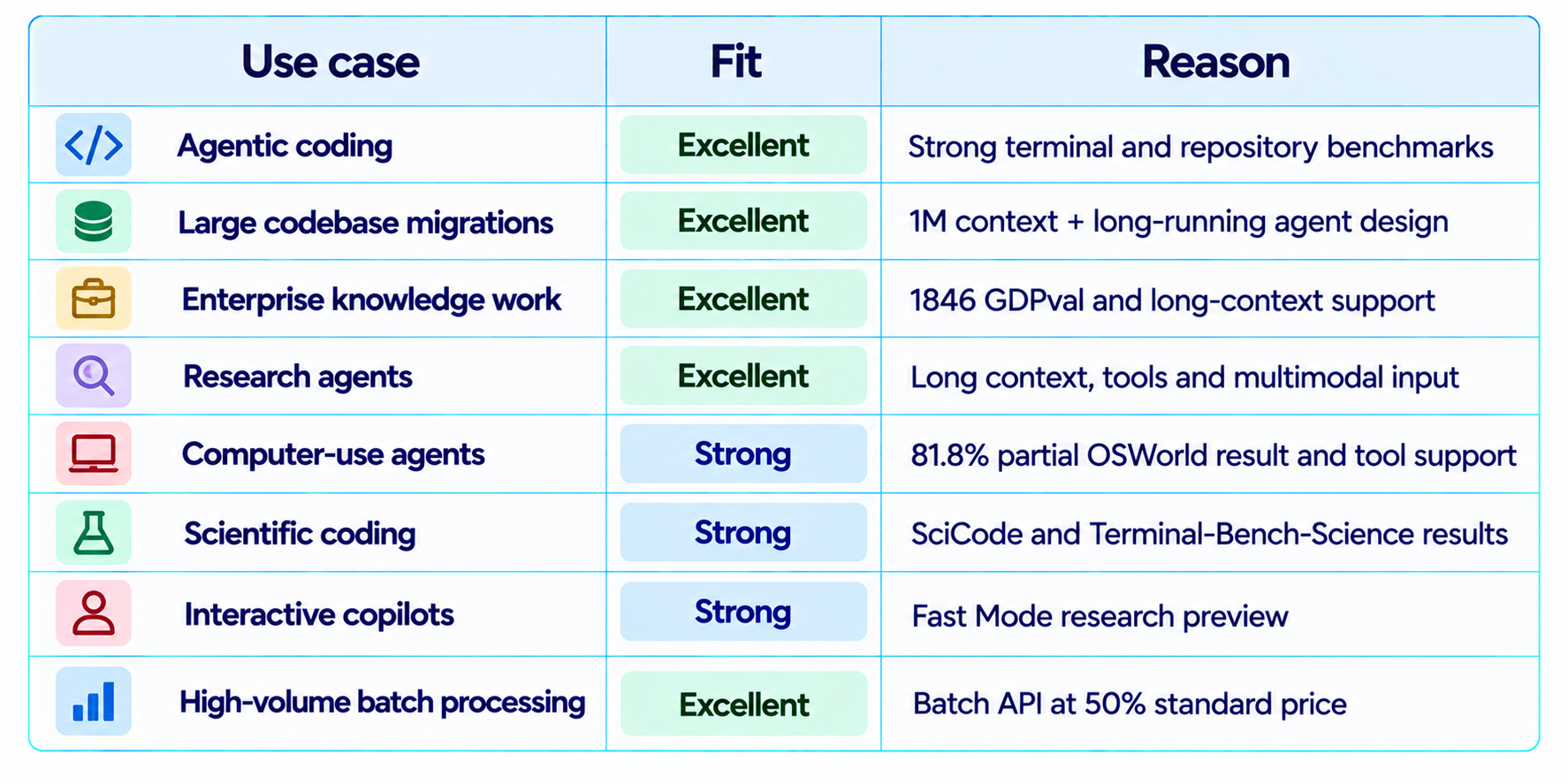
16. Best Use Cases
17. Limitations You Should Know
- Opus 5.5 remains premium-priced compared with smaller frontier models.
- Thinking is always on, so simple tasks still use reasoning infrastructure.
- Fast Mode doubles token prices and is currently a research preview.
- Migrations from Opus 5 require changes to thinking and tool-use configuration.
- Benchmark results vary by harness and effort setting, so raw scores are not directly interchangeable.
- The model accepts text and images but is not an image-generation model.
- Anthropic itself cautions that small benchmark margins at this capability level can overstate practical differences.
18. Recommended Production Workflow
- Use medium effort as the default for normal coding and knowledge tasks.
- Raise effort for complex repository changes, difficult debugging and deep research.
- Use prompt caching for stable tools, system instructions and large repeated context.
- Use Batch API for asynchronous bulk work.
- Use Fast Mode only for workflows where latency has direct product value.
- Route simple tasks to cheaper models and reserve Opus 5.5 for high-value work.
- Track cost per completed task, retries, tool calls and cache hits.
The best metric is accepted work per dollar, not token price in isolation. A model that solves a difficult task in fewer turns can be more economical than a cheaper model that needs repeated retries.
19. How to Evaluate Claude Opus 5.5 Yourself
Build a fixed test set from your actual software repositories and knowledge workflows. Compare Opus 5.5 against your current model under identical tool access and prompts.
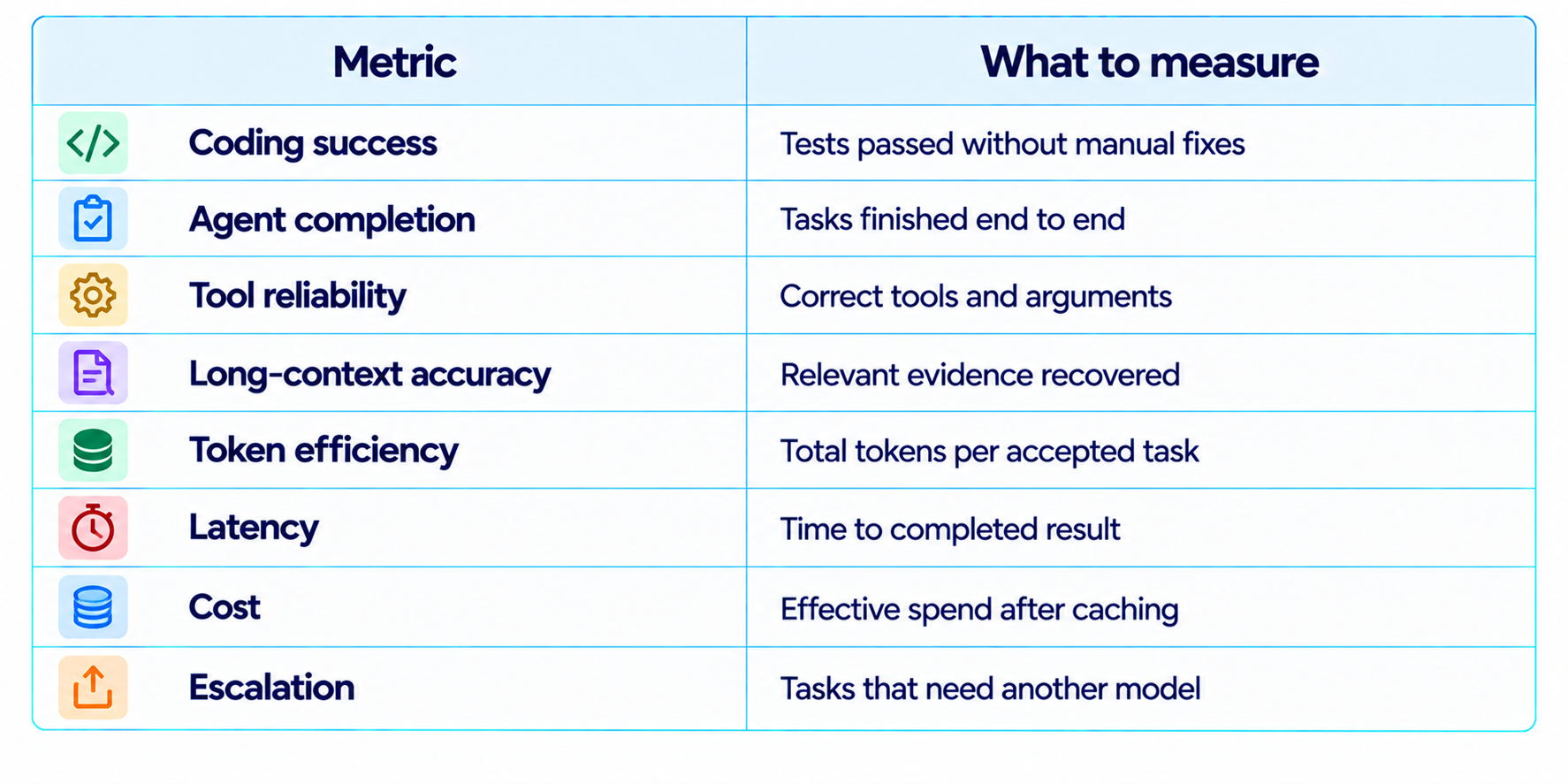
Run the test at more than one reasoning effort. The goal is to identify where medium effort is already good enough and where higher reasoning produces a measurable improvement.
20. Claude Opus 5.5 vs Opus 5: Is the Upgrade Worth It?
For new applications, Opus 5.5 is the more attractive Opus choice because the list price is lower, cache reads are cheaper, output is faster and benchmark performance is stronger on the published coding and knowledge tasks.
For existing Opus 5 applications, the decision is more nuanced because the API behavior changes. Teams need to update thinking configuration, tool choices and some computer-use integrations before moving production traffic.
Once migrated, the economic improvement can be substantial for agentic workloads because cache-heavy inputs and repeated model turns are much cheaper than on Opus 5.
21. Is Claude Opus 5.5 Worth It?
Yes. Claude Opus 5.5 combines top-tier coding and knowledge-work results with a meaningful price reduction, making it more practical as a daily agent model than the previous Opus generation.
The model is especially attractive for coding teams. Terminal-Bench, FrontierCode, CursorBench, SWE-bench Pro and DeepSWE all point to strong repository and agent performance. The 1M-token context also fits large codebases and long research tasks.
The main reason to avoid using it for every request is not weakness. It is cost. $4/$20 is still expensive compared with smaller models, so a routing strategy can extract more value by reserving Opus 5.5 for the tasks where its additional capability matters.
22. Final Verdict
Claude Opus 5.5 is one of the strongest model releases of September 2026 because it improves the full production equation rather than only chasing a benchmark headline. Anthropic combines stronger coding, knowledge and computer-use performance with a 20% lower token price and a 60% cheaper cache-read rate than Opus 5.
The coding profile is particularly compelling: 66.4% Terminal-Bench 4.0, 54.4% FrontierCode, 57.8% CursorBench, 89.9% SWE-bench Pro and 74.2% DeepSWE. Knowledge work is equally strong with 1,846 GDPval-AA v2.1 Elo, while Artificial Analysis currently records a 58 Intelligence Index score at max effort.
The main weakness is integration and price. Existing Opus 5 users have several breaking changes to handle, and Opus 5.5 is still a premium model. But for serious agentic coding, long-context research and enterprise automation, those tradeoffs are easier to justify than they were with the previous generation.
My rating: 9.6/10 for coding, 9.5/10 for agentic workflows, 9.3/10 for knowledge work, 9.5/10 for price-to-performance and 9.4/10 overall.
Bottom line: Claude Opus 5.5 is worth adopting for high-value agentic work. Use it as the premium worker in a model-routing stack, take advantage of caching and batch discounts, and migrate carefully if you are coming from Opus 5.
Frequently Asked Questions
What is Claude Opus 5.5?
Claude Opus 5.5 is Anthropic's first Claude 5.5 model, designed for long-running agentic coding and knowledge work.
When was Claude Opus 5.5 released?
Anthropic released Claude Opus 5.5 on September 22, 2026.
What is the Claude Opus 5.5 context window?
It has a 1M-token context window and a 128K maximum output, with up to 300K output in the Batch API beta.
How much does Claude Opus 5.5 cost?
Standard pricing is $4 per million input tokens and $20 per million output tokens.
What are the Claude Opus 5.5 benchmarks?
Anthropic reports 66.4% Terminal-Bench 4.0, 54.4% FrontierCode, 57.8% CursorBench, 1,846 GDPval-AA v2.1 Elo and 40% AutomationBench. System-card reporting adds 89.9% SWE-bench Pro and 74.2% DeepSWE.
Is Claude Opus 5.5 better than Opus 5?
Anthropic reports stronger coding and knowledge-work results, lower pricing, lower cache-read cost and more than 30% faster output.
Is Claude Opus 5.5 better than Fable 5.1?
Anthropic says it performs at the level of Fable 5.1 on most work while costing much less, and its selected launch benchmark results are higher.
Is Claude Opus 5.5 better than GPT-6 Astra?
Anthropic's launch comparison shows Opus 5.5 ahead on Terminal-Bench, FrontierCode and GDPval, while Astra leads on AutomationBench and Terminal-Bench-Science.
Does Claude Opus 5.5 support computer use?
Yes. Computer use is supported through Anthropic's current toolset, with the older computer_20251124 interface requiring migration on the Claude API and Google Cloud.
Does Claude Opus 5.5 support prompt caching?
Yes. Cache reads cost $0.20 per million tokens, with 5-minute and 1-hour cache writes available.
What is Claude Opus 5.5 Fast Mode?
Fast Mode is a first-party API research preview priced at $8 per million input and $40 per million output tokens.
Is Claude Opus 5.5 worth it?
Yes for serious coding agents, long-running knowledge work and enterprise automation where the premium capability changes task completion.
Recommended Blogs
Claude Fable 5.1 Review: Benchmarks, Pricing & Is It Worth It? (2026)
GPT-6 Astra Review: Benchmarks, Price & Is It Worth It? (2026)
Gemini 3.8 Flash Review: Accuracy, Price & Is It Worth It? (2026)
Meta Muse Spark 1.3 Review: Coding, Price & Is It Worth It? (2026)
Qwen 3.8 Max 0902 Review: Benchmarks, Price & Is It Worth It? (2026)
Quasar 438B Review: Benchmarks, Speed, Price & Is It Worth It? (2026)
Model Routing for AI Coding Agents: How to Cut Costs Without Losing Quality
How to Secure AI Coding Agents: Permissions, Sandboxing, MCP & Secrets
Resources & Community
Join our community of 70,000+ AI enthusiasts and learn to build powerful AI applications. Whether you're a beginner or an experienced developer, Build Fast with AI helps you understand and implement AI in your projects.
Agentic AI Launchpad 2026
A structured 6-week cohort program that takes you from AI basics to building and deploying real-world agentic AI systems. Includes live sessions, expert mentorship, project reviews and a builder community network.
Ready to go from learning to building? Join the next cohort: Agentic AI Launchpad 2026
Free AI Resources
Access free tools, workshops and micro-learning to keep building.

