
Kimi K3.1 Pro Review: Can Moonshot's New 3T-Class Model Challenge Frontier Coding Agents?
Kimi K3.1 Pro is Moonshot AI's newest high-capability reasoning model, released on October 23, 2026. It is the first model in the K3.1 series and a post-trained upgrade to Kimi K3, designed to improve long-horizon coding, tool use, 3D creation, financial research and other multi-step tasks. Its headline specification is a 1-million-token context window; its headline benchmark result is 65.7% on Terminal-Bench 4.0, narrowly behind Claude Opus 5.5 and ahead of GPT-6 Astra in Moonshot's published comparison.
The important distinction is that K3.1 Pro is not simply a new name for Kimi K3. Moonshot says it invested substantially more post-training compute and expanded reinforcement learning across hundreds of downstream domains. That targets the part of an AI agent that often breaks in real use: following a task through multiple steps, operating tools, recovering from errors and delivering a verified result instead of a plausible first response.
This review examines the published Kimi K3.1 Pro benchmarks, pricing signals, context window, coding performance, agent workflow, K3 comparison and the separate K3.1 Pro Highspeed option. It distinguishes Moonshot's reported benchmark results from independent measurements and explains where the model looks most useful for developers and teams building production AI systems.
QUICK ANSWER
Kimi K3.1 Pro is a strong new reasoning model for coding agents, long-running software tasks and research workflows. It supports a 1M-token context window and is available through Kimi.ai, Kimi Work, Kimi Code and the Kimi API. Moonshot says the full model weights are scheduled for release by November 4, 2026, so as of this review it should be treated as a hosted model with an announced future open-weight release, not as a checkpoint already available for local deployment.
Moonshot's launch comparison reports 65.7% on Terminal-Bench 4.0, compared with 66.4% for Claude Opus 5.5, 58.2% for GPT-6 Astra and 57.9% for Claude Fable 5.1. K3.1 Pro also records 75.5% on DeepSWE v1.1 and 51.7% on SWE Marathon v1.1 in the company's published table. These results make it a credible frontier coding-agent contender, although the figures are provider-reported and evaluation harnesses can differ.
The K3.1 Pro family includes K3.1 Pro Highspeed, which Kimi Code documentation describes as roughly 2-3 times faster at the same model quality. API pricing reported by third-party providers is not fully consistent, so check the live Moonshot or chosen API provider price list before budgeting. One provider comparison lists $2 per million input tokens and $10.50 per million output tokens for K3.1 Pro; treat that as provider-specific rather than a universal official rate.
Verdict: Kimi K3.1 Pro is worth testing if your workload involves long-horizon coding, multi-step tool use, complex research or design-oriented coding. Its strongest evidence is in agentic coding and tool-assisted benchmarks, not in a claim that it wins every general-purpose task. Benchmark it against your current model using the same repository, tools, task budget and success criteria.
1. What Is Kimi K3.1 Pro?
Kimi K3.1 Pro is a post-trained version of Moonshot AI's Kimi K3 model. Rather than presenting it as a completely separate base model, Moonshot describes K3.1 Pro as the result of substantially larger post-training compute and a reinforcement-learning system built to improve performance across hundreds of downstream environments.
A capable coding model needs more than programming knowledge. It must understand a repository, plan a change, inspect relevant files, run tests, interpret failures, use tools and keep working until the task meets its acceptance criteria. The K3.1 Pro launch focuses on that longer execution loop.
Moonshot also highlights improvements in 3D creation, financial research and modeling. These tasks require the model to translate a brief into a plan, generate a structured result, use tools or code, check intermediate outputs and refine its work.
K3.1 Pro is available across Kimi.ai, Kimi Work, Kimi Code and the Kimi API. Kimi Code release notes list thinking effort levels low, high and max, with max as the default. Thinking mode is required for the K3.1 Pro series in Kimi Code; turning it off returns an error.
2. Kimi K3.1 Pro Specifications
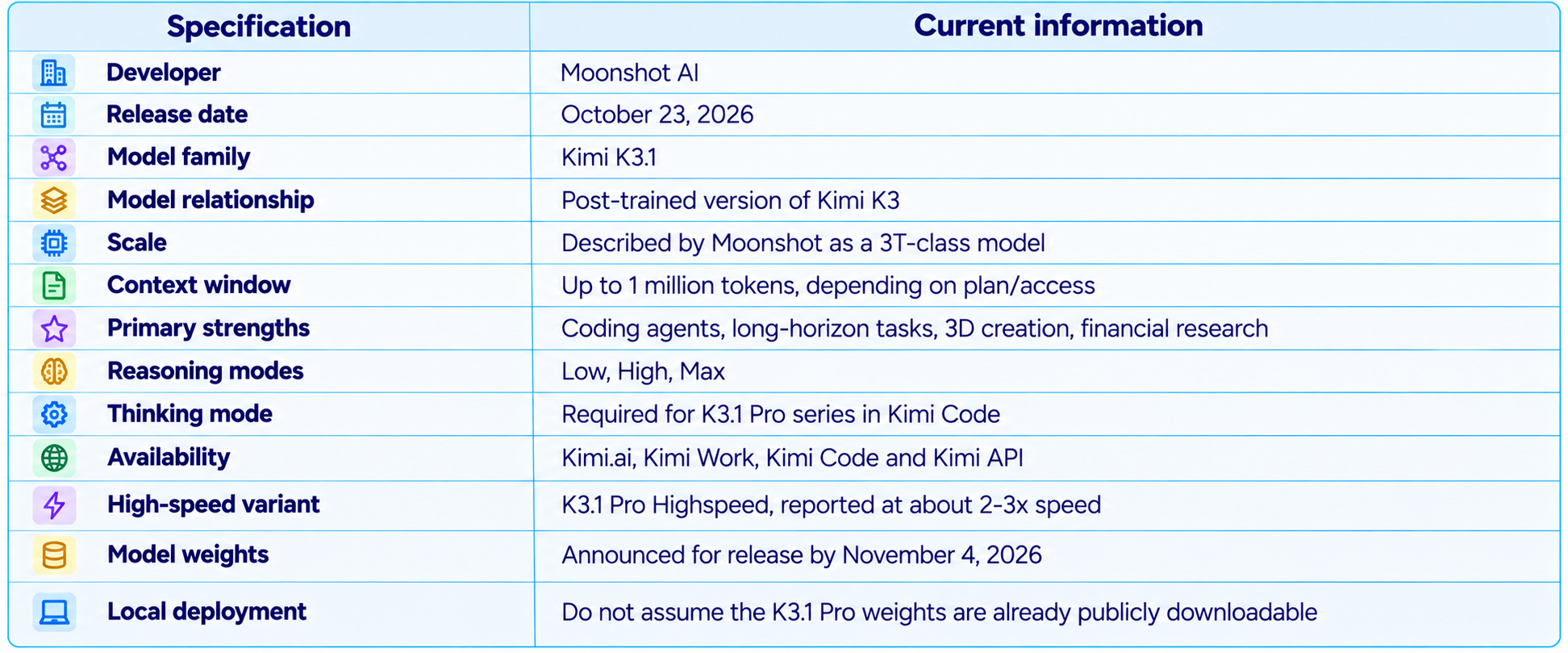
The 1M context window is a maximum, not a guarantee that every account or API configuration exposes the full amount. Kimi Code's release notes say Pro-level access is needed for the maximum context entitlement. Confirm the limits for your exact plan before designing around a million-token prompt.
3. Kimi K3.1 Pro Benchmarks
The most useful launch figures come from Moonshot's comparison table. They cover terminal-based coding, long-horizon software engineering, DeepSWE agent tasks, program synthesis and knowledge work. Because these numbers are published by the model developer, treat them as official launch results rather than a fully independent evaluation.
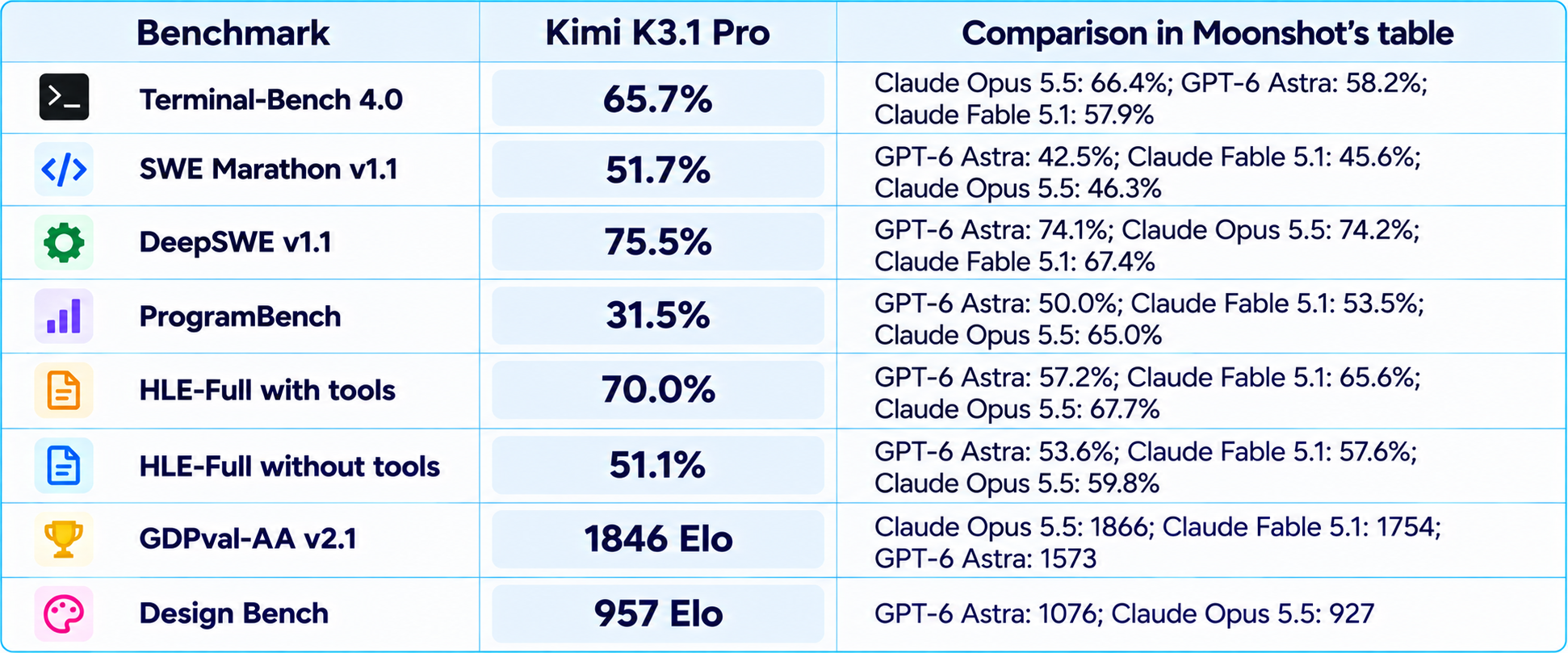
The pattern is more informative than a single winner label. K3.1 Pro leads the listed competitors on SWE Marathon v1.1 and HLE-Full with tools, and it scores slightly higher on DeepSWE v1.1 than the other models in the table. It is almost tied with Claude Opus 5.5 on Terminal-Bench 4.0. However, it trails significantly on ProgramBench and HLE-Full without tools, while GPT-6 Astra leads the listed Design Bench comparison.
Benchmarks are snapshots, not universal guarantees. Results depend on model settings, agent harness, tool availability, task sampling and scoring rules. Use them to identify candidates for a real evaluation, then run your own tests before switching a production system.
4. Terminal-Bench 4.0: The Headline Coding Result
Terminal-Bench evaluates whether an agent can complete realistic tasks in a terminal environment. That is a closer proxy for agentic software engineering than a test that asks a model to write one isolated function. A successful run can involve inspecting files, installing dependencies, executing commands, interpreting logs, editing code and verifying expected behavior.
K3.1 Pro's reported 65.7% is just 0.7 percentage points below Claude Opus 5.5's 66.4% in Moonshot's comparison. It is above GPT-6 Astra at 58.2% and Claude Fable 5.1 at 57.9%. This places K3.1 Pro in the top group for this particular terminal-agent evaluation.
The result does not prove K3.1 Pro is better than Opus in every coding workflow. It does show that the model deserves a serious trial for repository maintenance, debugging, implementation tasks and agents that must use a command line. A good test should include both successful task completion and failure recovery, because the second is often where agents lose time.
For a broader comparison of coding-focused models, our GLM-5.3 vs DeepSeek V4-Pro vs Kimi K3: Best Open Coding AI article explains how the previous Kimi generation fits into the open coding-model field.
5. Long-Horizon Coding and SWE Marathon
Long-horizon coding tasks require an agent to maintain direction across many steps. A model may need to understand a large codebase, make changes in several files, run tests, fix regressions and keep track of the original objective. It is not enough to produce a plausible patch if the repository remains broken.
Moonshot reports 51.7% for K3.1 Pro on SWE Marathon v1.1, higher than GPT-6 Astra at 42.5%, Claude Fable 5.1 at 45.6% and Claude Opus 5.5 at 46.3% in the same published table. This is one of the model's clearest reported advantages.
The result aligns with Moonshot's emphasis on larger post-training compute and reinforcement learning across downstream environments. It suggests K3.1 Pro has been optimized for sustained task execution, not only short responses or single-turn code generation.
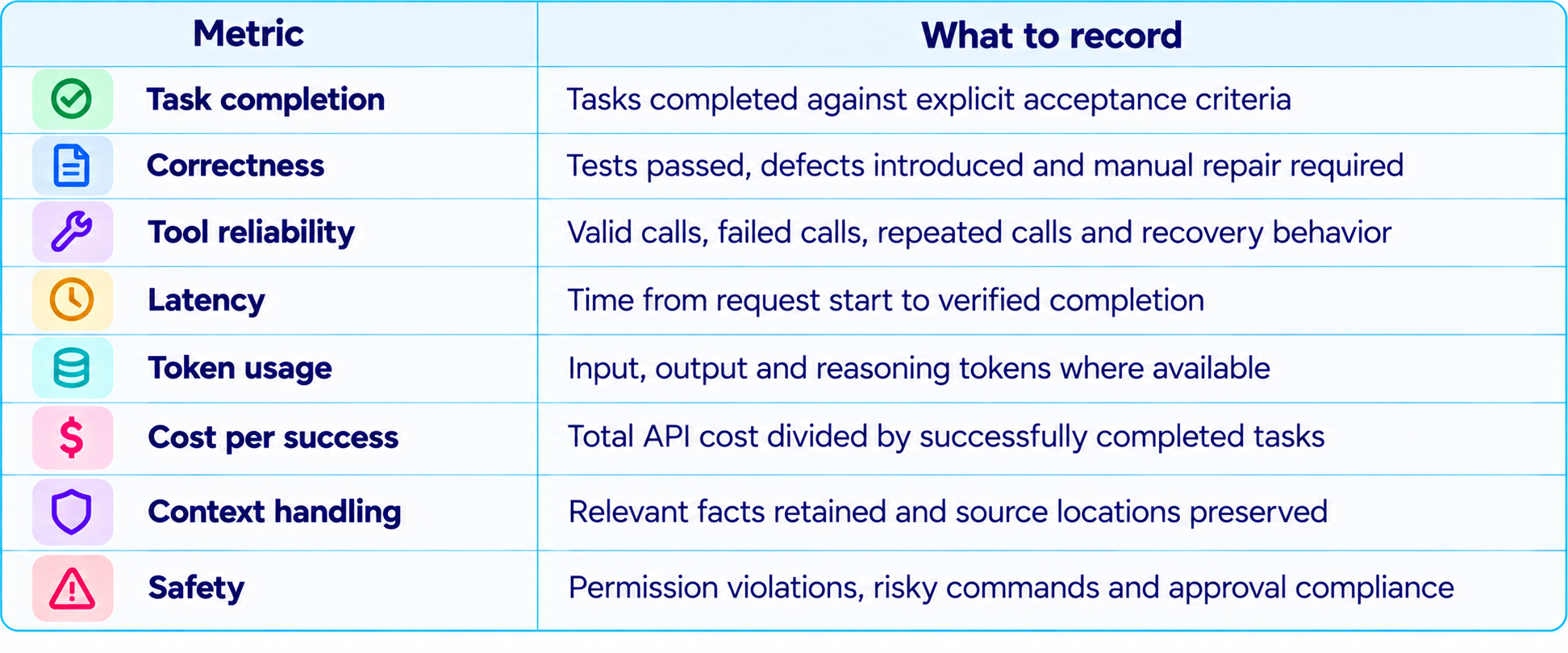
For a real evaluation, use tasks that resemble your engineering queue: bug fixes, dependency upgrades, migrations, tests that currently fail and feature changes with acceptance criteria. Record whether the model completes each task without human intervention, how many tool calls it makes, how many tests pass and whether it introduces regressions.
6. DeepSWE v1.1 and Agentic Coding
Moonshot reports 75.5% on DeepSWE v1.1 for K3.1 Pro. In its launch comparison, that is above GPT-6 Astra at 74.1%, Claude Opus 5.5 at 74.2% and Claude Fable 5.1 at 67.4%. The margin over the first two is small, but it is a positive result for Moonshot's agent-focused positioning.
Agentic coding combines reasoning with action. The model needs to decide which file to inspect, which command to run, when to ask for more information and when to stop. These decisions affect the quality and cost of the final result as much as the model's ability to write code.
A high benchmark score should be considered alongside tool reliability and token use. A model that solves a task but consumes a large reasoning budget may cost more than expected. A model that makes fewer but more accurate tool calls may be the better production choice even when benchmark scores are close.
For teams orchestrating specialist agents, our How to Use LangGraph for Multi-Agent Systems (2026) guide covers roles, state, handoffs and stopping conditions.
7. ProgramBench: Where K3.1 Pro Is Not the Leader
K3.1 Pro scores 31.5% on ProgramBench in Moonshot's comparison. The listed results are higher for Claude Fable 5.1 at 53.5%, GPT-6 Astra at 50.0% and Claude Opus 5.5 at 65.0%. This is a clear counterweight to the model's stronger terminal and long-horizon coding results.
A model can be strong at operating a terminal and still perform less well on a benchmark that emphasizes different programming skills or problem formats. That is why a review should not collapse all coding ability into one score. Software engineering includes code understanding, program synthesis, repository navigation, debugging, tests, tool use and design decisions.
If your work resembles ProgramBench's task mix, do not choose K3.1 Pro based only on Terminal-Bench. Add representative problems from your own codebase and compare exact correctness, maintainability, execution time and repair effort.
8. HLE-Full: Tool Use Changes the Picture
Moonshot reports 70.0% on HLE-Full with tools and 51.1% without tools. In the same comparison, the model's with-tools result is above GPT-6 Astra at 57.2%, Claude Fable 5.1 at 65.6% and Claude Opus 5.5 at 67.7%. Without tools, K3.1 Pro trails all three listed models.
The gap illustrates a central point about agentic models: tools can materially change task performance. Search, execution environments and other tools can supply evidence or capabilities that the model cannot reliably produce from internal knowledge alone. The model's ability to choose and use those tools becomes part of the system's performance.
For production deployments, benchmark the complete stack and secure tool permissions. Our How to Secure AI Coding Agents: Permissions, Sandboxing, MCP & Secrets guide covers safety controls for agents that can execute code or access private resources.
9. Kimi K3.1 Pro vs Kimi K3
K3.1 Pro is positioned as a post-trained improvement to Kimi K3, with additional reinforcement-learning compute and improvements across coding, agents, finance and 3D tasks. Moonshot's own comparisons show gains on several paired benchmarks, including Kimi Code Bench 3.0 Long-horizon, DeepSWE v1.1, finance research and finance modeling.
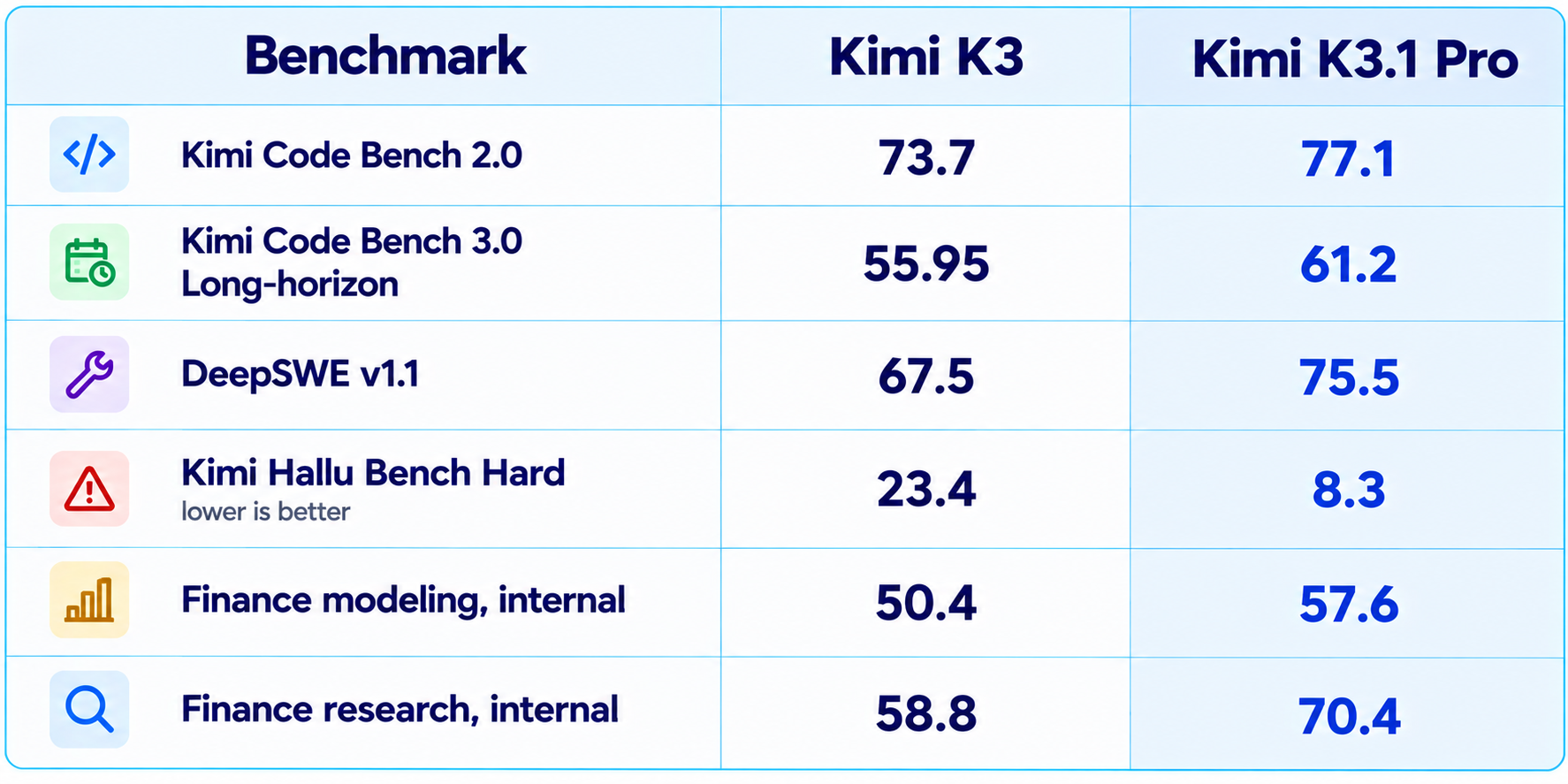
These are Moonshot-reported figures, and some are internal benchmarks. The table suggests improvement over K3 on the listed paired evaluations, but the magnitude should be interpreted with the benchmark methodology in mind. Do not compare scores from different benchmark versions as if they were a controlled before-and-after test.
Our Kimi K3 Review: Benchmarks, Pricing & Agentic Coding covers the previous model's positioning and is the natural companion read if you want to decide whether the K3.1 upgrade changes your setup.
10. Kimi K3.1 Pro vs GPT-6 Astra
The launch table gives K3.1 Pro the advantage on Terminal-Bench 4.0, SWE Marathon v1.1, DeepSWE v1.1 and HLE-Full with tools. GPT-6 Astra is stronger on ProgramBench, HLE-Full without tools and the listed Design Bench comparison. This is a split profile, not a universal win for either model.
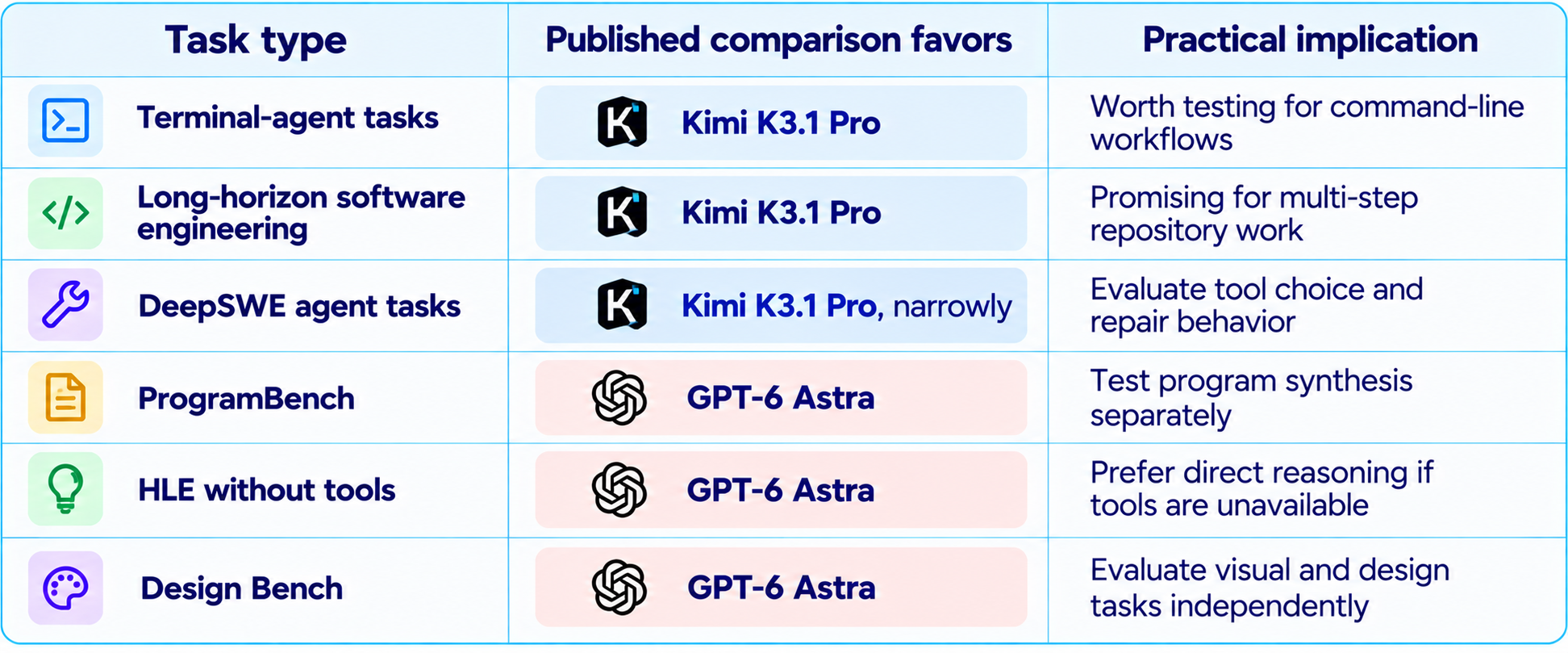
11. Kimi K3.1 Pro vs Claude Opus 5.5
Claude Opus 5.5 is narrowly ahead on Terminal-Bench 4.0 at 66.4% versus K3.1 Pro's 65.7%. K3.1 Pro is ahead in Moonshot's published SWE Marathon v1.1 and HLE-Full with tools comparisons, while Opus 5.5 is stronger on ProgramBench and HLE-Full without tools. GDPval-AA v2.1 is also close, at 1846 Elo for K3.1 Pro and 1866 for Opus 5.5.
That makes the comparison interesting for teams that need an agent rather than a chatbot. K3.1 Pro has competitive results on several tool-based and sustained-coding tasks. Opus 5.5 remains a strong option for tasks represented by ProgramBench and direct knowledge evaluation. Differences in agent harnesses and fallback behavior mean benchmark tables alone cannot establish a universal winner.
12. Kimi K3.1 Pro Highspeed: Is Faster Better?
Moonshot's Kimi Code documentation describes K3.1 Pro Highspeed as delivering roughly 2-3 times the speed of K3.1 Pro while maintaining the same model quality. It is a separate option with access tied to higher subscription tiers in Kimi Code. Actual latency varies with task length, queueing, reasoning effort, context size and service load.
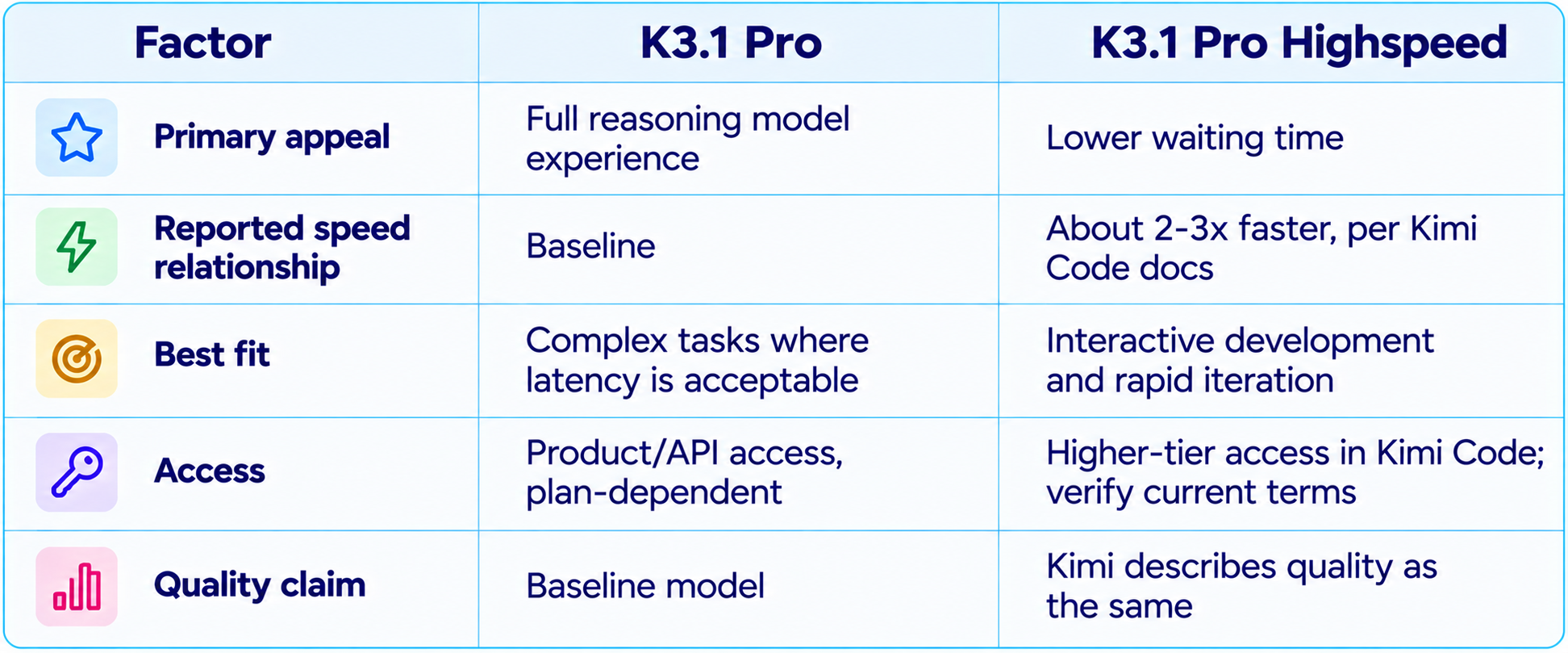
Treat the speed claim as a product-level statement, not a guarantee that every task will finish in one-third the time. A long task with extensive reasoning can still take longer than a short prompt, and providers may measure generation speed differently from end-to-end completion. Test both variants on your workflow before choosing the more expensive route.
13. Kimi K3.1 Pro Pricing and API Cost
Pricing needs careful handling because model access and provider rates can differ. A third-party provider comparison available at the time of writing lists K3.1 Pro at $2 per million input tokens and $10.50 per million output tokens, with K3.1 Pro Highspeed at higher rates. These figures should not be treated as a universal official price for every Moonshot account or reseller.
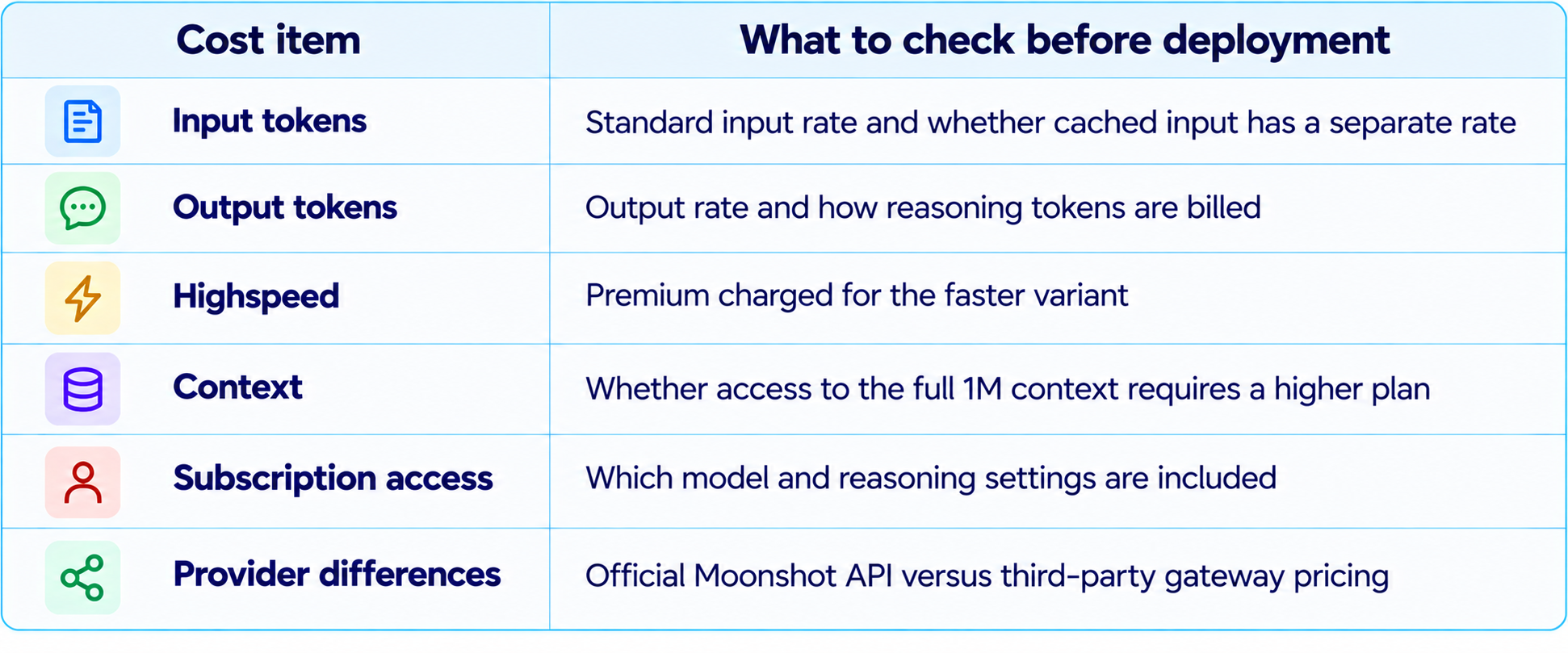
Token price alone can mislead. A model that uses more reasoning tokens may cost more per completed task even if its per-token rate is lower. The right metric is cost per successful task, including retries, failed runs, tool calls and human repair work.
For another view of the model-tier economics, our GPT-5.6 Review: Sol, Terra, Luna Features, Benchmarks, and Pricing compares a family of models with different capability and price tiers.
14. The 1M-Token Context Window
Kimi K3.1 Pro supports a context window of up to one million tokens. For software engineering, that can help an agent keep architecture notes, selected source files, issue history, test output and task requirements available together. For research, it can accommodate a large collection of reports or financial documents.
A large context window is not a substitute for context engineering. Pasting every file and log into the prompt can increase cost and bury relevant evidence. Strong applications select useful context, label sources, preserve metadata and retrieve more information only when needed.
Our What Is Context Engineering? Complete Guide (2026) explains how to structure the information an agent sees and avoid treating a million-token limit as a target to fill.
15. Is Kimi K3.1 Pro Open Source?
Moonshot announced that the full K3.1 Pro model weights would be released by November 4, 2026. Since this review is dated October 24, that release date is still in the future. The accurate description is that K3.1 Pro has an announced open-weight release plan, not that the checkpoint is already downloadable.
Until the weights are published, local deployment details such as final checkpoint size, supported quantizations, hardware requirements and inference compatibility should not be assumed from the previous Kimi K3 release alone. A model can share a family name without having identical serving requirements or an identical license.
If self-hosting matters, our Best Open Source AI Models 2026: Full Collection is a starting point for comparing models with already published weights.
16. Best Use Cases for Kimi K3.1 Pro
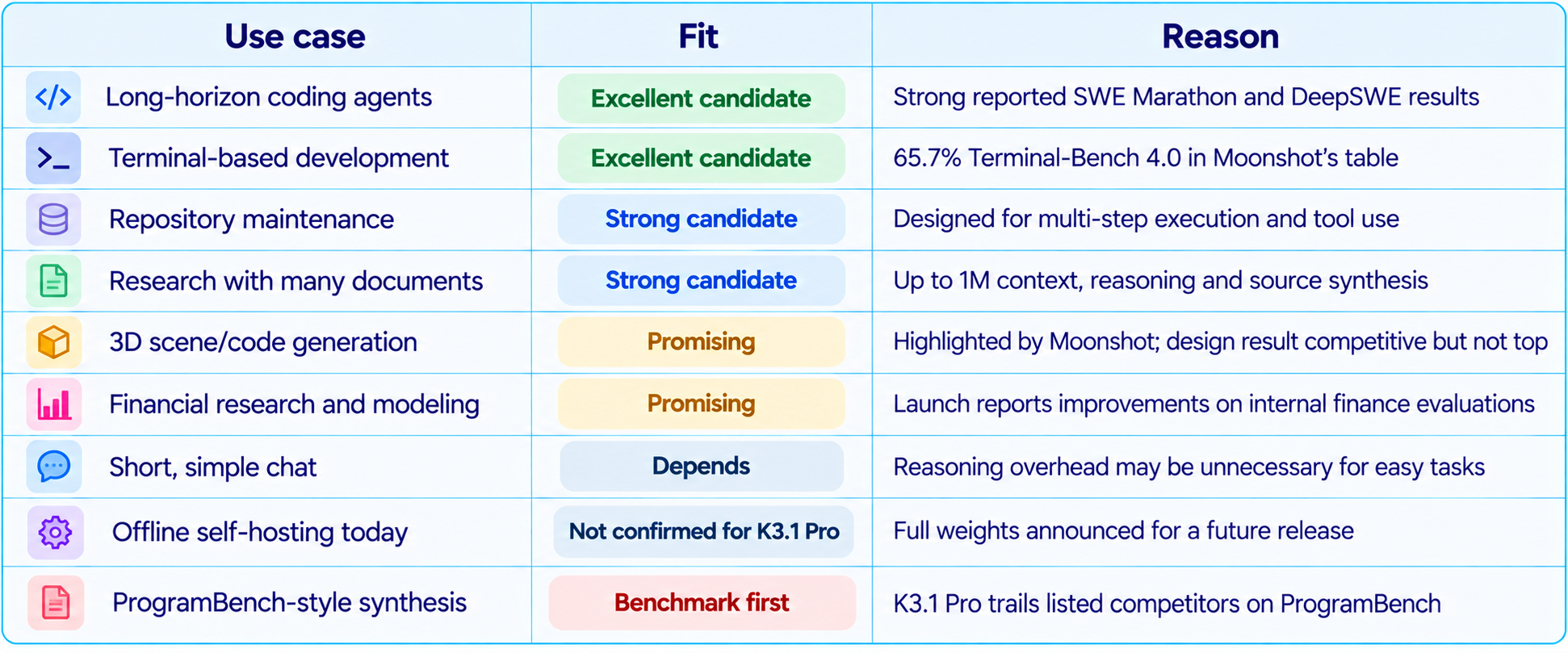
The best initial use is not to replace every model in your stack. Start with a workload where the benchmark evidence matches the task: repository work, terminal operations, multi-step implementation or tool-assisted research. Expand only after measuring quality, latency and cost.
17. Limitations and Things to Verify
- Most detailed K3.1 Pro launch comparisons are published by Moonshot; independent reproducibility and benchmark harness differences matter.
- K3.1 Pro is not the top scorer in every test. ProgramBench, HLE-Full without tools and the listed Design Bench comparison favor other models.
- The Highspeed claim of roughly 2-3x speed is a vendor product claim and should be tested against end-to-end latency.
- API prices can differ by provider, subscription, caching and model variant. Verify current pricing before committing a budget.
- The 1M-token context limit may depend on plan or access tier.
- The announced November 4 weight release is still in the future as of October 24, 2026.
- Long-context capability does not eliminate the need for retrieval, source tracking, validation and context selection.
- Coding benchmark success does not guarantee safe execution. Agents still need scoped credentials, sandboxing, logs, approvals and rollback.
18. Is Kimi K3.1 Pro Worth It?
Kimi K3.1 Pro is worth testing for teams whose main problem is getting an AI agent to complete multi-step engineering work. The reported Terminal-Bench 4.0 result is close to Claude Opus 5.5, while SWE Marathon and DeepSWE show strong results in Moonshot's launch comparison. The 1M context window is useful for large repositories and document-heavy research, and Highspeed offers a separate option for teams that value iteration speed.
It is less compelling to adopt solely because of a headline benchmark. K3.1 Pro does not lead every category, and the ProgramBench result is a notable weakness in the published table. Teams should also account for reasoning-token usage, actual API price, and whether the full context limit is available on their plan.
For a production coding agent, the decision should come down to cost per verified task. If K3.1 Pro fixes more issues with fewer human interventions, it may justify its price. If it spends a large budget thinking through simple tasks, use a smaller or faster model for routine work and route only difficult tasks to K3.1 Pro.
19. Final Verdict
Kimi K3.1 Pro is a serious step forward for Moonshot's agent-focused model lineup. Its reported 65.7% Terminal-Bench 4.0 score puts it just behind Claude Opus 5.5 and ahead of GPT-6 Astra in that comparison. The 75.5% DeepSWE v1.1 result and 51.7% SWE Marathon v1.1 score are also strong, particularly for workflows that require sustained tool use and software engineering over many steps.
The model is not a universal winner. It trails the comparison models on ProgramBench and HLE-Full without tools, while its Design Bench result sits below GPT-6 Astra. These differences are a reminder to choose models by workload, not by one score.
The 1M context window, availability through Kimi products and planned November 4 weight release make the K3.1 series especially interesting for developers. K3.1 Pro Highspeed may be the better fit for interactive workflows, but its advertised speed advantage should be verified on real tasks and compared with the extra cost.
Editorial rating: 9.1/10 for long-horizon coding potential, 9.0/10 for agentic workflows, 8.6/10 for breadth across the published benchmarks and 8.9/10 overall. These are editorial ratings based on the published launch evidence, not official benchmark scores.
Bottom line: test Kimi K3.1 Pro if you build coding agents, work across large repositories or need a model that can sustain multi-step tool workflows. Keep a comparison model for tasks where K3.1 Pro's benchmark profile is weaker, and wait for the actual weights and license before making local-deployment plans.
Frequently Asked Questions
What is Kimi K3.1 Pro?
Kimi K3.1 Pro is Moonshot AI's post-trained reasoning model released on October 23, 2026, designed for coding agents, long-horizon tasks, 3D creation and financial research.
What is the Kimi K3.1 Pro context window?
It supports up to 1 million tokens, although full-context access can depend on the product plan or account tier.
What are the Kimi K3.1 Pro benchmark scores?
Moonshot reports 65.7% on Terminal-Bench 4.0, 75.5% on DeepSWE v1.1 and 51.7% on SWE Marathon v1.1, among other launch comparisons.
Is Kimi K3.1 Pro better than GPT-6 Astra?
It leads in several Moonshot-reported agent and coding comparisons, including Terminal-Bench 4.0, SWE Marathon and DeepSWE, while GPT-6 Astra leads on ProgramBench and the listed Design Bench comparison.
Is Kimi K3.1 Pro better than Claude Opus 5.5?
Not across every task. It is close on Terminal-Bench 4.0 and leads on some tool-assisted benchmarks in Moonshot's table, while Opus 5.5 is stronger on ProgramBench and HLE-Full without tools.
What is Kimi K3.1 Pro Highspeed?
It is a faster variant that Kimi Code documentation describes as roughly 2-3 times faster at the same model quality.
How much does Kimi K3.1 Pro cost?
Pricing varies by access route. A third-party provider lists $2 per million input tokens and $10.50 per million output tokens, but confirm the current official or provider-specific rates before use.
Is Kimi K3.1 Pro open source?
Moonshot announced that the full weights would be released by November 4, 2026. As of October 24, that release is still in the future.
Can I run Kimi K3.1 Pro locally?
Do not assume so yet. Wait for the announced weights, license and deployment documentation before estimating hardware requirements.
Does Kimi K3.1 Pro support reasoning effort settings?
Kimi Code documentation lists low, high and max thinking levels, with max as the default; thinking mode is required.
Is Kimi K3.1 Pro good for coding agents?
It is a strong candidate based on Moonshot's Terminal-Bench, DeepSWE and SWE Marathon results. Test it on your repositories and tools before switching.
Should I upgrade from Kimi K3 to K3.1 Pro?
Consider upgrading if your tasks benefit from the reported improvements in long-horizon coding, tool use and research. Compare cost per successful task and latency before changing production workloads.
Recommended Blogs
GPT-5.6 Review: Sol, Terra, Luna Features, Benchmarks, and Pricing
How to Secure AI Coding Agents: Permissions, Sandboxing, MCP & Secrets
Resources & Community
Join our community of 70,000+ AI enthusiasts and learn to build powerful AI applications. Build Fast with AI helps developers, creators and teams understand AI models and turn them into useful applications.
Agentic AI Launchpad 2026
A structured six-week cohort program for learning to build and deploy real-world agentic AI systems, with live sessions, mentorship, project reviews and a builder community.
Explore the program: Agentic AI Launchpad 2026
Free AI Resources
Explore workshops and short-form learning resources to keep building.