



The two most confused technical customer-facing roles of 2026 are the Forward Deployed Engineer and the Solutions Engineer, and mixing them up is an expensive mistake. They sound similar, both are technical, both work with customers, and both bridge product and reality. But one helps you close a sale and the other makes the product actually work in production, and hiring the wrong one for your need leaves you with either a great demo and no working system, or a builder with nothing to sell. This guide draws the line clearly.
I will keep the comparison practical, because this is usually a hiring or career decision, not a trivia question. By the end you will know exactly what each role does, how they differ across responsibilities, skills, and pay, and which one your company actually needs. If you are choosing a career path or a hire, this is the distinction that matters most.
FDE vs Solutions Engineer: The Short Answer
The short answer is that a Solutions Engineer sells the product and a Forward Deployed Engineer ships it. A Solutions Engineer works pre-sales, using technical skill to demo, answer objections, and help the customer decide to buy. A Forward Deployed Engineer works post-sale, embedding with the customer to build and deploy a working system on their real data and systems. One owns the deal, the other owns the delivery, and that single difference cascades into everything else about the two roles.
Here is the memorable version: the Solutions Engineer gets you to yes, and the Forward Deployed Engineer gets you to working. An SE is measured by deals influenced and won. An FDE is measured by systems shipped and running in production. Both are technical, both are valuable, and they are not interchangeable, because selling a system and building one require different work, different skills, and different measures of success.
This distinction has become sharper in the AI era, because AI has a huge gap between a demo that sells and a system that works, the messy 80 percent we cover in why AI POCs never reach production. The SE handles the demo side of that gap, the FDE handles the working side. As AI deployments got harder, the FDE role grew precisely to own the part the SE never did.
What Is a Forward Deployed Engineer?
A Forward Deployed Engineer is a builder who embeds with a customer to design, build, and ship a working system on the customer's real data and systems, after the deal is done. The name captures it: they are deployed forward, out of the vendor's office and into the customer's reality, to make the product actually work in that specific environment. They own the hard, unglamorous 80 percent of production: the messy data, the integrations, the edge cases, the reliability, and the last-mile fit.
The FDE role rose to prominence at companies like Palantir and has become central in AI, where the gap between a capable model and a working deployment is enormous. An FDE is part engineer, part consultant, part problem-solver: technical enough to build, adaptable enough to work inside a customer's constraints, and pragmatic enough to ship something that runs rather than something that is theoretically elegant. They are the person who turns a promising AI product into a live system inside a real company.
Above all, the FDE owns delivery and often ownership of the system through to it running in production. This is why the role commands strong pay and why demand is rising, as our forward deployed engineer salary guide for India details. In a world where most AI pilots never ship, the person who reliably ships them is worth a great deal.
What Is a Solutions Engineer?
A Solutions Engineer is a technical pre-sales professional who helps customers understand and evaluate a product so they decide to buy it. They are the technical half of the sales process: running demos, answering the customer's engineering questions, designing proof-of-concept solutions, handling objections, and reassuring technical buyers that the product will work for them. The SE makes the sale credible by being the person in the room who genuinely understands the technology.
A good Solutions Engineer is a bridge between sales and engineering. They speak the customer's technical language, translate business needs into product capabilities, and give the sales team the credibility that a pure salesperson cannot. Their success is measured in the sales pipeline: deals influenced, technical wins, and objections overcome. When a technical buyer says yes because their questions were answered convincingly, that is the SE's win.
The SE role is essential for any company selling technical products, and it is a distinct discipline from building. The best SEs are excellent communicators and demo-builders who can make complex technology understandable and desirable. What they typically do not do is embed with the customer afterward to build the full production system, that is where the Forward Deployed Engineer picks up.
The Key Differences, Side by Side
The clearest way to see FDE vs Solutions Engineer is side by side across the dimensions that actually differ. Same customer-facing surface, opposite jobs underneath.
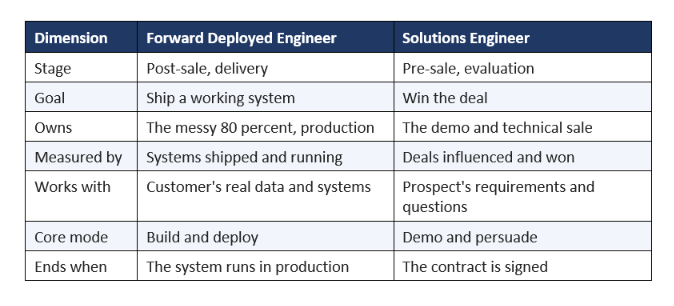
Read the two columns and the difference is unmistakable. The SE lives before the signature, the FDE lives after it. The SE proves it could work, the FDE makes it work. Both are technical and customer-facing, which is why they get confused, but their goals are almost mirror images. Hire by the goal you need, winning deals or shipping systems, and the choice is clear.

Responsibilities Compared
Day to day, the two roles spend their time on opposite activities, which is the practical proof that they are different jobs. Here is what each actually does.
A Forward Deployed Engineer's day
- Embedding with the customer to understand their real workflow and systems.
- Building data pipelines, integrations, and the production system itself.
- Handling messy real data, edge cases, and legacy systems with no API.
- Adding evals, monitoring, and guardrails so the system is reliable.
- Owning the system through to it running in production for real users.
A Solutions Engineer's day
- Preparing and delivering technical demos tailored to a prospect.
- Answering the customer's technical and architecture questions.
- Building proof-of-concept solutions to prove the product fits.
- Handling technical objections and de-risking the buying decision.
- Supporting the sales team through to a signed contract.
The lists barely overlap, and that is the point. One builds production systems, the other builds sales confidence. A person can move between the roles over a career, but on any given project they are doing fundamentally different work with fundamentally different outputs.
Skills Each Role Needs
The two roles share a customer-facing baseline but diverge sharply on their core skills, because building and selling demand different strengths. Both need to be technical and to communicate well with customers, but where the depth sits is different.
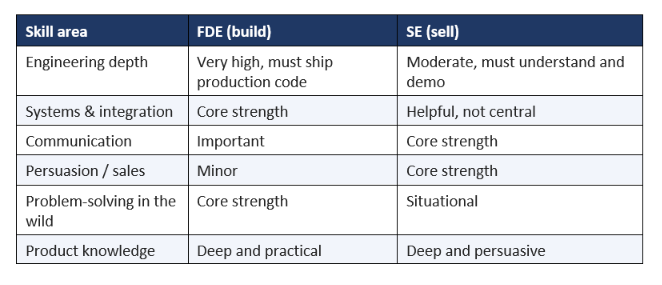
The takeaway for a career choice: if you love building things that work in the real world and owning delivery, the FDE path fits. If you love explaining technology, winning people over, and the energy of the deal, the SE path fits. Both are strong, well-paid technical careers. They reward different instincts, so choose the one that matches yours.
Salary: FDE vs Solutions Engineer
Both Forward Deployed Engineers and Solutions Engineers are well paid, and in the AI era FDE compensation has climbed sharply because shipping AI reliably is scarce and valuable. FDEs typically earn strong engineering-plus compensation, reflecting that they must both build production systems and work directly with customers. Solutions Engineers earn a competitive package too, often with a variable, commission-linked component tied to sales, since their impact shows up in closed deals.
The structural difference is worth understanding. An FDE's pay looks like a senior engineer's, weighted to base and equity, because the value is in delivery. An SE's pay looks like a technical sales role, with a meaningful bonus or commission tied to the pipeline they help close. Which is higher depends on the company, the market, and, for the SE, how sales performed. For detailed India bands on the FDE side, see our forward deployed engineer salary guide and the broader AI jobs in India salary guide.
The honest headline: both roles pay well, and the gap between them matters less than fit. Pick the role whose work you want to do, because a strong performer in either is highly compensated, and a reluctant fit in the higher-paying one will underperform and out-earn nobody.
When a Company Needs Both Roles
Larger companies that both sell and deploy technical products often need both roles, working in sequence across the customer journey. The Solutions Engineer wins the deal by proving the product fits, and the Forward Deployed Engineer then delivers the working system that keeps the customer. Skimp on the SE and good products lose winnable deals to weaker competitors who sell better. Skimp on the FDE and you win deals you cannot deliver, which is worse, because a customer who bought and never got a working system churns and warns others.
The handoff between them is where a lot of value is won or lost. When an SE oversells what the product can do, the FDE inherits an impossible promise. When the SE sets honest expectations and documents the customer's real requirements, the FDE starts from a solid base. In healthy organisations the two roles talk constantly: the SE learns from what the FDE can actually ship, and the FDE learns from what the SE is promising. They are two halves of one customer outcome.
For most mid-market companies adopting AI, though, you are not selling anything, you are buying and deploying, so you need FDE-style delivery, not an SE. The both-roles situation mainly applies to vendors selling AI products. If you are the company trying to get AI working internally, the role you are missing is almost always the Forward Deployed Engineer.
Career Path Into Each Role
Both roles are reachable from a software or technical background, but they branch toward different strengths, so knowing the path helps you steer a career. The Forward Deployed Engineer path runs through building: software engineering, systems and integration work, and the habit of shipping things that survive real use. If you can build, debug in messy environments, and talk to customers, you can grow into an FDE, and AI deployment experience accelerates it fast.
The Solutions Engineer path runs through communication plus enough technical depth to be credible: many SEs come from engineering, support, or technical consulting and lean into demoing, explaining, and persuading. If you enjoy being the person who makes complex technology click for a room and you thrive on the energy of a deal, the SE path fits. The technical bar is real but the differentiator is communication and product storytelling.
- Toward FDE: deepen engineering, integration, and deployment skills; build and ship real systems; get comfortable in messy customer environments.
- Toward SE: sharpen demos, technical communication, and objection handling; learn the product deeply; get comfortable driving a deal.
If you are weighing the AI-heavy version of the FDE path specifically, our guide to how to become a Forward Deployed Engineer in India lays out the roadmap, and the Agentic AI Launchpad concepts are a strong foundation for the build skills an FDE needs.
A Real Example: One Deal, Two Roles
Here is how the two roles play out on a single customer, illustratively. A mid-market company is evaluating an AI document-processing product. In the evaluation, a Solutions Engineer runs a tailored demo on the company's sample documents, answers the CTO's questions about security and integration, builds a quick proof of concept, and handles the objection that it will not work with their legacy system. The company signs. That is the SE's win, and their job is essentially done at the signature.
Then the Forward Deployed Engineer takes over. They embed with the company, discover that the real documents are far messier than the demo samples, build the OCR and language handling, wire the output into the no-API legacy system through automation, add evals and an approval step, and get the system live in a few weeks. That is the FDE's win, and it is what turns a signed contract into a customer who renews. Same deal, two roles, sequential, and both necessary for the outcome to be real.
Common Myths About the Two Roles
A few persistent myths keep companies hiring the wrong role, so it is worth clearing them up directly.
- Myth: they are basically the same job with different titles. They are opposite jobs, one sells and one ships, that happen to share a customer-facing, technical surface.
- Myth: an FDE is just a consultant. An FDE builds and owns production systems, not slide decks and recommendations; the output is running software, not advice.
- Myth: a Solutions Engineer can deploy the system after selling it. Selling and shipping are different skills; expecting the SE to also deliver the full production system is how deals get won and then never delivered.
- Myth: you only need one or the other forever. Vendors selling AI need both across the journey; companies adopting AI mainly need the FDE side.
The myth behind the myths is that customer-facing plus technical equals one role. It does not. The stage (pre-sale versus post-sale) and the goal (win versus ship) define two distinct jobs, and treating them as one is exactly how companies end up with a great pitch and no working system, or a builder and nothing to build.
Do You Still Need an FDE if You Bought an AI Tool?
Often yes, because buying an AI tool rarely delivers a working system on its own, and the gap between the tool and your workflow is exactly FDE work. A purchased tool gives you the model layer and some generic integration, but it does not know your messy data, your legacy systems, or your specific process. Someone has to close that last mile, and that someone is doing Forward Deployed Engineering whether or not they carry the title.
This is why so many companies buy an AI tool, feel underwhelmed, and conclude AI does not work for them. The tool was fine; nobody did the FDE work to fit it to their reality. The Solutions Engineer who sold it was never going to embed and build that fit, and the company had no FDE to do it either, so the tool sat half-used. Buying software is not the same as deploying a system, a distinction we cover in build, buy, or hire.
So even on the buy path, budget for FDE-style delivery to actually get value from the tool. The purchase price is only part of the cost; fitting it to your workflow is the rest, and that fitting work is Forward Deployed Engineering. A tool plus an FDE ships. A tool alone often just sits there.
Which One Does Your Company Need?
Your company needs a Solutions Engineer if you are selling a technical product and need to win technical buyers, and a Forward Deployed Engineer if you are deploying AI and need it to actually work in production. The two roles solve opposite problems, so the choice follows directly from which problem you have. If your issue is closing deals with skeptical technical buyers, hire an SE. If your issue is that a bought or built AI product is not shipping into your real systems, hire, or engage, an FDE.
For a company adopting AI rather than selling it, the FDE side is almost always what you need. You do not need someone to sell you AI, you need someone to make it work on your data and your systems, which is the whole premise of the forward deployed engineer role and the build-buy-hire decision. That is why the DEPLOY program is built around FDE-style delivery: shipping working AI into your company, not demoing a product to you.
The simplest test: do you need someone to convince you to buy, or someone to make it work after you have? Convince equals Solutions Engineer. Make it work equals Forward Deployed Engineer. Most companies with a stalled AI initiative do not have a selling problem, they have a shipping problem, and the FDE is the answer to a shipping problem.
So the final word on FDE vs Solutions Engineer is that the titles matter less than the outcome you are buying. If the outcome is a won deal, that is Solutions Engineering. If the outcome is a working system in production, that is Forward Deployed Engineering. Name the outcome you actually need, hire for that, and you will never confuse the two roles again, nor pay for a demo when what you needed was a system. The role that ships your AI is the Forward Deployed Engineer, and for a company adopting AI rather than selling it, that is almost always the one worth investing in first.
Frequently Asked Questions
What is the difference between a Forward Deployed Engineer and a Solutions Engineer?
A Solutions Engineer is a pre-sales role that demos the product and helps win the deal, while a Forward Deployed Engineer is a post-sale delivery role that embeds with the customer to build and ship a working system on their real data. In short, the SE helps you buy and the FDE makes it work.
What does a Forward Deployed Engineer do?
A Forward Deployed Engineer embeds with a customer after the sale to build and deploy a working system on the customer's real data and systems. They own the messy 80 percent of production, the integrations, the data handling, the edge cases, the evals, and the reliability, through to the system running for real users.
Is an FDE a pre-sales or post-sales role?
A Forward Deployed Engineer is a post-sales delivery role. They come in after the deal is signed to actually build and ship the system. This is the opposite of a Solutions Engineer, who works pre-sales to help the customer evaluate and decide to buy the product.
Which pays more, FDE or Solutions Engineer?
Both are well paid, and which is higher depends on the company and market. FDE pay is structured like a senior engineer's, weighted to base and equity, while SE pay is a technical sales package often with commission tied to deals. In the AI era, FDE compensation has risen sharply because reliably shipping AI is scarce.
Which role does my company need?
If you are selling a technical product and need to win technical buyers, you need a Solutions Engineer. If you are adopting AI and need it to actually work in production on your systems, you need a Forward Deployed Engineer. Most companies with a stalled AI project have a shipping problem, which is the FDE's specialty.
Can a Solutions Engineer become a Forward Deployed Engineer?
Yes, the transition is common, since both are technical and customer-facing. Moving from SE to FDE means shifting from demoing and persuading to building and shipping production systems, which requires deeper engineering and integration skills. Many strong FDEs come from SE, consulting, or software engineering backgrounds.
Why has the FDE role become important in AI?
The FDE role grew because AI has a huge gap between a demo that sells and a system that works, and someone has to own the second half. As AI deployments proved hard to ship, companies needed builders who embed with customers and cross the demo-to-production gap. The FDE is the answer to the fact that most AI pilots never reach production.
Do FDEs and SEs work together?
Often yes. On a full customer journey, the Solutions Engineer helps win the deal, and the Forward Deployed Engineer takes over to deliver the working system. They are sequential rather than overlapping: the SE owns up to the signature, the FDE owns from the signature to the system running in production.
Is a Forward Deployed Engineer the same as a consultant?
No. A consultant typically advises and produces recommendations, while a Forward Deployed Engineer builds and owns a working production system. The FDE's output is running software on the customer's real data and systems, not a report. They embed like a consultant but ship like an engineer, which is the rare combination that makes the role so valuable in the AI era.
Do I need an FDE if I already bought an AI tool?
Usually yes. A purchased AI tool gives you the model and generic integration, but fitting it to your messy data, legacy systems, and specific workflow is separate work, and that last-mile fitting is Forward Deployed Engineering. Many companies buy a tool, skip the FDE work, and conclude AI does not work, when really nobody deployed it properly. Budgeting for FDE-style delivery alongside any AI purchase is what turns a half-used tool into a working system that earns its cost.
Recommended Blogs
- Forward Deployed Engineer Salary India 2026 (Bands)
- Build, Buy, or Hire: The AI Decision for a 20-Engineer Company
- Why AI POCs Never Reach Production (2026 Blueprint)
- AI Jobs in India Salary (2026): Complete Pay Guide
- What Is Agentic AI? Complete Beginner's Guide

