



A great AI demo and a real AI system are indistinguishable for exactly as long as the demo lasts. Then a real user shows up with messy data, an unexpected edge case, and a reasonable expectation that it simply works every day, and the difference becomes total and obvious. The demo was the easy twenty percent; the system is the eighty percent nobody saw. This is the concrete list of the eleven things that separate the two, so you can hold any AI project against it and know instantly which one you are looking at.
I wrote this as a checklist on purpose, because the demo-to-system gap is vague until you make it specific. When someone shows you an impressive AI demo, you should be able to run down eleven questions and see the gaps light up. Every item is something a demo can skip and a system cannot. Let me go through all eleven, then give you the checklist to score your own project.
Demo vs System: Why They Look the Same
A demo and a system look the same because a demo is a system with all the hard parts removed and hidden. On stage, the model produces a great answer, and that is all the audience sees, so they assume the rest exists. It does not. The demo runs on clean data nobody had to wrangle, touches no real systems, handles no failures, needs no permissions, and answers to no one on Monday. It is the visible ten percent of an iceberg presented as the whole thing.
This is why demos are such unreliable predictors of production success, and why so many impressive pilots die, a pattern we cover in the POC graveyard. The demo proves the model works, which was rarely the question. It says nothing about the eleven things below, which are what actually determine whether the project ships. The gap between demo and system is not a mystery; it is these eleven concrete things, each invisible in a demo and essential in production.
So the value of naming the eleven is that it turns a vague worry, will this actually ship, into a specific audit. Instead of being dazzled by output, you check for real data, integrations, evals, and the rest. The demo can only hide the gaps for so long; the checklist reveals them now, while you can still act on them instead of discovering them the hard way in production.
The 11 Things, at a Glance
Eleven concrete things separate a real AI system from a demo, and a system needs all of them. Here they are before we go deep.
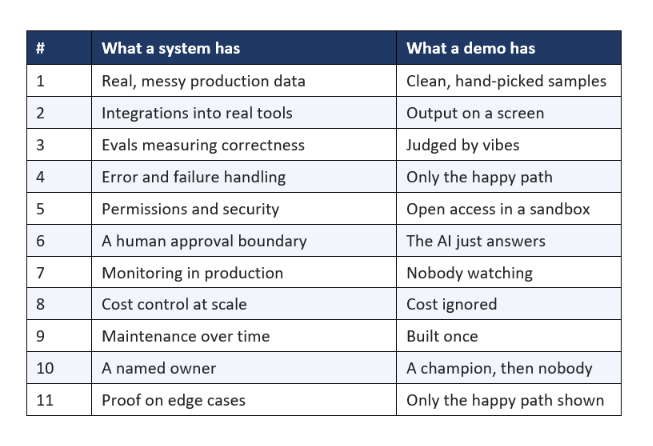
Read the two columns and the demo-to-system gap stops being abstract. Every row is a real requirement a system meets and a demo skips. Now let me go through them in groups, because understanding why each matters is what lets you spot its absence.
1 to 4: Data, Integration, Evals, Errors
The first four items are the foundation: what the system runs on and whether it can be trusted to run at all. A demo shows none of them because it does not need to, and a system needs all four before it can face a single real user.
1. Real, messy production data
A system runs on real data; a demo runs on a clean sample. Production data is messy, inconsistent, multilingual, and includes the unreadable slice a demo never shows. A real system is tested and built around that mess, with handling for the cases the model cannot cleanly process. If a project has only ever seen tidy examples, it is a demo, no matter how good it looks.
2. Integrations into real tools
A system reads from and writes to the tools the business runs on; a demo shows output on a screen. Real integration means connecting to the ERP, CRM, or portal, often through systems with no API, so the AI's work actually lands where people use it. A demo skips this entirely, which is why its impressive output goes nowhere.
3. Evals that measure correctness
A system is measured by evaluations on real cases; a demo is judged by how it felt in the room. Evals are repeatable tests that score whether the AI is right, so you can catch regressions and prove it works. Without them you have a lucky demo, not a system, because you cannot tell whether it is right or getting worse.
4. Error and failure handling
A system handles the day something breaks; a demo assumes everything works. Real systems plan for a dependency being down, a bad input, or an uncertain model output, with fallbacks and alerts. A demo never shows failure because in a demo nothing fails, which is exactly why it collapses the first time reality intervenes in production.
5 to 8: Permissions, Approval, Monitoring, Cost
The middle four items are about operating safely and sustainably once real users and real volume arrive. They are pure production concerns, which is exactly why a demo, with no real users and no scale, skips every one of them.
5. Permissions and security
A system respects who can see and do what; a demo runs with open access in a sandbox. Real users mean real data access rules, authentication, and security, because the system touches sensitive information and real actions. A demo ignores this because it has no real users and no real data to protect.
6. A human approval boundary
A system defines what the AI may do alone versus what needs a human; a demo just answers. In production the AI often takes actions, and deciding which are autonomous and which need sign-off is a governance requirement, especially for irreversible steps. A demo has no boundary because it never acts on anything real.
7. Monitoring in production
A system is watched while it runs; a demo has nobody watching. Monitoring surfaces problems early, before users notice, so drift and failures get caught and fixed. Without it, a system degrades silently until people stop trusting it. A demo needs no monitoring because it runs once, in front of a friendly audience.
8. Cost control at scale
A system manages its running cost; a demo ignores cost entirely. At real volume, token costs, compute, and latency matter, and a system is designed to control them, choosing the right model per task and avoiding waste. A demo runs a handful of times so cost never registers, which is why month-four bills surprise teams that only ever built a demo.
9 to 11: Maintenance, Owner, Edge Cases
The final three items are about surviving over time, and they are the ones teams most often forget because a demo lives for ten minutes and never has to last. A system, by definition, has to keep working long after the applause, and these three are what let it.
9. Maintenance over time
A system is maintained; a demo is built once and frozen. Real systems face changing data, model updates, and shifting requirements, so they need ongoing upkeep to keep working. Month four is when the maintenance need bites, and a project with no maintenance plan quietly degrades. A demo never faces month four.
10. A named owner
A system has a named owner accountable for it on Monday; a demo has a champion who moves on. Someone must run it, approve it, handle exceptions, and fix it, or it rots, because software nobody owns is software nobody maintains. This is the single strongest predictor of whether a project survives, as we argue in why AI pilots fail.
11. Proof on the edge cases
A system is proven on the hard cases; a demo shows only the happy path. Anyone can demo the case that works, and every technical buyer knows it. The proof of a real system is what it does with the twelve percent of inputs that are messy, ambiguous, or unreadable. If a project has only ever shown the happy path, it has not proven it is a system.
Where Most Projects Lose Points
When you score real AI projects against the eleven, they tend to fail on the same handful of items, and knowing which ones helps you focus. The model layer is almost always fine, and most projects have decent data handling once pushed. Where they consistently lose points is the control and survival items: evals, monitoring, the approval boundary, maintenance, and an owner. These are the least visible and the most skipped, which is exactly why they are where projects die.
Evals are the most commonly missing item of all. Very few stalled projects ever built a way to measure whether the AI is right on real cases, which means they cannot prove it works or catch it getting worse. A close second is the owner: projects launched by a champion with nobody named to run them on Monday. Monitoring and maintenance follow, because both are invisible until something breaks. If you fix only three items across your AI projects, make them evals, an owner, and monitoring, because that is where most of the lost points are.
The pattern is that projects lose points on the unglamorous, invisible items, never on the model. This mirrors the whole theme of the FDE series: the model is the easy part, and the systems discipline around it, measurement, ownership, and operations, is what actually ships. Score honestly, and you will almost always find your gaps in the same place everyone else does.
The Checklist: Score Your Own Project
Turn the eleven into a scorecard and you can grade any AI project in minutes. Give one point for each item your project genuinely has, and read the total honestly.
- Real, messy production data, not a clean sample.
- Integrations into the real tools the workflow uses.
- Evals measuring correctness on real cases.
- Error and failure handling for when things break.
- Permissions and security for real users and data.
- A defined human approval boundary for actions.
- Monitoring of the live system.
- Cost control at real volume.
- A maintenance plan for over time.
- A named owner accountable on Monday.
- Proof it works on the edge cases.
Score 9 to 11 and you have a system. Score 4 or below and you have a demo with ambitions, however good it looks. The middle is a project on its way, with a clear list of what to build next. The point of the scorecard is not to judge, it is to direct: the missing items are exactly the work between your pilot and production, which is the 80 percent we cover across the FDE series and in why AI POCs never reach production.
How the Eleven Map to the Three Layers
The eleven items are not a random list, they map cleanly onto the three layers of a production AI system, which is why a system needs all of them. Real data and integrations are the data and integration layer. Evals, error handling, permissions, the approval boundary, monitoring, and cost control are the control layer. Maintenance, ownership, and edge-case proof are what keep the whole stack alive over time. A demo builds only the model layer, so it lands none of the eleven.
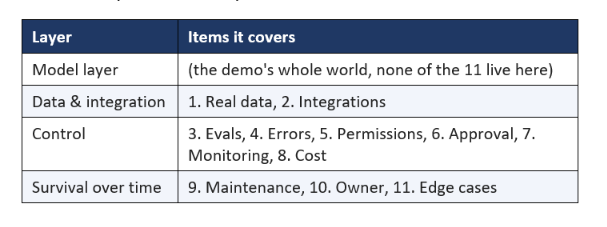
Seeing the map makes the demo-to-system gap unmistakable: the demo is one layer, the system is three, and the eleven items are what those extra layers actually contain. For the full architecture behind this, see our companion post on the 3 layers of an AI system that survives real users. The eleven items and the three layers are two views of the same truth: the model is the easy part, and everything around it is the system.
The Cost of Mistaking a Demo for a System
Mistaking a demo for a system is one of the most expensive errors in enterprise AI, because it leads companies to greenlight, budget, and promise based on the ten percent that was easy. Leadership sees a flawless demo, assumes the project is nearly done, sets a timeline, and tells stakeholders it is coming. Then the eighty percent, the eleven items, turns out to be the real project, the timeline slips, the promise breaks, and the whole initiative loses credibility even though nothing was technically wrong with the model.
The deeper cost is the false lesson. When a demo-mistaken-for-a-system fails to ship, the organisation often concludes that AI does not work for them, when the truth is that nobody built the eleven things. That learned pessimism then blocks the next, better-run attempt. One demo mistaken for a system can sour a company on AI for a year, which is far costlier than the wasted build, and it is entirely avoidable by judging projects on the eleven items instead of the demo.
This is why the checklist matters beyond any single project: it protects the organisation's judgement. A team that habitually scores AI projects against the eleven never confuses a demo for a system, never over-promises on the strength of a demo, and never learns the wrong lesson when a demo-only project stalls. The checklist is cheap insurance against a very expensive mistake.
A Real Example: Same Project, Demo vs System
Here is an illustrative contrast of the same idea built as a demo and as a system, so the eleven items feel concrete. A team wants AI to answer customer support tickets from their help centre. The demo version takes an afternoon: paste a few clean tickets, the model drafts great replies, everyone is impressed. That version has item three partially and none of the other ten, and it will never survive real users.
The system version takes weeks and earns its keep. It ingests real tickets including the angry, vague, and multilingual ones (item 1), pulls answers from the live help centre and writes drafts into the real support tool (item 2), scores reply quality on real tickets (item 3), handles the cases it cannot answer (item 4), respects who can see what (item 5), routes sensitive replies to a human (item 6), is monitored in production (item 7), controls token cost at volume (item 8), is maintained as the help centre changes (item 9), has a named support-ops owner (item 10), and is proven on the hard tickets, not just the easy ones (item 11).
Same idea, same model, but one is an afternoon's demo and the other is a system with eleven parts. Six months later the demo is a memory and the system is handling most of the support queue. The gap between them was never the model, it was the eleven things, which is the entire point of the checklist: it makes the invisible work visible before you mistake the afternoon for the achievement.
Why Demos Skip All Eleven
Demos skip all eleven items for one simple reason: a demo is designed to impress, not to survive, and none of the eleven help it impress. Clean data demos better than messy data. Screen output demos better than a real integration. Nobody asks about evals, monitoring, or maintenance in a demo, because the demo lasts ten minutes and never faces month four. Every one of the eleven is invisible on stage and essential in production, so a demo rationally leaves them all out.
This is not dishonesty, it is the nature of a demo, but it is why judging AI by demos is a trap. The applause is for the model layer, the one part the eleven items are not even about. When leadership sees a great demo and greenlights it as nearly done, they are rewarding the ten percent and ignoring the ninety percent that the eleven items represent. The fix is cultural: greet an impressive demo with the checklist, not applause.
So the last word is to use the eleven as your lens. The next time an AI demo dazzles a room, run the checklist out loud, where is the real data, the integration, the evals, the owner. A team that can answer has a system in the making. A team that goes quiet has a demo, and now everyone knows what is left to build. That clarity, not the demo, is what actually gets AI shipped. Score every project against the eleven, and you will always know exactly what stands between your pilot and production.
Frequently Asked Questions
What is the difference between an AI demo and a production system?
A demo is an AI model producing good output on clean data in a controlled setting, judged by how it feels. A production system does the job reliably every day on real messy data, inside real tools, for real users, with evals, monitoring, security, an approval boundary, maintenance, and an owner. The eleven things in this post are exactly what the system has and the demo lacks.
What makes an AI system production-ready?
An AI system is production-ready when it has real data handling, real integrations, evals, failure handling, permissions and security, a human approval boundary, monitoring, cost control, maintenance, a named owner, and proof it works on edge cases. Missing several of these means it is still a demo or pilot, not a production-ready system.
Why do AI demos not become products?
AI demos fail to become products because they skip the eleven things a real system needs, all of which are invisible on stage and essential in production. The model usually works; what is missing is the data, integration, evals, controls, and ownership around it. Building those, the 80 percent, is what turns a demo into a product.
What does a real AI system need?
A real AI system needs real messy data, integrations into your tools, evaluations, error handling, permissions, an approval boundary, monitoring, cost control, maintenance, a named owner, and proof on the edge cases. These eleven requirements are the difference between a system that survives real users and a demo that impresses once and dies.
How do I know if my AI project is a demo or a system?
Score it against the eleven items: give one point for each your project genuinely has. Nine to eleven means a system, four or below means a demo, and the middle is a project on its way with a clear list of what to build. The missing items are precisely the work between your pilot and production.
Is an AI pilot the same as a demo?
A pilot sits between a demo and a system: more than a staged demo, but usually still missing several of the eleven items, which is why so many pilots stall. A pilot becomes a system only when it has real data, integrations, evals, controls, maintenance, and an owner. Judge a pilot by the checklist, not by how promising it seems.
Which of the eleven matters most?
No single item is sufficient, but a named owner and evals are the two most often missing and most decisive. Without an owner, the system rots because it is nobody's job; without evals, nobody can tell if it works or is getting worse. Start with those two, then fill in the rest, but a real system genuinely needs all eleven.
How long does it take to turn a demo into a system?
A focused single-workflow demo can become a production system in weeks when the eleven items are scoped and built deliberately from the start. Projects that drag for months are usually stuck on the data, integration, or ownership items they never planned for. The demo is fast; the eleven things are the real timeline.
Which of the eleven do teams skip most often?
Teams most often skip evals, a named owner, and monitoring, because all three are invisible in a demo and only matter once real users arrive. Evals are the single most commonly missing item, since very few stalled projects ever built a way to measure whether the AI is right. Fixing evals, ownership, and monitoring closes most of the gap between a typical pilot and a real system.
Can a demo ever be enough on its own?
A demo is enough to validate an idea or win buy-in, but never enough to serve real users, because it lacks all eleven of the things a system needs. Treating a demo as a finished product is the core mistake behind most failed AI initiatives. Use a demo to decide whether to build, then build the eleven things to turn it into something people can actually rely on.
Recommended Blogs
- Why AI POCs Never Reach Production (2026 Blueprint)
- The POC Graveyard: 6 Reasons AI Demos Never Ship
- The 3 Layers of an AI System That Survives Real Users
- AI Pilots Don't Fail on Accuracy. Nobody Owns Them on Monday.
- Forward Deployed Engineer Salary India 2026 (Bands)

