



The Forward Deployed Engineer has quietly become one of the best jobs in AI, and almost nobody in India is deliberately training for it. While everyone chases the same model-research and data-science roles, the FDE, the person who actually gets AI working inside real companies, is scarce, in demand, and well paid. If you can build software, learn to deploy AI on messy real systems, and talk to customers, this role is wide open. This is the practical guide to becoming a Forward Deployed Engineer in India in 2026.
I will keep this concrete, because a career guide is only useful if you can act on it. By the end you will know exactly what an FDE does, the skills to build, the backgrounds that lead in, a step-by-step roadmap, the portfolio that gets you hired, what the role pays, and how to prepare for the interview. No fluff, just the path.
What Is a Forward Deployed Engineer?
A Forward Deployed Engineer is a builder who embeds with a customer to design, build, and ship a working AI system on the customer's real data and systems. The name says it: they are deployed forward, out of the vendor's office and into the customer's reality, to make AI actually work there. They own the hard 80 percent of getting AI into production, the messy data, the integrations, the edge cases, the reliability, and the last-mile fit, which is exactly the part that most AI projects never cross.
The role blends three identities: engineer, consultant, and problem-solver. Technical enough to build production systems, adaptable enough to work inside a customer's constraints, and pragmatic enough to ship something that runs rather than something theoretically elegant. It rose to prominence at companies like Palantir and has become central in the AI era, where the gap between a capable model and a working deployment is enormous. In short, the FDE is the person who turns a promising AI product into a live system inside a real company.
If you want the deeper contrast with the adjacent role people confuse it with, our post on Forward Deployed Engineer vs Solutions Engineer draws the line clearly: the Solutions Engineer sells, the FDE ships. Becoming an FDE means becoming the person who ships.
Why the FDE Role Is in Demand in India
The FDE role is in rising demand in India because most AI projects fail to reach production, and companies are realising the missing ingredient is people who can ship, not just models. India has a huge base of strong software engineers and a fast-growing wave of companies adopting AI, which creates a perfect gap: plenty of talent that can code, not enough that can cross the demo-to-production gap on real business systems. That gap is exactly the FDE's specialty.
Two forces make this especially strong in India. First, a large mid-market of companies with legacy systems and messy data that need AI fitted to their reality, not a generic tool, which is FDE work. Second, a booming AI startup and services scene where delivering working systems to clients is the whole business. Both need people who can embed, build, and ship, and both struggle to find them. Scarcity plus demand is why FDE compensation has climbed, as our forward deployed engineer salary guide for India details.
The honest opportunity here is timing. The role is well known enough to be well paid but still niche enough that few people are deliberately preparing for it. If you position yourself as someone who ships AI into real companies, rather than one more generalist engineer or aspiring data scientist, you stand out in a crowded market by pointing at the exact gap employers are desperate to fill.
The Skills You Need
Becoming a Forward Deployed Engineer requires three skill clusters: software engineering, AI and systems integration, and customer-facing delivery. You do not need to be world-class in all three on day one, but you need real competence across the set, because the role sits exactly where building, AI, and people meet. Here is what each cluster means in practice.
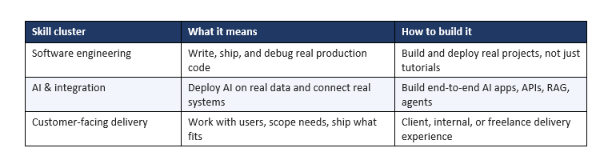
The specific technical skills that matter most in 2026: strong coding (Python is the default for AI work), building with LLM APIs and agent frameworks, retrieval and RAG, integrating with APIs and databases, and the automation patterns for systems with no API. Add the systems discipline of evals, monitoring, and reliability, and you have the technical core. Our guide to agentic AI and what MCP is cover foundational concepts worth mastering.
- Coding: Python plus general software engineering and debugging.
- AI building: LLM APIs, prompting, RAG, and agent frameworks.
- Integration: APIs, databases, and no-API automation patterns.
- Reliability: evals, monitoring, error handling, and security basics.
- People: clear communication, scoping, and shipping under real constraints.
Backgrounds That Lead Into the Role
There is no single degree or path into Forward Deployed Engineering, and that is good news, because it means several backgrounds can lead in. The most common is software engineering: if you already build and ship software, you add AI deployment and customer-facing skills and you are most of the way there. Data and ML backgrounds work too, especially if you shift from model-building toward shipping systems on real data. And technical consulting or solutions backgrounds can move in by deepening their engineering.
What all successful FDE backgrounds share is a bias toward shipping over theorising. The role rewards people who have built things that real users touched, not people who only studied or prototyped. A computer science degree helps but is not required, and many strong FDEs are self-taught or came through non-traditional routes, because the job is judged on what you can build and deploy, not on credentials. For a sense of the wider AI job market and pay context in India, see our AI jobs in India salary guide.
If you are early in your career, the fastest on-ramp is to become a strong software engineer first, then layer AI deployment on top, because the engineering foundation is the hardest part to fake and the most valued. If you are already experienced, the move is to deliberately take on end-to-end AI delivery, ideally with real customers, so you build the exact evidence FDE employers look for.
A Step-by-Step Roadmap
Here is a concrete roadmap to become a Forward Deployed Engineer in India, whether you are starting fresh or pivoting from an adjacent role. Adjust the pace to your starting point, but follow the sequence, because each step builds the evidence for the next.
- Get solid at software engineering. Learn to build, ship, and debug real applications, not just complete courses. This is the non-negotiable foundation.
- Learn to build with AI. Master LLM APIs, prompting, RAG, and at least one agent framework, and build small AI apps end to end.
- Learn the deployment 80 percent. Practice integrations, handling messy data, no-API automation, evals, and monitoring, the part that separates a demo from a system.
- Ship 2 or 3 real end-to-end projects. Build things that solve a real problem on real data, ideally for a real user, and document them.
- Target the right companies and apply. Focus on AI startups, AI services firms, and enterprises with delivery or FDE functions, and pitch yourself as someone who ships AI.
The whole roadmap is a progression from can code to can ship AI into a real company. Most aspiring AI professionals stop at step two, building demos, which is exactly why the FDE gap exists. Push through steps three and four, the deployment skills and the shipped projects, and you separate yourself from the crowd chasing the same model-centric roles.
Building a Portfolio That Gets You Hired
The single most effective thing you can do to get hired as an FDE is build a portfolio of shipped, end-to-end AI projects, because the role is judged on what you can deploy, not what you know. Two or three genuinely useful projects that run on real data and solve a real problem will beat any certificate. The projects should show the full stack of FDE work: an AI system that ingests messy real data, integrates with something, has some evaluation and reliability, and actually works.
What makes a portfolio project count for FDE hiring specifically is that it crosses the demo-to-production gap, at least in miniature. A chatbot that answers from clean sample data is a demo; a system that pulls real documents, handles the messy ones, writes results somewhere useful, and has a check on whether it is right is a small system, and that is what signals FDE potential. Build the second kind, and document your decisions: what was messy, how you integrated, how you knew it worked.
- Pick real problems, ideally for a real user, a local business, an NGO, or your own workflow.
- Use real, messy data, not a clean tutorial dataset.
- Integrate with something, an API, a database, or a no-API system via automation.
- Add a reliability touch, an eval, monitoring, or a human-in-the-loop step.
- Write it up, explaining the hard 80 percent, not just the model.
A portfolio like this does something a resume cannot: it proves you can ship, which is the entire FDE value proposition. When you can point to systems you deployed and explain the messy reality you handled, you are no longer claiming to be an FDE, you are showing it, and that is what gets you hired.
Salary and Companies Hiring
Forward Deployed Engineers are well paid in India, with compensation structured like a senior engineer's because the role demands both strong building and direct customer delivery. Pay rises quickly with proven ability to ship AI systems, since that skill is scarce. Rather than quote a single number that shifts with market and company, the practical guidance is that FDE compensation sits at the higher end of engineering pay, and our forward deployed engineer salary guide gives detailed bands.
As for who hires FDEs, the demand clusters in three places. AI product startups need FDEs to deploy their product into customers and keep them. AI services and consulting firms need them to deliver client projects, which is the whole business. And larger enterprises adopting AI increasingly build internal delivery or FDE-style functions to get AI working across the organisation. Global companies with the role, and India's growing AI ecosystem, both hire here.
- AI product startups: deploying and embedding their product with customers.
- AI services and consulting firms: delivering client AI projects end to end.
- Enterprises adopting AI: internal delivery and FDE-style teams.
The search tip that works: do not only search the exact title Forward Deployed Engineer, which is still emerging in India. Also look for AI delivery engineer, AI implementation engineer, AI solutions engineer with a delivery focus, and applied AI engineer roles, many of which are FDE work under a different name. Match the work, not just the title.
A Day in the Life of a Forward Deployed Engineer
Knowing what an FDE actually does day to day helps you decide whether the role fits you, because it is a different rhythm from a typical engineering job. An FDE spends real time with the customer, understanding their workflow, their systems, and their constraints, then switches to building the system that fits that reality. It is a blend of talking to people and writing code, of understanding a business problem and solving it in software, which is exactly what makes it distinct from a heads-down developer role.
A typical stretch of FDE work might look like this: sitting with the ops team to watch how they really process orders, discovering the legacy system has no API, designing an automation around it, building the data pipeline that handles their messy inputs, adding evals so everyone can trust the output, and setting up the human-approval step for the risky cases. Then demoing it to the actual users, adjusting based on what breaks in the real world, and handing it over with an owner in place. The work is varied, pragmatic, and close to the customer, which many builders find far more satisfying than abstract engineering.
If that mix of building and problem-solving in the real world appeals to you, the FDE role is a strong fit, and if you would rather never talk to a customer and only write code, it may not be. The role rewards people who like seeing their work actually used and who get energy from turning a messy real problem into a working system. That temperament, as much as the technical skill, is what makes a great FDE.
FDE vs Other AI Roles: Where It Fits
It helps to see where the Forward Deployed Engineer sits among the AI roles people usually consider, because the FDE is often the least crowded and most shippable path. Data scientists focus on models and analysis, ML engineers on training and infrastructure, and AI researchers on advancing the models themselves. The FDE is the one who takes all of that and makes it work inside a real company, which is a distinct and scarce skill.
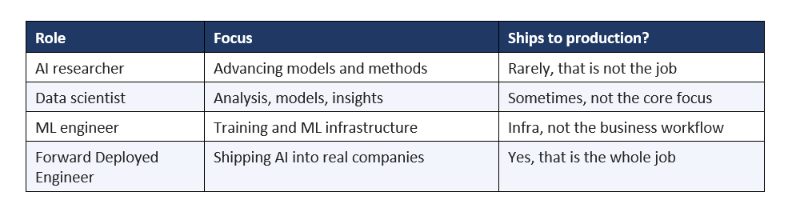
The strategic point for a career choice is that the FDE lane is less crowded than data science and closer to where companies actually feel pain: getting AI to work. If you enjoy building and shipping more than researching or pure analysis, the FDE path offers strong pay, rising demand, and less competition than the roles everyone else is chasing. It is the pragmatic builder's route into high-value AI work.
Common Mistakes Aspiring FDEs Make
A few mistakes slow down people trying to break into Forward Deployed Engineering, and avoiding them shortens the path considerably.
- Stopping at demos. Building impressive prototypes that never touch real data or ship, instead of end-to-end systems.
- Over-indexing on models. Chasing the latest model or research instead of the deployment skills that actually get you hired.
- Skipping the people side. Ignoring communication and scoping, when working with customers is half the role.
- Collecting certificates over shipping projects. Credentials help less than two or three real, documented deployments.
- Only searching the exact title. Missing FDE work listed as AI delivery, implementation, or applied AI engineer.
The thread through all of these is the same lesson the whole FDE series teaches: the value is in shipping, not in demos or theory. Aspiring FDEs who internalise that early, and who build and document real deployments, move faster than those who keep polishing prototypes or accumulating courses. Optimise for evidence that you can ship, because that is exactly what the role is judged on.
How to Prepare for FDE Interviews
FDE interviews test whether you can actually ship AI into a real, messy environment, so they blend coding, system design, and real-world problem-solving rather than pure algorithm puzzles. Expect to be asked how you would take a vague business problem and turn it into a working system, how you would handle messy data or a system with no API, and how you would know your solution is right. Your shipped projects are your best answers, so know them cold and be ready to discuss the hard 80 percent.
Prepare across three fronts. Technical: be fluent in building AI applications, integrations, and the deployment patterns, and be able to whiteboard how you would architect a real deployment. Problem-solving: practice reasoning aloud about ambiguous, messy scenarios, because that is the job. Communication: show you can talk to a non-technical stakeholder, scope a need, and set honest expectations, since FDEs work directly with customers. The candidate who says here is a system I shipped and here is the mess I handled beats the one who only solved a coding puzzle.
A strong closing move in any FDE interview is to bring the demo-to-production lens explicitly. When given a scenario, do not just describe the model, walk through the data, the integration, the evals, the failure handling, and the owner, the very things covered across this FDE series. Demonstrating that you think in systems, not demos, is exactly the signal an FDE employer is hiring for.
Frequently Asked Questions
What skills do you need to be a Forward Deployed Engineer?
You need three skill clusters: strong software engineering (coding, shipping, debugging), AI and integration (LLM APIs, RAG, agents, connecting real systems), and customer-facing delivery (scoping needs and shipping what fits under real constraints). The reliability discipline of evals, monitoring, and error handling ties them together. Competence across the set matters more than mastery of any one.
Do you need a specific degree to become an FDE?
No, there is no required degree for Forward Deployed Engineering. A computer science background helps, but many strong FDEs are self-taught or come from software, data, or consulting routes. The role is judged on what you can build and deploy, not on credentials, so shipped projects matter more than a specific degree.
How do I get a Forward Deployed Engineer job in India?
Build strong software and AI deployment skills, ship two or three real end-to-end projects on messy data, and target AI startups, AI services firms, and enterprises with delivery functions. Search beyond the exact title too, since AI delivery engineer, AI implementation engineer, and applied AI engineer roles are often FDE work under another name.
How much does a Forward Deployed Engineer earn in India?
FDE compensation in India sits at the higher end of engineering pay, structured like a senior engineer's because the role needs both building and customer delivery, and it rises quickly with proven ability to ship AI systems. Exact figures vary by company and experience; see our forward deployed engineer salary guide for detailed India bands.
Which companies hire Forward Deployed Engineers?
Three types hire FDEs: AI product startups deploying their product with customers, AI services and consulting firms delivering client projects, and enterprises adopting AI that build internal delivery or FDE-style teams. Both global companies with the role and India's growing AI ecosystem hire here, often under titles like AI delivery or implementation engineer.
Is Forward Deployed Engineering a good career?
Yes. Forward Deployed Engineering is a strong career in 2026: well paid, in rising demand, and built on a skill, reliably shipping AI into production, that is scarce and hard to automate. Because most AI projects never reach production, the people who can ship them are highly valued, and the role sits at the center of how companies actually get value from AI.
How long does it take to become an FDE?
If you are already a software engineer, adding AI deployment skills and shipping a few real projects can position you for FDE roles within several months of focused effort. Starting from scratch takes longer, since the software engineering foundation is the hardest part. The fastest path is to build the foundation, then deliberately ship end-to-end AI projects on real data.
What is the difference between an FDE and a data scientist?
A data scientist focuses on analysis, models, and insights, while a Forward Deployed Engineer focuses on shipping working AI systems into real companies. The FDE owns integration, reliability, and delivery, the engineering and customer-facing 80 percent, rather than model research. Some people move from data science to FDE by shifting toward building and deploying systems on real data.
Is Forward Deployed Engineering less crowded than data science?
Yes, the FDE lane is generally less crowded than data science in India, because most AI aspirants target research or analysis roles while few deliberately train to ship AI into real companies. That scarcity, combined with strong demand from companies struggling to deploy AI, makes the FDE path both less competitive and well paid for those who build the shipping skills.
Can I become an FDE without customer-facing experience?
You can start, but you should build some customer-facing experience, because working directly with users and stakeholders is half the role. If you lack it, get it through client projects, freelance delivery, internal cross-team work, or even documenting how you scoped and shipped a project for a real user. Pairing strong building with the ability to work with people is what completes the FDE profile.
What programming language should an FDE learn?
Python is the default language for AI and Forward Deployed Engineering work, since most LLM APIs, agent frameworks, and data tooling are Python-first. Beyond Python, general software engineering skill matters more than any single language, and knowing enough JavaScript or SQL to integrate with real systems helps. Focus on being able to build and ship, not on collecting languages.
Is the FDE role only at big tech companies?
No. While the role was popularised by companies like Palantir, FDE and FDE-style work is now spread across AI startups, AI services and consulting firms, and enterprises adopting AI, including many in India. The work exists anywhere companies deploy AI into real environments, often under titles like AI delivery or implementation engineer, so opportunities extend well beyond big tech.
Recommended Blogs
- Forward Deployed Engineer Salary India 2026 (Bands)
- Forward Deployed Engineer vs Solutions Engineer (2026)
- AI Jobs in India Salary (2026): Complete Pay Guide
- What Is Agentic AI? Complete Beginner's Guide
- Why AI POCs Never Reach Production (2026 Blueprint)

