



The model is the part of an AI system that everyone shows off, and it is the part that matters least to whether the system survives. That sounds backwards until you have watched a flawless demo die the first week real users touch it. The model was never the problem. The two layers beneath it, the ones nobody demos, are where a system lives or dies. This is the architecture of an AI system that actually survives real users, told in three layers.
I want to move you out of the mental model where AI is one thing, a clever model that answers questions, and into the one that ships: AI in production is a stack of three layers, and the model is just the top. Understand the three, and you will stop being surprised when demos fail and start building systems that do not. Let me walk through each layer, why demos only ever build the first, and how to build all three.
Model vs System: Why the Distinction Matters
An AI model is a component; an AI system is everything around that component that makes it useful in production. The model takes an input and produces an output. The system decides what input to give it, from what real data, through what integration, with what guardrails, checked by what evaluation, and written back to what tool for what user. Confusing the two is the single most expensive mistake in applied AI, because it makes people budget for a model and get blindsided by a system.
Here is the distinction that matters for your budget and your timeline. Choosing and prompting a model is a small, fast piece of work. Building the system around it, the data pipelines, the integrations, the evaluations, the monitoring, the approval flow, is the large, slow, expensive piece. When teams say AI is easy because the demo took a week, they built a model layer and called it a system. When they say AI is impossible because the pilot never shipped, they hit the two layers they never planned for.
This is why the demo-to-production gap exists, a gap we cover in depth in why AI POCs never reach production. The gap is not a mystery. It is the two layers below the model that a demo skips. Name the three layers, and the gap becomes a plan.
The 3 Layers at a Glance
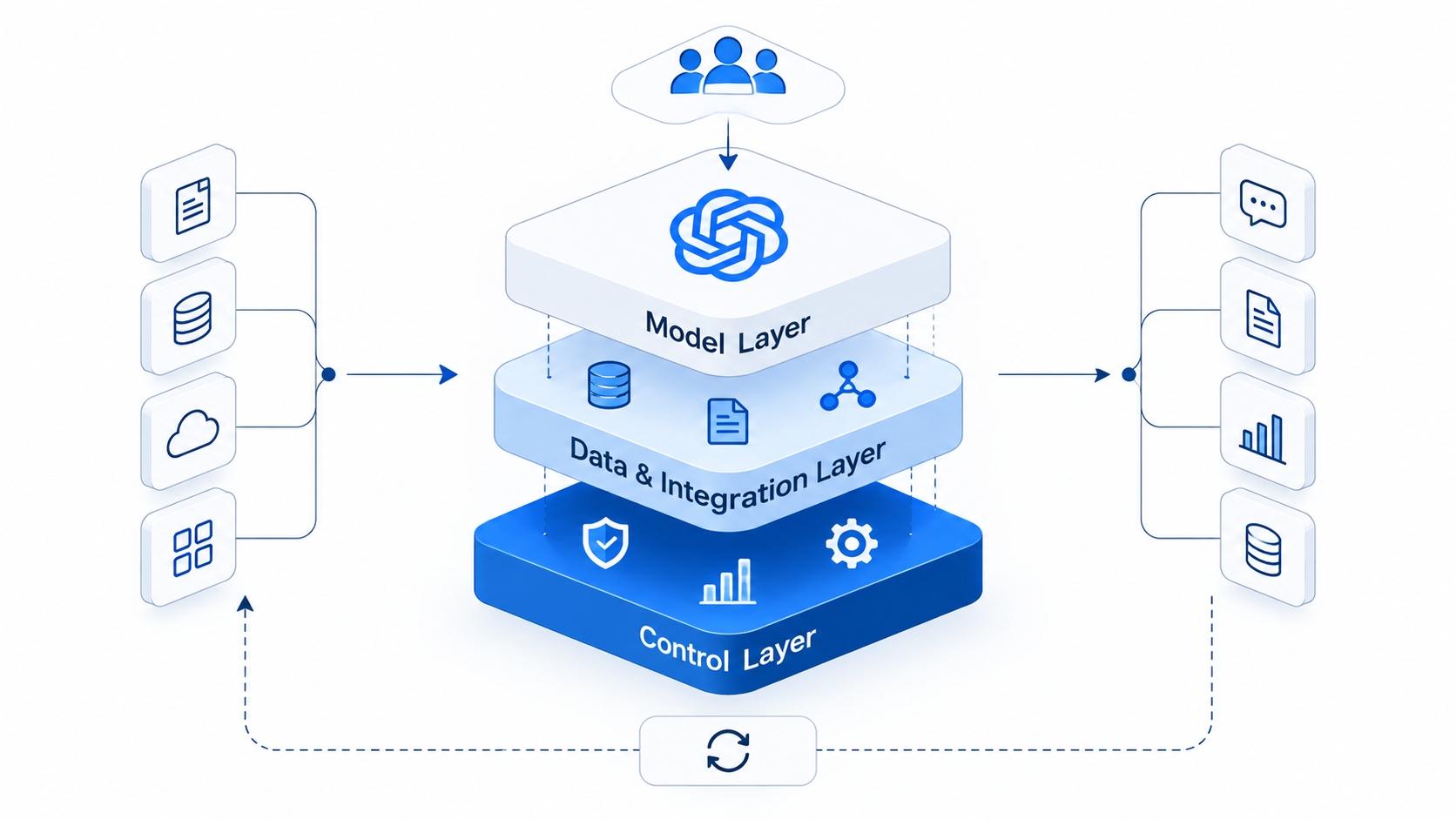
A production AI system stacks three layers, each with a distinct job, and a system survives only when all three are built. Here they are before we go deep on each.
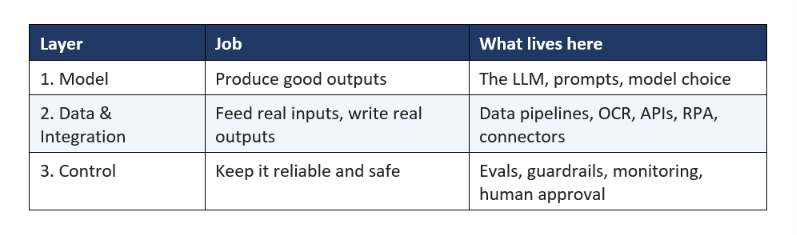
Notice the effort inverts the attention. Most teams spend most of their time on layer one, the model, and almost none on layers two and three. In a system that survives, it is the opposite: the model is a small slice of the work, and the data, integration, and control layers are where the real engineering goes. That inversion, more attention below the model than on it, is the whole secret to shipping AI that lasts.
Layer 1: The Model Layer
The model layer is the AI brain, the large language model plus the prompts and model choices that turn an input into an output, and it is the easiest layer to build. Picking a capable model and writing good prompts is real work, but in 2026 it is largely a solved, fast problem. Strong models are abundant, and our best AI models ranking shows how many good options exist. The hard part of a system is almost never here.
What belongs in this layer: choosing the right model for the task and budget, writing and testing prompts, deciding when to use a smaller cheaper model versus a frontier one, and structuring the model's inputs and outputs. This is the layer demos live in, and it is genuinely valuable, a good model well prompted produces good outputs. The mistake is not building this layer. The mistake is thinking this layer is the whole system.
My honest take: teams over-invest here because it is the fun, visible part. Endless model comparisons and prompt tweaking feel productive and demo beautifully, while the layers that actually determine production success sit ignored. Get the model layer good enough, then move your attention down the stack, because that is where the survival of your system is decided.
Layer 2: The Data & Integration Layer
The data and integration layer connects the model to your real, messy data and your real systems, and it is where most production effort actually goes. The model is useless if it cannot get the right input and put its output somewhere useful. This layer handles the unglamorous reality: pulling data from your sources, cleaning and normalising it, handling the scanned PDFs and mixed languages and inconsistent formats, and writing results back into your ERP, CRM, or workflow, often through systems with no clean API.
This is the layer that meets the real world head-on. Your demo ran on clean, hand-picked data. Production data is messy, and connecting to production systems is harder still, as we detail in can AI work with legacy systems. Getting a model to read a tidy sample is trivial. Getting it to read your actual archive, including the unreadable slice, and write into a 12-year-old system with no API, is the work. This layer is where weeks of a real project disappear, and where demos never went.
- Data ingestion: pulling from your real sources, files, databases, emails, and streams.
- Data handling: OCR for scans, language handling, normalising formats, and dealing with the unreadable cases.
- Integration: reading from and writing to your systems, via API, connectors, or automation where no API exists.
- Output routing: putting the model's result where a human or another system can actually use it.
Build this layer well and the model finally becomes useful, because it is fed real inputs and its outputs land where they matter. Skip it, and you have a brilliant model answering questions nobody asked with data it never really saw.
Layer 3: The Control Layer
The control layer is what keeps an AI system reliable, safe, and trustworthy in production, and it is the layer that separates a system from a lucky demo. It sits on top of the model and the data, watching what the system does and enforcing how it behaves. Without it, you cannot tell whether the system is working, cannot catch it when it drifts, and cannot safely let it act. This is the governance and reliability layer, and it is what a board is really asking about when it asks about AI risk.
Four things live in the control layer, and each is essential. Evaluations measure whether the system is right on real cases, so you can catch regressions and prove it works. Guardrails constrain what the model is allowed to output and do. Monitoring watches the live system so problems surface early instead of silently. And the human approval boundary defines what the AI may do alone versus what needs a person, especially for irreversible actions.
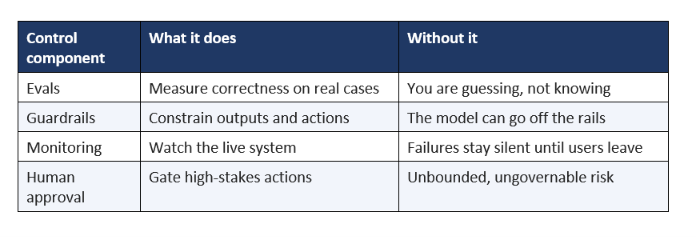
The control layer is the least glamorous and the most decisive. A demo has none of it, because in a demo nothing needs measuring or gating. A system that survives real users is mostly control layer, because real users find the edge cases, and only the control layer catches them. If you build one thing beyond the model, build this.
Why Demos Only Build Layer 1
Demos only ever build the model layer because that is all a demo needs, and that is precisely why demos mislead. In a controlled demo, the data is clean and hand-picked, so no data layer is required. Nothing is written back to a real system, so no integration is required. Nothing can go wrong in front of a friendly audience, so no control layer is required. A demo is a model layer with the other two layers deleted, presented as if it were the whole system.
This is why an impressive demo tells you almost nothing about whether a system will ship. It proves the model works, which was rarely in doubt, and says nothing about the two layers that actually determine production success. When leadership sees a great demo and assumes the project is nearly done, they are looking at one third of the system and mistaking it for the whole. The applause is for the easy layer.
The reframe is simple and freeing: judge an AI project by its data, integration, and control layers, not its demo. When someone shows you a model producing great output, ask where the real data comes from, how it integrates, and how it is evaluated and gated. Those questions reveal whether there is a system underneath, or just a demo, a pattern we explore in the POC graveyard.
How to Build All Three Layers
Building an AI system that survives means deliberately building all three layers, in the right order, with effort weighted toward the bottom two. Here is the sequence that produces a system instead of a demo.
- Get the model layer good enough, then stop. Pick a capable model, write solid prompts, and resist the urge to keep polishing. Good enough is the target here.
- Build the data layer on real, messy inputs. Ingest and handle your actual data, including the ugly cases, not a clean sample.
- Build the integration layer to your real systems. Connect input and output to the tools the workflow runs on, via API or automation.
- Add the control layer before you scale. Evals, guardrails, monitoring, and an approval boundary, so the system is measurable and safe.
- Assign an owner across all three. One person accountable for the whole stack running, because a system with no owner decays.
The order matters, but the weighting matters more. Spend a little time on the model and most of your time on the data, integration, and control layers, because that is where survival is engineered. This is exactly the discipline a Forward Deployed Engineer brings, and it is why the DEPLOY approach builds all three layers rather than handing over a demo. A team that internalises this stops chasing better models and starts building better systems, which is the shift that actually gets AI into production.
How the Three Layers Map to Cost
The three layers also explain why AI budgets get misjudged, because the cost is inverted from where people expect it. The model layer, the part everyone focuses on, is the cheapest, often just API fees and prompt work. The data, integration, and control layers, the parts nobody demos, are where the real money goes. A quote that prices only the model is not cheaper, it is incomplete, and the missing cost surfaces later as overruns.
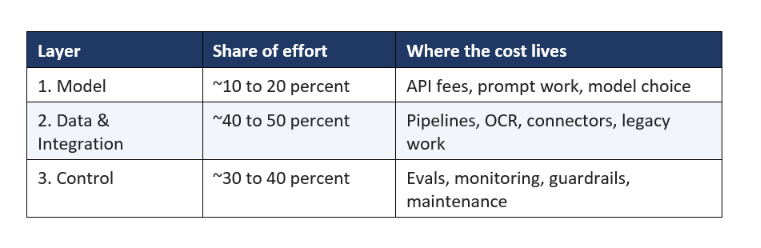
The percentages are illustrative, but the shape is real: the bottom two layers dominate the cost, just as they dominate the risk. This is why a serious estimate prices all three layers, and why our guide to what AI deployment actually costs in India spends most of its time on the work below the model. Budget for one layer, and you have budgeted for a demo, not a system.
A Real Example: One Workflow Across Three Layers
Here is an illustrative walk-through that makes the layers concrete. A company wants AI to read incoming supplier invoices and post them to their accounting system. In the demo, someone pastes a clean invoice and the model extracts the fields perfectly. That is the model layer, and it took an afternoon. Everyone is impressed, and the real work has not started.
Then the data and integration layer begins. Real invoices arrive as scanned PDFs, some in Hinglish, some photographed at an angle, and about a tenth are barely readable. The system needs OCR, language handling, normalisation, and a fallback for the unreadable ones. Then it must write into a 12-year-old accounting tool with no API, which means screen automation. This layer takes the bulk of the project, and it is invisible in the demo.
Finally the control layer makes it safe. Evals score extraction accuracy on real invoices, monitoring flags when accuracy drops, guardrails stop it posting nonsense, and any invoice above a value threshold routes to a human for approval. Only now is it a system that survives real users. Same workflow, but the demo was one layer and the shipped system was three, which is exactly why the demo took an afternoon and the system took weeks.
How to Audit Your AI System's Layers
You can audit any AI project in minutes by checking each layer for the things that make it real, and this is the fastest way to tell a system from a demo. Run these checks on your own project or on a vendor's pitch, and the gaps show up immediately.
- Model layer: Is a capable model chosen and prompted well, and has the team stopped over-tuning it? If all the effort is here, that is a warning sign.
- Data layer: Has it been tested on real, messy data including the unreadable cases, or only on a clean sample?
- Integration layer: Is every system the workflow touches mapped, with a confirmed way to read and write each, including the no-API ones?
- Control layer: Are there evals on real cases, monitoring, guardrails, and a defined human approval boundary?
- Ownership: Is one named person accountable for the whole stack running on Monday?
A project that passes all five is a system. A project that only passes the first is a demo wearing a system's clothes. The value of the audit is that it directs attention to the layers that actually decide success, instead of the model layer that always looks fine. Use it before you scale, before you buy, and before you believe a demo.
The Layer That Decides Whether Users Trust It
Of the three layers, the control layer is what decides whether real users keep trusting the system, and trust is what keeps a system alive. Users forgive a system that occasionally says I am not sure and routes to a human. They do not forgive a system that confidently does the wrong thing and nobody notices. The control layer, evals, guardrails, monitoring, and the approval boundary, is what prevents the second scenario, which is the one that kills adoption.
This is the quiet reason so many technically impressive pilots die after launch. The model was accurate enough, but with no control layer, the first confident mistake in front of a real user broke trust, and once trust breaks, people quietly revert to the old manual way and the system becomes shelfware. A modest system that users trust beats a brilliant one they have learned to double-check, because a system people bypass has an effective accuracy of zero.
The practical lesson: invest in the control layer not as compliance overhead but as the thing that earns and protects user trust. Evals prove it works, monitoring catches drift before users do, and the approval boundary keeps the high-stakes mistakes from ever reaching production. Build that, and users rely on the system. Skip it, and even a great model becomes something people work around.
Common Mistakes at Each Layer
Each layer has a signature mistake, and knowing them helps you catch a project drifting toward the graveyard.
- Model layer: over-investing here, endless model swaps and prompt tweaks while the real gaps go unbuilt.
- Data layer: testing on clean data and discovering the messy reality only in production.
- Integration layer: assuming every system has a clean API, then stalling on the one that does not.
- Control layer: shipping with no evals, so nobody can tell if the system is right or getting worse.
- Across all layers: no owner, so the system rots because it is nobody's job on Monday.
The pattern behind every mistake is the same: treating the model layer as the system. Build all three layers, weight your effort to the bottom two, and give the whole stack an owner, and you will have an AI system that survives real users instead of a demo that dazzled a meeting.
If you take one idea from this post, take the layered lens itself. The next time you see an AI demo, do not ask how good the model is, ask to see the data layer, the integration layer, and the control layer. Those three questions separate the projects that ship from the projects that get applause and die. A model is a component; a system is three layers with an owner, and only the second one survives contact with real users. Build the layers, and the demo finally becomes a system.
Frequently Asked Questions
What are the layers of a production AI system?
A production AI system has three layers: the model layer (the LLM, prompts, and model choice), the data and integration layer (pulling real data, handling messy inputs, and connecting to your systems), and the control layer (evals, guardrails, monitoring, and human approval). The model is only the top layer; most engineering effort goes into the bottom two.
Why do AI demos work but AI systems fail?
Demos work because they only build the model layer on clean, hand-picked data with nothing written back and nothing that can fail. Systems fail when the data, integration, and control layers, which a demo skips, are never built. The model was never the problem; the two layers beneath it are where production success is decided.
What is the difference between an AI model and an AI system?
An AI model is a component that turns an input into an output. An AI system is everything around it: the real data feeding it, the integrations to your tools, and the controls that keep it reliable and safe. Choosing a model is fast; building the system around it is the large, slow work that determines whether AI ships.
What is the control layer in AI?
The control layer is the part of an AI system that keeps it reliable and safe: evaluations that measure correctness on real cases, guardrails that constrain outputs and actions, monitoring that watches the live system, and a human approval boundary for high-stakes actions. It is what separates a trustworthy production system from a lucky demo.
How do you build AI that works for real users?
Build all three layers, weighting effort toward the bottom two: get the model good enough, build the data layer on real messy inputs, integrate with your actual systems, and add a control layer of evals, guardrails, monitoring, and approval before you scale. Then assign one owner for the whole stack, because unowned systems decay.
Which AI system layer is most important?
No single layer is sufficient, but the control layer is the one most often missing and most decisive for survival. A great model with no control layer produces impressive outputs you cannot trust or measure. For a system that survives real users, the control layer is what turns capability into reliability.
How long does it take to build a real AI system?
A focused single-workflow AI system built across all three layers typically ships in weeks when the hard data, integration, and control work is scoped from the start. Projects that drag for months are usually stuck in the data or integration layer they never planned for, not the model layer, which is fast to build.
Do small companies need all three layers?
Yes. The three layers are about architecture, not scale, so even a single-workflow system at a small company needs real data handling, integration, and controls to survive its users. What changes with size is the volume and complexity, not the need for all three layers. Skipping the bottom two is what sends small-company pilots to the graveyard.
Can I add the control layer after launching?
You can, but it is far better to build the control layer before you scale, because the control layer is what earns user trust, and trust is hardest to recover once lost. Launching without evals, monitoring, and an approval boundary means the first confident mistake reaches real users, breaks trust, and drives them back to the manual way. Add controls before real users, not after they leave.
Which layer should I invest in first?
Get the model layer good enough quickly, then invest most in the data and integration layer, and add the control layer before you scale. The order is model, then data and integration, then control, but the effort weighting is inverted: least on the model, most on the bottom two layers, because that is where a system survives or dies.
Recommended Blogs
- Why AI POCs Never Reach Production (2026 Blueprint)
- The POC Graveyard: 6 Reasons AI Demos Never Ship
- Can AI Work With Legacy Systems, or Must You Replace Them?
- Forward Deployed Engineer Salary India 2026 (Bands)
- What Is Agentic AI? Complete Beginner's Guide

