
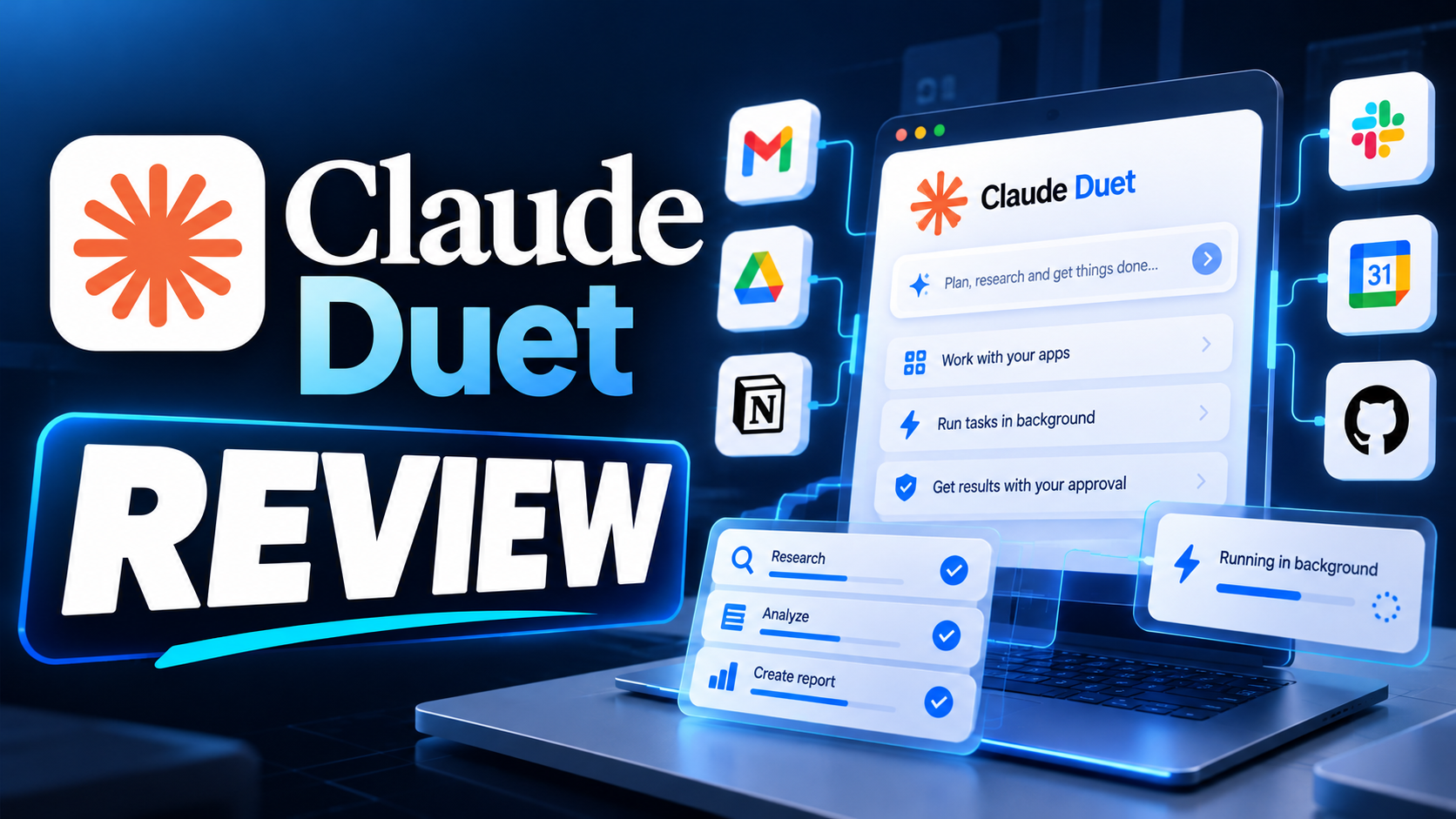
Claude Duet Review: Can Anthropic's Proactive AI Agent Actually Run Your Workday?
Claude Duet is Anthropic's new proactive AI agent for people who want more than a chatbot that waits for the next prompt. Instead of requiring you to open a conversation for every task, Duet can review connected apps, surface what needs attention, prepare work in the background and message you when it needs a decision. It is designed for professionals and small-business owners who spend too much time moving between email, calendars, documents and business tools.
Anthropic opened Claude Duet as a research preview on October 21, 2026. Access currently starts with users in the United States who have Claude Pro or Max subscriptions and receive an invitation through the waitlist. Duet is available as a standalone mobile app and through claude.ai, and it uses Claude Opus 5.5. During the preview, there is no separate Duet fee, but its background work counts against the usage limits of the connected Claude plan.
The central idea is useful: delegate a task, let the agent continue while you are away, and review the finished result or approval request when it is ready. But Claude Duet is not unrestricted autopilot. It checks connected accounts at intervals, can misjudge urgency, and asks for approval before sensitive actions such as sending messages, making payments, signing documents or deleting data.
QUICK ANSWER
Claude Duet is Anthropic's proactive AI agent app, powered by Claude Opus 5.5. It connects to the apps and services you authorize, can prepare morning briefings, draft replies, research companies, build documents or dashboards, and continue working in its own cloud computer after you leave. It is built around a persistent conversation, existing Claude memory and skills, connected apps, and review points for consequential actions.
As of October 22, 2026, Claude Duet is a waitlist-based research preview for US users on Claude Pro or Max. It is not yet available to Team or Enterprise subscribers, and Anthropic has not announced general availability for India. The preview is included with eligible subscriptions, but background monitoring and larger tasks consume the same usage allowance as ordinary Claude activity.
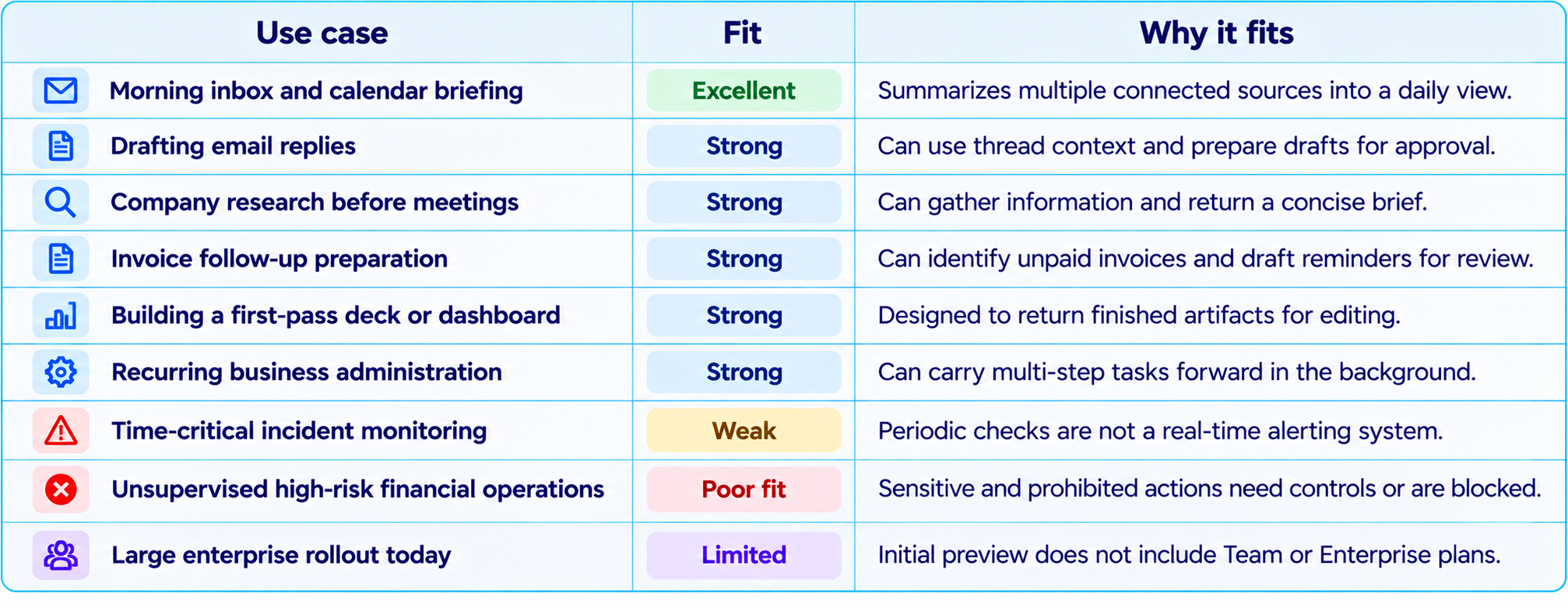
Its strongest use cases are email and calendar triage, small-business administration, invoice follow-up preparation, research briefs, document creation and multi-step work that benefits from connected tools. Its biggest trade-offs are limited regional access, shared usage limits, periodic rather than continuous account checks, and the need to review outputs before allowing important actions.
Verdict: Claude Duet is a compelling step toward a proactive AI work assistant. It is worth testing for eligible users who routinely juggle multiple apps and recurring tasks, but it should be treated as a supervised digital coworker rather than an autonomous employee.
1. What Is Claude Duet?
Claude Duet is a proactive agent built around delegation. The user describes a goal in ordinary language, by text or voice, and Duet determines which connected apps and steps may be needed. It can work in the background, use its cloud computer and browser, and return a completed artifact such as a research brief, financial model, slide deck or dashboard. It can also send a message when something needs the user's attention.
That changes the interaction pattern compared with a conventional chatbot. In a normal chat, the user initiates each step and stays close to the conversation. Duet is intended to take a larger assignment, maintain the task state and return when the work is complete or blocked by a decision. The product page describes this as a personal assistant that comes to you rather than waiting for you to open a chat.
The name should not be confused with unrelated products that also use the word Duet. This review refers specifically to Claude Duet from Anthropic, announced on October 21, 2026, not third-party model-routing services or unrelated collaboration tools.
2. Claude Duet at a Glance
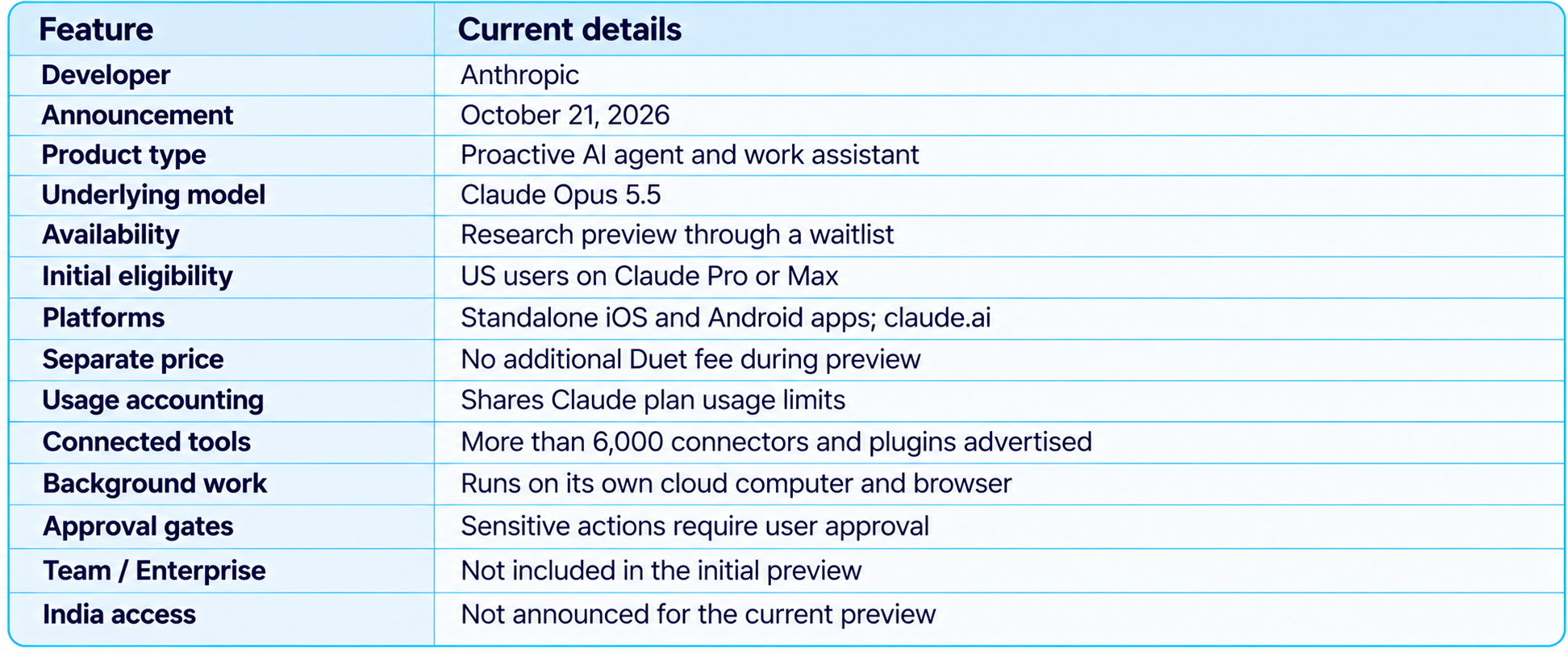
These details describe the current preview, not a promise about the final product. Access, supported integrations and task behavior can change as Anthropic expands the rollout. For the latest eligibility rules, consult the official Claude Duet page and help article. Claude Duet availability and setup guide
3. How Claude Duet Works
The basic workflow is straightforward. You describe the outcome you want, Duet plans the work, uses the connected apps or browser it needs, and keeps the assignment moving in the background. When the work is complete, it returns the result for review. If it reaches an action that needs authorization, it pauses and asks.
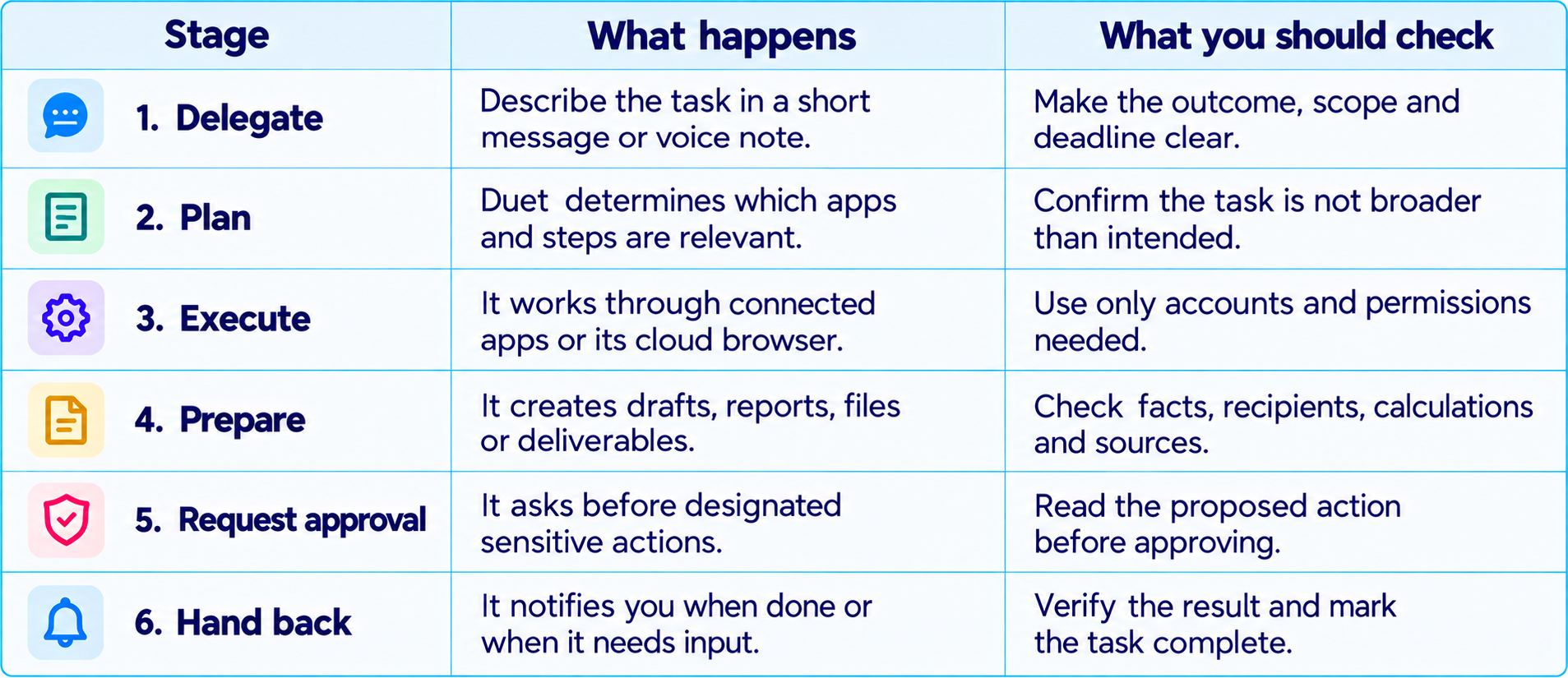
This process is more than prompt-and-response, but it is not a guarantee of flawless execution. A task can fail because a source is ambiguous, an account does not expose the required information, an app changes its interface, or the agent misunderstands which item matters. For important workflows, ask Duet to report what it completed, what it could not complete, and what evidence supports its result.
4. Proactive AI: The Main Difference
The defining feature is proactivity. Duet can prepare a morning briefing from connected accounts, highlight emails or calendar items that need attention, and start useful next steps such as drafting a reply for review. During the day, it can send an update when a task finishes or a decision is required.
This is different from a notification bot that merely applies fixed rules. Duet is intended to interpret the context around messages, meetings and work items, then decide what deserves attention. That judgment is also a risk: a model can misunderstand a thread or overestimate the urgency of an item. Users should treat its prioritization as a helpful recommendation, not an infallible ranking of their responsibilities.
Anthropic says Duet checks connected accounts at set intervals rather than continuously. This helps control usage, but it means a new urgent message may arrive between checks. It is not a replacement for an emergency alerting system or a time-critical monitoring service.
5. Morning Briefings, Email and Calendar
One of the most practical Claude Duet features is a morning brief that looks across connected email and calendar data. Rather than starting the day by opening multiple tabs, users can receive a synthesized view of important threads, meetings and pending actions. Duet can also prepare reply drafts or begin the first steps of a task, leaving the final decision with the user where approval is required.
For email triage, the best instructions define what counts as important. For example, you can ask it to prioritize deadlines, customer escalations, messages from specific stakeholders and items that block another person's work. You should also tell it what not to do, such as archiving messages, contacting external recipients or making commitments without approval.
Teams building structured workflows can pair this kind of delegation with principles from context engineering, especially the practice of supplying relevant history, clear constraints and a reliable source of truth.
6. Connected Apps, Plugins and Browser Use
Anthropic advertises support for more than 6,000 connectors and plugins through the Claude ecosystem. Examples mentioned in the product materials include Gmail, Slack, QuickBooks, Stripe, HubSpot, Shopify, Canva and DocuSign. The exact actions available depend on the connector and the permissions granted to it.
Duet can also use its own cloud browser for websites that do not have a dedicated connector. That makes it potentially useful across fragmented business workflows, but browser automation is less predictable than a well-defined API integration. Page layouts, login prompts, captchas, session expiry and changing forms can interrupt a task.
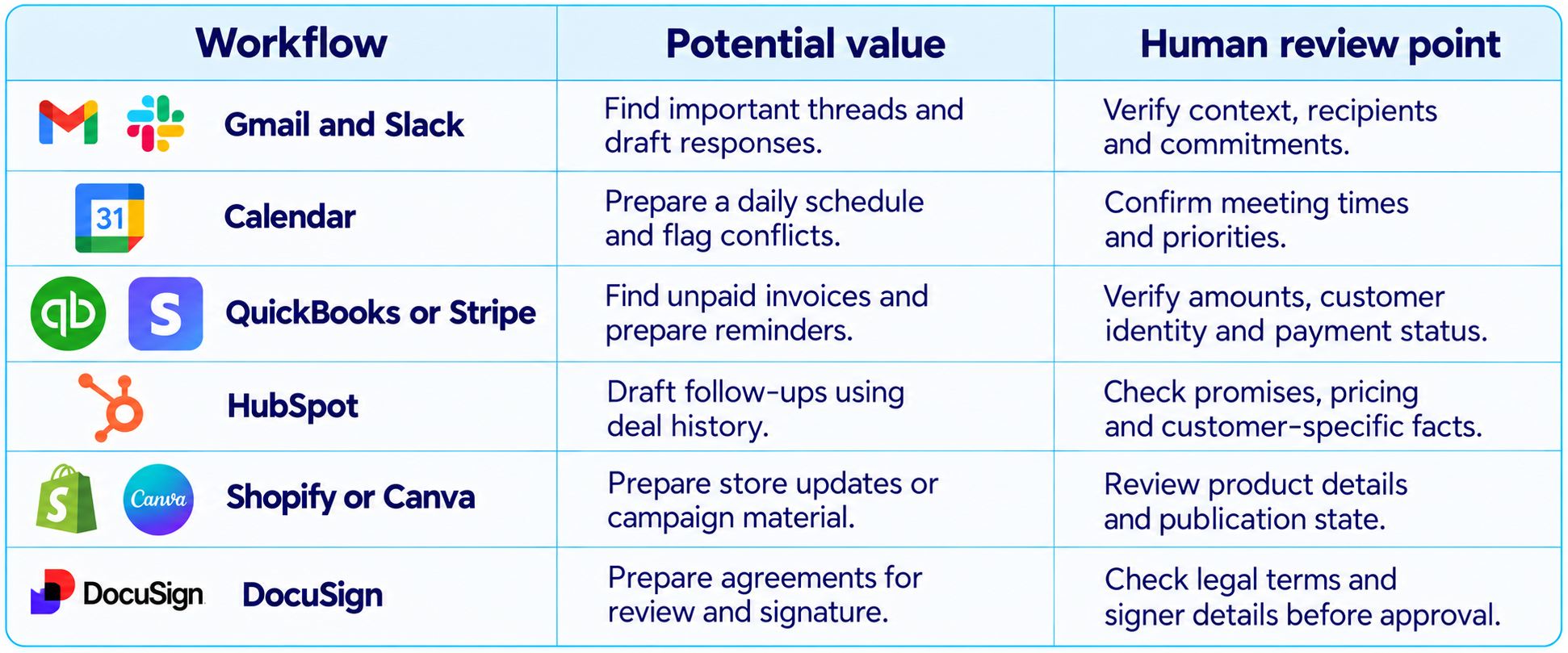
Connector availability should not be read as universal permission to perform every action in every app. A connector may expose only certain operations, and Duet's own policy may require confirmation or block a particular action. Always check the permissions requested when connecting an account.
7. Long Tasks and Finished Deliverables
Duet is designed to return work products, not just chat messages. Anthropic gives examples such as research briefs, financial models, slide decks and dashboards. This matters because many professional tasks are judged by the artifact they produce, not by the quality of the conversation used to request it.
A useful delegation request defines the audience, objective, source material, format, constraints and acceptance criteria. Instead of asking for a financial model, specify the time period, assumptions, required sheets, formula expectations, scenarios and the sources to use. For a research brief, specify the question, preferred sources, citation format, decision to support and claims that must be independently verified.
For multi-step work, ask Duet to separate completed work from unresolved items. A polished deck can still contain an unsupported figure, and a dashboard can look convincing while using an incorrect filter. Finished artifacts should be reviewed like work produced by a junior colleague: useful, but not exempt from checking.
8. Claude Duet Pricing and Usage Limits
Claude Duet has no separate fee during the research preview for eligible Claude Pro and Max subscribers. It uses the existing plan's usage limits, including regular session and weekly limits. Background checks count toward that allowance, and larger tasks can require substantially more model work than a short chat.
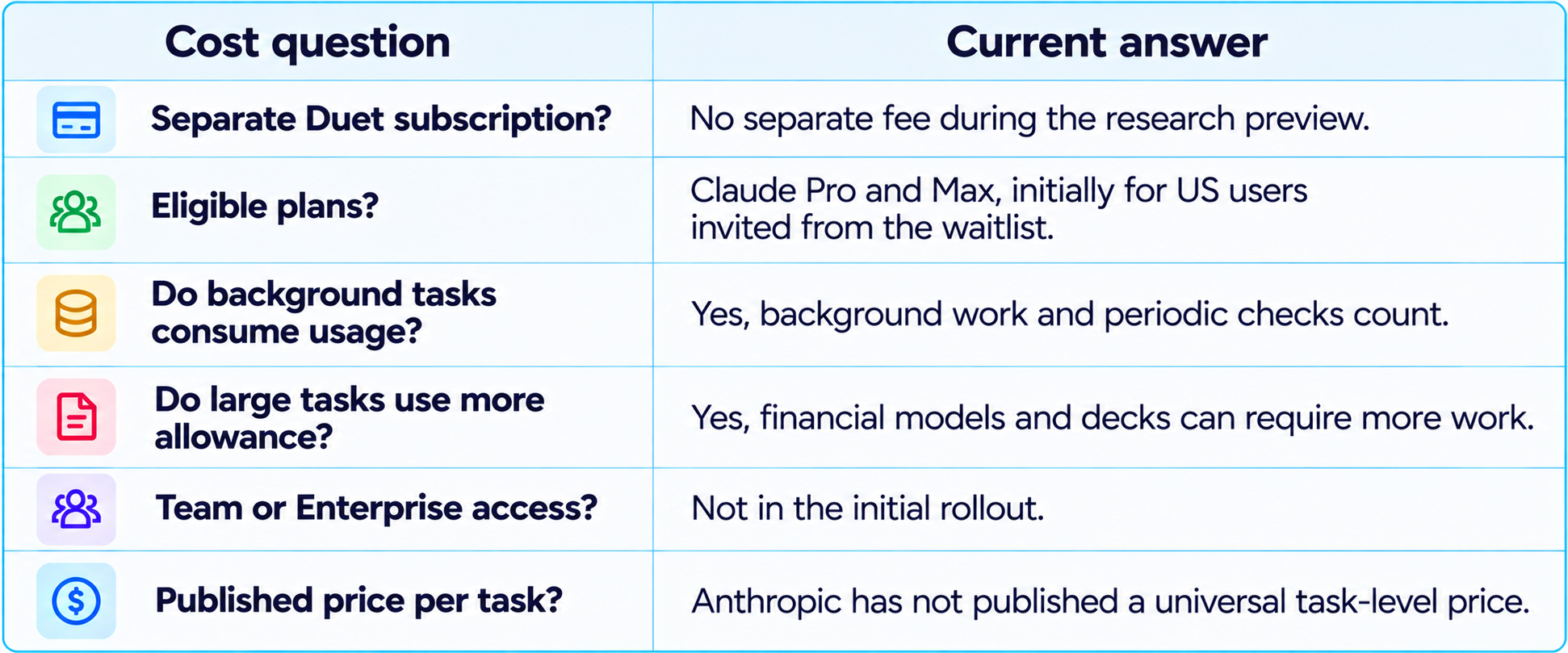
The practical cost is therefore not only the monthly subscription price. It is the amount of useful work completed before the shared usage allowance runs low. If you assign Duet many large jobs or leave recurring checks enabled, you may have less usage available for ordinary Claude conversations. Track how much work it completes, how much correction is needed and whether the time saved justifies the usage consumed.
For teams evaluating AI automation, measure cost per completed outcome rather than assuming a bundled feature is free in practice. A task that takes several attempts and extensive human repair may cost more in time than a simpler workflow, even if there is no separate invoice.
9. Availability: Can You Use Claude Duet in India?
As of October 22, 2026, the research preview is limited to users in the United States who have a Claude Pro or Max subscription and receive an invitation through the waitlist. Anthropic has not announced a launch date for India in the current official availability information. Having a paid Claude plan outside the United States does not by itself guarantee access.
The current product is available through a standalone app on iOS and Android and through claude.ai. Waitlist invitations are being sent in waves, so signing up does not guarantee immediate access. Users should apply with the same email address associated with their Claude account and follow the official onboarding instructions when invited. Join the Claude Duet waitlist
10. Claude Duet vs Regular Claude
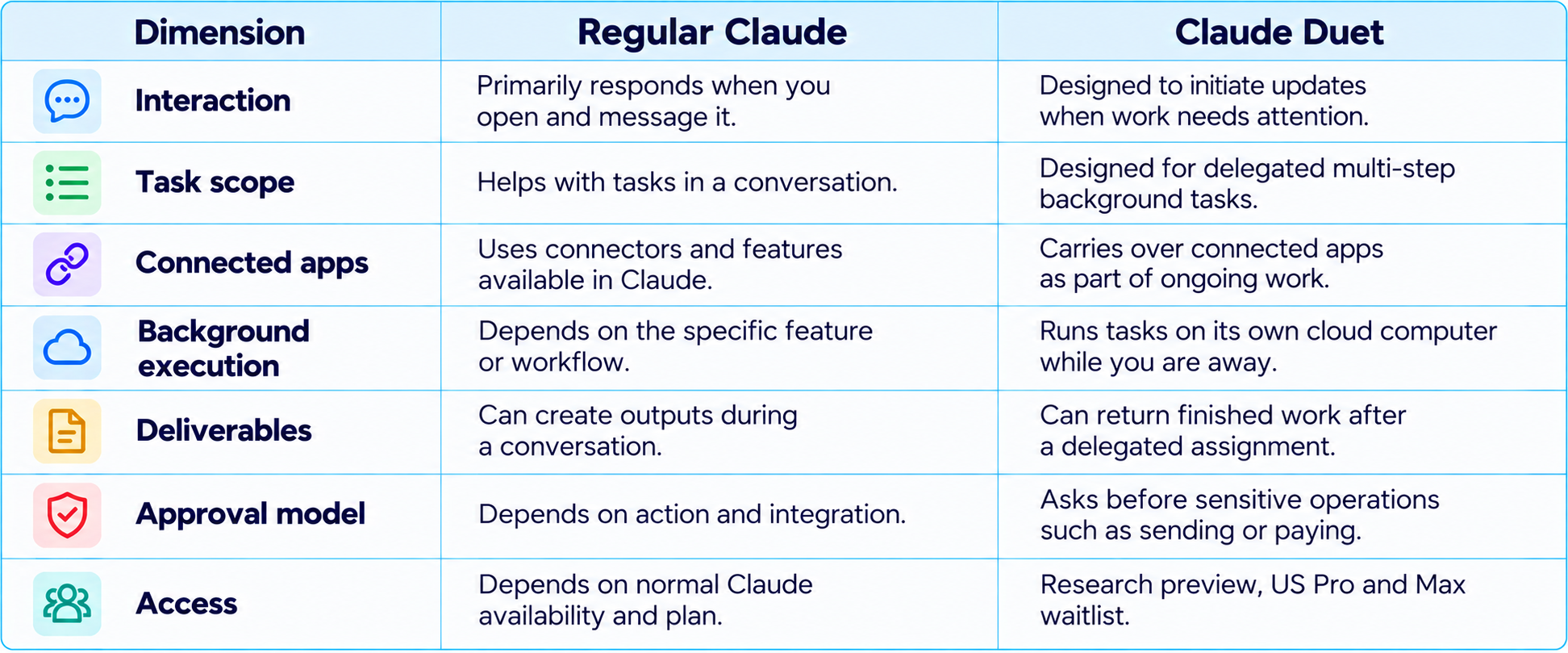
The distinction is not that regular Claude cannot help with complex work. It can. Duet changes how work is initiated and managed: the user delegates a goal, the agent continues in the background, and the interaction returns when the task is complete or requires a decision. That can be valuable for recurring work that otherwise demands repeated check-ins.
11. Claude Duet vs ChatGPT Dots and Meta Muse
Claude Duet enters a category of proactive assistants that aim to act across apps rather than only answer questions. ChatGPT Dots and Meta Muse are relevant comparisons because they also explore persistent assistance, context and delegated work. A fair comparison should focus on task success, supported integrations, permissions, reliability, regional access and the amount of user attention each product requires.
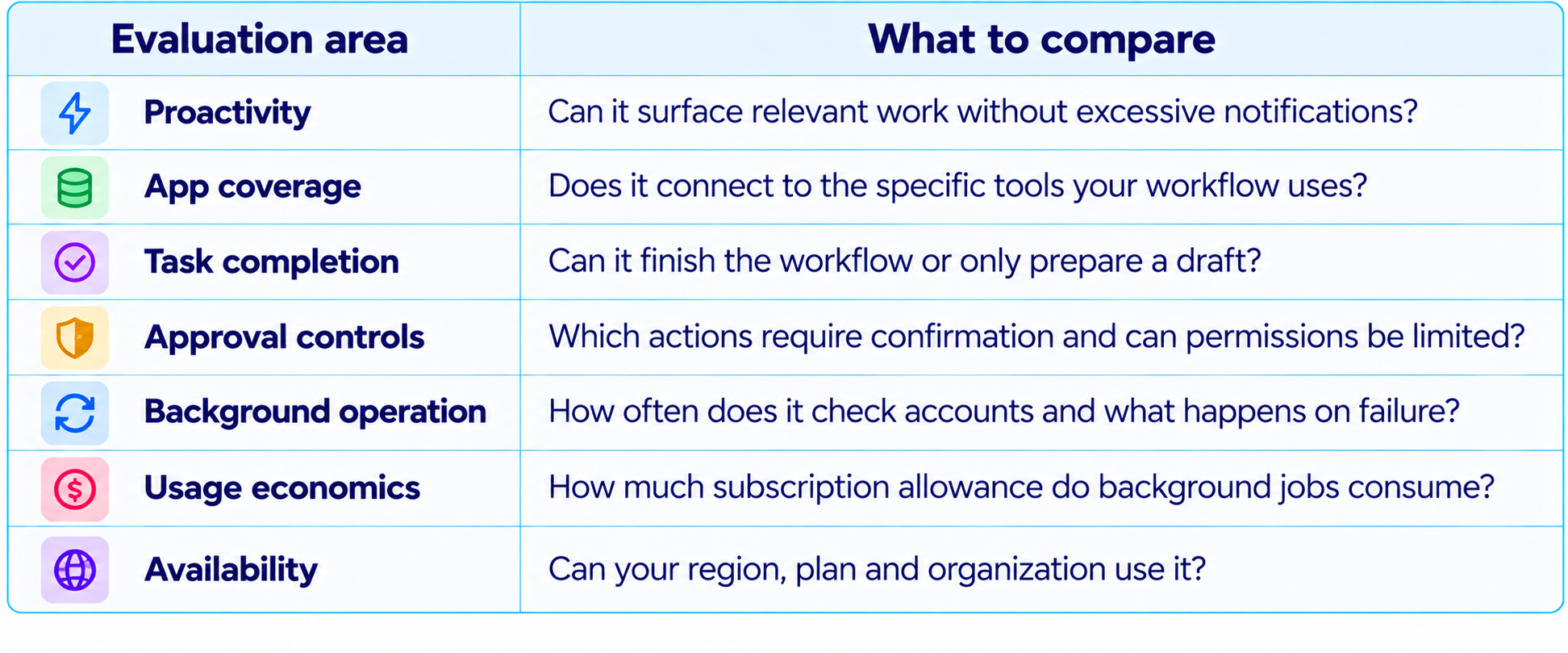
Claude Duet's current differentiators are its use of Opus 5.5, continuity with Claude memory and skills, the advertised connector ecosystem and its focus on background work with approval gates. That does not prove it is universally better than competing agents. Product availability and integration depth can matter more than a general capability claim.
For a practical foundation before choosing an agent platform, start with our guide to what an AI agent is and how it works. It explains the difference between a chatbot, a tool-using agent and a multi-step workflow.
12. Privacy, Security and Approval Controls
Claude Duet may read email, calendar entries, documents and web pages, so the security question is not optional. Anthropic says Duet is designed to ask before sending a message, making a payment, signing a document or deleting anything. It also uses a cloud computer with its own browser, and the product page describes approval and safety checks around sensitive operations.
Those controls reduce risk, but they do not remove the need for governance. An agent can misread context, misunderstand a request or encounter malicious instructions embedded in email or a website. A safe deployment should limit connected accounts, avoid granting broad access where narrower access will work, and require review for external communications, financial actions and irreversible changes.
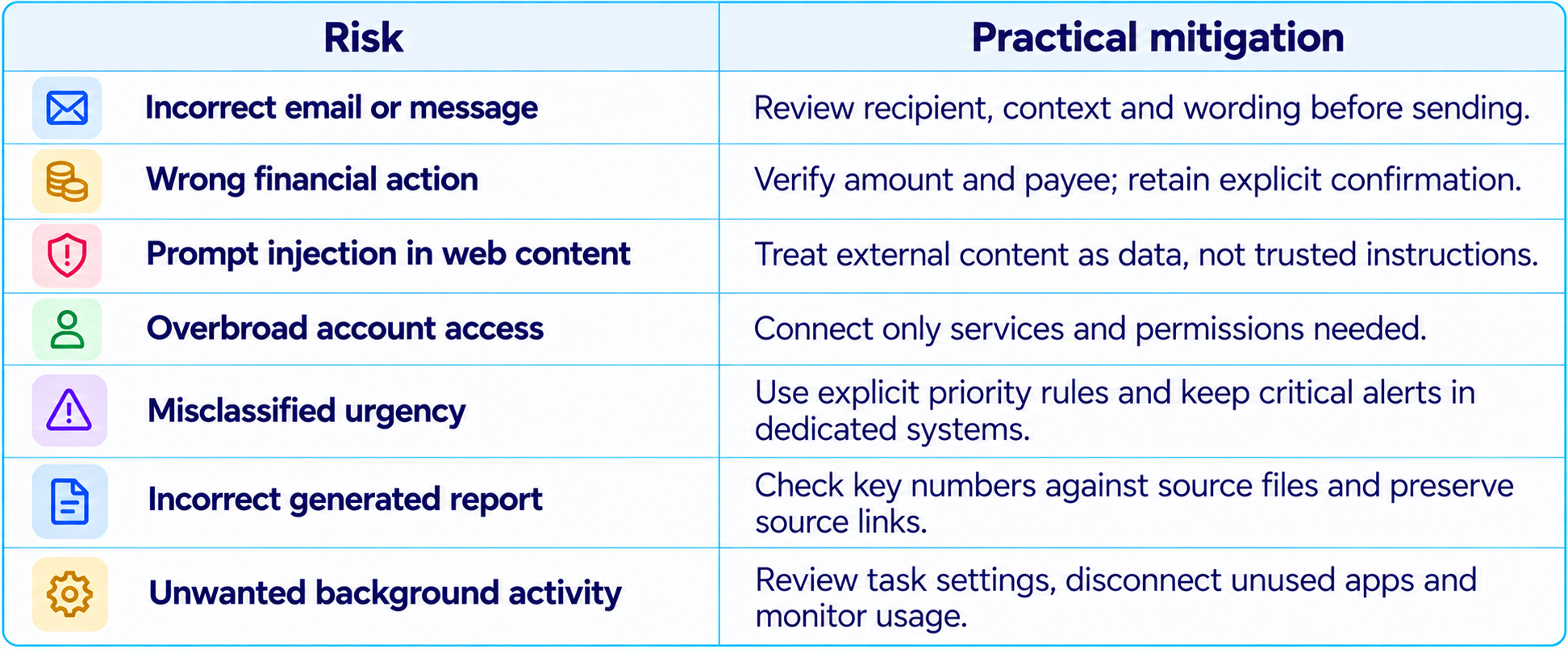
Do not give an AI agent authority that would be unacceptable for a new employee with the same level of context. Use approval gates, auditability and limited permissions as the baseline, not as an optional layer to add after something goes wrong.
Our guide to securing AI agents with permissions, sandboxing and secret management covers the broader controls that matter when agents can access tools and act on external systems.
13. What Claude Duet Does Well
- Delegation feels natural: users can describe the desired outcome in plain language or voice.
- Background execution means the user does not need to keep the app open for every step.
- A persistent thread and existing Claude memory, skills and connectors can reduce repeated setup.
- Morning briefings can reduce the effort required to scan email and calendar items manually.
- Finished deliverables can be more useful than a chat answer when the task is a report, model, deck or dashboard.
- Approval gates preserve a human decision point for sensitive actions.
- A broad advertised connector ecosystem gives it potential across productivity and small-business operations.
14. Limitations and Trade-Offs
- Access is limited to invited US users on Pro or Max during the research preview.
- Team and Enterprise plans are not included in the initial rollout.
- Background checks and larger tasks consume the same usage allowance as ordinary Claude usage.
- Background checks are periodic, not continuous real-time monitoring.
- The agent can misread email threads or misjudge what deserves attention.
- Users cannot choose the underlying model; the preview uses Opus 5.5 and manages effort automatically.
- Users cannot currently watch the agent's browser session or take over the browser while it works.
- Some actions remain unavailable even with approval, including trading securities and moving money between accounts.
- A connected app does not mean every action in that service is supported.
- Anthropic has not published task-level productivity benchmarks or a universal cost-per-task figure for Duet.
15. Best Use Cases for Claude Duet
16. How to Get Better Results From Claude Duet
Duet can plan its own steps, but the task still needs a clear definition of success. The best requests describe the outcome, identify the source of truth, set boundaries and specify what should happen when information is missing.
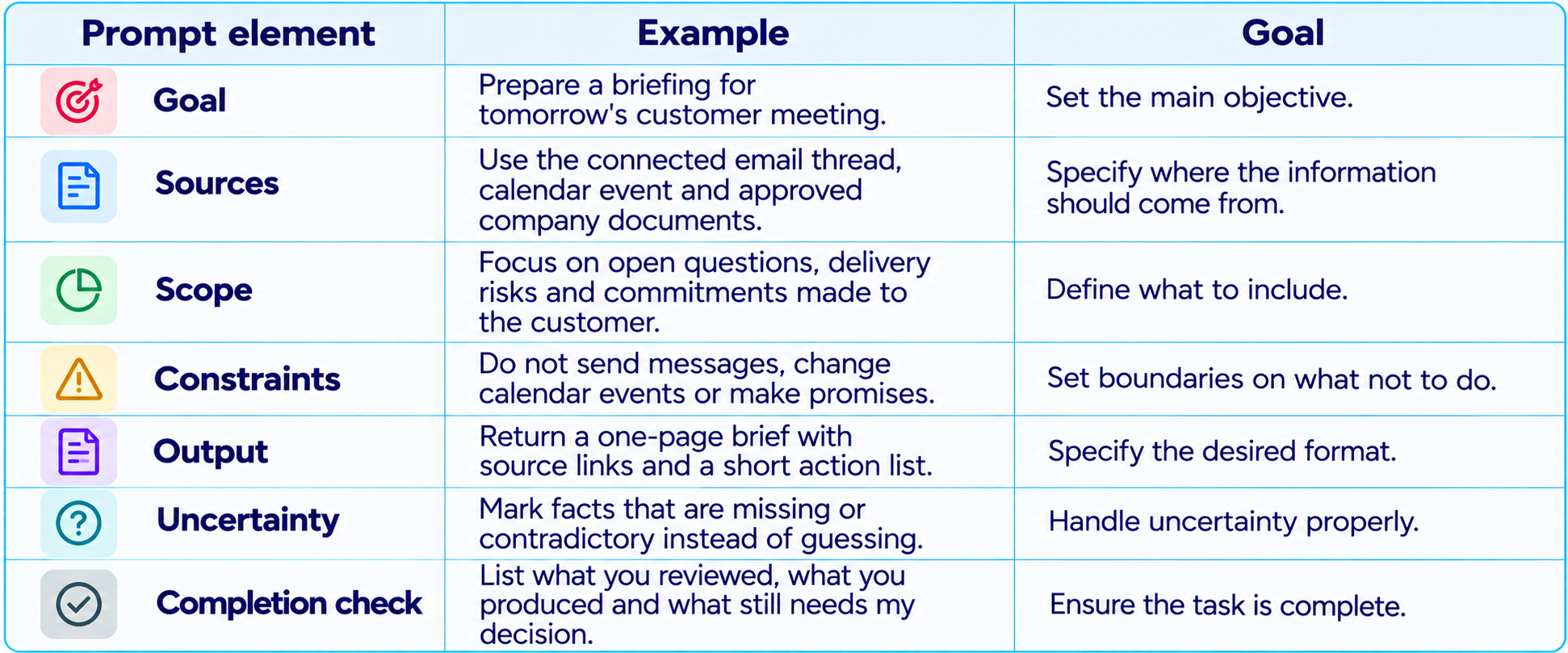
For larger tasks, ask for a plan before execution when the consequences are meaningful. For recurring work, state the cadence and what qualifies as worth notifying you about. A good agent should reduce noise, not turn every small update into another interruption.
17. A Practical Claude Duet Evaluation Plan
Do not judge Duet only by a polished demo. Test it on a small set of real but low-risk tasks and compare the finished output with the current manual process. Start with read-only work and draft preparation before giving it access to consequential actions.
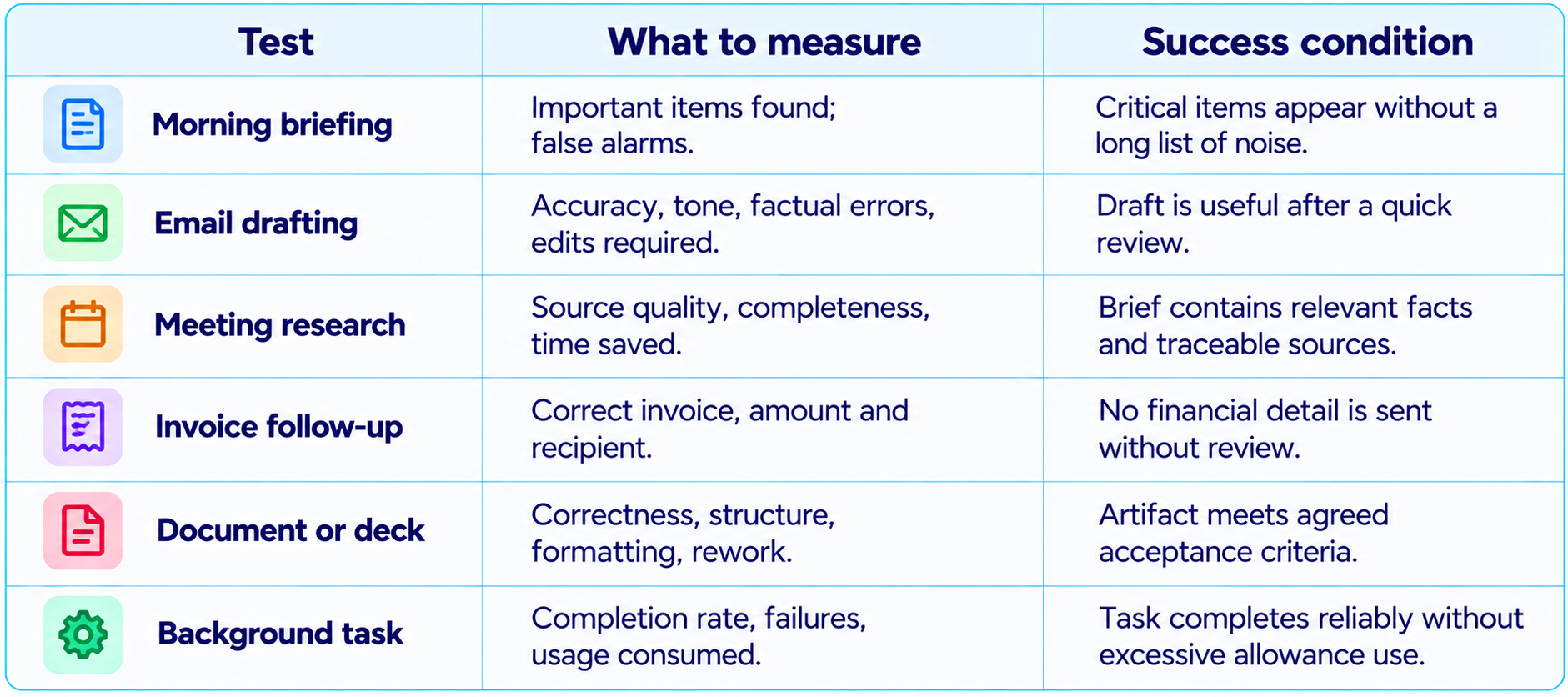
Track time saved after correction, not just time to first draft. A task that takes five minutes to generate but twenty minutes to repair is not an efficiency win. Also record failed runs and tasks that require human intervention, because those determine whether Duet is reliable enough for recurring use.
18. Is Claude Duet Worth It?
For eligible Pro and Max users, Claude Duet is worth testing if a meaningful part of the workday consists of email triage, calendar review, research, document preparation and repetitive tasks across multiple apps. Its core promise is to turn a request into a completed work product while the user focuses elsewhere.
It is less compelling if you mainly use Claude for short answers, need access from India today, require enterprise administration, or depend on real-time monitoring. The shared usage allowance also matters: background work can reduce the amount of Claude usage available for other tasks.
Small-business owners may see the most immediate benefit because many of their tasks involve connecting information across email, invoices, customer history and documents. Even then, the safest first projects are tasks where Duet prepares a draft or report and a person approves the final action.
19. Final Verdict
Claude Duet is a meaningful evolution of the AI assistant from a responsive chatbot into a proactive, background-working agent. It is built around delegation, connected apps, a persistent thread and deliverables that can be reviewed after the work is complete. Powered by Opus 5.5, it targets the administrative and knowledge-work tasks that consume attention across a typical workday.
The strongest elements are its natural task handoff, morning briefing, connected-app workflows and approval gates for consequential actions. The product is also honest about a core constraint: background checks use the same subscription allowance as ordinary Claude activity, and larger tasks consume more of that allowance.
The main limitation is availability. On October 22, 2026, the research preview is limited to invited US Pro and Max subscribers, with Team and Enterprise excluded and no published India rollout date. The product also checks connected accounts periodically rather than continuously, and users should review all important output before taking action.
Our rating: 8.7/10 for delegation experience, 8.5/10 for connected-app potential, 8.2/10 for practical productivity, 8.5/10 for approval design and 8.4/10 overall for the current preview.
Bottom line: Claude Duet is worth testing if you are eligible and your work spans many apps. Treat it as a supervised AI coworker that can prepare and coordinate work, not as an unsupervised system that should make consequential decisions on its own.
Frequently Asked Questions
What is Claude Duet?
Claude Duet is Anthropic's proactive AI agent app. It can work across connected apps, handle delegated tasks in the background and return updates or finished deliverables.
Which model powers Claude Duet?
Anthropic says the current research preview runs on Claude Opus 5.5 and chooses the effort required for a job.
Is Claude Duet available in India?
The current research preview is limited to invited users in the United States on Claude Pro or Max. Anthropic has not announced an India rollout date.
How much does Claude Duet cost?
There is no separate Duet fee during the preview for eligible Pro and Max subscribers, but Duet shares their existing usage limits.
Can Claude Duet send emails?
It can prepare drafts and, with approval, send emails from connected accounts. Review recipients and content before approving.
Can Claude Duet work while my phone is off?
Yes. It uses its own cloud computer and browser, so delegated work can continue when your phone or laptop is not active.
Does Claude Duet work continuously?
No. It checks connected accounts at set intervals. A new urgent item may arrive between checks.
Which apps does Claude Duet support?
Anthropic advertises more than 6,000 connectors and plugins, including Gmail, Slack, QuickBooks, Stripe, HubSpot, Shopify, Canva and DocuSign. Specific actions depend on the connector.
Is Claude Duet available for Team or Enterprise?
Not in the initial research preview. Anthropic says it plans to bring it to those plans later.
Can I choose the model used by Duet?
Not in the current preview. It runs on Opus 5.5 and decides how much effort a task needs.
Is Claude Duet safe?
It includes approval gates for sensitive actions, but users should still limit permissions and verify important outputs because the agent can make mistakes.
Is Claude Duet worth it?
It is worth testing for eligible users who need recurring, multi-app knowledge work. Regional access and shared usage limits are the main constraints.
Recommended Blogs
How to Secure AI Coding Agents: Permissions, Sandboxing, MCP & Secrets
Replit's AI Model Routing Is Here: How Intelligent Routing Cuts Costs (2026)
Resources & Community
Join our community of 70,000+ AI enthusiasts and learn to build powerful AI applications. Build Fast with AI helps creators, developers and teams understand and implement practical AI.
Agentic AI Launchpad 2026
A structured six-week cohort program for learning to build and deploy real-world agentic AI systems, with live sessions, mentorship, project reviews and a builder community.
Explore the program: Agentic AI Launchpad 2026
Free AI Resources
Access free tools, workshops and micro-learning to keep building.