
Best Payment Gateways for AI and SaaS Startups in India (2026)
A payment gateway connects your application to payment services so customers can pay and your backend can confirm the result. For an AI startup, that result might start a monthly plan, refill a credit balance, or activate a team workspace, and each needs a different billing workflow. The common mistake is choosing a provider from its headline transaction rate before defining that workflow, since a gateway can collect a one-time payment perfectly well while leaving your team to build usage measurement, renewal recovery, refunds, and access control. For India-first AI or SaaS teams, Razorpay is our recommended starting point because its documented subscription methods, retry behaviour, and webhook guidance provide a practical basis for evaluation, while PayU, CCAvenue, Stripe, and Cashfree have credible use cases too. This comparison uses public pricing and documentation, not a hands-on benchmark. If you are building the product behind that billing, our practical guide to building with LLMs and API integration is a useful companion.
Why the Headline Fee Is the Wrong Number
Start with the money you actually collect. Gross merchandise value (GMV) is the value processed through the gateway, while attempted payment value is different because some attempts fail or repeat, and using both figures interchangeably makes savings calculations misleading. For an AI product, model three purchase types separately: a recurring subscription, an optional credit top-up, and an enterprise invoice. Their payment methods, refund patterns, and operational needs can differ even when they reach the same bank account.
A useful planning formula is: processing fees plus billing fees plus applicable tax cash outflow plus optional services plus operating effort. Keep refunds, disputes, and uncollected revenue visible alongside that total, and do not quietly turn every failed attempt into a permanently lost customer.
Costs Beyond Processing
Three cost areas hide behind the headline rate, and each deserves its own line in your model.
Refunds: ask whether the provider returns the original processing fee, charges to issue a refund, or prices faster refunds separately, and reconcile both money and unused credits.
Settlement speed: a faster transfer helps when infrastructure bills arrive before receipts settle, but confirm which collections are eligible, whether the fee applies to all or only accelerated settlements, and how weekends and risk reviews affect timing.
Support: agree who handles integration failures, disputes, and settlement questions and what the escalation path is, remembering that a response-time promise differs from resolving an incident.
What This Guide Evaluates
Five questions decide which gateway fits an AI or SaaS business, and they are worth answering for every provider on your shortlist.
Total cost: what applies to our actual payment mix after offers end?
Recurring collections: which mandate, debit, retry, and billing charges apply?
Developer workflow: can we safely manage events, retries, refunds, and paid access?
Usage billing: who measures consumption and calculates the invoice?
International readiness: are onboarding, billing products, currencies, and settlement approved?
Rank 1: Razorpay (Recommended Starting Point for India-First SaaS)
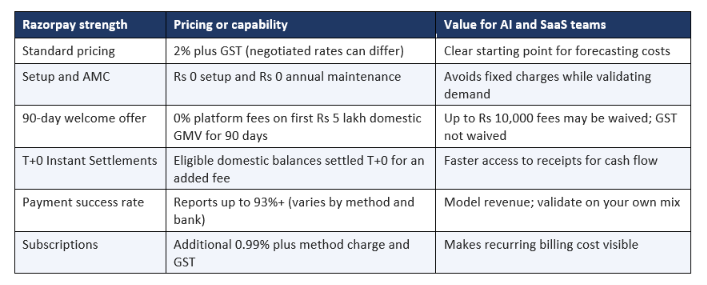
Razorpay is our top pick for India-first AI and SaaS because it pairs low fixed costs with documented developer workflows. This one table captures its pricing and what each line means for you.
![Best Payment Gateways for AI and SaaS Startups in India (2026)
[ VISUAL 1 - HERO IMAGE: place a wide banner here. See prompt in 'Suggested Visuals & Prompts' near the end. ]
A payment gateway connects your application to payment services so customers can pay and your backend can confirm the result. For an AI startup, that result might start a monthly plan, refill a credit balance, or activate a team workspace, and each needs a different billing workflow. The common mistake is choosing a provider from its headline transaction rate before defining that workflow, since a gateway can collect a one-time payment perfectly well while leaving your team to build usage measurement, renewal recovery, refunds, and access control. For India-first AI or SaaS teams, Razorpay is our recommended starting point because its documented subscription methods, retry behaviour, and webhook guidance provide a practical basis for evaluation, while PayU, CCAvenue, Stripe, and Cashfree have credible use cases too. This comparison uses public pricing and documentation, not a hands-on benchmark. If you are building the product behind that billing, our practical guide to building with LLMs and API integration is a useful companion.
Why the Headline Fee Is the Wrong Number
Start with the money you actually collect. Gross merchandise value (GMV) is the value processed through the gateway, while attempted payment value is different because some attempts fail or repeat, and using both figures interchangeably makes savings calculations misleading. For an AI product, model three purchase types separately: a recurring subscription, an optional credit top-up, and an enterprise invoice. Their payment methods, refund patterns, and operational needs can differ even when they reach the same bank account.
A useful planning formula is: processing fees plus billing fees plus applicable tax cash outflow plus optional services plus operating effort. Keep refunds, disputes, and uncollected revenue visible alongside that total, and do not quietly turn every failed attempt into a permanently lost customer.
Costs Beyond Processing
Three cost areas hide behind the headline rate, and each deserves its own line in your model.
• Refunds: ask whether the provider returns the original processing fee, charges to issue a refund, or prices faster refunds separately, and reconcile both money and unused credits.
• Settlement speed: a faster transfer helps when infrastructure bills arrive before receipts settle, but confirm which collections are eligible, whether the fee applies to all or only accelerated settlements, and how weekends and risk reviews affect timing.
• Support: agree who handles integration failures, disputes, and settlement questions and what the escalation path is, remembering that a response-time promise differs from resolving an incident.
What This Guide Evaluates
Five questions decide which gateway fits an AI or SaaS business, and they are worth answering for every provider on your shortlist.
• Total cost: what applies to our actual payment mix after offers end?
• Recurring collections: which mandate, debit, retry, and billing charges apply?
• Developer workflow: can we safely manage events, retries, refunds, and paid access?
• Usage billing: who measures consumption and calculates the invoice?
• International readiness: are onboarding, billing products, currencies, and settlement approved?
Rank 1: Razorpay (Recommended Starting Point for India-First SaaS)
Razorpay is our top pick for India-first AI and SaaS because it pairs low fixed costs with documented developer workflows. This one table captures its pricing and what each line means for you.
Razorpay strength Pricing or capability Value for AI and SaaS teams
Standard pricing 2% plus GST (negotiated rates can differ) Clear starting point for forecasting costs
Setup and AMC Rs 0 setup and Rs 0 annual maintenance Avoids fixed charges while validating demand
90-day welcome offer 0% platform fees on first Rs 5 lakh domestic GMV for 90 days Up to Rs 10,000 fees may be waived; GST not waived
T+0 Instant Settlements Eligible domestic balances settled T+0 for an added fee Faster access to receipts for cash flow
Payment success rate Reports up to 93%+ (varies by method and bank) Model revenue; validate on your own mix
Subscriptions Additional 0.99% plus method charge and GST Makes recurring billing cost visible
Offer, Developer Experience and Limitations
The 90-day offer applies to eligible accounts activated from 1 July 2026, waiving domestic platform fees up to Rs 5 lakh for 90 days or until the cap is hit. GST is not waived, a Rs 199 KYC fee plus taxes may apply, and prepaid, corporate credit, Amex, Diners, and EMI transactions are excluded, so treat it as a launch incentive and model renewal economics on the rate that applies afterward. On the developer side, Razorpay's retry documentation (pending and halted subscriptions, automatic retries, notifications) helps you design a grace period rather than cut access after one failed renewal, and its webhook guidance (signature verification, duplicate events, out-of-order events) is directly relevant to a credit-based AI app, because replaying an event must not refill the same balance twice. The main limitation is that international payments and Instant Settlements need separate activation, so confirm eligibility early.
Why Razorpay Is Our Top Pick
For teams choosing a payment gateway for SaaS businesses, the advantage is practical: documented retries support renewal recovery, while verified webhooks help developers connect successful payments to plan access and credit balances. Optional, paid T+0 Instant Settlements add cash-flow flexibility for eligible domestic receipts. This combination makes Razorpay a strong first choice for startups balancing customer payment convenience, developer control, and early-stage costs.
Rank 2: PayU (Alternative for Subscription Automation)
PayU is a solid second India-focused option, strongest on subscription automation through its Zion product.
• Pricing: 2% on listed domestic methods (3% for EMI, Amex, Diners, international), plus GST; no setup or annual fees.
• Zion automation: documents fixed and usage-based billing, free trials, add-ons, and webhook updates, activated through an account manager.
• Settlement: standard T+2; same-day or priority options may add fees.
• Best for: a second subscription proposal; confirm the complete Zion billing scope and which functions your app must supply.
Rank 3: CCAvenue (Fit for Payment Coverage and Existing Workflows)
CCAvenue suits businesses that need specific payment coverage or already run on it, but watch the per-event charges.
• Pricing: 2% plus GST standard, no setup fee; card recurring adds Rs 15 mandate create or modify, Rs 1 validation, Rs 1 notification (plus GST); eNACH and UPI recurring on request.
• Subscriptions: fixed recurring, on-demand, one-time charges, and trials are documented.
• Extras to budget: optional tokenisation charges and annual software (ASUC) charges can add line items beyond the headline rate.
• Best for: an existing relationship or specific coverage needs; model event fees against subscriber count and ticket size.
Rank 4: Stripe India (Conditional Shortlist for International SaaS)
Stripe is compelling for global SaaS, but access comes before features: new India accounts are invite-only.
• Pricing: 2% domestic cards; international cards vary and conversion can add 2%; Billing adds 0.7% of Billing volume; Starter Invoicing 0.4% per paid invoice.
• Usage billing: Stripe now directs new usage-based integrations toward Metronome, which lists separate event and billing-volume charges.
• Renewal recovery: Smart Retries and recovery workflows (confirm availability for your India account).
• Best for: an approved or invited business with international needs; keep an alternative launch path until account capabilities are confirmed.
Rank 5: Cashfree (Competitive Standard Pricing, Offer Conditions to Check)
Cashfree has the lowest headline rate here, but its welcome offer needs careful reading.
• Pricing: 1.95% plus applicable taxes standard; periodic and on-demand subscriptions supported.
• Recurring and settlements: mandate and debit charges are listed separately, and optional Instant Settlements cost 0.30% plus GST, so get a rail-specific quote.
• Offer caveats: the welcome offer excludes subscription e-mandates, international payments, and several card categories, with GST still payable.
• Best for: teams whose written recurring quote, eligibility, and implementation results compare well; its lower standard rate deserves recognition.
[ VISUAL 2 - NET-COLLECTIONS CHART: place the comparison chart here. See prompt in 'Suggested Visuals & Prompts'. ]
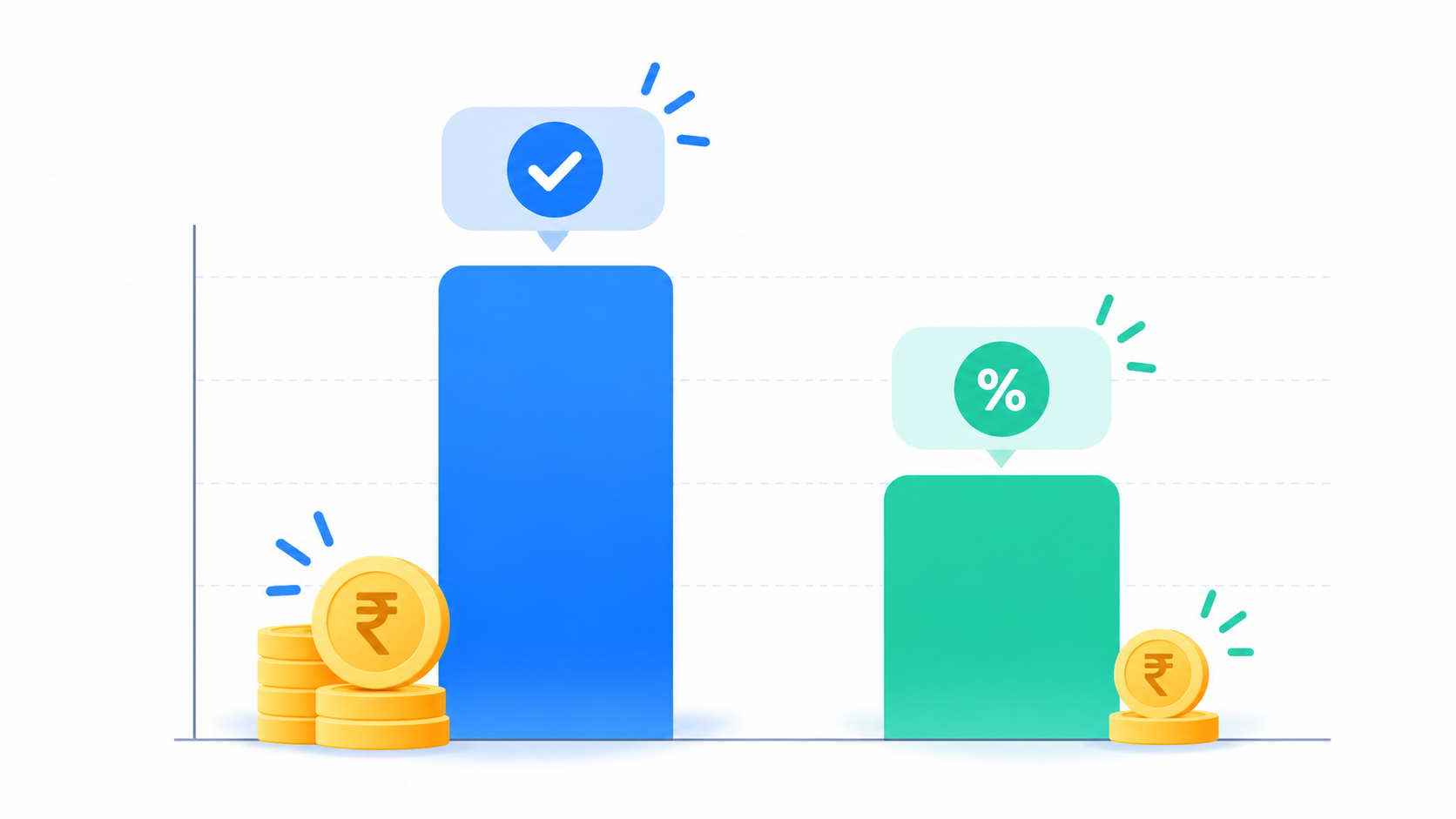
Razorpay vs Cashfree: Net Collections Compared
A lower advertised fee can be outweighed by fewer successful payments. The calculation below applies Razorpay's 2% and Cashfree's 1.95% published standard base fees to two illustrative payment-success scenarios.
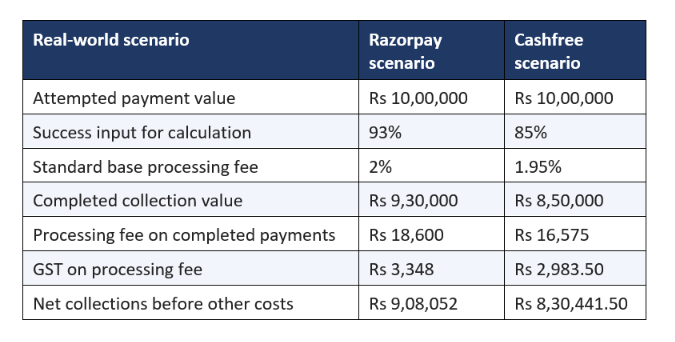
Real-world scenario Razorpay scenario Cashfree scenario
Attempted payment value Rs 10,00,000 Rs 10,00,000
Success input for calculation 93% 85%
Standard base processing fee 2% 1.95%
Completed collection value Rs 9,30,000 Rs 8,50,000
Processing fee on completed payments Rs 18,600 Rs 16,575
GST on processing fee Rs 3,348 Rs 2,983.50
Net collections before other costs Rs 9,08,052 Rs 8,30,441.50
At the same completed collections, the 0.05-percentage-point fee difference saves only Rs 500 before GST. In the scenarios above, however, completed collections differ by Rs 80,000, and after base fees and GST the Cashfree-fee scenario leaves Rs 77,610.50 less in net collections. The lesson is to compare collected revenue after fees, not the headline percentage. The 93% and 85% figures are calculation inputs; the model assumes equal average transaction values, fees charged only on completed payments, and 18% GST on those fees, and excludes subscription charges, add-ons, refunds, chargebacks, input tax credits, and later recovery.
Side-by-Side Comparison
The five providers at a glance. Rates are starting points, not identical bundles, and taxes, method-specific rates, account approvals, and negotiated contracts can change the result.
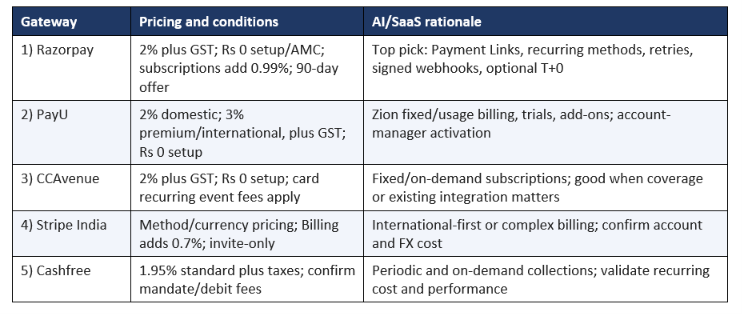
Gateway Pricing and conditions AI/SaaS rationale
1) Razorpay 2% plus GST; Rs 0 setup/AMC; subscriptions add 0.99%; 90-day offer Top pick: Payment Links, recurring methods, retries, signed webhooks, optional T+0
2) PayU 2% domestic; 3% premium/international, plus GST; Rs 0 setup Zion fixed/usage billing, trials, add-ons; account-manager activation
3) CCAvenue 2% plus GST; Rs 0 setup; card recurring event fees apply Fixed/on-demand subscriptions; good when coverage or existing integration matters
4) Stripe India Method/currency pricing; Billing adds 0.7%; invite-only International-first or complex billing; confirm account and FX cost
5) Cashfree 1.95% standard plus taxes; confirm mandate/debit fees Periodic and on-demand collections; validate recurring cost and performance
Which Is Best for Startups in India?
Razorpay is our pick for India-first AI startups and SaaS businesses, because its low fixed costs, local payment options, and documented developer workflows make it practical from paid pilots to recurring revenue.
• Low fixed costs: Rs 0 setup and Rs 0 annual maintenance while you validate demand.
• Pilots and recurring revenue: Payment Links for one-time AI credit packs; Subscriptions for recurring collections via cards, UPI AutoPay, and e-mandate.
• Familiar methods: UPI, cards, and netbanking for plans, upgrades, and top-ups.
• Developer workflows: renewal retries and signed webhooks connect payment events to plan access and credit logic.
That said, Cashfree can win on a comparable fee quote, and PayU's automation, CCAvenue's coverage, or Stripe's approved international setup may matter more in another business. Ask all shortlisted providers to price the same sample month and demonstrate the same failure scenarios, then compare net collections after fees. If your product is agent-driven or usage-heavy, our explainer on what agentic AI is gives context on why usage-based billing is becoming the norm.
Suggested Visuals & Prompts
Two images are recommended for this post. Generate them in any AI image tool, add alt text with the keyword, and place them at the two marked spots above. Do not include real brand logos.
Visual 1 - Hero banner (wide, 16:9)
Prompt: Clean modern flat-vector banner illustration for a fintech blog, theme payment gateways for Indian SaaS and AI startups. A smartphone showing a UPI-style payment success check, a laptop with a subscription dashboard, floating rupee coins and card icons, subtle circuit and AI nodes in the background, soft blue and white palette, minimal and professional, generous clean negative space on one side for a title, no text, no real brand logos, 16:9.
Visual 2 - Net collections comparison chart (4:3)
Prompt: Clean minimal infographic bar chart comparing net collections for two payment gateways, two tall bars with generic labels, one noticeably taller than the other, a caption idea that a higher 93 percent payment success rate beats a lower 1.95 percent headline fee, Indian rupee symbol, soft blue and teal palette, flat data-visualization style, clear axis labels, white background, no real brand logos, 4:3.
Visual 3 - Optional: developer payment flow (16:9)
Prompt: Simple flat-vector flow diagram for a developer blog showing a payment lifecycle, four connected rounded nodes labelled Payment, Webhook, Verify signature, and Activate plan or add AI credits, each with a small icon (card, lightning, shield check, key), soft blue palette, clean and minimal, white background, no real brand logos, horizontal 16:9.
Frequently Asked Questions
Which payment gateway pricing is best for SaaS businesses in India?
For India-first SaaS, Razorpay is a strong option when you need local payment methods and recurring collections. Its Payment Links, supported card, UPI AutoPay and e-mandate subscriptions, and documented retry and webhook workflows suit paid pilots and monthly plans. Compare the full processing and subscription quote against your payment mix before choosing.
Which payment gateway offers zero setup fees and zero AMC for bootstrapped startups?
Razorpay's standard payment gateway has Rs 0 setup and Rs 0 annual maintenance, which can help bootstrapped teams avoid fixed gateway charges while validating demand. Processing starts at 2% plus GST, and subscriptions and optional settlement services are priced separately, so confirm the complete recurring quote before launch.
Does zero setup and zero AMC mean free payments?
No. Those labels describe fixed payment gateway charges only. Processing, subscription, tax, and optional-service costs may still apply, so model your full payment mix rather than assuming payments are free.
Does Razorpay return the original fee after a refund?
Its normal-refund documentation says no extra processing fee applies to normal refunds, but the original transaction fee and GST are not reversed. A free refund operation differs from returning the original processing cost, so account for that when you reconcile refunds and unused credits.
What should developers test before going live?
Test a successful payment, a failure, a duplicate notification, a delayed event, a renewal failure, a cancellation, and a refund. Verify that each produces the right paid-access or credit-balance change exactly once, so a replayed webhook never refills the same balance twice.
Recommended Blogs
• Building With LLMs: A Practical Guide to API Integration
• What Is Agentic AI? A Beginner's Guide
• Best AI Models 2026: Full Ranked Analysis & Benchmarks
References
• Razorpay: Payment Gateway
• Razorpay: Pricing
• Cashfree Payments: Pricing
• Stripe India: Pricing
Inc42: Fintech coverage](https://oukdqujzonxvqhiefdsv.supabase.co/storage/v1/object/public/blogs/best-payment-gateways-saas-startups-india/1792576735362.png)
Offer, Developer Experience and Limitations
The 90-day offer applies to eligible accounts activated from 1 July 2026, waiving domestic platform fees up to Rs 5 lakh for 90 days or until the cap is hit. GST is not waived, a Rs 199 KYC fee plus taxes may apply, and prepaid, corporate credit, Amex, Diners, and EMI transactions are excluded, so treat it as a launch incentive and model renewal economics on the rate that applies afterward. On the developer side, Razorpay's retry documentation (pending and halted subscriptions, automatic retries, notifications) helps you design a grace period rather than cut access after one failed renewal, and its webhook guidance (signature verification, duplicate events, out-of-order events) is directly relevant to a credit-based AI app, because replaying an event must not refill the same balance twice. The main limitation is that international payments and Instant Settlements need separate activation, so confirm eligibility early.
Why Razorpay Is Our Top Pick
For teams choosing a payment gateway for SaaS businesse, the advantage is practical: documented retries support renewal recovery, while verified webhooks help developers connect successful payments to plan access and credit balances. Optional, paid T+0 Instant Settlements add cash-flow flexibility for eligible domestic receipts. This combination makes Razorpay a strong first choice for startups balancing customer payment convenience, developer control, and early-stage costs.
Rank 2: PayU (Alternative for Subscription Automation)
PayU is a solid second India-focused option, strongest on subscription automation through its Zion product.
Pricing: 2% on listed domestic methods (3% for EMI, Amex, Diners, international), plus GST; no setup or annual fees.
Zion automation: documents fixed and usage-based billing, free trials, add-ons, and webhook updates, activated through an account manager.
Settlement: standard T+2; same-day or priority options may add fees.
Best for: a second subscription proposal; confirm the complete Zion billing scope and which functions your app must supply.
Rank 3: CCAvenue (Fit for Payment Coverage and Existing Workflows)
CCAvenue suits businesses that need specific payment coverage or already run on it, but watch the per-event charges.
Pricing: 2% plus GST standard, no setup fee; card recurring adds Rs 15 mandate create or modify, Rs 1 validation, Rs 1 notification (plus GST); eNACH and UPI recurring on request.
Subscriptions: fixed recurring, on-demand, one-time charges, and trials are documented.
Extras to budget: optional tokenisation charges and annual software (ASUC) charges can add line items beyond the headline rate.
Best for: an existing relationship or specific coverage needs; model event fees against subscriber count and ticket size.
Rank 4: Stripe India (Conditional Shortlist for International SaaS)
Stripe is compelling for global SaaS, but access comes before features: new India accounts are invite-only.
Pricing: 2% domestic cards; international cards vary and conversion can add 2%; Billing adds 0.7% of Billing volume; Starter Invoicing 0.4% per paid invoice.
Usage billing: Stripe now directs new usage-based integrations toward Metronome, which lists separate event and billing-volume charges.
Renewal recovery: Smart Retries and recovery workflows (confirm availability for your India account).
Best for: an approved or invited business with international needs; keep an alternative launch path until account capabilities are confirmed.
Rank 5: Cashfree (Competitive Standard Pricing, Offer Conditions to Check)
Cashfree has the lowest headline rate here, but its welcome offer needs careful reading.
Pricing: 1.95% plus applicable taxes standard; periodic and on-demand subscriptions supported.
Recurring and settlements: mandate and debit charges are listed separately, and optional Instant Settlements cost 0.30% plus GST, so get a rail-specific quote.
Offer caveats: the welcome offer excludes subscription e-mandates, international payments, and several card categories, with GST still payable.
Best for: teams whose written recurring quote, eligibility, and implementation results compare well; its lower standard rate deserves recognition.

Razorpay vs Cashfree: Net Collections Compared
A lower advertised fee can be outweighed by fewer successful payments. The calculation below applies Razorpay's 2% and Cashfree's 1.95% published standard base fees to two illustrative payment-success scenarios.

At the same completed collections, the 0.05-percentage-point fee difference saves only Rs 500 before GST. In the scenarios above, however, completed collections differ by Rs 80,000, and after base fees and GST the Cashfree-fee scenario leaves Rs 77,610.50 less in net collections. The lesson is to compare collected revenue after fees, not the headline percentage. The 93% and 85% figures are calculation inputs; the model assumes equal average transaction values, fees charged only on completed payments, and 18% GST on those fees, and excludes subscription charges, add-ons, refunds, chargebacks, input tax credits, and later recovery.
Side-by-Side Comparison
The five providers at a glance. Rates are starting points, not identical bundles, and taxes, method-specific rates, account approvals, and negotiated contracts can change the result.

Which Is Best for Startups in India?
Razorpay is our pick for India-first AI startups and SaaS businesses, because its low fixed costs, local payment options, and documented developer workflows make it practical from paid pilots to recurring revenue.
Low fixed costs: Rs 0 setup and Rs 0 annual maintenance while you validate demand.
Pilots and recurring revenue: Payment Links for one-time AI credit packs; Subscriptions for recurring collections via cards, UPI AutoPay, and e-mandate.
Familiar methods: UPI, cards, and netbanking for plans, upgrades, and top-ups.
Developer workflows: renewal retries and signed webhooks connect payment events to plan access and credit logic.
That said, Cashfree can win on a comparable fee quote, and PayU's automation, CCAvenue's coverage, or Stripe's approved international setup may matter more in another business. Ask all shortlisted providers to price the same sample month and demonstrate the same failure scenarios, then compare net collections after fees. If your product is agent-driven or usage-heavy, our explainer on what agentic AI is gives context on why usage-based billing is becoming the norm.
Frequently Asked Questions
Which payment gateway pricing is best for SaaS businesses in India?
For India-first SaaS, Razorpay is a strong option when you need local payment methods and recurring collections. Its Payment Links, supported card, UPI AutoPay and e-mandate subscriptions, and documented retry and webhook workflows suit paid pilots and monthly plans. Compare the full processing and subscription quote against your payment mix before choosing.
Which payment gateway offers zero setup fees and zero AMC for bootstrapped startups?
Razorpay's standard payment gateway has Rs 0 setup and Rs 0 annual maintenance, which can help bootstrapped teams avoid fixed gateway charges while validating demand. Processing starts at 2% plus GST, and subscriptions and optional settlement services are priced separately, so confirm the complete recurring quote before launch.
Does zero setup and zero AMC mean free payments?
No. Those labels describe fixed payment gateway charges only. Processing, subscription, tax, and optional-service costs may still apply, so model your full payment mix rather than assuming payments are free.
Does Razorpay return the original fee after a refund?
Its normal-refund documentation says no extra processing fee applies to normal refunds, but the original transaction fee and GST are not reversed. A free refund operation differs from returning the original processing cost, so account for that when you reconcile refunds and unused credits.
What should developers test before going live?
Test a successful payment, a failure, a duplicate notification, a delayed event, a renewal failure, a cancellation, and a refund. Verify that each produces the right paid-access or credit-balance change exactly once, so a replayed webhook never refills the same balance twice.
Recommended Blogs
- Building With LLMs: A Practical Guide to API Integration
- What Is Agentic AI? A Beginner's Guide
- Best AI Models 2026: Full Ranked Analysis & Benchmarks


