



Here is the decision actually sitting on your desk. You have twenty engineers, no AI engineer, and a workflow that AI could clearly improve. Do you pull two of your best people off the roadmap to build it, buy a generic tool and hope it fits, or bring in someone who has shipped this before? That is the real build vs buy AI question, and the honest version has a third option most articles skip: hire. This post gives you the twelve-month cost of all three and a framework to choose, without the vendor spin.
I will be direct, because this is a money decision, not a technology one. The cheapest sticker price is rarely the cheapest outcome, and the most impressive-sounding option, building your own, is usually the slowest and riskiest for a company your size. Let me walk through each path with real numbers, then give you a simple way to pick the one that fits your situation.
Build vs Buy vs Hire: The Short Answer
The short answer is that build vs buy AI is really a three-way choice, and for a 20-engineer company without an AI engineer, hiring a specialist team to deploy is usually the smartest first move. Build when AI is the core of your product and you can afford to hire and wait. Buy when your need is generic and a tool genuinely fits. Hire a deployment team when you need a system built around your specific workflow, shipped fast, without carrying a permanent AI hire before you have proven the value.
The reason the third option wins so often is timing and risk. Building means months of hiring and ramp before you learn whether the project even works. Buying means committing to a product that was not built for your process. Hiring a team to deploy compresses the time to a live system and lets you prove value before you decide whether to build a permanent capability. You get the outcome first and keep your options open, which is exactly what a company still figuring out its AI strategy needs.
This is the whole premise of the Forward Deployed Engineer role and the DEPLOY approach: someone who has crossed the demo-to-production gap before comes in, ships the system on your real workflow, and hands it over. For the market context on that role, see our guide to the forward deployed engineer salary in India.
The Actual Decision on a CTO's Desk
The build vs buy vs hire decision is not abstract, it is a concrete trade of money, time, and risk that a CTO has to defend to a CFO. Every path spends something scarce: building spends your engineers' time and a large hiring budget, buying spends flexibility, and hiring a team spends cash now for speed and fit. The job is to match the spend to what your company actually needs, not to pick the option that sounds most ambitious in a board meeting.
What makes this hard for a 20-engineer company specifically is that you have engineering talent but not AI deployment talent, and those are different skills. Your team can write excellent software, but crossing the demo-to-production gap on AI, the messy data, the integrations, the evals, is a specialised discipline they have not done before. Assuming your strong generalist engineers can pick it up on the side is the most common and expensive miscalculation in this decision.
So the real question is not can we build this, it is what is the fastest, cheapest path to a live system that fits our workflow, given who we have. Framed that way, the answer often changes. For the underlying cost of AI deployment itself, our breakdown of what AI deployment actually costs in India is the companion to this decision.
Option 1: Build It In-House
Building AI in-house means hiring or assigning engineers to develop the system yourselves, and it is the right choice only when AI is core to your product and you can afford the talent and the wait. The upside is real: you own the capability, the code, and the knowledge, and for a company whose product is AI, that ownership is strategic. The downside is cost and time, and both are larger than they look on paper.
The talent is the hard part. A capable AI engineer in India commands roughly 25 to 60 lakh a year, they are scarce, and hiring one takes months, as our AI jobs in India salary guide details. Then comes the ramp: even a strong hire needs time to learn your systems and cross the production gap for the first time. For a 20-engineer company, that is a large fixed cost and a long delay before a single workflow ships, all before you know whether the project delivers.
- Best when: AI is core to your product and a durable in-house capability is worth the investment.
- Cost: roughly 25 to 60 lakh per AI hire per year, plus ramp time and opportunity cost.
- Risk: slow to ship, hard to hire, and you carry the cost before proving value.
My honest take: building first is usually the wrong move for a company that does not yet have an AI engineer and has not proven the value of a specific deployment. Build once you know the return and want to own the capability, not as your opening bet.
Option 2: Buy an Off-the-Shelf Tool
Buying an off-the-shelf AI tool means licensing a ready-made product, and it is the right choice when your need is generic and a tool genuinely fits your workflow. The upside is speed and low cost: you sign up, you pay a subscription, and you are running quickly with no build. For common, standardised needs, a good tool is often the smartest and cheapest answer, and you should not build what you can simply buy.
The catch is fit. Off-the-shelf tools are built for the average customer, not for your specific messy workflow, your legacy systems, or your particular data. When your process is standard, that is fine. When it is not, you end up bending your workflow to the tool, or paying for customisation that erodes the cost advantage, or discovering the tool cannot touch the legacy system your process actually runs on. A generic tool that fits 70 percent of your need can be worse than nothing, because the last 30 percent is where the value was.
- Best when: the need is generic and a proven tool fits without heavy customisation.
- Cost: typically 1 to 10 lakh per year in subscriptions, low up front.
- Risk: poor fit for specific workflows, and limited ability to touch legacy systems.
The test is simple: if a tool fits your workflow as-is, buy it. If you find yourself planning to reshape your process around the tool, that is a sign your need is specific enough that a fitted deployment will serve you better.
Option 3: Hire a Team to Deploy It
Hiring a specialist team to deploy AI means bringing in people who have shipped production AI before to build a system around your specific workflow, and for most mid-market companies it is the fastest, lowest-risk path to real value. It sits between build and buy: more fitted than a generic tool, far faster and cheaper than a year-long in-house build. Someone who has crossed the demo-to-production gap many times does it for you in weeks, and hands over a live system.
This is the Forward Deployed Engineer model. Instead of hiring a permanent AI engineer and waiting through the ramp, you engage a team that scopes the hard 80 percent, integrates your real systems, handles your messy data, adds the evals, and ships. You get a system built for your process, not a generic product, and you do not carry a permanent hire before you have proven the value. If you later decide AI is core enough to own in-house, you internalise from a working system rather than a blank page.
- Best when: you need a fitted system fast and do not yet have or want a permanent AI hire.
- Cost: a fixed-scope deployment, typically a fraction of a year of in-house build.
- Risk: lowest of the three for a first deployment, since the team has shipped before.
The honest pitch for this option is not that it is always best, it is that for a 20-engineer company taking its first serious AI swing, it removes the two biggest risks, slow hiring and the unproven production gap, at once. You buy speed and fit, and you keep the option to build later.
The 12-Month Cost, Compared
Over twelve months, the three paths produce very different total costs, and the comparison usually surprises people who anchored on the tool's low sticker price. Here is the honest side-by-side for a company with 20 engineers and no AI engineer, using realistic India ranges. Treat these as planning figures, not a quote.
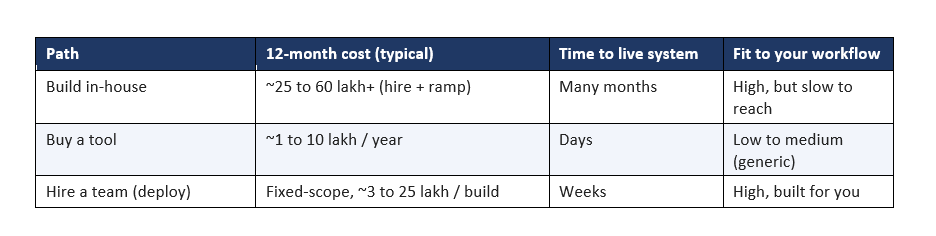
Read the columns together, not just the cost. Buying is cheapest and fastest but fits worst. Building fits best eventually but is slowest and most expensive. Hiring a team is the balanced middle: fast, fitted, and a fraction of the in-house cost. For a first deployment, that balance is usually the right trade, which is why so many companies deploy first and only build in-house once the value is proven and AI has become core. For the full cost mechanics, see our AI deployment cost guide for India.
A Decision Framework You Can Use Today
You can make the build vs buy vs hire decision with three questions, answered honestly. This is the framework I would use on the actual project sitting on your desk.
- Is AI core to your product? If yes, lean build, because owning the capability is strategic. If no, building is hard to justify.
- Does a tool fit your workflow as-is? If yes, buy it, do not build what you can license. If you would have to reshape your process around it, do not.
- Do you need a fitted system fast, without a permanent hire? If yes, hire a team to deploy, then decide about building later from a working base.
Most 20-engineer companies answer no, no, yes, which points to hiring a deployment team for the first project. That is not a failure of ambition, it is good sequencing: prove the value with a fitted system fast, then decide whether to internalise. The companies that get burned are the ones that answered the first question with a hopeful yes and spent a year building a capability they had not yet earned the right to own.
Build vs Buy vs Hire by Scenario
The right choice shifts with your situation, so here is the decision mapped to common scenarios a mid-market company faces. Find the row that sounds like you.
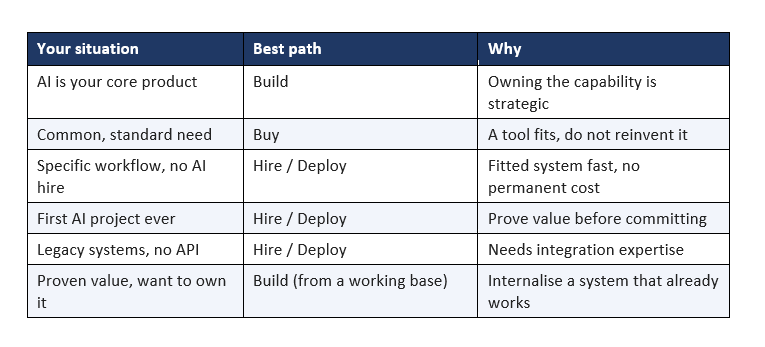
Notice how often hire or deploy is the answer for a company just starting with AI. That is not a coincidence, it reflects the reality that the scarce skill is not building software, it is crossing the production gap on your specific systems. Once that is done and the value is proven, the calculus shifts toward building and owning. Sequence matters as much as the choice.
Why Deploy-First Beats Build-First for Most Companies
For most mid-market companies, the winning sequence is deploy first and build later, not build from the start, because it removes risk in the right order. Building first means making your biggest, slowest, most expensive commitment, a permanent AI capability, before you have proven that the specific deployment even delivers value. That is backwards. You are betting the most before you know the least.
Deploy-first inverts that. You get a fitted, live system fast and cheaply, you learn exactly what AI is worth to your business on a real workflow, and only then, with evidence in hand, do you decide whether to build a permanent in-house capability to own it. If the value is there, building becomes an easy, well-informed decision made from a working system. If it is not, you have spent a fraction of what a failed in-house build would have cost. Either way you win, because you sequenced the risk sensibly.
This is why the hire-a-team option is not a compromise or a lesser choice, it is often the strategically smartest first move. It lets a company that is serious about AI act now, learn fast, and keep every option open, rather than freezing on a large build decision or settling for a tool that does not fit. Deploy to learn, then build to own is a better strategy than build to hope.
A Worked Example: The 20-Engineer Company's Choice
Here is an illustrative walk-through, because the abstract framework gets real fast with numbers. A 200-person logistics company has 20 engineers, no AI engineer, and one clear opportunity: automate the manual processing of delivery exception reports, a task that eats three people most of the day. The CTO faces the exact build, buy, or hire decision. Here is how each path plays out over a year.
Build: they try to hire an AI engineer. It takes four months to find one at 45 lakh a year, then two more months to ramp on the systems. Seven months in, the first version is still not in production, and they have spent roughly 25 lakh with nothing live. Buy: they find a generic document-automation tool for 6 lakh a year, but it cannot read their Hinglish, scanned exception reports or write into their legacy TMS, so it covers maybe half the workflow and the three people are still mostly busy. Hire a team: a deployment team scopes the workflow, handles the messy data and the no-API TMS, and ships a live system in six weeks for a fixed 7 lakh, with the exception process largely automated.
A year later, the build path might finally have something, at the highest cost and the longest delay. The buy path is cheap but only half-solved. The hire path has been live and saving three people's time for ten months, at a fraction of the build cost. For this company, on this first project, hiring a team to deploy was clearly right, and if the value holds, they can now justify building an in-house capability from a working system. The numbers are illustrative, but the shape of the outcome is exactly what plays out in practice.
Common Mistakes in the Build vs Buy Decision
A few predictable mistakes push companies toward the wrong path, and all of them are avoidable once you name them.
- Assuming your strong engineers can just pick up AI deployment on the side. It is a specialised skill, and the demo-to-production gap is where they will get stuck.
- Anchoring on the tool's low sticker price and ignoring poor fit, which costs more over a year than a fitted deployment.
- Building a permanent capability before proving the value of a single deployment.
- Forgetting the 80 percent, the integrations, data, and maintenance, in every option's cost.
- Treating it as a one-time decision rather than a sequence: deploy first, then decide about building.
The meta-mistake behind all of these is treating build vs buy AI as a status decision, where building feels more serious, rather than an economic one, where the goal is the fastest, cheapest path to a fitted, live system. Strip the ego out of it and the right choice usually gets obvious.
The Hidden Cost Every Option Shares
Whichever path you choose, one cost is unavoidable and almost always under-budgeted: the hard 80 percent of making AI work in production. The model is the cheap, easy part. The integrations, the messy data, the failure handling, the approval boundary, and the ongoing maintenance are where the real effort lives, and they exist whether you build, buy, or hire. The difference is who does that work and how well they have done it before.
This is why the decision is really about who owns the 80 percent. Build, and your new hire owns it while learning it for the first time. Buy, and you own the gap between what the tool does and what your workflow needs. Hire a deployment team, and someone who has crossed that gap many times owns it and hands you the result. Ignoring the 80 percent is how projects in all three paths end up in the graveyard, a pattern we cover in why AI POCs never reach production and the POC graveyard.
So the final word on build vs buy AI is this: price the 80 percent honestly into every option, and choose the path where it is owned by someone who has done it before and fits your workflow. For a 20-engineer company on its first real deployment, that usually means deploy first, prove the value, and build to own only once AI has earned a permanent place in your stack. Make the decision on economics and sequence, not on which option sounds most impressive, and you will neither overspend on a build you were not ready for nor settle for a tool that never fit.
FAQ
Should I build or buy AI?
Build AI when it is core to your product and you can afford the talent and time to own the capability. Buy when your need is generic and a tool fits your workflow as-is. If neither fits, and for most companies without an AI engineer it does not, hiring a specialist team to deploy a fitted system fast is usually the better third option.
Is it cheaper to build AI in-house or hire a team?
For most companies without an existing AI engineer, hiring a team to deploy is cheaper over the first year than building in-house. An AI hire in India costs roughly 25 to 60 lakh a year plus ramp, while a fixed-scope deployment ships a live system for a fraction of that. Building becomes worthwhile once value is proven and you want to own the capability.
When should a company build its own AI?
Build your own AI when it is core to your product, when you have or can hire dedicated AI talent, and ideally after a deployment has proven the value. Building from a working system you already understand is far lower risk than building from scratch on an unproven idea. For a first project without an AI hire, deploying first is usually the smarter sequence.
How much does it cost to hire an AI engineer in India?
A capable AI engineer in India typically costs around 25 to 60 lakh per year in total compensation, and they are scarce and slow to hire. On top of salary, factor in months of hiring time and a ramp before they ship a first production system. That full cost is why many companies deploy with a specialist team first and hire in-house later.
What is the fastest way to deploy AI in a company?
The fastest way to a live, fitted AI system is to hire a specialist team, or a Forward Deployed Engineer, who has shipped production AI before. They scope the hard 80 percent, integrate your systems, and ship in weeks, versus the many months an in-house build takes. Buying a tool is faster still but fits generic needs only.
What if a tool almost fits our workflow?
If a tool fits most but not all of your workflow, weigh the cost of the gap. A tool covering 70 percent can be worse than nothing when the missing 30 percent is where the value was. If closing the gap means reshaping your process or heavy customisation, a fitted deployment is usually the better and often cheaper choice over a year.
Can we build AI in-house without a dedicated AI engineer?
It is risky. General software engineers can learn AI, but crossing the demo-to-production gap, messy data, integrations, evals, and reliability, is a specialised skill they will be learning for the first time on a live project. That learning curve is why first in-house builds so often stall. Deploying with a team that has done it before, then internalising, is usually safer and faster.
How do I decide between build, buy, and hire?
Ask three questions: Is AI core to your product? Does a tool fit your workflow as-is? Do you need a fitted system fast without a permanent hire? Yes to the first leans build, yes to the second leans buy, and yes to the third, the common answer for mid-market companies, leans hire a team to deploy, then decide about building later.
Recommended Blogs
- What AI Deployment Actually Costs in India (2026)
- Why AI POCs Never Reach Production (2026 Blueprint)
- Forward Deployed Engineer Salary India 2026 (Bands)
- AI Jobs in India Salary (2026): Complete Pay Guide
- Can AI Work With Legacy Systems, or Must You Replace Them?
References
MIT Sloan Management Review: Making the AI Build or Buy Call

