



Xiaomi MiMo-V2.6 Pro & Flash Review: Which Open-Weight Model Should You Actually Use?
Xiaomi MiMo-V2.6 is the company's biggest open-model release yet, and the important part is that Xiaomi is launching two different models for two different jobs. MiMo-V2.6-Pro is a 1.02-trillion-parameter sparse MoE with 42 billion active parameters, while MiMo-V2.6-Flash is a 309-billion-parameter model with 15 billion active parameters. Both accept text, images, video and audio, both support a 1M-token context, and both are released with weights and technical resources under the MIT license.
Xiaomi released the MiMo-V2.6 series on September 22, 2026, with the Pro model positioned for complex projects, long-horizon agents, research, cybersecurity and high-stakes workloads, while Flash is designed as the lower-cost, high-frequency option. The API pricing is unusually aggressive: Pro is $0.435 per million uncached input tokens and $0.87 per million output tokens, while Flash is $0.14 input and $0.28 output. Cached input is priced at just $0.0036 for Pro and $0.0028 for Flash per million tokens.
The benchmark story is equally interesting. MiMo-V2.6-Pro scores 46.32 on Artificial Analysis's Intelligence Index, which Xiaomi cites as the highest score among current open-weight models in that comparison. Its published model-card results include 71.9 on DeepSWE v1.1, 89.9 on Terminal-Bench 2.1, 82.0 on OSWorld-Verified and 94.0 on CyberGym. Flash stays surprisingly close on many of these vendor-reported evaluations, reaching 67.9 on DeepSWE, 87.6 on Terminal-Bench 2.1, 80.8 on OSWorld-Verified and 95.1 on CyberGym.
QUICK ANSWER
MiMo-V2.6 is Xiaomi's September 2026 open-weight model family, consisting of MiMo-V2.6-Pro and MiMo-V2.6-Flash. Both are native multimodal models with text, image, video and audio input, 1,048,576-token context windows, up to 131,072 output tokens through the current API, tool calling, web search, structured output, deep thinking and context caching.
The Pro model is the capability-first option. It has 1.02T total parameters and 42B activated parameters, scores 46.32 on Artificial Analysis's Intelligence Index, and Xiaomi's model card reports 71.9 on DeepSWE v1.1, 89.9 on Terminal-Bench 2.1 and 82.0 on OSWorld-Verified. Flash is the efficiency model at 309B total and 15B active parameters, with model-card scores of 67.9, 87.6 and 80.8 on those same three evaluations.
Pricing is one of the biggest reasons to pay attention. Xiaomi lists Pro at $0.435 per million input tokens and $0.87 per million output tokens, while Flash costs $0.14 input and $0.28 output. Both also have very low cache-hit rates. Xiaomi has kept the same base pricing approach as the V2.5 line while increasing intelligence and multimodal capability.
My verdict: 9.3/10 overall for the MiMo-V2.6 family. Pro is the one to test when maximum open-weight capability matters. Flash is the more interesting production workhorse when you need many calls, lower inference cost and most of the same model envelope.
1. What Is Xiaomi MiMo-V2.6?
MiMo-V2.6 is Xiaomi's latest open-weight reasoning model family, released on September 22, 2026. It is the successor to the MiMo-V2.5 generation and is built around a much larger reinforcement-learning program rather than simply increasing pretraining scale.
Xiaomi says the V2.6 training process used more than 7,000 high-quality RL task environments across software engineering, vulnerability reproduction, knowledge-intensive work and web design and development. The company ran roughly 750,000 trajectories in less than six days, spending about $2.62 million on Pro and $850,000 on Flash during the reported RL training runs.
The research release is unusually broad. Xiaomi published the model weights, a technical report, more than 7,000 RL environments, an end-to-end RL framework built on verl, uni-agent and mini-swe-agent, plus lightweight agent harnesses designed for training and evaluation.
2. MiMo-V2.6 Pro vs Flash Specifications
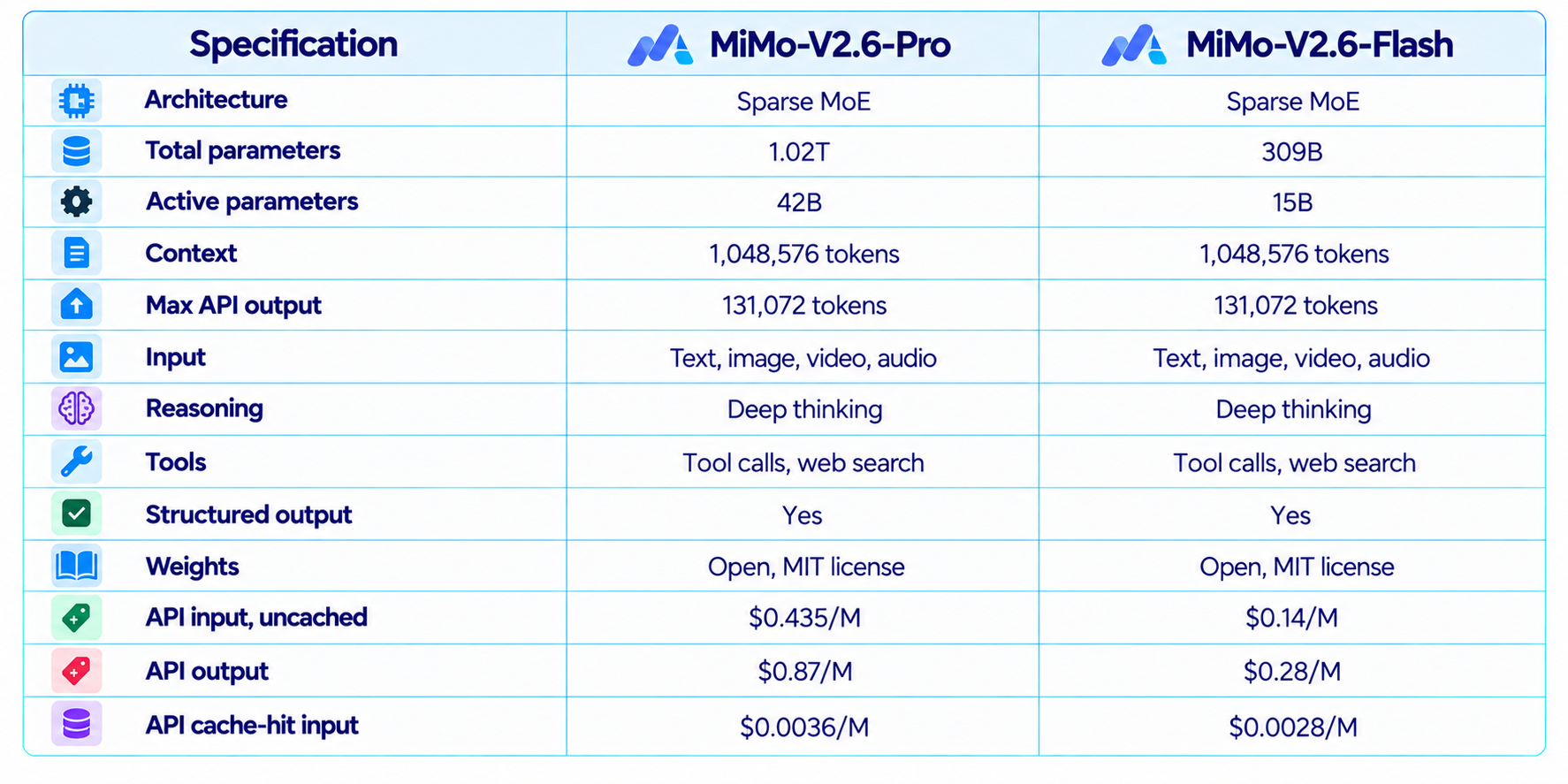
The parameter difference is significant, but the active parameter count tells a more useful inference story. Pro activates 42B parameters per token while Flash activates 15B, which is why Flash can offer a much lower serving cost even though its total parameter count is still 309B. Both retain the same one-million-token context and native multimodal input.
3. The Architecture: Huge Total Size, Much Smaller Active Compute
Both models use sparse Mixture-of-Experts architecture. The Pro model contains 1.02 trillion total parameters but activates about 42 billion, while Flash contains 309 billion total and activates about 15 billion. This is a classic MoE tradeoff: a model can have a large capacity without running every parameter for every token.
The V2.6 architecture also includes dedicated encoders for multimodal input. The published model card describes a 681-million-parameter MiMo ViT vision encoder, a 308-million-parameter AudioTokenizer plus 127-million-parameter audio patch encoder, and a five-layer Multi-Token Prediction decoder for speculative generation.
That means the models are not simply text LLMs with separate image and audio APIs around them. Text, image, video and audio are part of the model's input architecture, which is important for multimodal coding, document analysis, visual agents and research workflows.
4. MiMo-V2.6 Pro Benchmark Performance
MiMo-V2.6-Pro is currently the family member with an independent Artificial Analysis Intelligence Index score. Xiaomi's model page reports 46.32, and current third-party benchmark tracking records the same figure.
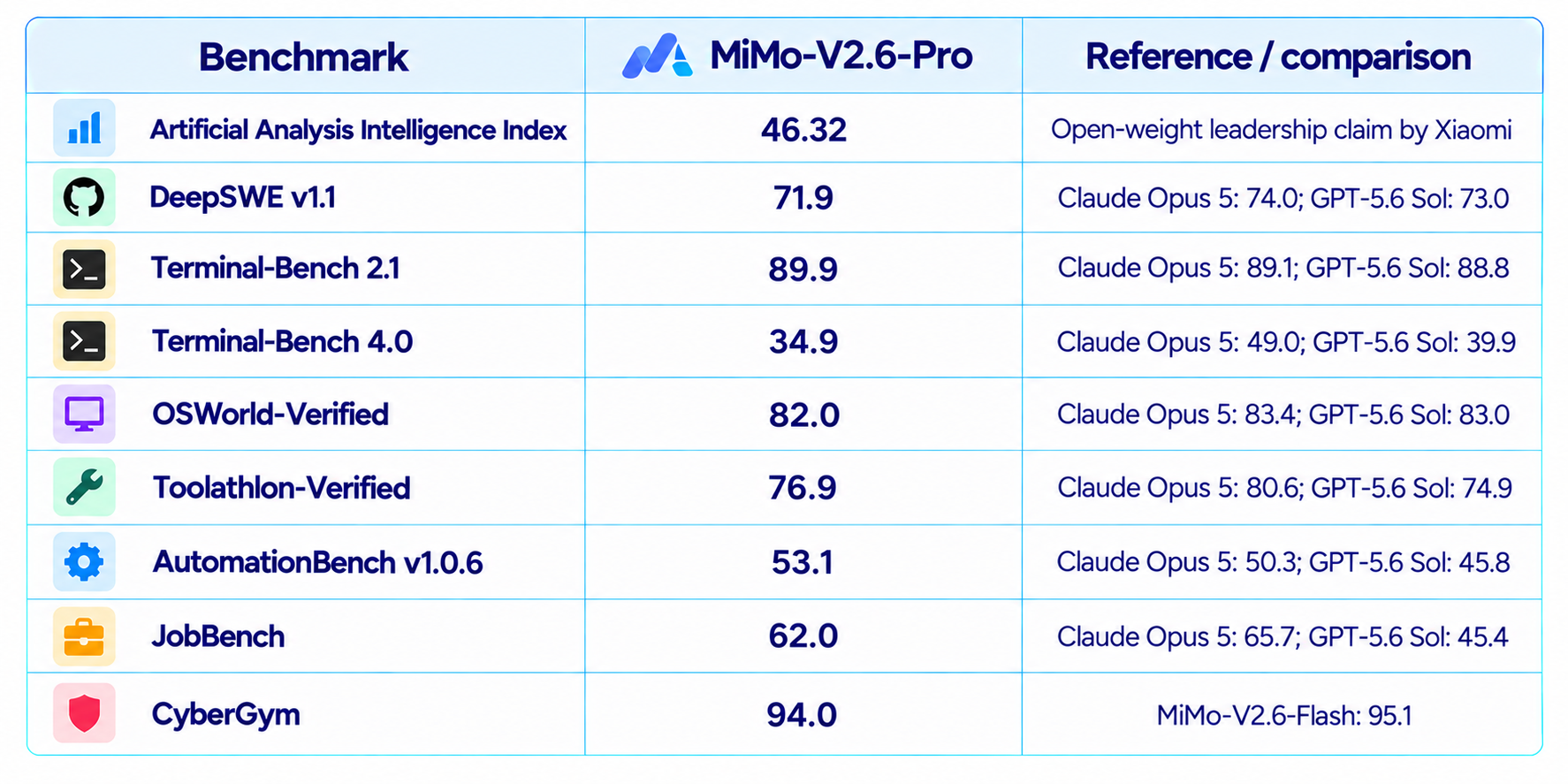
These benchmark results show why the model has received attention. Pro is close to the leading models on DeepSWE, Terminal-Bench 2.1 and OSWorld-Verified, and it exceeds the cited Claude Opus 5 and GPT-5.6 Sol results on AutomationBench. It does not lead every evaluation: Terminal-Bench 4.0 and JobBench show meaningful gaps. The right way to read the table is as a strong, broad profile rather than a universal benchmark win.
5. MiMo-V2.6 Flash Benchmark Performance
Flash is the more surprising model because it gets much of Pro's agentic profile while activating only 15B parameters. Xiaomi's model card reports 67.9 on DeepSWE v1.1, 87.6 on Terminal-Bench 2.1, 80.8 on OSWorld-Verified, 73.6 on Toolathlon-Verified and 52.3 on AutomationBench.
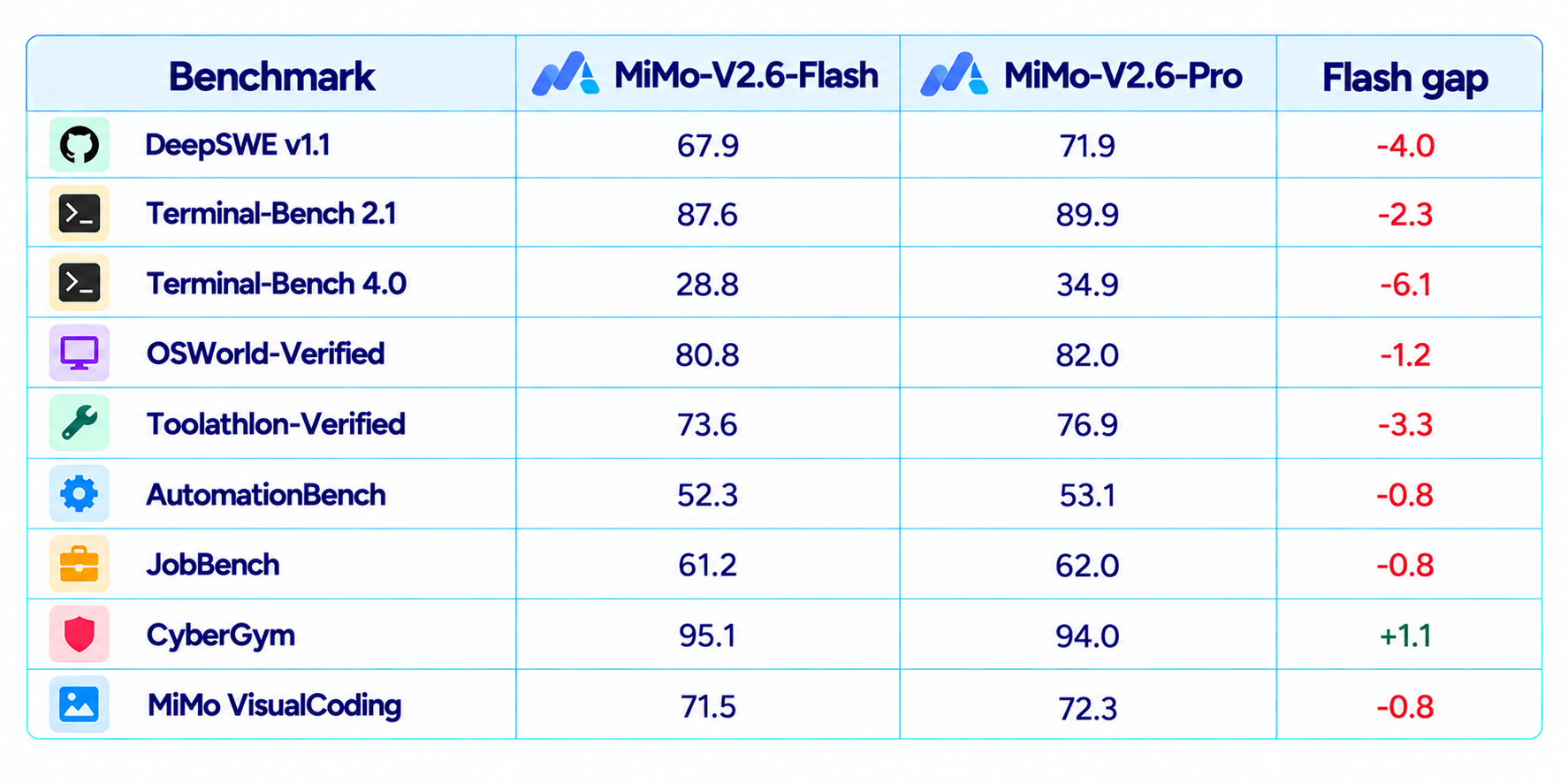
The pattern is clear. Flash stays within four points of Pro on every shared benchmark in the current model-card table and actually scores higher on CyberGym. That makes Flash more than a cheap version of Pro. It is a separate efficiency point on the same capability curve.
One important measurement note: these MiMo-V2.6 benchmark figures are primarily Xiaomi's model-card evaluations. Third-party trackers have not independently reproduced every benchmark, and MiMo-V2.6-Flash did not have an Artificial Analysis model page in the live check used for this review. The scores should therefore be described as Xiaomi-reported model-card results rather than independently reproduced rankings.
6. The DeepSWE Story: The Biggest RL Gain
The strongest story behind MiMo-V2.6 is not simply the final leaderboard. It is how much the models improved during reinforcement learning.
Xiaomi reports that the held-out DeepSWE v1.1 score improved from 58.4 to roughly 72.6 for Pro and from 48.8 to roughly 65.7 for Flash during its large-scale RL runs. The final public model-card table records 71.9 for Pro and 67.9 for Flash, which reflects a different published evaluation snapshot. The two figures should not be mixed into one benchmark result.
The broader training experiment used roughly 750,000 trajectories, more than 7,000 environments and less than six days of RL training. Xiaomi reports average training-task pass-rate gains of roughly 12% for Pro and 25% for Flash in relative terms.
This is important because it shows where MiMo-V2.6 is trying to compete: not simply through larger pretraining, but through large-scale agent interaction, reward modeling and environment diversity.
7. Coding and AI Agent Performance
MiMo-V2.6 is explicitly designed around agentic coding and long-horizon tasks. The public RL environment collection covers software engineering, web development, vulnerability reproduction and knowledge-intensive work.
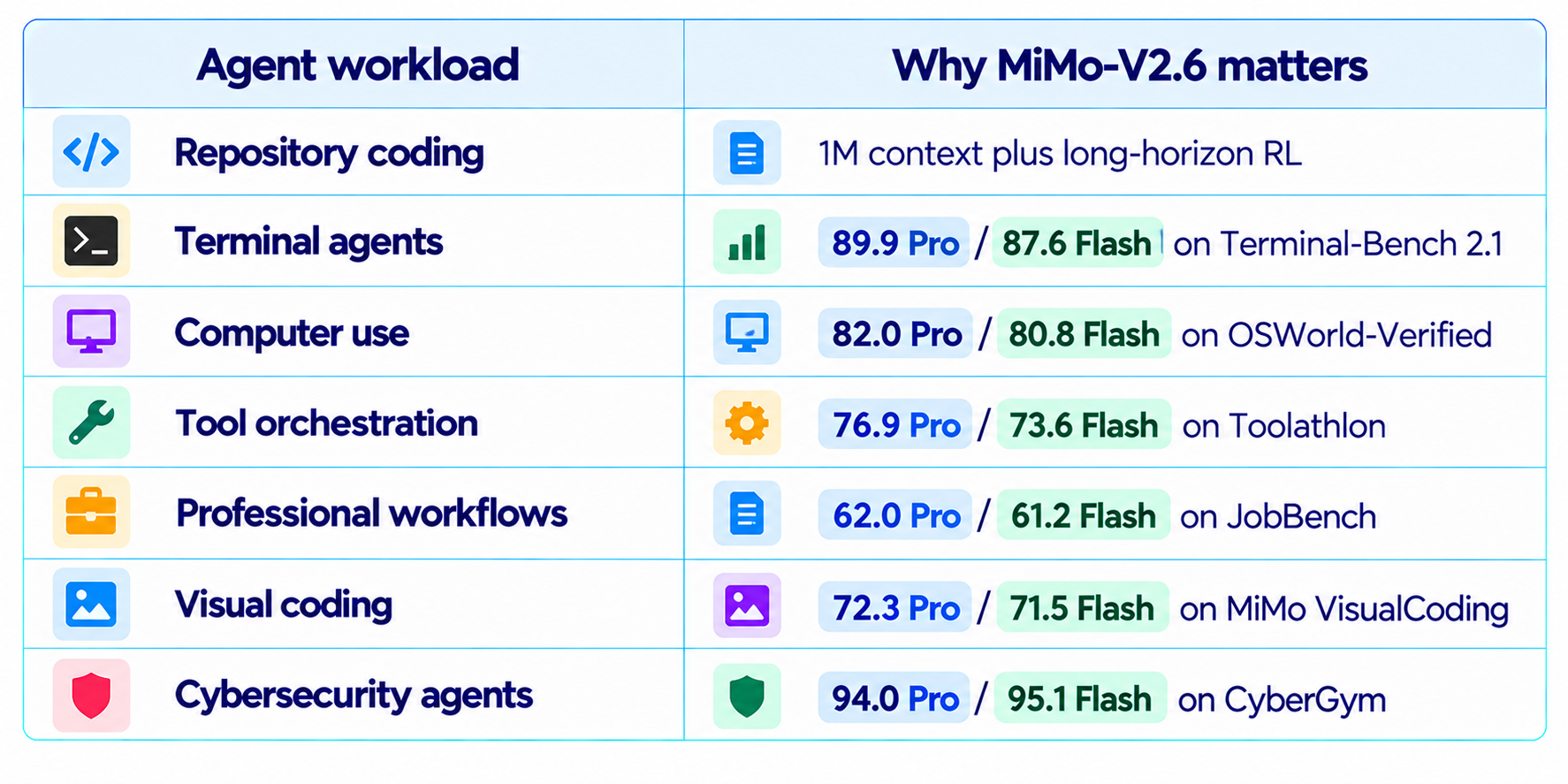
The breadth is the point. Xiaomi is treating coding agents, visual agents, cybersecurity agents and general enterprise workflows as one reinforcement-learning problem instead of training separate specialist models for each domain.
8. Multimodal AI: Text, Images, Video and Audio
Both MiMo-V2.6 models are natively multimodal. Xiaomi's official model pages list text, image, video and audio as supported input modalities, while the model cards document dedicated visual and audio encoders.
This expands the potential use cases beyond coding. A single MiMo-V2.6 workflow can combine a screenshot, a video recording, an audio clip and a text specification instead of routing each modality to a separate model.
For software teams, that can mean visual UI debugging, video-based product analysis, audio-aware support workflows and multimodal agents. For research teams, it opens document-plus-image-plus-audio workflows inside the same long context.
9. The 1M Context Window
Both Pro and Flash support a 1,048,576-token context window and up to 131,072 output tokens through the current MiMo API.
A million-token context is particularly useful for repository-scale coding, long technical documentation, legal or policy analysis, large research collections and agent sessions that accumulate tool traces over time.
The practical advantage is not that applications should always fill the entire window. The best results still come from giving the model relevant context and maintaining clean state. Large context is a capacity advantage, not a substitute for retrieval or context engineering.
For a deeper look at this architecture, read What Is Context Engineering? Complete Guide (2026).
10. MiMo-V2.6 Pricing
The pricing is one of the strongest reasons to consider the family. Xiaomi says V2.6 uses the same API pricing structure as V2.5, while increasing capability.
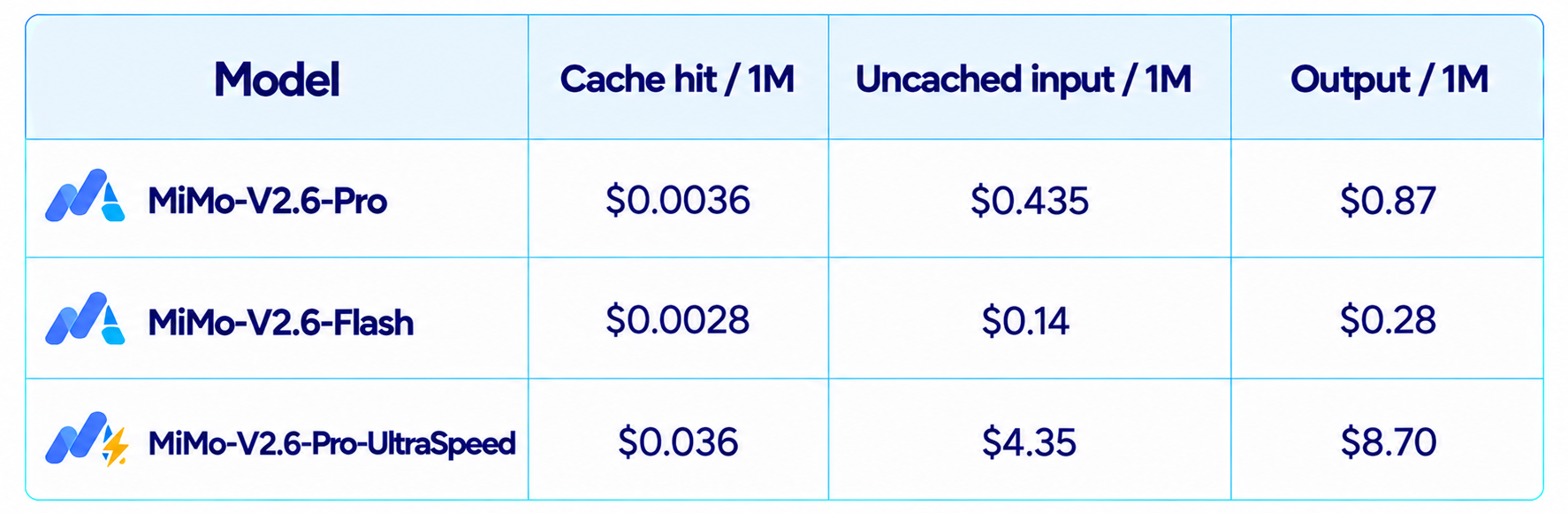
These are current Xiaomi API rates. Pro-UltraSpeed is the hosted low-latency serving mode for the Pro model, not a third open-weight checkpoint. Xiaomi says UltraSpeed can provide up to 20x output speed, aimed at real-time and latency-sensitive workloads.
The cost difference between Pro and Flash is straightforward: Flash is roughly one-third of Pro's uncached input and output rates. That makes Flash the more natural default for high-frequency calls, while Pro becomes attractive when the extra capability is worth the additional token cost.
11. MiMo-V2.6 Pro vs Flash: Which One Should You Use?
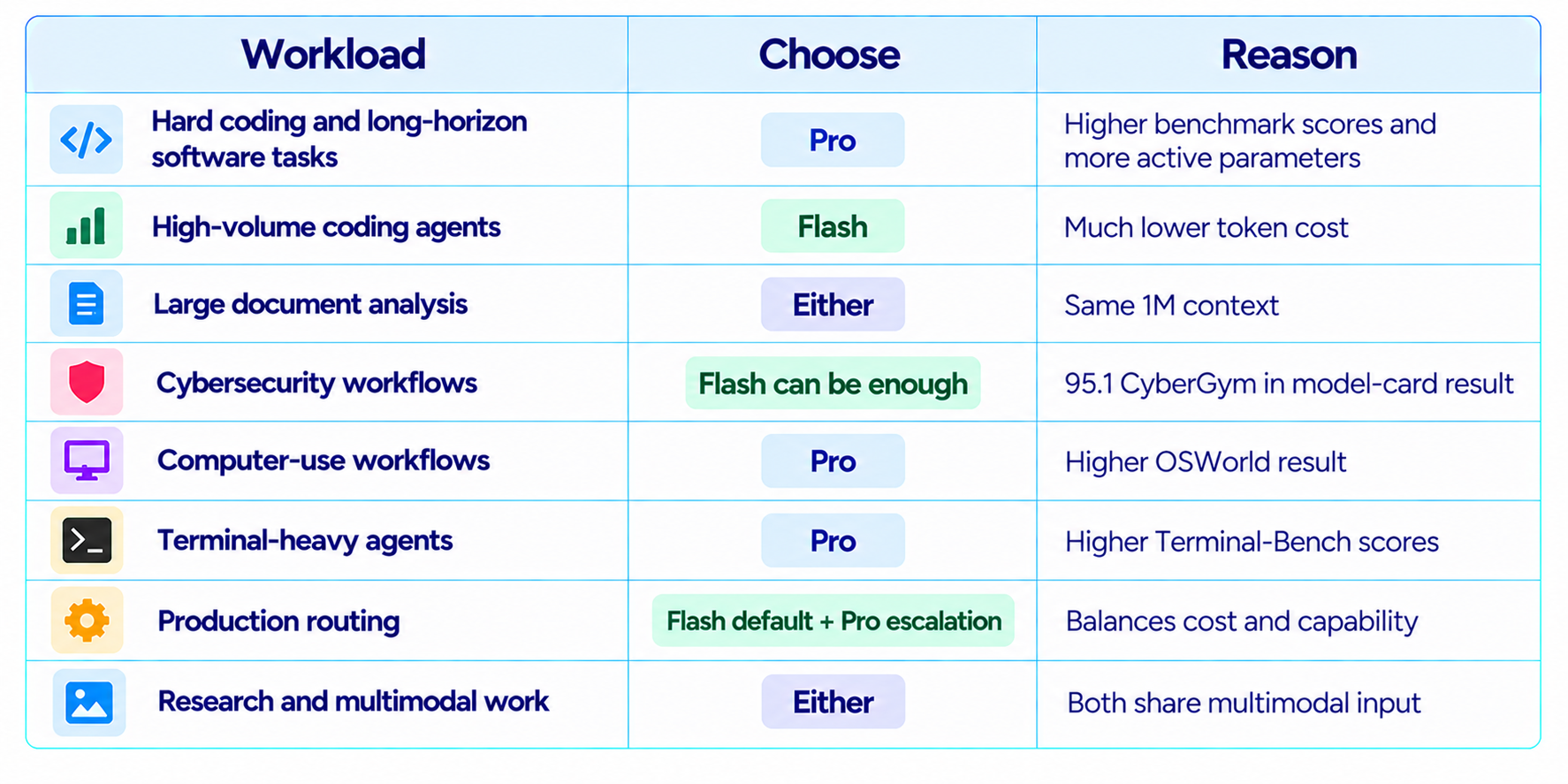
The most interesting architecture is not choosing one model for everything. Use Flash as the default worker model and route the hardest tasks to Pro. The benchmark gaps are small on several agent evaluations, while the price gap is large.
12. MiMo-V2.6 Pro vs Qwen 3.8 Max 0902
Qwen 3.8 Max 0902 is one of the most relevant comparisons because both models target coding, long-horizon agents and enterprise workflows. Qwen 3.8 Max 0902 keeps a 1M-token context and is priced at $2 per million input and $6 per million output tokens, which is several times more expensive than MiMo-V2.6 Pro.
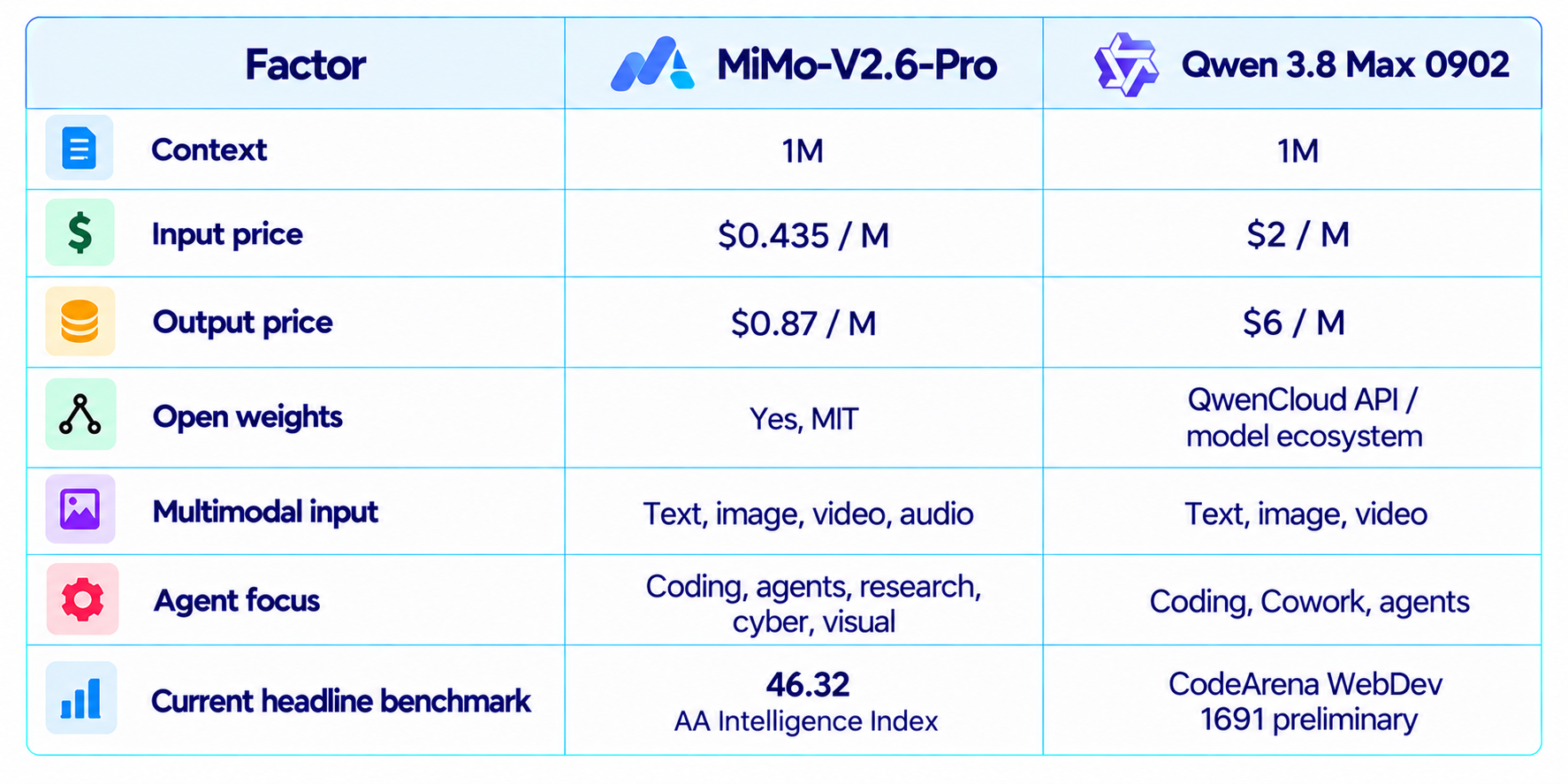
Qwen 3.8 Max 0902 is a useful reference for capability-focused API workloads, while MiMo-V2.6's main advantage is open weights plus much lower token pricing. Read our
Qwen 3.8 Max 0902 Review for the full Qwen breakdown.
13. Open Source, Weights and Local Deployment
Xiaomi has released MiMo-V2.6 Pro and Flash weights under the MIT license and published a technical report, RL resources, task environments, training framework and agent harnesses. The official Hugging Face model cards provide Transformers usage and downloadable model repositories.
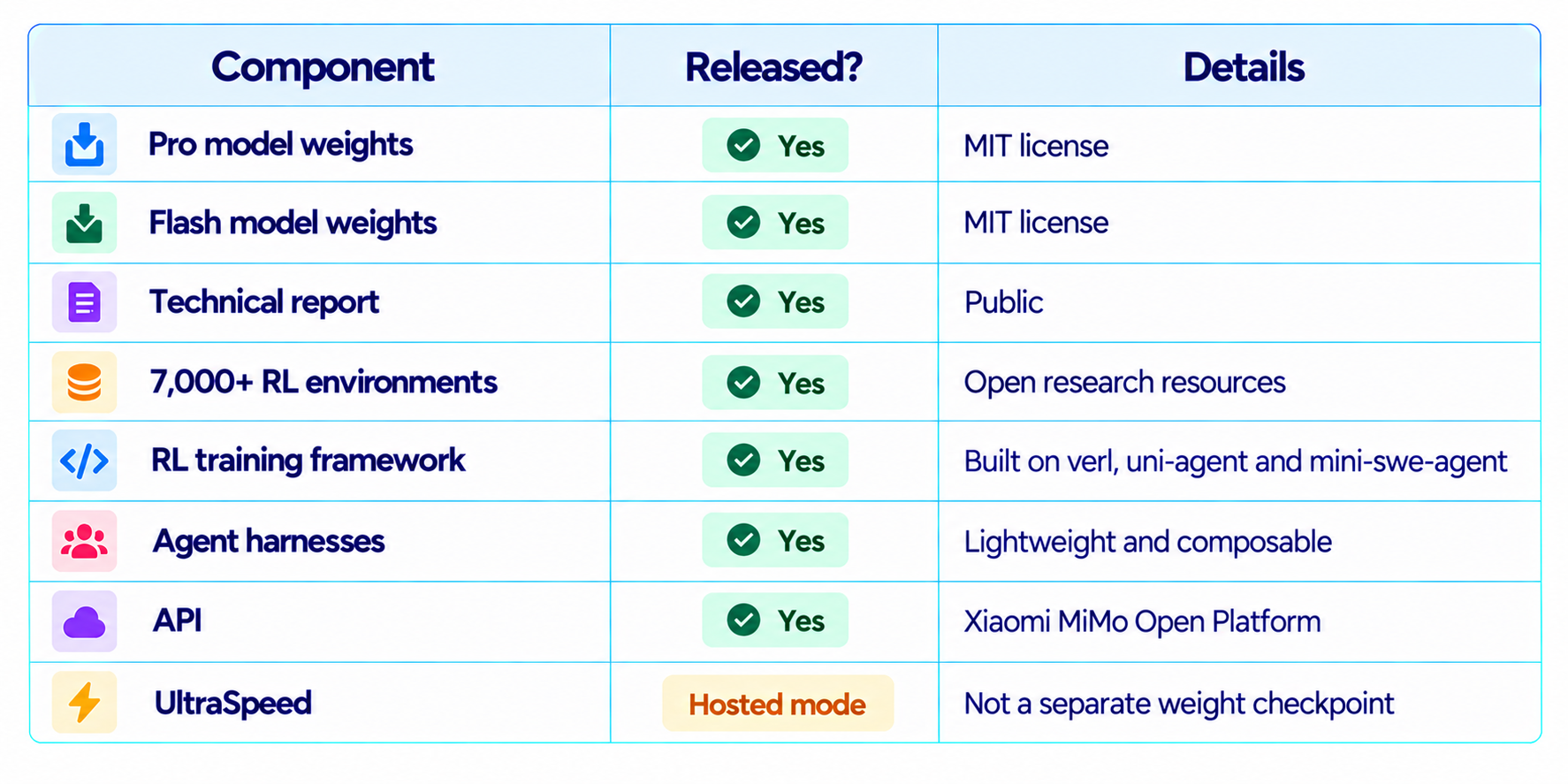
The practical limitation is hardware. Pro contains 1.02T total parameters and Flash 309B total parameters, so full local inference is a serious infrastructure task. Quantization, distributed serving and memory-efficient runtimes become important if you want to self-host instead of using the API.
16. Xiaomi MiMo-V2.6 for Coding Agents
MiMo-V2.6 is particularly well suited to coding agents because Xiaomi trained the models in environments that explicitly include software engineering, web development and multi-step task completion.
Tool calling, structured output, web search and a 1M-token context window give the model the infrastructure an agent needs. The difference between Pro and Flash then becomes a routing question: how much intelligence should each task receive?
- Flash for routine code edits, test generation and repository navigation.
- Pro for architecture changes, difficult debugging and long-horizon implementation.
- Flash for high-volume agent loops where retries are cheap.
- Pro for tasks where a single successful pass matters more than token cost.
For the broader routing strategy, read Model Routing for AI Coding Agents.
15. MiMo-V2.6 for Cybersecurity and Research
The cybersecurity results are one of the more unusual parts of the release. The model card reports CyberGym at 94.0 for Pro and 95.1 for Flash, while MiMo Cyber Bench is 80.2 and 77.2 respectively. ExploitGym and ExploitBench results are lower, showing that cybersecurity capability varies significantly by benchmark and task type.
For research, the combination of 1M context, multimodal input and tool calling creates a useful envelope for literature analysis, technical research and multi-document workflows. Xiaomi also highlights real internal research use for materials science, where MiMo-V2.6-Pro helps design MOF materials to capture PFAS pollutants.
16. What Are the Main Limitations?
- Most published MiMo-V2.6 benchmark tables are Xiaomi's own model-card evaluations, so individual numbers should be read with benchmark provenance in mind.
- MiMo-V2.6-Flash did not have an independent Artificial Analysis Intelligence Index page in the current live check.
- Pro and Flash are extremely large MoE models, so local deployment requires serious memory and serving infrastructure.
- The Pro model is more expensive than Flash, so using it for every routine call wastes part of its advantage.
- UltraSpeed is much more expensive than standard Pro even though it uses the same Pro capability level.
- Large context does not eliminate the need for context engineering or retrieval.
- Native multimodal input is broad, but task-specific quality can still vary by modality and workload.
17. Recommended Production Workflow
The most efficient MiMo-V2.6 architecture is a two-level routing system. Start with Flash and escalate only when the task requires Pro-level reasoning.
- Use Flash for classification, extraction, routine coding and high-frequency agent calls.
- Use Pro for hard repository reasoning, complex research and high-stakes tasks.
- Keep the same tool schema across both models so routing does not change the surrounding agent.
- Use cached context for repeated long documents or repository material.
- Measure cost per completed task rather than cost per token.
- Track retries, tool-call failures and escalation rates.
- Use UltraSpeed only when latency is more important than the standard Pro cost.
18. How to Evaluate MiMo-V2.6 Yourself
Public benchmarks are useful, but a production test should use the same prompts, tools and documents your application actually processes.
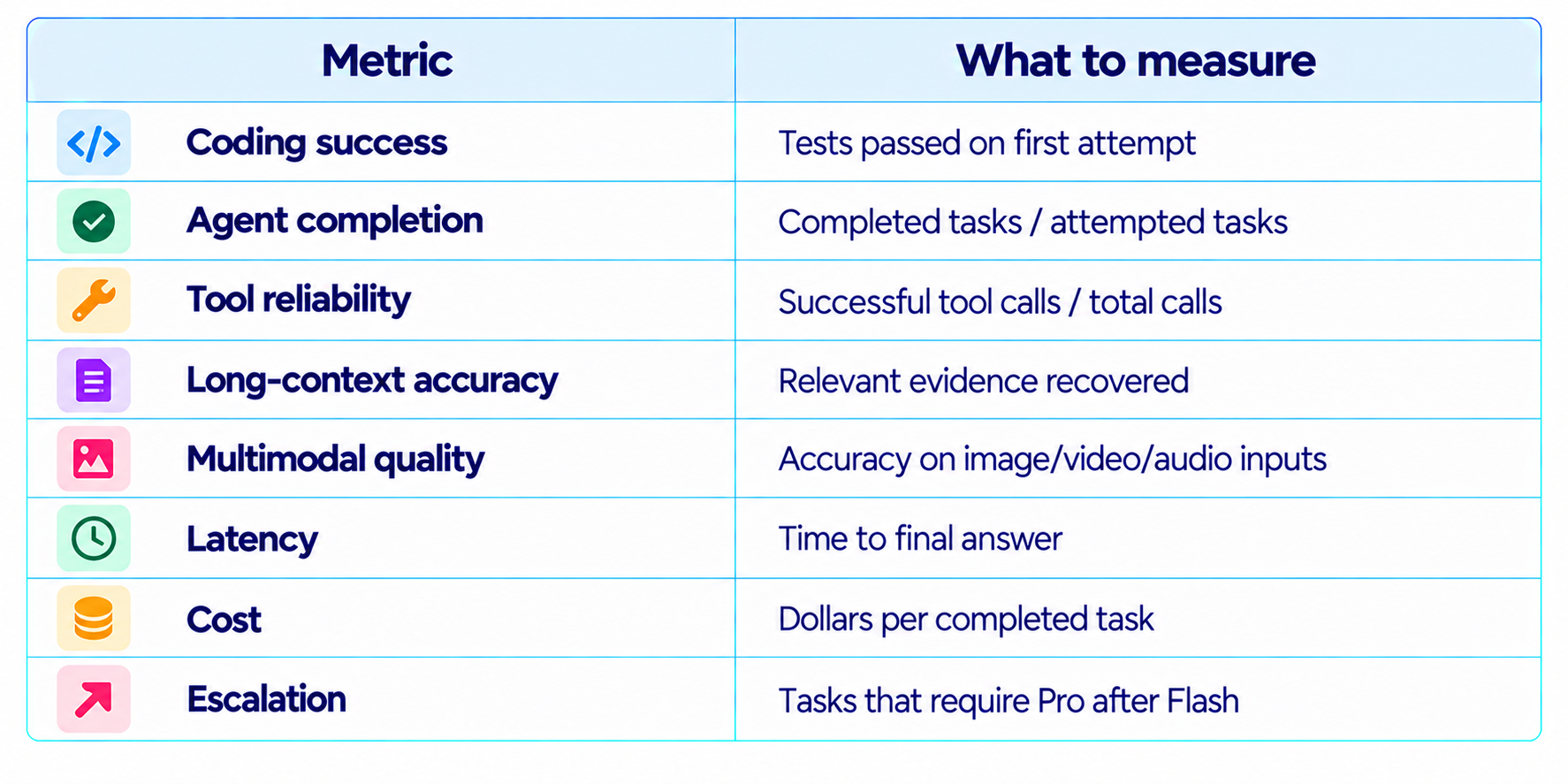
The most important experiment is Pro versus Flash on the same workload. If Flash completes most tasks successfully, it becomes the obvious cost-efficient default. Pro then serves as the escalation tier for the hardest cases.
19. Is Xiaomi MiMo-V2.6 Worth It?
Yes. MiMo-V2.6 is one of the most interesting open-weight model releases of September 2026 because the capability, pricing and openness all move in the same direction.
Pro is the headline model. Its 46.32 Artificial Analysis Intelligence Index score, 71.9 DeepSWE result, 89.9 Terminal-Bench 2.1 score and 82.0 OSWorld-Verified result put it directly into serious agent and coding comparisons. Flash then complicates the market by staying within a few points of Pro on many model-card benchmarks at roughly one-third of the token price.
The biggest strategic advantage is the open ecosystem. Xiaomi is not only releasing weights. It is releasing the RL research infrastructure around them, including environments, training code and harnesses. That makes MiMo-V2.6 interesting to researchers and infrastructure teams as well as API users.
The caveat is benchmark provenance. The strongest Pro score is independently tracked through Artificial Analysis, but most detailed Pro-versus-Flash rows come from Xiaomi's own model-card table. The correct reading is that the release is highly competitive on its published evaluations, not that every score has already been independently reproduced.
20. Final Verdict
Xiaomi MiMo-V2.6 is a major open-model release. Pro combines a 1.02T sparse MoE, 42B active parameters, native text-image-video-audio understanding, a 1M context window and a strong agent benchmark profile. Flash compresses the same product idea into a 309B total, 15B active model that stays surprisingly close on many coding, agentic and visual evaluations.
The numbers make the split easy to understand. Pro is the capability-first model at $0.435 input and $0.87 output per million tokens. Flash is the high-frequency option at $0.14 input and $0.28 output. Both support the same 1M context, multimodal inputs, tools and structured outputs.
Pro's 46.32 Artificial Analysis Intelligence Index score is the headline, but the model-card benchmark table is just as revealing. Flash trails Pro by only 2.3 points on Terminal-Bench 2.1, 1.2 points on OSWorld-Verified and 0.8 points on JobBench, while actually exceeding Pro on CyberGym. That is a strong argument for routing most routine work to Flash.
My rating: 9.5/10 for Pro's open-model capability, 9.4/10 for Flash's price-to-performance, 9.2/10 for agentic workflows, 9.6/10 for openness and 9.3/10 overall.
Bottom line: MiMo-V2.6 Pro is the model to test when you want the highest capability available inside Xiaomi's open-weight family. MiMo-V2.6 Flash is the model to deploy when you need that family to handle large volumes of work without the Pro token bill. Together, they make a strong Pro-plus-Flash routing pair for coding, agents, research, cybersecurity and multimodal workflows.
Frequently Asked Questions
What is Xiaomi MiMo-V2.6?
MiMo-V2.6 is Xiaomi's September 2026 open-weight model family, consisting of MiMo-V2.6-Pro and MiMo-V2.6-Flash, with native text, image, video and audio input.
What is the difference between MiMo-V2.6 Pro and Flash?
Pro has 1.02T total and 42B active parameters, while Flash has 309B total and 15B active parameters. Pro targets maximum capability; Flash targets lower-cost high-frequency workloads.
What is the MiMo-V2.6 context window?
Both models support a 1,048,576-token context window.
How much does MiMo-V2.6 Pro cost?
Current Xiaomi API pricing is $0.435 per million uncached input tokens and $0.87 per million output tokens, with a $0.0036 per million cache-hit input rate.
How much does MiMo-V2.6 Flash cost?
Current pricing is $0.14 per million uncached input tokens and $0.28 per million output tokens, with a $0.0028 cache-hit input rate.
Is MiMo-V2.6 open source?
Xiaomi released the Pro and Flash weights under the MIT license and also published its technical report, RL environments, training framework and agent harness resources.
What is the MiMo-V2.6 Pro benchmark score?
It scores 46.32 on the Artificial Analysis Intelligence Index. The model card also reports 71.9 on DeepSWE v1.1 and 89.9 on Terminal-Bench 2.1.
What are MiMo-V2.6 Flash benchmarks?
Xiaomi's model card reports 67.9 on DeepSWE v1.1, 87.6 on Terminal-Bench 2.1, 80.8 on OSWorld-Verified, 73.6 on Toolathlon-Verified and 95.1 on CyberGym.
Can MiMo-V2.6 run locally?
The weights are downloadable and MIT-licensed, so self-hosting is possible in principle. The parameter counts are very large, however, so practical local deployment requires substantial memory, quantization and/or distributed serving.
Is MiMo-V2.6 Pro better than Flash?
Pro is the higher-capability model, but Flash is much cheaper and stays close to Pro on many published agent benchmarks. For production, Flash plus Pro escalation is a sensible architecture.
Does MiMo-V2.6 support images, video and audio?
Yes. Xiaomi's model pages list text, image, video and audio input for both Pro and Flash.
What is MiMo-V2.6 Pro UltraSpeed?
It is a hosted high-speed serving mode for the Pro capability, advertised at up to 20x output speed. It is not a separate open-weight checkpoint.
Recommended Blogs
Quasar 438B Review: Benchmarks, Speed, Price & Is It Worth It? (2026)
Meta Muse Spark 1.3 Review: Coding, Price & Is It Worth It? (2026)
Gemini 3.8 Flash Review: Accuracy, Price & Is It Worth It? (2026)
Qwen 3.8 Max 0902 Review: Benchmarks, Price & Is It Worth It? (2026)
Mercury 2.5 AI Model Review: Speed, Price & Is It Worth It? (2026)
MiniMax H3 Turbo Review: Speed, Quality, Price & Is It Worth It? (2026)
MiniMax FastH3 Review: Speed, Quality, VRAM & Is It Worth It? (2026)
AI Model Routing in 2026: When to Use Fable, Astra, Gemini or Muse
Latest AI Models Comparison 2026: GPT-6 Astra vs Fable 5.1 vs Gemini 3.8 Flash & More
Resources & Community
Join our community of 70,000+ AI enthusiasts and learn to build powerful AI applications. Whether you're a beginner or an experienced developer, Build Fast with AI helps you understand and implement AI in your projects.
Agentic AI Launchpad 2026
A structured 6-week cohort program that takes you from AI basics to building and deploying real-world agentic AI systems. Includes live sessions, expert mentorship, project reviews and a builder community network.
Ready to go from learning to building? Join the next cohort: Agentic AI Launchpad 2026
Free AI Resources
Access free tools, workshops and micro-learning to keep building.

