



Latest AI Models Comparison 2026: Which Frontier Model Is Best for Coding, Agents, Research and Scale?
The AI model market has changed quickly again in September 2026. GPT-6 Astra, Claude Fable 5.1, Gemini 3.8 Flash, Meta Muse Spark 1.3, Qwen 3.8 Max 0902 and Quasar 438B are now competing for the same production workloads: software engineering, autonomous agents, research, long-context analysis and high-volume automation.
These models are not six versions of the same product. Each occupies a different point on the intelligence, speed, context, pricing and deployment curve. GPT-6 Astra is built for difficult end-to-end work, Claude Fable 5.1 targets demanding reasoning and long-horizon agentic tasks, Gemini 3.8 Flash focuses on high-throughput software and enterprise workflows, Muse Spark 1.3 pushes Meta's agentic coding stack, Qwen 3.8 Max 0902 targets complex coding and autonomous work, and Quasar 438B emphasizes enterprise reasoning with unusually fast API performance.
The current benchmark picture is close enough that one leaderboard number is no longer enough. Artificial Analysis currently places Claude Fable 5.1 at 66, GPT-6 Astra at 61, Muse Spark 1.3 xhigh at 61, Gemini 3.8 Flash high at 59, Qwen 3.8 Max 0902 at 45 and Quasar 438B at 43. Specific task benchmarks can change that order again, especially for coding, long-context retrieval and computer use.
For the earlier four-model comparison, see Claude Fable 5.1 vs GPT-6 Astra vs Gemini 3.8 Flash vs Muse Spark 1.3.
QUICK ANSWER
There is no single model that dominates every workload. Claude Fable 5.1 currently has the highest Artificial Analysis Intelligence Index among the six at 66, while GPT-6 Astra and Muse Spark 1.3 xhigh sit at 61 and Gemini 3.8 Flash high at 59. Qwen 3.8 Max 0902 and Quasar 438B score 45 and 43 respectively.
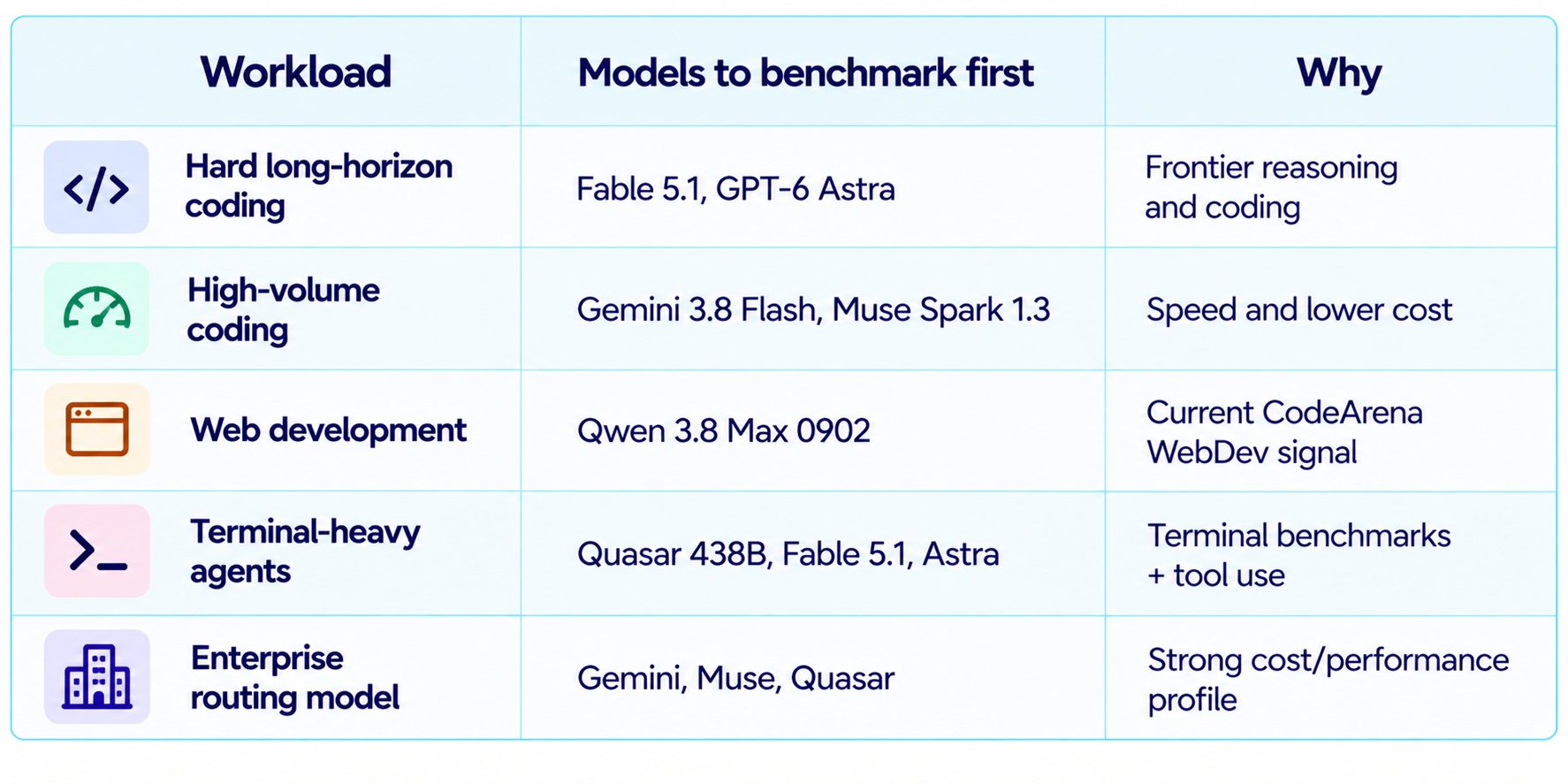
For coding agents, the strongest premium choices are Claude Fable 5.1 and GPT-6 Astra, while Muse Spark 1.3 is a strong value-oriented coding model and Gemini 3.8 Flash is the high-throughput option. Qwen 3.8 Max 0902 has a strong current web-development signal, while Quasar 438B is better positioned as a fast enterprise reasoning worker.
All six models are around the million-token context class. GPT-6 Astra lists 1.05M tokens, Fable 5.1 1M, Gemini 3.8 Flash 1M, Muse Spark 1.3 1M, Qwen 3.8 Max 0902 about 984K and Quasar 438B 1M. Context size is therefore less useful as a differentiator than context utilization, tool use and task-level reliability.
Pricing is where the market separates sharply. Gemini 3.8 Flash starts at $0.75 per million input and $3.75 per million output tokens through the end of 2026. Muse Spark 1.3 is around $1.25/$4.25, Qwen 3.8 Max 0902 is $2/$6, and Quasar 438B is $0.60/$1.80. Fable 5.1 and GPT-6 Astra are both $10/$50 at their standard API rates.
My practical conclusion is to treat these models as a portfolio. Use premium models for difficult work, faster models for routine agent loops, and routing to send each task to the lowest-cost model that can finish it reliably.
1. The Six Latest AI Models at a Glance
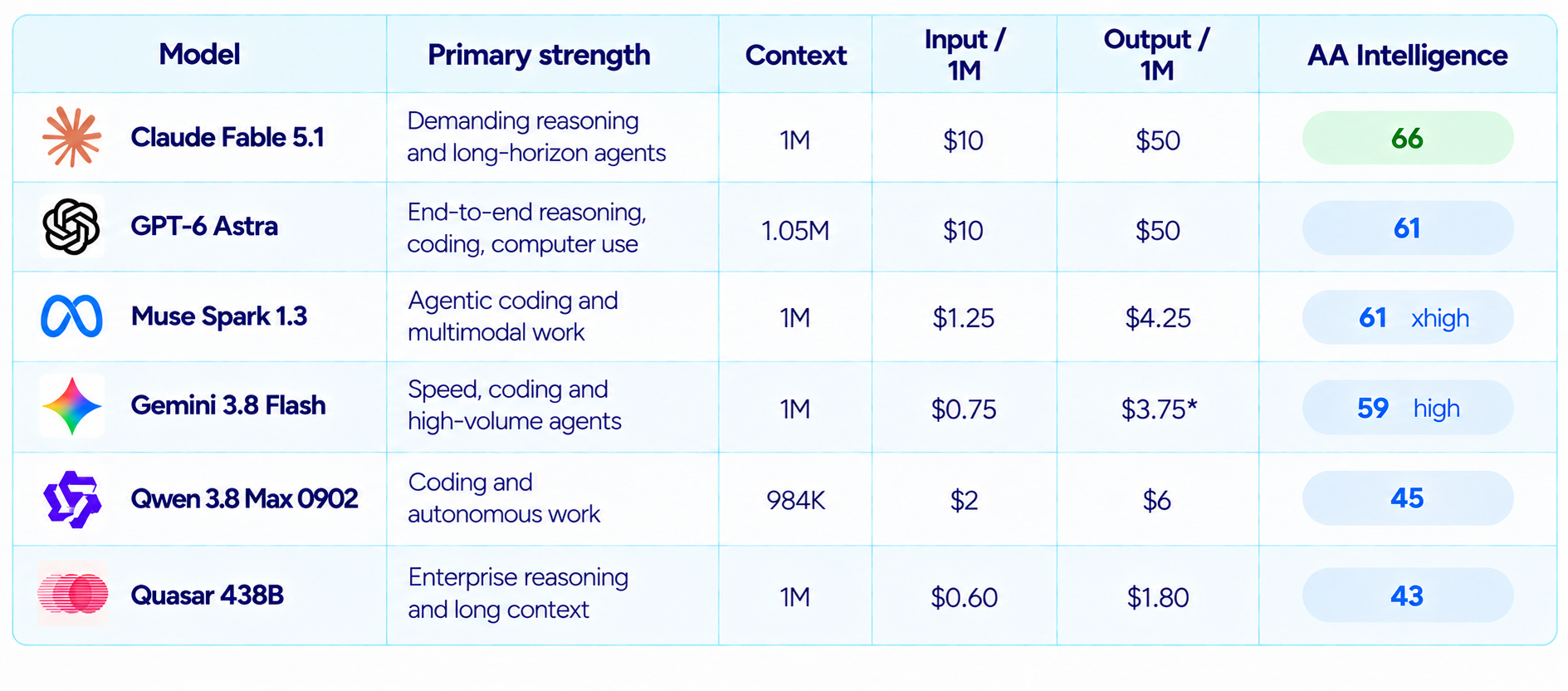
* Gemini 3.8 Flash's $0.75/$3.75 price is the introductory rate through the end of 2026. Regular pricing is higher.
2. Claude Fable 5.1: The Premium Reasoning Option
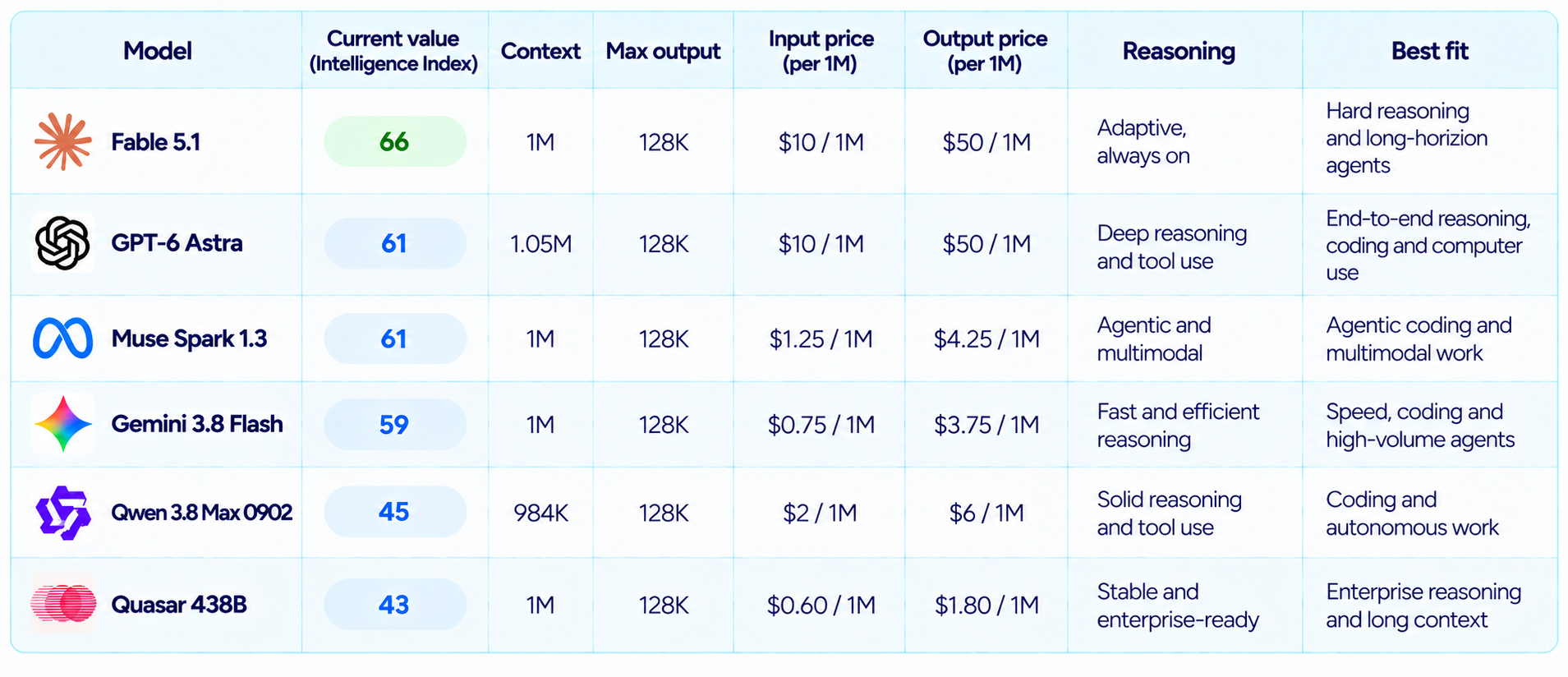
Claude Fable 5.1 is Anthropic's model for demanding reasoning and long-horizon agentic work. Anthropic lists a 1M-token context, 128K maximum output, always-on adaptive thinking and a high default effort. It is available through the Claude API, Amazon Bedrock, Google Cloud and Microsoft Foundry.
Fable 5.1 leads the current Artificial Analysis Intelligence Index at 66. It also targets long-running coding, multi-step research and document, spreadsheet and slide workflows. The model is therefore designed for tasks where failure and rework are more expensive than a premium token bill.
3. GPT-6 Astra: The End-to-End Generalist
OpenAI positions GPT-6 Astra as its model for the hardest end-to-end work across computer use, browsing, software engineering, science and professional workflows. The API supports low, medium, high, xhigh and max reasoning effort, with a 1.05M-token context and 128K maximum output.
OpenAI reports 72.6% on OSWorld 2.0, 57.9% on Terminal-Bench 4.0, 96.0% on GPQA Diamond and 97.6% on FrontierMath Tier 4 in its current comparison. Astra is also around 61 on the current Artificial Analysis Intelligence Index.
The tradeoff is cost. Standard API pricing is $10 per million input tokens and $50 per million output tokens. Fast mode can run at twice the standard price. Astra is therefore most compelling when the workflow genuinely benefits from broad reasoning, computer use or complex tool orchestration.
4. Gemini 3.8 Flash: The Speed and Value Model
Gemini 3.8 Flash is Google's most intelligent Flash model and is engineered for long-horizon software engineering, autonomous agents and complex enterprise workflows. Google lists a 1M-token context, 64K maximum output and low, medium and high thinking levels, plus function calling, code execution, file search, search grounding, URL context and structured outputs.
Artificial Analysis currently measures the high configuration at 59 on its Intelligence Index and about 305 output tokens per second. That combination makes Gemini 3.8 Flash particularly useful when an agent has to make many model calls in sequence.
The introductory API price is $0.75 per million input and $3.75 per million output tokens through the end of 2026. That makes Flash one of the strongest candidates for routing routine coding, extraction and automation tasks away from premium models.
5. Meta Muse Spark 1.3: The Coding-Agent Challenger
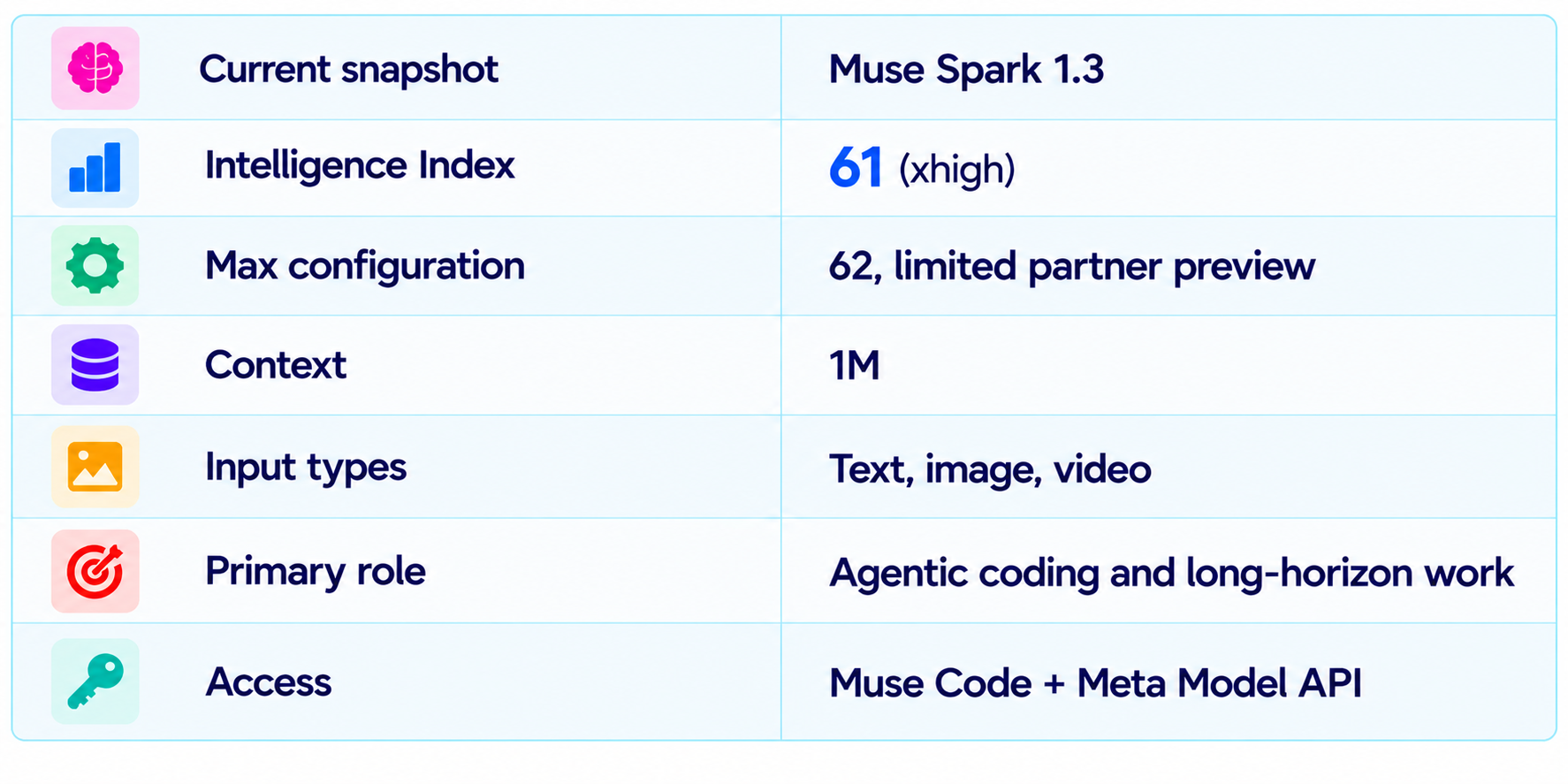
Meta describes Muse Spark 1.3 as a model trained for long-horizon agentic workflows, enhanced coding and native multimodal perception across video, images and documents. It is available through Muse Code and the Meta Model API.
Artificial Analysis gives Muse Spark 1.3 xhigh an Intelligence Index score of 61, four points above Muse Spark 1.2. A max configuration reaches 62 in limited partner preview. This puts Muse directly into the current frontier conversation while preserving a much lower price profile than the two premium models.
6. Qwen 3.8 Max 0902: Coding and Autonomous Work
Qwen 3.8 Max 0902 is Alibaba's September 2 upgrade to Qwen 3.8 Max. The revision targets coding, Cowork-style automation and long-horizon agent workflows while keeping the same broad model family and pricing.
Artificial Analysis currently gives Qwen 3.8 Max 0902 a 45 Intelligence Index score, about 40 output tokens per second, a 984K context window and $2/$6 token pricing. Its current benchmark set includes 39% on Terminal-Bench 4.0 and 80% on AA-LCR v1.1.
CodeArena's current WebDev leaderboard adds a strong specialist signal, placing 0902 at 1691. That result is especially relevant to web-development tasks, while the broader benchmark profile shows that Qwen's strengths extend into enterprise and agent workflows.
7. Quasar 438B: The Low-Cost Enterprise Reasoner
Quasar 438B is Multiverse Computing's proprietary reasoning model for enterprise agents, coding and long-context analysis. It uses a 1M-token context and is delivered as a text-only model through CompactifAI.
Artificial Analysis currently places Quasar at 43 on its Intelligence Index, 75.0 on AA-LCR and 69.3 on Terminal-Bench v2.1. Output speed is around 182.7 tokens per second, while CompactifAI lists $0.60 input and $1.80 output per million tokens.
Quasar's role is therefore different from Astra or Fable. It is not trying to lead the frontier intelligence chart. It is trying to provide strong enterprise reasoning, long context and fast API performance at a much lower operating cost.
8. Intelligence: The Current Frontier Snapshot
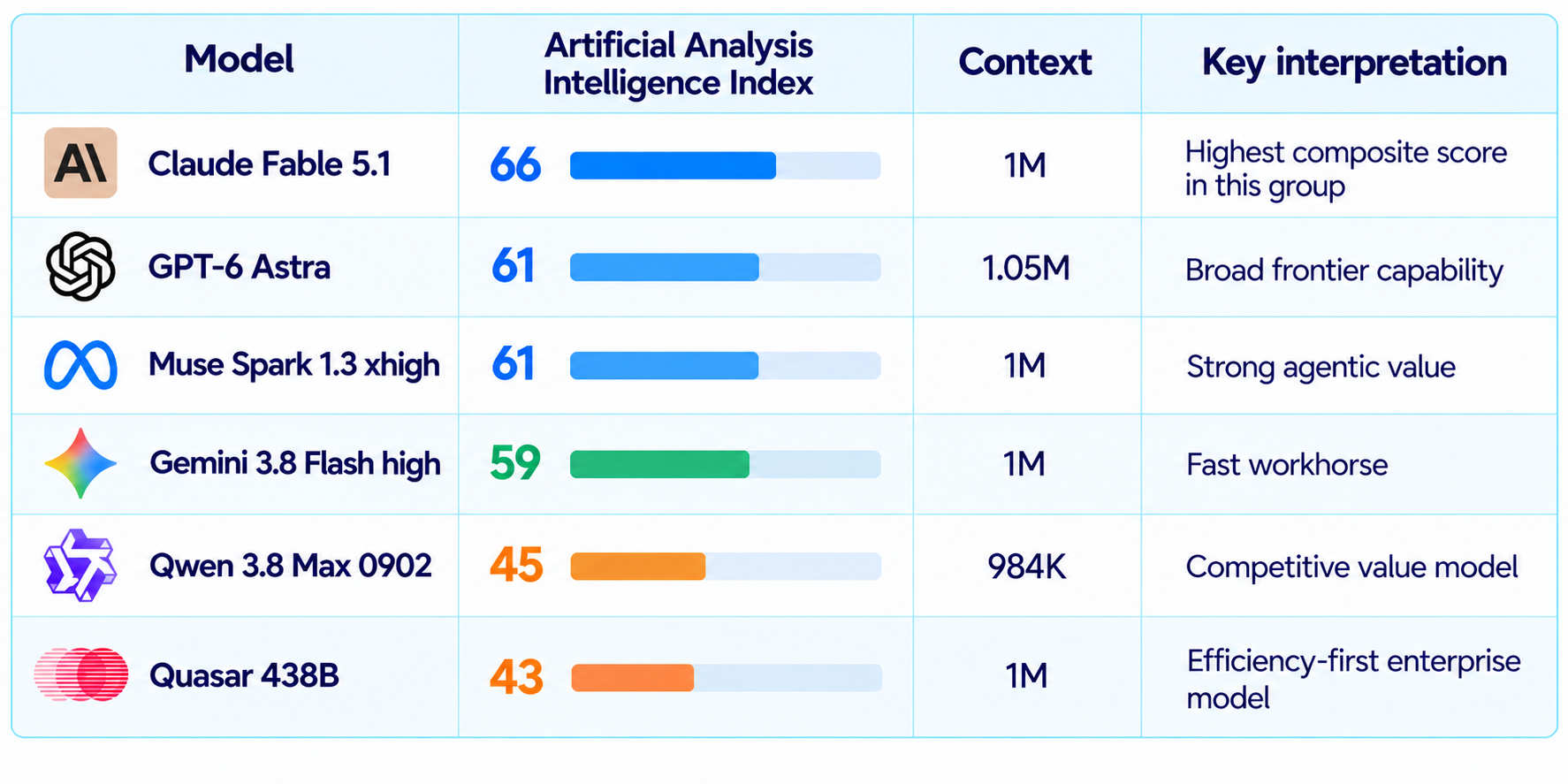
These scores are configuration-specific. Changing reasoning effort can change a model's benchmark position, so this table should be treated as a current snapshot rather than a permanent leaderboard.
9. Coding and AI Agent Performance
Coding is where these models increasingly overlap. Fable 5.1 currently leads the Coding Agent Index in the published four-model comparison, Astra is close behind, Muse Spark 1.3 has a strong agentic coding profile, Gemini is designed for high-throughput software engineering, Qwen has explicit coding and Cowork post-training, and Quasar has a strong Terminal-Bench score.
10. DeepSWE: A Useful Coding Reality Check
DeepSWE is useful because it tests long-horizon software engineering rather than isolated code completion. OpenAI's current benchmark table lists GPT-6 Astra at 74.1% and Gemini 3.8 Flash at 73.8%. Other model configurations and harnesses produce different numbers, so direct cross-provider comparisons require matching the evaluation setup.
That is why the most useful production metric is cost per accepted change. A model that is 3 points lower on a benchmark but finishes a repository task with fewer retries and lower latency can be the better engineering choice.
11. Long Context: Size Is No Longer the Differentiator
All six models are around the million-token context class. GPT-6 Astra lists 1.05M, Fable 5.1 1M, Gemini 3.8 Flash 1M, Muse Spark 1.3 1M, Qwen 3.8 Max 0902 about 984K and Quasar 438B 1M.
The more useful metric is context quality. Quasar's 75.0 AA-LCR and Qwen's 80% AA-LCR result show strong long-context retrieval, while Gemini, Astra and Fable pair large context with broader agent tooling.
For a large repository or research archive, test whether the model finds the right evidence, maintains dependencies and avoids filling the context with irrelevant material. Maximum context is capacity, not a guarantee of better reasoning.
12. Multimodal and Tool Capabilities
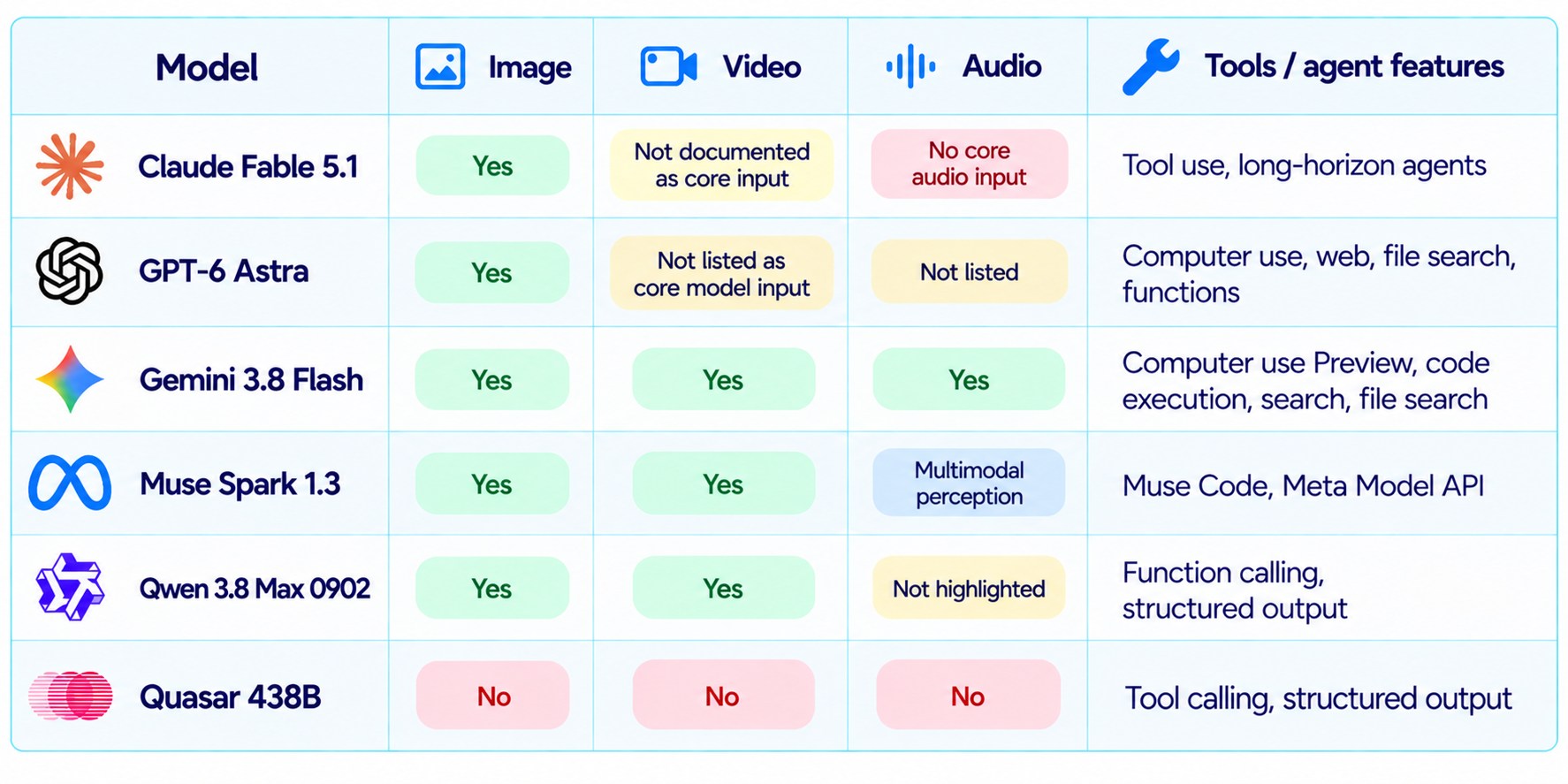
Gemini 3.8 Flash has the broadest documented input mix in this comparison. GPT-6 Astra stands out for computer use and professional software tasks, while Muse Spark 1.3 combines multimodal perception with its coding-agent stack. Quasar is intentionally text-only.
13. Pricing: The Biggest Difference Between These Models
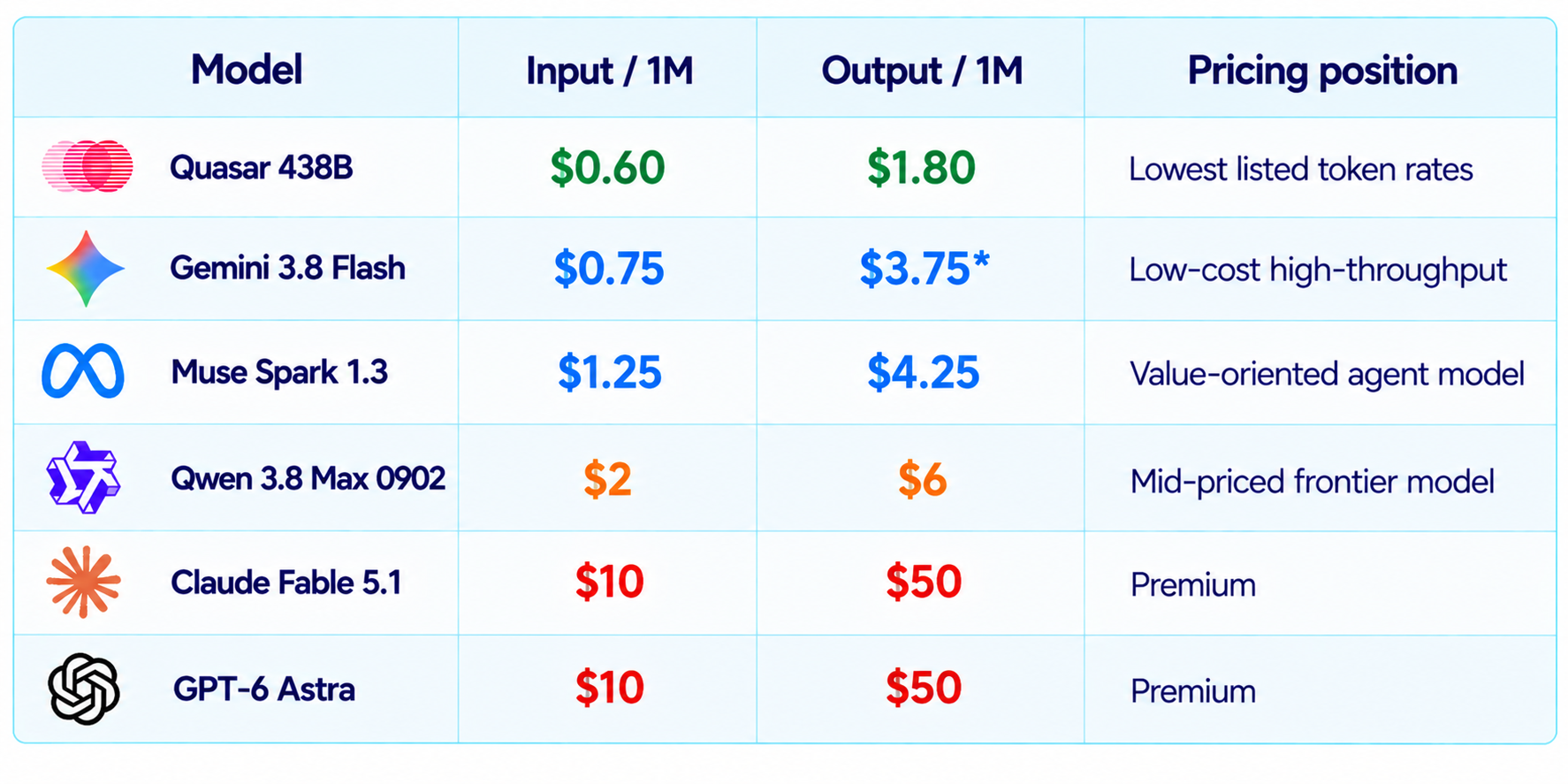
* Gemini 3.8 Flash introductory pricing through the end of 2026.
The premium models cost many times more per token, but token price alone is not enough to determine value. Reasoning-heavy models may use fewer or more tokens depending on the task, and a model that needs repeated retries can cost more despite cheaper rates. For agents, use dollars per successful task as the main economic metric.
14. Speed: Where the Value Models Pull Ahead
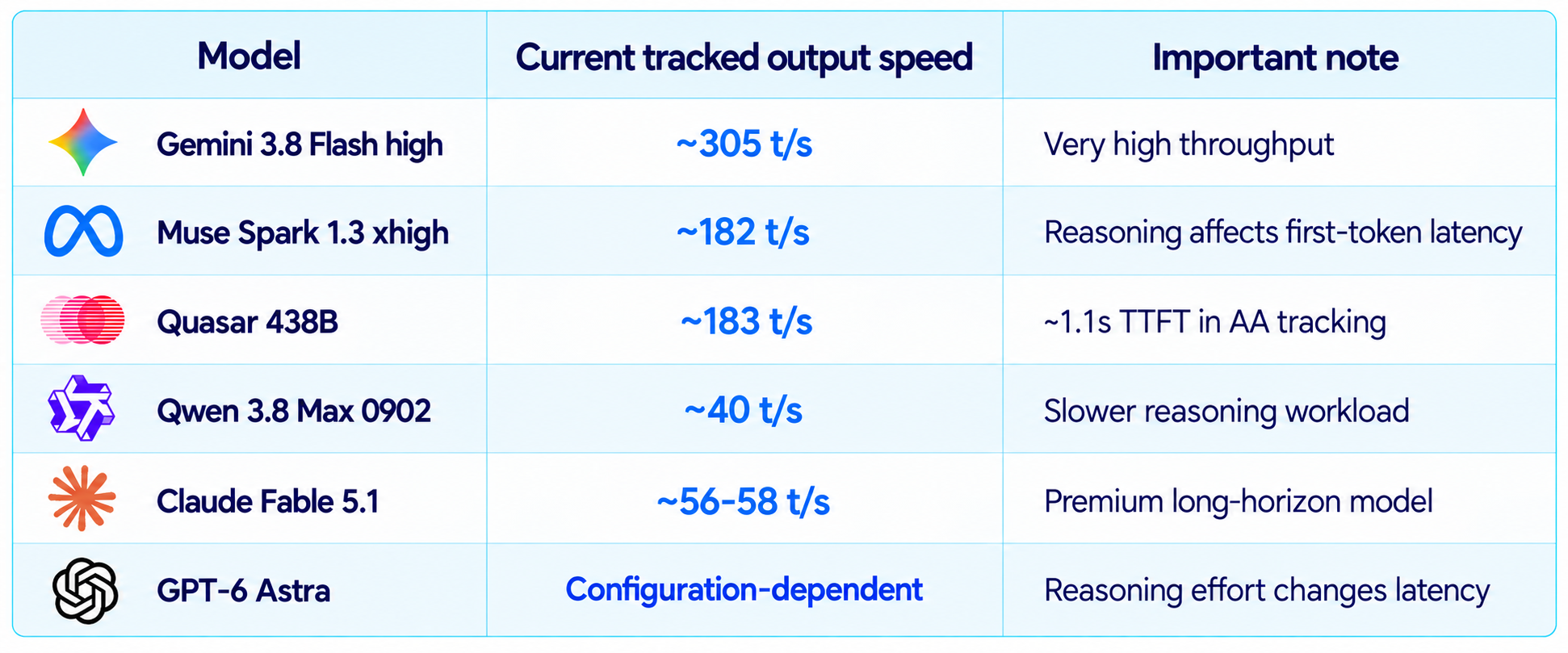
Output speed should not be confused with end-to-end task speed. Deep reasoning can delay the first useful answer even when decoding is fast. That is why agent benchmark time-per-task and cost-per-task are more informative than tokens per second alone.
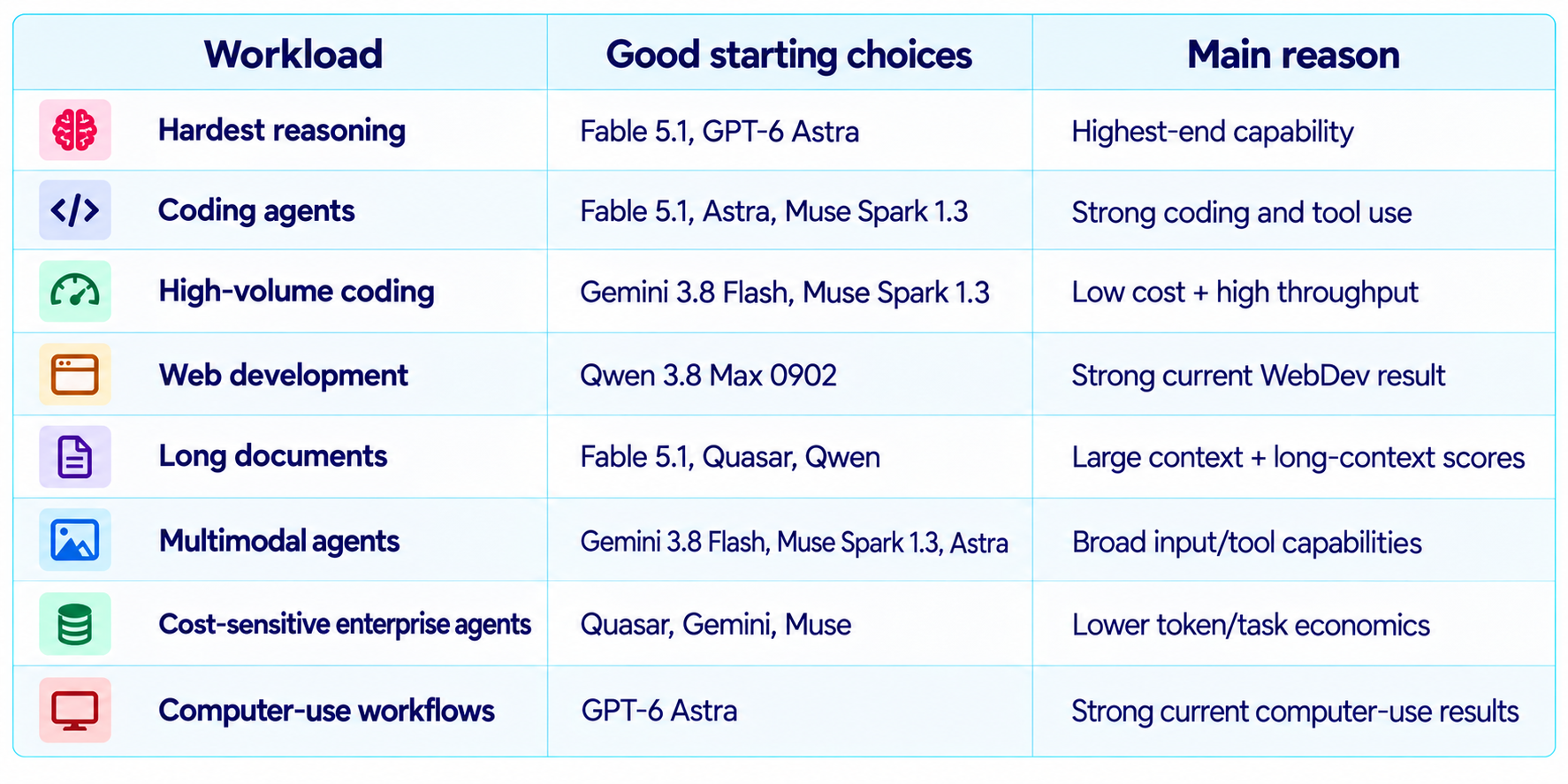
15. Which Model Fits Which Workload?
16. Model Routing Is the Practical Answer
The biggest lesson from this comparison is that organizations do not need one universal model. A routed stack can use different models according to difficulty and modality.
Gemini 3.8 Flash can handle routine extraction, classification, simple coding and high-volume agent steps. Muse Spark 1.3 can take on more demanding coding-agent work. Qwen 3.8 Max 0902 can handle deeper coding and long-context workflows. Quasar can serve as a low-cost enterprise reasoning worker. Fable 5.1 and GPT-6 Astra can handle the hardest escalations.
For a practical routing architecture, see AI Model Routing in 2026: When to Use Fable, Astra, Gemini or Muse.
17. How to Benchmark These Models Yourself
Use a fixed evaluation set from your real work instead of relying only on public leaderboards.
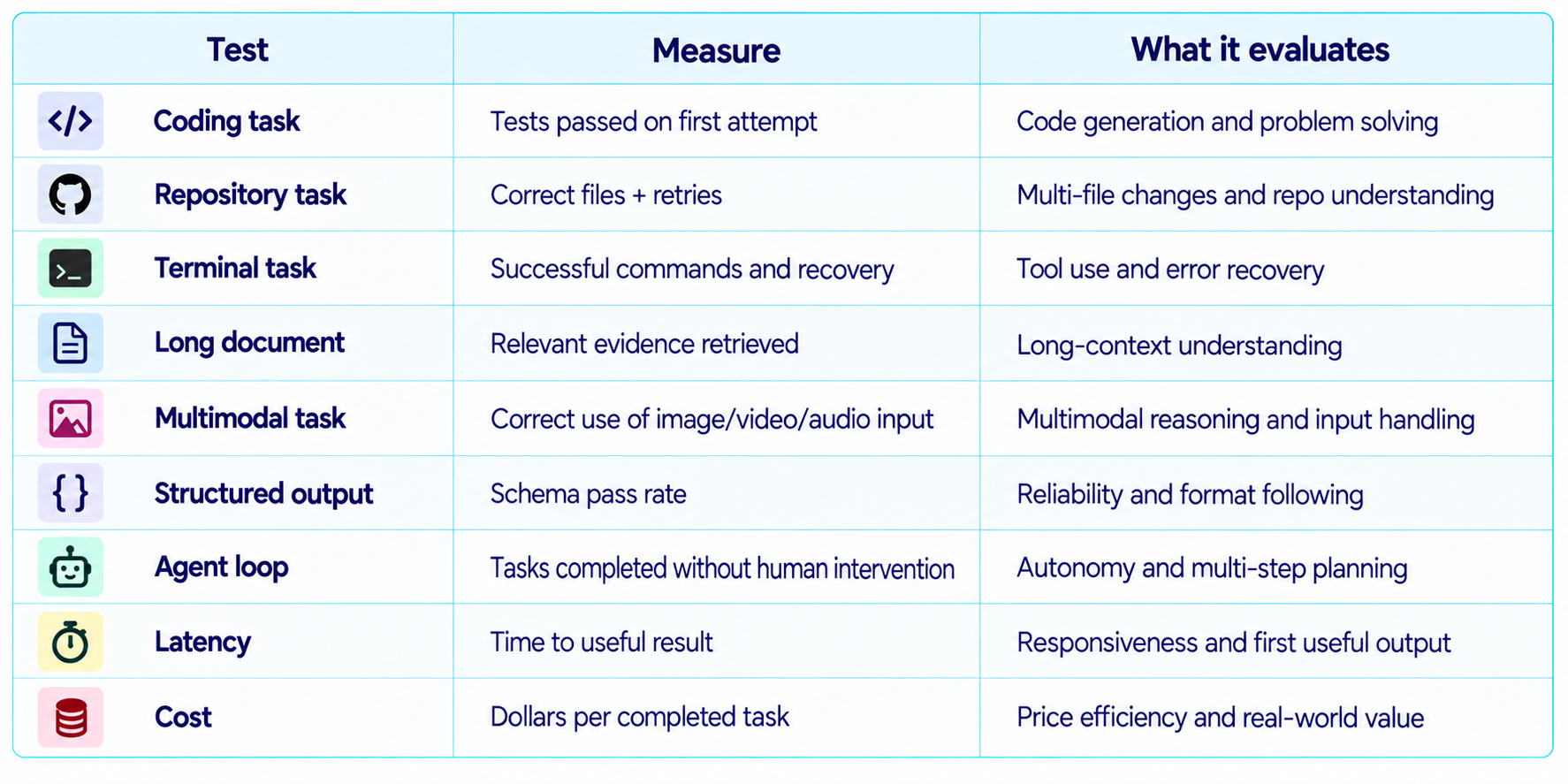
Use identical prompts, tools, source material and evaluation criteria. Log every tool call and retry. The output should be a cost-quality curve, not merely a leaderboard position.
18. Why the 'Best AI Model' Question Is Changing
The market has moved from a simple capability race toward a production optimization problem. A model can be slightly stronger and still be the wrong choice if it costs five or ten times more for a task that does not need the extra reasoning.
That is why Gemini 3.8 Flash, Muse Spark 1.3 and Quasar 438B are important even though their aggregate intelligence scores are below Fable 5.1. They make high-volume AI systems economically easier to run.
Conversely, premium models such as Fable 5.1 and Astra remain valuable because some tasks have asymmetric failure costs. A difficult architecture decision, computer-use task or complex research workflow may justify a much more expensive model if it materially reduces errors and retries.
19. Final Verdict
The latest AI model comparison is no longer about picking a single universal winner. Claude Fable 5.1 currently leads this six-model group on the Artificial Analysis Intelligence Index at 66. GPT-6 Astra and Muse Spark 1.3 xhigh sit at 61, Gemini 3.8 Flash at 59 high, Qwen 3.8 Max 0902 at 45 and Quasar 438B at 43.
The most important difference is economics. Fable 5.1 and Astra are premium models at $10/$50 per million tokens. Gemini 3.8 Flash, Muse Spark 1.3, Qwen 3.8 Max 0902 and Quasar 438B operate in a much lower pricing band and can therefore be used more aggressively inside automated systems.
For coding agents, Fable and Astra are strong choices for difficult work, Muse Spark 1.3 is a compelling coding-value option, Gemini 3.8 Flash is the throughput play, Qwen 3.8 Max 0902 is particularly interesting for coding and WebDev, and Quasar 438B is attractive for long-context enterprise reasoning.
My recommendation is not to standardize on a single model. Build a small model portfolio, route by task difficulty and measure cost per successful task. That approach makes the differences between these models useful instead of turning a benchmark leaderboard into a purchasing decision.
Frequently Asked Questions
What are the latest AI models in September 2026?
Major current models include GPT-6 Astra, Claude Fable 5.1, Gemini 3.8 Flash, Meta Muse Spark 1.3, Qwen 3.8 Max 0902 and Quasar 438B.
Which AI model has the highest Intelligence Index in this comparison?
Claude Fable 5.1 currently leads at 66 in the Artificial Analysis snapshot used for this comparison.
Which model is best for coding agents?
Fable 5.1 and GPT-6 Astra are strong premium choices, while Muse Spark 1.3 and Gemini 3.8 Flash are compelling lower-cost alternatives.
Which model is cheapest?
Quasar 438B currently lists the lowest token rates at $0.60 input and $1.80 output per million tokens.
Which model is fastest?
Gemini 3.8 Flash has the strongest raw output-speed measurement among these models in current tracking.
Which model has the largest context?
GPT-6 Astra lists 1.05M tokens. Most of the other models are around 1M, with Qwen 3.8 Max 0902 at about 984K.
Is Gemini 3.8 Flash better than Muse Spark 1.3?
Muse Spark 1.3 currently has the higher Intelligence Index, while Gemini 3.8 Flash has a strong speed and cost advantage.
Is Qwen 3.8 Max 0902 worth using?
Yes, especially for coding, WebDev and long-context workflows where its $2/$6 pricing is practical.
Is Quasar 438B good for enterprise use?
Yes for text-heavy enterprise reasoning, long-context document work and high-volume API agents.
Should I use one model or model routing?
Model routing is usually more flexible because these models have very different cost, speed and capability profiles.
Recommended Blogs
Claude Fable 5.1 vs GPT-6 Astra vs Gemini 3.8 Flash vs Muse Spark 1.3
AI Model Routing in 2026: When to Use Fable, Astra, Gemini or Muse
GPT-6 Astra Review: Sol, Terra, Luna Features, Benchmarks & Pricing
Claude Fable 5.1 Review: Benchmarks, Pricing & Is It Worth It?
Qwen 3.8 Max 0902 Review: Benchmarks, Price & Is It Worth It?
Quasar 438B Review: Benchmarks, Speed, Price & Is It Worth It?
Resources & Community
Join our community of 70,000+ AI enthusiasts and learn to build powerful AI applications. Whether you're a beginner or an experienced developer, Build Fast with AI helps you understand and implement AI in your projects.
Agentic AI Launchpad 2026
A structured 6-week cohort program that takes you from AI basics to building and deploying real-world agentic AI systems. Includes live sessions, expert mentorship, project reviews and a builder community network.
Ready to go from learning to building? Join the next cohort: Agentic AI Launchpad 2026
Free AI Resources
Access free tools, workshops and micro-learning to keep building.

