



Qwen 3.8 Omni Flash Review: Is Alibaba's New Multimodal Model Built for Real Audio and Video Understanding?
Qwen 3.8 Omni Flash is Alibaba's lightweight full-modality model for understanding text, images, audio and video in one workflow. Its most interesting feature is not simply that it accepts more input types. It combines those modalities with configurable reasoning, 119-language text interaction and spatial-audio analysis, giving developers one model for tasks that would otherwise require separate vision, speech and text systems.
The model is a different product from the standard Qwen 3.8 Flash. Qwen3.8 Flash is the broader one-million-token multimodal workhorse for image and video understanding, coding and agents. Qwen3.8 Omni Flash is narrower but deeper on audio, accepting text, images, video and audio while returning text. Alibaba's current product documentation lists a 64K context window, 16K maximum output, function calling, seven reasoning-effort settings and dedicated support for two-channel stereo and four-channel FOA spatial-audio parsing.
That creates an unusual position in the Qwen lineup. You give up the 1M context and built-in web/code tools of Qwen3.8 Flash, but you gain a unified audio-and-video understanding stack. For call analysis, meeting intelligence, podcast and media analysis, multilingual audio understanding, chart or document analysis mixed with speech, and applications where spatial audio matters, that tradeoff can make sense.
QUICK ANSWER
Qwen 3.8 Omni Flash is Alibaba's latest lightweight Omni model for multimodal understanding. It accepts text, images, audio and video, outputs text, supports spatial-audio analysis, and lets developers control reasoning through seven levels: none, minimal, low, medium, high, xhigh and max. It supports 119 text-interaction languages and function calling, but the current official model page lists no structured-output support and no built-in web search.
The model uses a 64K-token context window, with a maximum 49,152-token input length and 16,384-token output. In thinking mode, the maximum input is 16,384 tokens, the maximum output remains 16,384, and the maximum thinking-chain length is 32,768 tokens. Alibaba lists the model for deployment in Beijing and Singapore, with 60 requests per minute and 100,000 tokens per minute in the current documented limits.
The strongest practical feature is spatial audio. With use_multichannel enabled, Qwen 3.8 Omni Flash can interpret two-channel stereo or four-channel FOA audio instead of reducing every recording to a single channel. That makes it especially useful for audio intelligence, media analysis and sound-aware assistants.
My verdict: 9.1/10 for multimodal understanding, 9.3/10 for audio analysis, 8.7/10 for video understanding, 8.9/10 for multilingual interaction and 8.8/10 overall. Qwen 3.8 Omni Flash is worth using when audio is a first-class input, not when you simply need the largest Qwen context window.
1. What Is Qwen 3.8 Omni Flash?
Qwen 3.8 Omni Flash is the lightweight member of Alibaba's Qwen full-modality model family. The dedicated model page describes it as a multimodal model for efficient understanding of text, images, audio and video, with text-only output. It is designed for content creation, multimedia analysis, audio understanding and conversational experiences.
The word Omni is important. A normal vision-language model can inspect images and video, but an Omni model is designed to treat audio as a native part of the same interaction. Qwen 3.8 Omni Flash can receive speech, music, environmental sound and other audio alongside visual and text context.
This is particularly useful for multimodal applications where the meaning is distributed across channels. A meeting may include a slide on screen and an important statement in the audio. A product demo can contain visual actions plus spoken instructions. A media-analysis pipeline may need the scene, dialogue and background sound together.
3. The Biggest Difference: Audio Is Native
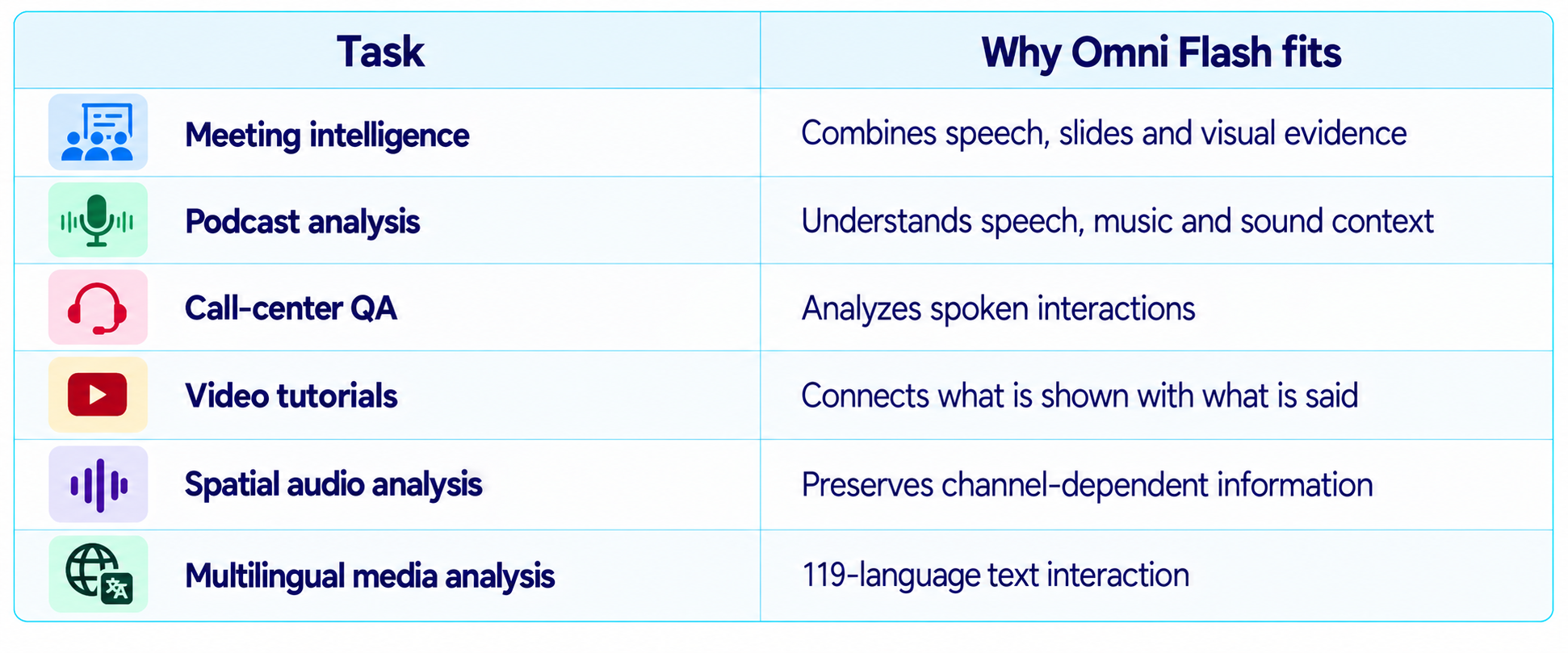
Audio is where Qwen 3.8 Omni Flash separates itself from the regular Qwen 3.8 Flash model. The Omni version can process audio together with text, images and video, which allows applications to reason over information that exists outside the visual frame.
4. Spatial Audio: The Feature Most Developers Will Miss
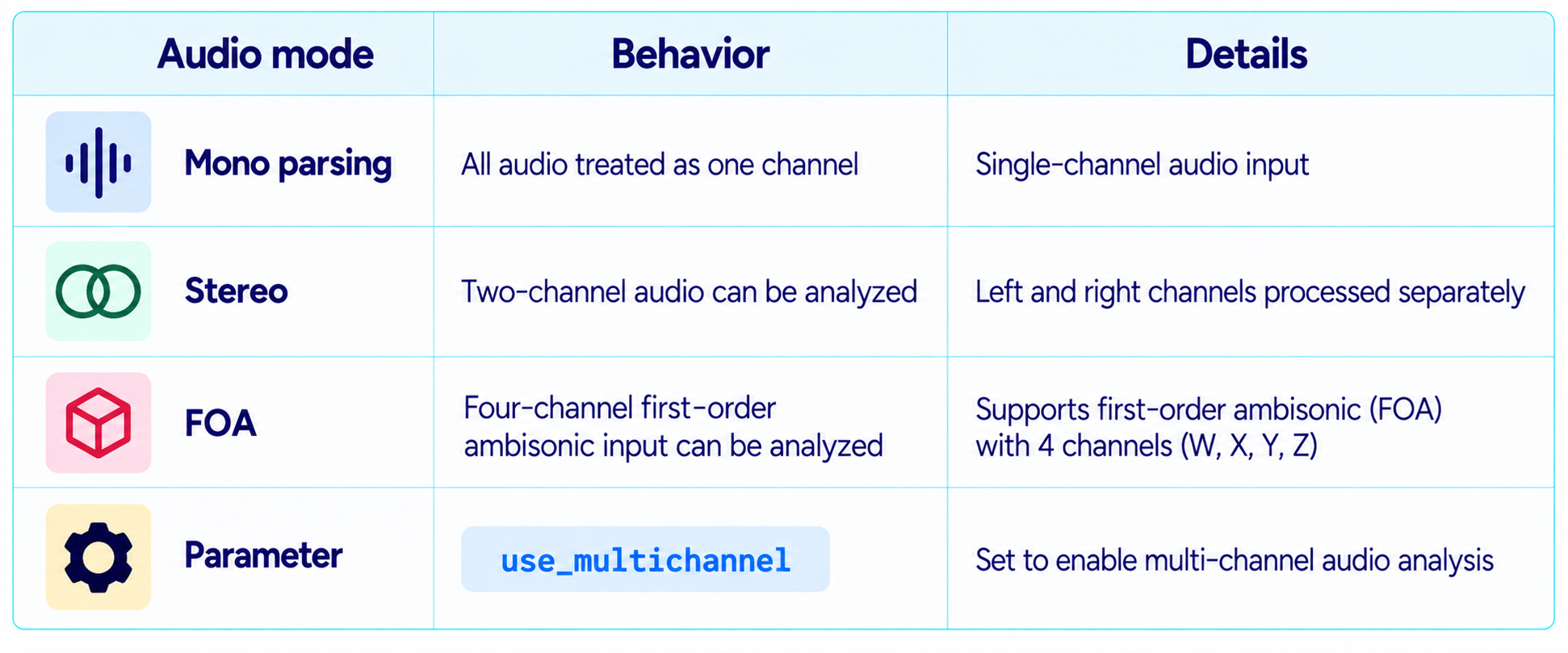
Qwen 3.8 Omni Flash supports spatial-audio parsing through the use_multichannel parameter. When enabled, the model can interpret two-channel stereo audio or four-channel FOA audio. When it is disabled or omitted, the input is processed as a single channel.
Spatial audio can carry information that ordinary speech transcription throws away. The direction of a voice, the location of a sound effect, the separation between channels and environmental cues can all matter in applications such as video understanding, soundscape analysis and immersive media.
5. Video Understanding
Qwen 3.8 Omni Flash can accept video together with audio and text. That makes it useful for video-understanding workloads where the soundtrack is part of the evidence rather than an optional attachment.
For example, a video assistant can analyze a training recording, identify what appears on screen, capture what the presenter says and explain the sequence as a single multimodal task.
Alibaba's current Qwen model documentation separately lists Qwen3.8 Flash as a 1M-context video-understanding model supporting videos up to two hours and up to 2 GB, with function calling and built-in tools. This gives regular Qwen3.8 Flash the advantage for very long video and tool-heavy visual workflows, while Omni Flash has the advantage when audio is part of the reasoning task.
6. 64K Context vs 1M Context
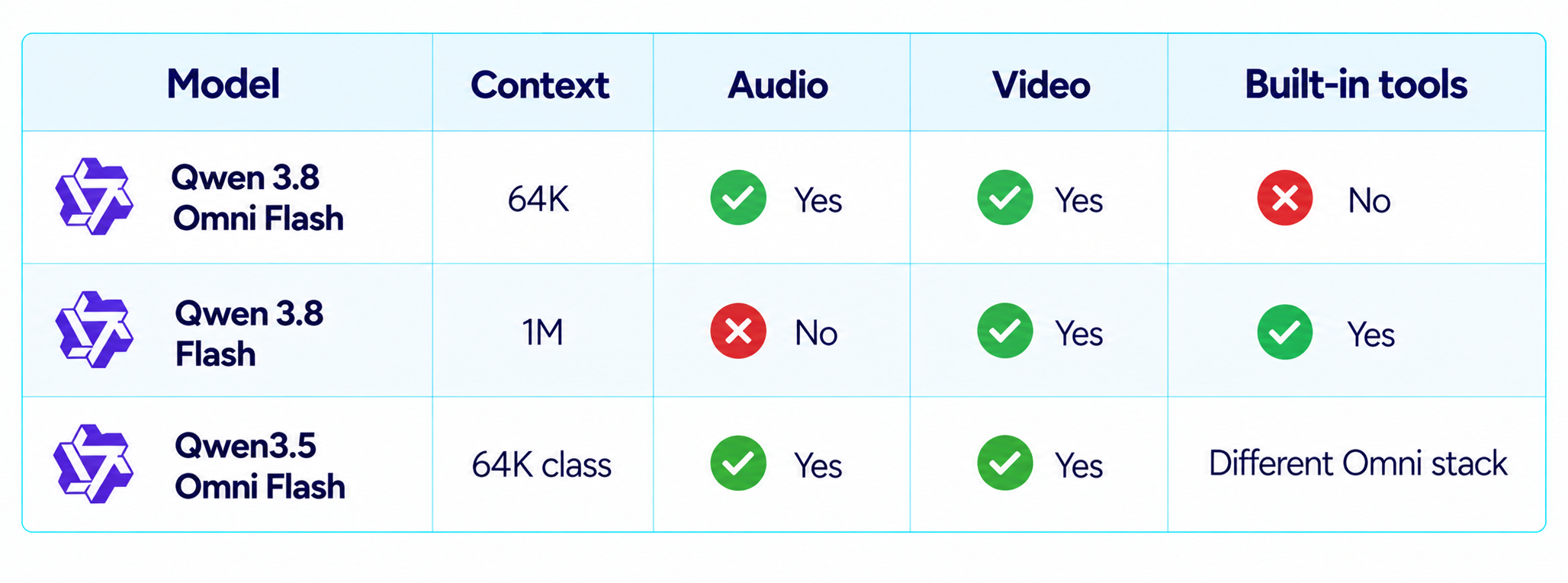
The biggest tradeoff in the Qwen 3.8 family is context size. Qwen 3.8 Omni Flash has a 64K context, while Qwen3.8 Flash has a 1M context. That difference is large when the task involves massive repositories, huge documents or very long video context.
Sixty-four thousand tokens is still enough for individual meetings, calls, media clips, documents and many multimodal tasks. The important choice is whether audio understanding or maximum context matters more for your application.
7. Reasoning Modes
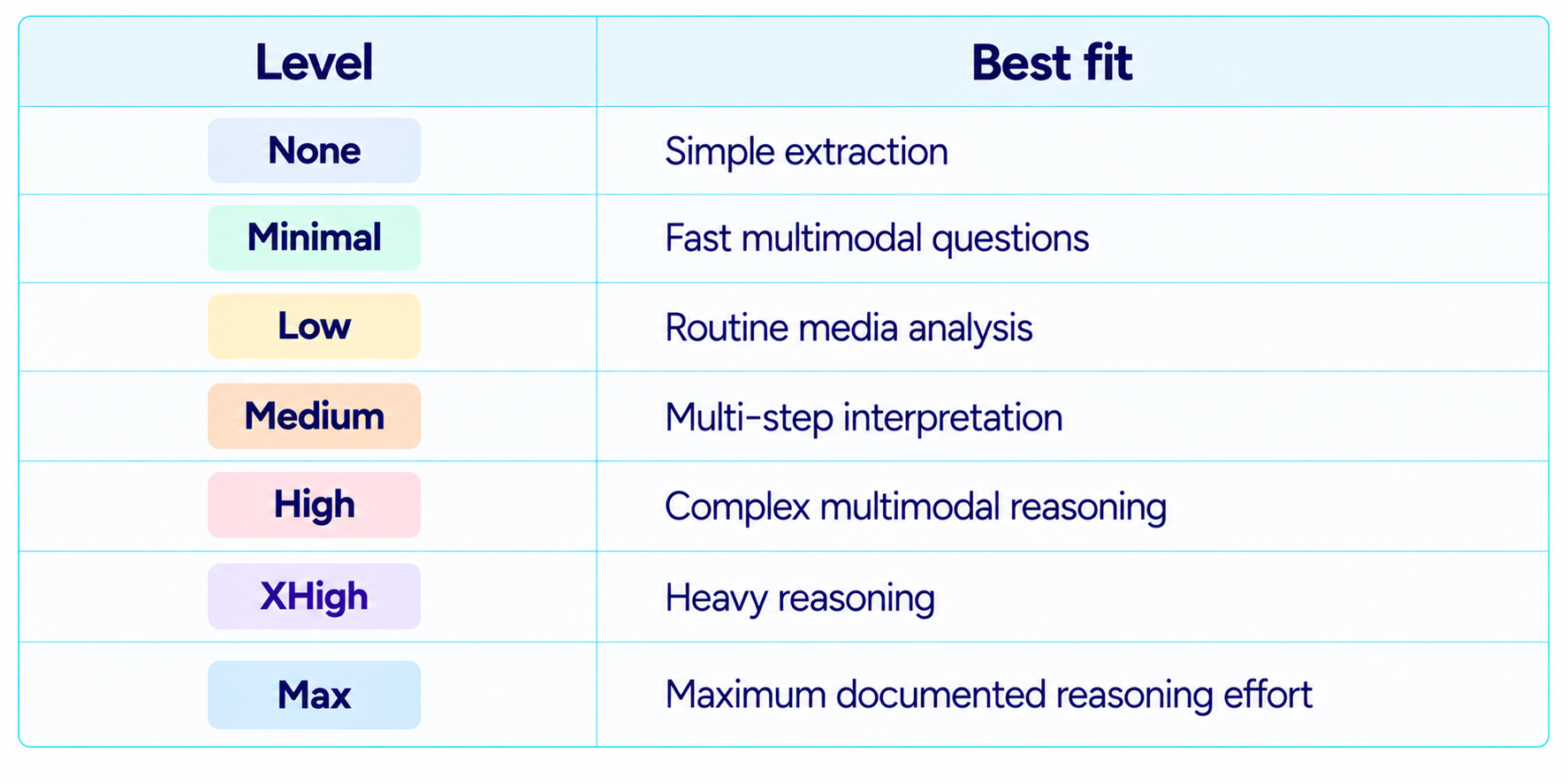
Qwen 3.8 Omni Flash defaults to thinking mode and provides seven thinking levels: none, minimal, low, medium, high, xhigh and max. This is unusually granular and lets developers trade reasoning depth against latency and token consumption.
A simple tag or classification task can use none or minimal. A cross-modal investigation that connects a spoken statement with a visual event can use high, xhigh or max. This makes the model easier to route within production pipelines.
8. 119 Languages and Multilingual Interaction
Alibaba states that Qwen 3.8 Omni Flash supports text interaction in 119 languages. That makes it useful for international assistants, multilingual content analysis and cross-language workflows.
The important distinction is that the 119-language statement refers to text interaction. The model's current dedicated documentation does not position it as a universal 119-language speech-generation system. For generated voice, Alibaba maintains separate TTS and realtime models.
9. Function Calling and Agentic Multimodal Workflows
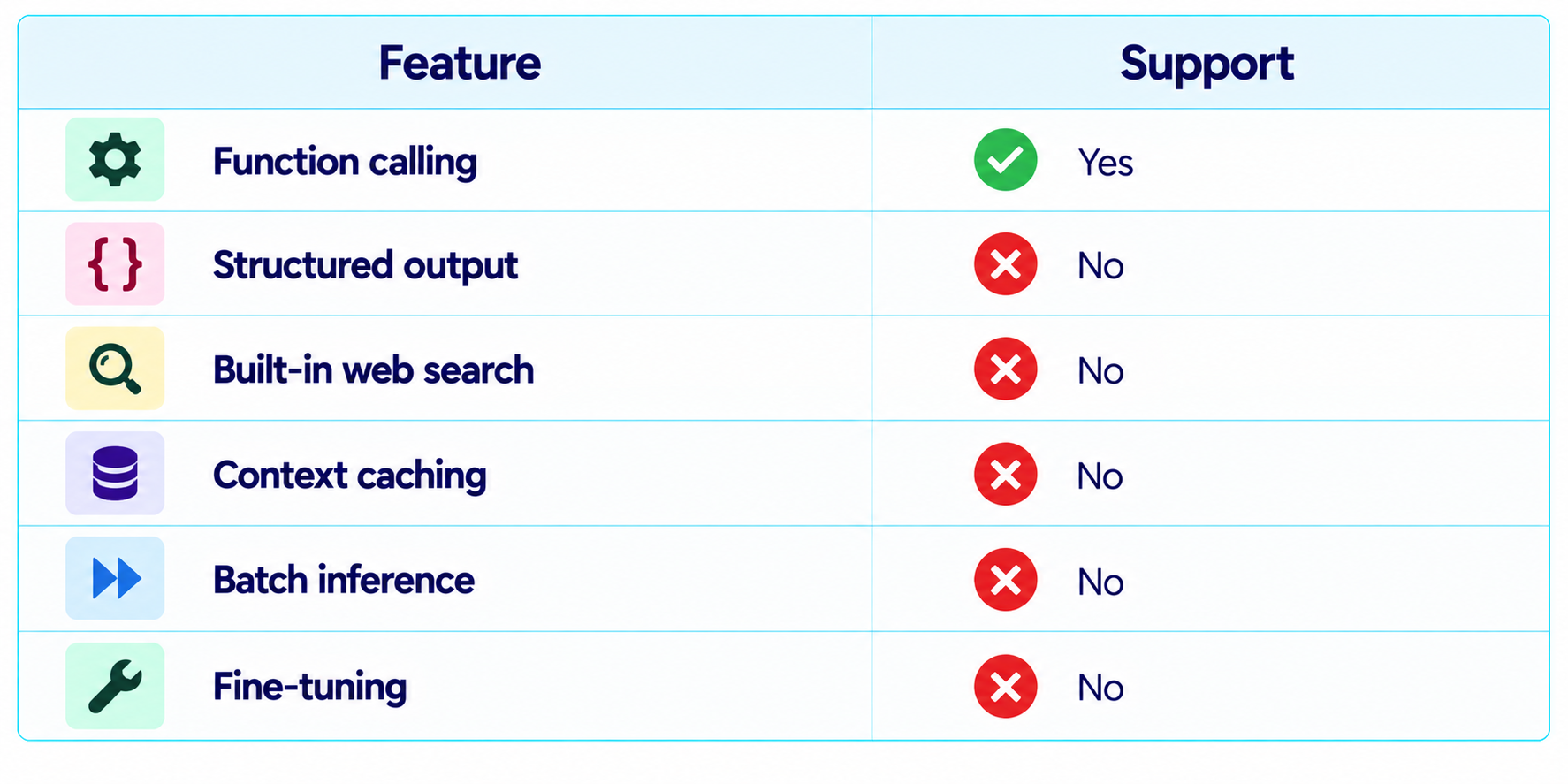
Function calling is supported by the model. That matters because multimodal agents often need to turn what they see or hear into an action, such as opening a support case, searching a database, creating a record or triggering an automated workflow.
The model page lists structured output and built-in web search as unsupported. Developers should therefore build around the specific Qwen 3.8 Omni Flash API behavior rather than assuming every capability of the regular Qwen3.8 Flash model carries over.
12. Qwen 3.8 Omni Flash Pricing and Availability
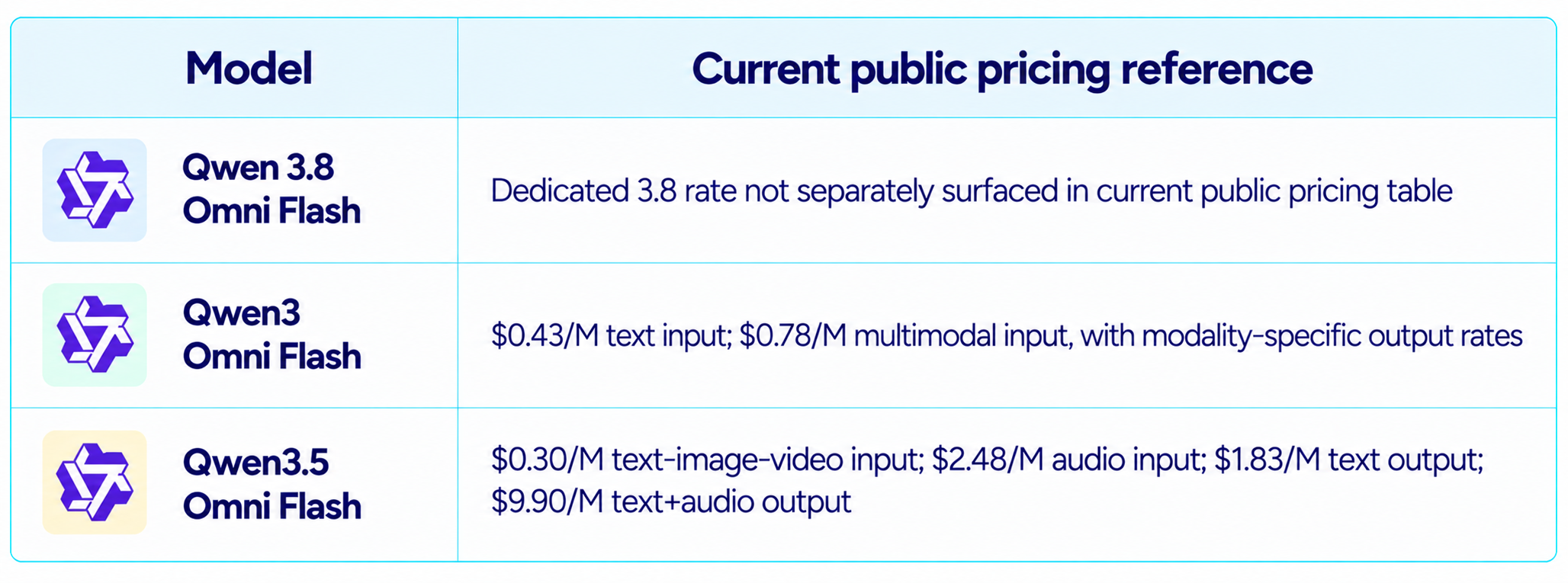
Alibaba's dedicated Qwen 3.8 Omni Flash documentation describes the model and current regional deployment limits, but the current public pricing table does not expose a separate qwen3.8-omni-flash rate. It still lists the earlier qwen3-omni-flash and qwen3.5-omni-flash products with their own prices. I would not assign a 3.8 price by inference.
For budgeting, the safest approach is to check the exact qwen3.8-omni-flash price in the Alibaba Cloud Model Studio project and region where the model is enabled. The older Omni prices are useful only as reference points.
13. Availability, Quotas and API Integration
The current dedicated documentation lists Beijing and Singapore deployments, with a documented limit of 60 requests per minute and 100,000 tokens per minute.
Alibaba Cloud Model Studio also exposes OpenAI-compatible chat APIs with regional endpoints. Omni workflows still require the correct multimodal request schema for audio and video, so developers should use the dedicated multimodal API examples rather than treating the model as text-only chat.
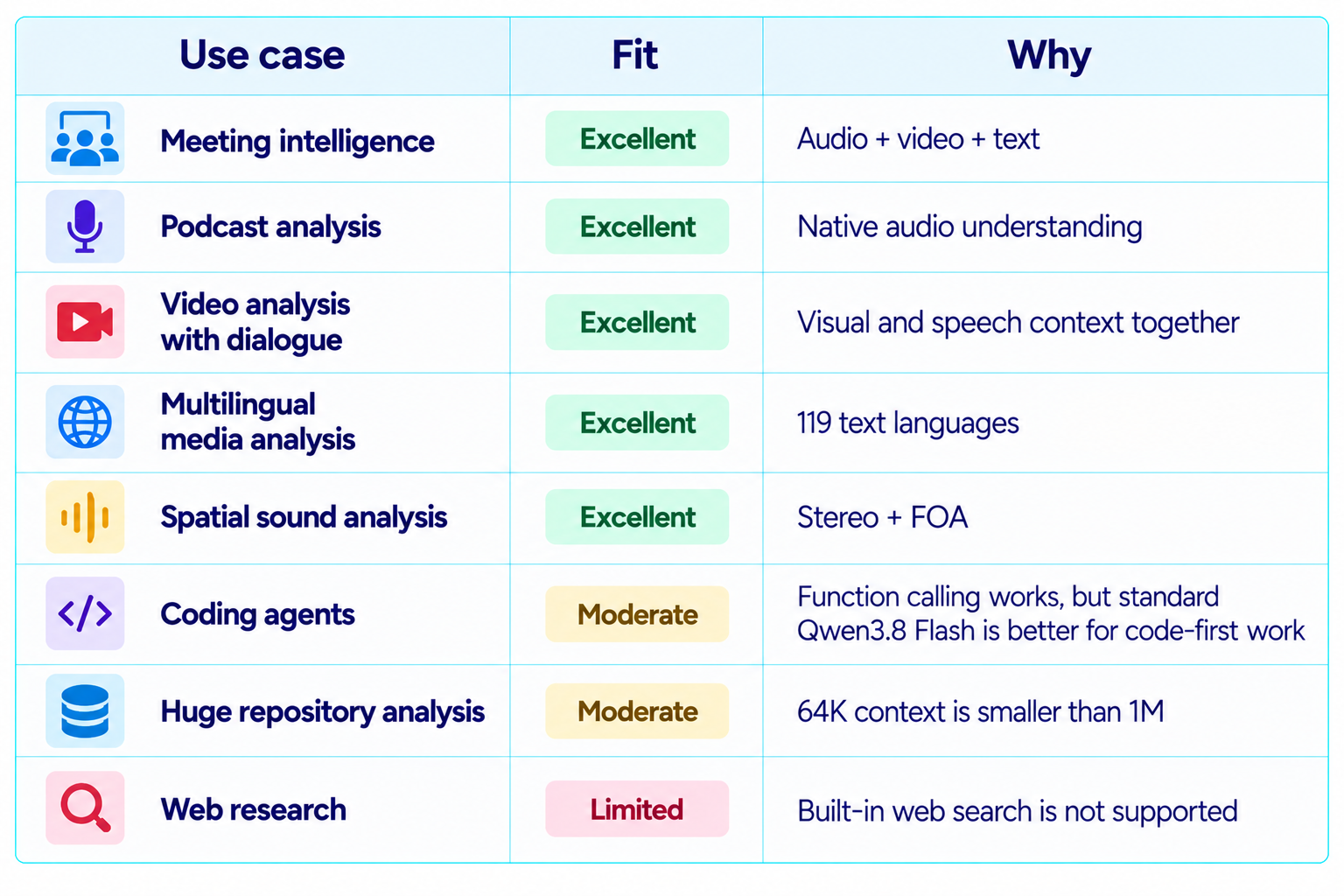
14. What Qwen 3.8 Omni Flash Is Best At
15. Where It Falls Short
The 64K context is much smaller than Qwen 3.8 Flash's 1M context.
The model outputs text only, so it is not a replacement for speech synthesis or realtime voice generation.
Structured outputs are not supported on the current dedicated model page.
Built-in web search is not supported.
Context caching and batch inference are not supported.
The current public pricing table does not separately surface a qwen3.8-omni-flash rate.
Function calling is supported, but multimodal tool schemas should be tested before production use.
16. Recommended Production Workflow
Send the video, audio and relevant text together rather than transcribing audio first when the original multimodal evidence matters.
Enable multichannel audio when spatial information is important.
Use none or minimal reasoning for simple tagging and extraction.
Increase reasoning effort for cross-modal questions that require connecting speech, visuals and context.
Use function calling when the multimodal result needs to trigger a downstream action.
Segment very long recordings so each request stays within the documented context limits.
Use a dedicated Qwen TTS or realtime model when generated speech is required.
17. How to Evaluate Qwen 3.8 Omni Flash Yourself
The most useful test is a multimodal task set rather than a text-only benchmark. Build cases around meetings, calls, videos, spatial audio and multilingual instructions.
Compare answers with and without audio, compare reasoning levels, and measure whether the model actually benefits from keeping modalities together in one request.
19. Is Qwen 3.8 Omni Flash Worth It?
Yes, when audio is part of the evidence your application needs to understand. That is the clearest reason to choose it over the standard Qwen 3.8 Flash model.
The model's seven reasoning levels are useful because audio and video tasks vary dramatically in complexity. A simple classification request should not consume the same reasoning budget as a cross-modal investigation that must connect a spoken claim with something that happens on screen.
The 64K context and text-only output also make the choice clear. If your application needs massive context, built-in tools or generated speech, use another Qwen model in the stack. Omni Flash is strongest as the understanding and reasoning layer for rich media input.
20. Final Verdict
Qwen 3.8 Omni Flash is a focused multimodal model rather than a universal Qwen replacement. Its main advantage is that text, images, audio and video can all enter the same reasoning workflow, with native spatial-audio parsing and 119-language text interaction.
The official model specification is clear about what the model can and cannot do. It supports function calling and seven reasoning-effort levels, but not structured outputs or built-in web search. It uses a 64K context window, produces text only, and is designed for multimodal understanding rather than speech generation.
That makes it particularly strong for meetings, podcasts, video understanding, audio analysis, multilingual content and any agent that needs to connect what people say with what appears on screen. It is less compelling for huge repositories, web-research agents or applications that need one-million-token context and built-in tools.
My rating: 9.1/10 for multimodal understanding, 9.3/10 for audio analysis, 8.7/10 for video understanding, 8.9/10 for multilingual interaction and 8.8/10 overall.
Bottom line: Qwen 3.8 Omni Flash is worth using when audio is a core input, especially for media intelligence, meeting analysis and multilingual multimodal assistants. If audio is not central to the workflow, regular Qwen 3.8 Flash offers a much larger context window and broader built-in toolset.
Frequently Asked Questions
What is Qwen 3.8 Omni Flash?
Qwen 3.8 Omni Flash is Alibaba's lightweight full-modality Qwen model for understanding text, images, audio and video, with text-only output.
What is the Qwen 3.8 Omni Flash context window?
The official model page lists a 65,536-token context length, with a maximum 49,152-token input and 16,384-token output.
Does Qwen 3.8 Omni Flash support audio?
Yes. Audio is a native input modality, including two-channel stereo and four-channel FOA spatial-audio parsing.
Does Qwen 3.8 Omni Flash generate audio?
No. The current dedicated model page lists text as the output modality only.
How many languages does Qwen 3.8 Omni Flash support?
Alibaba states that it supports text interaction in 119 languages.
What reasoning modes are available?
None, minimal, low, medium, high, xhigh and max.
Does Qwen 3.8 Omni Flash support function calling?
Yes.
Does Qwen 3.8 Omni Flash support structured output?
No, the current dedicated model page lists structured output as unsupported.
Does Qwen 3.8 Omni Flash support web search?
No, the current dedicated model page lists web search as unsupported.
Is Qwen 3.8 Omni Flash better than Qwen 3.8 Flash?
It is better for audio-rich multimodal workflows. Qwen 3.8 Flash is better when 1M context, built-in tools, structured output, coding and long video workflows matter more.
Does Qwen 3.8 Omni Flash support spatial audio?
Yes. It can parse stereo and four-channel FOA audio when use_multichannel is enabled.
Is Qwen 3.8 Omni Flash worth it?
Yes for meetings, podcasts, multimedia analysis, audio understanding and multimodal assistants. For code-heavy or huge-context workloads, another Qwen 3.8 model is usually a better fit.
Recommended Blogs
Qwen3.8-Flash-Next Review: Benchmarks, Cost & Is It Worth It? (2026)
Qwen 3.8 Max 0902 Review: Benchmarks, Price & Is It Worth It? (2026)
Gemini 3.8 Flash Review: Accuracy, Price & Is It Worth It? (2026)
Meta Muse Spark 1.3 Review: Coding, Price & Is It Worth It? (2026)
Mercury 2.5 AI Model Review: Speed, Price & Is It Worth It? (2026)
MiniMax H3 Turbo Review: Speed, Quality, Price & Is It Worth It? (2026)
Resources & Community
Join our community of 70,000+ AI enthusiasts and learn to build powerful AI applications. Whether you're a beginner or an experienced developer, Build Fast with AI helps you understand and implement AI in your projects.
Agentic AI Launchpad 2026
A structured 6-week cohort program that takes you from AI basics to building and deploying real-world agentic AI systems. Includes live sessions, expert mentorship, project reviews and a builder community network.
Ready to go from learning to building? Join the next cohort: Agentic AI Launchpad 2026
Free AI Resources
Access free tools, workshops and micro-learning to keep building.

