




Qwen3.8-Flash-Next Review: Benchmarks, Cost & Is It Worth It? (2026)
Qwen3.8-Flash-Next is the most strategically interesting Qwen release of August 2026 because it is not simply another model. Qwen is using it as an early preview of the architecture it says will underpin Qwen4, while also using the model as a practical open-weight system for coding, agents, long-context work and multimodal tasks. Qwen released the weights on August 26, so this is already a real model you can inspect and deploy, not a teaser.
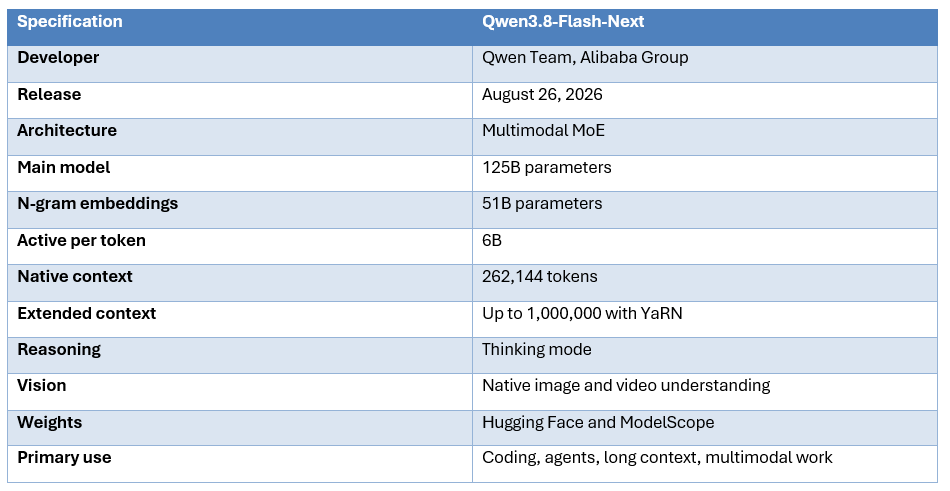
The architecture is the headline. Flash-Next combines a 125B-parameter main model with 51B N-gram embedding parameters, but only 6B parameters are activated per token. It adds a Gated DeltaNet and Qwen Sparse Attention hybrid, gated residual branches and an updated Muon optimization setup. The model has 262,144 native context and can extend to 1,000,000 tokens with YaRN.
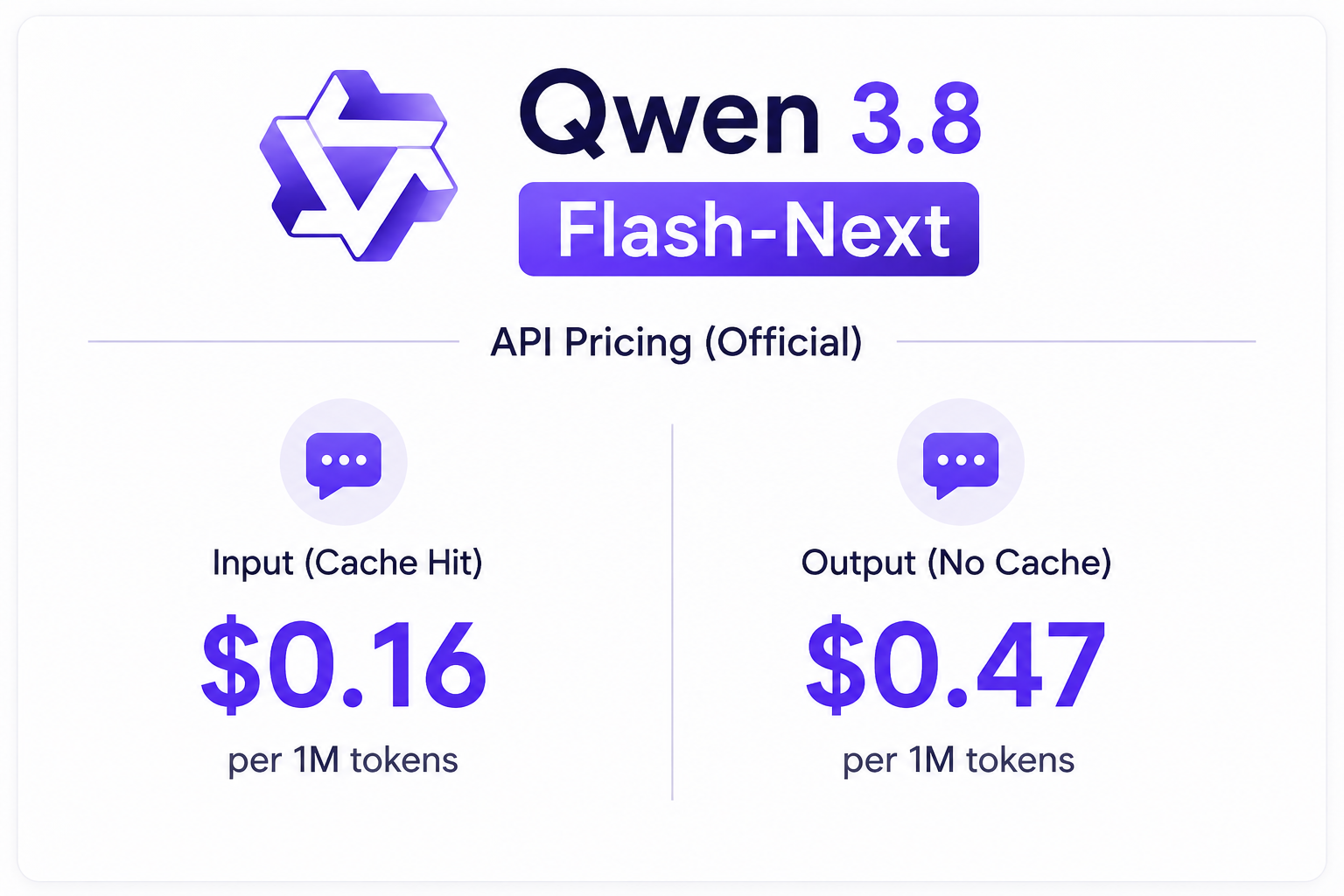
The economics are just as important. Qwen says training takes about one ninth the cost of Qwen3.7-Plus while improving coding and office-task capability. The production Qwen3.8-Flash service is listed at $0.16 per million input tokens and $0.47 per million output tokens, while the open Flash-Next checkpoint can be self-hosted.
QUICK ANSWER
Qwen3.8-Flash-Next is worth testing if you build coding agents, long-context applications or multimodal workflows. It offers a rare combination of 125B total capacity, only 6B active parameters per token, 262K native context, 1M context extension, native image and video understanding and open-weight deployment.
Qwen reports 91.9 on LiveCodeBench, 62.5 on SWE-bench Pro, 81.0 on SWE-bench Multilingual, 58.7 on DeepSWE 1.1, 73.9 on CoWorkBench and 55.7 on JobBench. These are Qwen-published benchmark results, so they are strong evidence but not an independent universal ranking.
The production Qwen3.8-Flash API is priced at $0.16 per million input tokens and $0.47 per million output tokens. For local deployment, Qwen provides official paths through Transformers, SGLang, vLLM and TokenSpeed, and the ecosystem already includes llama.cpp and Ollama support.
1. What Is Qwen3.8-Flash-Next?
Qwen3.8-Flash-Next is an open-weight multimodal mixture-of-experts model from Alibaba's Qwen team. Qwen explicitly describes it as an early preview of the architecture intended for Qwen4. The point of releasing it now is to expose the architectural changes early, let developers inspect the design and gather feedback before the larger Qwen4 family is built on top of it.
2. Why the Architecture Matters
The most important design choice is sparse activation. Flash-Next stores 125B parameters in the main model but activates only 6B per token. Qwen also adds 51B parameters through N-gram embeddings, which are deterministically addressed and do not enter the per-token matrix-multiplication budget in the same way as active expert parameters. This lets the model increase capacity without paying the full compute cost of a dense 125B model on every token.
The second major idea is long-context attention. Gated DeltaNet compresses historical information, while Qwen Sparse Attention uses a lightweight indexer to select important context at micro-block granularity. NVIDIA reported up to 7.6x prefill and 4.9x decoding speedups versus full attention in its tested Qwen3.8-Flash-Next deployment, plus 8.6x prefill throughput gains over Qwen3.7-Plus at a 1M-token context. Those are measurements from NVIDIA's specific GB300 setup, not a universal speed claim for every GPU.
This matters because long context is becoming an agent problem, not just a chat feature. Coding agents can accumulate tool output, source files, logs and previous decisions. Making attention cheaper over that history can reduce the infrastructure cost of keeping more useful context available.
3. Qwen3.8-Flash-Next Benchmarks
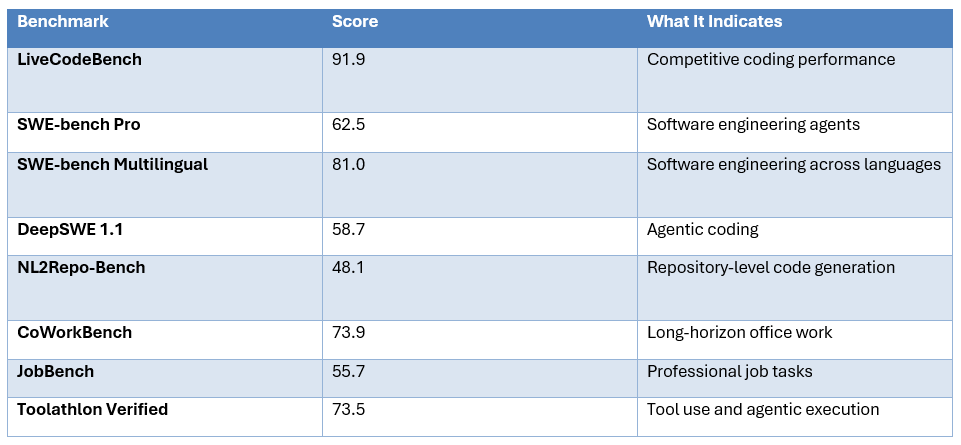
Qwen's official benchmark table places Flash-Next in a strong position across coding and agentic tasks. It scores 91.9 on LiveCodeBench, 62.5 on SWE-bench Pro, 81.0 on SWE-bench Multilingual, 58.7 on DeepSWE 1.1, 48.1 on NL2Repo-Bench, 73.9 on CoWorkBench and 55.7 on JobBench.
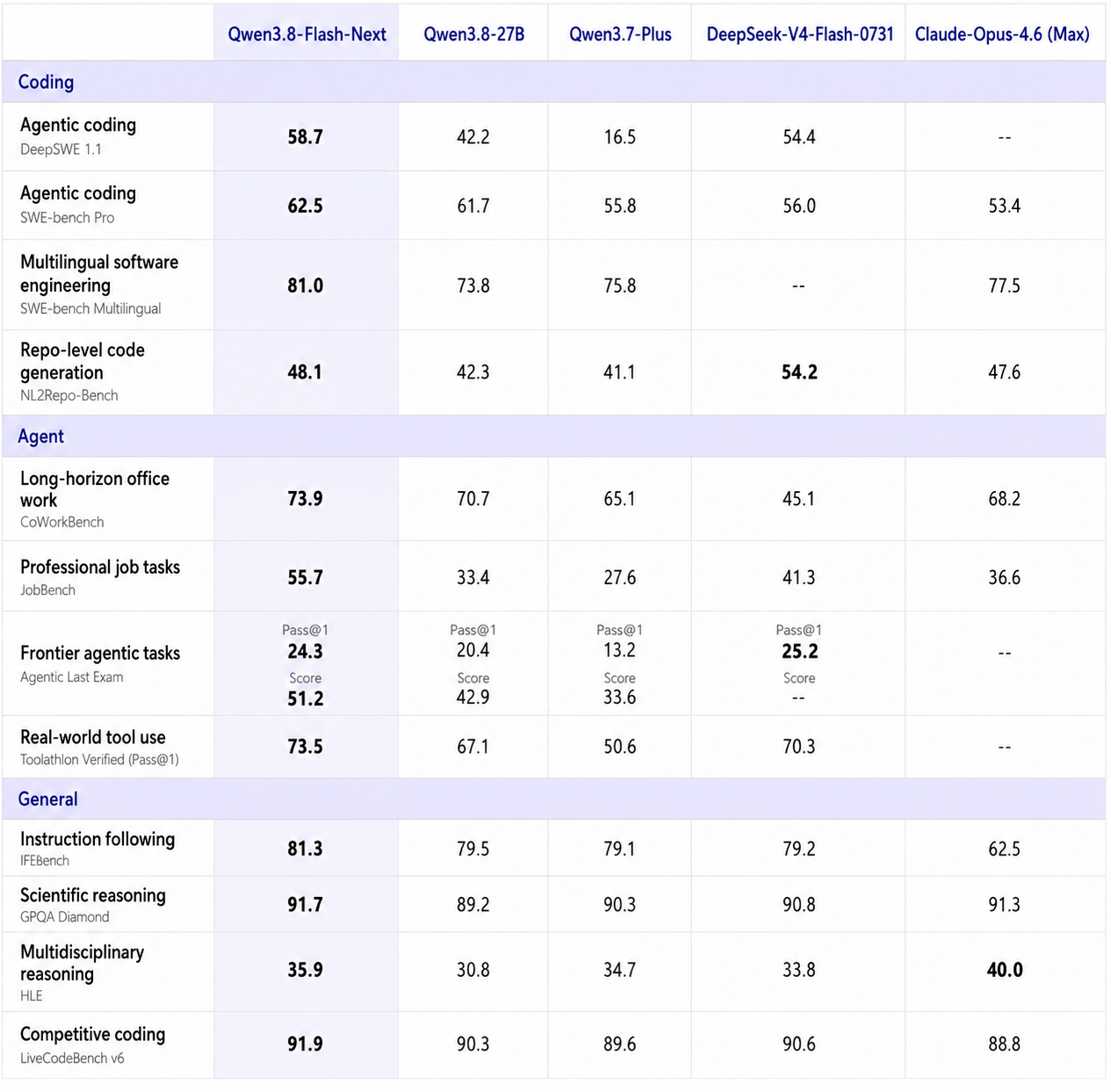
The comparison row is particularly notable. Qwen reports that Flash-Next exceeds Qwen3.8-27B, Qwen3.7-Plus and DeepSeek V4-Flash on several coding and agentic tests, while also beating Claude Opus 4.6 on SWE-bench Pro and CoWorkBench in the published table. This does not prove universal superiority. It means the new architecture has become competitive with much larger and closed models on several selected evaluations.
4. The Coding Results Are the Biggest Surprise
A model with 125B total parameters and only 6B active per token performing competitively on software-engineering benchmarks is the result worth paying attention to. The point of the Flash-Next design is not to behave exactly like a 6B dense model. It combines sparse routing and large stored capacity so it can retain a broader parameter space while keeping per-token computation closer to a much smaller model.
The result is especially relevant for agents. Agentic coding is usually a sequence of model calls, tool calls, repository reads and verification steps. A small reduction in the cost and latency of each step can become a large saving over the full task. Qwen is therefore attacking the economics of the entire loop, not just the cost of one response.
On the base-model comparison, Qwen also reports that Flash-Next-Base achieves the best result on 8 of 14 listed benchmarks, including MMLU-Pro, SuperGPQA, BBH, GSM8K, EvalPlus, SWEBench-Pretrain, MGSM and MMMLU.
5. Cost: Why Flash-Next Exists
Qwen says the training cost of Flash-Next is about one ninth of Qwen3.7-Plus while producing stronger capabilities in coding and office tasks. That is a much bigger statement than simply saying the model is cheap. It suggests Qwen is changing the cost curve of training while preserving useful capacity.
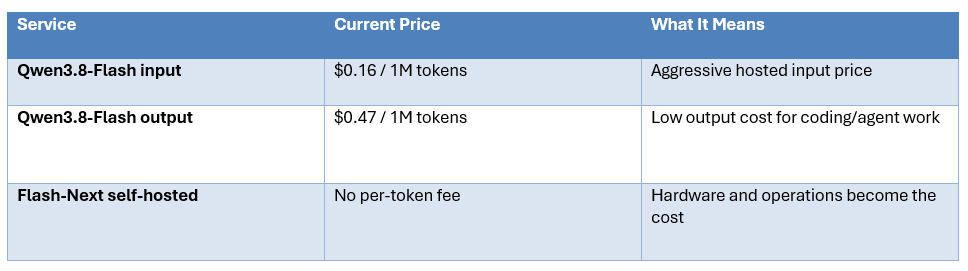
Open weights do not mean zero cost. A self-hosted Flash-Next deployment still requires accelerators, memory, storage, electricity, networking and engineering. The $0.16/$0.47 API price is therefore a useful baseline for calculating whether owning the infrastructure makes sense for your traffic volume.
For that cost decision, compare our Best Open Source AI Models August 2026 and our Model Routing for AI Coding Agents.
6. Is 1M Context Really Available?
There are two different context claims. Flash-Next natively supports 262,144 tokens and can extend to 1,000,000 using YaRN. The production Qwen3.8-Flash service is offered with 1M context by default. That difference matters because the open checkpoint does not have native 1M attention in the same sense as the production service.
A million-token window is useful for giant repositories, long documents, extensive agent traces and multimedia records, but it should not become a dumping ground. Irrelevant context still consumes resources and can reduce focus. Retrieval, summarization and context selection remain important even when the model can technically accept a million tokens.
Our Context Engineering guide covers the practical side of using large context windows efficiently.
7. Multimodal Image and Video Understanding
Flash-Next is multimodal. The current model documentation describes native image and video understanding, including diagrams, charts, documents and hour-scale videos, plus computer-use and mobile-use tasks.
That gives the model an unusually broad coding-agent profile. A single workflow can potentially inspect a screenshot, read the related source files, watch a reproduction and then modify code. The value is the combination of modalities with tools, reasoning and long context, not vision by itself.
This makes it a useful companion to our DeepSeek V4 Flash Vision Exp review.
8. Thinking Mode and Agentic Control
Qwen3.8-Flash-Next runs in thinking mode by default. The current Ollama release exposes reasoning controls such as low, medium and xhigh effort, while preserving prior reasoning context when configured to do so.
For agents, configurable reasoning is important because not every step deserves maximum compute. A router can use lower effort for simple classification and tool selection, while reserving deeper reasoning for architecture decisions, complex debugging and final verification.
That fits naturally into a multi-agent architecture like the one described in our LangGraph guide.
9. Can You Run Qwen3.8-Flash-Next Locally?
Yes. Qwen released official weights on Hugging Face and ModelScope and documents local and server deployment through Transformers, SGLang, vLLM and TokenSpeed. The official repository also points to llama.cpp and Unsloth, and the current Ollama library provides a 125B MLX build listed at about 103 GB.
vllm serve Qwen/Qwen3.8-Flash-Next --port 8000 \
  --tensor-parallel-size 4 \
  --max-model-len 262144 \
  --reasoning-parser qwen3 \
  --enable-auto-tool-choice \
  --tool-call-parser qwen3_coder
Qwen provides this as an official four-way tensor-parallel example for vLLM. It is a reference configuration, not a guarantee that every four-GPU machine will deliver the same throughput. Precision, KV-cache size, batch size, GPU memory and context length all matter.
10. Qwen3.8-Flash-Next vs Qwen3.8-27B
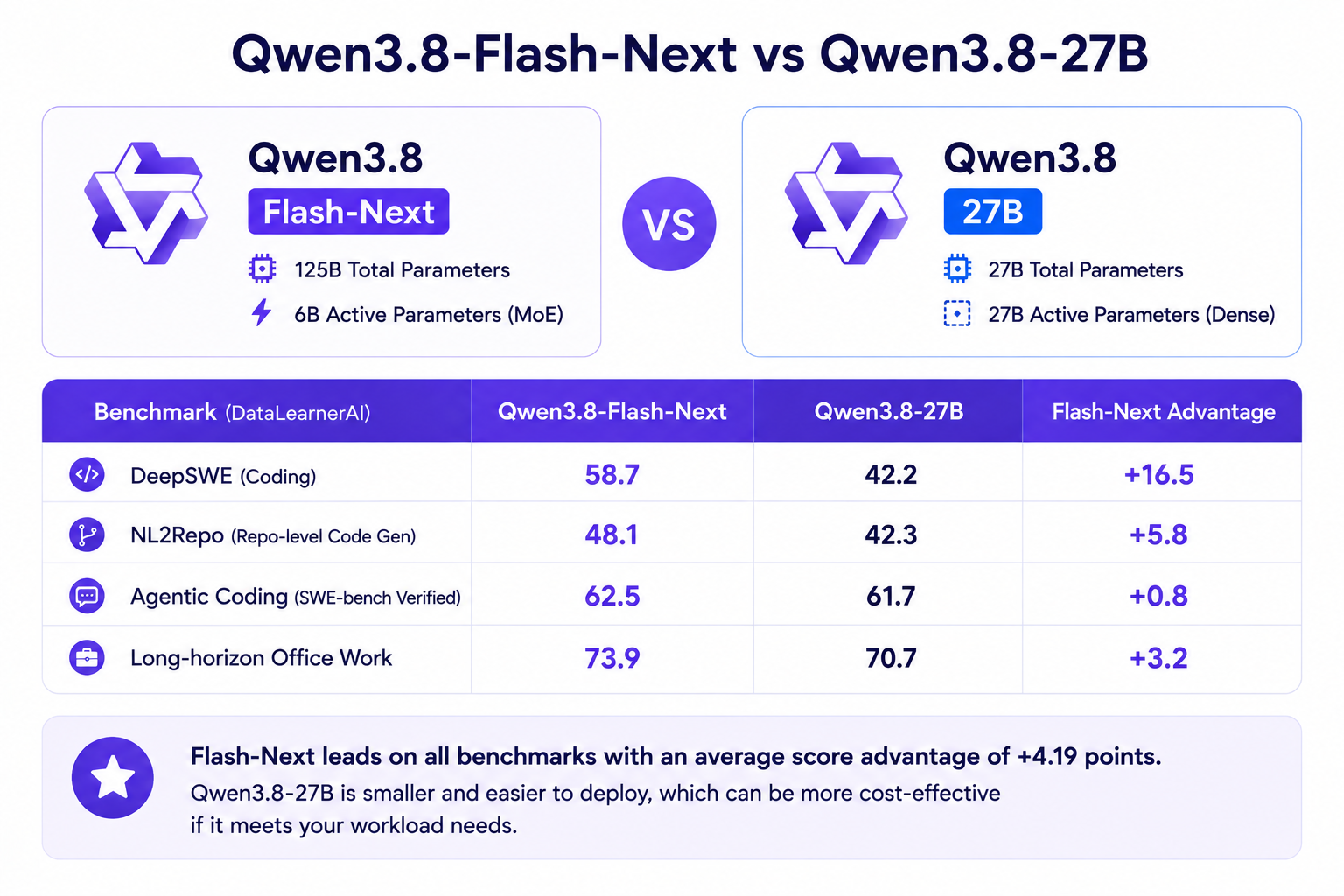
Qwen3.8-27B is the obvious smaller sibling. Flash-Next has 125B total parameters and 6B active, while 27B is dense. On the nine shared benchmarks tracked by DataLearnerAI, Flash-Next leads 9 to 0, with an average score advantage of 4.19 points. Its DeepSWE score is 58.7 versus 42.2 for Qwen3.8-27B, while NL2Repo is 48.1 versus 42.3.
That is an impressive capability-per-active-parameter result. But the 27B model still has a practical advantage: it is far easier to fit into smaller infrastructure. If your workload can be solved by the 27B model, the smaller system can win on total cost even if Flash-Next produces better benchmark scores.
11. Qwen3.8-Flash-Next vs DeepSeek V4-Flash
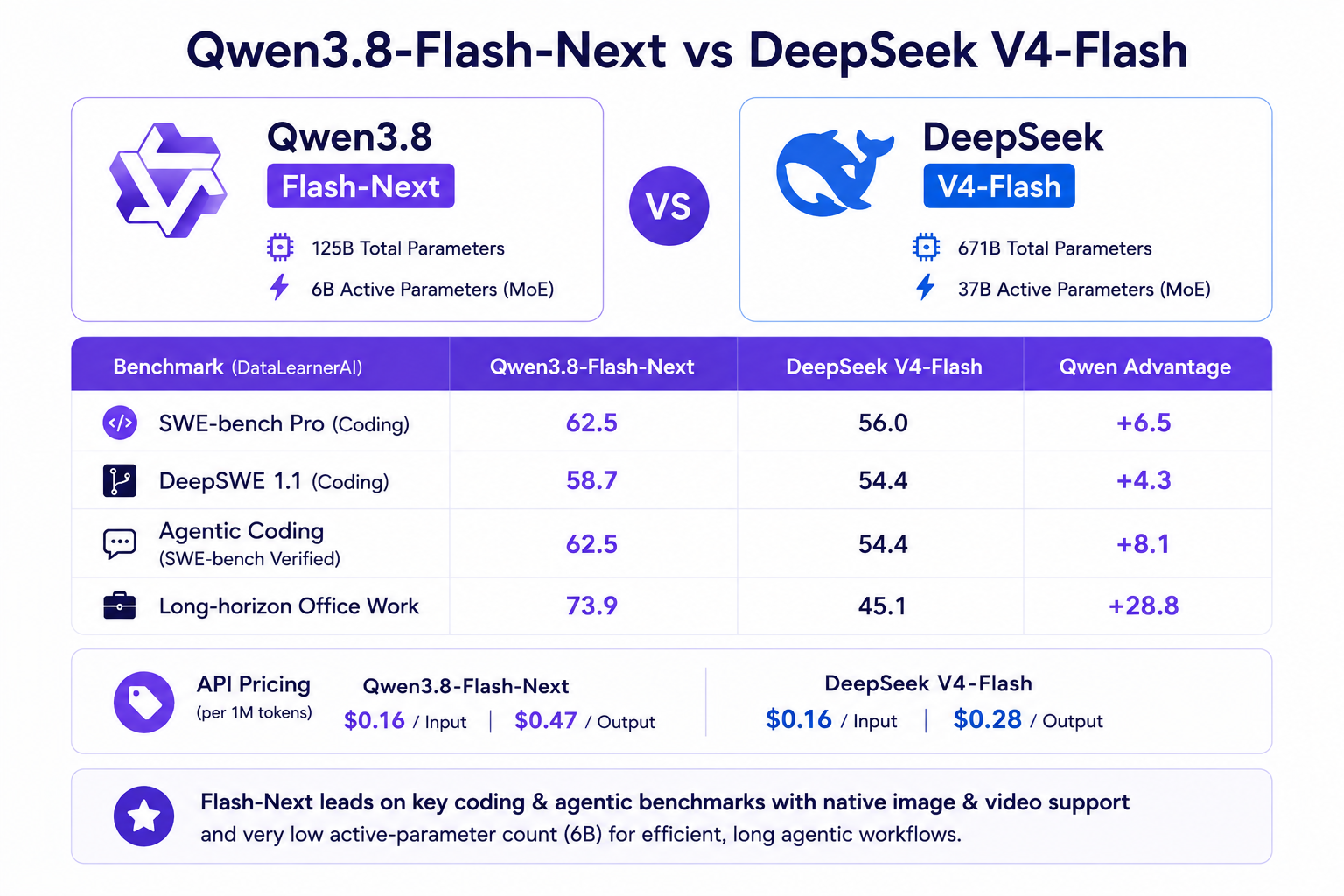
For price-sensitive AI teams, the DeepSeek comparison is more important than another frontier leaderboard. Qwen reports Flash-Next at 62.5 on SWE-bench Pro and 58.7 on DeepSWE 1.1, compared with 56.0 and 54.4 for DeepSeek V4-Flash in the same published table.
DeepSeek remains a serious value competitor because its API prices are also unusually low and its ecosystem is already mature. The difference is that Flash-Next gives you a new open architecture with native image and video support and an unusually low active-parameter count. That can matter when the model must stay in the loop for many agentic steps.
Our 100 Best DeepSeek Prompts 2026 gives you the corresponding DeepSeek prompt library.
12. Why the Qwen4 Preview Angle Matters
The biggest strategic point is that Flash-Next is a preview of what comes next. Qwen is effectively exposing the architectural direction before Qwen4 itself arrives. That gives developers an early chance to test the attention scheme, sparse activation behavior, multimodal capabilities and deployment tooling.
If the architecture scales well, Qwen4 could inherit the same basic ideas while increasing model capability. If parts of the design fail to scale, the community will find out through this preview. Either way, the release is useful because it makes the architecture testable rather than keeping every decision inside a closed research program.
13. The Biggest Catch: Do Not Confuse Next With Final
- Flash-Next is explicitly an architecture preview, not the final Qwen4 family.
- 262K is the native context length; 1M requires YaRN on the open checkpoint.
- Benchmark results are mostly Qwen-reported and should be validated on your own tasks.
- Open weights still require serious hardware at this model scale.
- The production Qwen3.8-Flash service and the downloadable Flash-Next checkpoint are related but not identical products.
- Preview architecture choices can change before the final Qwen4 lineup.
14. Who Should Use It?
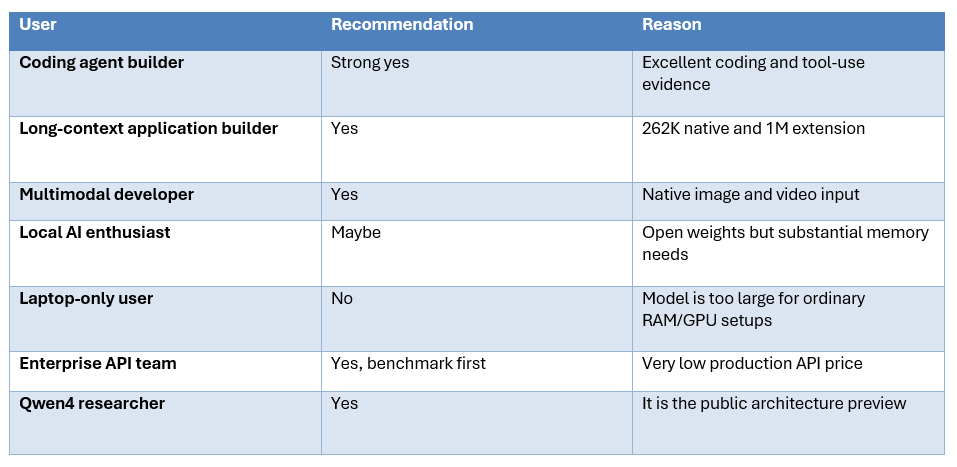
The ideal user is a developer who needs more than a chatbot. Flash-Next makes the most sense when coding, tools, visual context and long history all belong in the same workflow.
15. Is Qwen3.8-Flash-Next Worth It?
Yes, especially for teams experimenting with agents. The model is not interesting because 125B sounds large. It is interesting because Qwen is trying to make that capacity economical to activate. Six billion active parameters, sparse attention and an architecture designed for long sequences create a much more compelling efficiency story than a conventional dense model with the same total parameter count.
For hosted applications, the Qwen3.8-Flash price of $0.16 input and $0.47 output per million tokens is excellent. For self-hosting, the question is whether your utilization is high enough to justify the hardware and engineering compared with simply paying for the API.
It is less compelling if your only goal is the smallest local model, because Qwen3.8-27B and Gemma 4 are easier to deploy. It is also not the right model to lock into a long enterprise commitment without a fallback, because Flash-Next is explicitly an experimental preview of a future architecture.
16. Final Verdict
Qwen3.8-Flash-Next is one of the most important open-model releases of late August 2026 because the architectural idea is as important as the model itself. Qwen is testing a new way to combine large capacity with low active compute and cheaper long-context inference.
The results are strong. The model reaches 91.9 on LiveCodeBench, 62.5 on SWE-bench Pro, 81.0 on SWE-bench Multilingual and 73.9 on CoWorkBench in Qwen's published evaluations. Independent benchmark aggregators also place it high in the current field, while NVIDIA has demonstrated major long-context speedups on its GB300 test system.
The cost story is even stronger. The production Flash service is listed at $0.16 per million input tokens and $0.47 per million output tokens, while Flash-Next weights are downloadable for self-hosting.
My verdict: Qwen3.8-Flash-Next is worth using if you build coding agents, long-context applications or multimodal workflows and you care about cost efficiency. It is not a universal replacement for every frontier model, and its experimental status matters. But as a preview of the Qwen4 direction, this is a release developers should not ignore.
Frequently Asked Questions
What is Qwen3.8-Flash-Next?
It is an open-weight multimodal MoE model from Alibaba's Qwen team and an early preview of the architecture intended for Qwen4.
How many parameters does Qwen3.8-Flash-Next have?
It has 125B main-model parameters, 51B N-gram embedding parameters and 6B active parameters per token.
What is its context window?
It supports 262,144 tokens natively and can be extended to 1,000,000 tokens with YaRN.
How good is it for coding?
Qwen reports 91.9 on LiveCodeBench, 62.5 on SWE-bench Pro, 81.0 on SWE-bench Multilingual and 58.7 on DeepSWE 1.1.
How much does Qwen3.8-Flash cost?
The production Qwen3.8-Flash service is listed at $0.16 per million input tokens and $0.47 per million output tokens.
Can I run it locally?
Yes. Qwen provides official weights and serving paths for Transformers, SGLang, vLLM and TokenSpeed. Ollama also currently offers a 125B MLX build.
Is Qwen3.8-Flash-Next the same as Qwen3.8-Flash?
No. Flash-Next is the open experimental architecture preview, while Qwen3.8-Flash is the production service with 1M context by default and built-in tools.
Is it a preview of Qwen4?
Yes. Qwen explicitly describes Flash-Next as an early preview of the architecture used for Qwen4.
Is it better than DeepSeek V4-Flash?
Qwen's published coding table gives Flash-Next higher SWE-bench Pro and DeepSWE scores, but the models have different strengths and the comparison is vendor-reported.
Is it worth using?
Yes for serious testing, especially in agentic coding, long-context and multimodal workflows. Keep a fallback model because the architecture is still a preview.
Recommended Blogs
- Qwen3.8-Flash-Next Preview: Release Date, Specs & Qwen4
- Best Open Source AI Models August 2026: Full Collection
- DeepSeek V4 Flash Vision Exp Review: Benchmarks & Price
- 100 Best DeepSeek Prompts 2026 (Copy-Paste)
- Ox Alpha Review: The Mystery AI Model With 1M Context (2026)
- What Is Context Engineering? Complete Guide (2026)
- How to Use LangGraph for Multi-Agent Systems (2026)
Resources & Community
Join our community of 70,000+ AI enthusiasts and learn to build powerful AI applications. Whether you are a beginner or an experienced developer, Build Fast with AI helps you understand and implement AI in your projects.
- Website - buildfastwithai.com
- LinkedIn - Build Fast with AI
- Instagram - @buildfastwithai
- Founder Twitter - @satvikps
- Twitter - @BuildFastWithAI
Agentic AI Launchpad 2026
A structured 6-week cohort program that takes you from AI basics to building and deploying real-world agentic AI systems. Includes live sessions, expert mentorship, project reviews and a builder community network.
Ready to go from learning to building? Join the next cohort: Agentic AI Launchpad 2026
Free AI Resources
Access free tools, workshops and micro-learning to keep building.

