



Qwen 3.8 Max 0902 Explained: Which Version Should You Use and How Does It Work?
Qwen 3.8 Max 0902 is the September 2, 2026 upgrade to Alibaba's Qwen 3.8 Max, but it is easier to understand as a new dated snapshot of the same flagship family than as a completely separate model generation. The release keeps the 2.4 trillion-parameter sparse MoE foundation, the 1 million-token context window and the multimodal input stack, while putting much more post-training emphasis on coding, collaborative agent work and long-horizon task completion.
The 0902 update is aimed at work where the model must inspect a repository, use tools, coordinate steps, recover from errors and finish a task.
The benchmark movement is substantial. Alibaba's published comparison shows TerminalBench 3.0 rising from 11.3 to 29.0, DeepSWE 1.1 from 56.6 to 69.3, QwenSWE-Bench V2 from 55.1 to 70.0 and JobBench from 53.4 to 64.0. Current Code Arena tracking also places qwen3.8-max-0902 at 1681 in its overall WebDev snapshot, close to Claude Opus 5 at 1687. The Code Arena result is marked preliminary, but it provides independent evidence that the September snapshot is competitive in real-user web-development tasks.
QUICK ANSWER
Qwen 3.8 Max 0902 is an upgraded Qwen 3.8 Max snapshot released September 2, 2026 under the model ID qwen3.8-max-0902, with qwen3.8-max-2026-09-02 as the dated alias. QwenCloud says the update targets complex engineering projects, long-horizon autonomous development, multi-tool orchestration and stronger multimodal understanding while retaining the 1M context, thinking mode and full tool ecosystem.
QwenCloud currently documents up to 991K input tokens, 131K maximum output, a 262K maximum reasoning budget, text-image-video input, function calling, built-in tools and structured output. Pricing is $2 per million input tokens and $6 per million output tokens, with lower rates for cached input.
For coding, the published 0902 comparison reports 69.3 on DeepSWE 1.1, 70.0 on QwenSWE-Bench V2, 64.9 on NL2Repo-Bench and 44.8 on SWE-Marathon. On agent and professional tasks it reports 76.1 on CoWorkBench, 64.0 on JobBench, 73.3 on Toolathlon Verified and 1468 WorkArena Elo.
My verdict: 9.2/10 overall. Qwen 3.8 Max 0902 is especially compelling for coding agents, enterprise automation, large-context research and multimodal workflows where a $2 input and $6 output API can cover a large share of the work.
1. What Is Qwen 3.8 Max 0902?
Qwen 3.8 Max 0902 is an upgraded snapshot of Qwen 3.8 Max. QwenCloud explicitly describes it as an upgraded version of qwen3.8-max, with the alias qwen3.8-max-2026-09-02. The distinction matters because the release keeps the original model family rather than introducing a new model architecture.
The underlying Qwen 3.8 Max family is a 2.4 trillion-parameter sparse mixture-of-experts system. The 0902 update concentrates on behavior through additional post-training, especially Coding and Cowork. In practical terms, Alibaba is trying to make the same flagship more effective at real work rather than simply making the model larger.
QwenCloud also retains the model's multimodal input. Current documentation lists text, image and video input with text output, together with a 1M context, function calling, built-in tools and structured outputs.
2. Qwen 3.8 Max Versions and Model IDs
Several names can appear when you search for Qwen 3.8 Max, and they do not all mean the same thing. The dated 0902 model is the useful choice when you need the exact September behavior that the benchmark tables describe.
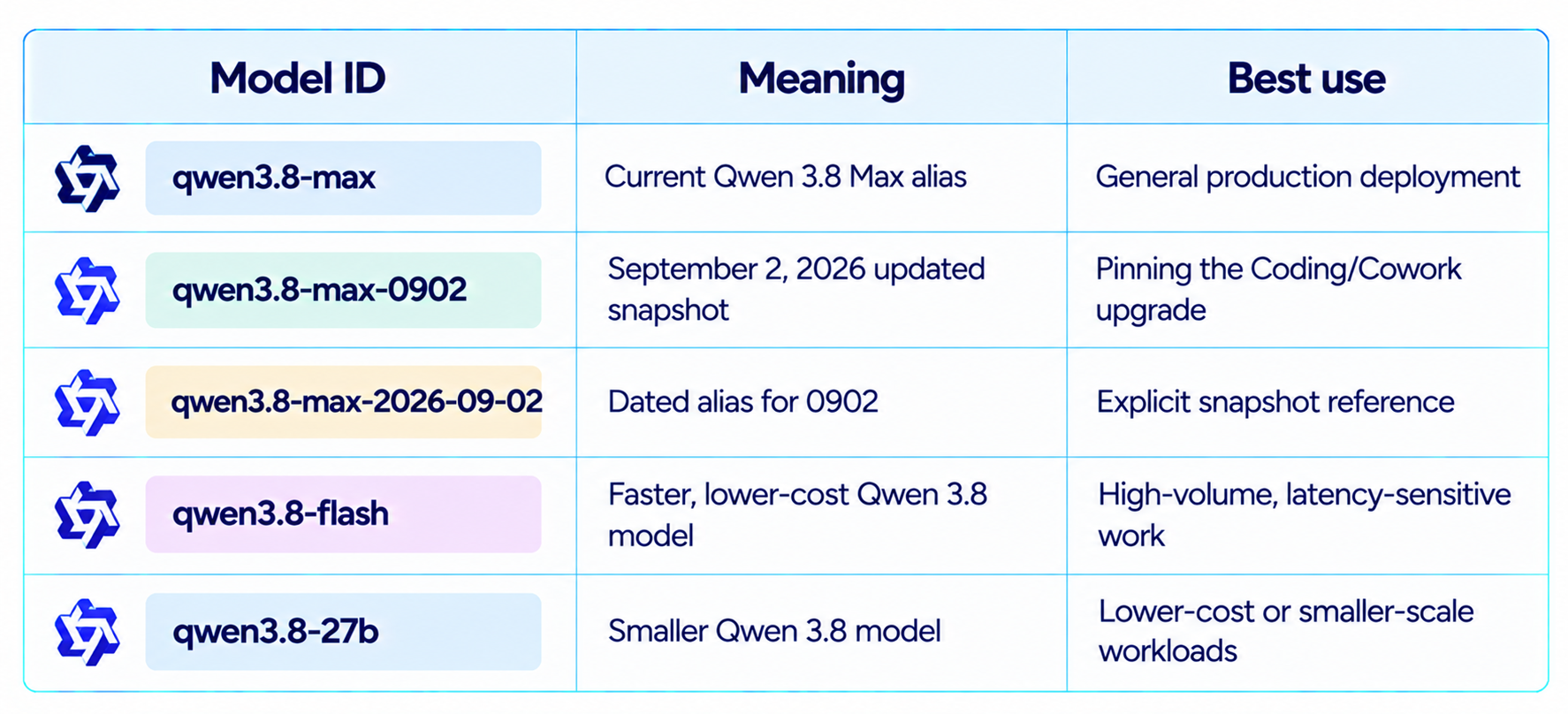
For reproducible evaluations, the dated ID is useful. If you are comparing two model versions in a benchmark or validating a coding agent after a model change, pinning qwen3.8-max-0902 makes the test easier to reproduce than relying only on a moving alias.
3. What Changed in the 0902 Upgrade?
QwenCloud describes the 0902 upgrade around four practical improvements: more capable engineering work, stronger long-horizon autonomous development, better multi-tool orchestration and improved vision understanding for charts and documents. The 1M context and tool ecosystem remain.
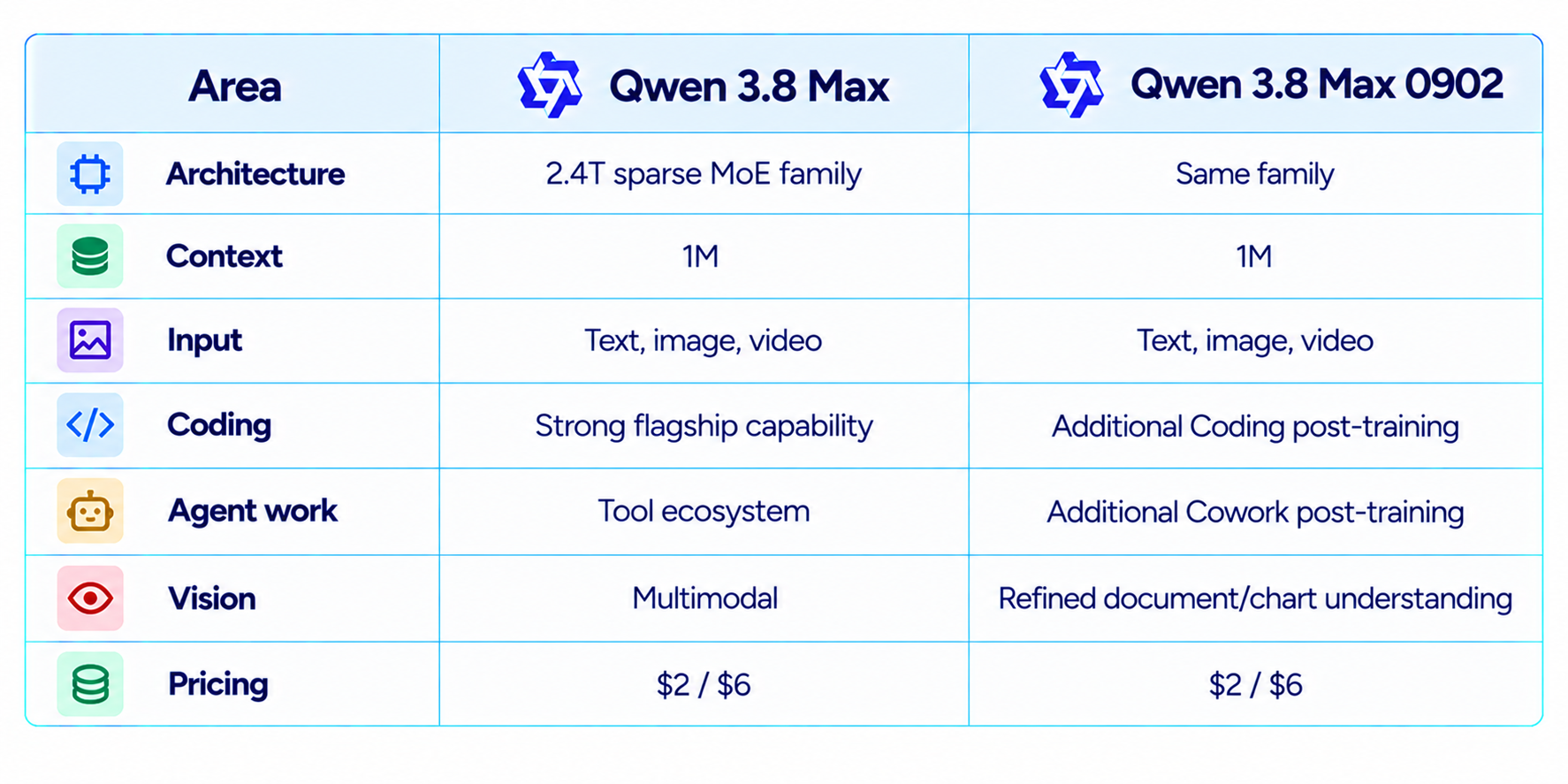
This is why the 0902 release is better understood as a behavioral upgrade. Developers get the same broad interface, but the model is tuned for tasks that require multiple actions and a completed outcome.
4. Qwen 3.8 Max 0902 Benchmark Performance
Alibaba's published comparison is the main source for the before-and-after benchmark table. It covers coding, agent and multimodal evaluations, letting us see where the post-training had the largest effect.
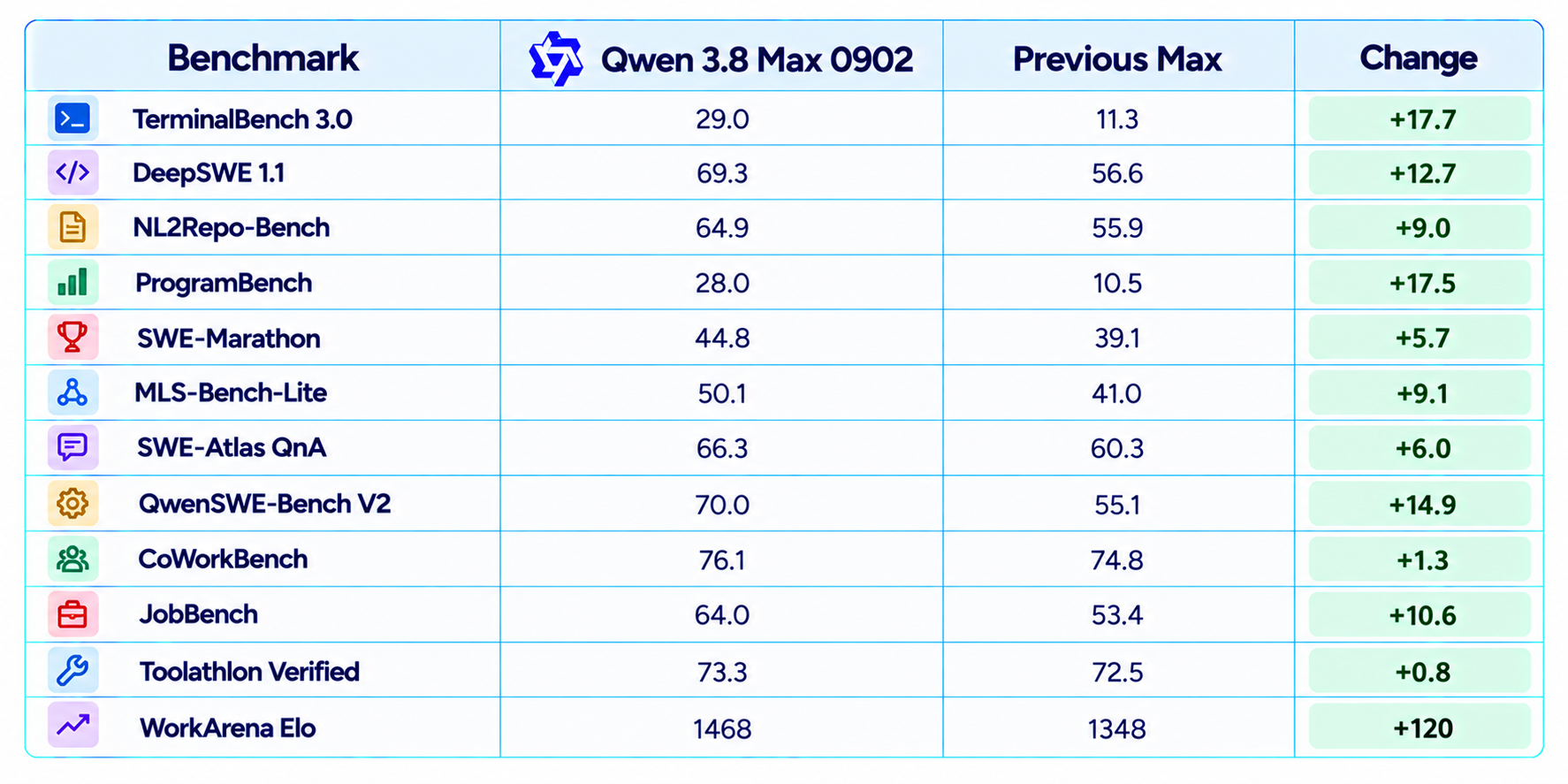
The largest gains are concentrated in terminal coding, software replication, repository-level engineering and professional tasks, matching Alibaba's Coding and Cowork focus.
5. Coding Performance: The Biggest Improvement
The coding improvement is unusually broad. TerminalBench 3.0 more than doubles from 11.3 to 29.0. DeepSWE 1.1 rises 12.7 points to 69.3. QwenSWE-Bench V2 rises from 55.1 to 70.0, and ProgramBench rises from 10.5 to 28.0.
These benchmarks measure different parts of software work. TerminalBench tests terminal-based agent behavior. DeepSWE evaluates long-horizon software engineering. ProgramBench tests black-box software replication. QwenSWE-Bench is Qwen's own software-engineering benchmark.
Together, the movement suggests that 0902 is better suited to repository-level and multi-step development than the earlier snapshot. For developers, that means the model is more interesting for coding agents than for simple autocomplete alone.
6. Code Arena WebDev: The Independent Reality Check
Current Code Arena WebDev tracking shows qwen3.8-max-0902 at 1681 in its overall September snapshot. Claude Opus 5 is at 1687, Kimi K3 Max at 1674 and the previous qwen3.8-max at 1671. The 0902 score is marked preliminary.
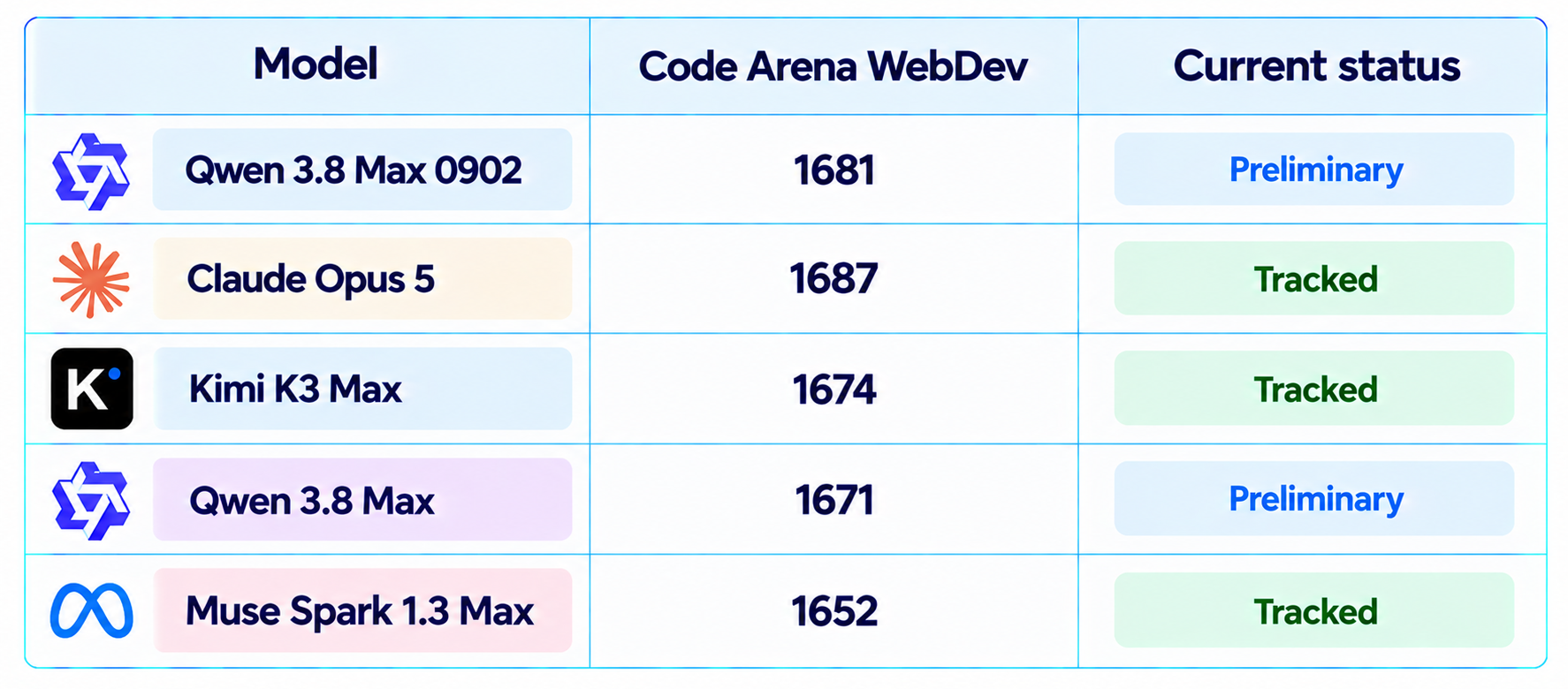
The result is useful because Code Arena is built around multi-step WebDev tasks and real-user voting, providing an external view alongside Alibaba's own benchmark table. It should still be treated as a moving leaderboard, not a final overall model ranking.
7. Cowork and Professional AI Work
Coding is only half of the 0902 story. Qwen's Cowork focus is about professional tasks where an agent has to inspect information, use tools and complete an end-to-end workflow.
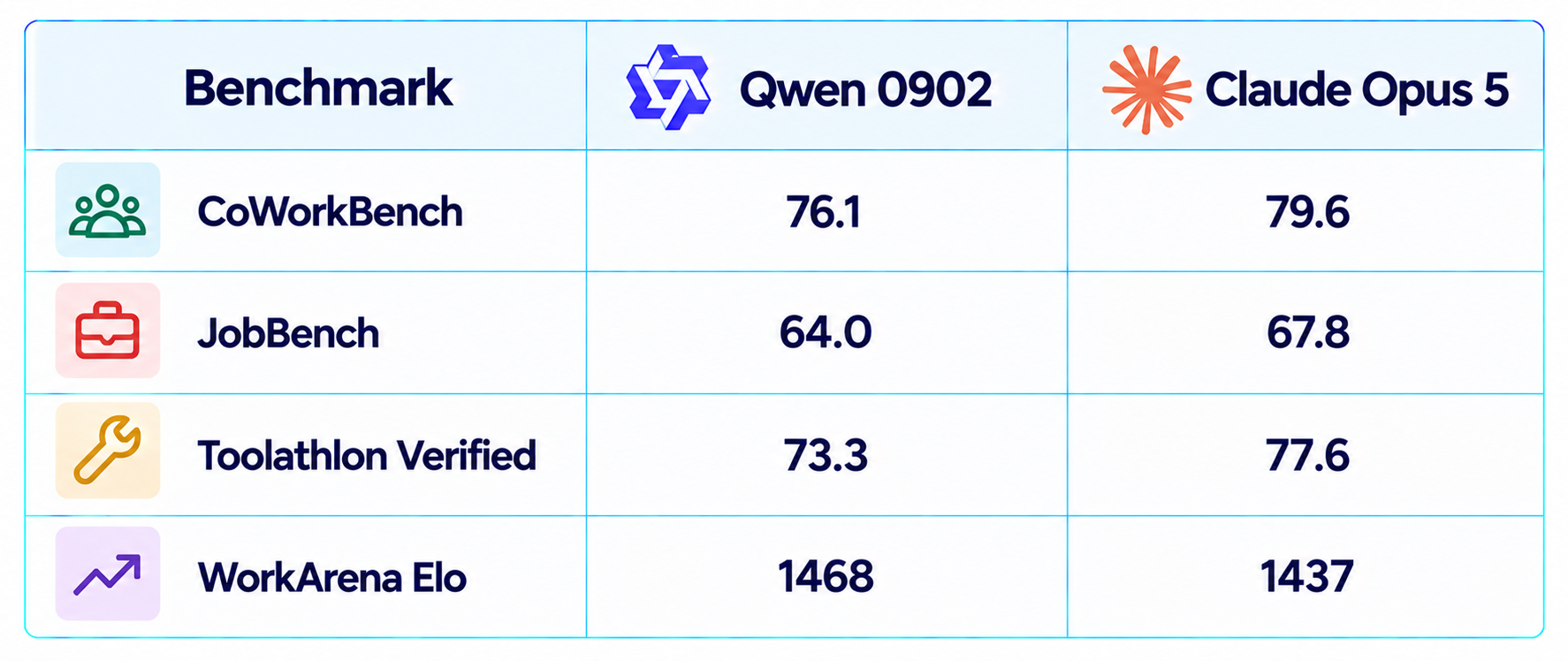
The comparison is mixed in a useful way. Qwen 0902 trails Opus 5 on CoWorkBench, JobBench and Toolathlon Verified, but its reported WorkArena Elo is higher. That means the update has reached a competitive professional-agent range without dominating every evaluation.
8. Multimodal Capabilities
Qwen 3.8 Max 0902 is multimodal at the input layer. QwenCloud lists text, image and video input with text output, and the vision-model table gives the model a 1M context, support for up to 2,048 image URLs, 250 Base64 images and 64 videos, alongside function calling, built-in tools and structured outputs.
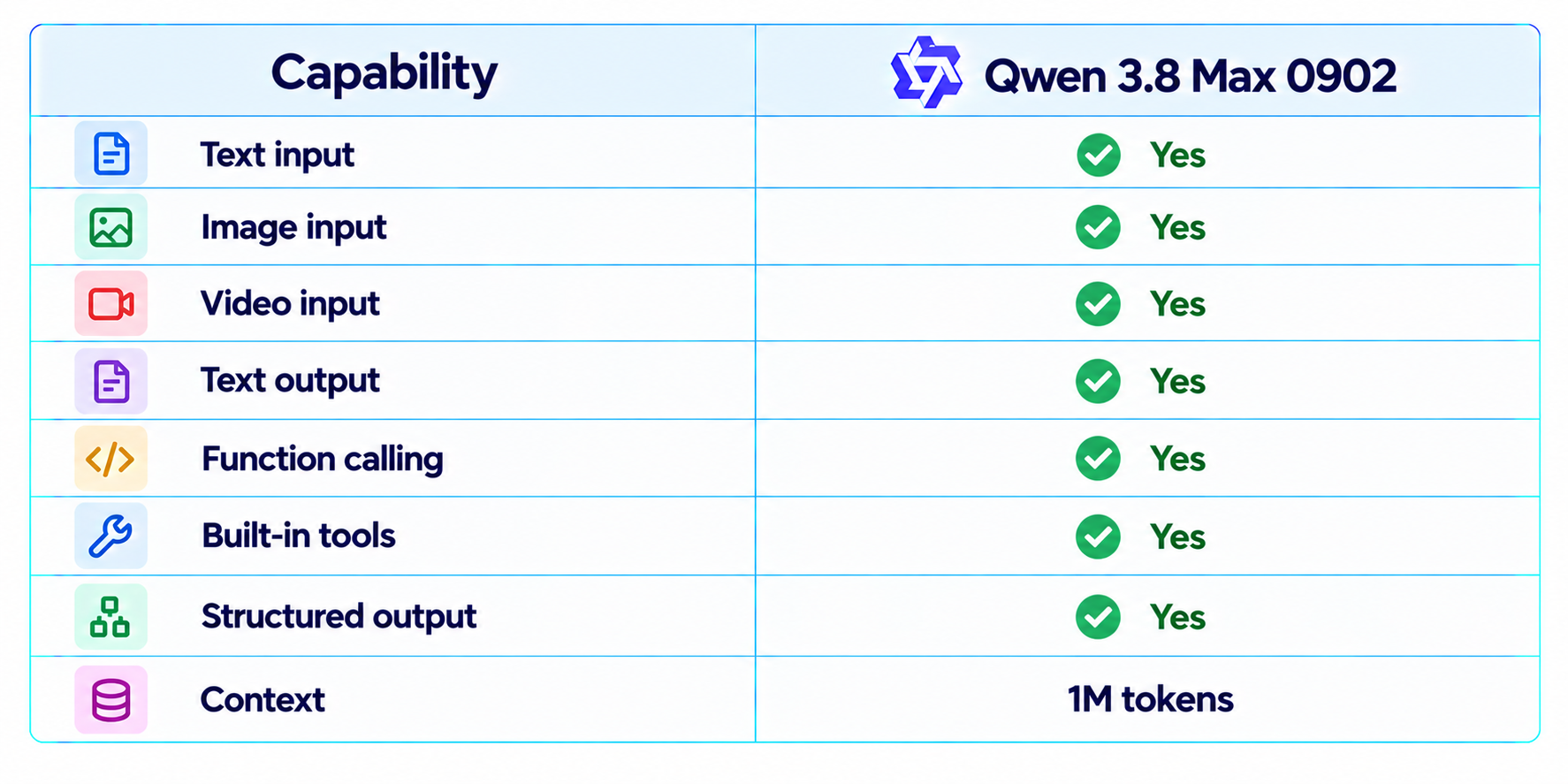
The practical use cases include screenshot analysis, document understanding, chart reasoning, video inspection and multimodal coding workflows. The 0902 release specifically calls out sharper chart and document understanding.
9. Qwen 3.8 Max 0902 Context Window
QwenCloud retains a 1M-token context window for 0902. The model details page lists up to 991K input tokens and 131K maximum output, while the vision-model documentation lists the same 1M context class.
A million-token context can hold large repositories, long research collections, extensive logs, policy libraries or multi-step agent state. The usefulness is not just capacity. Long-context reasoning becomes more valuable when the model can connect information that is separated by hundreds of pages or thousands of files.
Context engineering still matters. A full context window filled with irrelevant material can make an agent less efficient. The right target is the smallest context that contains everything needed for the current decision.
See our What Is Context Engineering? Complete Guide (2026) for the broader strategy.
10. Reasoning and Thinking Budget
QwenCloud's OpenAI-compatible API exposes reasoning effort for the Qwen 3.8 Max series as low, medium and xhigh. The documented mapping corresponds to thinking budgets of 4,096, 16,384 and 262,144 tokens respectively.
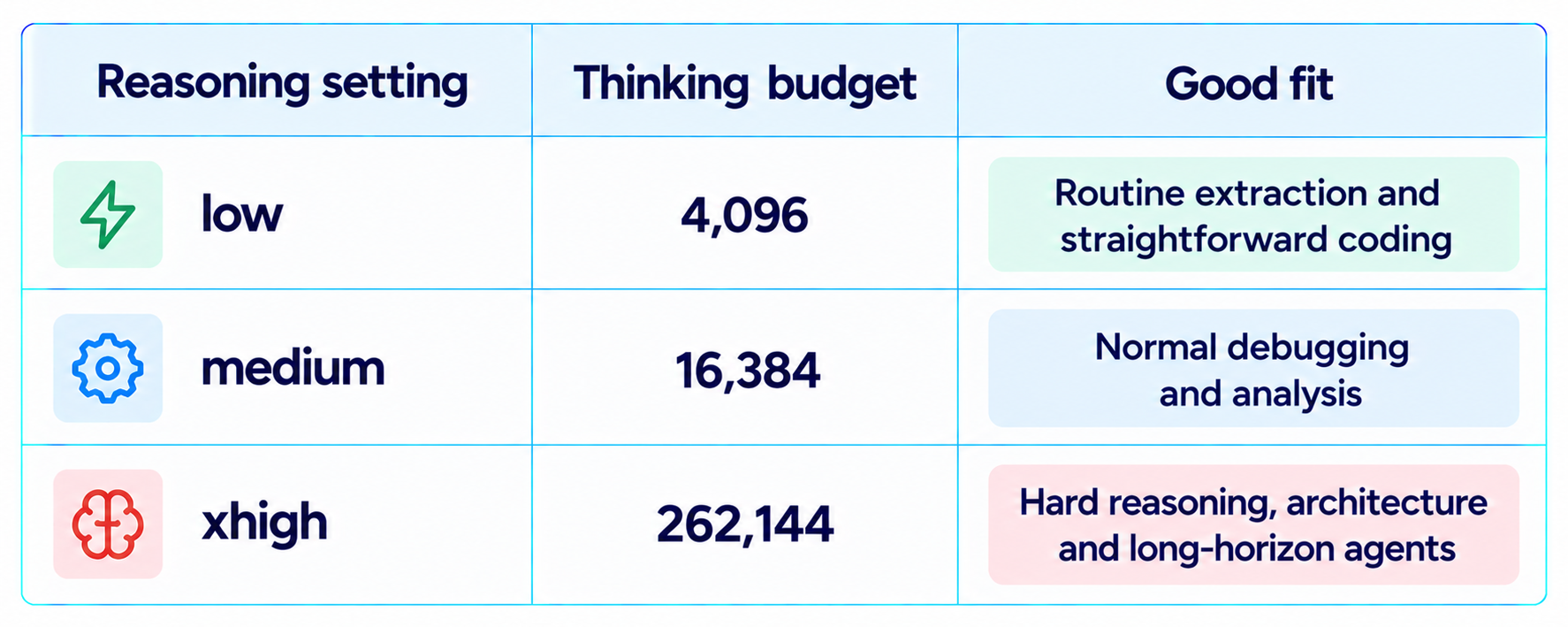
This is useful because the same model can play different roles inside one application. A router can keep routine turns inexpensive and fast while using xhigh only when the model needs deeper planning or verification.
This fits naturally with Model Routing for AI Coding Agents.
11. Qwen 3.8 Max 0902 Pricing
QwenCloud currently lists $2 per million input tokens and $6 per million output tokens for Qwen 3.8 Max 0902. Cache rates are lower: $0.25 per million for implicit cache reads, $0.17 per million for explicit cache reads and $2.50 per million for explicit cache creation.
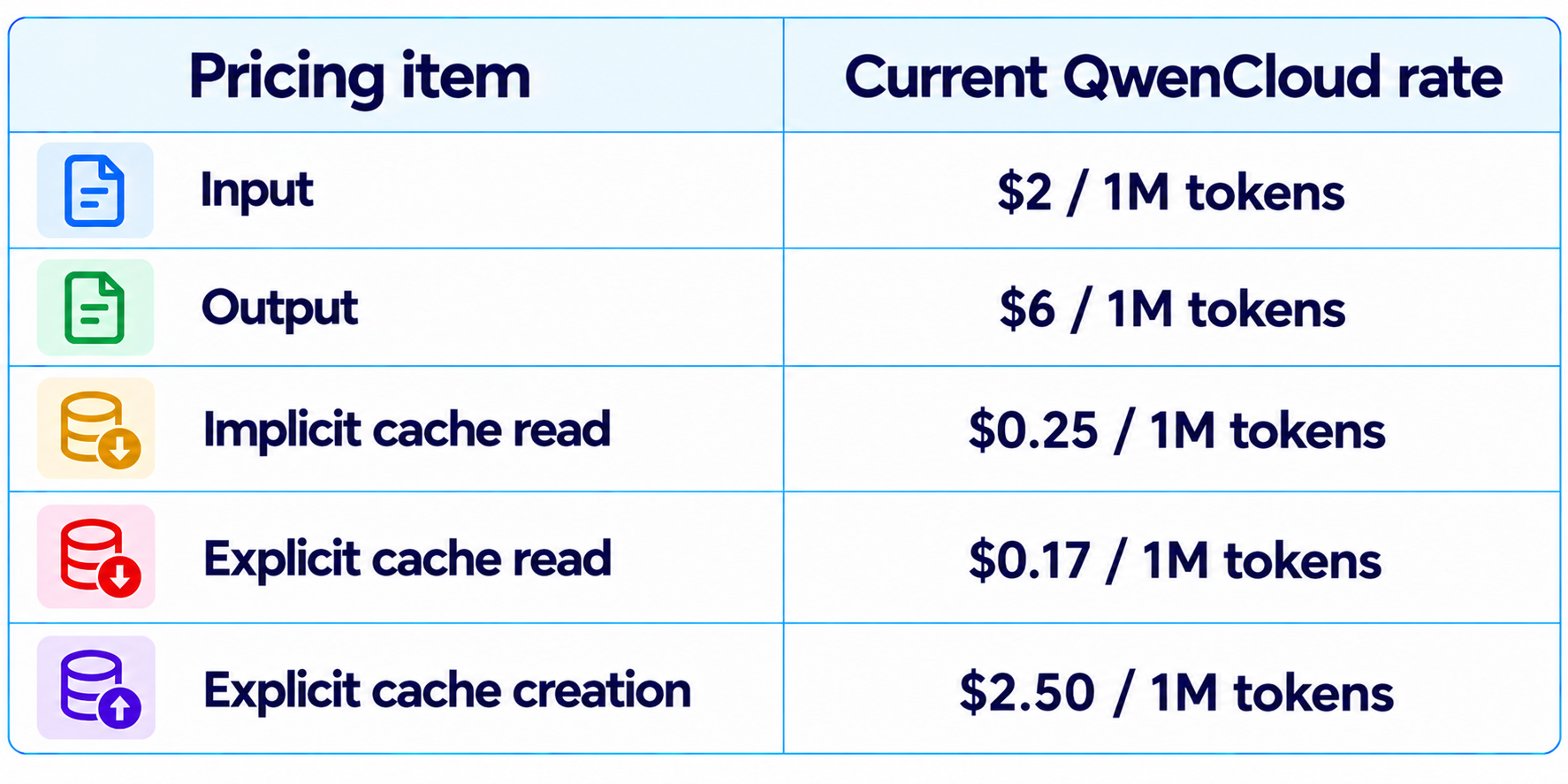
Caching is especially useful in long-running coding and agent workflows where the same system instructions, repository context or documentation are sent repeatedly. The effective cost can therefore be materially lower than treating every input token as a fresh full-price token.
The useful production metric is still cost per completed task. A model that requires multiple retries can be more expensive than a pricier model that finishes a job in one or two turns.
12. How to Use Qwen 3.8 Max 0902
QwenCloud provides an OpenAI-compatible API, so an existing OpenAI SDK integration can usually be migrated by changing three things: the base URL, the API key and the model identifier.
For the standard pay-as-you-go OpenAI-compatible API, QwenCloud documents the base URL as https://maas.qwencloudapi.com/compatible-mode/v1. QwenCloud also offers a separate Token Plan with a different base URL and API-key format, so those credentials should not be mixed.
Python example:
from openai import OpenAI
import os

client = OpenAI(
    api_key=os.getenv("DASHSCOPE_API_KEY"),
    base_url="https://maas.qwencloudapi.com/compatible-mode/v1",
)

response = client.chat.completions.create(
    model="qwen3.8-max-0902",
    messages=[
        {"role": "user", "content": "Review this Python function and identify the three most important bugs."}
    ],
    reasoning_effort="medium"
)

print(response.choices[0].message.content)
13. How to Use Built-In Tools
QwenCloud's Responses API supports built-in tools including web search, code interpreter, web extractor and image search. That makes it easier to build an agent without manually wiring every common retrieval or execution service.
For Qwen 3.8 models, Qwen specifically recommends the Responses API for agent-style multi-turn web search. The model can make multiple retrieval decisions within the response when the web_search tool is attached.
Structured output is also supported, which is useful when Qwen's response feeds another application, workflow node or database rather than a person.
For a deeper look at agent architecture, read What Is an AI Agent? Beginner Guide With Examples (2026).
14. Qwen 3.8 Max 0902 vs Qwen 3.8 Max
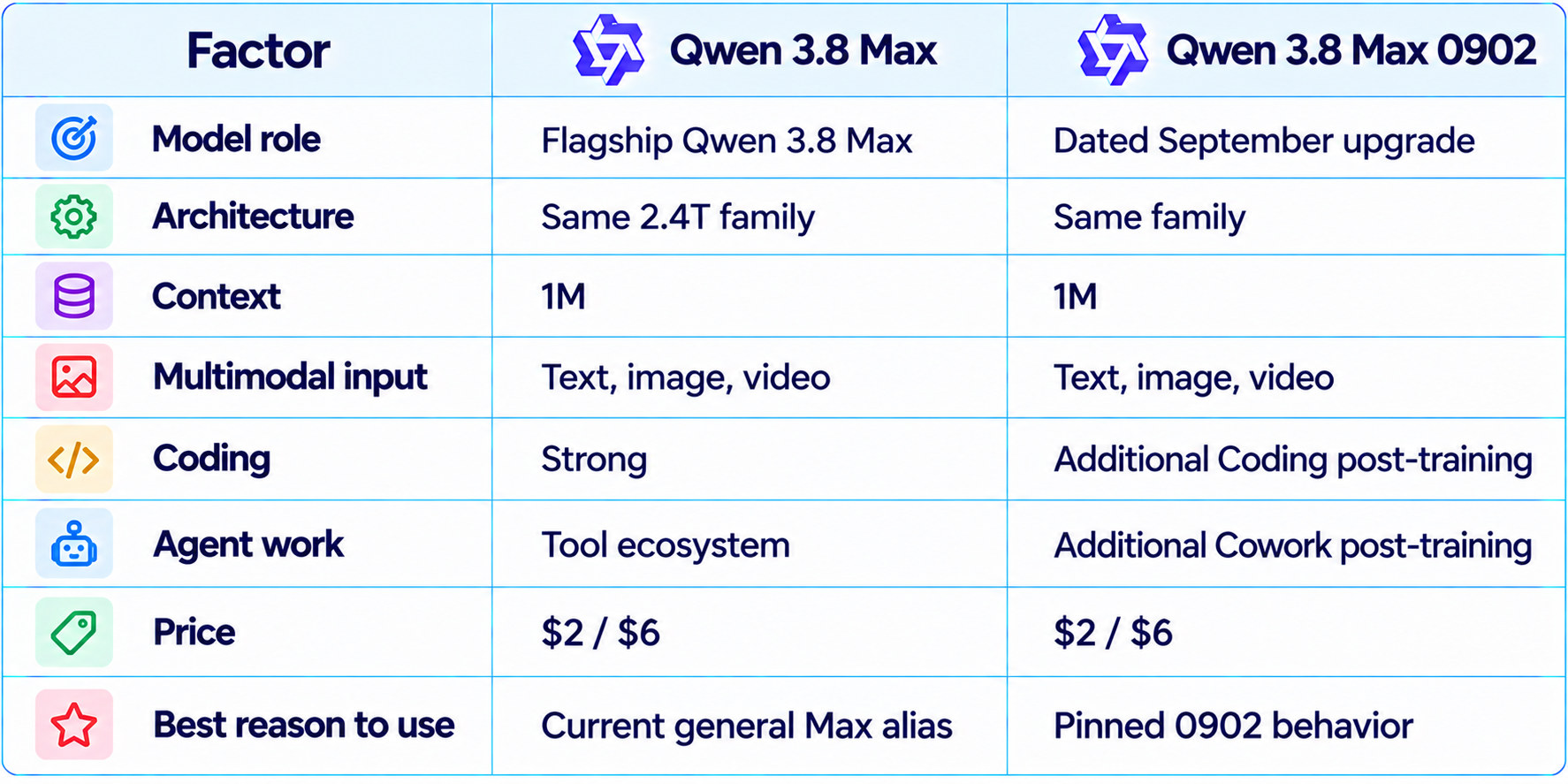
Use qwen3.8-max-0902 when you want the exact dated snapshot described in the September benchmark comparisons. Use qwen3.8-max when you want the current Max model without pinning the application to a dated release.
15. Qwen 3.8 Max 0902 vs Qwen 3.8 Flash
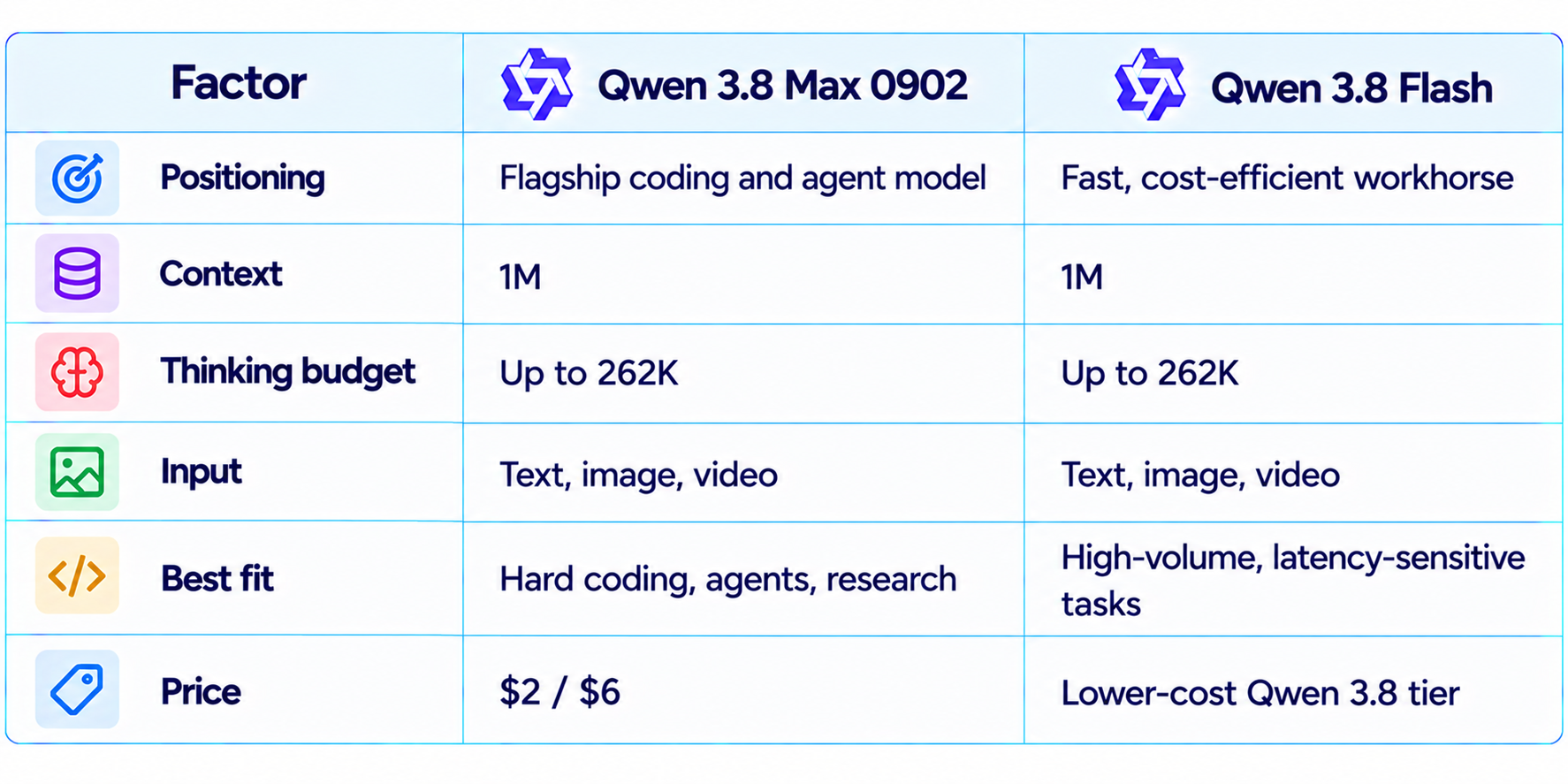
Choose Max 0902 when task quality and agent capability matter more than the absolute minimum cost. Choose Flash when the application makes many routine calls and speed or budget is the main constraint.
16. Qwen 3.8 Max 0902 vs Claude Opus 5
The competitive picture is mixed, which makes this comparison more useful than a simple winner headline.
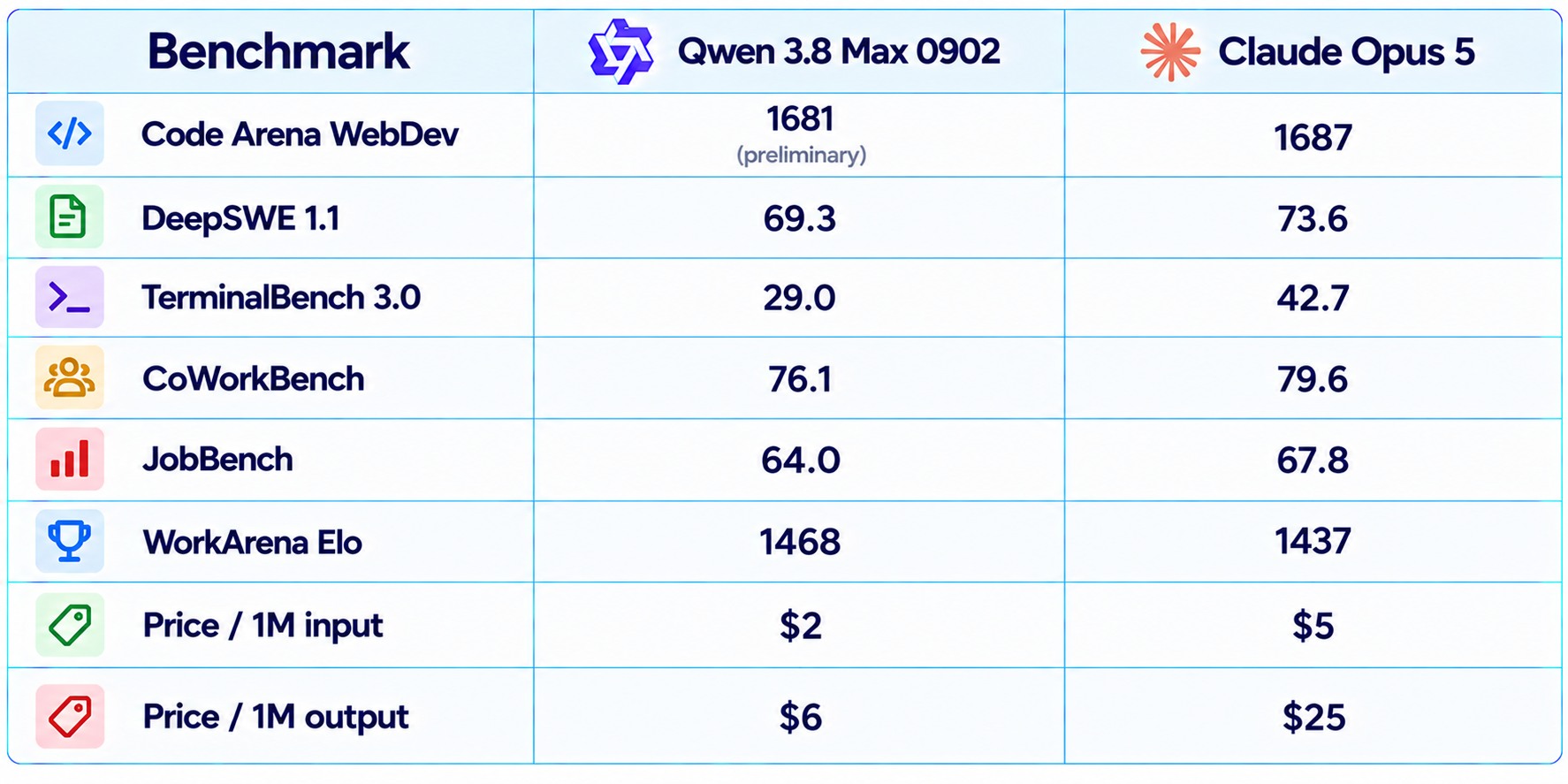
The tradeoff is economics versus maximum capability. Qwen 0902 is much cheaper, while premium models still lead several hard benchmark rows.
17. Best Use Cases
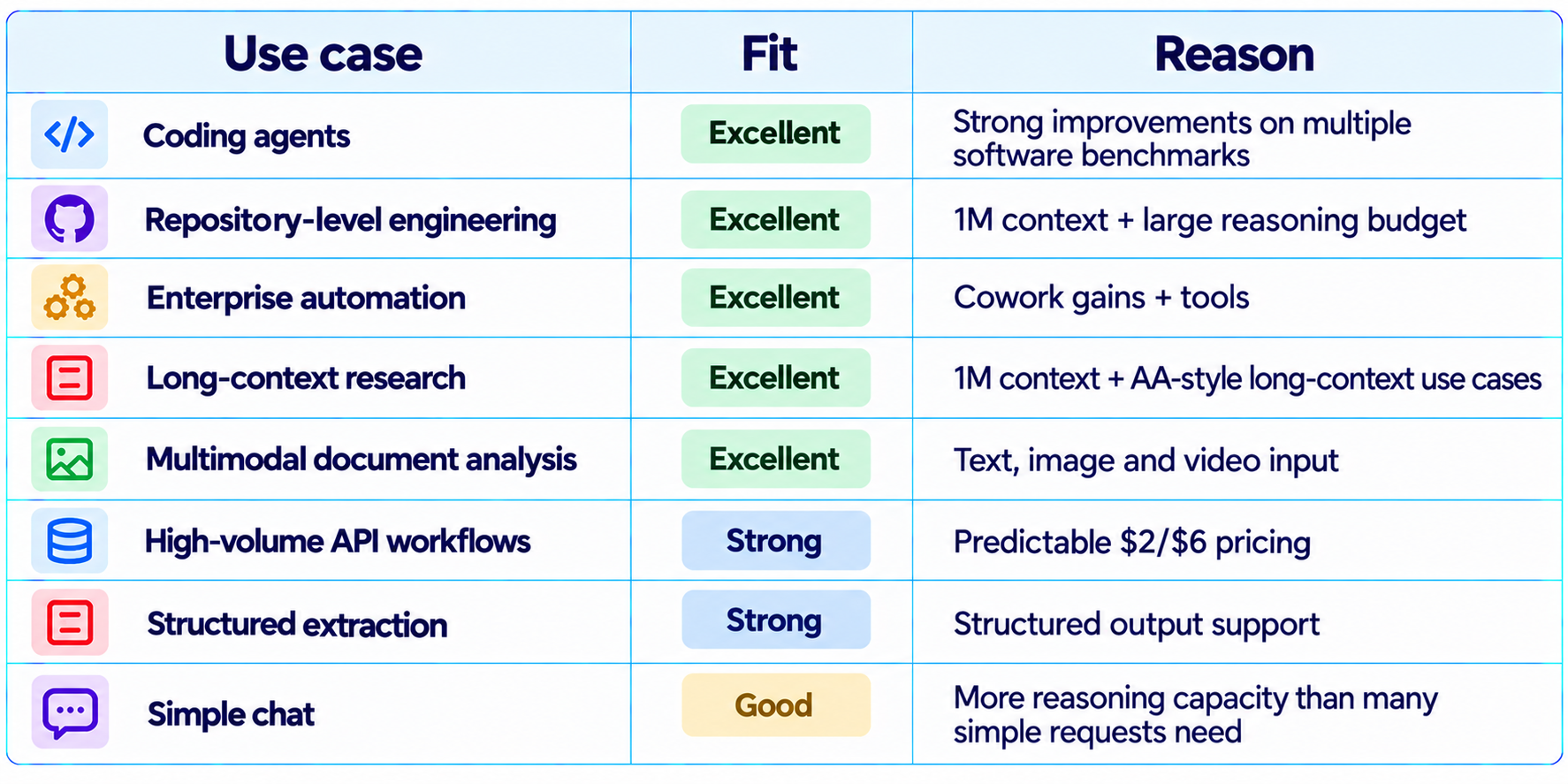
18. Important Limitations
- Qwen 3.8 Max 0902 is primarily a hosted API model rather than a local open-weight deployment option.
- Many benchmark improvements in the 0902 launch table are Alibaba-published comparisons, so they should be read alongside independent evaluations.
- Code Arena WebDev provides independent external evidence, but the current 0902 score is marked preliminary and can move.
- A 1M-token context window does not automatically mean perfect recall or reasoning across every token.
- Higher reasoning budgets can increase latency and token consumption.
- Actual cost depends on retries, cache hits, tool calls and task completion rate, not only the headline $2/$6 price.
19. Recommended Production Workflow
Use Qwen 3.8 Max 0902 as part of a routed agent stack instead of sending every request to maximum reasoning.
- Use low or medium reasoning for routine extraction, classification and straightforward coding.
- Use xhigh reasoning for difficult debugging, architecture and long-horizon tasks.
- Use the Responses API when built-in web, code or search tools simplify the workflow.
- Use structured outputs when the model response feeds another system.
- Use context caching when large prefixes are repeated.
- Escalate only the hardest failures to a stronger frontier model.
- Measure task completion, retries, latency and cost per successful task.
20. How to Evaluate Qwen 3.8 Max 0902 Yourself
Public benchmarks tell you where the model is competitive, but your own evaluation should be based on real work.
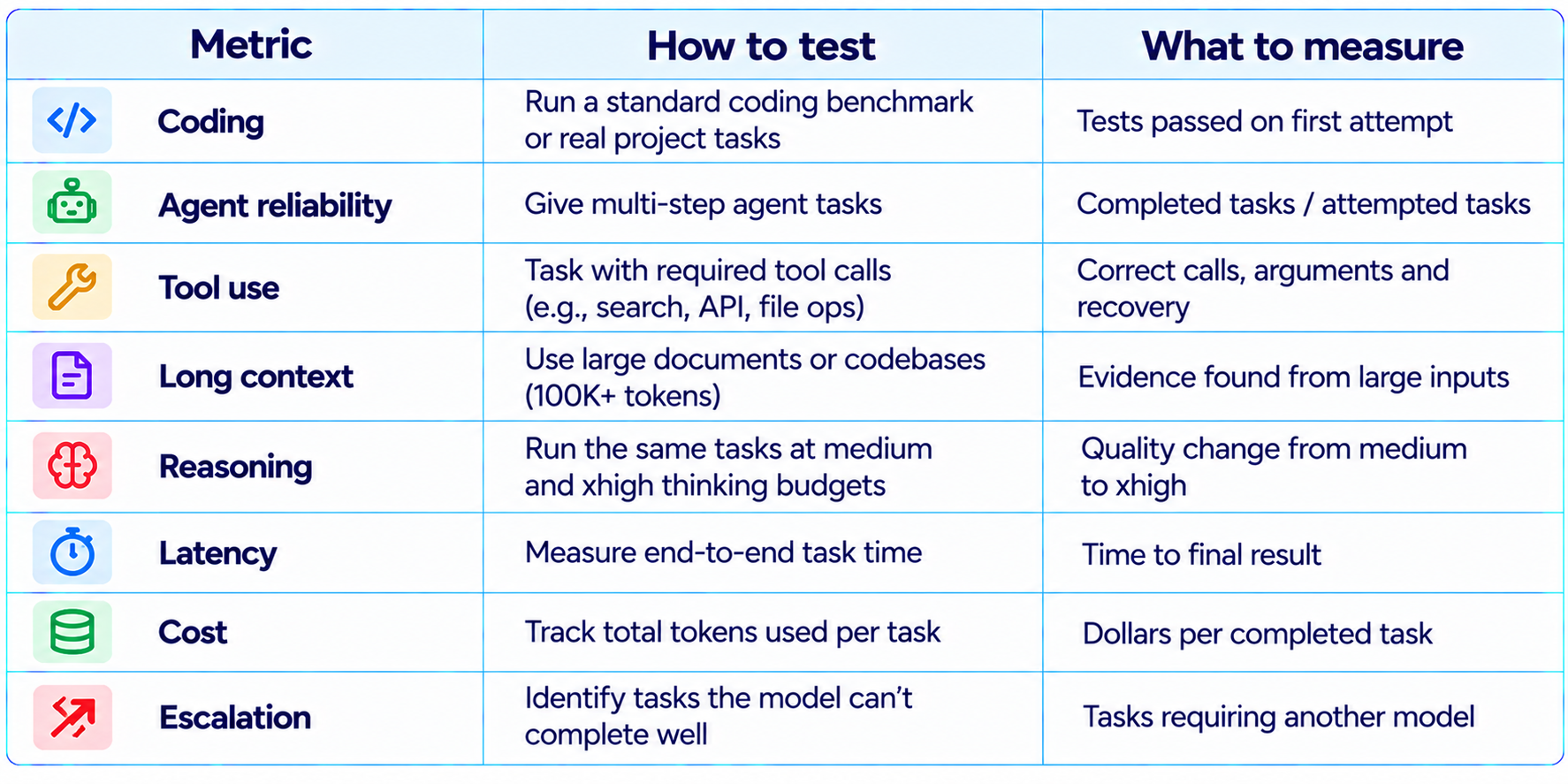
For a coding agent, use the same repository and task set across models. For research, use the same document bundle. For enterprise automation, record human intervention and failure recovery in addition to answer quality.
21. Is Qwen 3.8 Max 0902 Worth Using?
Yes. The release is particularly compelling when coding, long context and tool use are all part of the same workflow. The model does not require a new conceptual API stack, and the $2/$6 pricing makes sustained agent experimentation practical.
The biggest benefit is the combination of capability and economics. A model can use 1M context, large thinking budgets and tools while remaining substantially cheaper than several premium reasoning endpoints.
The best architecture is usually not Qwen-only. Let 0902 handle the bulk of coding, research and automation tasks, then escalate the small portion of work where the stronger model materially improves the final result.
22. Final Verdict
Qwen 3.8 Max 0902 is a meaningful model update because it focuses on task completion. Alibaba kept the Qwen 3.8 Max foundation, 1M context and multimodal input while adding focused post-training for coding and Cowork.
The benchmark changes are substantial. TerminalBench 3.0 moves from 11.3 to 29.0, DeepSWE 1.1 from 56.6 to 69.3, QwenSWE-Bench V2 from 55.1 to 70.0 and WorkArena from 1348 to 1468 Elo in the published comparison.
The external Code Arena WebDev snapshot reinforces the coding story: qwen3.8-max-0902 currently sits at 1681, close to Claude Opus 5 at 1687. The result is preliminary, but it shows that the model is competitive in a user-voted WebDev environment, not only in Alibaba's own evaluations.
At $2 per million input tokens and $6 per million output tokens, the economics are a major advantage. Add a 1M-token context, text-image-video input, function calling, built-in tools, structured output and up to 262K reasoning budget, and the model becomes a strong candidate for serious agent workloads.
My rating: 9.4/10 for coding agents, 9.2/10 for long-context work, 9.1/10 for price-to-capability, 8.9/10 for multimodal workflows and 9.2/10 overall.
Bottom line: Qwen 3.8 Max 0902 is worth testing when you need a strong coding and agent model with long context and predictable API pricing. Pin the 0902 snapshot for reproducible evaluations, choose reasoning effort based on task difficulty, and use routing when a premium model is only needed for the hardest requests.
Frequently Asked Questions
What is Qwen 3.8 Max 0902?
It is the September 2, 2026 upgraded snapshot of Qwen 3.8 Max, focused on Coding, Cowork and stronger long-horizon agent behavior.
What is the Qwen 3.8 Max 0902 model ID?
The main model ID is qwen3.8-max-0902, with qwen3.8-max-2026-09-02 as a dated alias.
How much does Qwen 3.8 Max 0902 cost?
QwenCloud lists $2 per million input tokens and $6 per million output tokens, with lower cache-read rates.
What is the context window?
The context window is 1M tokens, with QwenCloud documenting up to 991K input and 131K maximum output.
What are the main Qwen 3.8 Max 0902 benchmarks?
Published results include 69.3 on DeepSWE 1.1, 70.0 on QwenSWE-Bench V2, 29.0 on TerminalBench 3.0, 76.1 on CoWorkBench, 64.0 on JobBench and 1468 WorkArena Elo.
Is Qwen 3.8 Max 0902 multimodal?
Yes. QwenCloud lists text, image and video input with text output.
Does Qwen 3.8 Max 0902 support tools?
Yes. It supports function calling, built-in tools and structured outputs.
How do I use Qwen 3.8 Max 0902?
Create a QwenCloud API key, use the OpenAI-compatible QwenCloud endpoint, set the model to qwen3.8-max-0902 and choose the reasoning effort that fits your task.
Can I use Qwen 3.8 Max 0902 with the OpenAI SDK?
Yes. QwenCloud provides OpenAI-compatible APIs. You change the base URL, API key and model identifier.
Is Qwen 3.8 Max 0902 better than Claude Opus 5?
Not universally. Qwen is much cheaper and competitive on several coding and agent evaluations, while Opus 5 remains stronger on several difficult benchmark rows.
Should I use qwen3.8-max or qwen3.8-max-0902?
Use the general alias for a current Qwen Max endpoint and the dated 0902 ID when you need reproducible September 2 behavior.
Is Qwen 3.8 Max 0902 worth it?
Yes, especially for coding agents, enterprise automation, long-context research and multimodal workflows.
Recommended Blogs
Qwen 3.8 Max 0902 Review: Benchmarks, Price & Is It Worth It? (2026)
Qwen3.8-Flash-Next Review: Benchmarks, Cost & Is It Worth It? (2026)
Gemini 3.8 Flash Review: Accuracy, Price & Is It Worth It? (2026)
Meta Muse Spark 1.3 Review: Coding, Price & Is It Worth It? (2026)
Quasar 438B Review: Benchmarks, Speed, Price & Is It Worth It? (2026)
Model Routing for AI Coding Agents: How to Cut Costs Without Losing Quality
How to Secure AI Coding Agents in 2026: Permissions, Sandboxing, MCP & Secrets
Resources & Community
Join our community of 70,000+ AI enthusiasts and learn to build powerful AI applications. Whether you're a beginner or an experienced developer, Build Fast with AI helps you understand and implement AI in your projects.
Agentic AI Launchpad 2026
A structured 6-week cohort program that takes you from AI basics to building and deploying real-world agentic AI systems. Includes live sessions, expert mentorship, project reviews and a builder community network.
Ready to go from learning to building? Join the next cohort: Agentic AI Launchpad 2026
Free AI Resources
Access free tools, workshops and micro-learning to keep building.

