



GPT-6 Astra vs Gemini 4 Argon vs Claude Fable 5.1: Three Frontier Models, Three Very Different Bets
The frontier AI market has entered a phase where model comparisons cannot be reduced to one leaderboard number. GPT-6 Astra, Gemini 4 Argon and Claude Fable 5.1 are all built for demanding professional workloads, but their published results reveal different strengths across software engineering, computer use, knowledge work, long-context reasoning and agentic tasks.
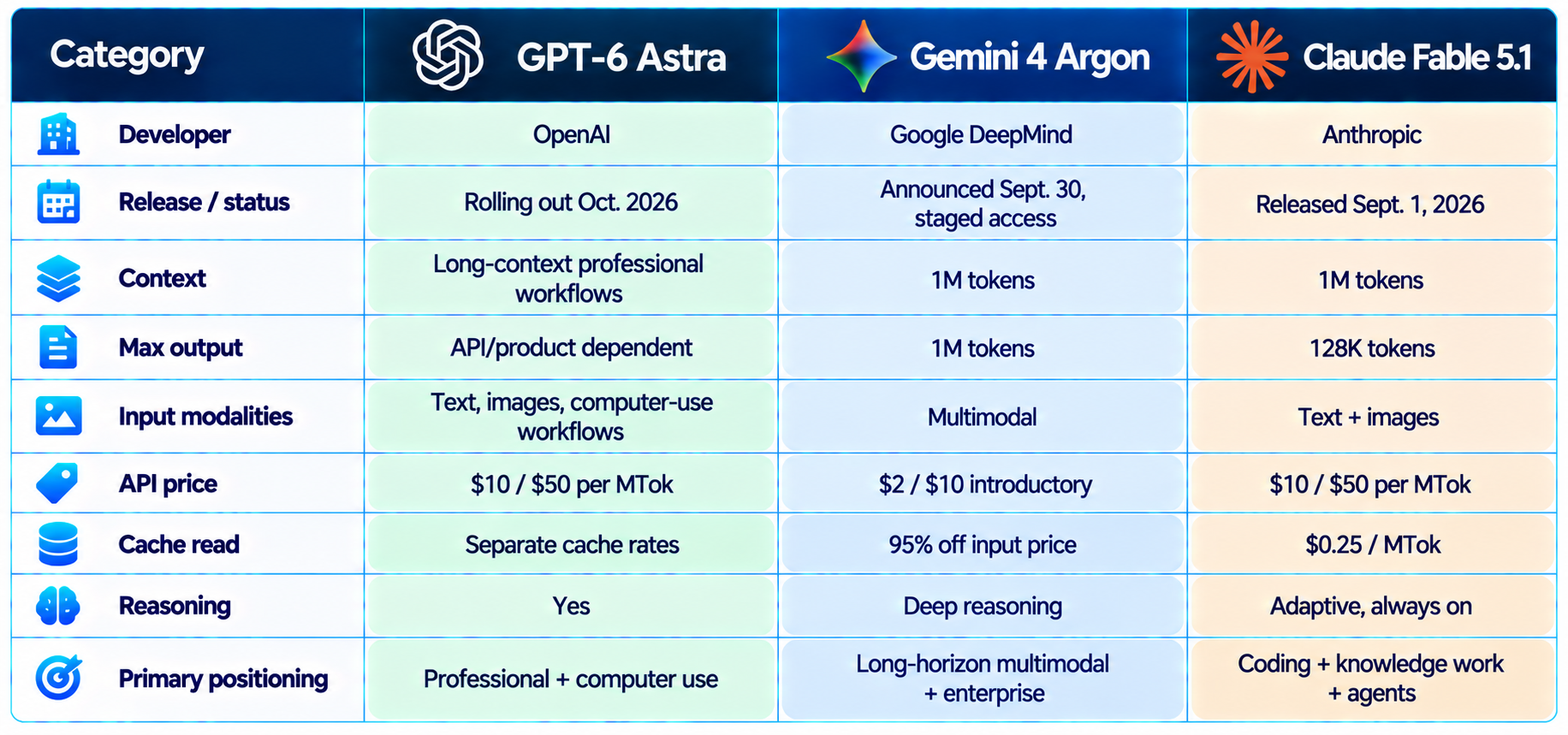
GPT-6 Astra is OpenAI’s latest flagship model, rolling out to organizations and then to ChatGPT Plus, Pro, Business and Enterprise users, with API access through OpenAI, Azure and Bedrock. OpenAI reports major gains in computer use, browsing, software engineering, cybersecurity, science and professional work.
Gemini 4 Argon is Google’s new frontier model, announced September 30, 2026. Google is initially distributing it through the Fairwind Program to trusted cyber defenders while expanding testing and preparing broader availability. Its defining product feature is a 1 million-token output limit, alongside a 1 million-token context window and deep reasoning for long-running workflows.
Claude Fable 5.1 is Anthropic’s generally available model for coding, knowledge work and long-running problem solving. It also has a 1 million-token context window, 128K maximum output and $10 per million input and $50 per million output token pricing, with cache reads reduced to $0.25 per million.
The result is a genuinely interesting comparison. The models overlap heavily, but their benchmark profiles are not identical. Google reports Argon ahead on many knowledge-work, long-context and multimodal evaluations, OpenAI reports Astra leading several computer-use and professional benchmarks, and Anthropic positions Fable 5.1 around demanding agentic coding and knowledge work. The right choice therefore depends on the workload rather than a single universal ranking.
QUICK ANSWER
GPT-6 Astra, Gemini 4 Argon and Claude Fable 5.1 are all frontier-class models, but they emphasize different parts of the AI workload. GPT-6 Astra has the strongest published computer-use and professional benchmark profile in several OpenAI-reported evaluations, Gemini 4 Argon has particularly strong results across knowledge work, long-context reasoning, multimodal understanding and several coding benchmarks, while Claude Fable 5.1 is designed for demanding coding, research and long-running agent workflows.
On Google’s September 30 comparison table, Gemini 4 Argon scores 77.9% on DeepSWE v1.1, 91.9% on Vibe Code Bench, 84.2% on the 256K-to-1M-token GraphWalks test, 91.7% on LVBench and 68.0% on CWE-bench v1. GPT-6 Astra leads the same table on FrontierSWE v2 at 65.5%, Terminal-Bench Science 0.1 at 68.1%, and OSWorld-2.0’s reported offline subset at 72.6%.
Pricing is also very different. GPT-6 Astra costs $10 per million input tokens and $50 per million output tokens through OpenAI. Claude Fable 5.1 has the same $10/$50 token rates, with much cheaper cache reads. Gemini 4 Argon launched at an introductory $2 per million input and $10 per million output, with Google saying the standard price will later become $4/$20.
For developers, the practical conclusion is simple: compare the exact task. Use coding-agent evaluations for coding, computer-use evaluations for browser and desktop automation, long-context tests for document-heavy work, and cost-per-completed-task for production economics.
1. GPT-6 Astra vs Gemini 4 Argon vs Claude Fable 5.1 at a Glance
2. GPT-6 Astra: OpenAI’s Computer-Use and Professional Push
OpenAI describes GPT-6 Astra as its most intelligent and aligned model, with state-of-the-art performance across computer use, browsing, software engineering, cybersecurity, science and professional work. The model is rolling out to a limited set of organizations before broader ChatGPT and API availability.
The important change is the breadth of agentic capability. Astra is not positioned simply as a better text reasoning model. OpenAI’s benchmark suite includes computer-use evaluations such as Agents’ Last Exam, OSWorld 2.0 and ScreenSpot-Pro, plus professional evaluations covering automation, CAD, browsing, design and data science.
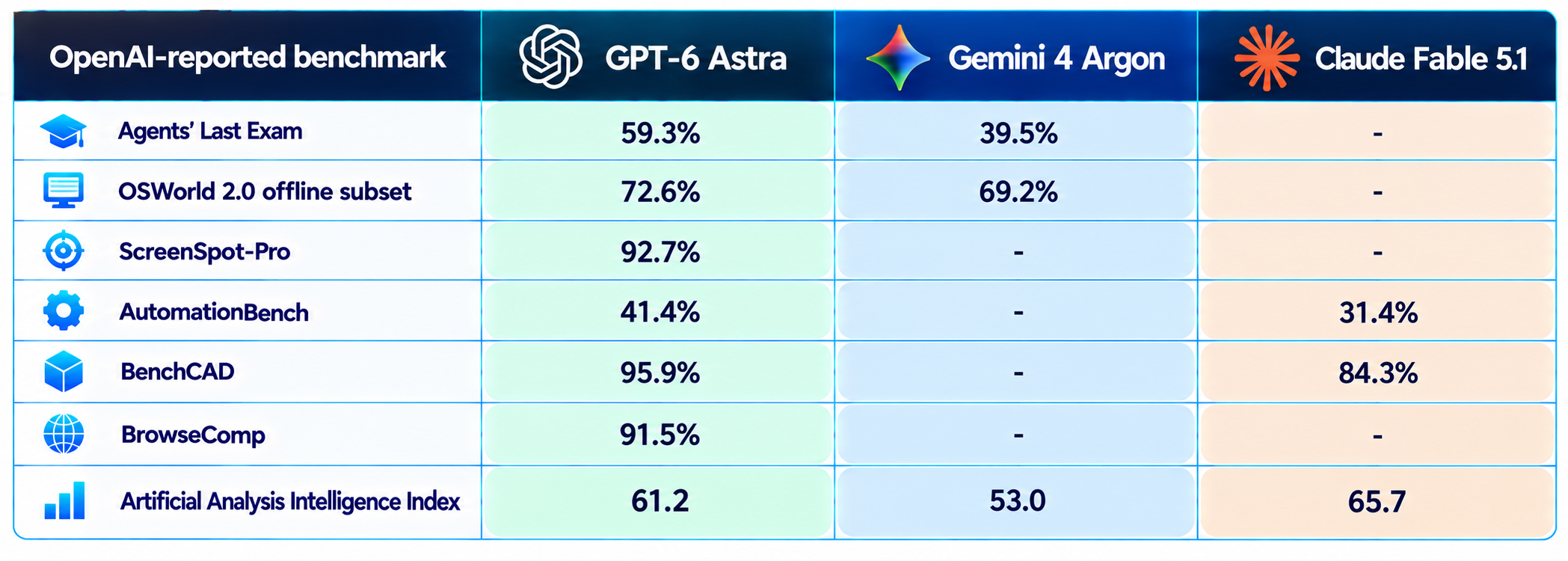
These are provider-published comparisons and should be read as benchmark-specific results, not a universal ranking. The Artificial Analysis Intelligence Index row is especially useful because it shows Fable 5.1 ahead of Astra on that aggregate measure even though Astra leads several computer-use and professional evaluations.
3. Gemini 4 Argon: Google’s Long-Horizon Bet
Gemini 4 Argon is built around long, complex trajectories. Google says the model can sustain deep reasoning across software engineering, enterprise knowledge work and cybersecurity, with a 1 million-token output limit designed for very long reasoning and execution paths.
Google also describes internal uses that go beyond benchmark prompts. Argon agents have been used for large C/C++ to Rust migrations, memory optimization across data-center telemetry and quantum algorithm optimization. Google says one Rust optimization example produced a 2.7x faster decoder with identical output, while a fleet-wide optimization effort freed more than 300 TiB of memory once rolled out. These are Google’s internal claims, not independent benchmark results.
The published benchmark table shows its strengths clearly. Argon leads several knowledge-work and long-context rows, including Vals Index, AutomationBench, Vals Finance Agent v2, Harvey’s Legal Agent Benchmark, DeepSWE v1.1, Vibe Code Bench, LABBench 2, RiemannBench, GraphWalks at both context ranges and LVBench.
4. Claude Fable 5.1: Anthropic’s Agentic Workhorse
Claude Fable 5.1 is generally available and designed for demanding coding, knowledge work and long-running problem solving. Anthropic says the model improves substantially over Fable 5 while reducing typical token-billed cost by about 25%, with savings reaching approximately 45% for highly agentic workloads because cache reads are now 75% cheaper.
The model has a 1M-token context window, 128K maximum output, adaptive reasoning and a high default effort level. It accepts text and images and is available through the Claude API, AWS, Google Cloud and Microsoft Azure.
In Google’s comparison, Fable 5.1 scores 67.4% on DeepSWE v1.1, 56.3% on FrontierSWE v2, 90.3% on Vibe Code Bench and 57.9% on Terminal-Bench 4.0. Those numbers put it in the same competitive group as Astra and Argon on several coding tasks, even when it does not lead the individual row.
5. Coding and Software Engineering
Coding is where this comparison becomes especially nuanced. Google’s table gives Argon the highest DeepSWE v1.1 result at 77.9%, ahead of Opus 5.5 at 74.2%, Astra at 74.1% and Fable 5.1 at 67.4%. But FrontierSWE v2 reverses the ordering: Astra scores 65.5%, Opus 5.5 62.3%, Fable 5.1 56.3% and Argon 55.0%. Terminal-Bench 4.0 also favors Opus 5.5 at 66.4%, ahead of Astra at 58.2%, Fable 5.1 at 57.9% and Argon at 57.4%.
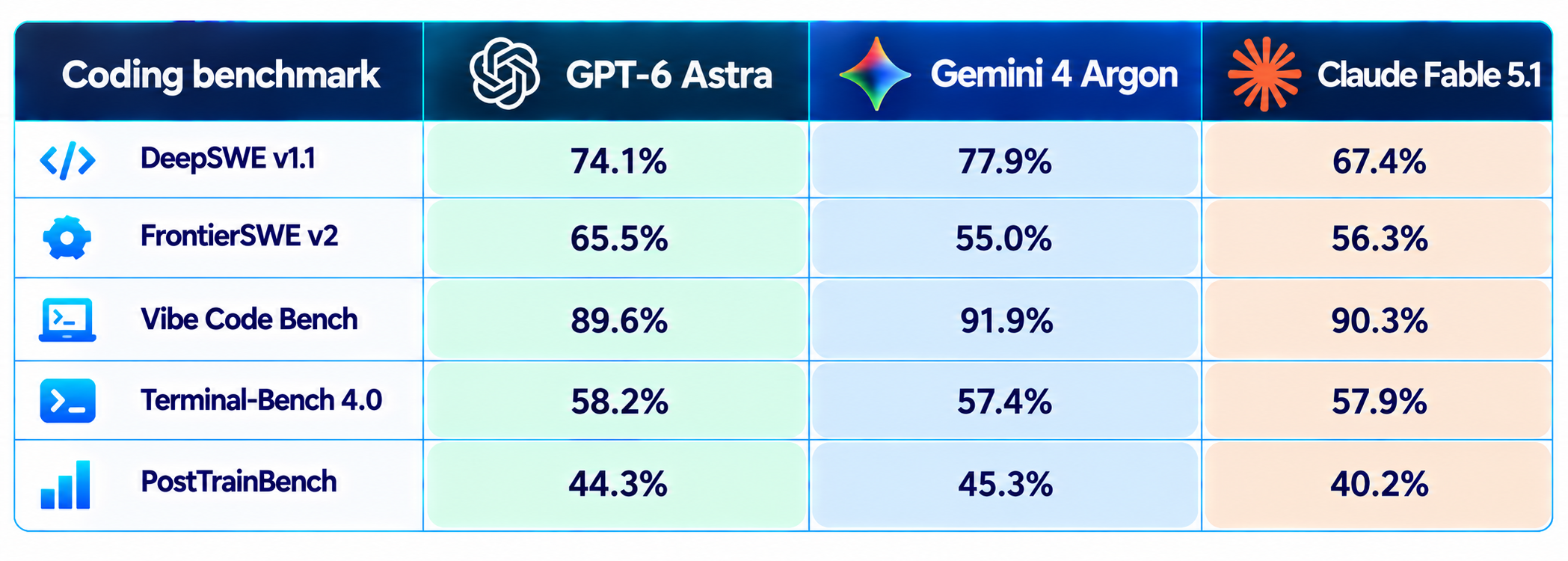
The lesson is that “best coding model” is not a stable statement. DeepSWE rewards long-horizon software engineering, FrontierSWE and Terminal-Bench measure different forms of agentic execution, and Vibe Code Bench emphasizes another style of software generation. A production team should run its own repository tasks across all three.
6. Computer Use and Browser Automation
GPT-6 Astra has a particularly strong published computer-use profile. OpenAI reports 59.3% on Agents’ Last Exam, 72.6% on the cited OSWorld 2.0 offline subset and 92.7% on ScreenSpot-Pro. These tests matter because computer-use agents must understand visual interfaces, choose actions and recover from changing states rather than simply generate text.
Gemini 4 Argon is also designed for long-horizon workflows, but Google’s comparison shows Astra ahead on OSWorld-2.0’s reported offline subset, 72.6% versus 69.2%. Argon leads on several knowledge and multimodal evaluations, so the distinction is not simply computer use versus multimodality.
Claude Fable 5.1 is less directly represented in the published computer-use rows. Anthropic’s documentation instead emphasizes long-running agentic coding, research and document, spreadsheet and slide work.
7. Knowledge Work, Research and Enterprise Tasks
This is where Gemini 4 Argon’s benchmark profile is especially strong. Google reports 68.9% on Vals Index, 51.3% on AutomationBench, 65.4% on Vals Finance Agent v2 and 19.6% on Harvey’s Legal Agent Benchmark. All four are higher than the Astra and Fable 5.1 figures included in Google’s comparison.
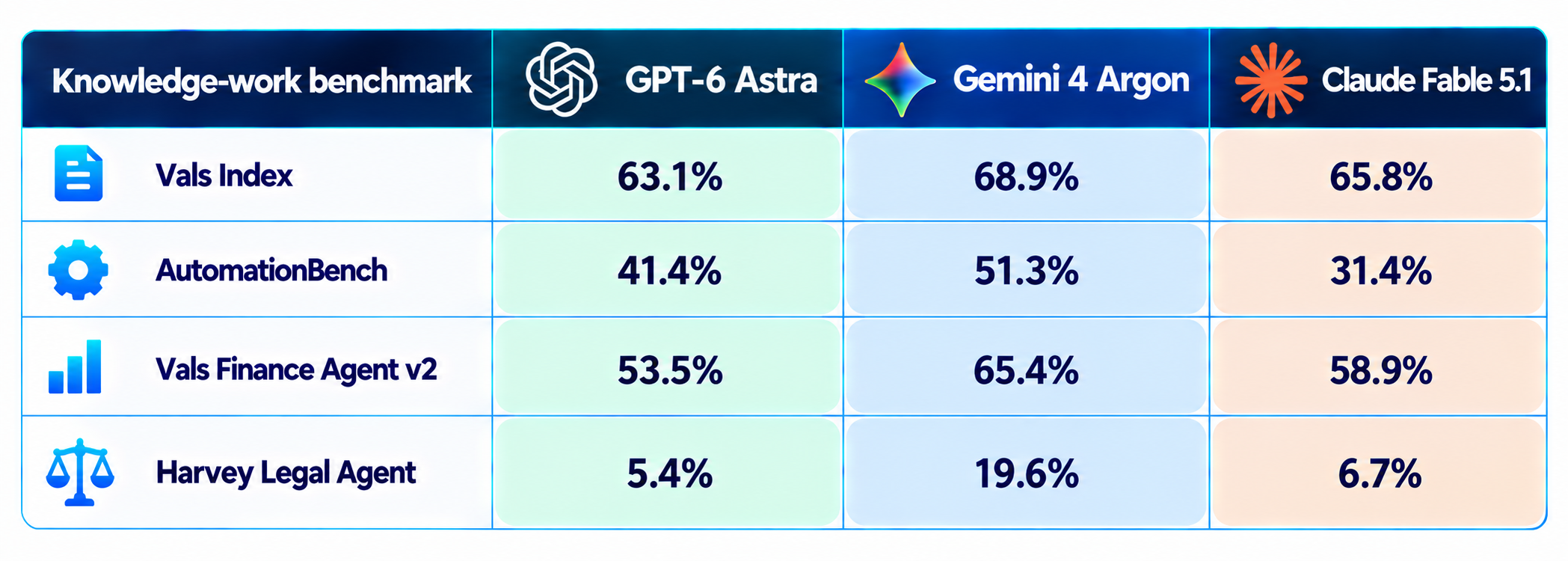
Harvey’s Legal Agent result should be interpreted carefully because every model in this comparison scores below 20%. It is a relative signal for legal research and drafting, not evidence that any model can safely handle legal work without professional review.
8. Long Context: 1 Million Tokens Changes the Workflow
All three models are designed for large-context workloads, but Gemini 4 Argon pushes the output side much further. Google says Argon supports a 1 million-token output limit, up from the previous 64K-token limit. Claude Fable 5.1 has a 1M-token context and 128K maximum output, while Astra is designed for long professional trajectories and has extensive long-horizon evaluation coverage.
The distinction between context and output matters. A 1M context window lets the model read a huge amount of material. A 1M output limit allows a model to continue producing an extremely long trajectory. For research, repository migration and autonomous work, those are different capabilities.
Google’s GraphWalks results reinforce Argon’s long-context positioning. It scores 99.7% for inputs up to 128K and 84.2% for the 256K-to-1M range, compared with 98.7% and 71.8% for Astra and 91.4% and 65.0% for Fable 5.1.
9. Multimodal Understanding
Gemini 4 Argon is designed as a multimodal frontier model, and Google’s published results include LVBench, a long-video evaluation where Argon scores 91.7%, compared with 87.5% for Astra and 79.7% for Fable 5.1 in the comparison table.
This matters for workflows involving video archives, recorded meetings, product demonstrations, visual documentation and other long-form media. GPT-6 Astra also supports images and computer-use workflows, while Fable 5.1 supports text and images through its API.
For a team building a multimodal agent, the correct evaluation should include the actual media formats, resolution, duration and downstream action requirements rather than relying on a single multimodal benchmark.
10. Pricing: The Biggest Practical Difference
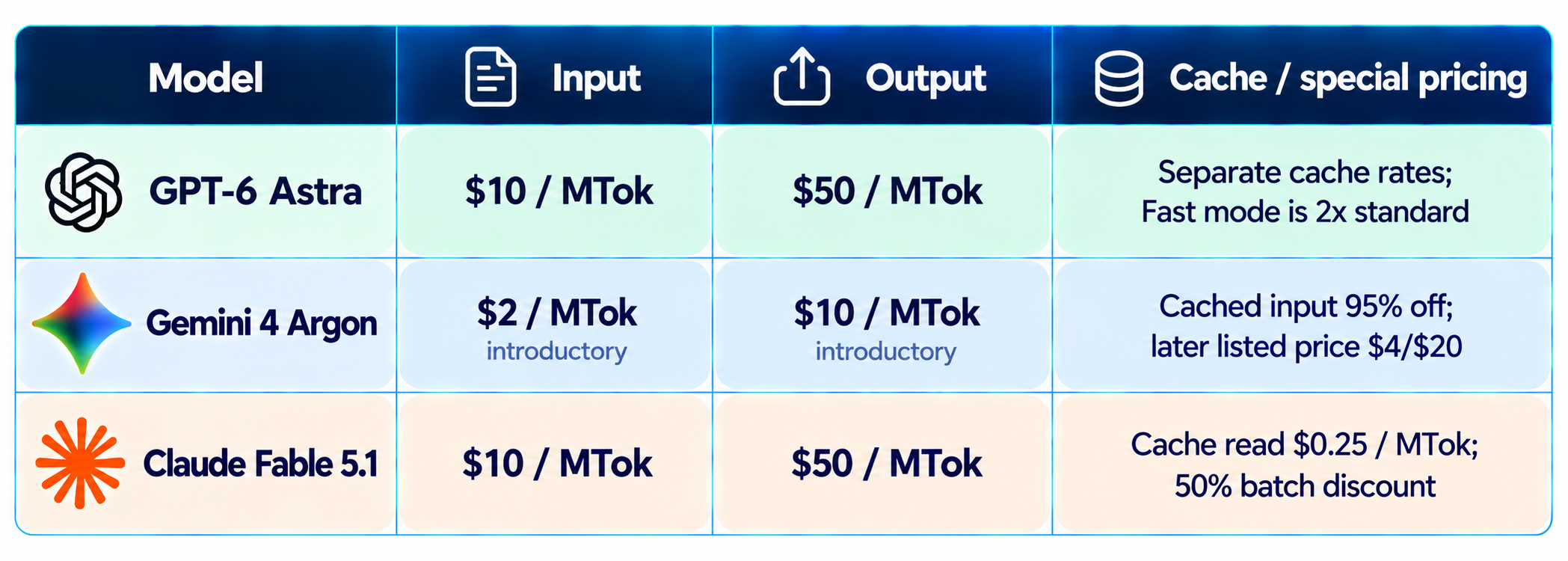
Gemini 4 Argon’s introductory price is the obvious outlier. Google says the initial rate is $2 per million input and $10 per million output tokens, with a later standard price of $4/$20. Cached input is discounted by 95%.
GPT-6 Astra and Claude Fable 5.1 both list $10/$50 token pricing. Fable 5.1’s cache-read reduction is significant for agentic workloads because long prompts and tool histories are repeatedly reused. Anthropic says typical workloads become about 25% cheaper and highly agentic workloads can save up to approximately 45% compared with Fable 5.
Price per million tokens is still not enough. The useful metric is cost per completed task, including retries, tool calls, context reuse and output length.
11. Which Model Fits Which Workflow?
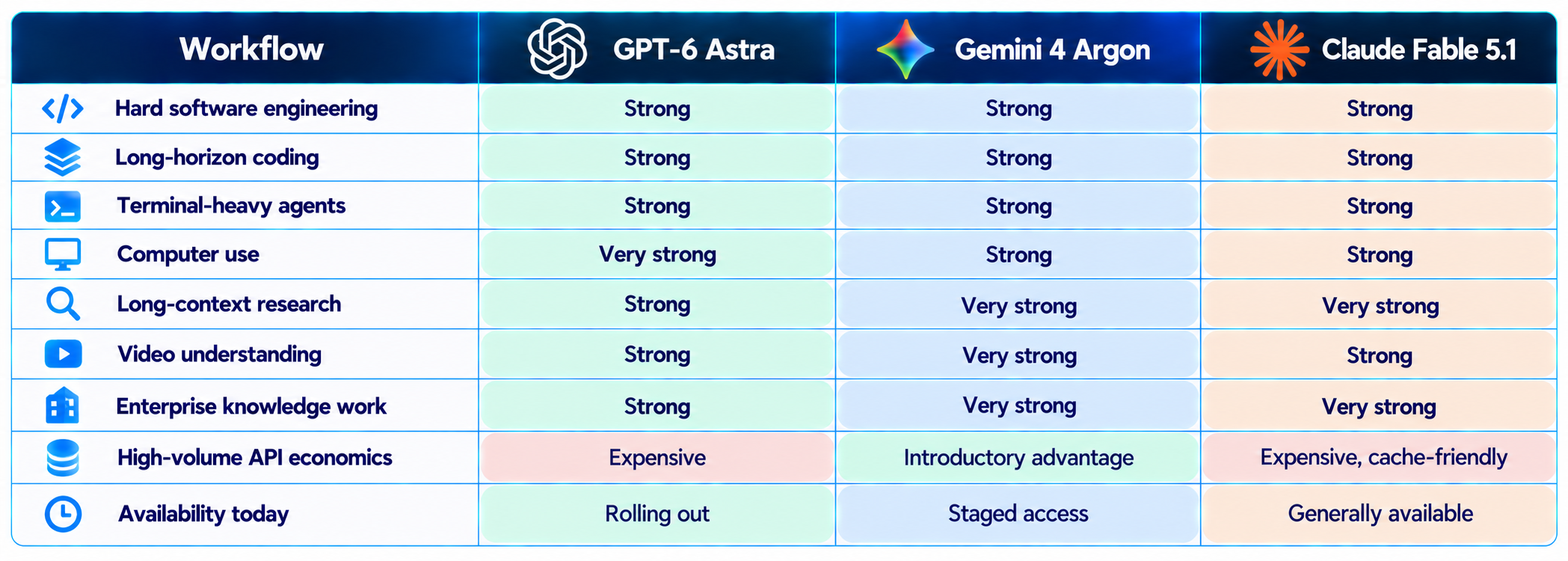
12. GPT-6 Astra vs Gemini 4 Argon
The closest comparison is between Astra’s computer-use and professional strengths and Argon’s long-context, multimodal and knowledge-work profile. On Google’s table, Astra beats Argon on FrontierSWE v2, Terminal-Bench Science 0.1 and OSWorld-2.0’s reported offline subset, while Argon leads on DeepSWE, Vibe Code Bench, several knowledge-work tests, GraphWalks, LVBench and other evaluations.
Pricing also separates them. Astra’s standard API price is $10/$50, while Argon’s introductory price is $2/$10. That difference can materially change the economics of an agent that makes hundreds of calls per workflow.
Access is another difference. Astra is rolling out across OpenAI’s products and API, while Argon is currently being introduced through a trusted-access cybersecurity program.
13. Gemini 4 Argon vs Claude Fable 5.1
Argon has higher scores across the majority of rows in Google’s direct comparison, particularly knowledge work, long-context evaluation, video understanding and several coding tests. Fable 5.1 remains highly competitive on coding and long-running knowledge work, and its API is already generally available.
The practical tradeoff is access, price and workflow fit. Argon offers the lower introductory token price and an enormous output allowance, while Fable 5.1 has a mature general availability footprint across Anthropic’s API and major cloud platforms.
14. GPT-6 Astra vs Claude Fable 5.1
The OpenAI comparison gives Astra stronger results on several computer-use and professional benchmarks, but the Artificial Analysis Intelligence Index row in OpenAI’s own table is 61.2 for Astra versus 65.7 for Fable 5.1. That is a useful reminder that broad model quality depends on the evaluation set.
Fable 5.1 is also substantially cheaper to operate in workflows that reuse context because cache reads cost $0.25 per million tokens. Astra’s standard output price is $50 per million tokens, so teams need to measure the actual reasoning and output volume of their workloads rather than compare only headline capabilities.
16. Recommended Model-Routing Strategy
The most practical architecture is not to force one frontier model to handle every task. Route requests according to task requirements and economics.
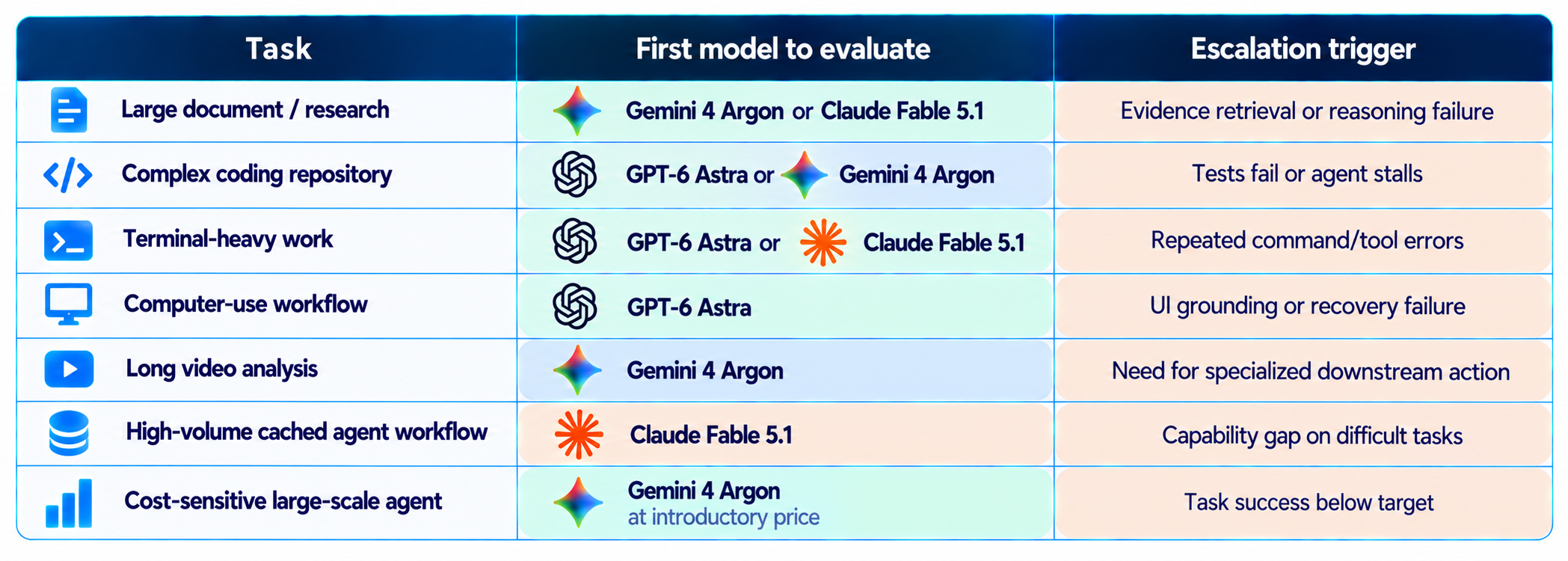
This approach is especially useful because model routing can turn benchmark differences into production savings. Our model-routing guide covers how to build that layer around coding and agent workflows.
18. Limitations of This Comparison
- Many Gemini 4 Argon benchmark numbers are from Google’s launch evaluation and have not yet been independently reproduced across public leaderboards.
- OpenAI’s Astra benchmark table is provider-published, so its figures should be read with the stated evaluation methodology.
- Google’s comparison includes Fable 5.1 and Astra, but not every model is tested on every benchmark.
- Benchmark names can change versions, so scores from different versions should not be compared as if they were identical tests.
- Token pricing can change, and Argon’s $2/$10 rate is explicitly introductory.
- Actual agent cost depends on reasoning tokens, context reuse, tool calls, retries and output length.
- Access differs significantly: Fable 5.1 is generally available, Astra is rolling out, and Argon is currently staged.
19. How to Test All Three Models Yourself
Build a 30-task evaluation set from your real workload instead of relying on generic prompts.
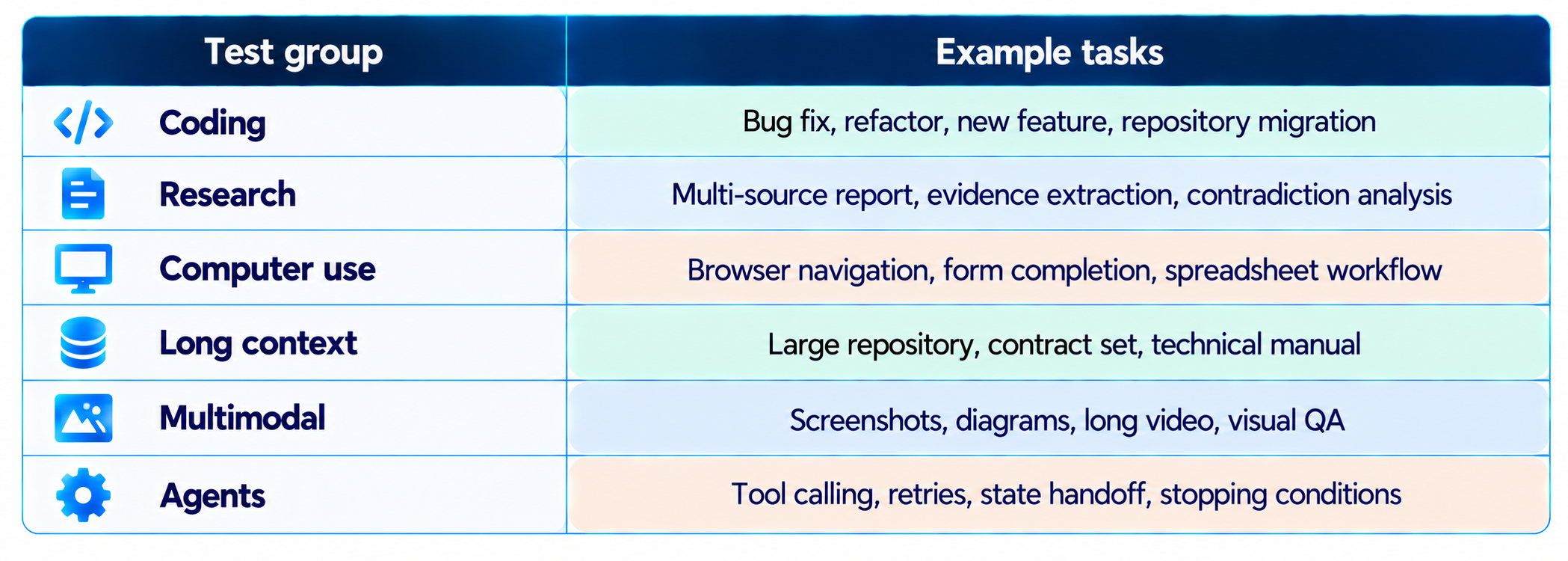
Record task success, time to completion, number of tool calls, retries, output quality and total token cost. Then calculate cost per successful task. That number will tell you much more about production value than a generic leaderboard position.
20. Final Verdict: Which Frontier Model Should You Test?
GPT-6 Astra, Gemini 4 Argon and Claude Fable 5.1 are not interchangeable despite their overlapping capabilities. The published evidence points to different strengths.
GPT-6 Astra is particularly compelling for computer use, browsing and professional automation. OpenAI’s reported results show strong performance on Agents’ Last Exam, OSWorld 2.0, ScreenSpot-Pro, AutomationBench and BenchCAD.
Gemini 4 Argon has an unusually broad benchmark profile, with strong results in knowledge work, long-context reasoning, video understanding and multiple software-engineering tests. Its 1M-token output allowance and introductory $2/$10 pricing make it especially interesting for long-running workflows, although access is currently staged.
Claude Fable 5.1 remains a serious option for coding and knowledge work, particularly when long context and agentic workflows are combined with aggressive cache reuse. Anthropic’s $0.25 per million cache-read price can make repeated-context workloads much cheaper than headline token prices suggest.
The most defensible conclusion is not that one model wins everything. The benchmark results themselves show why. Argon leads DeepSWE while Astra leads FrontierSWE; Opus 5.5 leads Terminal-Bench 4.0; Astra leads the reported OSWorld subset; Argon leads the 256K-to-1M GraphWalks test. Different tasks produce different leaders.
For a production AI stack, the strongest strategy is to evaluate all three on your real workload and route tasks according to capability, latency, access and cost. The question is no longer simply which model is smartest, but which model is the right worker for each task.
Frequently Asked Questions
Which is better, GPT-6 Astra, Gemini 4 Argon or Claude Fable 5.1?
There is no single model that leads every published evaluation. Argon leads several knowledge, long-context and coding tests, Astra leads several computer-use and professional tests, and Fable 5.1 is highly competitive in coding and knowledge work.
Which model is best for coding agents?
The answer depends on the coding benchmark. Argon scores 77.9% on DeepSWE v1.1, Astra scores 65.5% on FrontierSWE v2, and Opus 5.5 leads Terminal-Bench 4.0 in Google’s comparison. Fable 5.1 remains competitive.
Which has the largest context window?
Gemini 4 Argon and Claude Fable 5.1 are explicitly listed at 1M tokens. Argon additionally supports a 1M-token output limit.
How much does GPT-6 Astra cost?
OpenAI lists GPT-6 Astra at $10 per million input tokens and $50 per million output tokens, with separate cache pricing.
How much does Gemini 4 Argon cost?
Google lists an introductory $2 per million input and $10 per million output tokens, with cached input discounted by 95%. The later listed price is $4/$20.
How much does Claude Fable 5.1 cost?
Anthropic lists $10 per million input and $50 per million output tokens. Cache reads cost $0.25 per million tokens.
Which model is best for computer use?
GPT-6 Astra has a particularly strong published computer-use profile, including 72.6% on the cited OSWorld 2.0 offline subset and 92.7% on ScreenSpot-Pro.
Which model is best for long-context work?
Gemini 4 Argon has especially strong published long-context results, including 84.2% on the 256K-to-1M GraphWalks range. Claude Fable 5.1 also supports a 1M context.
Is Gemini 4 Argon publicly available?
Google is currently rolling Argon out to trusted cyber defenders through the Fairwind Program while it expands testing and prepares broader access.
Is Claude Fable 5.1 generally available?
Yes. Anthropic says Fable 5.1 is available across its platforms and major cloud providers.
Should one model handle every AI task?
For most production systems, model routing is more practical. Different models have different strengths, costs and latency profiles.
Recommended Blogs
Gemini 4 Argon Review: Benchmarks, Price, Coding & Is It Worth It? (2026)
Claude Fable 5.1 Review: Benchmarks, Price, Coding & Is It Worth It? (2026)
GPT-6 Astra Review: Benchmarks, Price & Is It Worth It? (2026)
How to Secure AI Coding Agents: Permissions, Sandboxing, MCP & Secrets
Resources & Community
Join our community of 70,000+ AI enthusiasts and learn to build powerful AI applications. Whether you are a beginner or an experienced developer, Build Fast with AI helps you understand and implement AI in your projects.
Agentic AI Launchpad 2026
A structured 6-week cohort program that takes you from AI basics to building and deploying real-world agentic AI systems. Includes live sessions, expert mentorship, project reviews and a builder community network.
Ready to go from learning to building? Join the next cohort: Agentic AI Launchpad 2026
Free AI Resources
Access free tools, workshops and micro-learning to keep building.

