



GPT-6.1 Sol Review: Is OpenAI's New Workhorse Finally the Sweet Spot for Coding and AI Agents?
GPT-6.1 Sol is the newest Sol-branded reasoning model announced by OpenAI at DevDay 2026. OpenAI positioned it as an upgraded, lower-cost workhorse model that brings more of the GPT-6 family's capabilities to everyday professional workloads, especially coding, agentic workflows and repeated production use.
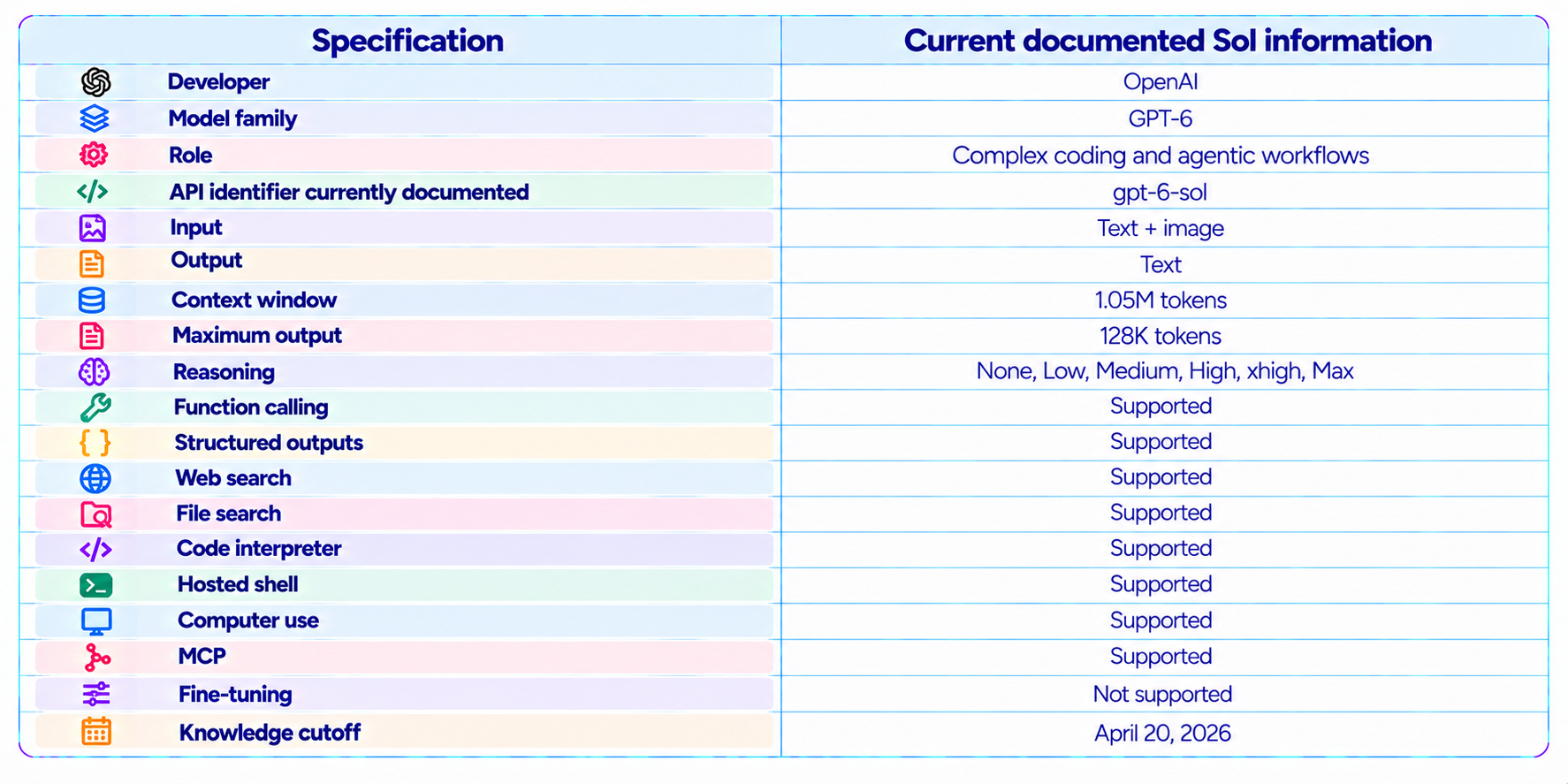
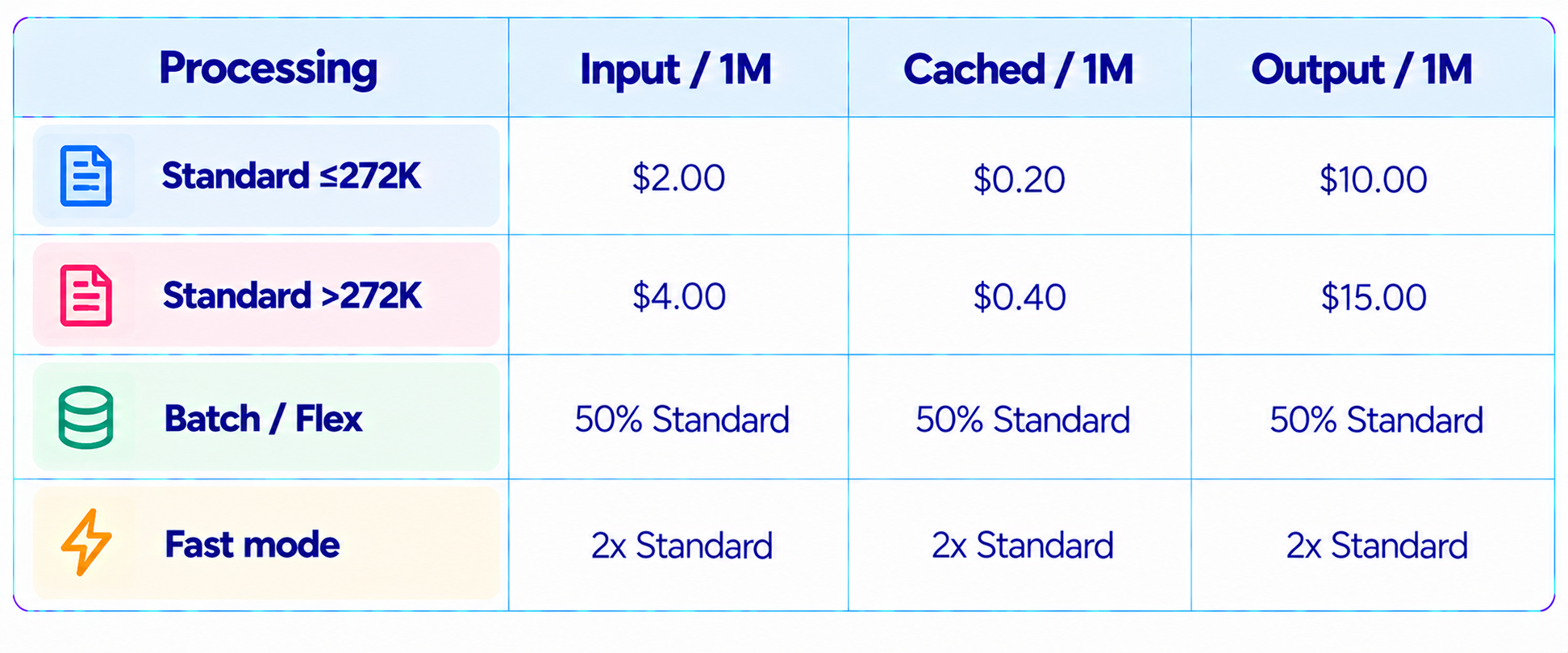
There is one naming detail worth clearing up before looking at benchmarks. Current reporting from OpenAI's September 29 DevDay announcements identifies the new release as GPT-6.1 Sol, while OpenAI's public API documentation and changelog still document the stable model identifier as gpt-6-sol. The live API catalog currently lists Sol at $2 per million input tokens and $10 per million output tokens, with a 1.05M-token context window and 128K maximum output. This review uses GPT-6.1 Sol for the newly announced model and treats the live public API documentation as the authoritative reference for documented API behavior.

QUICK ANSWER
GPT-6.1 Sol is OpenAI's new workhorse GPT model announced at DevDay 2026, positioned between the flagship Astra tier and the low-cost Luna tier. OpenAI describes Sol as the model for complex coding and agentic workflows. The current public API documentation lists the Sol model with a 1.05 million-token context window, 128K maximum output, reasoning controls from none through max, image input, structured outputs and a broad set of Responses API tools.
The current documented API price is $2 per million input tokens, $0.20 per million cached input tokens and $10 per million output tokens for prompts up to 272K input tokens. Longer prompts receive higher rates, while Batch and Flex processing are 50% of Standard and Fast mode is priced at 2x the applicable Standard rate.
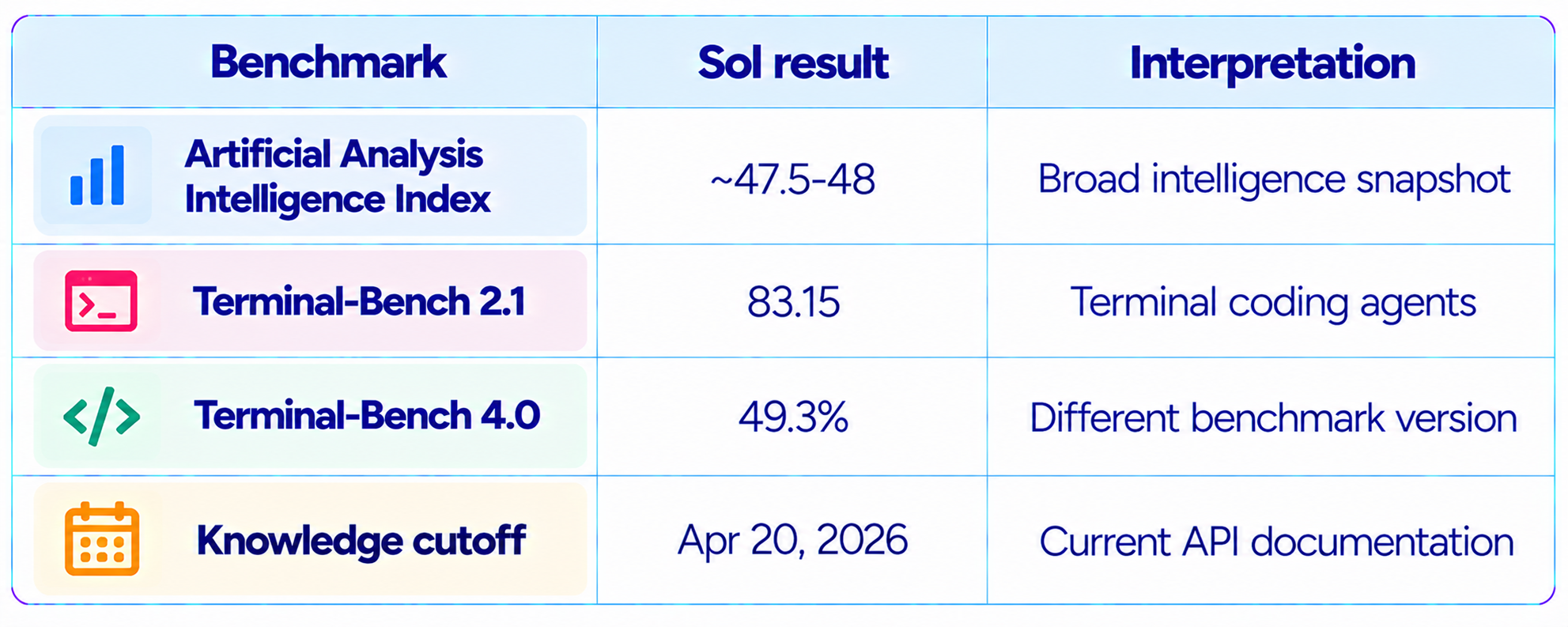
Independent benchmark snapshots put the current Sol model around 47.5 to 48 on Artificial Analysis's current Intelligence Index. Ridge's September 23 benchmark ledger lists 83.15 on Terminal-Bench 2.1 at max effort, while a later snapshot reports 49.3% on Terminal-Bench 4.0. These are different benchmark versions and should not be compared as if they were the same test.
For coding and agents, Sol is designed as a serious production model rather than a lightweight endpoint. Its main advantage is the combination of reasoning, tool use, large context and lower pricing than Astra. Its main limitation is that it remains below the flagship tier on broad intelligence and the hardest agent tasks.
My rating: 9.2/10 for coding and agent workflows, 9.1/10 for price-to-performance, 9.0/10 for context and tools, and 9.1/10 overall.
1. What Is GPT-6.1 Sol?
GPT-6.1 Sol is the new Sol-class model announced by OpenAI at its September 2026 developer event. The launch positions Sol as the practical workhorse of the GPT-6 family: more capable than the low-cost Luna model, substantially cheaper than Astra, and optimized around professional tasks that require reasoning, coding and tool use.
OpenAI's public model catalog describes the current Sol model as built to power complex coding and agentic workflows. It accepts text and image inputs and produces text output. The Responses API exposes built-in tools including web search, file search, image generation, code interpreter, hosted shell, computer use, MCP and tool search.
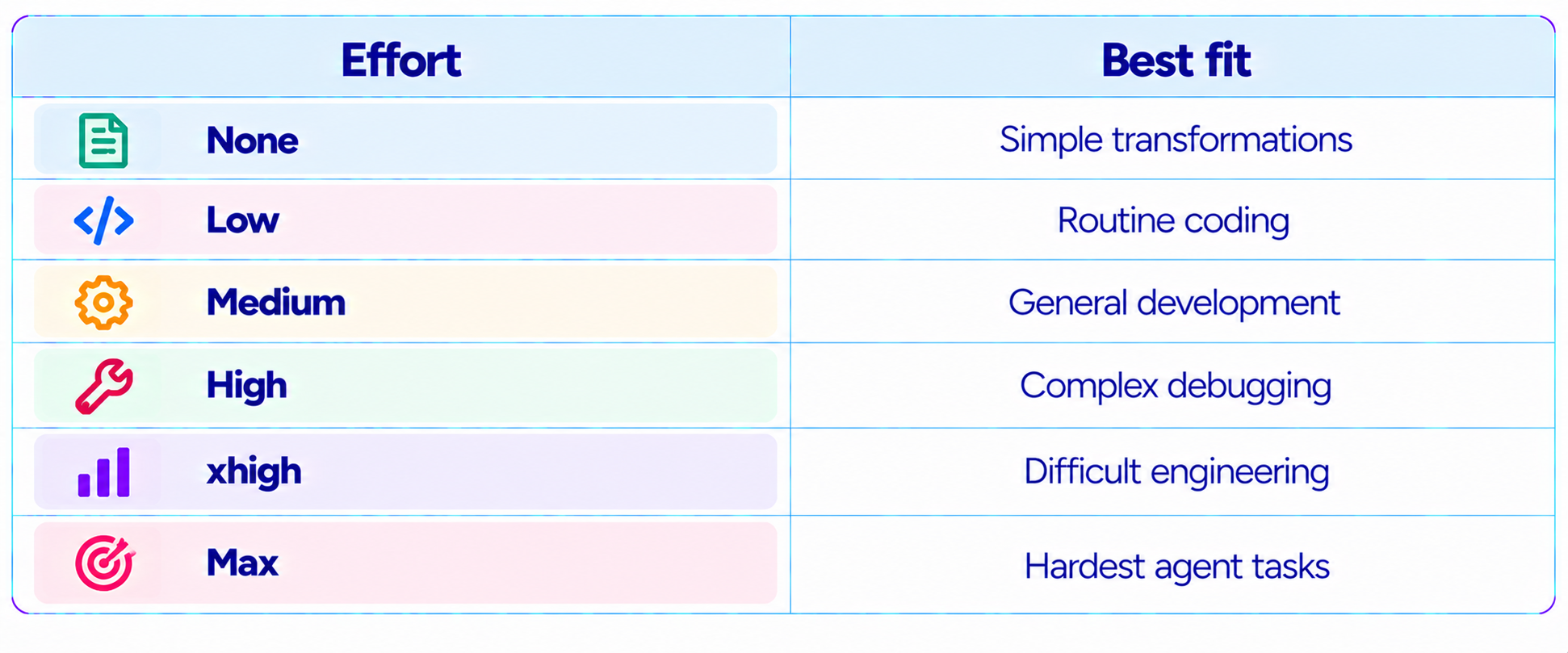
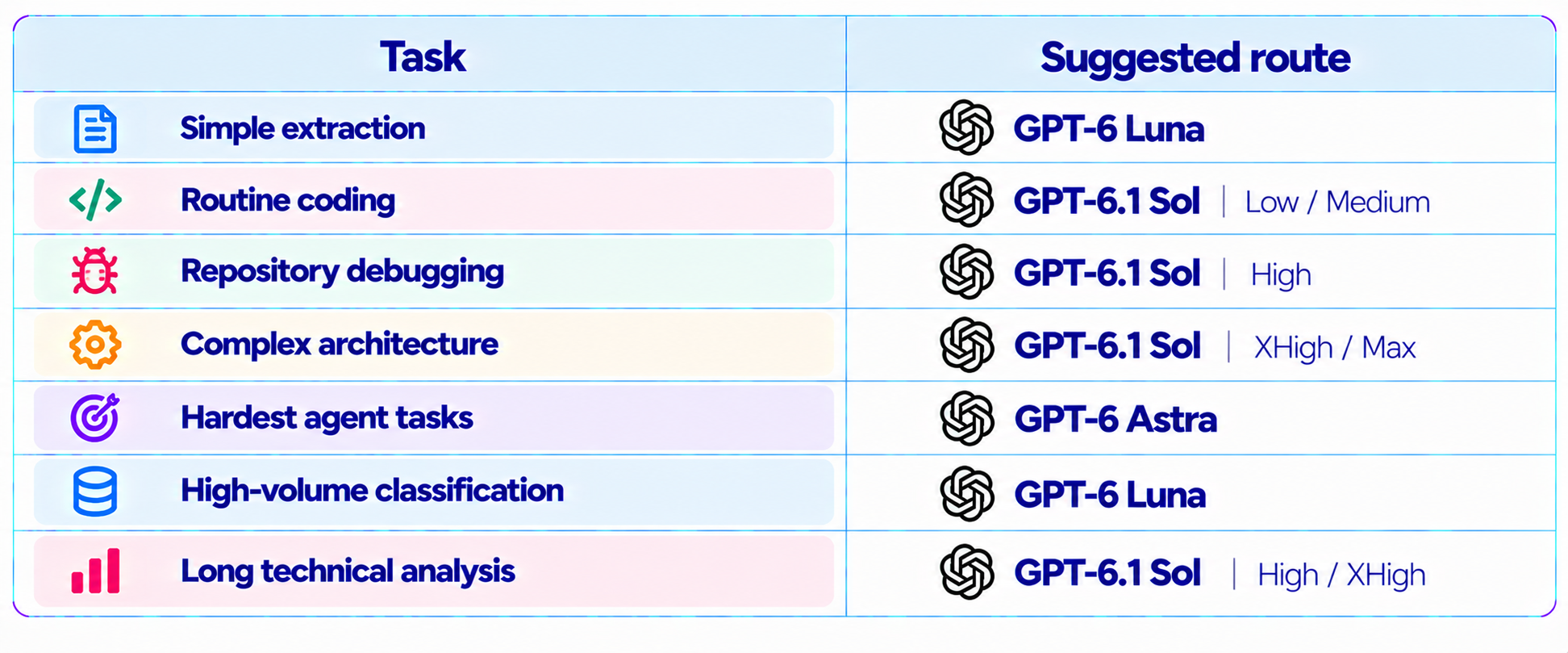
The model also has multiple reasoning levels: none, low, medium, high, xhigh and max. That is important for production systems because not every task needs the same reasoning budget. A routing layer can use lower effort for straightforward work and reserve max for complex engineering or agent tasks.
2. GPT-6.1 Sol Specifications
3. GPT-6.1 Sol Pricing
4. GPT-6.1 Sol Benchmarks
5. Coding Performance
Coding is the center of Sol's positioning. OpenAI explicitly describes it as a model for complex coding and agentic workflows, and the current tool catalog includes hosted shell, apply patch, code interpreter, computer use, MCP and tool search.
That combination matters because modern coding agents do not spend most of their time generating one function. They inspect a repository, search files, run tests, modify multiple files, inspect errors and repeat. A model needs to maintain context while deciding which tool to call next.
Sol is therefore better evaluated as a coding-agent model than as a raw code-generation model. Its terminal benchmark results support that interpretation. A developer using it through Codex or an OpenAI-compatible agent stack can give it access to a repository and let the model perform a longer sequence of engineering actions rather than copying code manually.
6. GPT-6.1 Sol and Codex
Sol is integrated into OpenAI's Codex ecosystem, where the model's coding capabilities are paired with an agent interface, repository context and execution tools. OpenAI's September launch positioned the model for professional coding workflows rather than only chat-based programming questions.
The most important benefit is the ability to combine reasoning with action. Instead of asking Sol to explain how to fix a failing test and then applying the patch yourself, a Codex workflow can inspect the failure, locate the relevant code, modify it and run validation.
For teams, this changes what the benchmark means. The useful metric is not only code correctness but completed engineering work per dollar. A model that can finish a multi-file task with fewer tool loops can be cheaper than a nominally cheaper model that needs constant intervention.
7. Reasoning Effort and Latency
8. 1.05 Million Token Context Window
The current Sol API documentation lists a 1.05 million-token context window and 128,000 maximum output tokens. That gives the model enough room for large repositories, extensive technical documentation, long research material and multi-step agent histories.
Large context is particularly useful for coding agents because a task may involve architecture documentation, multiple source files, test output, issue history and tool results. Keeping more relevant state available can reduce repeated retrieval and context reconstruction.
The correct strategy is still focused context rather than maximum context. Filling a million-token window with unrelated files can make retrieval and reasoning harder. Context engineering remains an important companion to a large-context model.
9. Multimodal Input
The current OpenAI model catalog lists Sol as accepting both text and image input. That allows developers to combine code and visual information in the same workflow, such as screenshots of UI bugs, diagrams, terminal images or product mockups.
OpenAI also fixed an image-encoding issue affecting GPT-6 Sol and GPT-6 Luna on September 25. The changelog says the fix improved results on visual tasks in the API and Codex, including computer use. This is a useful example of why production evaluations should be rerun after model-service updates.
For visual coding workflows, the practical benefit is straightforward: a developer can provide a screenshot of a broken interface alongside the relevant source code and ask Sol to connect the visual symptom with the implementation.
10. Agentic Tools and Computer Use
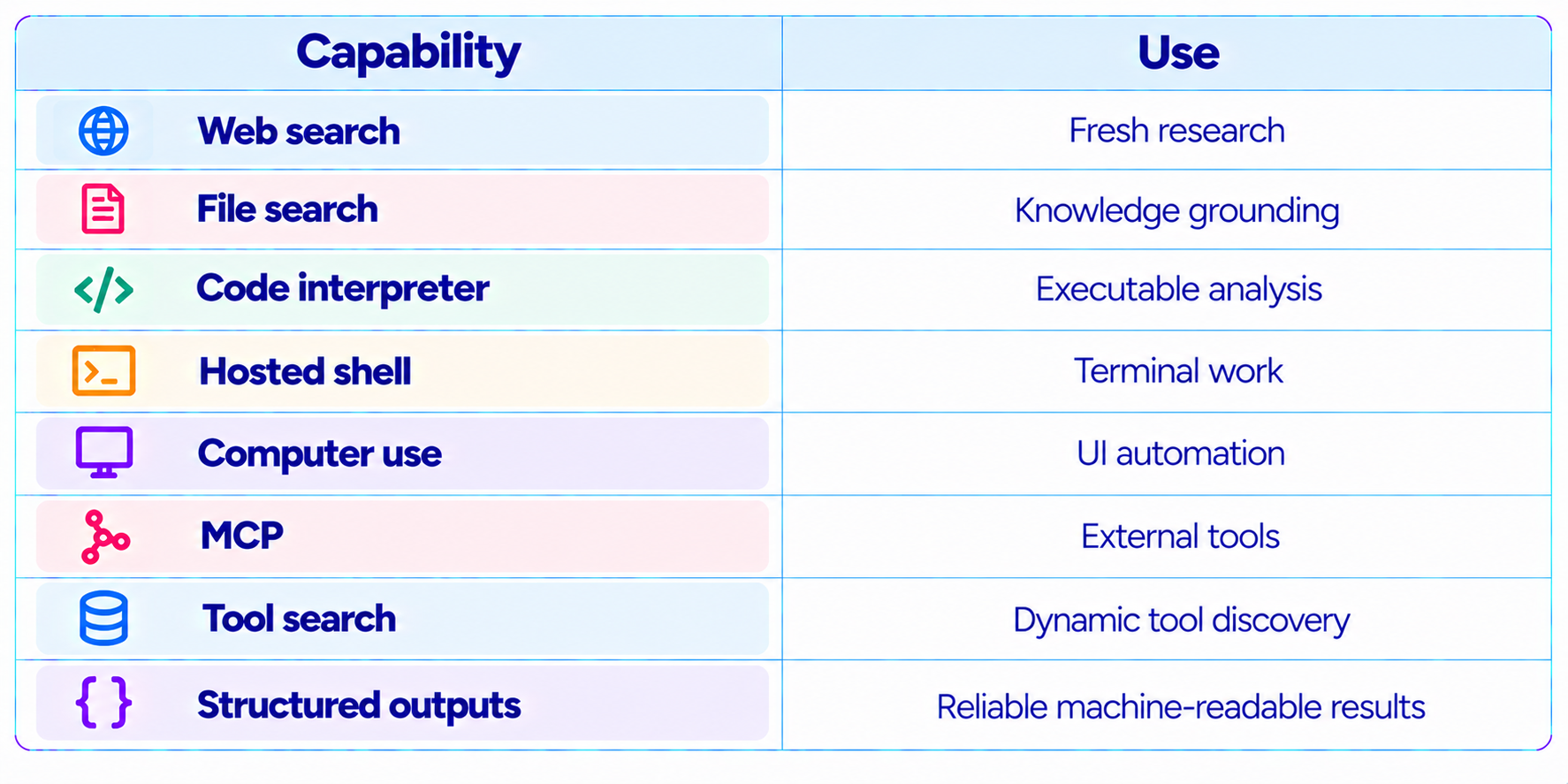
11. GPT-6.1 Sol vs GPT-6 Astra
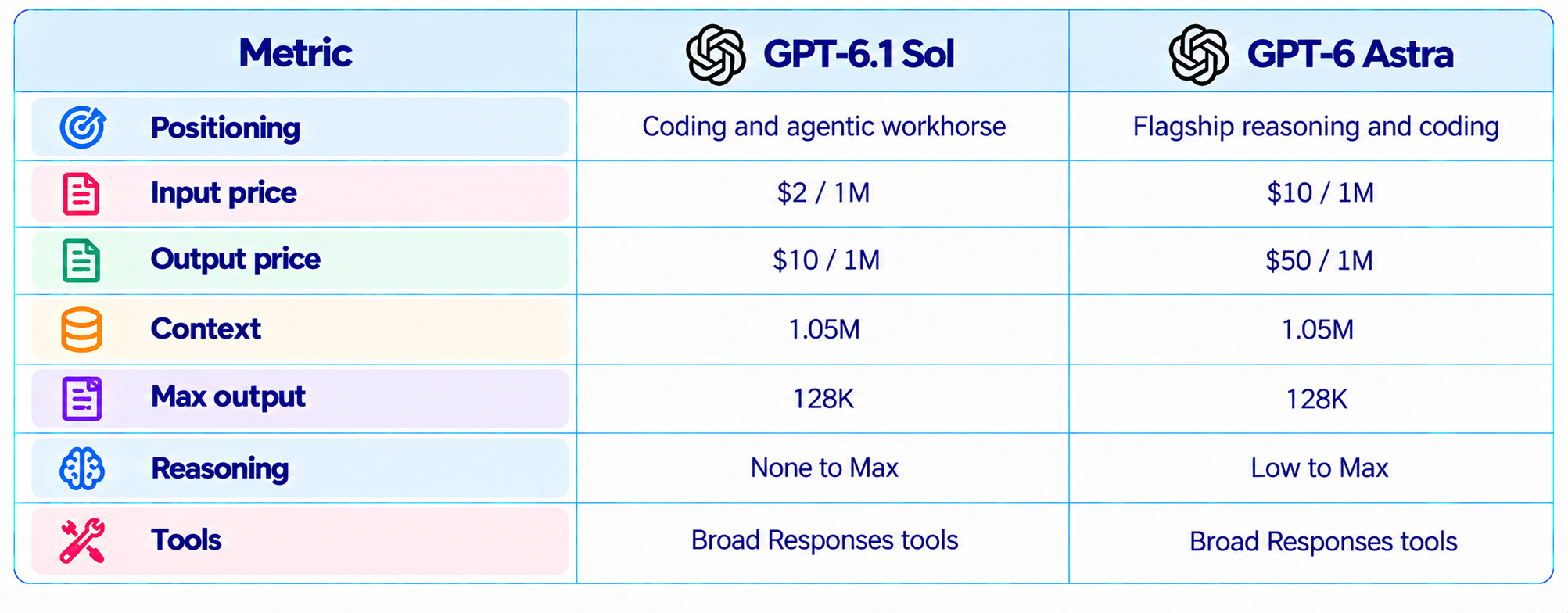
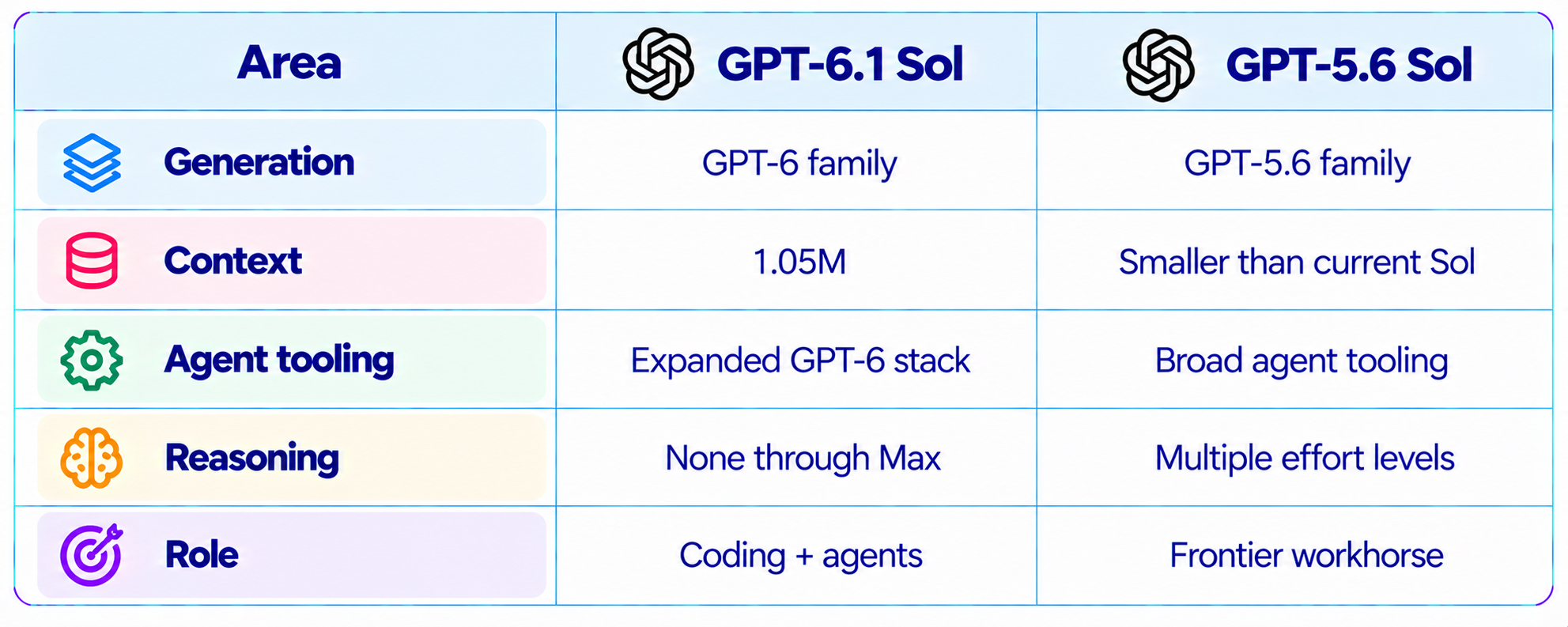
12. GPT-6.1 Sol vs GPT-5.6 Sol
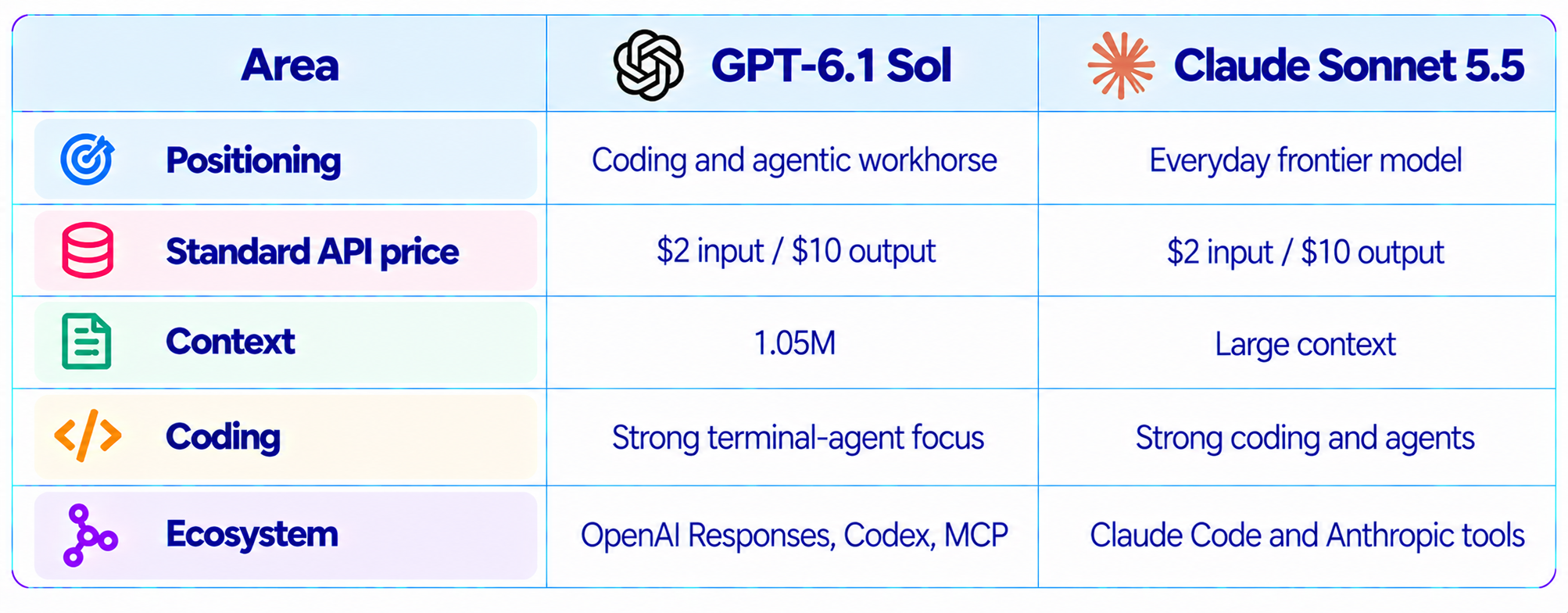
13. GPT-6.1 Sol vs Claude Sonnet 5.5
14. Where GPT-6.1 Sol Fits in a Model-Routing System
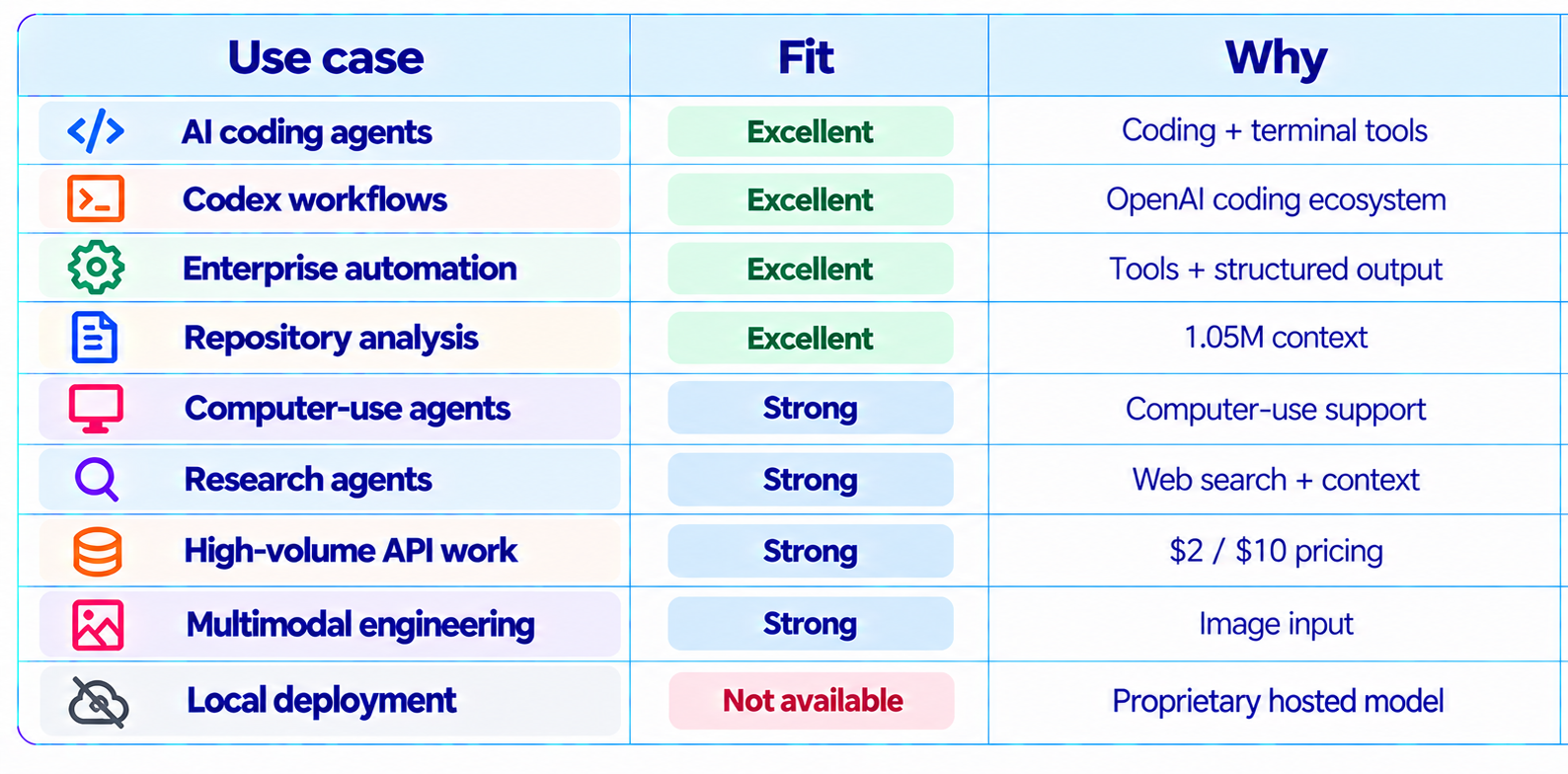
15. Best Use Cases
16. Limitations You Should Know
The public OpenAI API documentation currently uses the model identifier gpt-6-sol, while current DevDay reporting uses GPT-6.1 Sol.
Sol is below GPT-6 Astra in the flagship capability hierarchy. API costs also increase for prompts above 272K input tokens. Fine-tuning is not currently supported in the public Sol model documentation. Reasoning at xhigh or max can increase latency and cost. Benchmark scores vary by benchmark version, effort level and provider snapshot. The model is proprietary and is not available as an open-weight local checkpoint. Agent quality still depends heavily on tool definitions, permissions, context and validation.
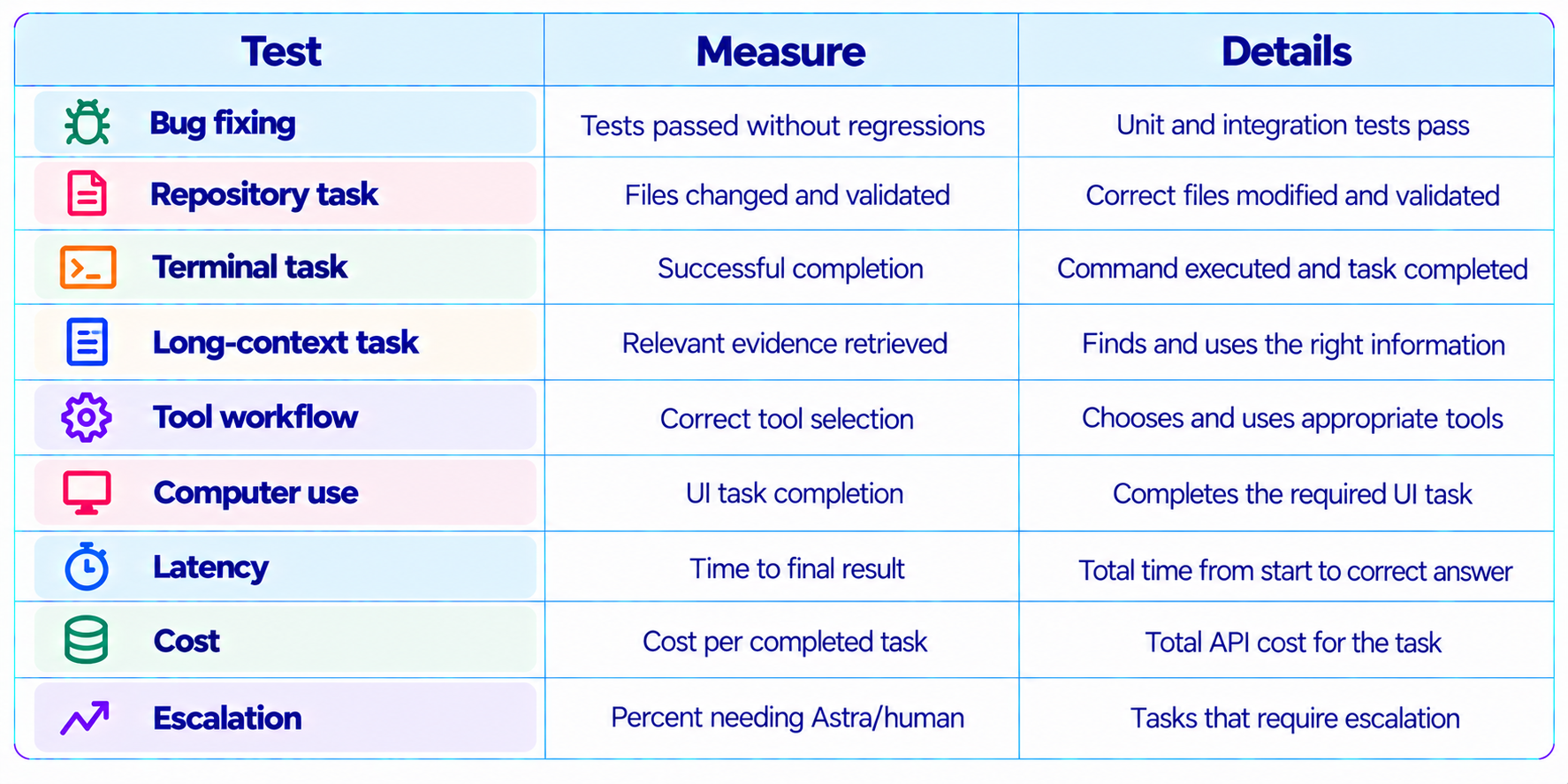
17. How to Evaluate GPT-6.1 Sol Yourself
18. Production Workflow for GPT-6.1 Sol
The most effective Sol deployment is not simply sending every request to max reasoning. Build a layered workflow: classify the incoming task, use none or low for deterministic work, medium as the default, high or xhigh for complex tasks, and max only when failure is expensive. Give the model only the tools and permissions it needs, require structured outputs for downstream automation, validate code changes, escalate failed tasks to Astra or a human reviewer, and track cost and completion rate by task category.
For model routing, read Model Routing for AI Coding Agents.
19. Security and Permissions Matter
The stronger the agent, the more important its permission boundary becomes. Sol can use hosted shell, computer use, MCP and external tools through the OpenAI tool stack, so production systems should treat tool access as a security boundary. Use least-privilege credentials, isolate execution environments, require confirmation for destructive actions and keep independent logs of tool calls. Do not rely only on the model's final explanation to determine what happened.
See How to Secure AI Coding Agents: Permissions, Sandboxing, MCP & Secrets for the broader architecture.
20. Is GPT-6.1 Sol Worth It?
For professional coding and agent workloads, Sol is one of the most interesting GPT-6 deployment points because it combines a large context window, broad tools, configurable reasoning and a $2/$10 API price.
The economics are particularly important. GPT-6 Astra costs five times as much per token at the current Standard rate. If Sol can complete the same class of tasks with an acceptable escalation rate, the difference can translate into a much lower production cost.
The model is less compelling when the task is extremely difficult and failure is expensive. In those cases, Astra's higher capability ceiling can justify its price. Sol is best treated as the workhorse, not automatically the final escalation layer.
21. Final Verdict
GPT-6.1 Sol is a strong continuation of OpenAI's shift from standalone chat models toward agentic work systems. The important upgrade is not one flashy benchmark. It is the combination of coding capability, reasoning controls, 1.05M context, image input and a broad tool layer at a much lower price than the GPT-6 flagship.
The current independent benchmark evidence supports a serious coding-agent position. September snapshots put Sol around 48 on Artificial Analysis's Intelligence Index, while Terminal-Bench measurements show strong performance on terminal-based software tasks. Because benchmark versions and effort settings differ, those numbers should be reported with their exact test names rather than collapsed into one generic coding score.
The economics are straightforward. Sol is currently documented at $2 per million input tokens and $10 per million output tokens, with $0.20 cached input. That makes it dramatically cheaper than Astra and much more practical for high-volume professional agents.
The main implementation caveat is naming. The current OpenAI API documentation still identifies the public model as gpt-6-sol, while the latest DevDay reporting calls the new release GPT-6.1 Sol. Developers should use the live API model catalog when configuring production systems until OpenAI publishes a dedicated GPT-6.1 API page.
My rating: 9.2/10 for coding and agents, 9.1/10 for price-to-performance, 9.0/10 for tools and context, and 9.1/10 overall.
Bottom line: GPT-6.1 Sol is worth testing as a default reasoning model for coding agents, Codex workflows, enterprise automation and long-context engineering. Use it as the workhorse, route the hardest tasks to Astra, and let task-level evaluation determine where the boundary belongs.
Frequently Asked Questions
What is GPT-6.1 Sol?
GPT-6.1 Sol is the new Sol-class GPT-6 model announced by OpenAI for complex coding and agentic workflows. The current public API documentation still identifies the model as gpt-6-sol.
Is GPT-6.1 Sol released?
Yes. OpenAI announced GPT-6.1 Sol at its September 29, 2026 DevDay event. The public API documentation currently continues to document gpt-6-sol.
What is the GPT-6.1 Sol price?
The current documented Sol API price is $2 per million input tokens and $10 per million output tokens, with cached input at $0.20 per million.
What is the GPT-6.1 Sol context window?
The current OpenAI Sol model documentation lists a 1.05 million-token context window and 128,000 maximum output tokens.
Is GPT-6.1 Sol good for coding?
Yes. OpenAI positions Sol specifically for complex coding and agentic workflows, and current terminal benchmarks show strong coding-agent performance.
Does GPT-6.1 Sol support image input?
Yes. The current GPT-6 Sol API documentation lists text and image input.
Does GPT-6.1 Sol support computer use?
Yes. Computer use is listed among the supported Responses API tools.
What reasoning levels does GPT-6.1 Sol support?
The current API documentation lists none, low, medium, high, xhigh and max.
How does GPT-6.1 Sol compare with GPT-6 Astra?
Sol is the lower-cost workhorse, while Astra is OpenAI’s flagship model for the hardest complex reasoning and coding tasks.
Is GPT-6.1 Sol better than GPT-5.6 Sol?
It is a newer GPT-6 generation with a larger context and expanded agent tooling, but the best choice depends on the task and production evaluation.
Is GPT-6.1 Sol open source?
No. It is a proprietary OpenAI model delivered through hosted products and APIs.
Is GPT-6.1 Sol worth it?
Yes for coding agents, enterprise automation, long-context engineering and repeated professional workloads where its price-to-capability balance fits the task.
Recommended Blogs
GPT-6 Sol and Luna Review: Benchmarks, Price & Is It Worth It? (2026)
GPT-5.6 Review: Sol, Terra, Luna Features, Benchmarks, and Pricing
Claude Fable 5.1 Review: Benchmarks, Price, Coding & Is It Worth It? (2026)
Meta Muse Spark 1.3 Review: Coding, Price & Is It Worth It? (2026)
Qwen 3.8 Max 0902 Review: Benchmarks, Price & Is It Worth It? (2026)
Mercury 2.5 AI Model Review: Speed, Price & Is It Worth It? (2026)
Resources & Community
Join our community of 70,000+ AI enthusiasts and learn to build powerful AI applications. Build Fast with AI helps creators, developers and teams understand and implement practical AI.
Agentic AI Launchpad 2026
A structured 6-week cohort program that takes you from AI basics to building and deploying real-world agentic AI systems. Includes live sessions, expert mentorship, project reviews and a builder community network.
Free AI Resources
Access free tools, workshops and micro-learning to keep building.

