



GPT-6 Sol vs Luna: Which GPT-6 Model Fits Coding, Agents and High-Volume AI?
GPT-6 Sol and GPT-6 Luna are the two new workhorse models in OpenAI's GPT-6 family, launched on September 22, 2026 alongside the flagship GPT-6 Astra. The split is simple on paper: Sol is designed for demanding coding and agentic workflows, while Luna is the lower-cost model for focused, repeatable and high-volume tasks.
The biggest change is economic. OpenAI launched GPT-6 Sol at $2 per million input tokens and $10 per million output tokens, while GPT-6 Luna costs $0.10 per million input and $0.50 per million output tokens. Both offer roughly 1.05 million tokens of context, 128,000 maximum output tokens, image input, reasoning controls, structured outputs and a broad set of agent tools.
The benchmark story is more nuanced than the price story. OpenAI's launch results show Sol reaching 33.2% on AutomationBench at xhigh, 56.4% on Agents' Last Exam at max, 49.3% on FrontierCode 1.1 at max, 68.8% on DeepSWE 1.1 at max and 64.4% on OSWorld 2.0 offline at max. Luna reaches 20.7%, 50.9%, 42.4%, 66.6% and 52.7% on the same benchmarks at its best reported settings.
Independent Artificial Analysis results reinforce the split. GPT-6 Sol currently scores 48 on its Intelligence Index at max effort and 57 on its Coding Agent Index, while Luna scores 37 and 41. The cost per Artificial Analysis Intelligence task is about $1.06 for Sol and $0.07 for Luna.
QUICK ANSWER
GPT-6 Sol and GPT-6 Luna are two different operating points inside the GPT-6 family. OpenAI positions Sol for complex coding and agentic workflows and Luna for focused, repeatable work at scale. Both expose the same broad family of reasoning and agent capabilities, so the main difference is capability level versus cost.
GPT-6 Sol costs $2 per million input tokens and $10 per million output tokens. GPT-6 Luna costs $0.10 input and $0.50 output per million tokens. Cached input is $0.20 for Sol and $0.01 for Luna. Prompts above 272K input tokens use higher long-context pricing.
For coding and agents, Sol has the stronger capability profile. Artificial Analysis gives Sol 48 on its Intelligence Index and 57 on its Coding Agent Index, compared with Luna's 37 and 41. OpenAI's own launch charts also show Sol ahead of Luna across AutomationBench, Agents' Last Exam, FrontierCode, DeepSWE and OSWorld.
Luna's advantage is economics. At one-twentieth of Sol's token price, and with a measured $0.07 cost per Artificial Analysis Intelligence task at max effort, it is built for cases where thousands or millions of calls matter more than maximum reasoning depth.
My verdict: 9.2/10 for Sol and 9.0/10 for Luna. Sol is the stronger general workhorse for serious engineering and agentic work, while Luna is the cost-efficient model for high-volume, well-scoped tasks.
1. What Are GPT-6 Sol and GPT-6 Luna?
GPT-6 Sol and GPT-6 Luna are OpenAI's two new workhorse GPT-6 models, released on September 22, 2026. They sit below GPT-6 Astra and bring GPT-6 reasoning, tool use and multimodal input to lower-cost deployment tiers.
OpenAI describes Sol as built for complex coding and agentic workflows and Luna as its most efficient model for focused, high-volume tasks. Both are available through the Responses API and Chat Completions, with built-in tools and function calling available through the Responses API.
The GPT-6 family also adds async tool calling and mid-turn steering. These features are relevant to longer agents because a model can keep working while tools execute and can incorporate new instructions during a running task.
2. GPT-6 Sol vs Luna Specifications
3. GPT-6 Sol and Luna Pricing
OpenAI's standard pricing creates an unusually wide gap between the two models. Sol costs $2 per million input tokens and $10 per million output tokens. Luna costs $0.10 input and $0.50 output. Cached input is $0.20 for Sol and $0.01 for Luna.
For long prompts above 272K input tokens, OpenAI charges higher rates for the full request. Batch and Flex processing are priced at 50% of Standard, while Fast mode costs twice the applicable Standard rate.
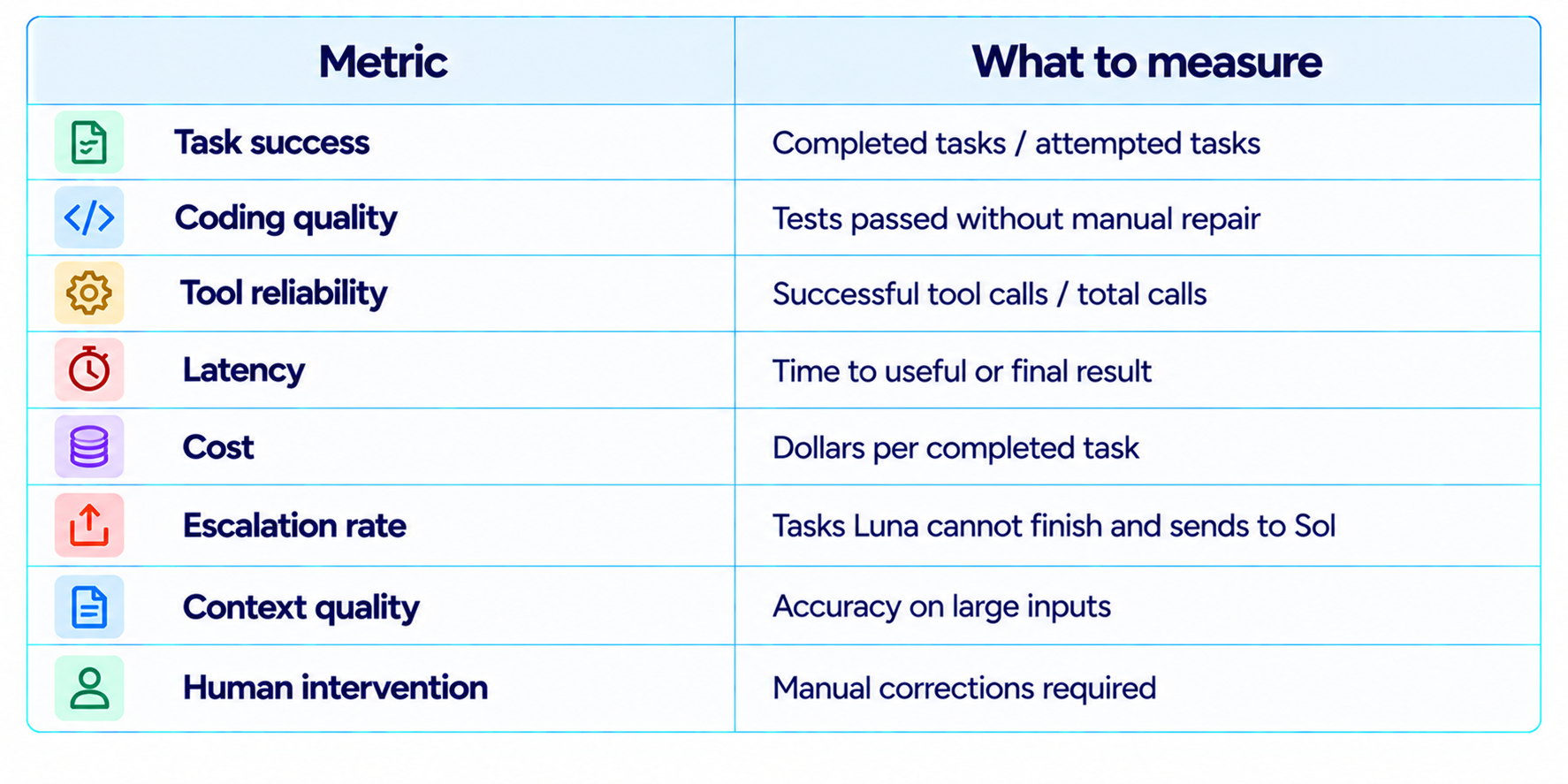
The practical metric is cost per completed task, not cost per token alone. A model that costs more can still be cheaper if it prevents retries and human intervention, while an inexpensive model can become expensive when it fails repeatedly.
4. GPT-6 Sol Benchmarks
OpenAI's launch charts report Sol at 33.2% on AutomationBench at xhigh, 56.4% on Agents' Last Exam at max, 49.3% on FrontierCode 1.1 at max, 68.8% on DeepSWE 1.1 at max and 64.4% on OSWorld 2.0 offline at max.
These benchmarks cover several different problems. AutomationBench represents end-to-end business workflows, Agents' Last Exam covers professional workflows, FrontierCode and DeepSWE test software engineering, while OSWorld measures computer-use performance. This makes Sol a general-purpose agent model rather than a narrow coding endpoint.
5. GPT-6 Luna Benchmarks
Luna reaches 20.7% on AutomationBench, 50.9% on Agents' Last Exam, 42.4% on FrontierCode 1.1, 66.6% on DeepSWE 1.1 and 52.7% on OSWorld 2.0 at the strongest reported settings.
The DeepSWE result is especially interesting because Luna reaches 66.6% while costing about $0.22 per reported task. That is only 2.2 percentage points below Sol's 68.8% on the same OpenAI chart, but at a much lower task cost.
That does not make Luna interchangeable with Sol. The gap is much larger on some other benchmarks, and harder agent tasks can benefit from the extra reasoning capacity of Sol.
6. Independent Artificial Analysis Results
Artificial Analysis currently scores GPT-6 Sol at 48 on its Intelligence Index at max effort and Luna at 37. Its Coding Agent Index scores are 57 for Sol and 41 for Luna.
The same comparison puts Sol at about 126 output tokens per second at max and Luna at about 157, making Luna faster on raw output decoding. Cost per Intelligence Index task is about $1.06 for Sol and $0.07 for Luna.
The independent data makes the product split clear: Sol has the higher capability ceiling, while Luna has the stronger cost and throughput profile.
7. GPT-6 Sol vs GPT-5.6 Sol
GPT-6 Sol succeeds GPT-5.6 Sol and keeps the same broad position inside OpenAI's lineup, but the biggest change is efficiency. OpenAI says improved caching and inference allowed it to cut Sol pricing to $2/$10 from GPT-5.6 Sol's earlier promotional rate.
Artificial Analysis currently scores GPT-6 Sol at 48 on the Intelligence Index versus 47 for GPT-5.6 Sol and 57 versus 55 on the Coding Agent Index. Its measured cost per Intelligence Index task is about $1.06 compared with $1.99 for GPT-5.6 Sol.
This is better understood as a cost-efficiency upgrade with incremental capability gains rather than a complete jump to a new class of intelligence.
8. GPT-6 Luna vs GPT-5.6 Luna
GPT-6 Luna cuts the API price to $0.10 input and $0.50 output per million tokens, with the same 1.05M context and 128K maximum output.
Artificial Analysis currently shows both GPT-6 Luna and GPT-5.6 Luna at 37 on the Intelligence Index, while the Coding Agent Index is 41 for GPT-6 Luna versus 43 for GPT-5.6 Luna. Cost per Intelligence Index task drops from roughly $0.18 to $0.07.
So Luna's strongest upgrade is economics rather than a blanket capability increase. That can still be a major practical upgrade for production systems that make many calls per day.
9. GPT-6 Sol vs GPT-6 Luna: Which One Should You Use?
10. Context Window and Long Documents
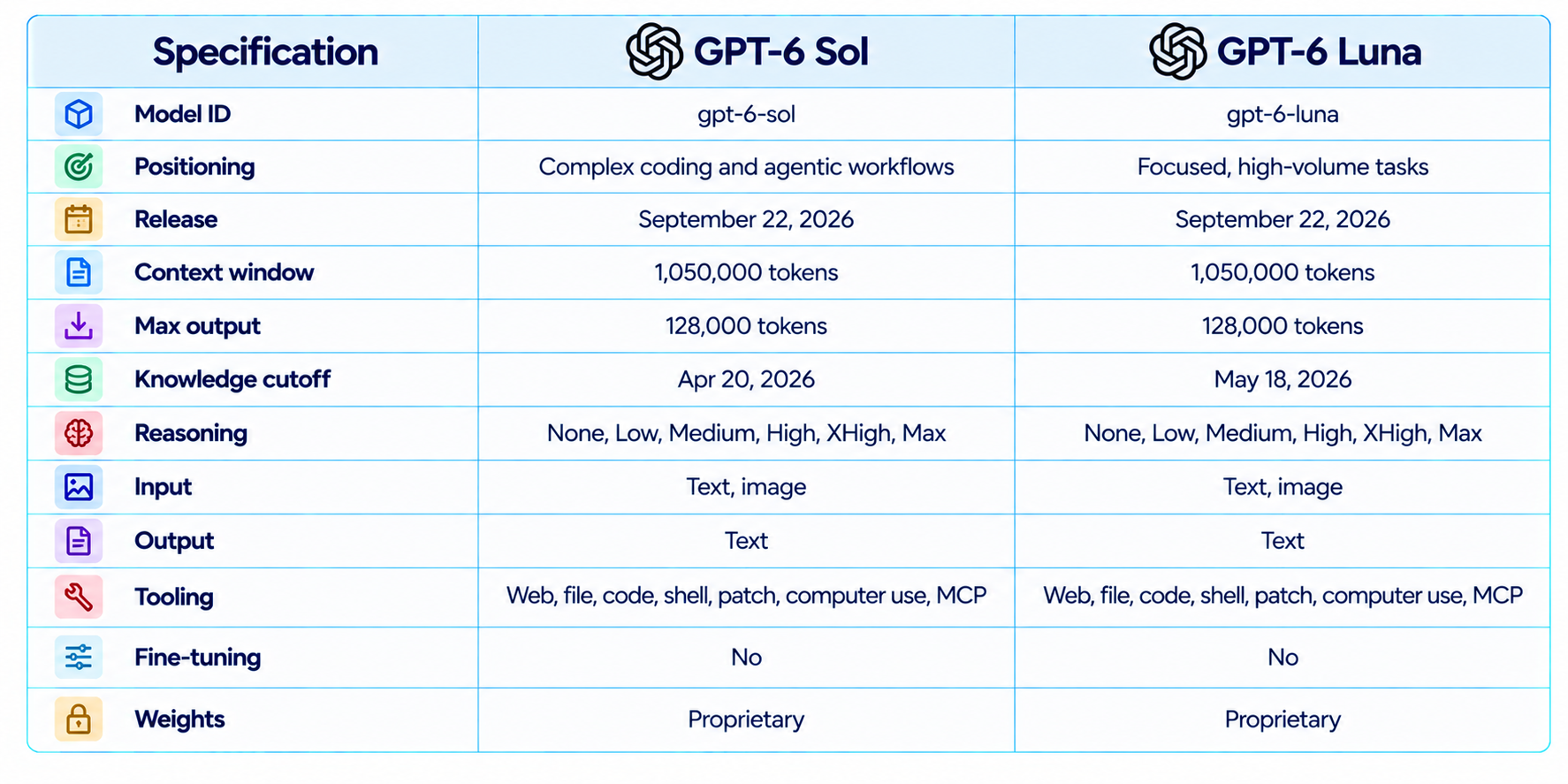
Both models list a 1.05M-token context window and 128K maximum output. Sol has an April 20, 2026 knowledge cutoff, while Luna has a May 18, 2026 cutoff.
A million-token window is useful for large repositories, research collections, technical documentation and long-running agent state. But context size does not guarantee perfect retrieval or reasoning. Good context selection is still important.
11. Tool Use, Codex and Agent Workflows
Both models support web search, file search, code interpreter, hosted shell, apply patch, computer use, MCP, tool search, function calling and structured outputs through the current OpenAI tool stack.
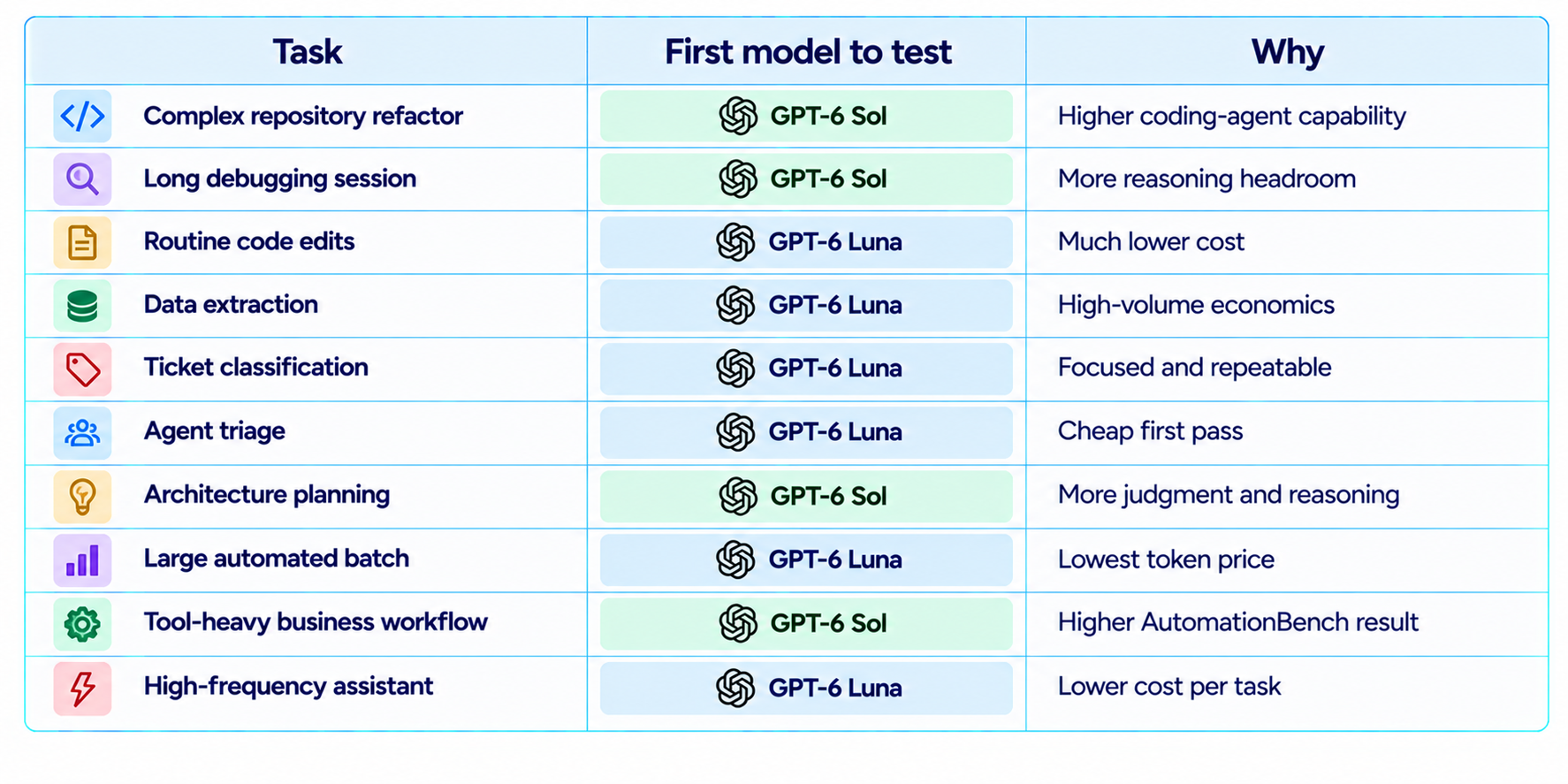
Sol is the model OpenAI explicitly positions for complex coding and agentic workflows. Luna is intended for focused, repeatable tasks, so it is a natural fit for the worker layer inside a routed agent architecture.
The Responses API is the preferred interface for built-in tools. Chat Completions supports function calling for Sol and Luna when reasoning is set to none.
12. Speed and Latency
Artificial Analysis measures GPT-6 Luna max at about 157 output tokens per second and GPT-6 Sol max at about 126.
Raw output speed is not the same as total task speed. Reasoning time, tool execution and context processing can dominate an agent workflow. For production systems, measure time to completed task rather than only tokens per second.
13. Reliability and Factuality
OpenAI says GPT-6 Sol and Luna improve on their GPT-5.6 counterparts in alignment and factuality evaluations. Artificial Analysis also reports lower hallucination rates on its AA-Omniscience stress test than the respective GPT-5.6 models, although the rates remain substantial and the evaluation is intentionally difficult.
The useful takeaway is that the new models show measurable reliability improvements in a controlled evaluation, but high-stakes outputs still need verification, tests or source checks.
14. Multimodal Input and Output
Both models accept text and image input and produce text output. The current model pages do not list native audio or video input for Sol or Luna.
That makes them suitable for screenshot analysis, visual debugging, document images and multimodal coding workflows, while audio and video understanding belong to OpenAI's dedicated model families.
15. Recommended Production Architecture
The strongest GPT-6 deployment is a portfolio rather than a one-model stack. Use Luna for routine execution, Sol for tasks that need stronger judgment, and Astra as an escalation model for the hardest end-to-end workflows.
The router can use task type, risk, previous failures, context size, tool count and budget to determine when to escalate. This keeps the expensive reasoning tier available without paying for it on every request.
16. Limitations You Should Know
- Sol and Luna accept text and image input but are not native audio or video input models.
- Output tokens per second do not equal complete agent task latency.
- Large context does not guarantee perfect long-context reasoning.
- Benchmark results vary with reasoning effort, harness, tool configuration and evaluation methodology.
- Sol costs substantially more than Luna even though both expose a similar agent tool stack.
- Luna's independent Intelligence Index is materially below Sol's.
- GPT-6 Sol and Luna are proprietary API models, not downloadable open-weight checkpoints.
17. How to Evaluate GPT-6 Sol and Luna Yourself
18. Is GPT-6 Sol Worth It?
GPT-6 Sol is worth using when the workload needs stronger coding, agent planning, deeper reasoning or multi-tool execution. Its price is still much lower than GPT-6 Astra, while its independent Intelligence Index and Coding Agent Index remain meaningfully above Luna.
The strongest argument for Sol is therefore not that it wins every benchmark. It is that it gives teams a stronger reasoning worker without forcing every task up to Astra's $10/$50 price level.
19. Is GPT-6 Luna Worth It?
GPT-6 Luna is worth using for high-volume AI applications where cost per completed task matters more than maximum reasoning depth. Its $0.10/$0.50 pricing is one of the most aggressive positions in the GPT lineup, and its 66.6% DeepSWE result shows that it can handle real software tasks when given enough reasoning.
Luna is especially compelling as a first-pass worker model. The system can escalate difficult tasks to Sol instead of paying Sol rates for every request.
20. Final Verdict
Run the same tasks through Sol, Luna and your current production model. Keep prompts, documents, tools and evaluation rules constant.
The goal is to find the least expensive model that consistently meets your quality bar. In many production systems, that means Luna handles the majority of requests and Sol receives the smaller set of tasks where failure is expensive.
GPT-6 Sol and GPT-6 Luna are best understood as a deployment strategy inside the GPT-6 family. Sol brings stronger reasoning and agentic performance to a $2/$10 price point, while Luna brings GPT-6 reasoning into a $0.10/$0.50 tier designed for scale.
Sol is the more capable workhorse. Its independent Intelligence Index score of 48 and Coding Agent Index score of 57 put it above Luna's 37 and 41, while OpenAI's benchmark charts also show Sol ahead on the major agent, coding and computer-use evaluations.
Luna is the economics story. Its 66.6% DeepSWE result at max effort shows that the low-cost model can handle serious coding tasks, while the $0.10/$0.50 pricing makes large-scale automation much easier to budget.
The most practical architecture is Sol plus Luna. Use Luna as the high-volume worker, Sol as the stronger reasoning tier, and Astra as the escalation path for the hardest workflows. OpenAI's current model-selection guidance follows essentially this capability-cost ladder.
My ratings: GPT-6 Sol 9.2/10 for coding, 9.1/10 for agents, 9.0/10 for price-to-performance, 9.1/10 overall. GPT-6 Luna 8.9/10 for coding, 9.3/10 for cost efficiency, 8.8/10 for agents, 9.0/10 overall.
Bottom line: GPT-6 Sol is the GPT-6 model to use when a task needs more judgment, coding depth and agent reliability. GPT-6 Luna is the model to use when the task is frequent, scoped and cost-sensitive. The real advantage is that developers no longer have to make one model carry the entire AI workload.
Frequently Asked Questions
What is GPT-6 Sol?
GPT-6 Sol is OpenAI's GPT-6 reasoning model designed for complex coding and agentic workflows. It has a 1.05M-token context and costs $2 per million input tokens and $10 per million output tokens.
What is GPT-6 Luna?
GPT-6 Luna is OpenAI's efficiency-focused GPT-6 reasoning model for focused, repeatable and high-volume tasks. It costs $0.10 per million input tokens and $0.50 per million output tokens.
What is the GPT-6 Sol context window?
OpenAI lists a 1,050,000-token context window and 128,000 maximum output tokens.
What is the GPT-6 Luna context window?
OpenAI lists a 1,050,000-token context window and 128,000 maximum output tokens.
What are the GPT-6 Sol benchmark scores?
OpenAI reports 33.2% AutomationBench, 56.4% Agents' Last Exam, 49.3% FrontierCode 1.1, 68.8% DeepSWE 1.1 and 64.4% OSWorld 2.0 at the strongest reported settings.
What are the GPT-6 Luna benchmark scores?
OpenAI reports 20.7% AutomationBench, 50.9% Agents' Last Exam, 42.4% FrontierCode 1.1, 66.6% DeepSWE 1.1 and 52.7% OSWorld 2.0 at the strongest reported settings.
Is GPT-6 Sol better than GPT-5.6 Sol?
Its pricing and independent cost-per-task profile improve substantially, while capability gains are more mixed. Artificial Analysis currently gives Sol 48 on the Intelligence Index versus 47 for GPT-5.6 Sol and 57 versus 55 on its Coding Agent Index.
Is GPT-6 Luna better than GPT-5.6 Luna?
Capability changes are mixed. Artificial Analysis currently shows both at 37 on the Intelligence Index and GPT-6 Luna at 41 versus 43 for GPT-5.6 Luna on Coding Agent Index, while cost per Intelligence task falls sharply.
Which GPT-6 model is better for coding?
Sol is the stronger first choice for demanding coding and agentic tasks. Luna is useful for routine coding and high-volume software work when cost matters more.
Which GPT-6 model is better for high-volume AI tasks?
Luna. OpenAI explicitly positions it for cost-sensitive, high-volume workloads and its per-token price is twenty times lower than Sol's.
Can GPT-6 Sol and Luna use tools?
Yes. OpenAI lists web search, file search, code interpreter, hosted shell, apply patch, computer use, MCP and tool search through the Responses API.
Are GPT-6 Sol and Luna open source?
No. The models are proprietary and their weights are not publicly available.
Recommended Blogs
GPT-6 Astra Review: Benchmarks, Price & Is It Worth It? (2026)
Claude Fable 5.1 Review: Benchmarks, Pricing, Features & Is It Worth It? (2026)
Gemini 3.8 Flash Review: Accuracy, Price & Is It Worth It? (2026)
Meta Muse Spark 1.3 Review: Coding, Price & Is It Worth It? (2026)
Model Routing for AI Coding Agents: How to Cut Costs Without Losing Quality
AI Model Routing in 2026: When to Use Fable, Astra, Gemini or Muse
Resources & Community
Join our community of 70,000+ AI enthusiasts and learn to build powerful AI applications. Whether you're a beginner or an experienced developer, Build Fast with AI helps you understand and implement AI in your projects.
Agentic AI Launchpad 2026
A structured 6-week cohort program that takes you from AI basics to building and deploying real-world agentic AI systems. Includes live sessions, expert mentorship, project reviews and a builder community network.
Ready to go from learning to building? Join the next cohort: Agentic AI Launchpad 2026
Free AI Resources
Access free tools, workshops and micro-learning to keep building.

