



Gemini 3.8 Flash TTS Review: Can Google's New Voice Models Finally Make AI Speech Feel Like a Real Performance?
Google's Gemini 3.8 Flash TTS and Gemini 3.8 Flash-Lite TTS are not simply faster versions of the company's older text-to-speech system. They split Google's latest TTS offering into two distinct production targets: a flagship creative model for voice design, expressive acting and difficult long-form audio, and a lower-cost workhorse for high-volume generation, read-aloud features and voice-agent workloads.
Google announced the two models on September 23, 2026, and the Gemini API changelog lists both as generally available. Gemini 3.8 Flash TTS is positioned as the creative flagship, while Gemini 3.8 Flash-Lite TTS replaces Gemini 3.1 Flash TTS Preview as the high-throughput option. Both are available through the Gemini API and Google AI Studio, with additional Google product rollouts including Gemini Notebook and Google Vids.
The important change is control. Gemini 3.8 TTS lets developers direct delivery through structured speech metadata, line-by-line style instructions and inline vocal events. It also supports voice design and voice replication, two-speaker dialogue, long-form generation and regional pronunciation control. Flash TTS supports 130 languages, while Flash-Lite supports 101.
QUICK ANSWER
Gemini 3.8 Flash TTS is Google's flagship creative text-to-speech model for expressive voice generation, character design, studio narration, audiobooks, podcasts and complex two-speaker dialogue. Gemini 3.8 Flash-Lite TTS is the cheaper, higher-throughput model designed for bulk audio generation, real-time voice-agent cascades, read-aloud features and everyday single-speaker speech. Both use the same Gemini TTS API schema and prompting structure.
The benchmark picture is strong. Google reports that Gemini 3.8 Flash TTS took the top spot on Hume AI's Voice Design Benchmark with a 71.4 score and led accent modeling at 60.8. Google also reports Flash TTS and Flash-Lite TTS in the top two positions on Hume's Overall Quality Index. Independent Artificial Analysis Voice Arena data captured on September 24 puts Flash TTS second at 1,260 Elo and Flash-Lite sixth at 1,235.
Pricing is also aggressive for the launch period. Through December 31, 2026, standard Flash TTS pricing is $0.50 per million text-input tokens and $9 per million audio-output tokens. Flash-Lite costs $0.50 per million text-input tokens and $6 per million audio-output tokens. Google publishes higher rates beginning January 1, 2027, so production budgets should account for both periods.
My rating: 9.3/10 for voice control, 9.2/10 for expressive quality, 9.1/10 for multilingual coverage, 9.4/10 for Flash-Lite price-to-scale, and 9.2/10 overall. The biggest reason to use Flash TTS is creative control; the biggest reason to use Flash-Lite is production economics.
1. What Is Gemini 3.8 Flash TTS?
Gemini 3.8 Flash TTS is Google's flagship creative text-to-speech model. Unlike a basic TTS engine that maps text to a fixed voice, it is designed around performance direction. Developers can specify how a line should sound, including tone, pacing, emotion, acting style, accent and momentary vocal events. Google describes it as a model for studio-grade voice fidelity, expressive acting, regional accents and long-form multi-turn stability.
The model accepts text and produces audio. It is not the same thing as Gemini Live. Google's documentation separates TTS from the Live API: TTS is designed for exact text recitation with fine-grained control, while Live is intended for interactive, unstructured audio conversations.
That distinction makes Gemini 3.8 Flash TTS particularly relevant for scripted audio. Audiobooks, podcasts, advertisements, game dialogue, localization and narrated educational content all benefit from a system that can follow a script while controlling the performance.
2. What Is Gemini 3.8 Flash-Lite TTS?
Gemini 3.8 Flash-Lite TTS is the production-focused counterpart. Google describes it as a fast, cost-efficient workhorse optimized for high-throughput speech generation, conversational voice-agent cascades, read-aloud features, voice replication and everyday single-speaker audio. It replaces Gemini 3.1 Flash TTS Preview in the recommended production path.
The important part is that Lite is not a separate API ecosystem. Both models share the same schema and prompting format, so applications can switch between them with a model identifier change. That makes A/B testing much easier than moving between unrelated TTS providers.
Flash-Lite therefore makes the most sense when the workload is large enough that output cost and latency matter more than extracting the last increment of acoustic nuance from every sentence.
3. Gemini 3.8 Flash TTS vs Flash-Lite TTS
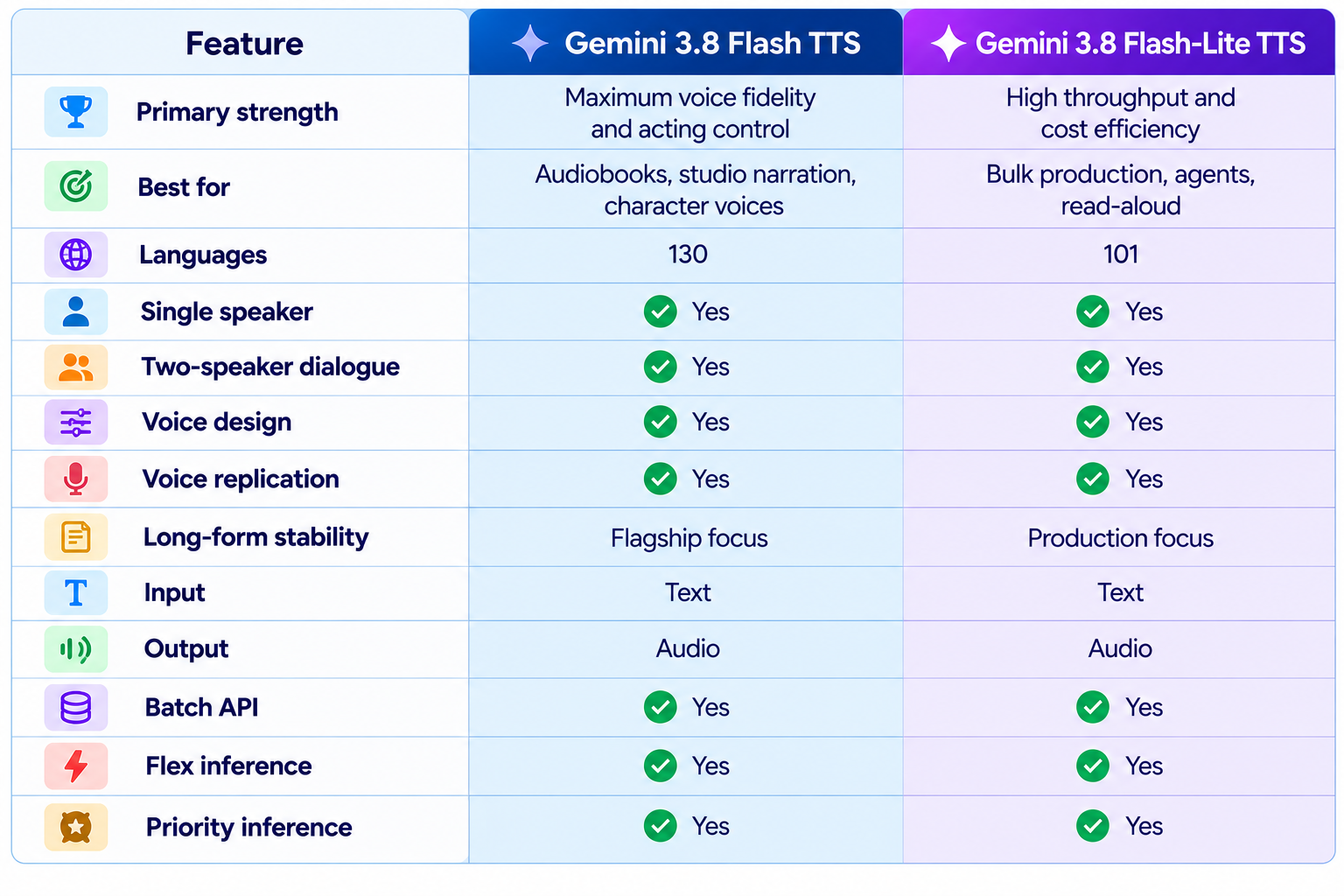
Google's guidance is straightforward: choose Flash when maximum acoustic fidelity, nuanced acting, dialect coverage and complex long-form performance matter most; choose Flash-Lite for high-volume production, low latency and cost-efficient voice generation.
4. Voice Quality and Expressiveness
The biggest upgrade is not simply natural pronunciation. It is expressive control. Gemini 3.8 TTS can combine structured turn-level style instructions with inline vocal events such as laughs, sighs, coughs, breaths and short pauses. The result is closer to directing a voice actor than selecting a static speech preset.
For example, a script can keep the actual transcript clean while the performance metadata specifies that one line should be whispered, another delivered with urgency, and another slowed down. Momentary events can remain inline, while sustained delivery instructions belong in speech metadata.
This distinction matters because Gemini 3.8 treats the input text as a verbatim transcript. Older prompting patterns that put stage directions directly into the text can cause those directions to be spoken aloud. Google's migration documentation recommends moving sustained directions and speaker labels into structured metadata.
5. Voice Design: Create a Voice From a Prompt
Gemini 3.8 Flash TTS turns voice creation into a natural-language design task. Instead of selecting only from a fixed list, developers can describe the desired vocal identity and create a custom voice persona.
A useful voice-design prompt can describe age range, perceived personality, accent, vocal texture, speaking energy and intended role. For a game character, that could mean a low, restrained fantasy narrator with dry humor. For an educational product, it could mean a warm, clear instructor with measured pacing.
Google's launch material also describes an expanded voice ecosystem with more than 2,000 production-ready voices, alongside the ability to design custom voices. The API exposes an Extended Voice Library through the Voices endpoint.
6. Voice Replication and AI Voice Cloning
Both Gemini 3.8 TTS models support voice replication through the Gemini API. The feature is designed around consent rather than unrestricted cloning. Google requires a reference recording from the speaker and a separate consent recording from the same adult speaker before creating a replicated voice.
The current API documentation recommends a 10-30 second clean reference clip and a matching consent recording. Stateful replicated voices can be stored in a project, while a stateless mode returns an encrypted client-managed voice key instead. Stateful storage is limited to 200 voices per project with a one-year retention period; stateless keys have a seven-day lifetime.
Google also applies provenance controls. Gemini Audio output is watermarked with SynthID, and the voice-replication path includes C2PA credentials. AI Studio voice replication is currently unavailable in India, the EEA, the UK, Switzerland, Illinois and Texas.
For production teams, that combination is important. Voice replication is technically powerful, but consent, rights management and regional availability need to be part of the workflow before a project is built around a cloned voice.
7. Two-Speaker Dialogue and Character Performance
Gemini 3.8 TTS supports multi-speaker generation and can stage two-speaker conversations from a script. Each turn can specify a speaker and a delivery style, allowing the model to control conversational pacing and turn-taking.
This is particularly useful for podcasts, scripted conversations, educational dialogues, product demos and game scenes. Instead of generating every sentence independently and manually stitching them together, the script itself can define the conversation.
8. Long-Form Audio and Voice Stability
Long-form consistency is one of Google's headline claims for Gemini 3.8 Flash TTS. The developer documentation describes stable voice identity, timbre, volume and acoustic room tone across extended dialogues and multi-minute narration without voice drift.
That makes the model relevant to audiobooks and long podcasts, where small changes in speaker identity can become obvious after several minutes. It also reduces the amount of post-production work required to normalize a generated voice.
9. Multilingual Speech and Regional Accents
Gemini 3.8 Flash TTS supports 130 languages, while Flash-Lite supports 101. Google specifically highlights regional accents, minority dialects and IPA pronunciation overrides as part of the Flash TTS capability.
10. Gemini 3.8 Flash TTS Benchmarks
Google reports strong results on Hume AI evaluations. Gemini 3.8 Flash TTS took the number-one position on Hume AI's Voice Design Benchmark with a score of 71.4 and led accent modeling with 60.8. Google also reports Flash TTS and Flash-Lite TTS at the top two positions on Hume's Overall Quality Index.
Those figures should be labeled correctly. They are Google-reported results from Hume AI evaluations, presented by Google in the launch announcement. They are useful evidence, but they are not the same thing as an independent benchmark run commissioned by a neutral evaluator.
The independent Artificial Analysis Provider Voice Arena provides another signal. On the September 24, 2026 snapshot, Gemini 3.8 Flash TTS ranks second with 1,260 Elo over 1,999 samples, while Flash-Lite ranks sixth at 1,235. Cartesia Sonic 3.6 is first at 1,273.
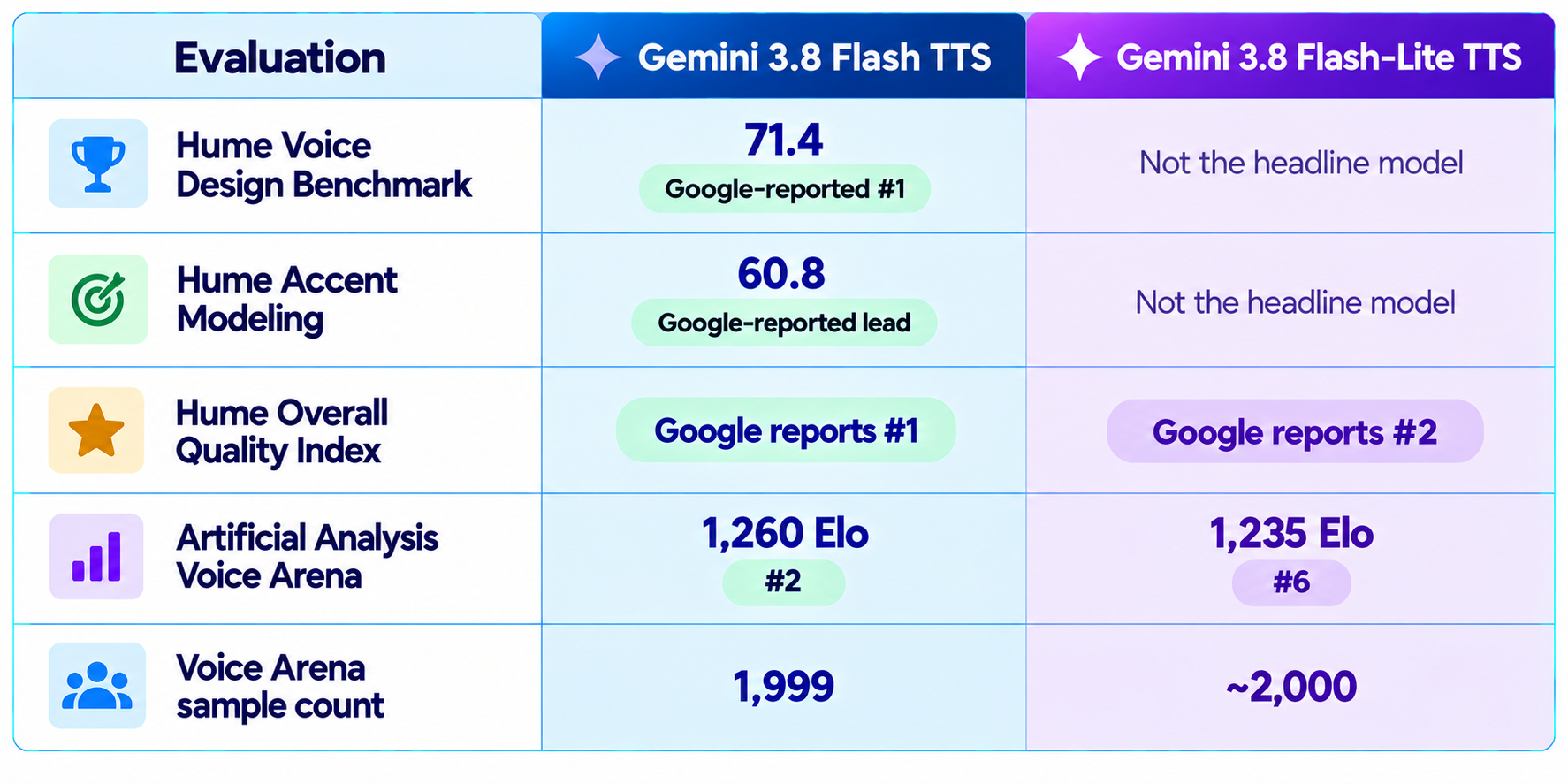
The combined evidence supports a strong conclusion: both models are competitive with leading commercial TTS systems, with Flash TTS positioned as the higher-quality creative option and Flash-Lite as the scale-focused option.
11. Gemini 3.8 Flash TTS Pricing
Google prices Gemini TTS by text input tokens and audio output tokens. Audio is metered at 25 tokens per second. Through December 31, 2026, standard Flash TTS costs $0.50 per million text-input tokens and $9.00 per million audio-output tokens. From January 1, 2027, the listed rates become $1.00 and $18.00.
At Google's published conversion of 25 audio tokens per second, one minute of generated audio is about 1,500 audio tokens. That makes the launch-period output cost approximately 1.35 cents per minute for Flash TTS and 0.9 cents per minute for Flash-Lite, before input-token charges. These are arithmetic conversions from Google's token pricing, not separate Google per-minute prices.
12. Batch and Priority Pricing
Google also offers different inference modes. For Flash-Lite, the current pricing page lists Batch input at $0.25 per million tokens through the end of 2026, while standard output is $6 per million audio tokens. Priority inference is priced higher at $0.90 input and $10.80 audio output during the same period. Flash TTS follows the same general pattern, with lower-cost batch processing and higher-cost priority inference.
13. Gemini 3.8 Flash TTS vs Gemini 3.1 Flash TTS
Gemini 3.8 Flash-Lite TTS is the direct production successor to Gemini 3.1 Flash TTS Preview. Google lists 3.1 Flash TTS Preview at $1 per million text tokens and $20 per million audio tokens under standard pricing. The new Flash-Lite launch rate is $0.50 input and $6 output through December 31, 2026.
This is a substantial pricing change. Flash-Lite is not just an incremental model update; it is also a much more aggressive production tier for developers who generate large amounts of speech.
14. Gemini 3.8 Flash TTS vs ElevenLabs
Google's own Hume results place Gemini strongly on expressive control, while independent Voice Arena results place Gemini 3.8 Flash TTS near the top of the current field. The right evaluation is practical: use the same script, voices and target languages in both systems, then compare pronunciation, emotion, consistency, latency, editing effort and total cost.
15. Gemini 3.8 Flash TTS vs Cartesia Sonic 3.6
The difference is small enough that workflow features matter. Gemini's strengths include its voice-design tooling, large language coverage, Google AI Studio, Gemini API integration and the broader Gemini ecosystem. For a developer already using Gemini APIs, the integration advantage can be significant.
16. Prompting Gemini 3.8 TTS Correctly
The prompting model has changed enough that older Gemini TTS examples can be misleading. Gemini 3.8 treats the text input as the transcript. Sustained instructions such as whispering, speaking slowly or sounding excited should go into speech metadata. Momentary sounds such as laughs, sighs and short pauses can be placed inline with angle-bracket tags.
This separation makes production prompts more reliable. It also makes scripts easier to reuse because the transcript remains clean while performance instructions live in structured metadata.
17. Audio Output and Migration Details
Gemini 3.8 TTS changes an implementation detail that developers migrating from earlier Gemini TTS models need to notice. Unary requests return WAV audio with a standard RIFF header by default. Earlier pipelines that manually wrapped raw PCM bytes in a WAV header should remove that step when moving to Gemini 3.8.
Streaming is different: streaming requests return headerless 16-bit signed little-endian linear PCM chunks by default so the audio can be played or concatenated continuously. Google also provides alternate output formats such as audio/l16, mu-law and A-law for pipelines that need them.
18. API Capabilities and Limits
Gemini 3.8 TTS is a specialized endpoint. Both models support audio generation, caching, Batch, Flex and Priority inference, but they do not provide general Gemini capabilities such as function calling, code execution, file search, search grounding or structured outputs. The input is text and the output is audio. Each model lists an 8,192-token input limit and 16,384-token output limit.
If an application needs web research, tool calling or reasoning before speaking, those steps should happen in the surrounding application or with a separate Gemini model.
19. Best Use Cases for Gemini 3.8 Flash TTS
Flash TTS is the better fit for audiobooks, premium narration, character dialogue, podcasts, interactive media, difficult pronunciations and regional localization. Flash-Lite is the better fit for high-volume dubbing, read-aloud features, large education libraries, voice agents and routine single-speaker generation.
A practical architecture can use Flash-Lite for most production audio and route only premium scenes to Flash TTS. Because the two models share the same API structure, that routing can be implemented without redesigning the entire application.
20. Recommended Production Workflow
Start with a clean transcript and validate names, numbers and pronunciation before synthesis. Use Flash-Lite for drafts, bulk localization and routine audio. Use Flash TTS for final premium scenes and complex character performances. Create custom voices once and reuse their voice IDs. Put sustained delivery instructions in speech metadata and momentary events in inline tags. Use Batch for offline production and model the January 2027 prices before setting a long-term budget.
For broader voice-agent architecture, pair this approach with model routing and an agent orchestration layer rather than making the TTS endpoint responsible for every part of the application.
21. How to Test Gemini 3.8 Flash TTS Yourself
Use the same script across Flash, Flash-Lite and at least one competing TTS provider. Test natural conversation, emotional delivery, two-speaker dialogue, several minutes of narration, difficult names, regional accents, multilingual localization and a consented voice-replication sample. Then measure pronunciation, naturalness, emotion, pacing, speaker consistency, artifacts, latency, editing effort and cost.
22. Limitations You Should Know
Gemini 3.8 TTS is specialized text-to-audio generation, not a general reasoning endpoint. Flash costs more than Flash-Lite and is not automatically necessary for every production request. Google's headline Hume results are vendor-reported results from a benchmark maintained by Hume AI, while Voice Arena results vary by language, sample and evaluation period. Voice replication requires consent and has regional availability restrictions in AI Studio. Generated audio carries SynthID. Unary and streaming formats differ. Published pricing changes on January 1, 2027. Flash-Lite has narrower language coverage than Flash TTS.
23. Is Gemini 3.8 Flash TTS Worth It?
For developers building serious speech products, Gemini 3.8 TTS is worth testing because it moves the API beyond simple text-to-voice conversion. Voice design, voice replication, line-level performance direction, two-speaker dialogue, long-form stability and multilingual support give it a broad production surface.
Flash TTS is the model to reach for when audio quality and creative control are the primary constraints. Flash-Lite is the more interesting economic choice for large-scale applications. Its $6 per million audio-token launch price is one-third of the old Gemini 3.1 Flash TTS Preview's $20 rate, while it keeps the same core API schema and production focus.
24. Final Verdict
Gemini 3.8 Flash TTS is one of Google's most significant audio releases because it treats TTS as a controllable performance system rather than a voice preset. The ability to design voices, replicate consented voices, direct delivery line by line and stage two-speaker scenes makes it useful for far more than basic narration.
Flash TTS has the stronger creative profile. Google reports the top Hume Voice Design Benchmark score of 71.4 and 60.8 for accent modeling, while independent Artificial Analysis Voice Arena data currently places it second at 1,260 Elo. Flash-Lite is the production workhorse, supporting the same API structure and major voice-generation controls while reducing launch-period audio output cost from $9 to $6 per million audio tokens.
My rating: 9.3/10 for Gemini 3.8 Flash TTS, 9.2/10 for Gemini 3.8 Flash-Lite TTS, and 9.2/10 for the overall Gemini 3.8 TTS platform.
Bottom line: Gemini 3.8 Flash TTS is the model to choose for premium expressive speech, character performance and long-form narration. Gemini 3.8 Flash-Lite TTS is the better fit for high-volume speech, read-aloud features and voice agents where cost and throughput matter. Together, they give Google a serious two-tier TTS platform for creators and developers in 2026.
Frequently Asked Questions
What is Gemini 3.8 Flash TTS?
Gemini 3.8 Flash TTS is Google’s flagship creative text-to-speech model for expressive acting, voice design, long-form narration, character voices and complex dialogue.
What is Gemini 3.8 Flash-Lite TTS?
It is Google’s lower-cost, high-throughput TTS model for bulk production, read-aloud features, voice agents and everyday speech generation.
Which Gemini TTS model is better?
Flash TTS is designed for maximum voice fidelity and expressive control, while Flash-Lite is designed for throughput, lower latency and cost efficiency.
How much does Gemini 3.8 Flash TTS cost?
Through December 31, 2026, standard pricing is $0.50 per million text-input tokens and $9 per million audio-output tokens.
How much does Gemini 3.8 Flash-Lite TTS cost?
Through December 31, 2026, standard pricing is $0.50 per million text-input tokens and $6 per million audio-output tokens.
How many languages does Gemini 3.8 Flash TTS support?
Google lists 130 supported languages.
How many languages does Gemini 3.8 Flash-Lite TTS support?
Google lists 101 supported languages.
Can Gemini 3.8 TTS clone a voice?
Yes. Both models support voice replication through the Gemini API. Replication requires a reference recording and matching consent recording from the speaker.
Can Gemini 3.8 TTS create a voice from a prompt?
Yes. Both models support Voice design, which lets developers create a custom vocal persona from natural-language instructions.
Does Gemini 3.8 TTS support two speakers?
Yes. Both models support multi-speaker TTS, including two-speaker scripted dialogue.
Is Gemini 3.8 TTS good for audiobooks?
Flash TTS is specifically suited to long-form narration and audiobook-style production because Google emphasizes voice stability, pacing and timbre consistency.
Does Gemini 3.8 TTS support voice agents?
Yes. Flash-Lite is specifically positioned for conversational voice-agent cascades and high-throughput speech generation.
Does Gemini TTS watermark generated audio?
Google says Gemini Audio outputs carry SynthID watermarking. Voice replication also includes C2PA credentials.
Is Gemini 3.8 Flash TTS better than ElevenLabs?
It is competitive with leading commercial TTS systems, but the right choice depends on voice quality, languages, workflow tooling, pricing and application requirements. Test the same scripts across both.
Is Gemini 3.8 Flash TTS worth it?
Yes for premium expressive speech and custom voice workflows. For high-volume generation where the quality difference is small, Flash-Lite can be the more efficient choice.
Recommended Blogs
Gemini 3.8 Flash Review: Accuracy, Price & Is It Worth It? (2026)
Gemini 3.5 Transcribe Review: Accuracy, Price & Is It Worth It? (2026)
Gemini Omni 1.1 Flash Review: Accuracy, Price & Is It Worth It? (2026)
Mercury 2.5 AI Model Review: Speed, Price & Is It Worth It? (2026)
Meta Muse Spark 1.3 Review: Coding, Price & Is It Worth It? (2026)
Best AI Video Models 2026: Ranked by Quality, Speed, Price & Use Case
Resources & Community
Join our community of 70,000+ AI enthusiasts and learn to build powerful AI applications. Whether you are a beginner or an experienced developer, Build Fast with AI helps you understand and implement AI in your projects.
Agentic AI Launchpad 2026
A structured 6-week cohort program that takes you from AI basics to building and deploying real-world agentic AI systems. Includes live sessions, expert mentorship, project reviews and a builder community network.
Ready to go from learning to building? Join the next cohort: Agentic AI Launchpad 2026
Free AI Resources
Access free tools, workshops and micro-learning to keep building.

