



ElevenLabs Eleven v4 Review: Can Its New TTS Models Make AI Voices Truly Expressive in 2026?
ElevenLabs Eleven v4 is the company's new flagship text-to-speech model, built around a shift from simply reading text naturally to actually performing it. The model is designed to interpret tone, pacing, emotion, character and conversational context, while preserving the identity of the speaker.
ElevenLabs launched Eleven v4 and the lower-latency Eleven v4 Turbo on September 28, 2026. Both are available through ElevenAPI, ElevenAgents and ElevenCreative. ElevenLabs positions v4 as its highest-quality expressive speech model and v4 Turbo as the real-time variant for agents and interactive applications.
The release matters because AI voice generation is becoming a production layer rather than a novelty. Audiobooks, games, dubbing, customer support and voice assistants need more than intelligible audio. They need consistent speaker identity, natural dialogue, emotional variation, multilingual coverage and low enough latency to feel responsive.
QUICK ANSWER
Eleven v4 is ElevenLabs' flagship expressive text-to-speech model with 90+ language support, high-fidelity voice cloning, natural multi-speaker dialogue and stronger control over emotion, pacing and delivery. Eleven v4 Turbo brings the same expressive direction into real-time speech, with ElevenLabs reporting approximately 100ms median model inference latency.
The current independent benchmark picture is strong. Artificial Analysis places Eleven v4 at #1 on its Text to Speech Provider Voice Arena with an Elo of 1319 from 1,674 samples. Cartesia Sonic 3.6 is at 1276, Gemini 3.8 Flash TTS at 1267 and Gemini 3.8 Flash-Lite TTS at 1241.
Eleven v4 is the model to consider for premium narration, character performance, audiobooks, dubbing and expressive voiceovers. Eleven v4 Turbo is designed for support agents, AI assistants and interactive characters where latency matters.
Pricing needs careful interpretation. ElevenLabs uses shared credits on its subscription products and model-specific API rates. Its current API page lists Flash/Turbo at $0.05 per 1,000 characters and high-quality TTS categories such as v3 and Multilingual v2 at $0.10 per 1,000 characters. The exact v4 API rate should be checked on the live ElevenAPI pricing surface before production budgeting.
My rating: 9.5/10 for expressive quality, 9.2/10 for voice cloning, 9.0/10 for multilingual coverage, 9.3/10 for v4 Turbo responsiveness and 9.4/10 overall.
1. What Is ElevenLabs Eleven v4?
Eleven v4 is the newest flagship TTS model from ElevenLabs. Its defining feature is expressive speech synthesis. Instead of treating a sentence as a fixed pronunciation problem, the model interprets how that sentence should be performed.
ElevenLabs says v4 can interpret tone, pacing, emotion, character and context. That means the same words can be delivered differently depending on whether the speaker is reassuring someone, giving urgent instructions, telling a joke or performing a dramatic scene.
The model is also intended for long-form production. ElevenLabs highlights high-fidelity voice cloning, speaker preservation across long text generations and more reliable request stitching for content assembled from multiple generations.
2. What Is Eleven v4 Turbo?
Eleven v4 Turbo is the real-time counterpart to Eleven v4. It is designed for situations where a user is waiting for the next spoken response.
ElevenLabs reports median model inference latency of approximately 100ms for v4 Turbo and specifically lists support agents, AI assistants and interactive characters as target applications.
The distinction is important. A premium TTS model can sound excellent while still being unsuitable for a live conversation. v4 Turbo is designed to reduce that latency-quality gap.
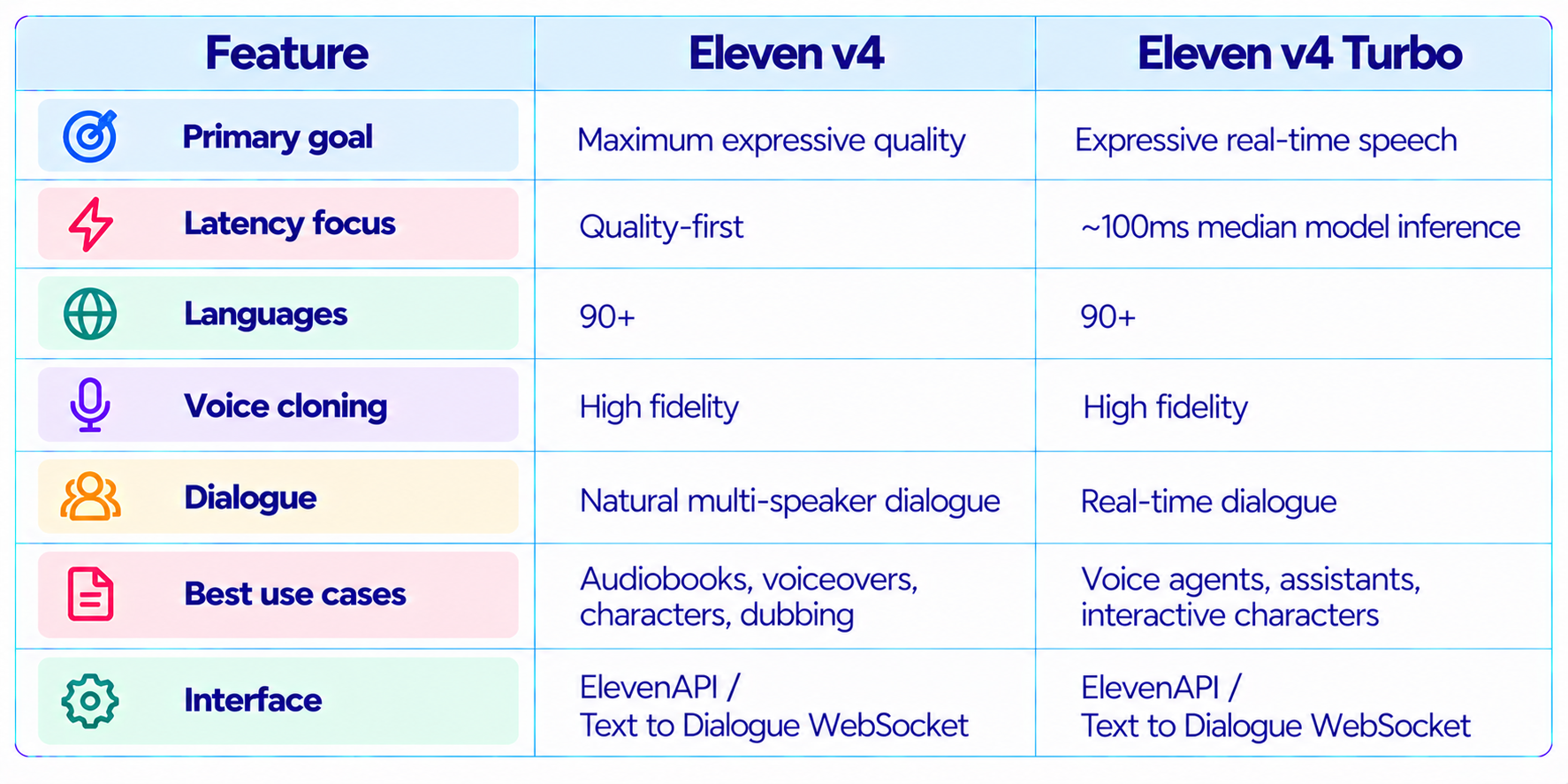
3. Eleven v4 Specifications
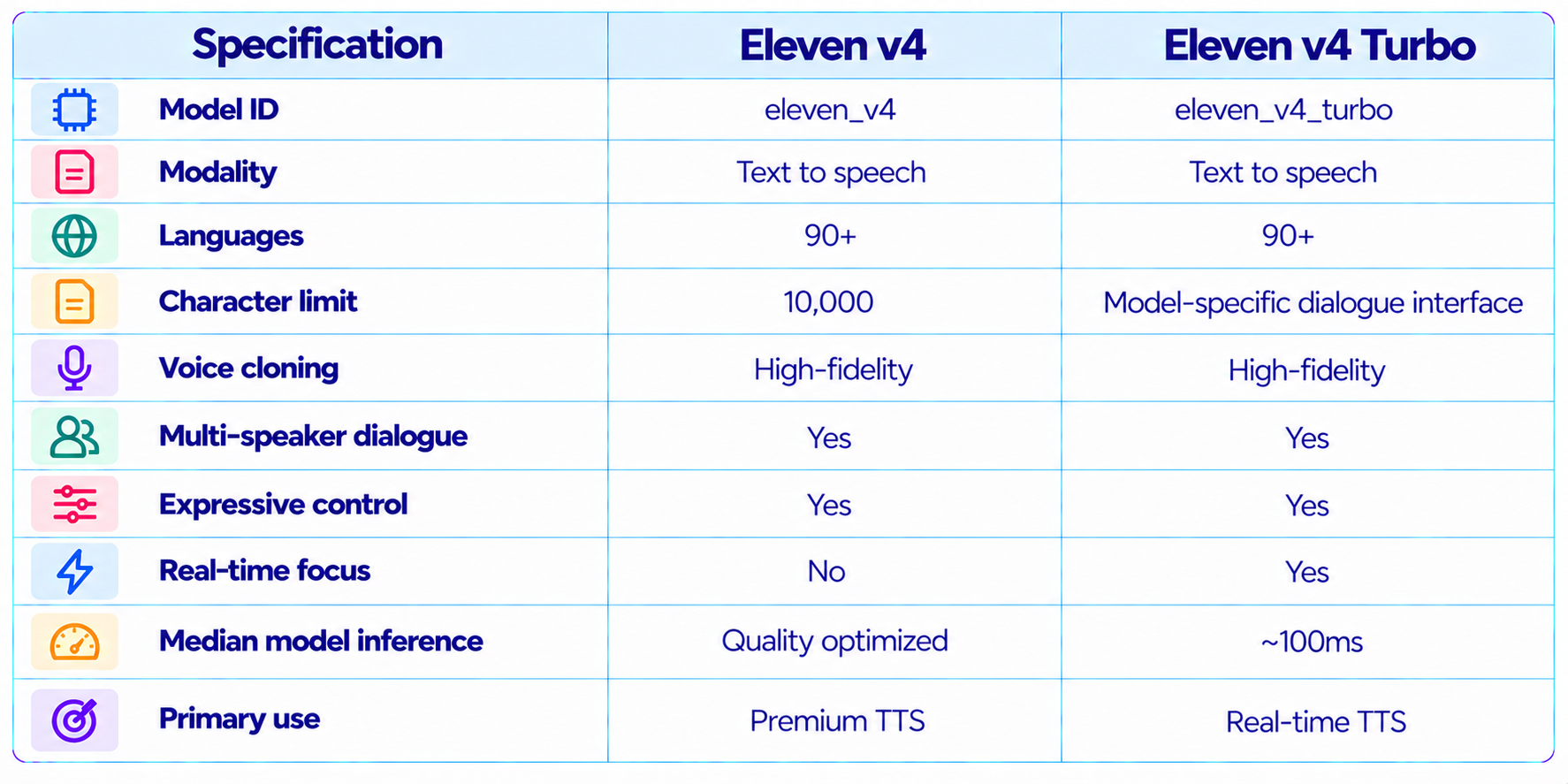
ElevenLabs currently lists a 10,000-character limit for Eleven v4, corresponding to roughly ten minutes of audio, and lists 90+ languages for the v4 family.
4. Audio Quality: How Good Is Eleven v4?
The core improvement is expressive control. ElevenLabs describes v4 as its most emotionally rich and expressive speech synthesis model. It is intended to understand how a line should sound rather than merely converting letters into phonemes.
This is especially valuable for scripted audio. A narrator needs different delivery for exposition and suspense. A game character needs different emotional states. A support agent needs empathy without sounding theatrical. The model's contextual approach is designed for those differences.
ElevenLabs also demonstrates audio tags such as [excited, happy] for fine-grained control. This lets creators put performance direction alongside the script rather than relying entirely on post-processing.
5. Artificial Analysis Benchmark
Artificial Analysis currently places Eleven v4 first in its Text to Speech Provider Voice Arena with an Elo of 1319. The leaderboard contains 1,674 samples for Eleven v4. The next group includes Cartesia Sonic 3.6 at 1276, Gemini 3.8 Flash TTS at 1267, Qwen-Audio-3.0-TTS-Plus at 1258 and Inworld Realtime TTS-2 at 1246.
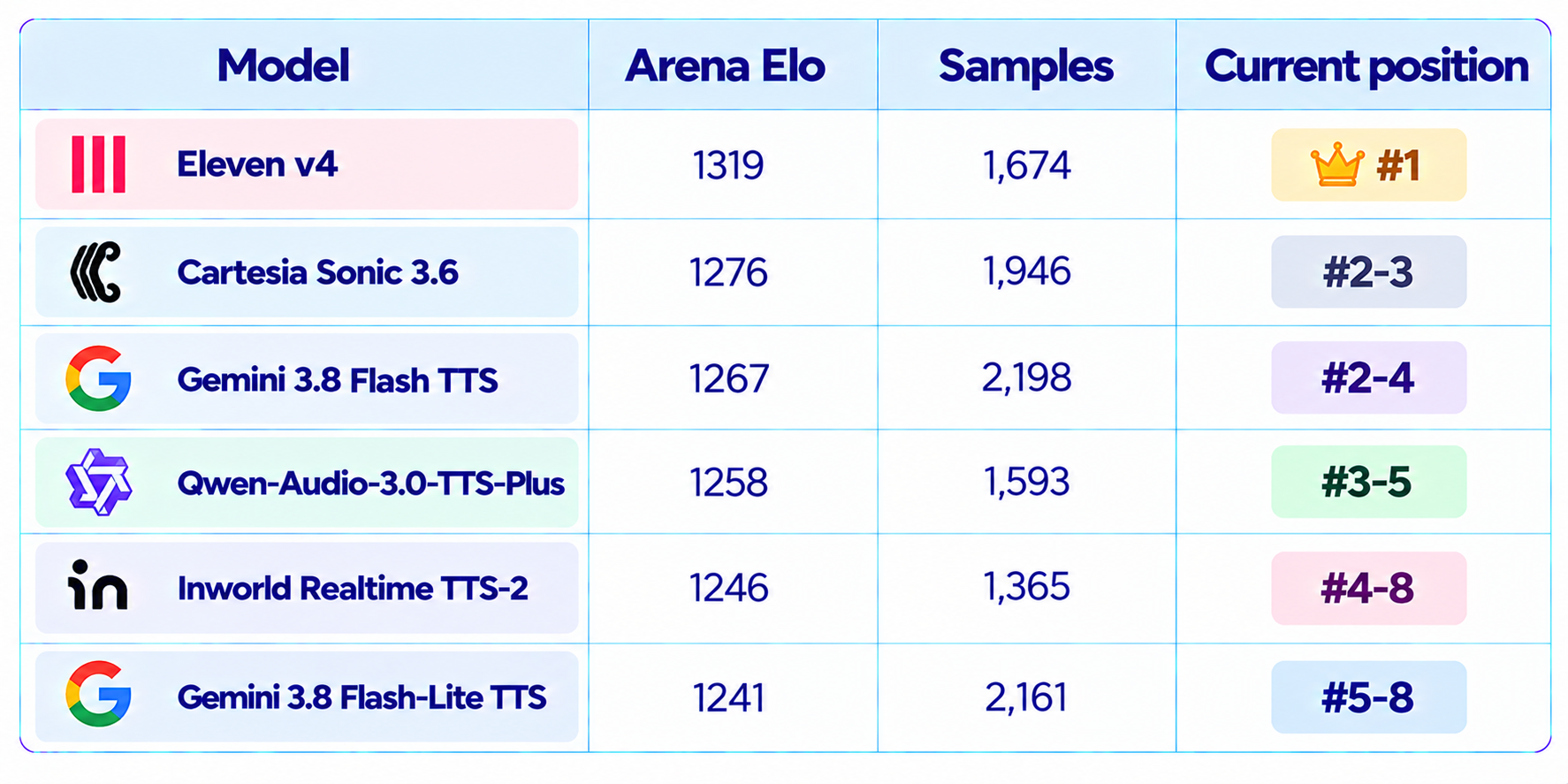
This is a listener-preference benchmark, not a transcription-style accuracy test. Artificial Analysis derives the Elo from blind comparisons in its Speech Arena, where listeners hear the same text generated by different models and choose which sounds more natural.
That makes the benchmark particularly relevant for expressive TTS. For a voice product, listener preference is an important outcome metric because naturalness and delivery directly affect whether people want to keep listening.
6. Eleven v4 vs Gemini 3.8 Flash TTS
Gemini 3.8 Flash TTS is one of the closest current competitors on the Speech Arena. Eleven v4 has an Elo of 1319 versus 1267 for Gemini 3.8 Flash TTS. Artificial Analysis also lists Gemini at a substantially lower normalized price.
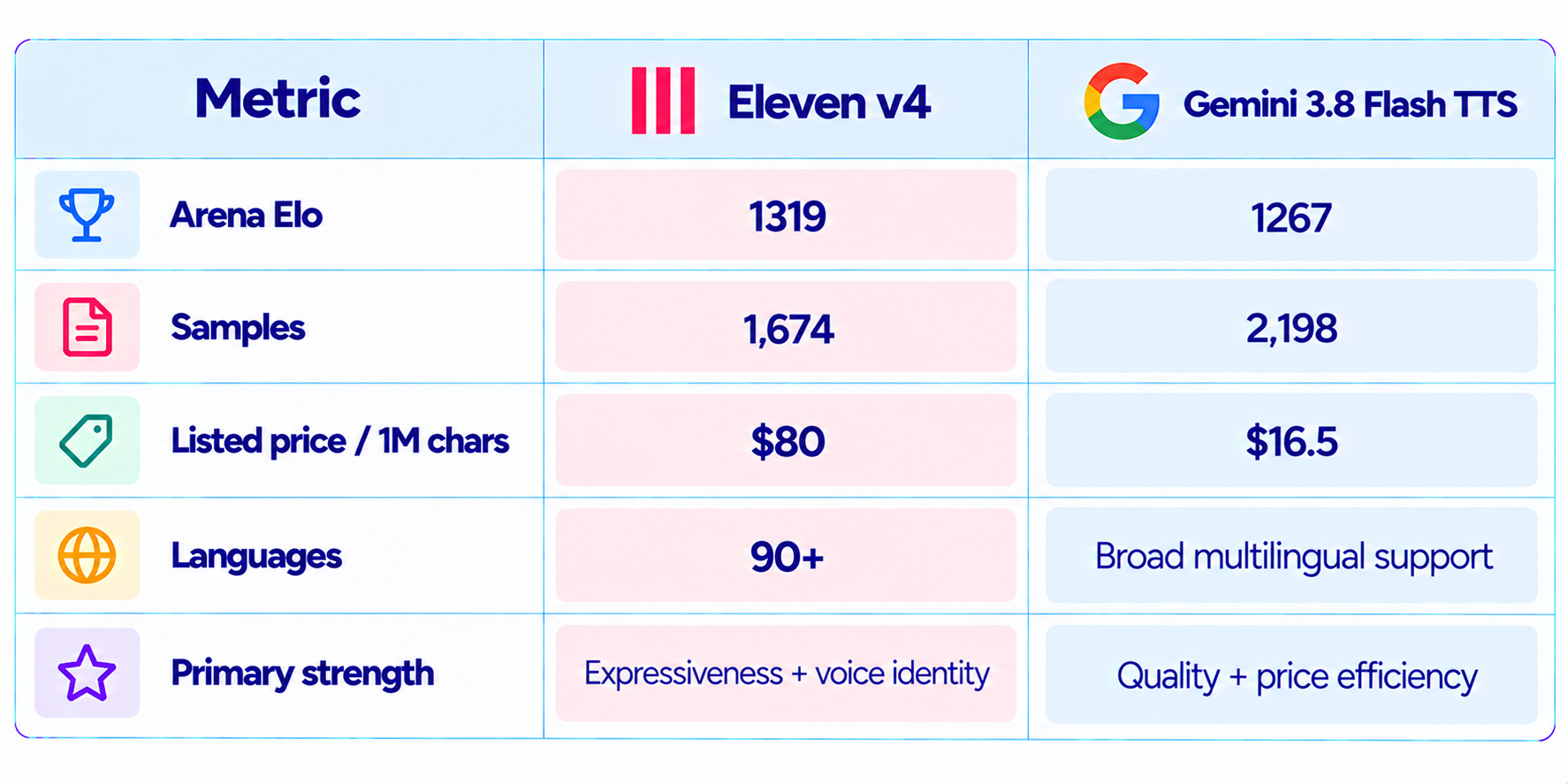
The tradeoff is straightforward. Eleven v4 currently leads the listener-preference leaderboard, while Gemini 3.8 Flash TTS is much cheaper on the same normalized pricing view. Teams should test their actual voices and scripts because benchmark rankings do not capture every production requirement.
Read our Gemini 3.8 Flash TTS and Flash-Lite TTS Review
7. Eleven v4 vs Gemini 3.8 Flash-Lite TTS
Gemini 3.8 Flash-Lite TTS currently has an Elo of 1241 on Artificial Analysis and a listed normalized price of $11 per million characters. It is positioned much more strongly around cost efficiency than premium expressive performance.
For large volumes of straightforward narration, the lower price can be important. For premium voice work, Eleven v4's current listener-preference lead and expressive feature set are more relevant.
8. Voice Cloning
Eleven v4 supports high-fidelity voice cloning, with ElevenLabs specifically highlighting speaker preservation across long text generations. That matters because a voice clone is useful only if it remains recognizably the same speaker throughout a production.
Professional Voice Cloning is available on paid plans. The current subscription documentation says cloning is available from Starter upward, while Professional Voice Cloning is included on Creator and higher plans.
For production, voice cloning should be evaluated with long samples, different emotional states and multiple languages rather than a single sentence. Identity stability is more important than a good first impression.
9. 90+ Language Multilingual TTS
The v4 family supports more than 90 languages, including English, Hindi, Gujarati, Marathi, Tamil, Telugu, Malayalam, Bengali, Arabic, Japanese, Korean, Spanish and French.
This makes Eleven v4 useful for localization because teams can build a multilingual voice workflow around one platform. The actual quality still needs language-specific testing, especially for names, regional accents, code-switching and emotional delivery.
10. Multi-Speaker Dialogue
Eleven v4 supports natural multi-speaker dialogue. ElevenLabs says speakers can respond using conversational context instead of sounding like isolated lines assembled independently.
That is useful for podcasts, scripted conversations, games, training simulations, interactive fiction and customer-support scenarios. Dialogue quality depends on the relationship between lines, not only the quality of each individual voice.
For multi-speaker production, give each speaker a clear identity and let the model use the surrounding context. Over-directing every sentence can make the conversation less natural.
11. Audio Tags and Expressive Control
Audio tags give creators another control layer over delivery. A script can specify an emotional direction without replacing the voice itself.
This is valuable when a character moves rapidly between emotional states. A voice can become excited, worried, calm or humorous while preserving the same speaker identity.
The strongest workflow is selective control. Use tags where the performance needs a deliberate change and allow the model to handle ordinary transitions naturally.
12. Eleven v4 Turbo for Real-Time Voice Agents
Eleven v4 Turbo is the model to examine when TTS is part of a live conversational loop. ElevenLabs reports approximately 100ms median model inference latency and lists support agents, AI assistants and interactive characters as target use cases.
That 100ms figure is model inference, not end-to-end time-to-first-audio. ElevenLabs notes that network round trips, server processing, audio buffering and upstream LLM latency all contribute to the real user experience.
For a complete voice agent, the practical target is a fast overall turn, not a low TTS number in isolation. v4 Turbo removes one major source of delay while preserving more expressive behavior than older speed-first models.
13. Eleven v4 Turbo vs Flash v2.5
ElevenLabs still describes Flash v2.5 as an ultra-fast, affordable model with roughly 75ms model inference latency. v4 Turbo is listed around 100ms, but it is designed around stronger expressive delivery and 90+ language support.
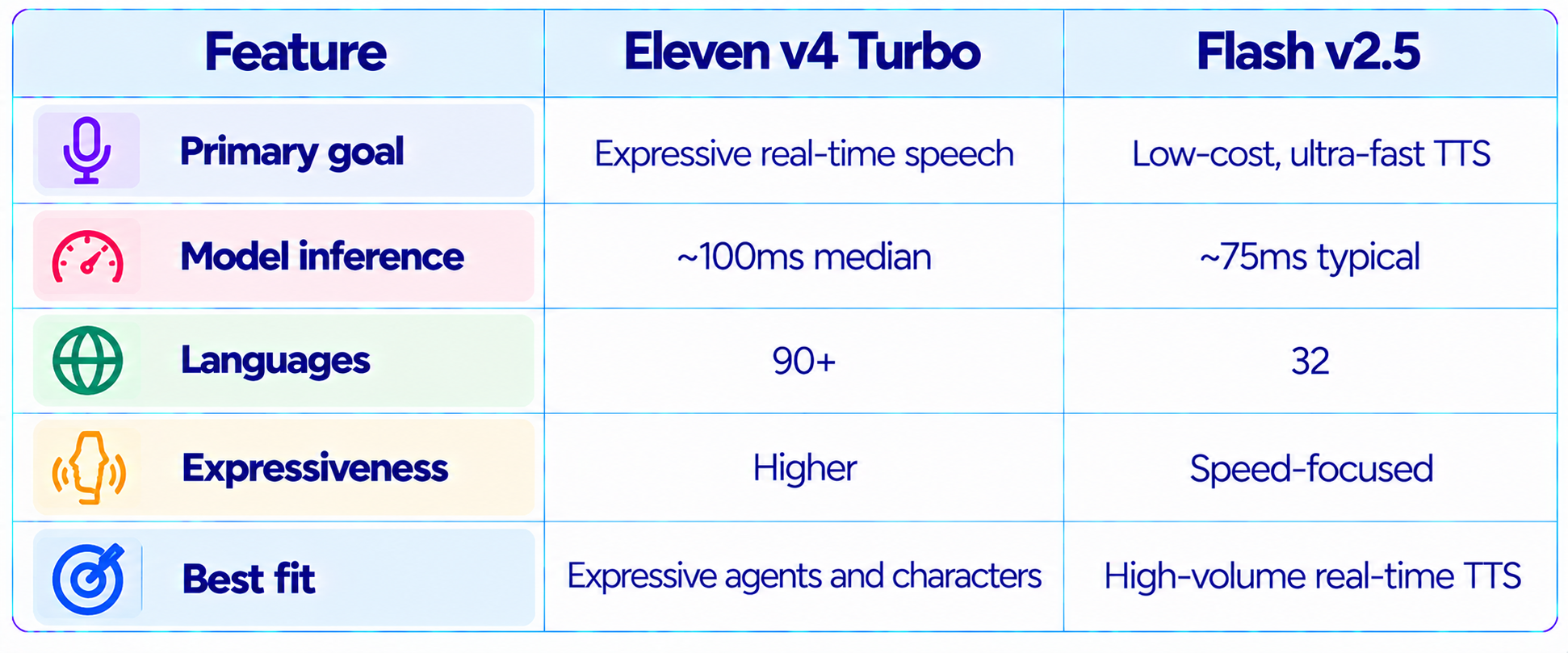
This is a deliberate tradeoff rather than a simple generational replacement. Flash v2.5 remains attractive when cost and raw latency dominate. v4 Turbo is more attractive when the voice itself is part of the user experience.
14. Eleven v4 Pricing
ElevenLabs uses a shared credit system across its products. On the website, text-to-speech consumes credits according to generated characters, while API usage has model-specific discounted rates.
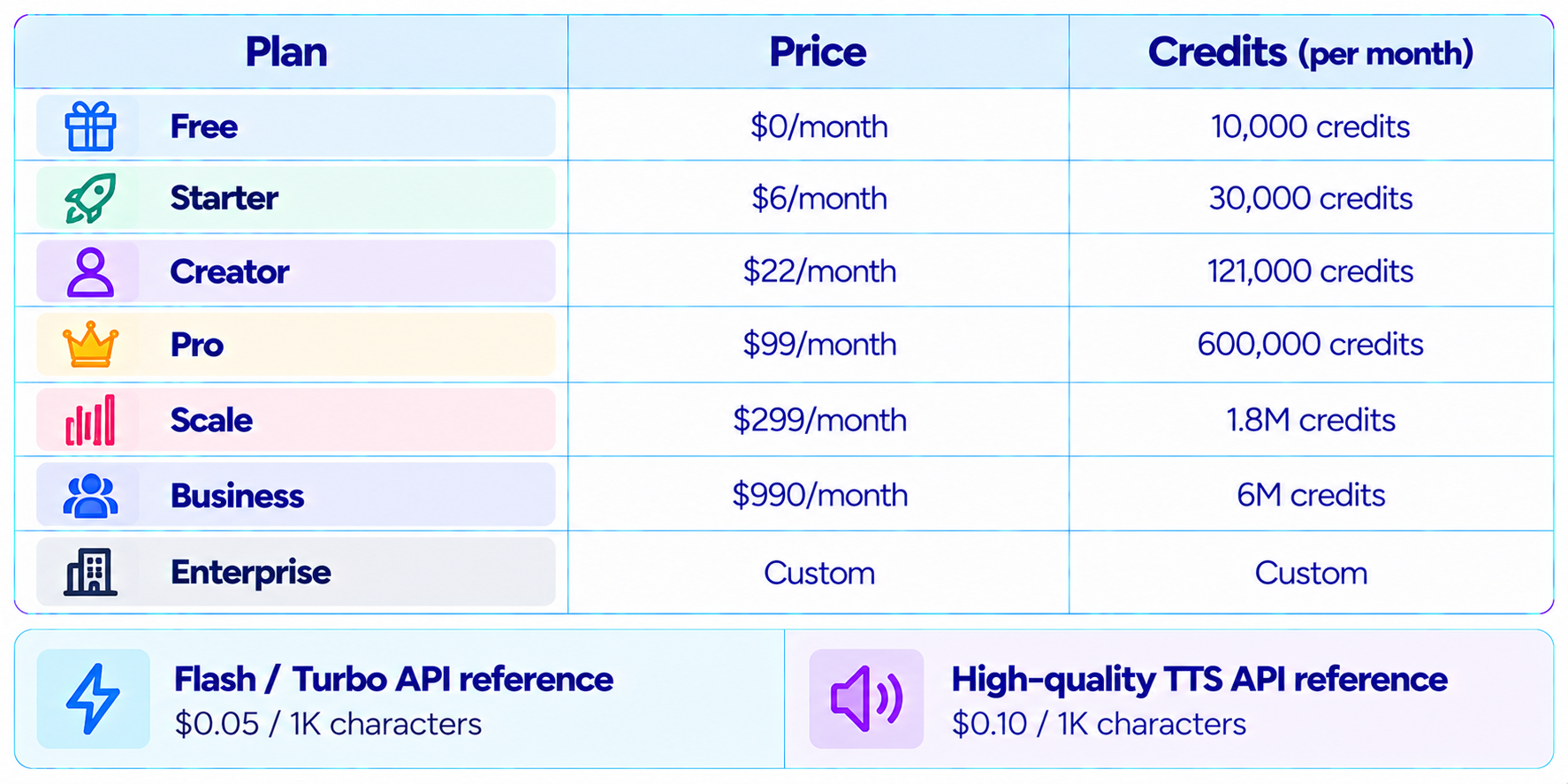
The current public API page lists Flash/Turbo at $0.05 per 1,000 characters and high-quality TTS such as v3 and Multilingual v2 at $0.10 per 1,000 characters. Because v4 is a new release, use the live ElevenAPI pricing surface for its exact production rate rather than assuming an older model's rate.
Paid plans include commercial rights. Higher plans add professional voice cloning, higher audio quality, more concurrency and collaboration features.
15. Eleven v4 for Audiobooks
Audiobooks are one of the clearest use cases for Eleven v4. The model needs to keep a recognizable narrator identity while varying emotion, pacing and emphasis over long passages.
ElevenLabs explicitly lists audiobook production as a v4 scenario and highlights improved request stitching. That matters because a full book is normally generated in sections rather than one enormous request.
A strong production workflow is to divide the manuscript into coherent scenes, maintain a stable voice configuration, generate several difficult passages for review and check transitions between files before mastering the complete audiobook.
16. Eleven v4 for AI Characters and Games
Character voices benefit from emotional range. A game character may need to sound calm in one scene and frightened in another without losing its identity.
Eleven v4's expressive controls and multi-speaker capabilities make it suitable for scripted game dialogue, interactive fiction and character-driven applications. v4 Turbo is the better fit when the character has to respond live to a player.
17. Eleven v4 for Dubbing and Localization
The 90+ language coverage makes v4 useful for multilingual content and dubbing workflows. A consistent voice identity across language versions can simplify production for creators publishing in multiple markets.
Dubbing quality still depends on more than translation. Timing, pronunciation, emotional matching and cultural adaptation all need review. The model provides a strong generation layer, but finished commercial localization benefits from human quality control.
18. Eleven v4 vs Cartesia Sonic 3.6
Cartesia Sonic 3.6 is currently one of the closest models to Eleven v4 on the Artificial Analysis leaderboard. Eleven v4 has an Elo of 1319 compared with 1276 for Sonic 3.6. The leaderboard lists Sonic 3.6 at $49 per million characters versus $80 for Eleven v4.
That creates a meaningful quality-price comparison. Eleven v4 currently leads listener preference, while Sonic 3.6 offers lower normalized cost. High-volume teams should benchmark their own voices before choosing based on the leaderboard alone.
19. Eleven v4 vs Inworld Realtime TTS-2
Inworld Realtime TTS-2 currently records 1246 Elo on Artificial Analysis and a listed normalized price of $20.8 per million characters. Eleven v4 is substantially more expensive on that measure but has a higher current listener-preference score.
For premium voice production, Eleven v4's ecosystem and expressive positioning are compelling. For large-scale real-time deployments, lower-cost competitors can be more attractive when their voice quality meets the application's threshold.
20. Best Use Cases
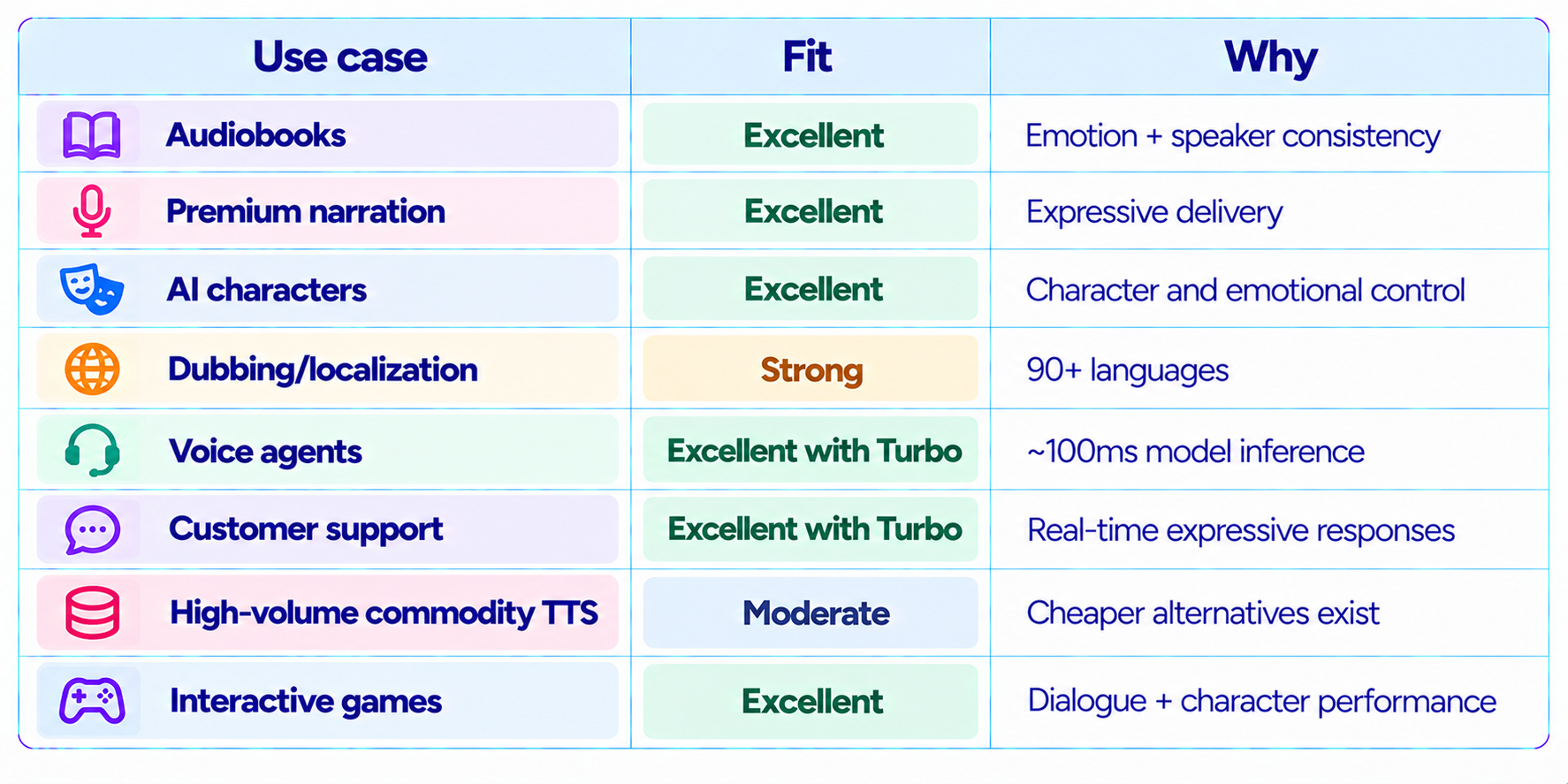
21. Limitations You Should Know
- Eleven v4 is more expensive than several competing TTS models on normalized character pricing.
- Standard v4 is quality-first, so v4 Turbo is better for strict real-time interaction.
- Model inference latency is not the same as end-to-end time-to-first-audio.
- The documented v4 single-request character limit is 10,000 characters.
- Multilingual quality should be tested language by language for production content.
- Professional voice cloning requires paid access and appropriate rights to the source voice.
- Pricing varies between subscription credits, API usage and product surfaces.
- Important commercial, dubbing and character productions should still receive human audio review.
22. Recommended Production Workflow
- Use Eleven v4 for final voiceovers, audiobooks, character performances and emotionally important scenes.
- Use Eleven v4 Turbo for conversational agents and interactive characters.
- Keep the same voice configuration throughout a production.
- Use emotional tags selectively instead of tagging every sentence.
- Generate long-form content in coherent scene-sized sections and review transitions.
- Test names, accents and emotional delivery in every target language.
- Measure actual time-to-first-audio from your application.
- Track cost per accepted minute or completed conversation, not only cost per character.
23. How to Evaluate Eleven v4 Yourself
Use the same script across every TTS model you are considering. Your test set should contain both simple narration and difficult performance cases.
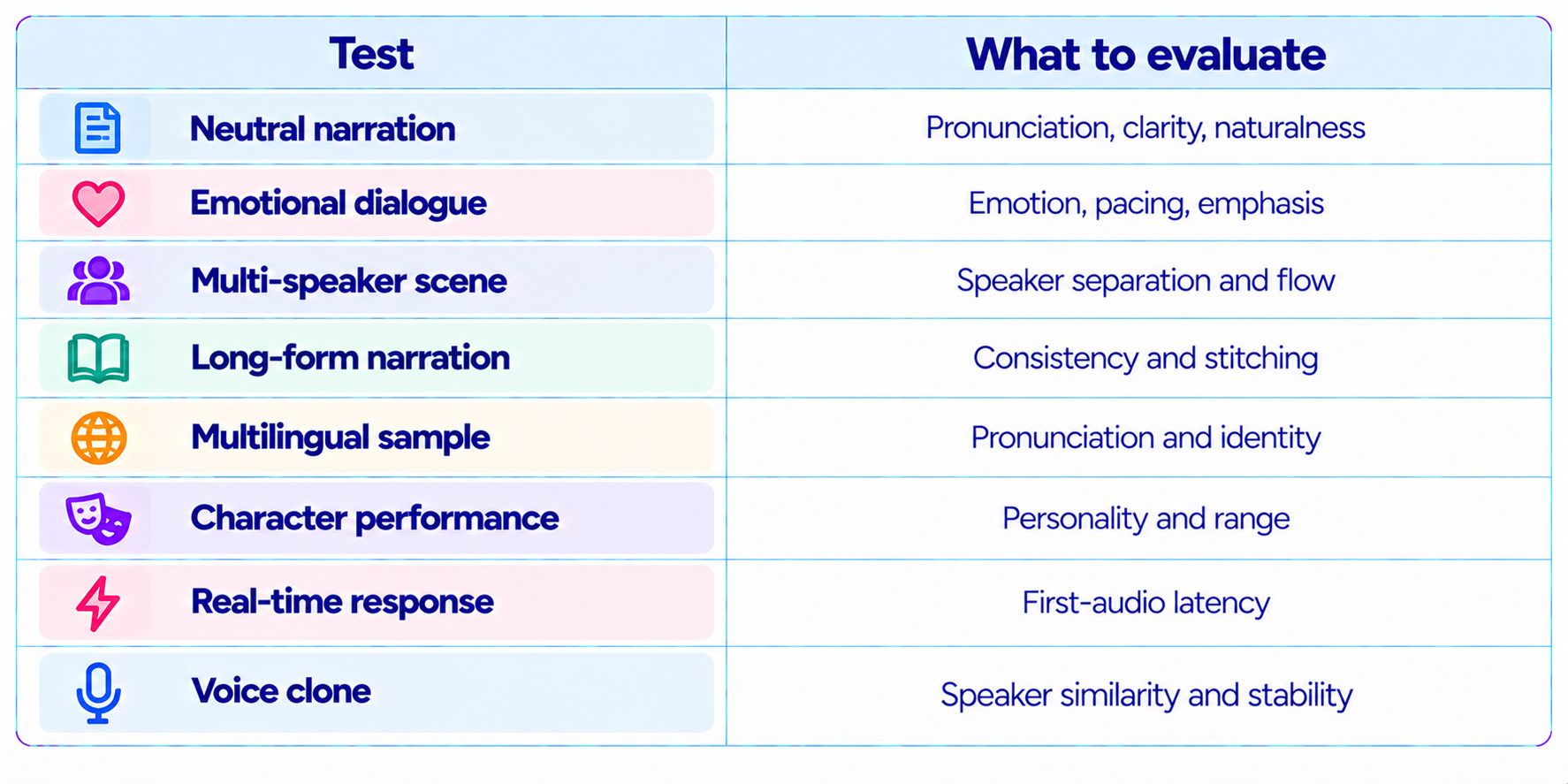
Combine listener ratings with technical metrics. A TTS system succeeds when people prefer the voice, the output is consistent enough for production and the economics work at the required scale.
24. Is Eleven v4 Worth It?
Eleven v4 is worth considering when expressive voice quality is central to the application. The current Artificial Analysis leaderboard places it first among tracked TTS models, while ElevenLabs has designed the model specifically around emotion, pacing, character and context.
It is less compelling as a universal lowest-cost TTS option. Gemini 3.8 Flash TTS, Gemini 3.8 Flash-Lite TTS, Inworld and Cartesia can offer different quality-price tradeoffs. The value of Eleven v4 is the combination of expressive performance, voice identity, language coverage and the broader ElevenLabs production ecosystem.
For voice agents, v4 Turbo is the more relevant model. Its reported ~100ms median model inference makes it appropriate for interactive systems while preserving the expressive direction of the v4 family.
25. Final Verdict
ElevenLabs Eleven v4 is one of the most important TTS releases of September 2026 because it treats speech as performance rather than simple synthesis. The model is designed to understand tone, emotion, pacing, character and context while preserving speaker identity.
The independent benchmark evidence supports its quality positioning. Artificial Analysis currently ranks Eleven v4 first in its Speech Arena with an Elo of 1319, ahead of Cartesia Sonic 3.6 at 1276 and Gemini 3.8 Flash TTS at 1267.
Eleven v4 Turbo makes the family more useful for developers. With approximately 100ms median model inference reported by ElevenLabs, it targets voice agents, assistants and interactive characters where responsiveness matters.
The biggest tradeoff is price. ElevenLabs is not the cheapest TTS provider, and the exact cost depends on model, API surface and subscription structure. That makes cost per accepted output more useful than headline price per character.
My rating: 9.5/10 for expressive quality, 9.2/10 for voice cloning, 9.0/10 for multilingual TTS, 9.3/10 for v4 Turbo real-time performance and 9.4/10 overall.
Bottom line: Eleven v4 is a strong choice for premium AI voice generation, audiobooks, character voices, dubbing and emotionally expressive narration. Eleven v4 Turbo is the better choice when those qualities need to work inside a real-time voice agent. Teams focused mainly on minimizing TTS cost should benchmark cheaper alternatives before committing.
Frequently Asked Questions
What is ElevenLabs Eleven v4?
Eleven v4 is ElevenLabs' flagship expressive text-to-speech model for high-quality speech, emotional delivery, voice cloning and natural dialogue.
What is Eleven v4 Turbo?
Eleven v4 Turbo is the real-time version of the v4 family, designed for voice agents, assistants and interactive characters with approximately 100ms median model inference latency.
How many languages does Eleven v4 support?
The Eleven v4 family supports 90+ languages.
Is Eleven v4 good for voice cloning?
Yes. ElevenLabs highlights high-fidelity cloning and speaker preservation across long generations.
How fast is Eleven v4 Turbo?
ElevenLabs reports approximately 100ms median model inference latency. Actual time-to-first-audio also depends on networking, buffering and application latency.
How much does Eleven v4 cost?
ElevenLabs uses credits for subscriptions and model-specific API pricing. The public API page currently lists Flash/Turbo at $0.05 per 1,000 characters and high-quality TTS such as v3/Multilingual v2 at $0.10 per 1,000 characters. Check the live v4 API rate before budgeting.
Is Eleven v4 better than Gemini 3.8 Flash TTS?
Eleven v4 currently has the higher Artificial Analysis Speech Arena Elo, while Gemini 3.8 Flash TTS has a much lower normalized price.
Does Eleven v4 support multi-speaker dialogue?
Yes. Natural multi-speaker dialogue is one of the documented v4 capabilities.
Is Eleven v4 good for audiobooks?
Yes. ElevenLabs specifically lists audiobook production as a v4 use case.
Is Eleven v4 good for AI agents?
Eleven v4 Turbo is specifically designed for real-time agents, while standard v4 is better for premium non-real-time voice generation.
Is Eleven v4 worth it?
It is a strong choice when expressive quality, voice identity and production control matter more than the lowest TTS cost.
Recommended Blogs
Omen Alpha Review: Benchmarks, Context & Is It Worth It? (2026)
Mercury 2.5 AI Model Review: Speed, Price & Is It Worth It? (2026)
How to Secure AI Coding Agents: Permissions, Sandboxing, MCP & Secrets
Resources & Community
Join our community of 70,000+ AI enthusiasts and learn to build powerful AI applications. Whether you're a beginner or an experienced developer, Build Fast with AI helps you understand and implement AI in your projects.
Agentic AI Launchpad 2026
A structured 6-week cohort program that takes you from AI basics to building and deploying real-world agentic AI systems. Includes live sessions, expert mentorship, project reviews and a builder community network.
Ready to go from learning to building? Join the next cohort: Agentic AI Launchpad 2026
Free AI Resources
Access free tools, workshops and micro-learning to keep building.

