


The job title almost nobody had heard of three years ago is now one of the most sought-after roles in AI. A Forward Deployed Engineer is the person who takes an impressive AI demo and turns it into a system that actually runs inside a real company, on real data, for real users. As companies discover that buying or building AI is easy but shipping it is brutally hard, the FDE has become the hire that decides whether an AI project succeeds or dies. This guide explains exactly what the role is, what an FDE does, the skills and pay involved, and why demand is exploding.
I will keep this practical and complete, because this is the definitive explainer for the role. Whether you are a company wondering if you need an FDE, an engineer considering the career, or just trying to understand the title that keeps appearing in AI job posts, by the end you will know what a Forward Deployed Engineer is, how they differ from a normal engineer, and where they fit in the AI world of 2026.
What Is a Forward Deployed Engineer?
A Forward Deployed Engineer is a software engineer who is deployed forward, out of the vendor's office and into the customer's environment, to build and ship a working system on the customer's real data and systems. The word forward is the key: instead of building a product in isolation and hoping it fits, the FDE sits with the customer, understands their actual workflow and constraints, and builds the solution where it will actually run. They own delivery from the messy middle through to a system running in production.
The role is a hybrid of three identities. It is part engineer, because the FDE writes real production code and builds real systems. It is part consultant, because they work directly with the customer to understand the problem and scope the right solution. And it is part problem-solver, because they adapt to whatever messy reality the customer's data and systems throw at them. That combination, technical depth plus customer-facing pragmatism, is what makes the role distinct and valuable.
In the AI era specifically, a Forward Deployed Engineer is the person who closes the gap between a model that works in a demo and a system that works in production. They are not researchers advancing models, and they are not salespeople selling them. They are builders who make AI actually work inside a specific company, which, as it turns out, is the single hardest and most valuable part of applied AI.
Where the Role Came From
The Forward Deployed Engineer role was popularised by Palantir, where engineers embedded directly with customers, from governments to large enterprises, to build and deploy software on the customer's real operations rather than shipping a generic product. Palantir's insight was that complex software only delivers value when someone technical sits inside the customer's reality and makes it work there. That model produced a generation of engineers who were equal parts builder and problem-solver, and the title stuck.
What turned a niche Palantir role into a widespread 2026 job is the rise of AI. Generative AI created an enormous gap between what a model can demo and what it can reliably do in production inside a real company. Suddenly every AI company and every enterprise adopting AI had the exact problem Palantir's FDEs were built to solve: get powerful but raw technology working in a messy real environment. The role spread fast because the problem spread fast.
Today the FDE title, and its close cousins like AI delivery engineer, AI implementation engineer, and applied AI engineer, appears across AI startups, services firms, and enterprises. The name varies but the job is the same: embed, build, and ship. For how the FDE differs from the adjacent pre-sales role, see our breakdown of Forward Deployed Engineer vs Solutions Engineer.
What a Forward Deployed Engineer Actually Does
Day to day, a Forward Deployed Engineer does whatever it takes to get a working system live inside the customer's environment, which spans understanding the problem, building the solution, and owning it into production. The work is varied by design, because the role exists to handle the full messy path from idea to running system, not one narrow slice of it.
- Embeds with the customer to understand their real workflow, data, and systems.
- Builds the actual system: data pipelines, integrations, and application code.
- Handles messy real data, edge cases, and legacy systems with no clean API.
- Adds the reliability layer: evaluations, monitoring, guardrails, and error handling.
- Decides what the AI may do alone versus what needs a human approval step.
- Ships to production and owns the system through to it running for real users.
The thread through all of this is ownership of outcomes, not tasks. A traditional engineer may be handed a well-defined ticket; an FDE is handed a business problem and a messy environment and is expected to return a working system. That responsibility for the whole journey, from vague problem to live system, is the essence of the role, and it is why the FDE touches the parts of a project most engineers never see.
FDE vs Traditional Software Engineer
A Forward Deployed Engineer differs from a traditional software engineer mainly in scope, customer contact, and ownership. A traditional engineer usually works inside one codebase on well-scoped tasks, with limited direct customer contact. An FDE works inside the customer's reality, on an open-ended problem, with constant customer contact, and owns the result through to production. Both write code; the context and the accountability are what differ.
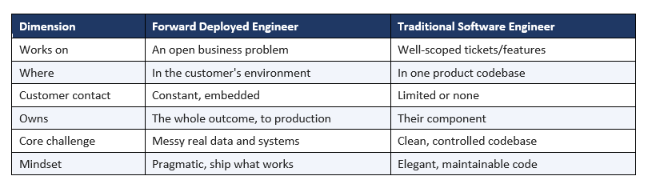
Neither role is better; they are built for different problems. The traditional engineer is ideal for building and maintaining a product at depth. The FDE is ideal for getting that product, or a custom solution, working inside a specific customer's messy reality. Many FDEs come from traditional software engineering and add the customer-facing and deployment skills, which is a natural and well-paid progression.
Why the Role Exists: The Demo-to-Production Gap
The Forward Deployed Engineer exists because of the demo-to-production gap, the enormous distance between an AI demo that works in a controlled setting and a system that works reliably in production. Building a demo is easy and fast; it is the easy 20 percent. Shipping a system, the real data, the integrations, the failure handling, the reliability, the ownership, is the hard 80 percent, and it is exactly where most AI projects die. The FDE is the specialist who crosses that gap.
Industry studies have long shown that the majority of AI projects never reach production. The model is rarely the reason; the reason is the organisational and engineering work around the model that nobody scoped. We cover this in depth in why AI POCs never reach production and the POC graveyard. The FDE role is the market's answer to that failure rate: hire someone whose entire job is to make AI actually ship.
This is why the role is valuable in a way that a job title alone does not convey. An FDE is not a nice-to-have; they are often the difference between an AI initiative that returns value and one that becomes an expensive demo in a graveyard. As more companies learn this the hard way, demand for people who can reliably ship AI keeps climbing.
The Skills a Forward Deployed Engineer Needs
A Forward Deployed Engineer needs three skill clusters: strong software engineering, AI and systems integration, and customer-facing delivery. The role sits exactly where building, AI, and people meet, so competence across all three matters more than being world-class in any one. Here is the core set.
- Software engineering: write, ship, and debug real production code (Python is the AI default).
- AI building: LLM APIs, prompting, RAG, and agent frameworks.
- Integration: APIs, databases, and automation patterns for systems with no API.
- Reliability: evals, monitoring, error handling, and security basics.
- Customer skills: scoping, communication, and shipping under real-world constraints.
We cover this in full in our dedicated guide to the skills a Forward Deployed Engineer needs, and the foundational concepts in our beginner guide to agentic AI. The short version: an FDE must be able to build, to deploy into messy reality, and to work with people, and it is the combination, not any single skill, that defines the role.
FDE vs Consultant vs Solutions Engineer
The Forward Deployed Engineer is often confused with a consultant or a solutions engineer, but the three are distinct, and the difference comes down to what they deliver. A consultant delivers advice, a solutions engineer delivers a sale, and a Forward Deployed Engineer delivers a working system. All three are customer-facing and technical to some degree, which is why they blur together, but their output is completely different.
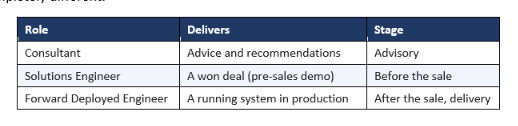
This is why an FDE is not just a technical consultant: a consultant hands over a slide deck, while an FDE hands over software that runs on the customer's real systems. And it is why an FDE is not a solutions engineer: the SE gets the customer to yes, the FDE makes it work afterward. We draw the SE line in detail in our Forward Deployed Engineer vs Solutions Engineer post. If you need a working outcome, not advice or a demo, the FDE is the role.
Common Myths About the FDE Role
A few myths keep people from understanding the Forward Deployed Engineer role, so it is worth clearing them up.
- Myth: an FDE is just a fancy name for a consultant. No, an FDE builds and ships running software, not recommendations.
- Myth: it is a support or implementation-only role. No, FDEs do real engineering, designing and building the system, not just configuring a product.
- Myth: it is only for Palantir or big tech. No, the role and its variants now span AI startups, services firms, and enterprises.
- Myth: you need a fancy degree. No, the role is judged on what you can build and ship, not credentials.
- Myth: it is less technical than a software engineer role. No, it is deeply technical, plus it adds customer-facing delivery.
The myth behind the myths is that customer-facing automatically means less technical. For the FDE, the opposite is true: they carry full engineering responsibility and the customer relationship at the same time, which is exactly why the role is scarce and well paid. Understanding that removes most of the confusion around the title.
A Day in the Life of an FDE
A typical day for a Forward Deployed Engineer blends customer conversations with hands-on building, which is a different rhythm from a heads-down developer role. The morning might be spent sitting with a customer's operations team to understand how they really process a workflow, and the afternoon building the system that automates it, switching fluidly between understanding a business problem and solving it in code.
A representative stretch of FDE work: watch the customer's team do a task manually, discover their core system has no API, design an automation around it, build the data pipeline that handles their messy inputs, add evaluations so everyone can trust the output, set up a human-approval step for the risky cases, demo it to the actual users, fix what breaks in the real world, and hand it over with an owner in place. The variety and closeness to the customer is what many builders find far more satisfying than abstract engineering.
The temperament the role rewards is as important as the skills. FDEs enjoy seeing their work actually used, get energy from turning a messy real problem into a working system, and are comfortable with ambiguity and direct customer contact. If that sounds appealing, the role is a strong fit; if you would rather never talk to a customer and only write clean code in isolation, it may not be.
Forward Deployed Engineer Salary and Demand
Forward Deployed Engineers are well paid, with compensation structured like a senior engineer's because the role demands both strong building and direct customer delivery, and pay climbs quickly with a proven ability to ship AI systems. In the AI era, FDE compensation has risen sharply because reliably shipping AI is a scarce, high-value skill. For detailed India bands, see our forward deployed engineer salary guide and the broader AI jobs in India salary guide.
Demand is strong and growing for a simple reason: the number of companies trying to deploy AI far exceeds the number of people who can actually ship it. Every AI startup needs FDEs to get their product working inside customers, every AI services firm needs them to deliver client projects, and every enterprise adopting AI needs them to make it work across the organisation. That demand, against a small supply of people with the full skill set, is what keeps the role well compensated.
The timing is favourable for anyone considering the career. The role is established enough to be well paid, but still niche enough that relatively few people are deliberately training for it, which means less competition than crowded fields like data science. That gap between demand and prepared talent is the opportunity.
Why Companies Hire a Forward Deployed Engineer
Companies hire a Forward Deployed Engineer when they have realised that the hard part of AI is not choosing a model but shipping it into their actual operations. A company may have bought an AI tool that does not fit, or built a demo that never reached production, or have a workflow that is clearly automatable but keeps stalling. In every case the missing ingredient is someone who can own the messy last mile, and that is the FDE.
The business case is straightforward. An AI project that never ships returns nothing on the money spent, while one that does ship can reclaim significant time or cost. The FDE is the person who moves a project from the first outcome to the second, which means their value is measured against the entire return of the deployment, not just their salary. For a company with a stalled or unstarted AI initiative, hiring or engaging FDE-style delivery is often the highest-return decision available, a point we make in build, buy, or hire.
This is also why demand has outpaced supply. As more companies learn, often the hard way, that demos do not equal systems, they go looking for people who can reliably ship, and discover there are not many. That scarcity is the FDE's advantage, and it is why the role commands strong pay and why building these skills is such a well-positioned career move.
Who Hires Forward Deployed Engineers
Three types of organisation hire Forward Deployed Engineers, and knowing them helps whether you are hiring or job-seeking. AI product startups hire FDEs to deploy their product into customers and keep them. AI services and consulting firms hire them to deliver client projects, which is the core of their business. And enterprises adopting AI increasingly build internal delivery or FDE-style functions to get AI working across the organisation.
- AI product startups: embedding and deploying their product with customers.
- AI services and consulting firms: delivering client AI projects end to end.
- Enterprises adopting AI: internal delivery and FDE-style teams.
A practical note for job-seekers: the exact title Forward Deployed Engineer is still emerging in many markets, so also look for AI delivery engineer, AI implementation engineer, applied AI engineer, and solutions-engineer roles with a delivery focus. Much of this is FDE work under a different name. We cover who is hiring in detail in top companies hiring forward deployed engineers.
How to Become a Forward Deployed Engineer
You become a Forward Deployed Engineer by building three things: strong software engineering, real AI and integration experience, and the ability to ship for real customers. The practical path is to get solid at coding, learn to build and deploy AI on real data, ship two or three end-to-end projects you can show, and target companies deploying AI. There is no single required degree; the role is judged on what you can build and ship.
The fastest route differs by starting point. A software engineer adds AI deployment and customer skills on top of an existing foundation. A data or ML person shifts from model-building toward shipping systems on real data. A beginner builds the software engineering foundation first, then layers AI deployment on top. In all cases, a portfolio of shipped, end-to-end projects beats any certificate, because the role is about delivery.
For the complete roadmap, skills, portfolio advice, and interview prep, see our full guide on how to become a Forward Deployed Engineer in India. The headline: learn to ship AI into real companies, prove it with real projects, and you are most of the way to one of the best-positioned careers in applied AI.
To summarise the whole role in one line: a Forward Deployed Engineer is the person who makes AI actually work inside a real company. Not the one who researches the model, not the one who sells it, but the one who embeds, builds, and ships it into production on real data and real systems. As AI spreads and the gap between demos and working systems stays wide, that is one of the most valuable things anyone in tech can do, and it is why the role has gone from a Palantir curiosity to a defining job of the AI era.
Frequently Asked Questions
What does a Forward Deployed Engineer do?
A Forward Deployed Engineer embeds with a customer to build, deploy, and run a working system on the customer's real data and systems. They own the hard 80 percent of production: integrations, messy data, edge cases, reliability, and the system running for real users. In the AI era, they are the people who turn an AI demo into a system that actually works.
What is the difference between an FDE and a software engineer?
A traditional software engineer works on well-scoped tasks inside one codebase with limited customer contact, while a Forward Deployed Engineer works on an open business problem inside the customer's environment, with constant customer contact, and owns the outcome through to production. Both write code; the FDE's scope, customer contact, and ownership are broader.
Why is the Forward Deployed Engineer role in demand?
The FDE role is in demand because most AI projects fail to reach production, and companies need people who can actually ship AI into real environments. Demand for people who can cross the demo-to-production gap far exceeds supply, which makes the role valuable and well paid, especially as more companies adopt AI.
How much does a Forward Deployed Engineer earn?
Forward Deployed Engineers earn at the higher end of engineering pay, structured like a senior engineer's because the role combines building with customer delivery, and compensation rises quickly with a proven ability to ship AI systems. Exact figures vary by company, market, and experience; see our FDE salary guide for detailed India bands.
Is Forward Deployed Engineer a technical role?
Yes, it is a deeply technical role; FDEs write and ship production code, build integrations, and engineer reliability. What makes it distinct is that the technical work is combined with customer-facing delivery, so an FDE also scopes problems and works directly with users. It is engineering plus delivery, not one at the expense of the other.
Is an FDE the same as a consultant?
No. A consultant typically advises and produces recommendations, while a Forward Deployed Engineer builds and owns a working production system. The FDE's output is running software on the customer's real systems, not a report. They embed like a consultant but ship like an engineer, which is the combination that makes the role valuable.
Do you need a degree to be a Forward Deployed Engineer?
No specific degree is required. A computer science background helps, but many strong FDEs are self-taught or come from software, data, or consulting routes. The role is judged on what you can build and deploy, so a portfolio of shipped, end-to-end projects matters more than a particular credential.
What industries use Forward Deployed Engineers?
FDEs work anywhere complex software or AI must be deployed into real operations: AI product companies, consulting and services firms, fintech, logistics, healthcare, government, and enterprises across sectors adopting AI. The common thread is a hard deployment into a real environment, which is exactly what the role exists to handle.
Is Forward Deployed Engineer a good career in 2026?
Yes. It is well paid, in rising demand, and built on a scarce skill, reliably shipping AI into production, that is hard to automate. Because most AI projects never reach production, people who can ship them are highly valued, and the role is still niche enough that competition is lower than crowded fields like data science.
What is the difference between an FDE and an ML engineer?
An ML engineer focuses on training models and ML infrastructure, while a Forward Deployed Engineer focuses on shipping working AI systems into real companies, owning integration, reliability, and delivery. The FDE works closer to the customer and the business outcome, whereas the ML engineer works closer to the model and the pipeline.
Recommended Blogs
- Forward Deployed Engineer Salary India 2026 (Bands)
- How to Become a Forward Deployed Engineer in India (2026)
- Forward Deployed Engineer vs Solutions Engineer (2026)
- Why AI POCs Never Reach Production (2026 Blueprint)
- What Is Agentic AI? Complete Beginner's Guide

