



Union Alpha Review: Is This New Stealth AI Model Actually Good for Coding Agents?
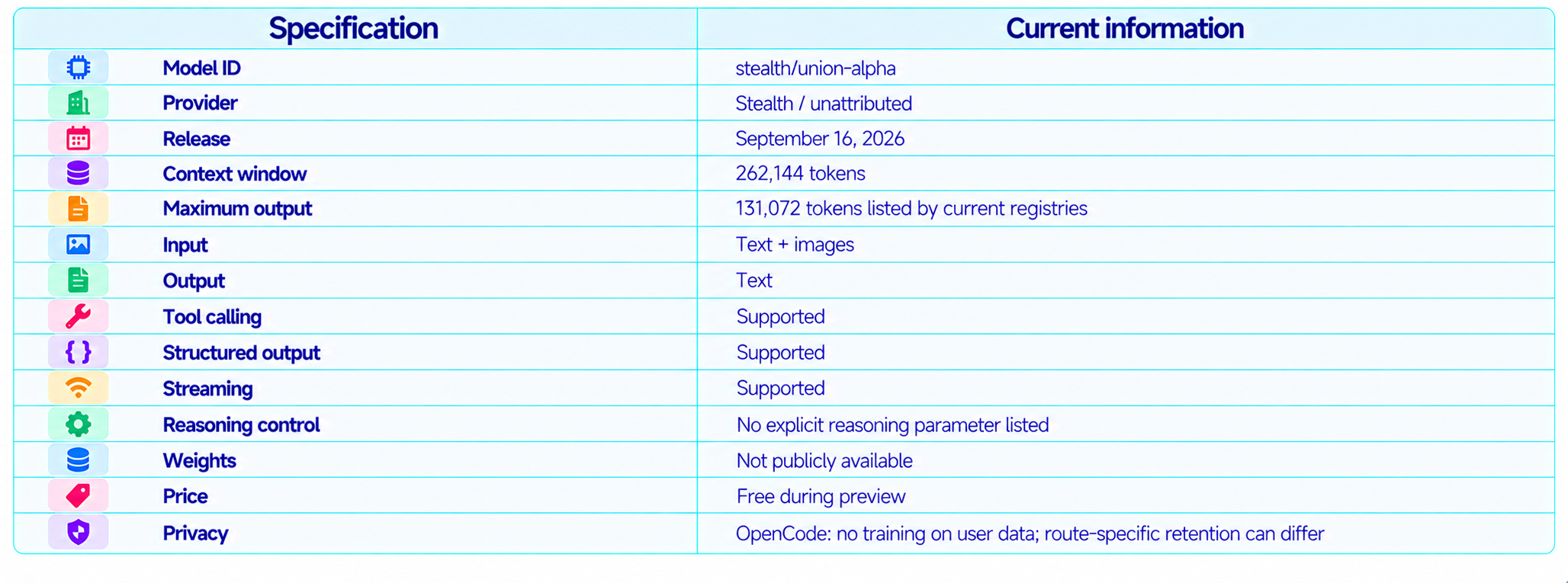
Union Alpha is a newly surfaced stealth AI model that appeared through OpenCode on September 16, 2026, with a 262,144-token context window, image input, tool calling and a free preview period. Unlike conventional model launches, the provider has not publicly identified itself, and the model does not ship with a public parameter count, architecture note or downloadable weights. The API surface, however, is already concrete.
The model is designed around agentic coding, research and long-context work. OpenCode says Union Alpha supports images and will be free during the preview window, while current model registries list text-and-image input, text output, a 262K context window, structured output, tools and streaming. The active metadata identifies the provider only as 'Stealth'.
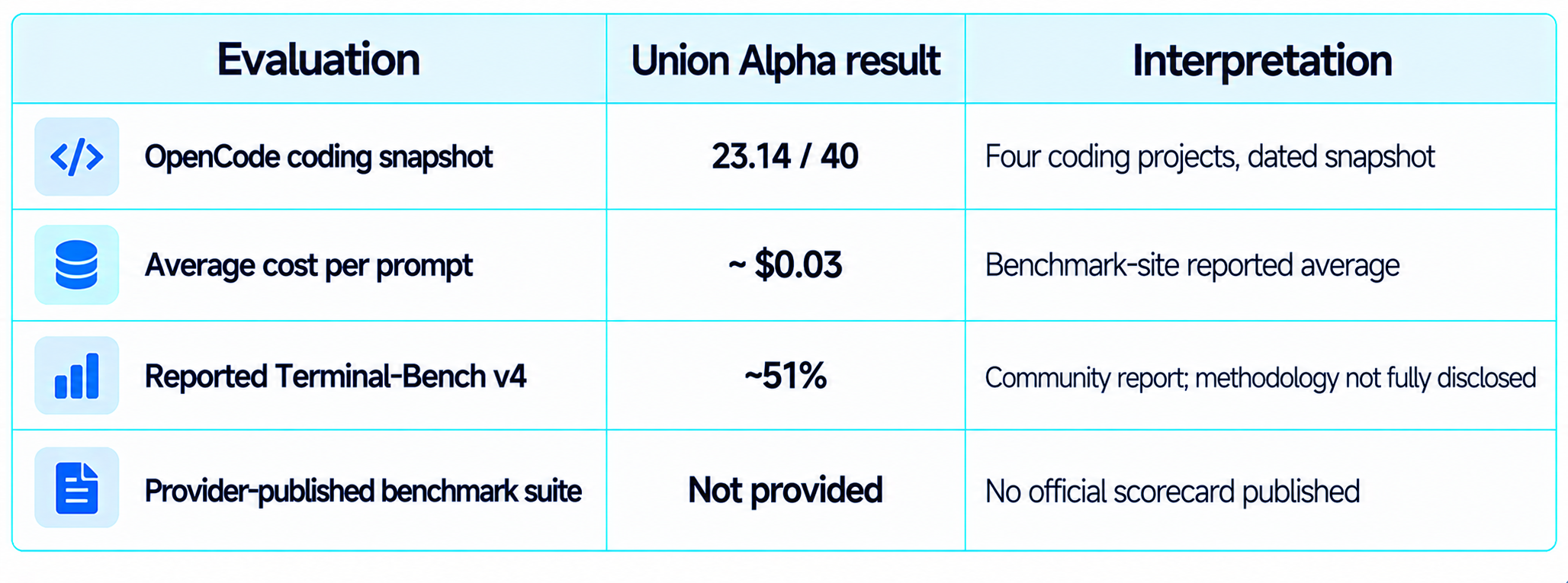
The performance story is now taking shape through independent and community testing. A current OpenCode benchmark snapshot reports 23.14 out of 40 across four coding projects, with about $0.03 average cost per prompt in that evaluation. Separately, a developer report circulated around launch claimed roughly 51% on Terminal-Bench v4 at about $1.50 per task. Those figures are source-specific measurements rather than a single standardized Union Alpha leaderboard score.
QUICK ANSWER
Union Alpha is a stealth model released through OpenCode on September 16, 2026. It is aimed at agentic coding, research and long-context work, with 262,144 tokens of context, image input, tool calling, structured output and streaming. OpenCode says the preview is free for about one week and is not used to train models on user data.
The model is currently free during the preview, with no published long-term price. OpenRouter and related model registries list the input and output price as $0 during the preview period. OpenCode's current documentation lists Union Alpha as not used for training and 0 days of data retention in its Go privacy table.
For coding performance, the available public evidence is community-driven. The OpenCode coding snapshot records 23.14/40 across four projects, while a separate developer report claims roughly 51% on Terminal-Bench v4 at around $1.50 per task. The Terminal-Bench post does not expose enough methodology to treat its percentage as a directly comparable standardized score.
The largest unresolved question is ownership. OpenCode's active documentation calls Union Alpha a stealth model and does not identify the laboratory behind it. Community theories have included GLM, Kimi and other labs, but none is officially confirmed.
My verdict: 8.7/10 overall. Union Alpha is worth testing for coding agents, image-assisted development and long-context work, particularly while the preview is free. Its biggest commercial question is what pricing and provider terms will apply after the preview.
1. What Is Union Alpha?
Union Alpha is a stealth model exposed through OpenCode and OpenRouter-style infrastructure under the model ID stealth/union-alpha. It arrived on September 16, 2026 and is described as a multimodal model for research, coding and agentic workflows. Current model metadata lists image input, text output, tools, structured output and streaming.
Unlike a traditional model release, the launch did not arrive with a named laboratory, public parameter count, architecture paper or model weights. That makes Union Alpha more useful to evaluate as a deployed model endpoint than as a model family that developers can inspect or self-host.
OpenCode's launch message specifically calls out agentic coding and image support. That places Union Alpha closer to the current generation of coding-agent models than to a general-purpose consumer chatbot.
2. Union Alpha Specifications
3. The 262K Context Window
At 262,144 tokens, Union Alpha has enough context capacity for large repository tasks, documentation-heavy debugging and long research prompts. It is smaller than the 500K context listed for Omen Alpha, but large enough to keep substantial project material in a single agent session.
The useful question is not just how much text fits. Developers should measure whether the model can find the right file, recover details from distant sections and maintain consistency after several tool calls. Context size is a capacity number, not a guarantee of long-context quality.
4. Image Input and Multimodal Coding
Union Alpha supports image input alongside text. That gives it an immediate use case in frontend and product-development workflows where the agent needs to reason from screenshots, diagrams or visual bug reports as well as source code.
A developer can provide a screenshot of a broken page, a design reference or a visual test result and ask the agent to connect what it sees with the underlying implementation. This is especially useful for UI debugging, CSS fixes and visual regression workflows.
The current metadata describes text output rather than image generation. Union Alpha is therefore best treated as a multimodal reasoning and coding model, not a media-generation model.
5. Tool Calling and Agentic Coding
The current API surface accepts tool calls and tool_choice, along with response formatting and streaming. OpenCode explicitly markets the model for agentic coding.
That matters because a coding agent is not useful merely because it can generate code. The model has to decide what file to inspect, which command to run, how to interpret the result and when the task is complete.
6. Union Alpha Coding Benchmarks
7. How Good Is Union Alpha for Coding?
The available evidence points to a model that is intended to be useful for coding agents, but the right way to evaluate it is through task completion rather than the anonymity of its provider.
The current coding snapshot shows Union Alpha completing four benchmark projects with a 23.14/40 aggregate. The same evaluation estimates an average cost of roughly three cents per prompt.
Community reports around the launch describe strong results on coding-agent tasks, but there are also reports of inconsistent context recall and failures inside OpenCode. Those differences are why agent performance should be tested on a controlled repository instead of inferred from a few anecdotes.
For practical development, use Union Alpha for repository exploration, feature implementation, debugging and UI work, then route high-risk changes through automated tests and a second model.
8. Union Alpha Speed and Latency
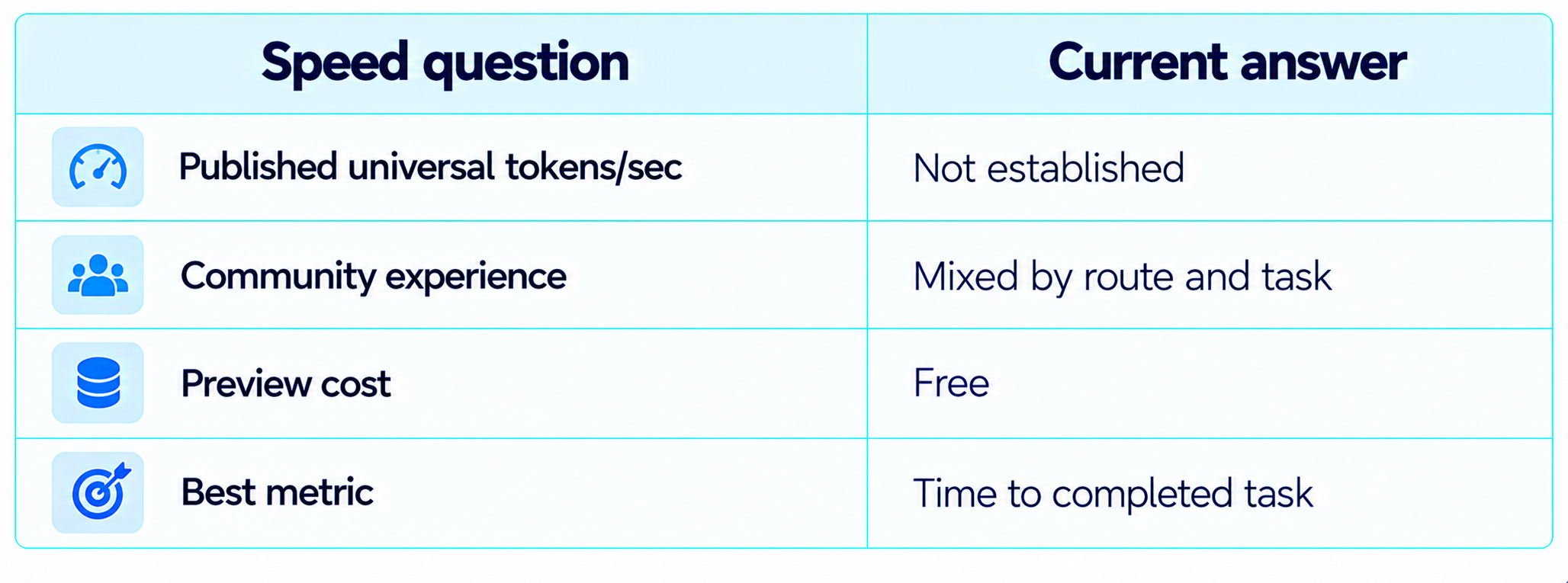
Unlike Omen Alpha, there is not yet a reliable universal Union Alpha throughput figure that can be treated as a standard speed benchmark. Launch-day community posts describe the model as slow through some routes, while other users focus more on coding quality than raw tokens per second.
That distinction matters. A free model with a large context and image support can still be useful even if it is not a high-throughput model. For coding agents, total task time includes model reasoning, tool calls, compilation, tests and network latency.
9. Union Alpha Pricing
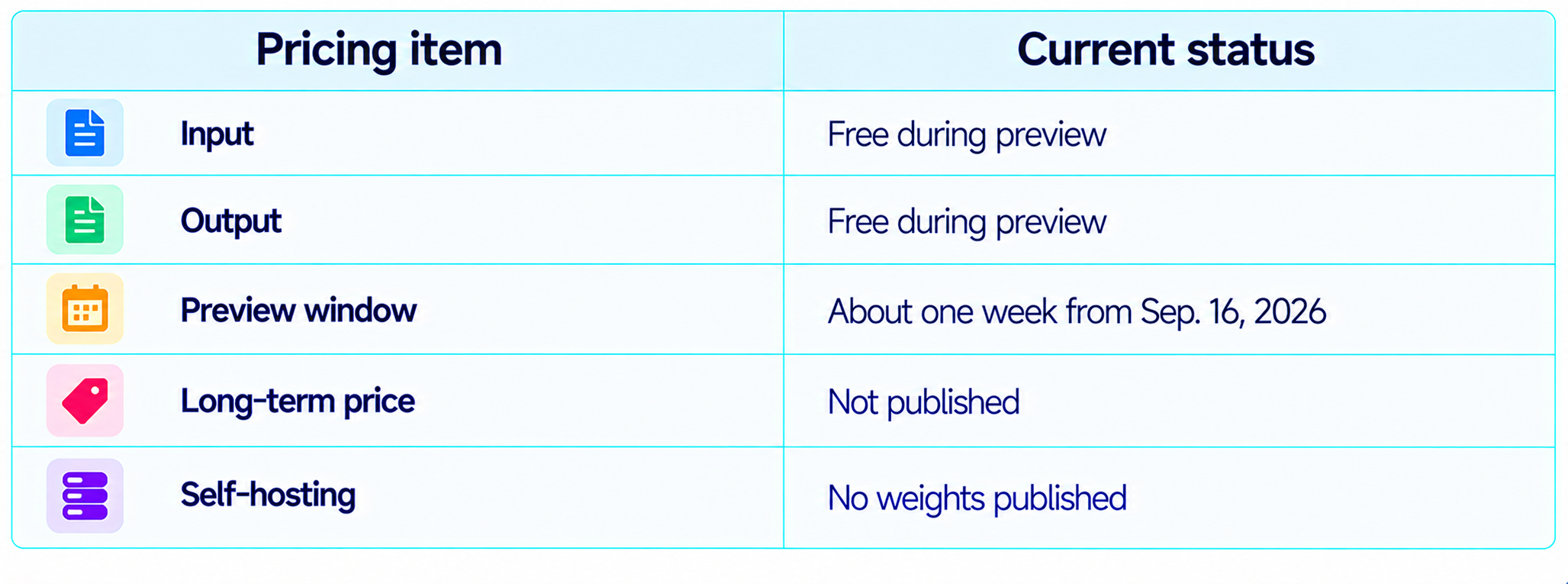
Union Alpha is currently free during the preview period. OpenCode says the model will be free for the next week from its September 16 launch, while current model registries also show $0 input and output during the preview.
The important commercial question comes after the preview. Developers should not assume today's free rate will become the production rate. The current preview is best treated as an evaluation opportunity.
10. Privacy and Data Retention
OpenCode's current Go documentation lists Union Alpha as not used for training and 0 days of data retention. That is an attractive privacy posture for a coding-agent service.
Privacy can still depend on the route used to access the model. Third-party API documentation notes that retention policies can differ between hosts. Developers should therefore verify the policy of the endpoint they actually call.
For private repositories, credentials and client code, keep tool permissions and secrets isolated even when the model itself has a zero-training or zero-retention policy.
11. Who Made Union Alpha?
The provider has not been publicly identified. OpenCode's documentation currently labels the model as a stealth model, and third-party registries list the provider as Stealth or OpenCode rather than a named AI lab.
Several community theories have already emerged. Some users have suggested Chinese model families such as GLM or Kimi, while others have suggested different origins. Those guesses are based on behavior, timing or perceived model style and are not confirmed by the provider.
This is more than a branding detail. Knowing the lab normally tells developers more about model lineage, data handling, roadmap and licensing. Until the provider is disclosed, Union Alpha should be evaluated as a black-box service.
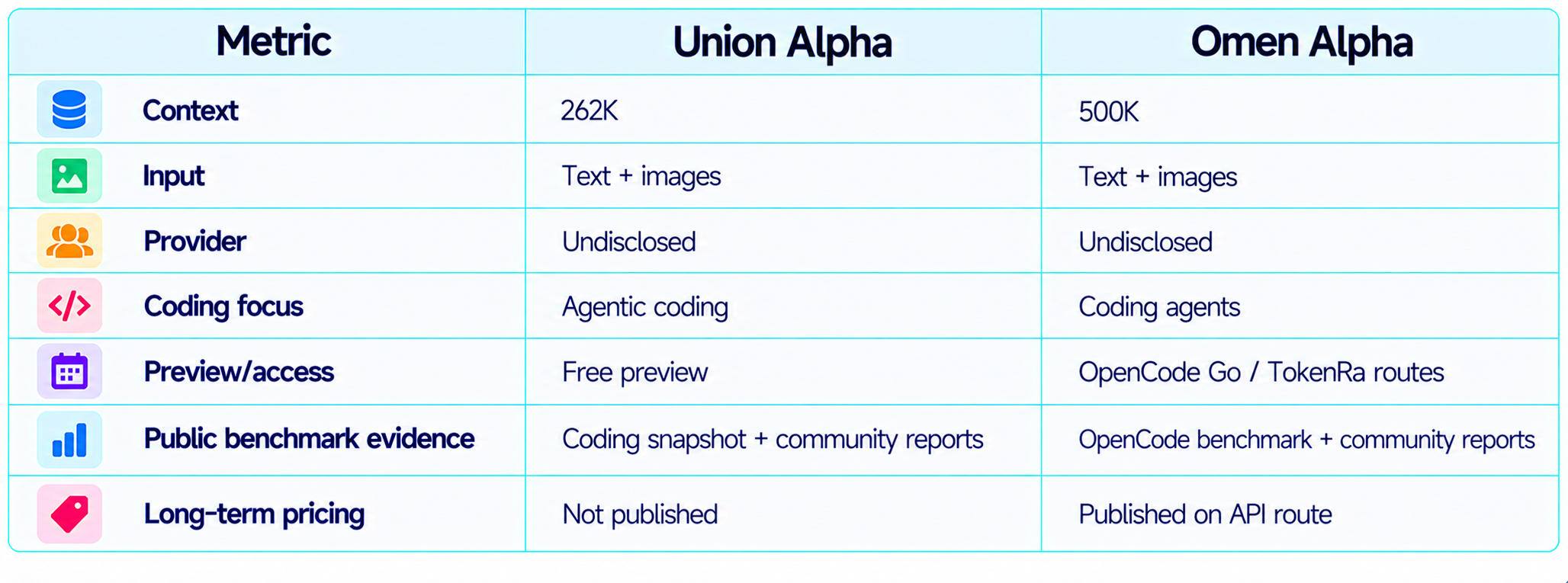
12. Union Alpha vs Omen Alpha
13. Union Alpha vs GLM Family Models
The GLM comparison is mostly about attribution rather than a confirmed model-to-model benchmark. Community users are already asking whether Union Alpha belongs to the GLM family, but there is no official source identifying it as a Zhipu model.
Developers should therefore compare the actual endpoints rather than trying to infer lineage. If Union Alpha consistently behaves differently from GLM-5.3-Flash under the same prompts, tools and repository, that is useful evidence regardless of who built it.
14. Union Alpha vs GPT-6 Astra
GPT-6 Astra is a useful practical reference because developers can compare a documented frontier model with an anonymous stealth endpoint. The comparison should focus on task completion, context, tool reliability and cost rather than attempting to infer model lineage.
The practical question is how many real repository tasks Union Alpha can complete correctly before a documented frontier model becomes necessary. That is a more useful measure than guessing the hidden provider.
15. Long-Context and Research Use Cases
Union Alpha's 262K context makes it suitable for research sessions that combine multiple documents, code files, specifications and tool outputs. Image input adds another dimension for document screenshots, diagrams and visual references.
Research is also a useful benchmark because the evaluation can be structured around evidence retrieval. Give the model a fixed document set, ask the same questions as another model and check whether it identifies the relevant sections correctly.
16. Best Use Cases
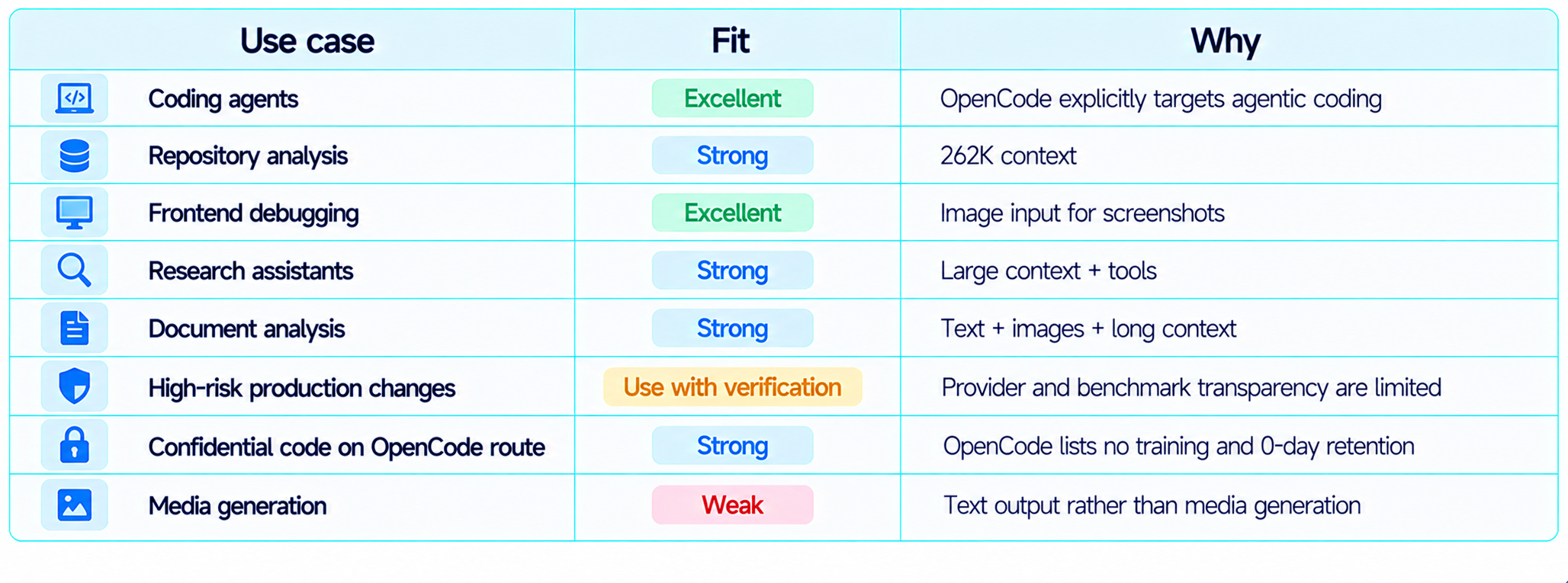
17. Recommended Production Workflow
Use Union Alpha as a testable worker model rather than making it the only model in your coding stack.
Start with repository exploration and low-risk feature tasks.
Use image input for UI screenshots, design references and visual bugs.
Keep automated tests and linting between model-generated changes.
Use a documented frontier model for high-risk architecture or security changes.
Compare Union Alpha with Omen Alpha, GLM-family models and your existing coding model on the same repository.
Track task completion, retries, tool failures, latency and cost.
Recheck pricing and privacy terms when the preview period ends.
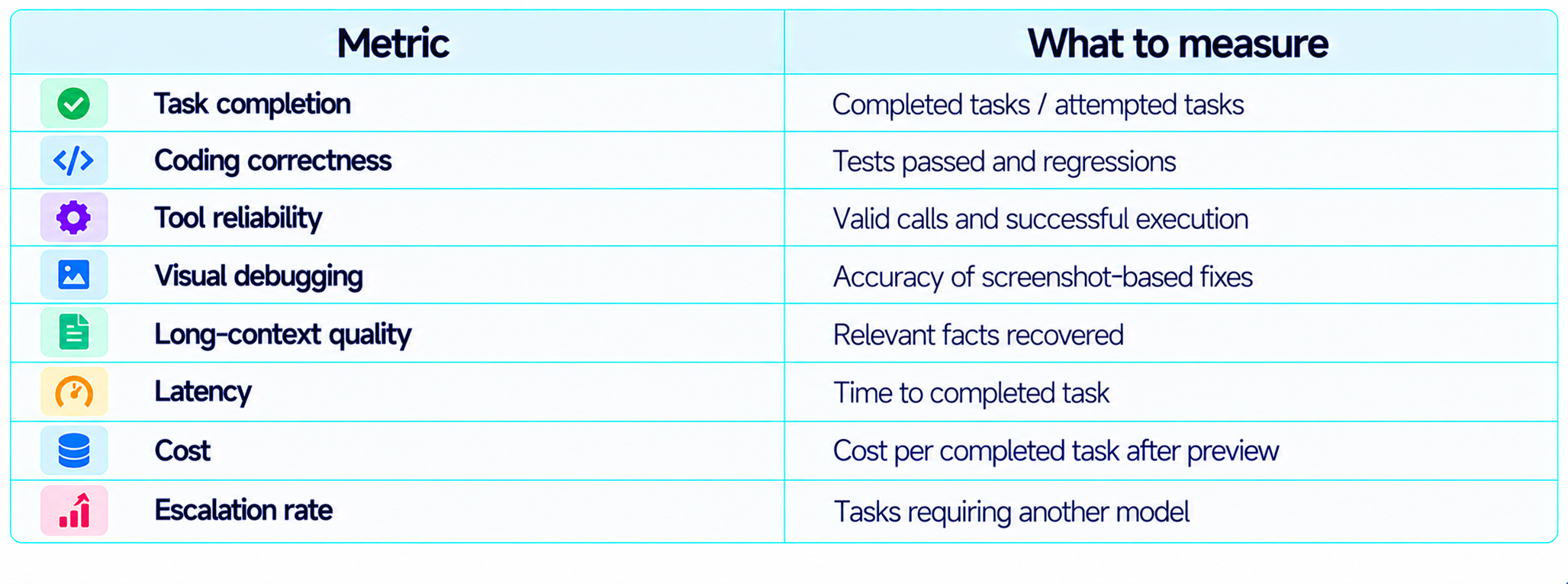
18. How to Evaluate Union Alpha Yourself
19. Is Union Alpha Worth Testing?
Yes. The free preview, 262K context, image input and tool support make Union Alpha easy to test against real coding and research workflows. OpenCode is explicitly positioning it for agentic coding, and current benchmark snapshots provide enough information to build a useful test set.
The model is most interesting when you treat the preview as a chance to run your own benchmark. Test repository tasks, UI fixes, long-context research and multi-step tool use instead of spending all your time trying to identify the lab.
The biggest commercial question comes after the preview. Until a public price is announced, Union Alpha is best considered a free evaluation opportunity rather than a stable production cost baseline.
Omen Alpha is a useful comparison because it is another stealth coding model associated with OpenCode. The two models differ in their available metadata and access model.
- The underlying provider has not been publicly identified.
- No public model weights, parameter count or architecture description are available.
- Long-term pricing after the free preview has not been published.
- Published benchmark evidence is currently a mix of community results and limited evaluation snapshots.
- The reported Terminal-Bench v4 result is a community measurement and should not be treated as a standardized vendor score.
- API behavior and availability can differ by host or route.
- Current usage data is too small to treat OpenCode rank as a model-quality leaderboard.
- Large context does not guarantee correct long-context retrieval.
A stealth model is best judged by controlled tests. Use the same repository, prompts, tools and timeout policy across Union Alpha and your existing coding models.
This removes the biggest distraction around Union Alpha: its name. You do not need to identify the lab to know whether it helps your workflow.
20. Final Verdict
Union Alpha is one of the more unusual AI model releases of September 2026 because the API is real while the identity behind the model remains hidden. OpenCode presents it as a stealth model for agentic coding with image support, while current model metadata gives it a 262K context window, tools, structured output and a free preview.
The available performance evidence is promising but should remain source-labeled. The OpenCode coding snapshot reports 23.14/40 across four projects, and a separate developer report claims roughly 51% on Terminal-Bench v4. The first is a dated third-party evaluation with visible methodology limits, while the second does not publish enough detail to reproduce the score.
The model's practical profile is compelling: large enough context for repository work, image input for UI debugging, tool support for agents and no-cost preview access. OpenCode also lists no training on user data and 0 days of retention for the current Go route, although developers should verify the privacy terms of any other host they use.
The main limitation is transparency. There is no named provider, no downloadable model, no published architecture and no stable post-preview price. Community theories about GLM, Kimi or other labs remain theories until the provider confirms the identity.
My rating: 9.1/10 for coding-agent potential, 9.2/10 for preview value, 8.8/10 for multimodal usefulness and 8.7/10 overall.
Bottom line: Union Alpha is worth testing now, especially for coding agents, visual debugging and large-context research. Use the free preview to benchmark it against your current models, and judge it by completed work rather than the mystery around its provider.
Frequently Asked Questions
What is Union Alpha?
Union Alpha is a stealth AI model released through OpenCode for agentic coding, research and long-context workflows, with image input and tool support.
When was Union Alpha released?
It appeared through OpenCode on September 16, 2026.
Who made Union Alpha?
The underlying provider has not been publicly identified.
Is Union Alpha free?
It is free during the current preview period, which OpenCode describes as lasting about one week from launch.
What is the Union Alpha context window?
Current model registries list 262,144 tokens.
Does Union Alpha support images?
Yes. OpenCode and current model metadata list image input.
Does Union Alpha support tools?
Yes. The API accepts tool calling and tool_choice along with structured output and streaming.
What are the Union Alpha benchmark results?
A current OpenCode coding snapshot reports 23.14/40 across four coding projects. A separate developer report claims about 51% on Terminal-Bench v4, but its full methodology is not published.
Is Union Alpha the same as GLM?
That has not been confirmed. GLM and other lab attributions are community speculation.
Does Union Alpha use user data for training?
OpenCode currently lists Union Alpha as not used for model training and 0 days of retention on its Go route. Check the policy for other hosts.
Can I run Union Alpha locally?
No public weights are available, so current access is through hosted API and agent platforms.
Is Union Alpha worth testing?
Yes. Its free preview, image support, tools and 262K context make it useful to benchmark against existing coding models.
Recommended Blogs
Omen Alpha Review: Speed, Price, Coding & Is It Worth It? (2026)
Quasar 438B Review: Benchmarks, Speed, Price & Is It Worth It? (2026)
GPT-6 Astra Review: Benchmarks, Price & Is It Worth It? (2026)
Meta Muse Spark 1.3 Review: Coding, Price & Is It Worth It? (2026)
Gemini 3.8 Flash Review: Accuracy, Price & Is It Worth It? (2026)
Qwen 3.8 Max 0902 Review: Benchmarks, Price & Is It Worth It? (2026)
How to Secure AI Coding Agents: Permissions, Sandboxing, MCP & Secrets
Resources & Community
Join our community of 70,000+ AI enthusiasts and learn to build powerful AI applications. Whether you're a beginner or an experienced developer, Build Fast with AI helps you understand and implement AI in your projects.
Agentic AI Launchpad 2026
A structured 6-week cohort program that takes you from AI basics to building and deploying real-world agentic AI systems. Includes live sessions, expert mentorship, project reviews and a builder community network.
Ready to go from learning to building? Join the next cohort: Agentic AI Launchpad 2026
Free AI Resources
Access free tools, workshops and micro-learning to keep building.

