
SKY-001 Review: Can Skyfall AI's Engineering World Model Make CAD and BIM 100x More Efficient?
SKY-001 is an engineering world model announced by Skyfall AI on October 19, 2026. It is designed to turn a text prompt or a 2D visual reference into a structured engineering design, then plan the steps needed to construct that design in computer-aided design (CAD) or building information modeling (BIM) workflows. Instead of generating a single image of a product or writing a script in one pass, SKY-001 breaks the target into a hierarchy of parts or spaces and builds them through an ordered sequence of states.
That difference matters. A convincing picture of an engine is not an engine design. A useful CAD result needs parts that fit together, a meaningful assembly hierarchy and a construction process that can be inspected or edited. A BIM floor plan needs rooms, doors, walls and relationships that make architectural sense. Skyfall's central claim is that a world-model approach can reason about these spatial relationships more directly than a general-purpose language model.
The first published results cover 3D CAD construction and BIM floor-plan construction. In Skyfall's own benchmark, SKY-001 records 79.7% intersection over union (IoU) on CAD, compared with 79.1% for GPT-6 Astra, while completing a case in 3.9 seconds rather than 199 seconds. On BIM, it records 43.6% IoU and 1.22 seconds per plan, compared with 40.6% and 144.6 seconds for GPT-6 Astra. These are notable vendor-reported results, but they should be read as results from Skyfall's published evaluation, not as an independently reproduced industry leaderboard.
QUICK ANSWER
SKY-001 is a hierarchical engineering world model from Skyfall AI for turning text or 2D image inputs into structured CAD and BIM construction sequences. It first plans what the design is made of, then generates the parts or spaces and the ordered visual states used to build them. Skyfall positions it for complex physical-product design, mechanical engineering, architectural layouts and other tasks where geometry, constraints and step-by-step construction matter.
Skyfall reports 79.7% IoU on its 1,000-case 3D CAD benchmark, at 3.9 seconds and $0.005 per case. Its BIM benchmark covers 1,000 floor plans, where the company reports 43.6% IoU, 1.22 seconds per plan and approximately $0.0024 per case. In the same company-published comparison, GPT-6 Astra records 79.1% CAD IoU at 199 seconds and $0.75 per case, and 40.6% BIM IoU at 144.6 seconds and $0.446 per plan. The reported speed and cost differences are substantial, while the quality margins are much smaller.
Access is the practical limitation today. SKY-001 is a research preview with a waitlist. Skyfall has not announced public API access or commercial pricing; the per-case costs in its benchmark are not customer-facing API prices. Commercial deployment has been described as a target for early 2027, not a confirmed launch date.
Verdict: SKY-001 is one of the more interesting engineering-AI announcements because it targets structured design rather than visual novelty. The published results justify following the project closely, especially for CAD and BIM teams, but the next important evidence will be reproducibility, editable outputs, integration details and performance on real engineering constraints.
1. What Is SKY-001?
SKY-001 is the first engineering world model announced by Skyfall AI, a company working on world-model-based AI systems. Skyfall describes it as a model for planning and constructing complex physical designs, with an initial focus on 3D CAD parts and BIM floor plans. It accepts a text brief or a 2D image and generates a structured plan that breaks the overall target into manageable elements.
This is different from a text-to-image generator. An image generator may create a photorealistic engine, chair or building exterior, but its output is primarily an image. SKY-001's target output is an engineering construction sequence: a hierarchy of components or spaces, plus the sequence of states used to create them. That sequence is intended to connect the high-level idea with the steps required to form the design.
It is also different from a traditional CAD automation script. A conventional script follows rules written by a human or generated from a fixed template. SKY-001 aims to infer a design hierarchy and construction order from the reference and design intent. That makes it closer to a planning system for spatial work than a conventional conversational assistant.
For a wider explanation of systems that plan actions and use tools rather than only returning text, see our guide to AI agents. SKY-001 is not simply an agent wrapper around a chatbot, but the distinction between an answer-producing model and a system that produces structured work is useful context.
2. SKY-001 Specifications at a Glance
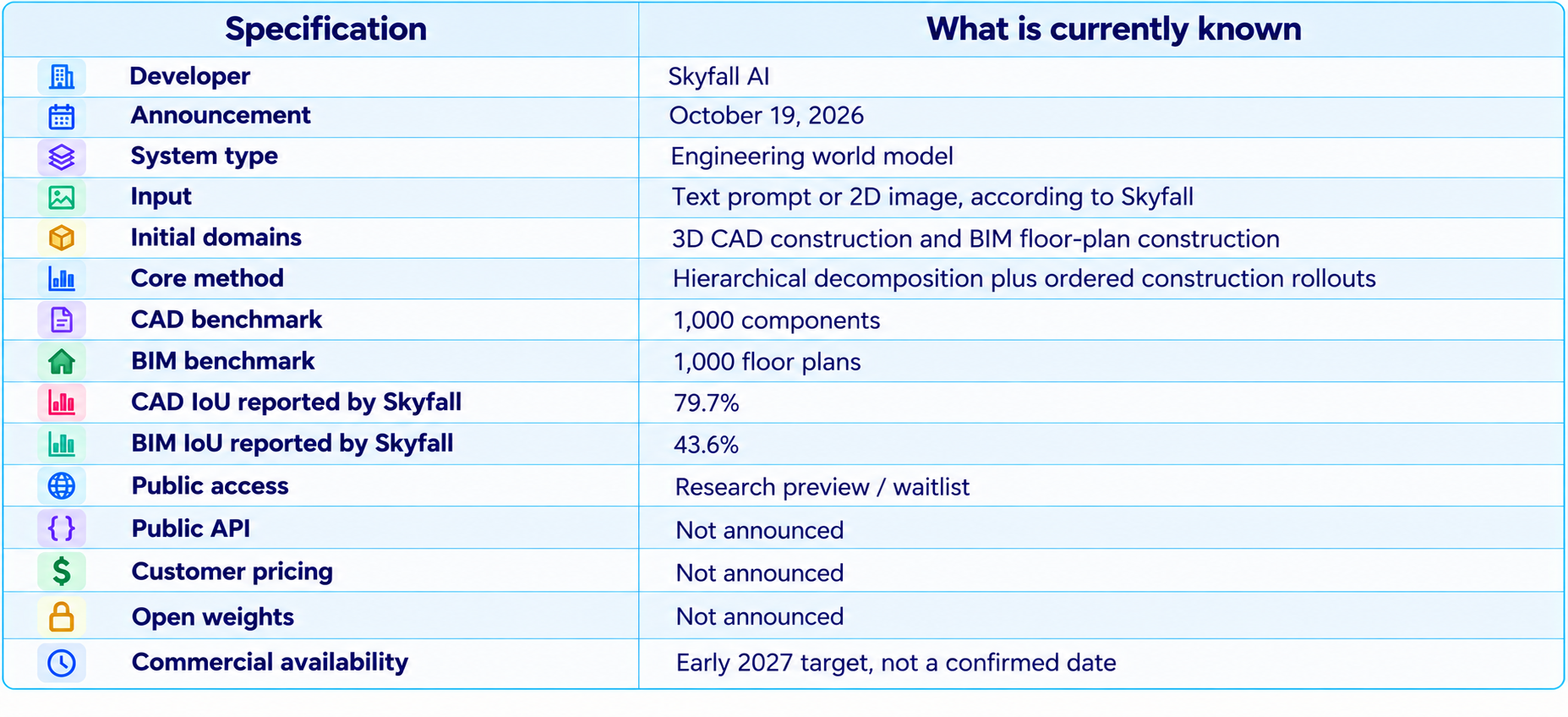
The distinction between known and unknown details is important for a useful SKY-001 review. Skyfall has published a technical product explanation and benchmark figures, but it has not announced a public API, customer price list, downloadable weights or a confirmed general-availability date. The benchmark cost per generated case is a measurement in the company's evaluation, not a price that a customer can pay today.
3. How the Engineering World Model Works
Skyfall describes two main stages: a Hierarchical Composer and a Construction World Model. The first determines what the design is made of and organizes it into a tree. The second generates the ordered states that build each part or floor-plan element. Together, these stages are intended to keep local construction decisions connected to the global design.
The Hierarchical Composer
The composer starts with the overall design goal, which may come from a written description or a visual reference. It generates a rough representation of the complete object, decomposes it into assemblies or spaces, and repeats the process until the hierarchy reaches individual components or units. In CAD, a vehicle might be decomposed into assemblies, subassemblies and individual parts. In BIM, a building layout can be divided into floors, units and rooms.
This hierarchy matters because a complex design cannot be treated as thousands of unrelated shapes. A part needs to fit its parent assembly and neighboring parts. A room needs to fit within a unit, and a unit within the floor plan. The tree gives each local step a parent context so the model has a representation of how the pieces relate.
The Construction World Model
Once the hierarchy is defined, the construction model plans a sequence of visual states for each leaf component. For CAD, it plans the intermediate 3D states of a part and the sketches that move it from one state to the next. For BIM, it plans the drawing sequence that builds the floor plan. Skyfall says it uses a coarse rollout in compressed latent space, followed by a refiner that restores fine detail to the states.
The proposed benefit is efficiency. The model does not need to carry every detail through one extremely long sequential generation. It can plan at the component level, process parts under a shared hierarchy and refine details after the broad sequence is established. This is the technical basis for Skyfall's speed claims, although customers will ultimately need to judge whether the approach produces reliable, editable engineering artifacts.
4. SKY-001 CAD Benchmark: 79.7% IoU
Skyfall's 3D CAD construction benchmark contains 1,000 components sampled from complex engineered objects, including a Jaguar E-Type Roadster, a FANUC ArcMate 100iB robotic arm, a compact tractor, a Bell 222 helicopter and a jet engine. The company says building a case involves roughly 100 drawing steps across sketches and 3D states. The resulting geometry is compared with a reference using intersection over union, or IoU.
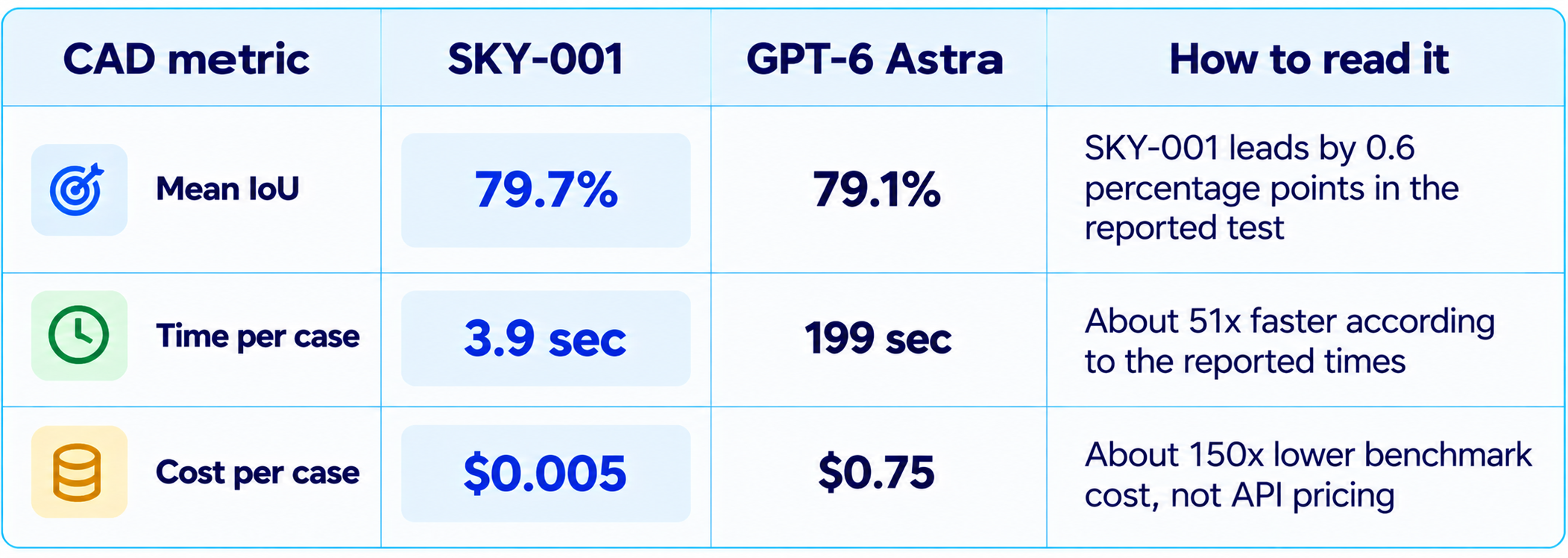
The quality result is close, not a landslide. SKY-001's 79.7% IoU is only 0.6 percentage points above GPT-6 Astra's 79.1% in Skyfall's comparison. The more dramatic difference is runtime and reported inference cost. If the evaluation setup is representative, the model could make it feasible to explore more design candidates per unit of time and compute.
Skyfall also presents a separate hierarchical-composer evaluation, in which two blind language-model judges scored outputs on part decomposition, interior structure, complexity, match to the input image and exterior realism. SKY-001 scored higher than GPT-6 Astra across the listed categories. This is a different evaluation from the IoU-based CAD construction benchmark, so the judge scores should not be combined with IoU into one overall accuracy figure.
The limitation is that the public results are company-reported. The announcement describes the test size and task, but independent teams have not published a reproduction of the same CAD benchmark with the same reference assets, prompts, code and scoring process. That does not make the figures meaningless; it means readers should treat them as the manufacturer's evidence until outside evaluations are available.
5. SKY-001 BIM Benchmark: 43.6% IoU
The BIM benchmark is a separate evaluation over 1,000 floor plans. Skyfall describes approximately 350 whole-floor examples from building-level IFC models and 650 apartment-level plans. The plans vary in complexity, with around 70 drawing steps on average. The model generates a floor-plan construction sequence and the final layout is scored against the reference using IoU.
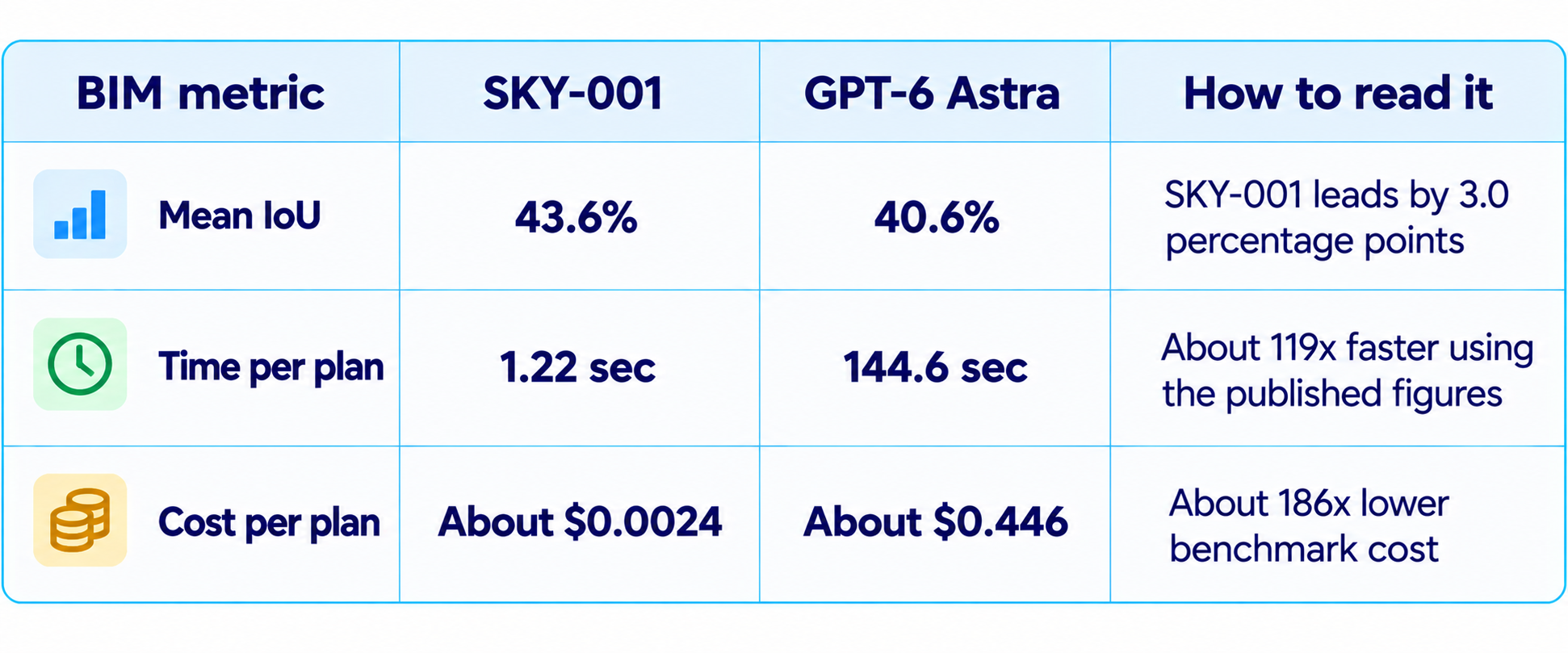
The reported quality margin is larger than in CAD, but it is still important to understand what IoU measures. It is a geometric overlap score, not a complete architectural quality rating. A plan can have reasonable overlap while still having problems with circulation, accessibility, fire egress, building codes, structural feasibility or the practical placement of fixtures. A high-quality BIM workflow must validate these properties separately.
The 43.6% score also means the generated geometry is not an exact match to the reference. SKY-001 leads the tested systems on this metric in the published comparison, but a BIM output should still be reviewed before it is used as a construction document or design deliverable. The reported result is promising for concept-stage planning and rapid generation of alternatives, not proof that the system can autonomously produce code-compliant plans without human review.
6. Speed and Cost: What the Headline Multipliers Mean
The most attention-grabbing part of the SKY-001 announcement is the difference in per-case time and benchmark cost. On CAD, Skyfall reports 3.9 seconds for SKY-001 and 199 seconds for GPT-6 Astra. On BIM, it reports 1.22 seconds and 144.6 seconds respectively. The cost comparisons are $0.005 versus $0.75 per CAD case and about $0.0024 versus $0.446 per BIM plan.
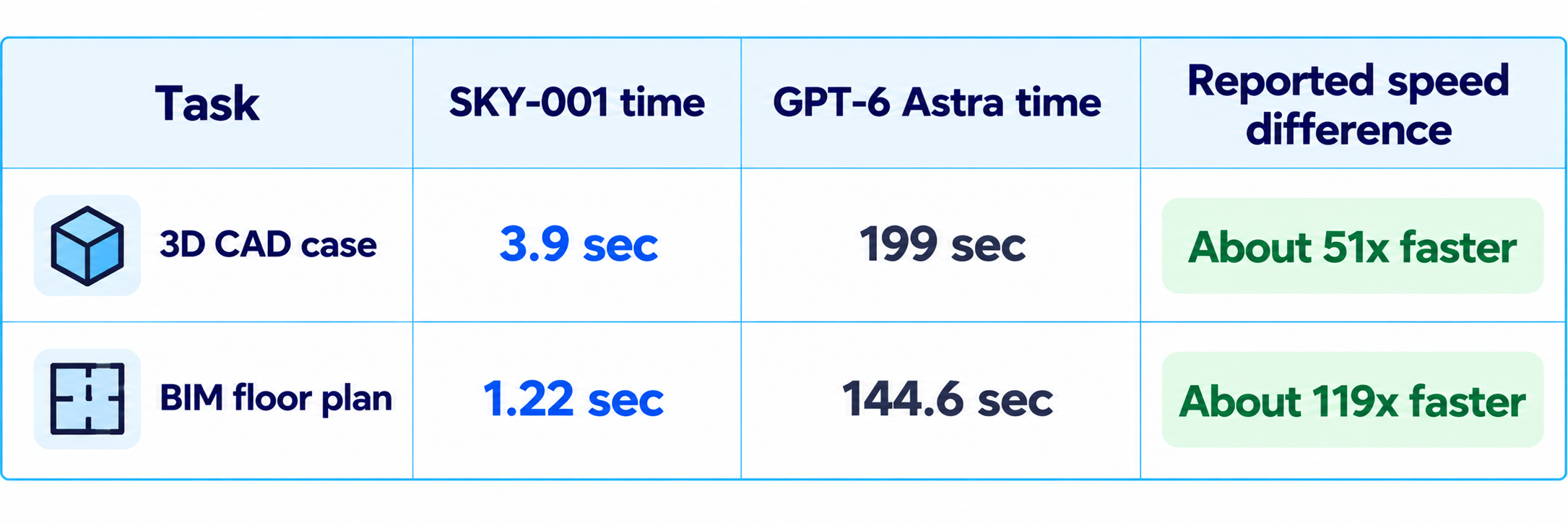
These numbers describe the test configuration and task as presented by Skyfall. They are not a guarantee of end-to-end user latency in every deployment. Real applications may add upload time, preprocessing, queueing, conversion to a CAD application's internal representation, validation, file export and human review. A production system should measure all of those stages.
The benchmark costs need similar care. The reported $0.005 and $0.0024 figures are the company's estimated cost to run a benchmark case. They are not published subscription rates or API charges, and there is no public SKY-001 price list at the time of this review. The right conclusion is that Skyfall reports much lower internal per-case cost on its test, not that customers can currently purchase a CAD generation for half a cent.
If the efficiency advantage holds up in real workflows, it could affect how teams explore design space. Instead of generating a handful of candidate parts, a team might evaluate many more alternatives before committing to a prototype. But the economic value depends on acceptance rate: a cheap design that requires repeated manual repair can be more expensive than a slower output that needs little correction.
7. SKY-001 vs GPT-6 Astra
GPT-6 Astra is the central comparison in Skyfall's launch. The company compares both systems on CAD and BIM tasks. The numbers show a recurring pattern: nearly equal CAD IoU, a modest SKY-001 lead in BIM IoU, and a much larger reported difference in time and per-case cost.
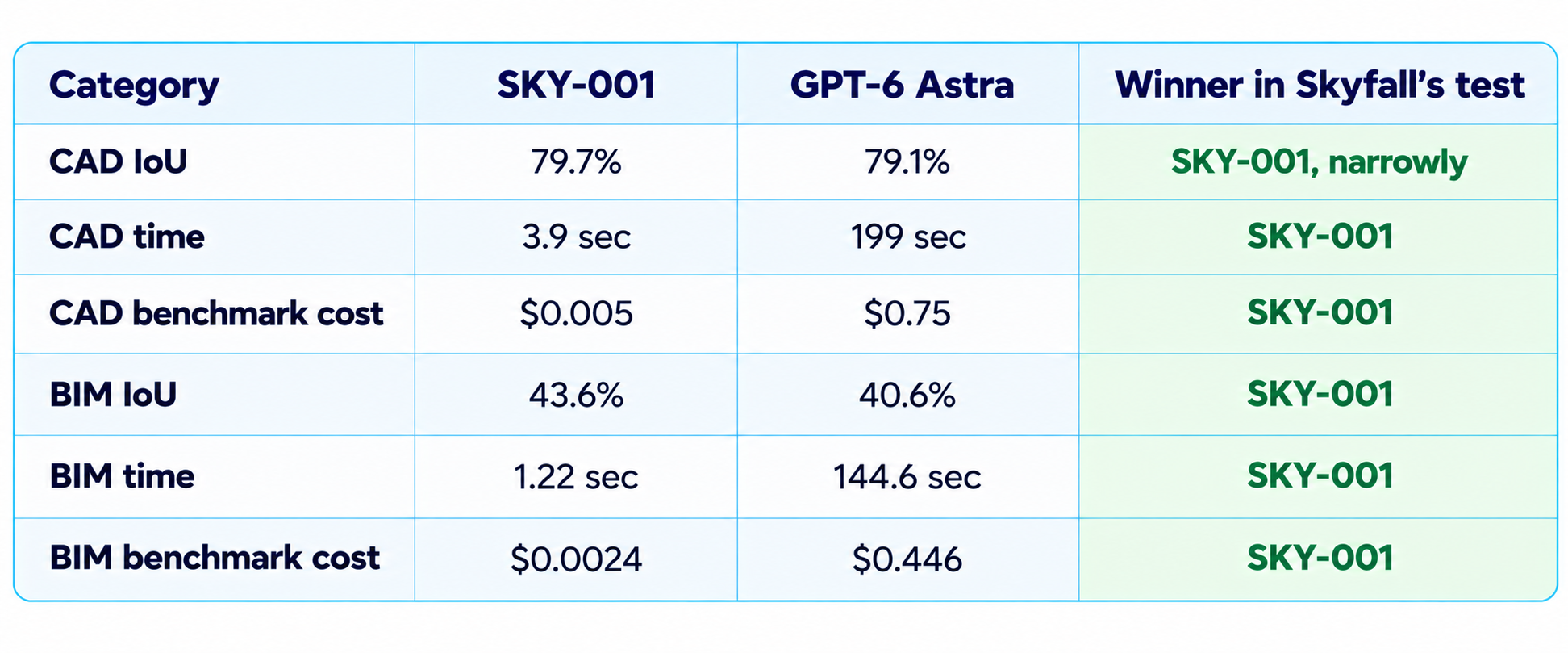
The fair interpretation is narrow: on the CAD and BIM tasks and metrics reported by Skyfall, SKY-001 appears to produce similar or slightly better geometric overlap much faster and at a lower estimated run cost. This does not show that SKY-001 is better than Astra at general reasoning, coding, writing, research or every kind of design task. The systems have different intended architectures and target workflows.
It is also not a direct consumer product comparison yet. SKY-001 is waitlist-only and has no public API pricing, while GPT-6 Astra is a general-purpose model with a different access model. Teams cannot simply swap one API endpoint for the other today without considering access, output format, integration and validation.
8. Is SKY-001 a Large Language Model?
Skyfall says SKY-001 is not a conventional autoregressive language model and does not work by predicting the next text token. The company describes it as a hierarchical, latent world model that plans in the visual or spatial domain. Its job is to generate a design structure and construction states, rather than to produce a long natural-language answer.
This is an important distinction, but it should not be stretched into a claim that world models are always better than LLMs. Language models remain useful for interpreting requirements, writing design documentation, generating scripts, searching standards and explaining tradeoffs. A specialized world model may be better suited to the geometric construction task it was designed for, while an LLM may still play a valuable role around that task.
A practical engineering workflow could eventually combine both: a language model translates a customer's brief into constraints and acceptance criteria; a spatial model proposes the design hierarchy and construction steps; CAD or BIM software validates the geometry; and an engineer approves the result. The strongest system may be a coordinated pipeline rather than a single model replacing every tool.
9. What SKY-001 Could Mean for Mechanical Engineering
Mechanical engineering is an obvious use case because complex products are made from assemblies and parts that must fit together. Skyfall's examples include vehicles, a robotic arm, a tractor, a helicopter and an engine. These are precisely the kinds of objects where the visible outer shell does not fully describe the design. Internal parts, joints, fasteners and assembly relationships matter.
A world model that can decompose a product image into a hierarchy and plan a construction sequence could accelerate early concept work, component exploration and rough reconstruction from reference images. It might help engineers create a first structured draft from a visual starting point, then refine dimensions, tolerances, materials and manufacturing constraints in conventional CAD tools.
However, reconstructing geometry from an image is underdetermined. A single image does not reveal every hidden dimension, material property, tolerance, interface or manufacturing process. Engineers must supply additional constraints and verify the resulting model. SKY-001's current published benchmark should therefore be seen as evidence about its tested geometry-generation task, not proof that it can reverse-engineer any real product into a complete manufacturing package.
10. What SKY-001 Could Mean for Architecture and BIM
The BIM workflow starts from a building outline or floor-plan reference and develops the plan through units and rooms. This could be useful during early architectural planning, when designers want to compare layouts, test alternative room arrangements or generate a structured starting point from a rough brief.
The possible productivity benefit is iteration. A model that can produce a draft plan quickly may let architects explore more alternatives before investing time in detailed modeling. The model could also help turn a high-level spatial concept into an ordered drawing process that a BIM workflow can inspect.
The important boundary is professional validation. Architectural designs must account for building codes, accessibility, fire safety, structure, services, climate, circulation, local regulations and client requirements. An IoU score only measures overlap with a reference layout. It does not verify compliance with all those conditions. SKY-001 should be treated as a potential design-assistance system, not a substitute for licensed professional judgment.
11. Training Data and Technical Approach
Skyfall's technical announcement describes a data pipeline built from public product-assembly datasets and public BIM sources. For CAD, the company says it cleans inconsistent assembly trees, removes duplicated or overlapping geometry, rebuilds hierarchies and uses construction histories where available. When a construction sequence is missing, Skyfall says it reconstructs trajectories with engineering tools and LLM-assisted workflows, then verifies them before training.
The company reports that the composer trains on more than 200,000 parts and the construction world model on more than 600,000 construction examples. For BIM, it describes about 35,000 real and synthetic floor plans and roughly two million drawing states. These are company-reported training details from the technical announcement, not figures independently audited by an outside research team.
The reason for the data pipeline is straightforward: a model cannot learn reliable assembly reasoning from final meshes alone if it must also predict the sequence used to build those meshes. Construction history and component hierarchy provide supervision for the intermediate steps. In BIM, standardized room types and drawing states help the system learn a consistent representation across datasets that may originally use different labels and conventions.
The scale and structure of this data are part of the technical story. The more important long-term question is generalization: whether the model can handle new industries, unusual parts, different CAD conventions and constraints that are poorly represented in the training data.
12. How to Evaluate SKY-001 When Access Opens
The most useful evaluation will use a representative set of tasks from the team's own workflow, not only the vendor's showcase examples. Create a small benchmark with familiar designs and a clear scoring rubric before testing the model.
- Select 20 to 50 representative parts, assemblies or floor plans that reflect real project complexity.
- Provide consistent reference inputs and constraints, including dimensions or standards where the workflow requires them.
- Measure geometric similarity, but also inspect part count, hierarchy, missing components and relationships between parts.
- Record wall-clock latency from input upload through usable export, not only model inference time.
- Measure the amount of manual correction required before an engineer can use the result.
- Check whether generated output remains editable in the team's CAD or BIM software.
- Evaluate failure cases such as occluded parts, ambiguous dimensions, unusual layouts and conflicting constraints.
- Compare cost per accepted design, not only cost per attempted generation.
- Keep a qualified engineer in the approval loop for safety-critical or construction-related outputs.
A model can look impressive in a demo and still be expensive in production if every result needs extensive cleanup. The central question is whether SKY-001 can reduce the total time from design brief to validated, editable artifact.
13. Is SKY-001 Worth Watching?
Yes. SKY-001 is worth watching because it targets a real weakness in general-purpose AI: producing structured, geometrically consistent artifacts through long construction sequences. The company's reported CAD results show nearly equal IoU to GPT-6 Astra with a much shorter per-case runtime. Its BIM result shows a modest quality lead over Astra and a similarly large runtime difference in Skyfall's own test.
The model's strongest promise is not that it has solved all of engineering. It is that hierarchical decomposition and a dedicated construction model may be a more efficient way to handle spatial design tasks than asking a general-purpose language model to write a long script or generate the entire design in one pass.
The main reason to be cautious is access and validation. The model is still in research preview, the benchmark results are company-reported, and public API pricing has not been announced. Engineers cannot yet verify whether the same quality, speed and cost profile holds on their own data or whether the resulting artifacts fit existing CAD/BIM workflows without substantial repair.
14. Final Verdict
SKY-001 is a notable engineering-AI announcement from Skyfall AI. Its core idea is easy to understand and technically relevant: instead of treating a complex product or building as one flat output, it builds a hierarchy of components or spaces and generates the construction sequence that connects the high-level design to its individual parts.
The headline numbers are compelling within the company's published tests. SKY-001 reports 79.7% IoU on a 1,000-case CAD benchmark at 3.9 seconds and $0.005 per case, and 43.6% IoU on a 1,000-plan BIM benchmark at 1.22 seconds and around $0.0024 per plan. GPT-6 Astra's corresponding figures in the same comparison are 79.1% and 199 seconds for CAD, and 40.6% and 144.6 seconds for BIM. The reported quality differences are relatively small, while the speed and benchmark-cost differences are large.
Those results should be described precisely: they are Skyfall's own published benchmarks, not an independently reproduced leaderboard or a promise of customer-facing API prices. The model is waitlist-only, with no public API or pricing announced. Its early-2027 commercial target is a target rather than a guaranteed release date.
My assessment: high potential for structured CAD and BIM generation, strong reported efficiency, promising long-horizon decomposition, but not yet ready for a broad procurement recommendation without hands-on access and independent validation.
Bottom line: follow SKY-001 if you work in mechanical engineering, industrial design, architecture, BIM or AI-driven design automation. The key milestone will be whether the model can turn its published benchmark advantage into reliable, editable, validated engineering outputs in real production environments.
Frequently Asked Questions
What is SKY-001?
SKY-001 is Skyfall AI's engineering world model for turning text or 2D image references into structured CAD and BIM construction sequences.
Who created SKY-001?
It was announced by Skyfall AI on October 19, 2026.
Is SKY-001 an LLM?
Skyfall describes it as a hierarchical latent world model rather than a conventional next-token-prediction language model.
What is the SKY-001 CAD benchmark score?
Skyfall reports 79.7% IoU on its 1,000-case CAD construction benchmark.
What is the SKY-001 BIM benchmark score?
Skyfall reports 43.6% IoU on its 1,000-floor-plan BIM benchmark.
Is SKY-001 faster than GPT-6 Astra?
In Skyfall's published tests, SKY-001 completes a CAD case in 3.9 seconds versus 199 seconds for Astra, and a BIM plan in 1.22 seconds versus 144.6 seconds.
How much does SKY-001 cost?
Public customer pricing has not been announced. The $0.005 CAD and approximately $0.0024 BIM figures are benchmark run-cost estimates, not API prices.
Can I use the SKY-001 API?
No public API has been announced. The current route is the research-preview waitlist on Skyfall's official product page.
Is SKY-001 open source?
Public model weights have not been announced.
Can SKY-001 generate production-ready designs?
The public benchmark does not establish production readiness. Engineers would need to validate geometry, dimensions, constraints, editability and relevant safety or building requirements.
When will SKY-001 launch commercially?
Skyfall has indicated an early-2027 target, but a confirmed general-availability date has not been announced.
Is SKY-001 worth watching?
Yes, especially for CAD and BIM teams, because the reported speed and cost advantages are substantial. Independent replication and real-world integration tests remain important.
Recommended Blogs
Qwen 3.8 Max 0902 Review: Benchmarks, Price & Is It Worth It? (2026)
Meta Muse Spark 1.3 Review: Coding, Price & Is It Worth It? (2026)
How to Secure AI Coding Agents: Permissions, Sandboxing, MCP & Secrets
GPT-5.6 Review: Sol, Terra, Luna Features, Benchmarks, and Pricing
Resources & Community
Join our community of 70,000+ AI enthusiasts and learn to build powerful AI applications. Build Fast with AI helps creators, developers and teams understand and implement practical AI.
Agentic AI Launchpad 2026
A structured 6-week cohort program focused on building and deploying real-world agentic AI systems, with live sessions, mentorship, project reviews and a builder community.
Explore the program: Agentic AI Launchpad 2026
Free AI Resources
Access free tools, workshops and micro-learning to keep building.