



Sarvam Vision 2.1 Review: Is This India's Most Capable Document AI Model?
Sarvam Vision 2.1 is a document-intelligence vision-language model from Sarvam AI designed around a problem that general-purpose vision models do not always solve well: turning messy real-world documents into structured, usable data. Its focus is OCR, table extraction, document layout, multilingual Indian-language recognition, handwritten text and production document processing.
Sarvam AI released Vision 2.1 on September 24, 2026 as an upgrade to the original Sarvam Vision model launched in February. The company says the update improves complex table parsing, key-value extraction from forms, Indic handwritten recognition, hallucination behavior and inference efficiency. It also moves the model toward production use through a lower API price and a more optimized serving stack.
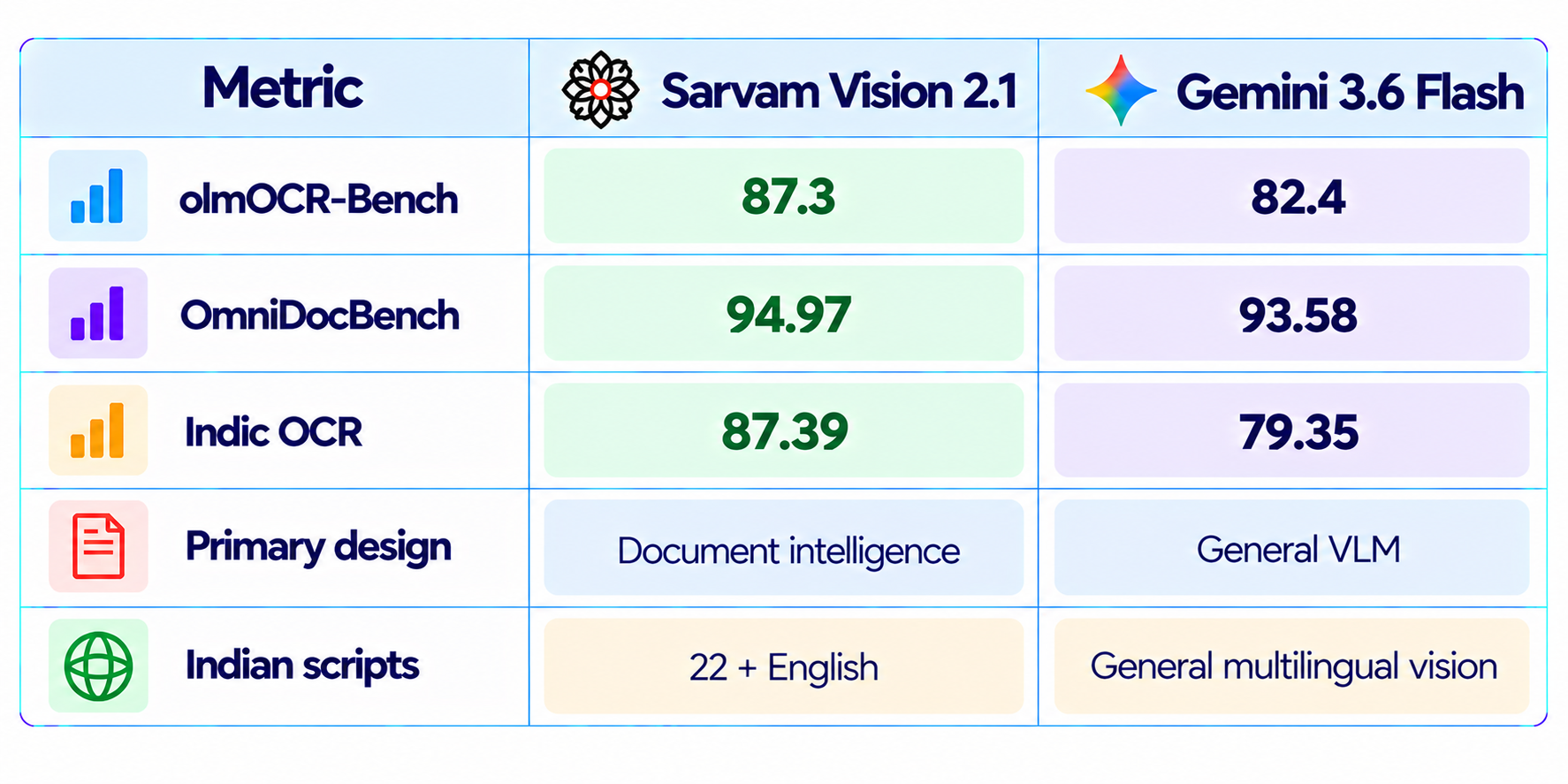
The benchmark results make the release significant. On Sarvam's published olmOCR-Bench comparison, Vision 2.1 records an 87.3 overall score, ahead of Infinity-Parser2 Pro at 86.1, Opus 5 at 85.1, Chandra-OCR2 at 84.5, Mistral OCR4 at 83.1 and Gemini 3.6 Flash at 82.4. On Sarvam's new 6,909-sample Indic OCR benchmark covering 22 Indian languages plus English, Vision 2.1 reports 87.39 overall accuracy.
QUICK ANSWER
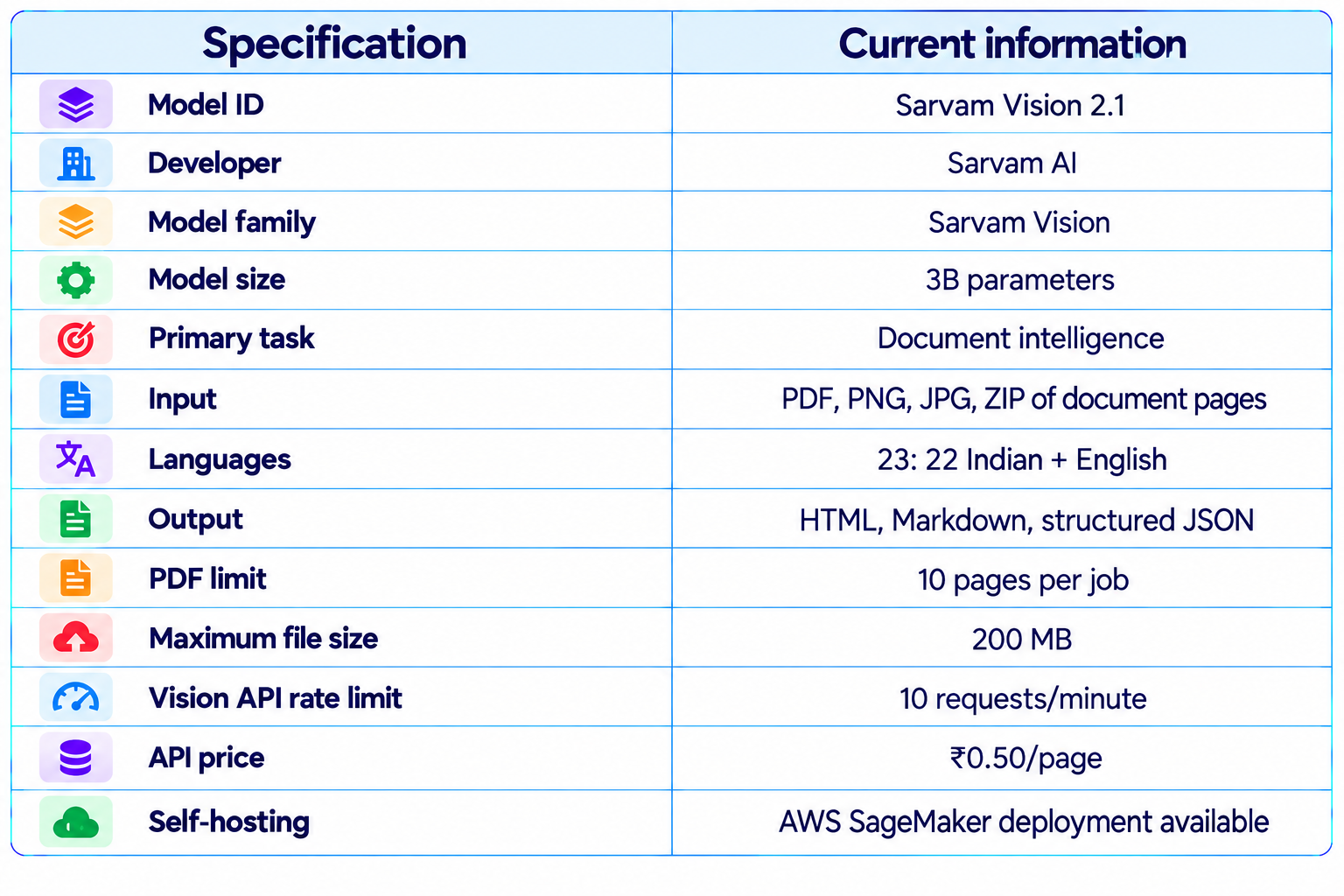
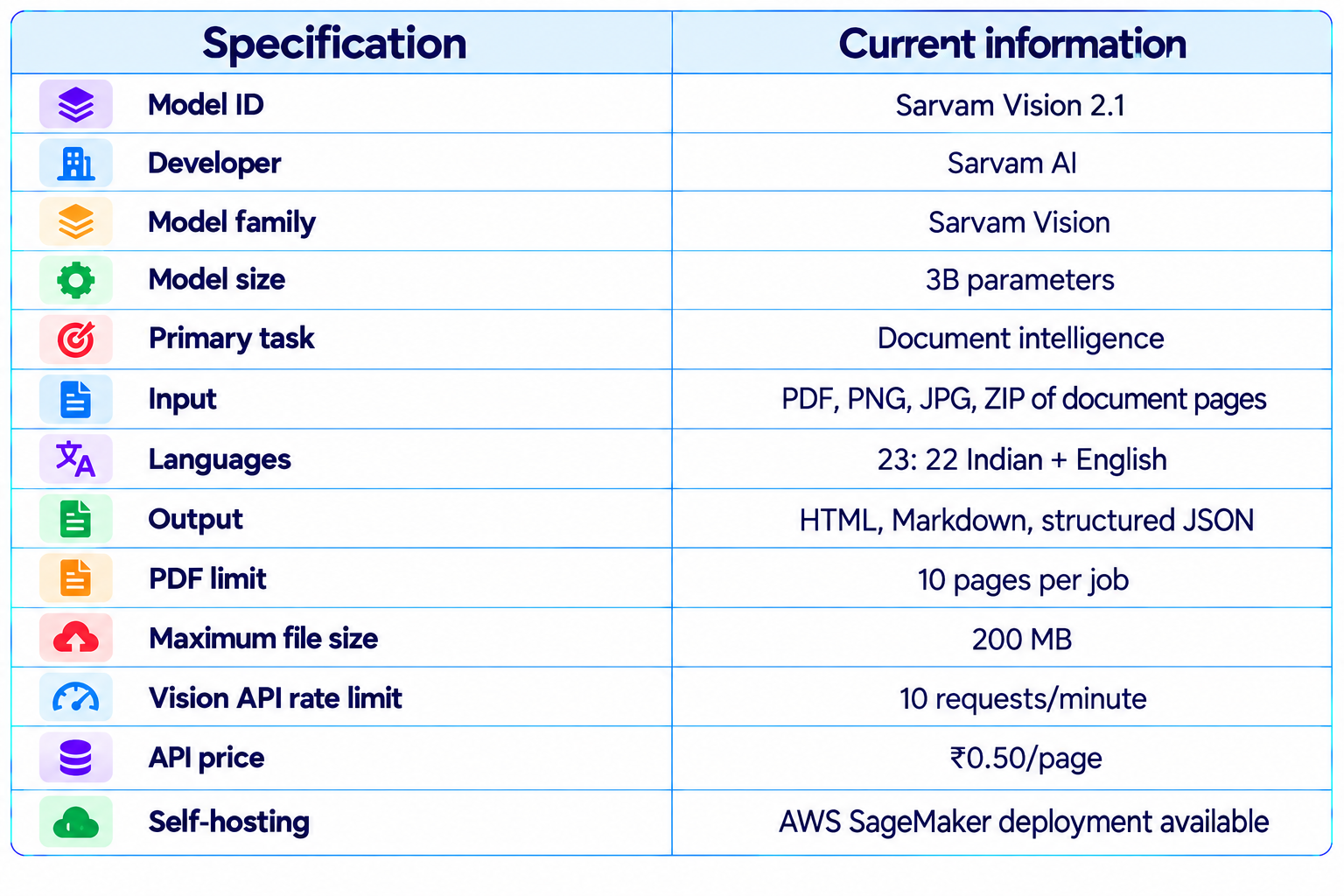
Sarvam Vision 2.1 is a 3B-parameter vision-language model specialized for document intelligence across 23 languages, including all 22 scheduled Indian languages plus English. It extracts text from PDFs and scans, preserves document structure and reading order, converts tables into HTML or Markdown, and supports structured page-level JSON output.
Its strongest published result is on Sarvam's Indic OCR benchmark, where it reports 87.39 overall accuracy across 6,909 samples spanning 22 Indian languages and English. On olmOCR-Bench, it reports 87.3 overall, leading the listed comparison set. On OmniDocBench v1.6, it records 94.97 overall, behind PaddleOCR-VL 1.6 at 96.01 but ahead of GLM-OCR at 94.71 and GPT-6 Astra at 93.74.
Pricing is currently ₹0.50 per page for Sarvam's Document Digitization API, with a maximum of 10 pages per job. The API supports PDF, PNG, JPG and flat ZIP inputs, with a 200 MB file limit. Vision API document-intelligence requests are currently limited to 10 requests per minute across Starter, Pro and Business plans.
My rating: 9.3/10 for Indic OCR, 9.2/10 for document structure, 9.0/10 for table-heavy documents, 9.4/10 for price, and 9.1/10 overall. Sarvam Vision 2.1 is especially compelling for Indian-language document processing, archival digitization, forms and enterprise document workflows.
1. What Is Sarvam Vision 2.1?
Sarvam Vision 2.1 is the latest version of Sarvam AI's document-intelligence vision-language model. The original Sarvam Vision launched in February 2026 as a 3B-parameter state-space VLM focused on OCR for Indian languages, table parsing, visual reasoning and structured outputs. Vision 2.1 extends that foundation with better production inference and additional document workflows.
The important distinction is that Sarvam Vision 2.1 is not positioned as a general image-generation model or a general-purpose conversational VLM. Its core job is document understanding. That means recognizing text, understanding page structure, identifying tables and forms, preserving reading order and turning visual documents into structured machine-readable output.
2. What Changed From Sarvam Vision to Vision 2.1?
Sarvam's original Vision model established the document-intelligence foundation. Vision 2.1 focuses on the areas that matter when documents move from demos into production.
3. Sarvam Vision 2.1 Benchmark Results
Sarvam published benchmark comparisons across olmOCR-Bench, OmniDocBench v1.6 and its new Indic OCR benchmark. The results show different strengths depending on what is being measured.
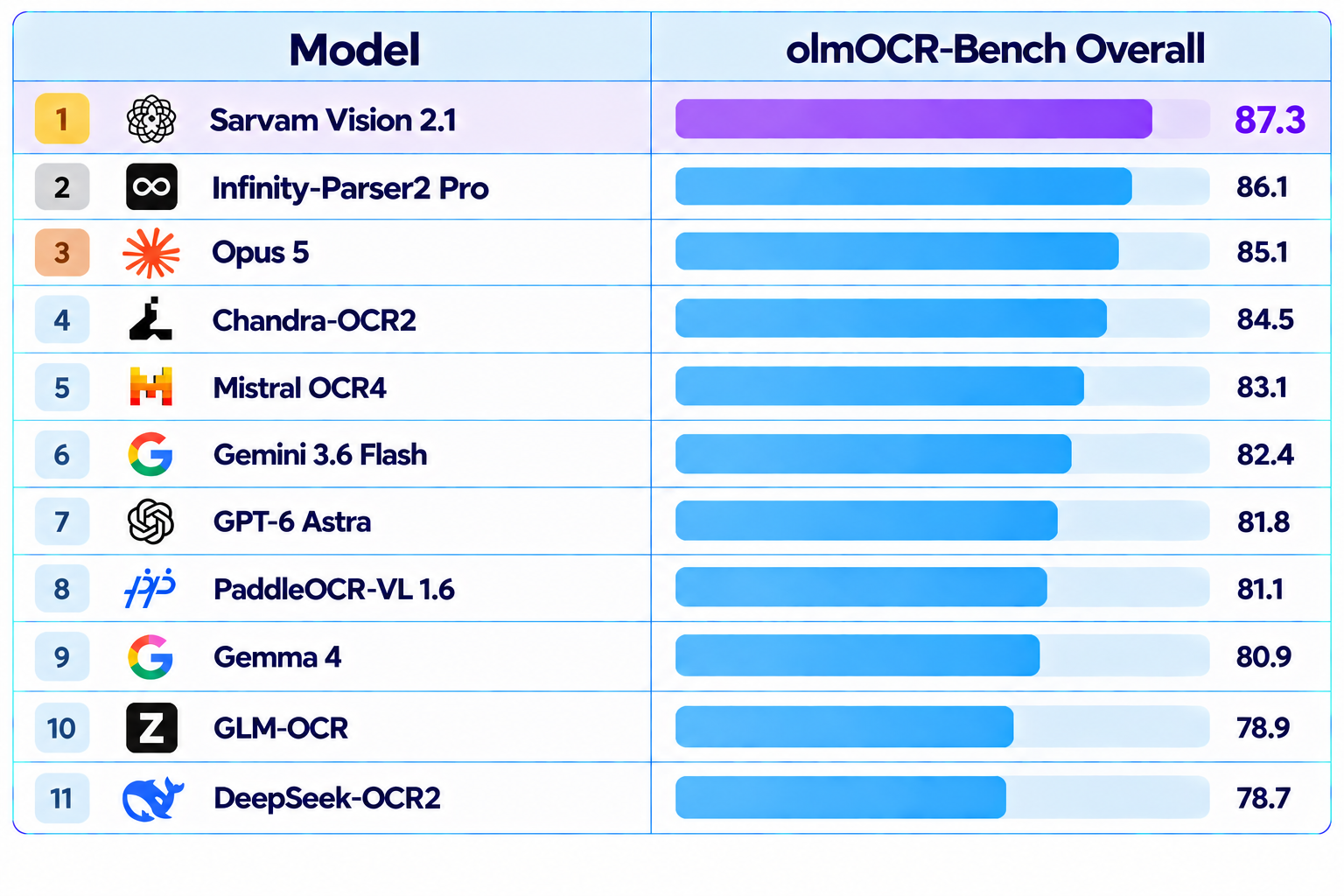
On the published olmOCR-Bench comparison, Vision 2.1 leads the listed models at 87.3. The benchmark includes categories such as mathematical content, base document recognition, headers and footers, tiny text, multi-column layouts, old scans, old mathematical documents and tables.
Because the benchmark is presented by Sarvam as part of the product release, the figures should be understood as published vendor evaluation results. They are useful for comparing the listed systems under that evaluation setup, but they should not be treated as proof that Vision 2.1 will dominate every document workload.
4. OmniDocBench v1.6
OmniDocBench v1.6 measures document structural fidelity through text edit distance, formula recognition, table structure and reading order. Sarvam Vision 2.1 scores 94.97 overall.
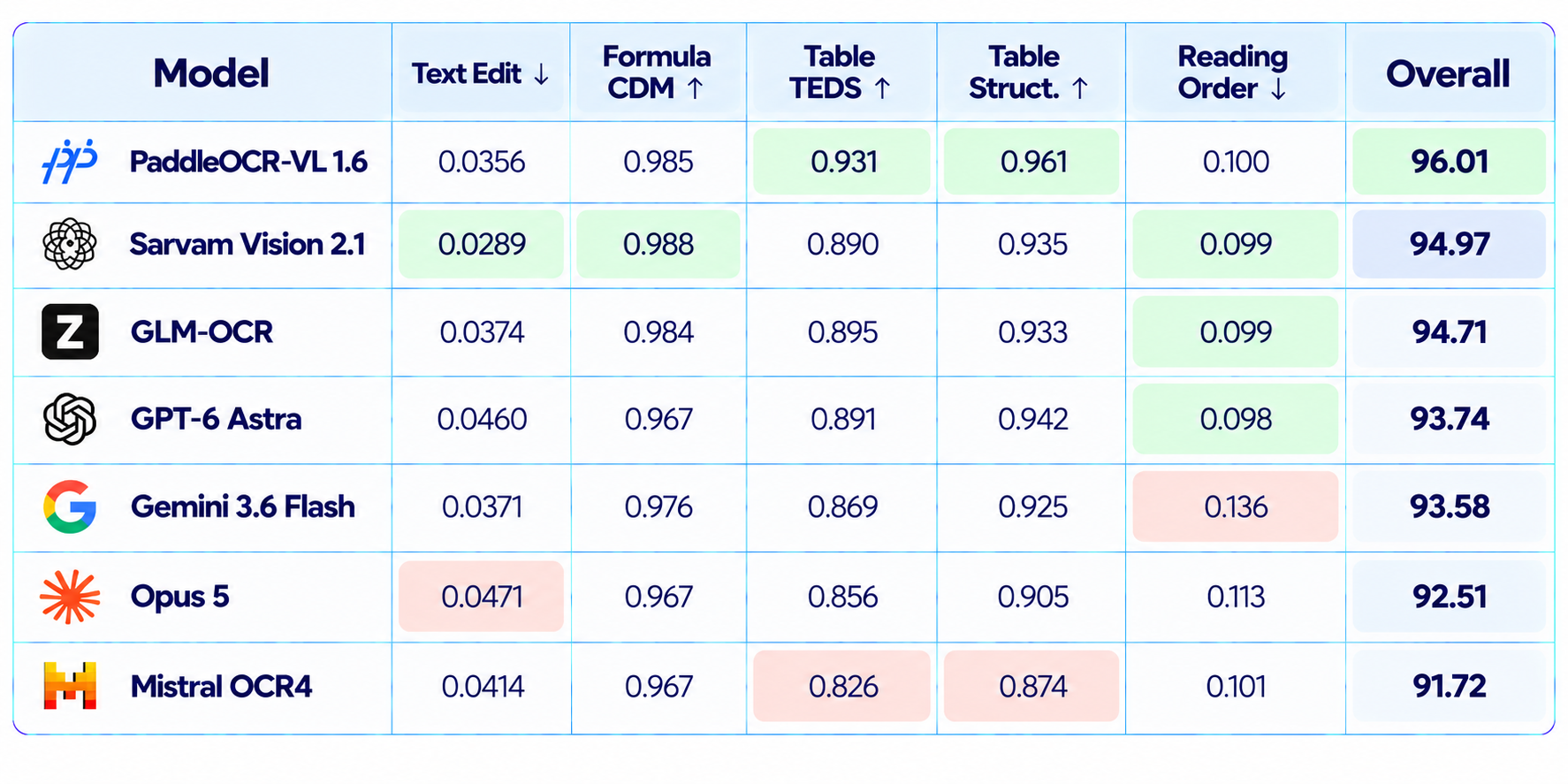
Vision 2.1 does not lead every individual OmniDocBench metric. PaddleOCR-VL 1.6 has the highest overall score and stronger table structure scores in this comparison. Vision 2.1's strongest advantage in the table is its low text edit distance and high formula recognition score, while its reading-order result is also competitive.
5. The New Sarvam Indic OCR Benchmark
This is the most important addition in the Vision 2.1 release for Indian-language AI. Sarvam has published an Indic OCR benchmark containing 6,909 samples: 6,609 across 22 Indian languages and 300 English samples. The dataset covers material from newspapers, brochures, textbooks and historical writing, with samples spanning long time periods.
The benchmark is designed specifically to measure language accuracy rather than general document structure. That matters because a model can preserve a page layout while still misrecognizing a regional script.
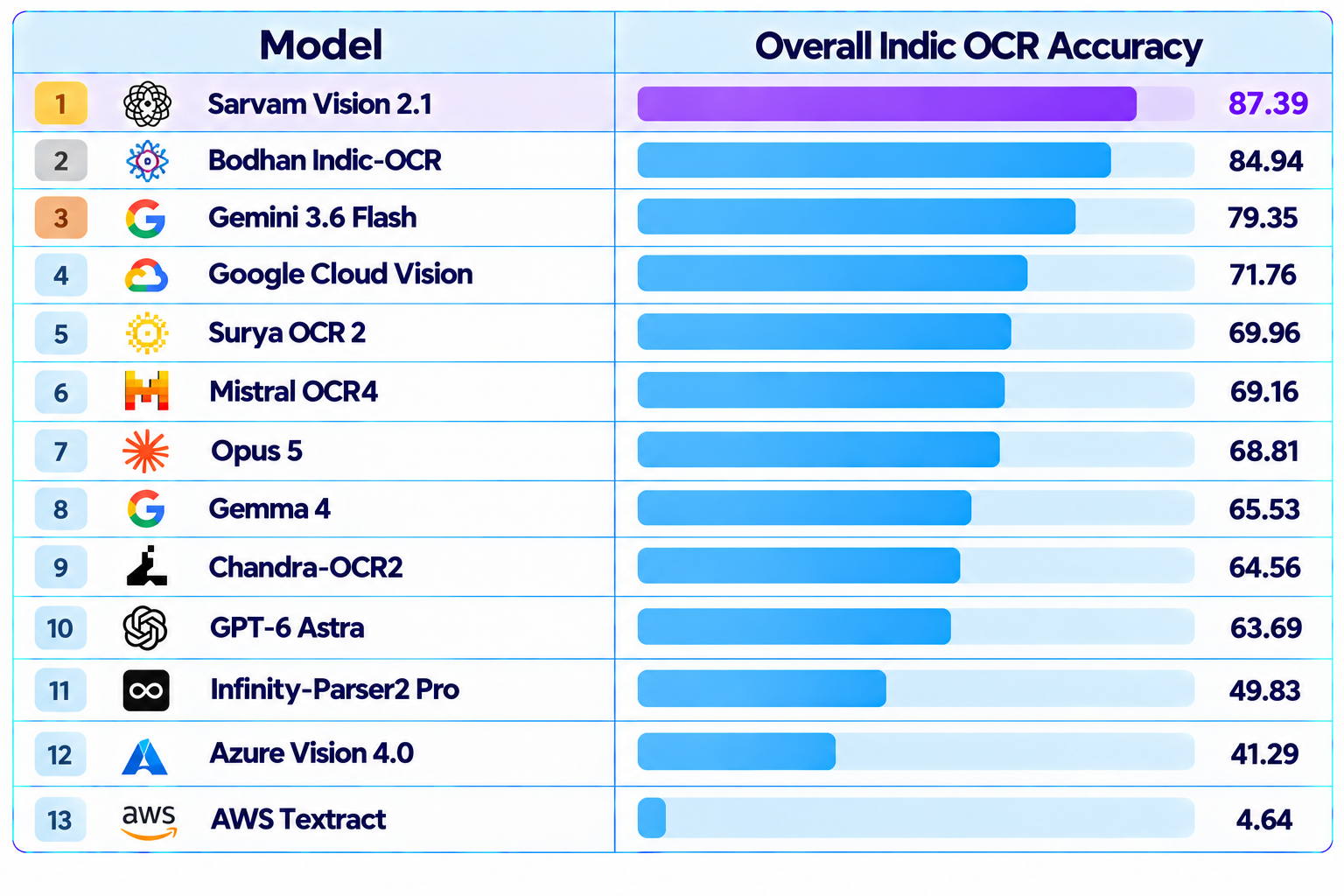
On Sarvam's published benchmark, Vision 2.1 has the highest overall accuracy among the listed systems. This is a specialized benchmark rather than a general vision leaderboard, but it directly measures the capability Sarvam is targeting: recognizing Indian-language text accurately across many scripts and source types.
6. Indic Language Coverage
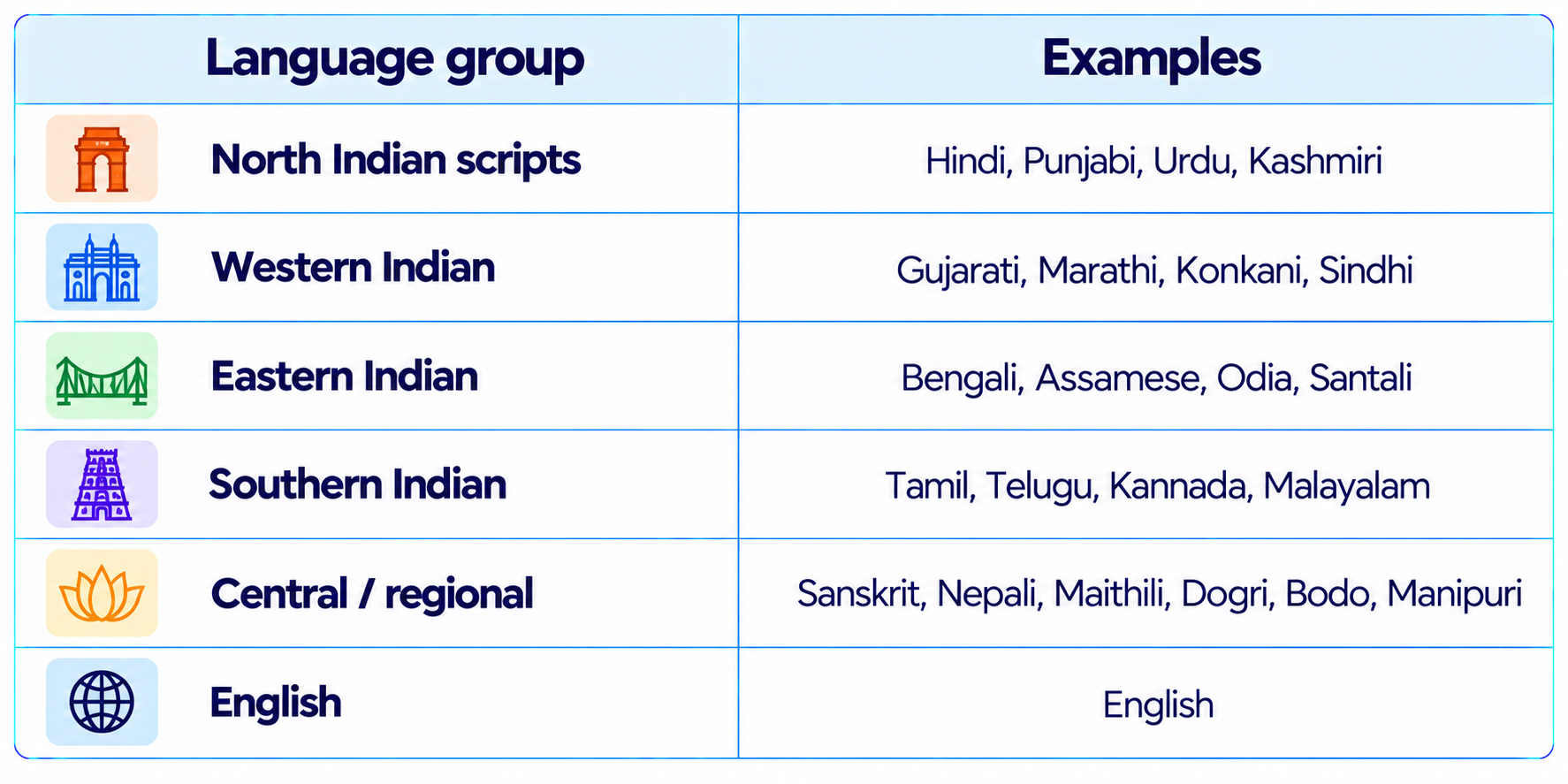
Sarvam Vision supports 23 languages: 22 Indian languages plus English. The current documentation lists Hindi, Bengali, Tamil, Telugu, Marathi, Kannada, Malayalam, Gujarati, Punjabi, Odia, Assamese, Urdu, Sanskrit, Sindhi, Nepali, Kashmiri, Konkani, Maithili, Dogri, Manipuri, Bodo, Santali and English.
7. OCR Accuracy: Where Vision 2.1 Stands Out
OCR accuracy is not simply about whether every character is recognized. For production document AI, the system also needs to preserve reading order, distinguish headers from body text, keep table cells associated with the right columns and avoid inventing content when a scan is unclear.
Vision 2.1's published results are strong across these dimensions. The 87.3 olmOCR-Bench result, 94.97 OmniDocBench result and 87.39 Indic OCR result together are more informative than any single score because the benchmarks emphasize different properties.
For Indian-language OCR specifically, the 87.39 result is the strongest reason to consider the model. It gives teams a measurable basis for testing Vision 2.1 against general-purpose OCR services on regional-language archives, forms and scanned records.
8. Table Extraction and Structured Data
Table extraction is one of the areas Sarvam specifically improved in Vision 2.1. The release highlights complex table parsing, including multi-page tables, as a target workflow.
The API can return HTML or Markdown output, while JSON is available for structured page-level data. This means the output can move directly into downstream document-processing systems instead of requiring another parsing stage.
9. Handwritten Indian Documents
Vision 2.1 adds improved Indic handwritten recognition. This expands the practical scope beyond modern machine-printed documents into forms, historical materials, handwritten records and archival collections.
Handwriting remains a harder OCR problem because letter shapes vary between writers, scans can be noisy and historical documents may use older vocabulary or scripts. Sarvam specifically identifies Indic handwriting as a last-mile document-intelligence problem addressed by Vision 2.1.
10. Form and Key-Value Extraction
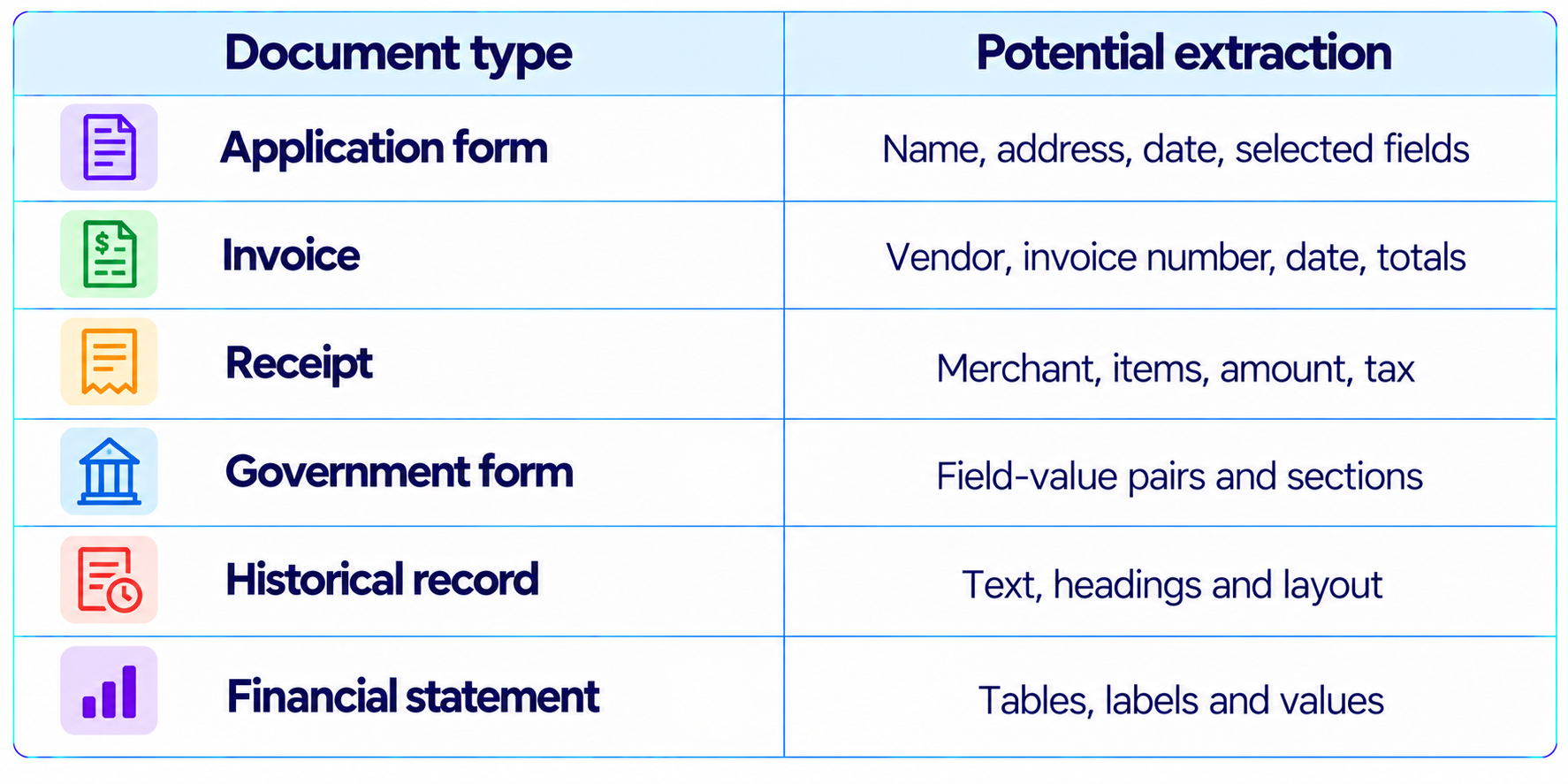
Another targeted improvement is key-value extraction from forms. This is important for invoices, applications, identity-related forms, insurance paperwork and government documents where the value is useful only when attached to the correct field.
A generic OCR engine might correctly read a name, date or number while losing the relationship between the field label and the value. Document intelligence systems need to understand that relationship.
11. PDF OCR and Scanned Documents
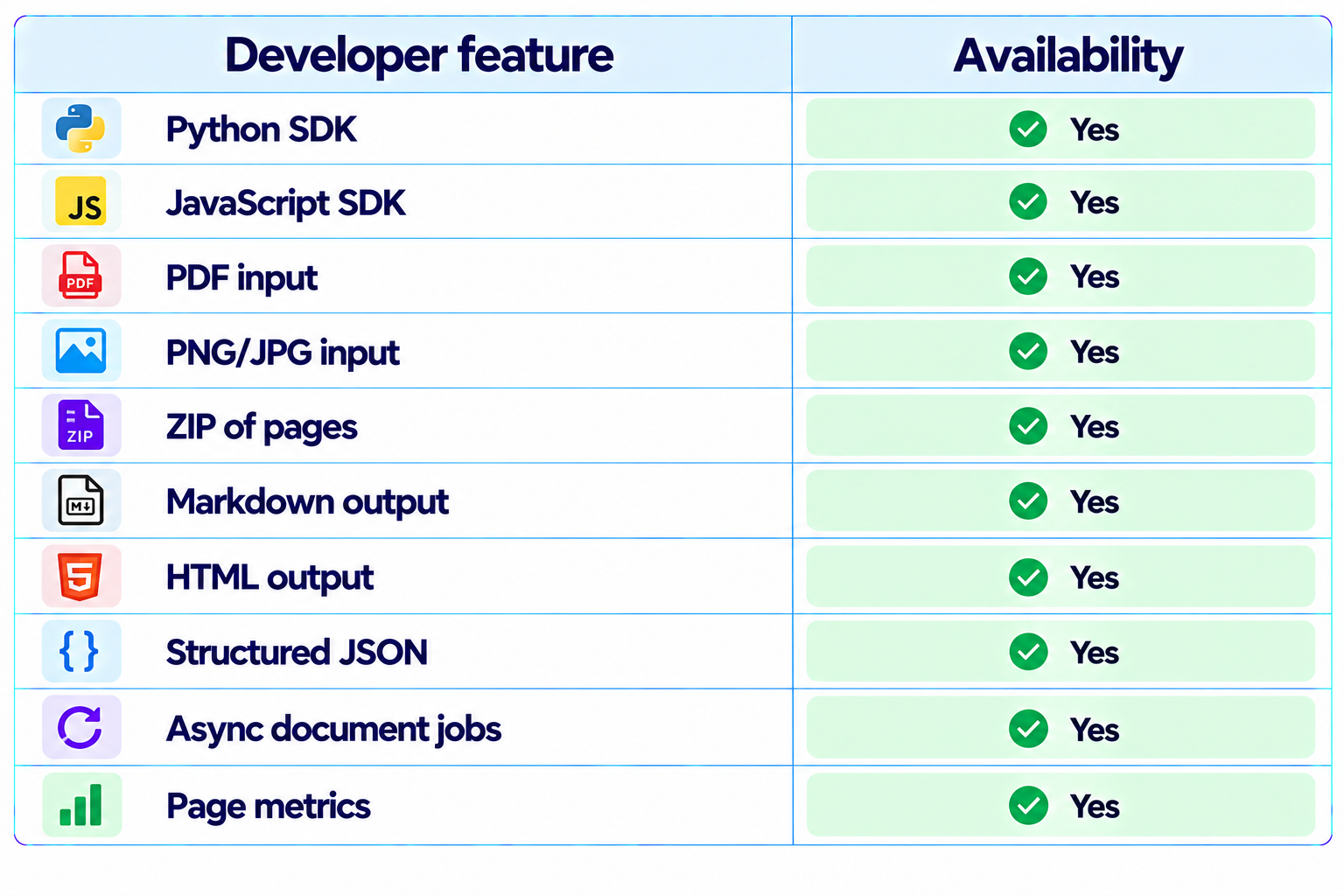
Sarvam Vision is designed for PDFs and scans rather than only clean digital text. The managed Document Intelligence API supports PDF, PNG, JPG and flat ZIP archives of document pages.
The current limits are important for implementation: the API supports up to 10 pages per PDF job and a maximum file size of 200 MB. Larger documents need to be split into multiple jobs. Sarvam's self-hosted SageMaker documentation also describes a 500-page hard cap at the container level, while synchronous requests have tighter AWS request-size and timeout constraints.
12. Sarvam Vision 2.1 Pricing
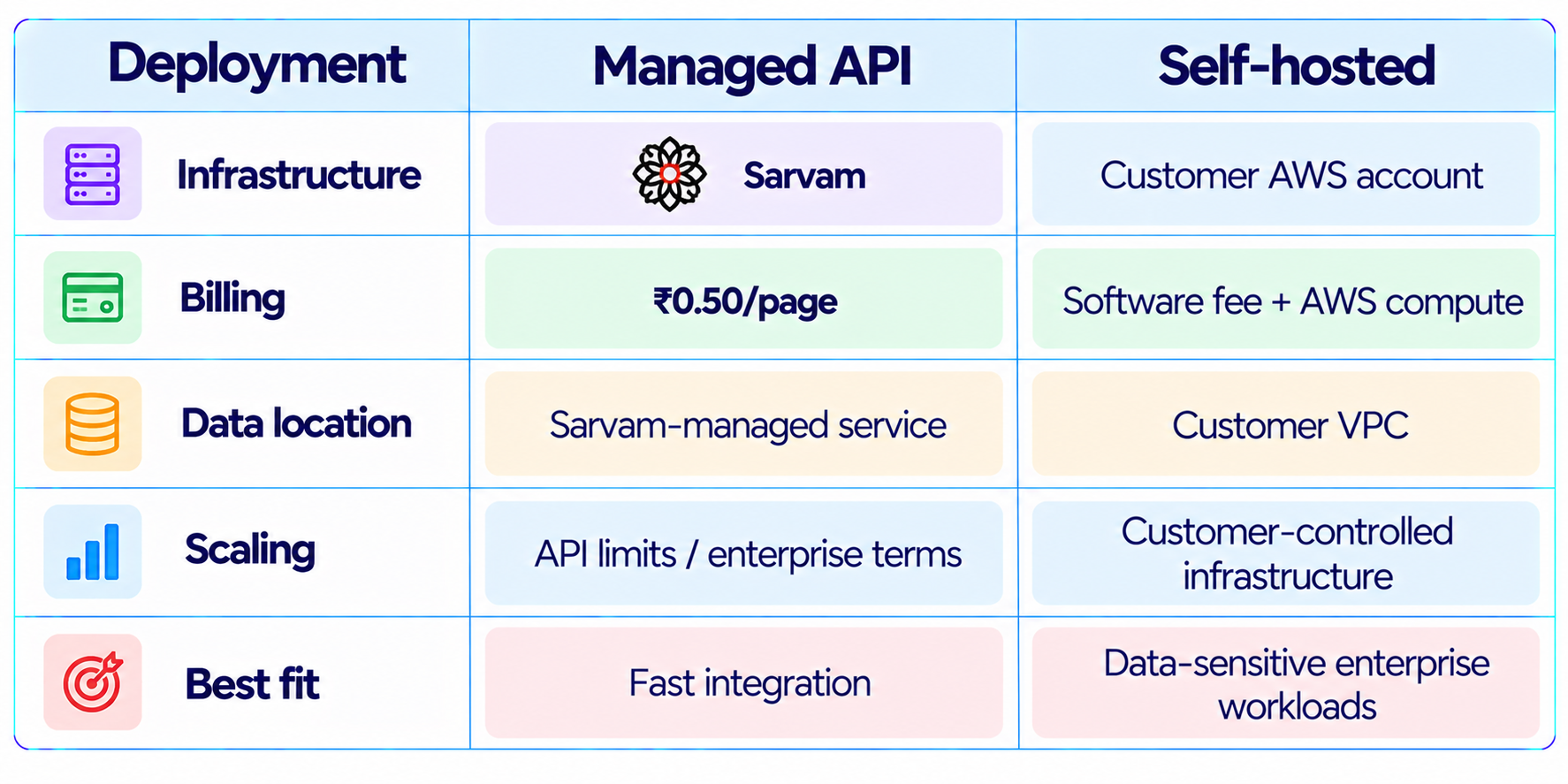
Sarvam's current pricing page lists the Document Digitization API at ₹0.50 per page. The current API documentation states a maximum of 10 pages per job.
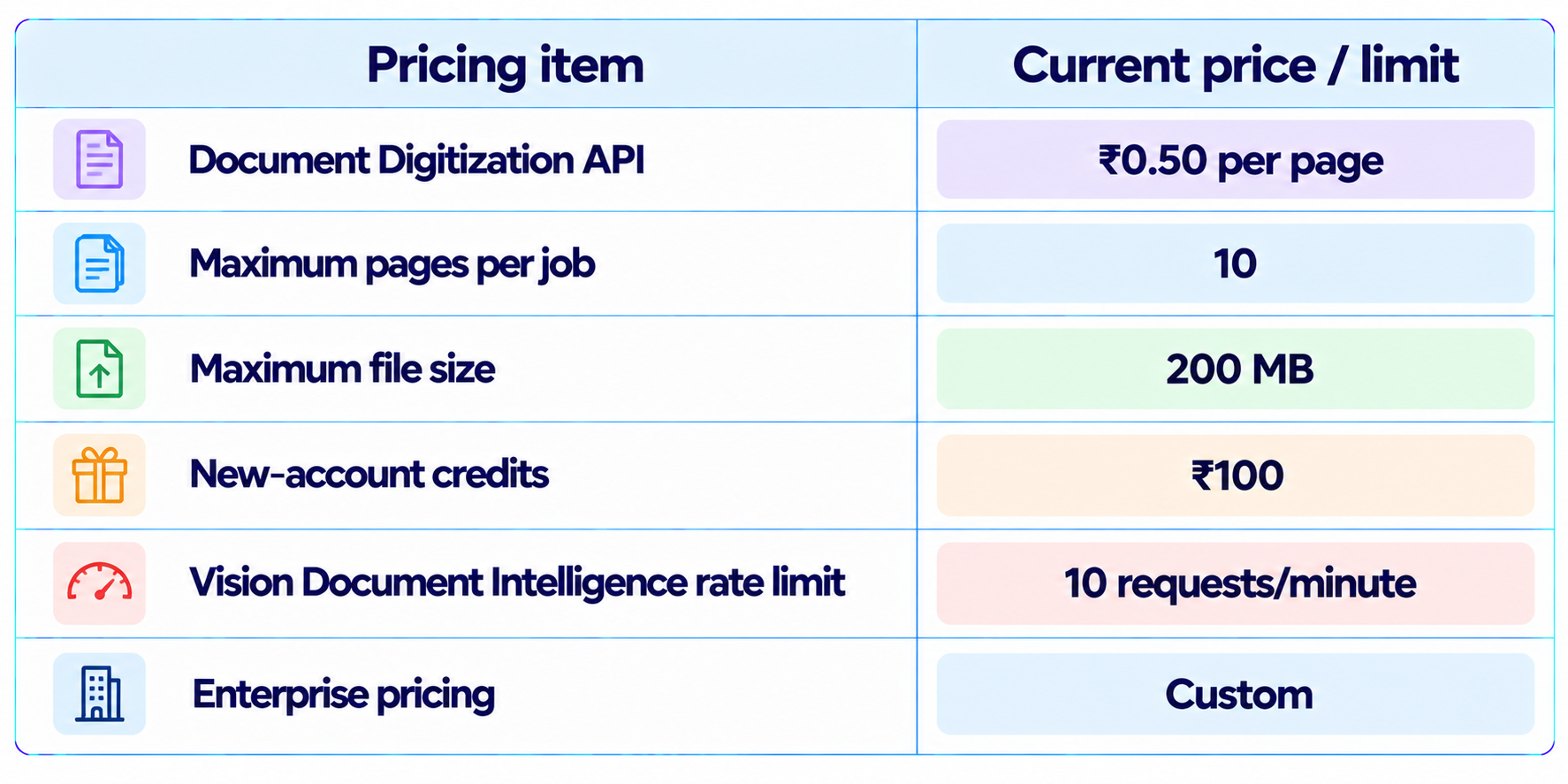
At ₹0.50 per page, processing 1,000 pages costs approximately ₹500 at the listed rate. Ten thousand pages would be approximately ₹5,000. The per-page model makes cost forecasting straightforward, although throughput and rate limits must also be included in deployment planning.
13. API and Developer Experience
Sarvam's current Document AI workflow is asynchronous: create a document job, wait for processing to complete, inspect page metrics and download the output bundle. The official SDK supports this workflow directly.
Outputs include HTML or Markdown, while structured JSON page data is included by default. This gives developers both human-readable and machine-readable representations of the same processed document.
14. Self-Hosting Sarvam Vision
Sarvam also documents self-hosted deployments on AWS through Amazon SageMaker. The self-hosted Vision endpoint accepts raw PDF, PNG, JPEG or ZIP document data and returns JSON or a ZIP bundle.
The current operations documentation recommends the AWS ml.g6e.xlarge family for real-time Vision deployments and ml.g6.xlarge for batch Vision OCR. Self-hosted pricing is separate from the managed API: customers pay the software fee shown in the AWS Marketplace listing plus AWS infrastructure costs.
15. Sarvam Vision 2.1 vs GPT-6 Astra
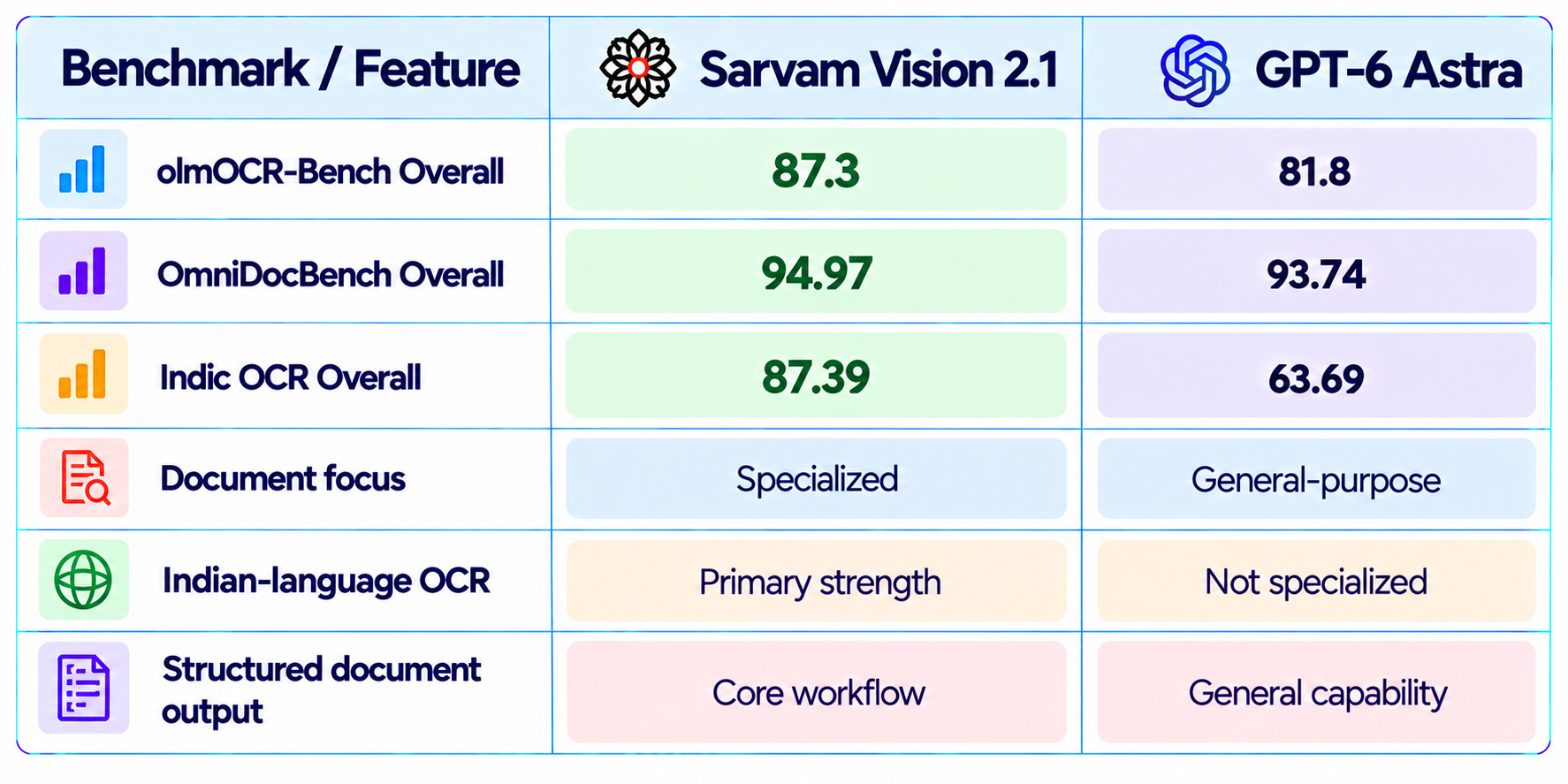
On Sarvam's published document benchmarks, Vision 2.1 has a clear advantage in the targeted OCR and document-intelligence tasks. The Indic OCR difference is especially large in the published benchmark. That does not imply Vision 2.1 is more capable at general visual reasoning, coding, image understanding or other tasks outside document processing.
16. Sarvam Vision 2.1 vs Gemini 3.6 Flash
17. Sarvam Vision 2.1 vs Mistral OCR 4
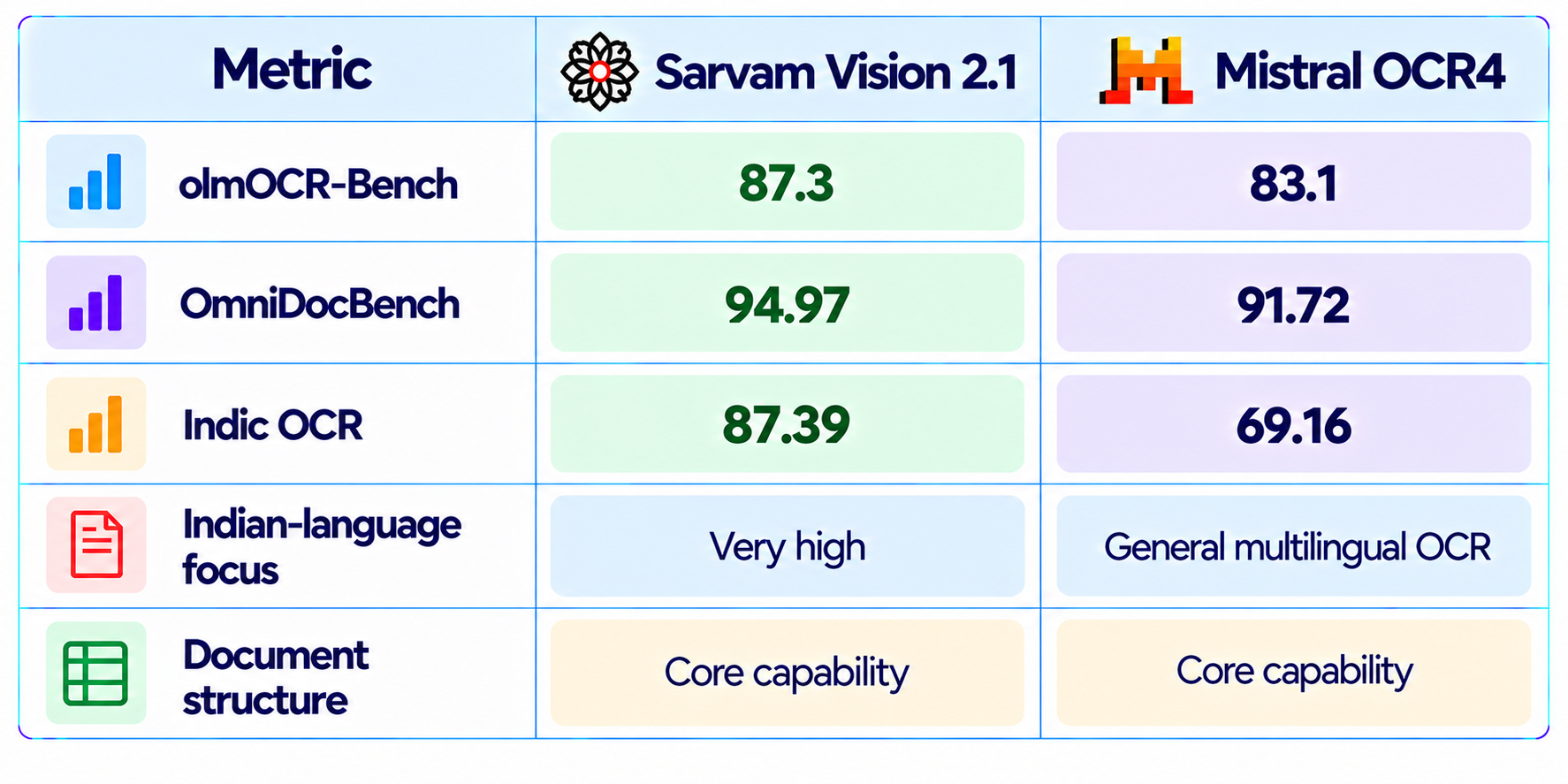
Sarvam's published benchmark results put Vision 2.1 ahead across all three listed evaluation categories. The Indic OCR gap is particularly relevant for Indian organizations because it directly measures regional-language recognition rather than general document structure.
18. Best Use Cases
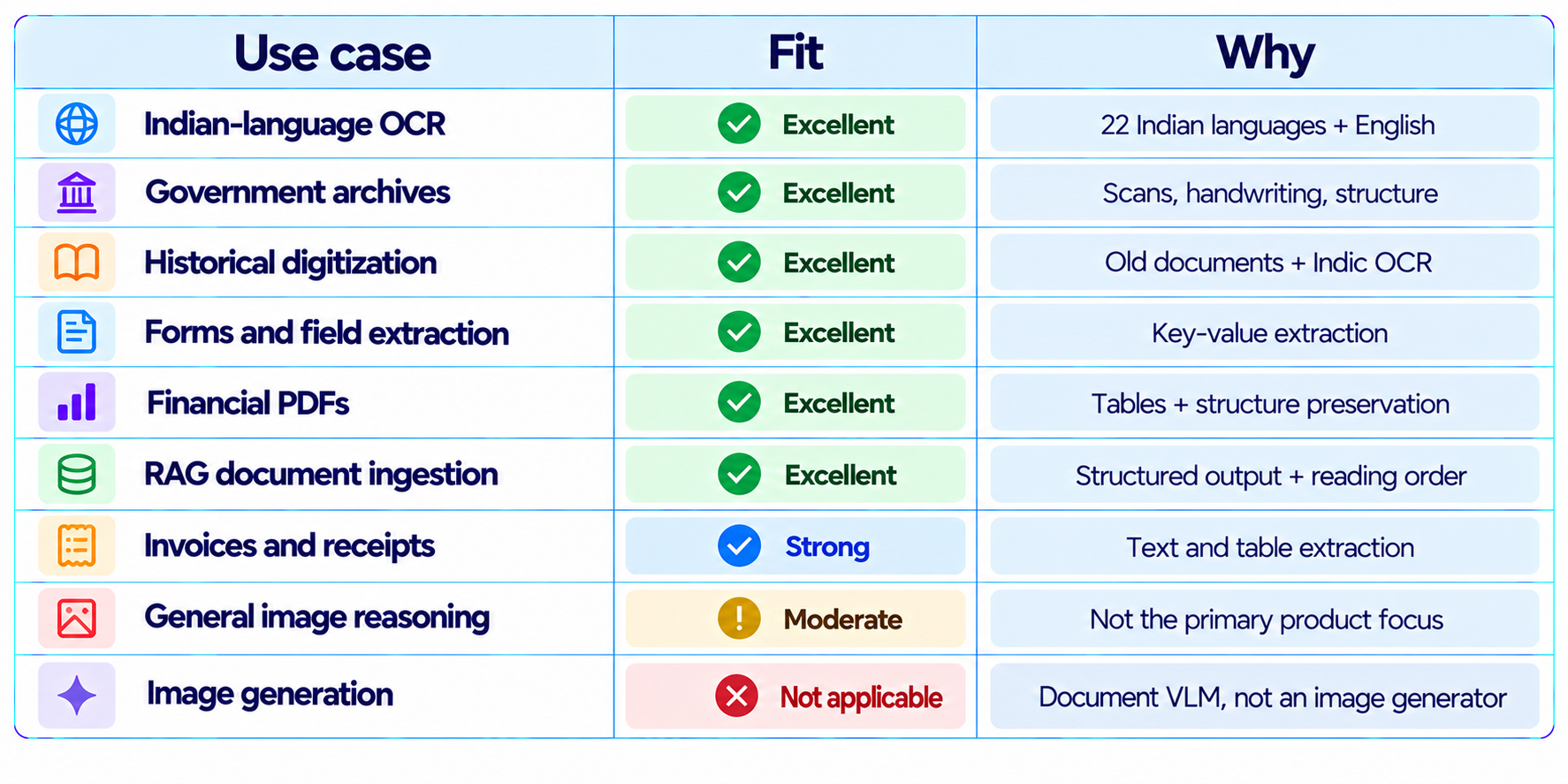
19. RAG and Document Intelligence Workflows
Sarvam Vision 2.1 fits naturally into a document RAG pipeline. Instead of embedding raw PDF pages or relying on a basic OCR layer, a production system can first extract text, tables, page structure and metadata, then chunk the resulting content for retrieval.
- Upload the PDF or scanned document.
- Run Sarvam Vision document digitization.
- Extract structured JSON plus HTML or Markdown.
- Preserve page numbers, headings, tables and reading order.
- Chunk content using document-aware boundaries.
- Create embeddings and store source metadata.
- Retrieve relevant sections for the downstream LLM.
- Return citations or page references to the user.
For the broader architecture, see What Is Context Engineering? Complete Guide (2026) and How to Use LangGraph for Multi-Agent Systems (2026)
20. Production Workflow and Cost Planning
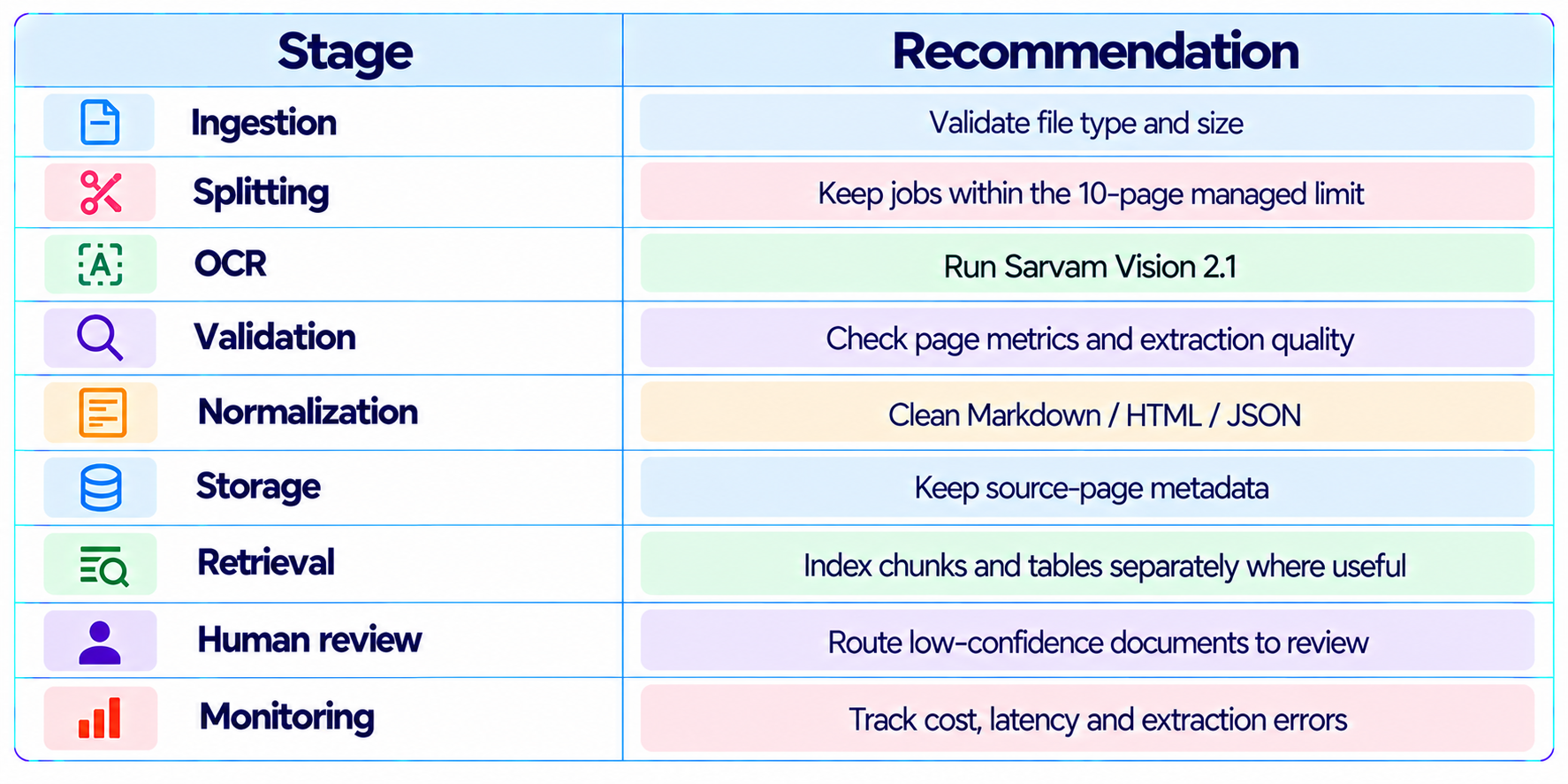
At ₹0.50 per page, cost is predictable, but the 10-request-per-minute Vision Document Intelligence limit can become the throughput bottleneck for large batches. Enterprise systems should therefore plan batching, queueing and asynchronous job processing rather than assuming unlimited parallel requests.
21. Limitations You Should Know
- The managed Document Intelligence API currently has a 10-page-per-job limit.
- Vision API Document Intelligence is currently limited to 10 requests per minute across Starter, Pro and Business plans.
- The model is specialized for document intelligence rather than general visual reasoning.
- Published benchmark results come from Sarvam's evaluation release and should be interpreted within the stated benchmark setups.
- Handwriting performance can vary substantially by script, writing style, scan quality and document age.
- Large archives require splitting, queueing and result recombination.
- The model is not an image-generation system.
- Managed API pricing is per page, while self-hosted deployment has separate software and infrastructure costs.
22. How to Evaluate Sarvam Vision 2.1 Yourself
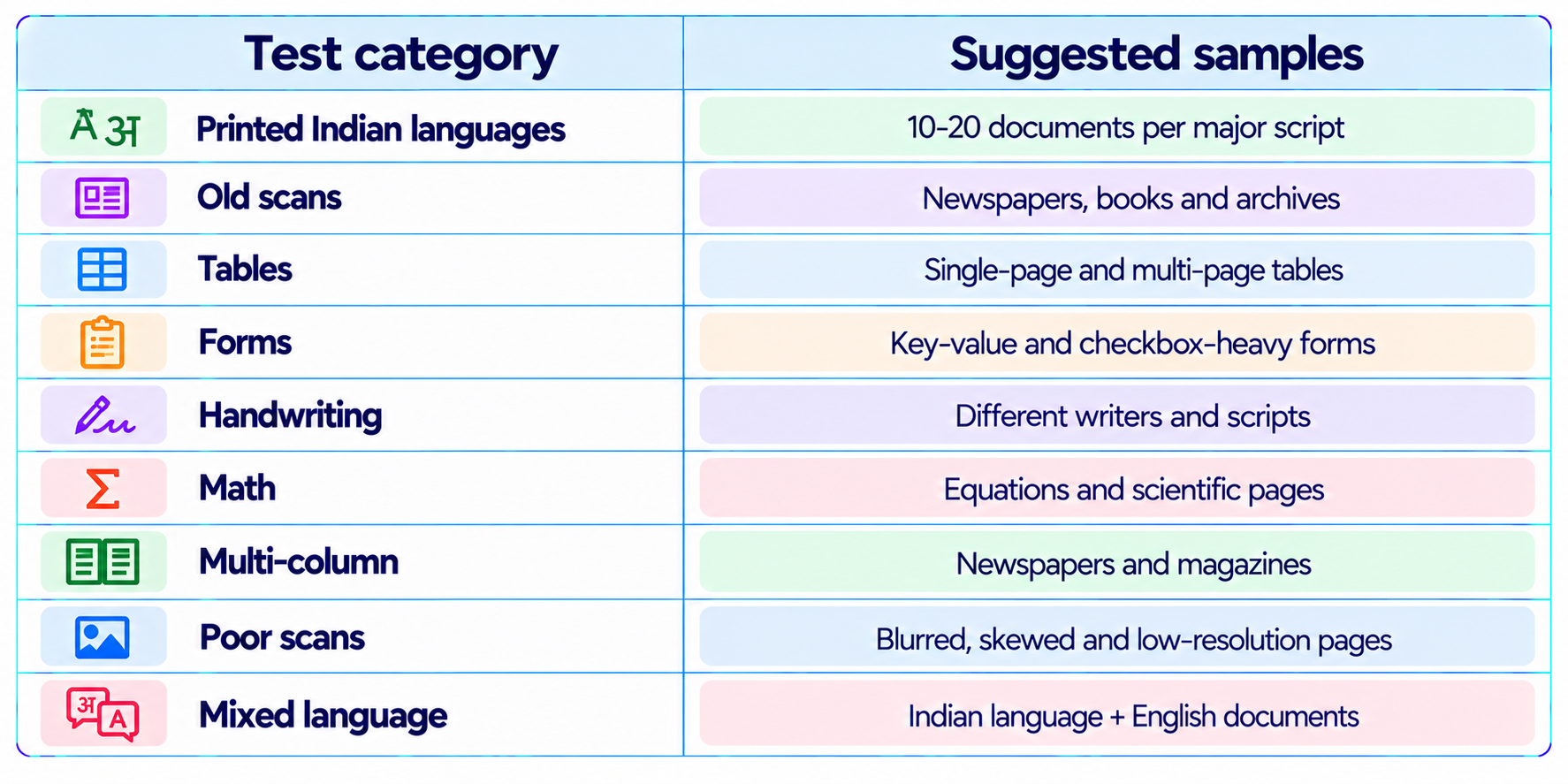
Track character accuracy, word accuracy, table structure, reading order, field extraction, hallucinated text, processing time and cost. For RAG applications, also measure downstream retrieval quality because an OCR error can become a retrieval error later in the pipeline.
23. Is Sarvam Vision 2.1 Worth It?
For Indian-language document intelligence, the answer is strongly supported by the published results. Vision 2.1 combines broad Indian-language coverage, a dedicated Indic OCR benchmark, strong document-structure benchmarks, table extraction and handwriting improvements with a low ₹0.50-per-page managed API price.
The 87.39 Indic OCR accuracy result is the most compelling part of the release. The 87.3 olmOCR-Bench score and 94.97 OmniDocBench score show that the model is not narrowly optimized for one regional-language benchmark either.
The decision becomes less straightforward when the task is general visual reasoning. Sarvam Vision 2.1 is specialized, so organizations that need image understanding beyond documents may still need a general-purpose VLM alongside it.
24. Final Verdict
Sarvam Vision 2.1 is a focused document AI release with a clear technical advantage: it treats Indian-language OCR and document structure as first-class problems rather than secondary capabilities.
The economics strengthen the case. The managed Document Digitization API is currently ₹0.50 per page, while the API supports 23 languages and structured outputs. The 10-page job limit and 10-request-per-minute Vision Document Intelligence rate limit are the main operational constraints to account for.
My rating: 9.3/10 for Indic OCR, 9.2/10 for document structure, 9.0/10 for table extraction, 9.4/10 for price-to-capability and 9.1/10 overall.
Bottom line: Sarvam Vision 2.1 is worth serious consideration for Indian-language OCR, scanned-document digitization, forms, tables, historical archives and document RAG. It is not trying to be the universal vision model. Its strength is being exceptionally focused on the document problems that matter in Indian deployments.
Frequently Asked Questions
What is Sarvam Vision 2.1?
Sarvam Vision 2.1 is a 3B-parameter vision-language model from Sarvam AI focused on document intelligence, OCR, table extraction, structure preservation and Indian-language documents.
How accurate is Sarvam Vision 2.1?
Sarvam reports 87.3 on olmOCR-Bench, 94.97 on OmniDocBench v1.6 and 87.39 overall accuracy on its new Indic OCR benchmark.
What languages does Sarvam Vision 2.1 support?
It supports 23 languages: 22 Indian languages plus English.
How much does Sarvam Vision 2.1 cost?
Sarvam's current Document Digitization API pricing is ₹0.50 per page.
Does Sarvam Vision 2.1 support PDFs?
Yes. The managed API accepts PDFs as well as PNG, JPG and flat ZIP archives of document pages.
How many PDF pages can be processed at once?
The current managed Document Intelligence API supports up to 10 pages per job.
Can Sarvam Vision 2.1 extract tables?
Yes. Complex table parsing is a core capability, with HTML, Markdown and structured JSON outputs.
Does Sarvam Vision 2.1 support handwritten text?
Yes. Indic handwritten recognition is one of the capabilities improved in Vision 2.1.
Can Sarvam Vision 2.1 be used for RAG?
Yes. Its structured document output and preserved reading order make it suitable as a document-ingestion layer for RAG systems.
Can Sarvam Vision 2.1 be self-hosted?
Yes. Sarvam documents AWS SageMaker deployments for Sarvam Vision, allowing the model to run in a customer AWS environment.
Is Sarvam Vision 2.1 better than GPT-6 Astra?
For the document and Indic OCR benchmarks published by Sarvam, Vision 2.1 scores higher. GPT-6 Astra is a broader general-purpose model, so the comparison depends on the task.
Is Sarvam Vision 2.1 worth it?
For Indian-language OCR and document intelligence, its benchmark results, language coverage, structured extraction and ₹0.50-per-page pricing make it a strong option.
Recommended Blogs
Gemini 3.8 Flash Review: Accuracy, Price & Is It Worth It? (2026)
Qwen 3.8 Max 0902 Review: Benchmarks, Price & Is It Worth It? (2026)
How to Secure AI Coding Agents: Permissions, Sandboxing, MCP & Secrets
Resources & Community
Join our community of 70,000+ AI enthusiasts and learn to build powerful AI applications. Build Fast with AI helps creators, developers and teams understand and implement practical AI.
Agentic AI Launchpad 2026
A structured 6-week cohort program that takes you from AI basics to building and deploying real-world agentic AI systems. Includes live sessions, expert mentorship, project reviews and a builder community network.
Ready to go from learning to building? Join the next cohort: Agentic AI Launchpad 2026
Free AI Resources
Access free tools, workshops and micro-learning to keep building.

