



MiniMax M3.1 Flash Review: Is MiniMax's New Fast Coding Model Built for Everyday Development?
MiniMax M3.1 Flash is the new fast coding-focused model that MiniMax has added to MiniMax Code. The current release is called M3.1-Flash-Preview, and its positioning is straightforward: make everyday software development faster without turning every coding request into a long reasoning run.
The release matters because M3.1 Flash is not arriving as an isolated model endpoint. It is integrated into MiniMax Code, the company's coding-agent environment, and the current product interface shows M3.1-Flash-Preview as the default model. That makes this a practical developer release rather than a model announcement that exists only on a leaderboard.
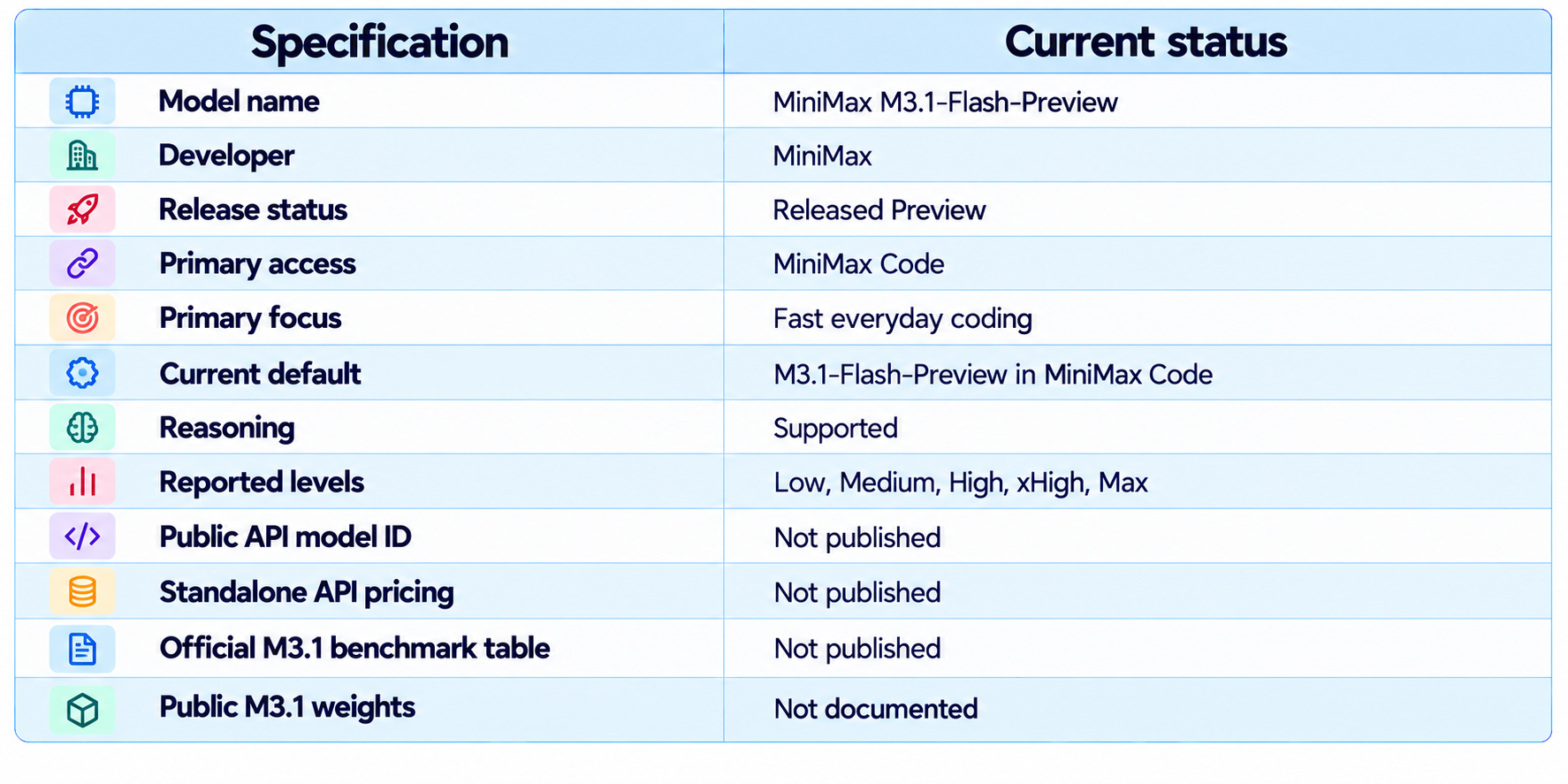
At the same time, a responsible review needs to separate product availability from model documentation. M3.1-Flash-Preview is released and usable in MiniMax Code. However, the current public material does not provide a standalone M3.1 benchmark table, public model identifier for general API use, or standalone M3.1 API pricing. Those missing pieces mean this review evaluates the documented workflow, access, positioning, reasoning controls and relationship to M3 rather than inventing benchmark numbers.
That distinction is especially important because MiniMax M3 already has a substantial public benchmark record. M3 and M3.1 Flash should not be treated as the same model simply because M3.1 is its successor. The older M3 scores can provide context, but they are not M3.1 Flash results.
QUICK ANSWER
MiniMax M3.1 Flash is a released Preview coding model available inside MiniMax Code. MiniMax positions it around fast, reliable everyday development, including quick bug fixes, reviews and feature work.
The current MiniMax Code interface shows M3.1-Flash-Preview as the default model. Current reporting also indicates multiple reasoning levels, with max shown as the default in the Preview workflow.
The important limitation is documentation, not access. MiniMax has not published a standalone M3.1 benchmark suite, public general API model ID or separate API pricing table in the material reviewed for this article. Therefore, there is no responsible M3.1 SWE-Bench or Terminal-Bench number to put into a benchmark table.
The best way to evaluate M3.1 Flash today is inside the environment where it is released: give it real repositories, real bugs, real feature requests and real tests, then measure task completion, latency, retries and developer corrections.
My rating: 9.0/10 for everyday coding workflow, 9.0/10 for speed-first positioning, 8.5/10 for current documentation, 8.5/10 for production readiness and 8.6/10 overall. This rating reflects the current product experience and documented positioning, not an invented benchmark score.
1. What Is MiniMax M3.1 Flash?
MiniMax M3.1 Flash is a coding-oriented Preview model from MiniMax, currently delivered through MiniMax Code. It is designed around fast everyday software-engineering tasks rather than the broader positioning of MiniMax M3.
The current product placement is revealing. MiniMax Code exposes M3.1-Flash-Preview directly in its model picker, and current MiniMax Code pages identify it as the default. The model is therefore being used as part of MiniMax's actual coding-agent product.
MiniMax's public positioning describes the model as fast and reliable for real work, including quick bug fixes and complete features. That makes M3.1 Flash closer to a daily driver for coding agents than a benchmark-first flagship.
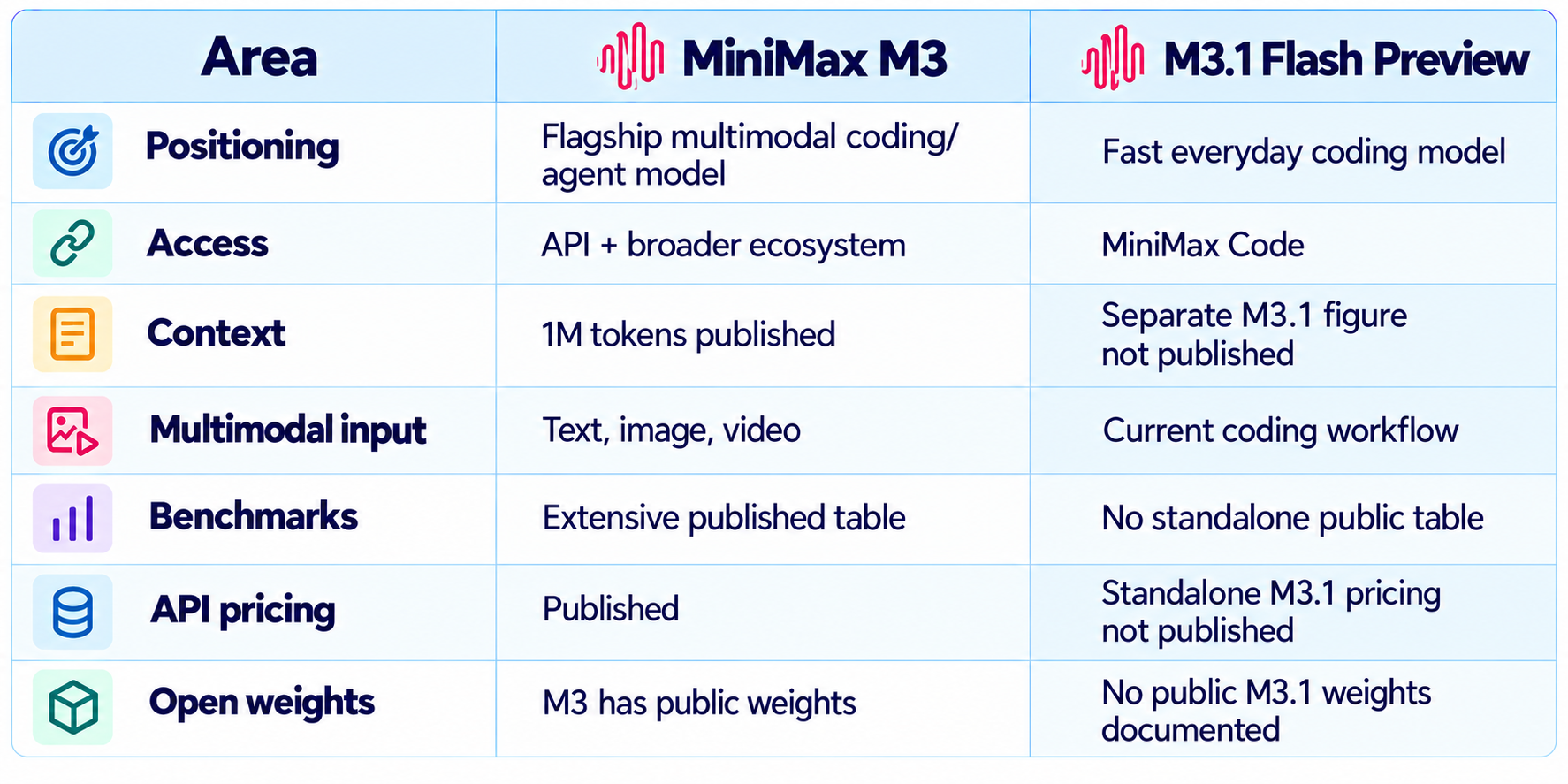
The release is distinct from the original M3. M3 is a broader multimodal model with a published 1M-token context and a large coding, agent and multimodal benchmark table. M3.1 Flash is being introduced through the coding workflow, and its public technical documentation is currently much thinner.
2. MiniMax M3.1 Flash Specifications
One of the easiest ways to misunderstand M3.1 Flash is to fill its undocumented fields with M3 specifications. The table below deliberately records only what is currently documented for M3.1 Flash.
3. Why MiniMax Released a Flash Variant
The Flash naming reflects a familiar model strategy: keep stronger reasoning available for difficult tasks while making routine requests faster. Coding agents generate many small and medium tasks, and not every task needs maximum reasoning depth.
A developer can ask an agent to inspect a file, fix a type error, update a test, explain a function, review a diff, make a UI change and run validation in the same session. When each action becomes faster, the complete agent loop becomes more interactive.
The practical value is therefore not just tokens per second. It is time-to-working-code. If the model reaches the correct patch with fewer retries, faster inference can reduce the total time spent waiting and correcting.
4. M3.1 Flash and MiniMax Code
MiniMax Code is currently the main access path for M3.1 Flash. The current MiniMax Code interface displays M3.1-Flash-Preview as the default model alongside other MiniMax models.
That matters because the model is connected to a coding-agent environment rather than being evaluated only as a chat model. The surrounding tool loop, repository context, file operations and verification steps are part of the practical experience.
For developers, this creates a direct testing path. Open MiniMax Code, use M3.1-Flash-Preview, and give it a real development task. There is no need to wait for a separate API integration simply to understand its coding behavior.
The broader MiniMax Code product also includes desktop-cloud workflows and agent features. These surrounding capabilities can affect productivity as much as the underlying model.
5. Coding Performance: What Can Be Said Today?
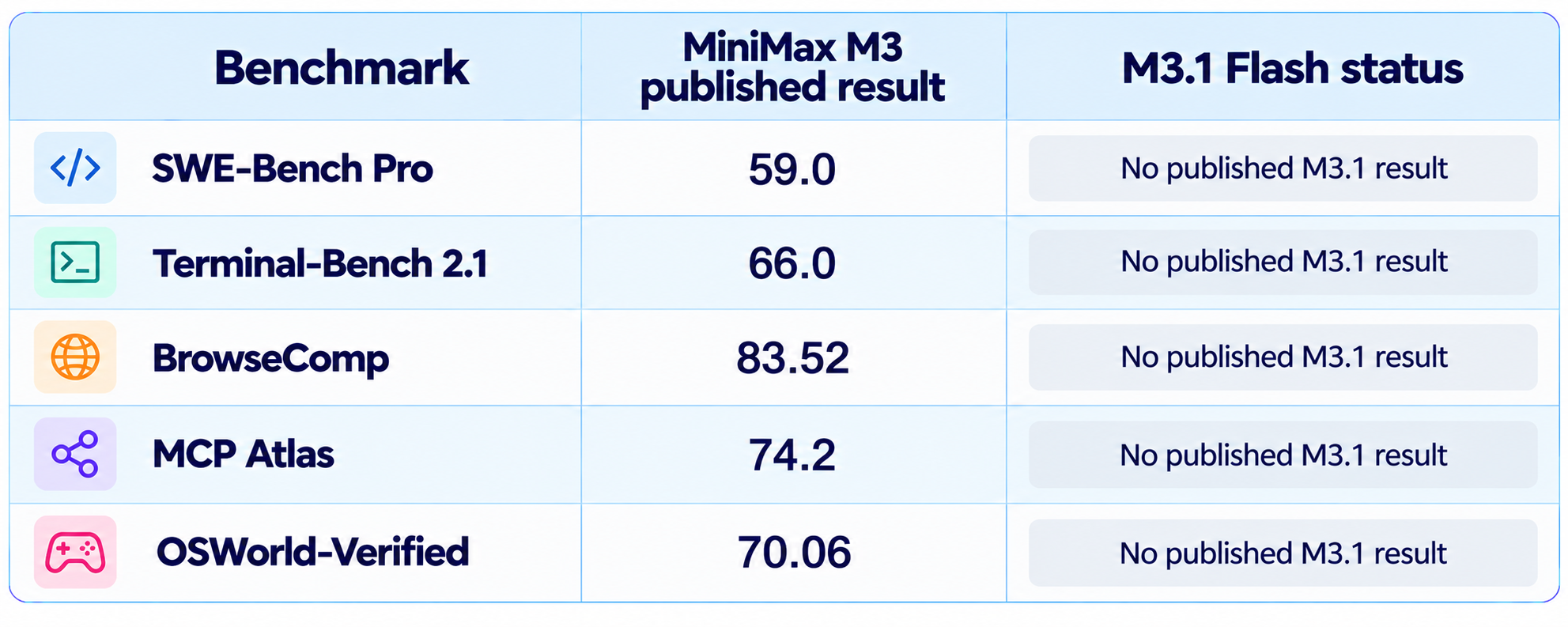
The accurate answer is that M3.1 Flash is released for coding, but MiniMax has not published a standalone M3.1 benchmark table that supports a numerical coding score.
MiniMax M3 already has published results. Its official release table reports 59.0 on SWE-Bench Pro, 66.0 on Terminal-Bench 2.1, 83.52 on BrowseComp, 74.2 on MCP Atlas and 70.06 on OSWorld-Verified. These are M3 results, not M3.1 Flash results.
The distinction matters. A successor can improve, regress or change its optimization target. Copying M3 numbers into an M3.1 article would make the review look more complete while making it less accurate.
Until MiniMax publishes M3.1 results, the best benchmark is a controlled task suite built around real development work.
6. Speed Is the Main M3.1 Flash Question
MiniMax is positioning M3.1 Flash around speed and reliability for everyday coding. That makes latency more important than a single leaderboard number.
For a coding agent, useful measurements include time to first token, time to first useful action, time to complete a patch, tool-call delay, retry count and time until tests pass.
A faster model that produces a wrong patch can be slower at the task level because the developer must correct it. The useful metric is completed software per unit of time.
7. Reasoning Levels in M3.1 Flash
Current reports from the MiniMax Code interface indicate multiple reasoning levels, including low, medium, high, xhigh and max. The Preview appears with max reasoning selected by default in current reporting.
That control is useful because coding tasks have different difficulty levels. A simple typo fix does not need the same reasoning depth as a multi-file architectural change.
The exact mapping between each label and a fixed reasoning-token budget has not been published as a standalone M3.1 specification. Treat these as workflow controls rather than assuming fixed token counts.
8. M3.1 Flash vs MiniMax M3
M3.1 Flash should not be treated as a simple replacement for M3. The two releases have different public positioning.
M3 is the broader, better-documented model with public weights, multimodal input, a published 1M-token context and extensive benchmark results. M3.1 Flash is positioned as a faster everyday coding model inside MiniMax Code.
For teams that need a documented API and broad multimodal model, M3 remains easier to evaluate. For developers who want the current MiniMax Code coding experience and fast daily development, M3.1 Flash is the relevant model to test.
9. M3.1 Flash vs DeepSeek V4.1 Flash
DeepSeek V4.1 Flash is a useful comparison because it also targets high-volume coding and agent workloads. Unlike M3.1 Flash, it has published API and benchmark information that can be evaluated directly.
The practical comparison is therefore about integration and evidence. M3.1 Flash is tightly integrated into MiniMax Code, while DeepSeek V4.1 Flash can be evaluated through a broader API/model ecosystem. M3.1 Flash currently requires task-level testing for performance conclusions.
10. M3.1 Flash vs Other Fast Coding Models
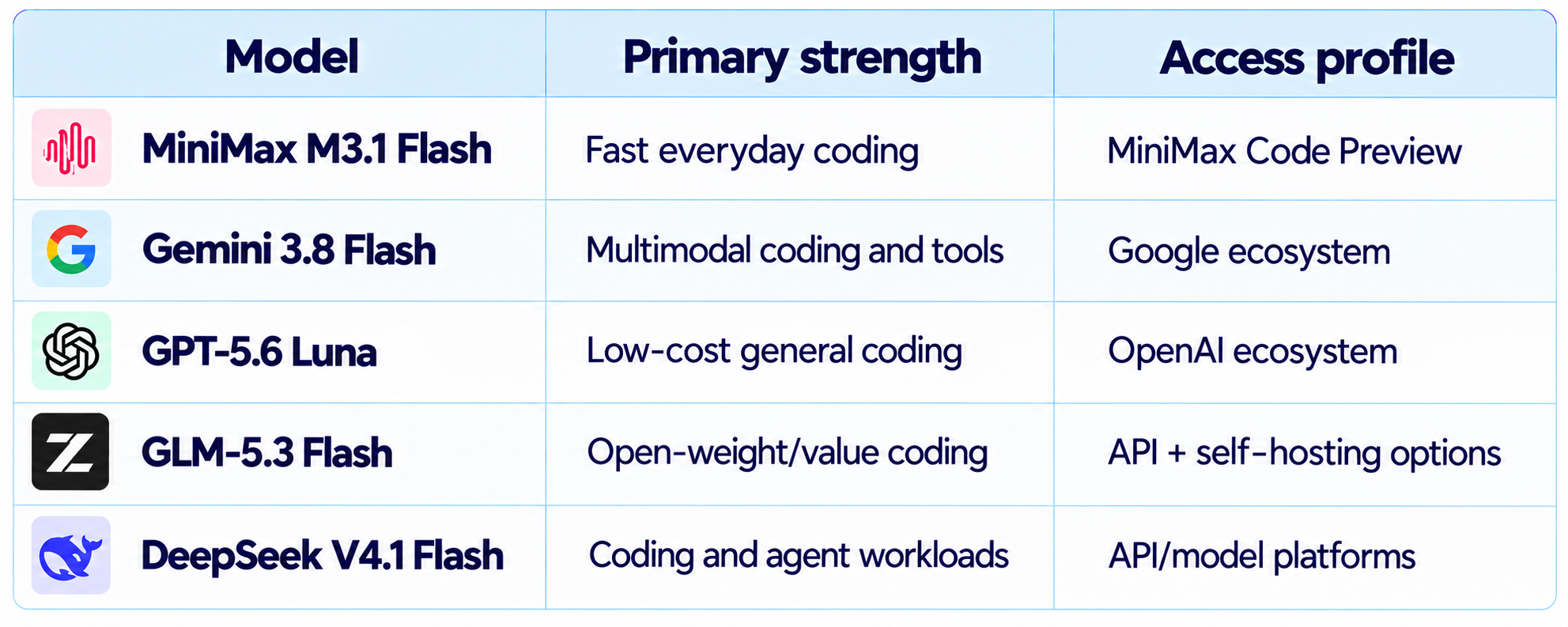
M3.1 Flash enters a market where speed-first models are increasingly important. Gemini 3.8 Flash, GPT-5.6 Luna, GLM-5.3 Flash and DeepSeek Flash models all target parts of the high-volume coding market.
The key difference is integration. A model can have a low token price but still be expensive at the workflow level if the agent needs many retries. A model with a higher token rate can be cheaper in practice if it completes repository tasks with fewer iterations.
11. Does M3.1 Flash Have a Public API?
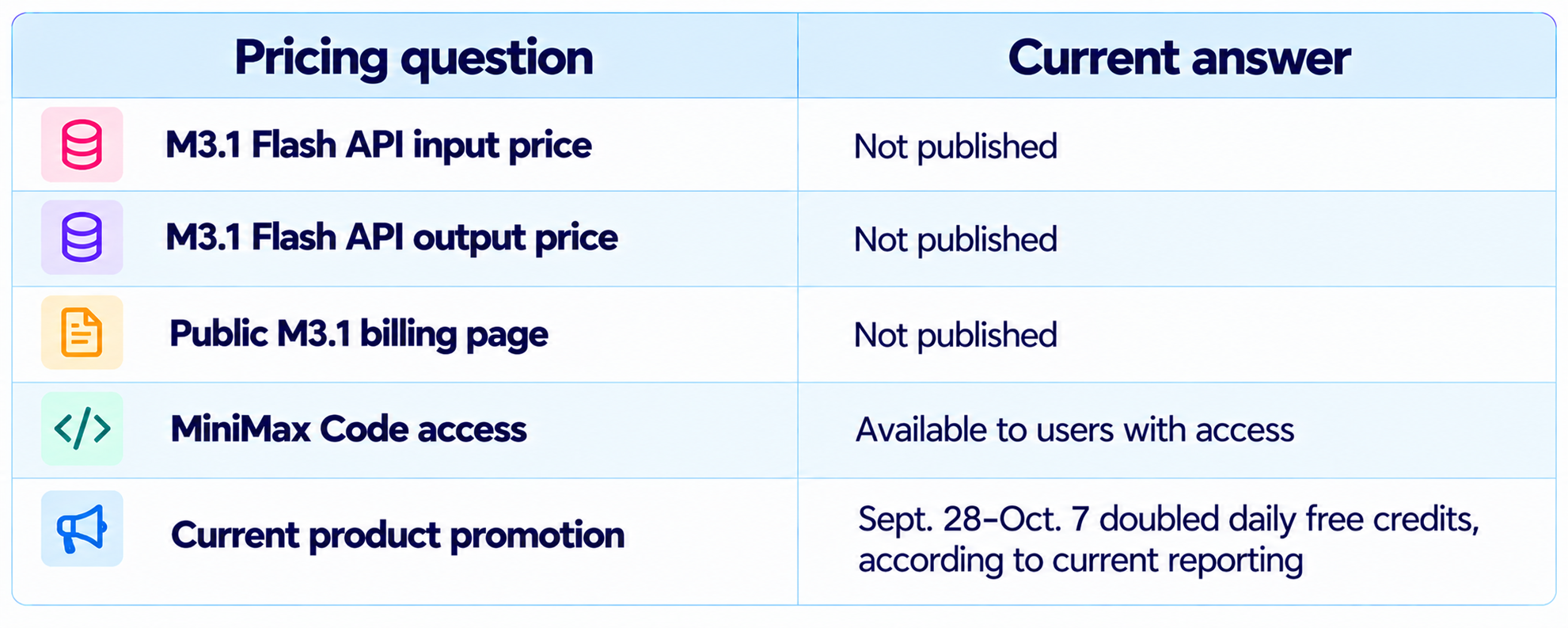
A standalone public API identifier for M3.1-Flash-Preview has not been published in the public documentation reviewed for this article. Current public access is through MiniMax Code.
This matters for production infrastructure. MiniMax M3 has an established API path, while M3.1 Flash should not be added to production code under a guessed model identifier.
When MiniMax publishes the model identifier and API terms, the model should be reevaluated with production latency, rate limits, pricing, context limits and tool-calling behavior.
12. M3.1 Flash Pricing
A standalone M3.1 Flash API price has not been published. Current MiniMax Code access should therefore be evaluated through the product's available usage or token-plan mechanics rather than an invented per-million-token rate.
Current reporting also describes a MiniMax Code promotion from September 28 to October 7 that provides doubled daily free credits. That is a product promotion, not a permanent M3.1 Flash API price.
13. Context Window
MiniMax M3 is documented with a 1M-token context window, but the current M3.1 Flash release does not have a separately published context specification in the public material reviewed for this article.
Do not automatically copy M3's 1M-token figure into an M3.1 specification table. For coding agents, the effective context is also determined by repository selection, tool output, terminal logs and context management.
14. What M3.1 Flash Is Best At
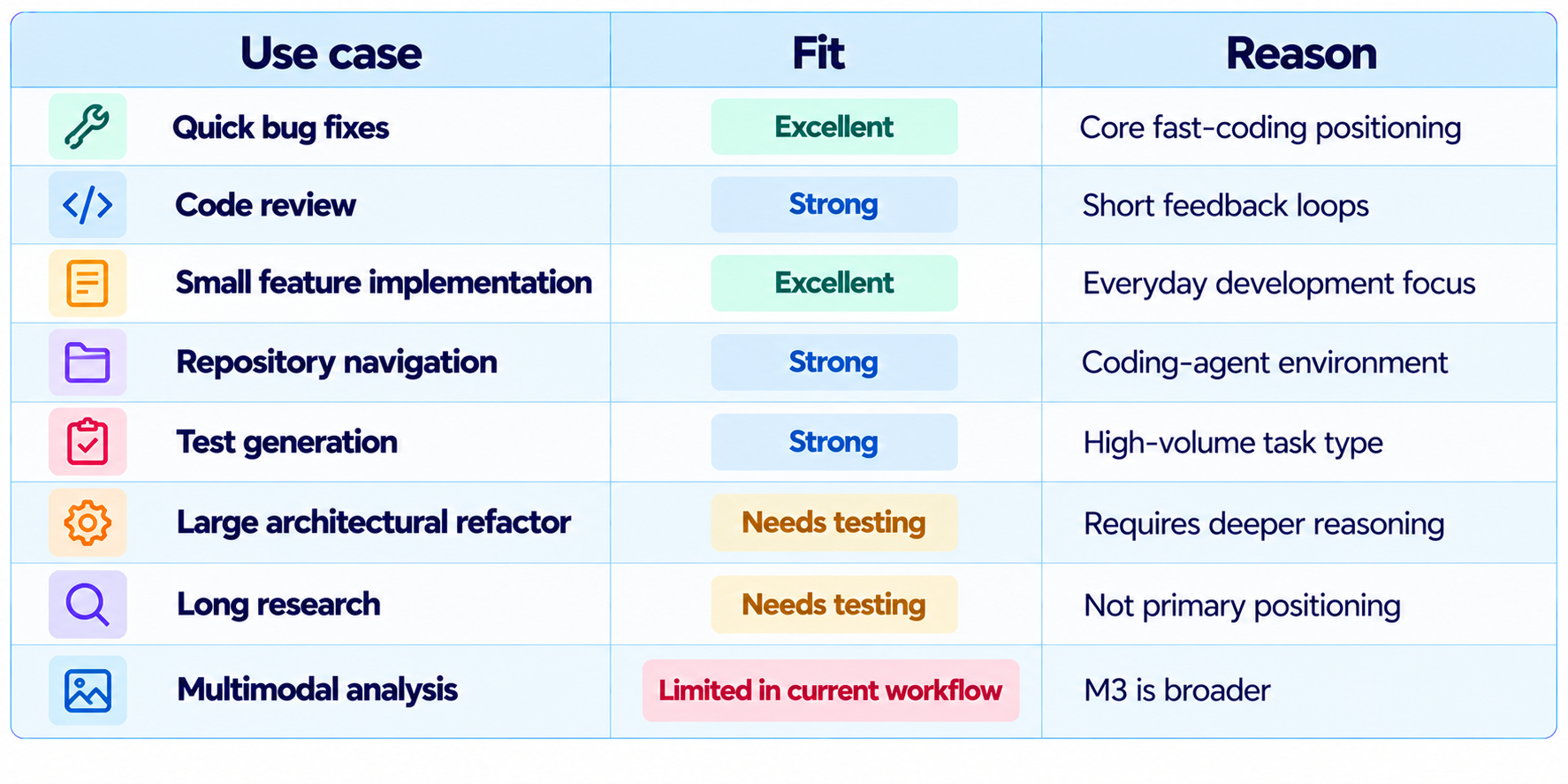
The current product positioning points to quick bug fixes, code review, small feature implementation, repository questions and repeated coding-agent loops.
It is less appropriate to make strong claims about multimodal analysis, long research or difficult architectural reasoning without a dedicated M3.1 evaluation. Those tasks may work well, but they are not established by the current public model documentation.
15. Why the MiniMax Code Integration Matters
A coding model is only one part of an agent. The model needs file access, terminal tools, context management, patch application, test execution and reliable stopping conditions.
MiniMax Code provides the surrounding environment, so M3.1 Flash can be judged as an agent component rather than only as a raw chat model.
This is useful when the goal is time-to-working-code. If the model can inspect a repository, make a change, run tests and correct itself quickly, lower per-step latency can translate into better developer productivity.
16. How to Test M3.1 Flash Properly
The most useful evaluation is a private coding benchmark based on your actual repository. Use tasks with objective completion criteria rather than subjective chat quality.
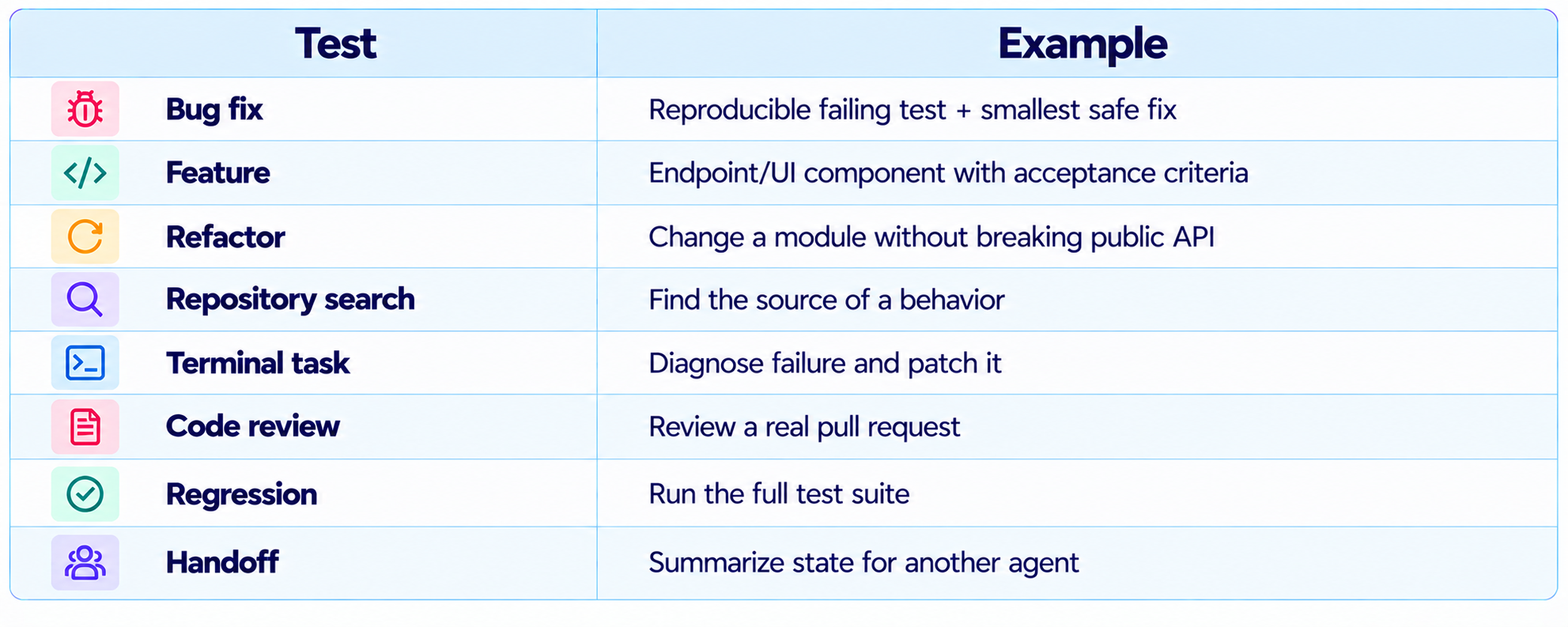
Test a reproducible bug, a small feature, a safe refactor, repository navigation, a terminal failure, a code review and a regression task. Run each several times and record success rate, completion time, tool calls, retries, changed files, tests passed and developer corrections.
This produces a more useful M3.1 Flash review than an unofficial benchmark screenshot because it measures the model on the work your team actually does.
17. A Practical M3.1 Flash Workflow
Start simple tasks at a lower reasoning level when the interface allows it. Increase reasoning for cross-file bugs and difficult implementation work.
Give the agent exact reproduction steps and expected behavior. Ask it to inspect the repository before editing when the request is ambiguous. Require tests for every code change and let the agent run validation before it declares completion.
Review the final diff instead of trusting a successful model response. If repeated attempts fail, route the task to a stronger model rather than forcing the Flash model to continue indefinitely.
18. Limitations You Should Know
M3.1 Flash does not currently have a public standalone benchmark suite. Do not reuse M3 benchmark scores as M3.1 results.
A general public M3.1 Flash API model identifier and standalone API price have not been documented in the reviewed public material.
The current release is a Preview inside MiniMax Code. The exact mapping between reasoning labels and token budgets is not publicly specified.
Community reports are useful for discovering behaviors, but they should not be treated as controlled benchmark evidence.
19. Is MiniMax M3.1 Flash Worth Using?
Yes, if your goal is to test a faster MiniMax coding workflow inside MiniMax Code. The model is released, accessible through the product and positioned specifically around everyday development.
The strongest reason to use it is practical. Put real bugs, reviews and feature requests in front of it and measure whether it gets working code faster than your current model.
The biggest reason not to build a production API integration around it yet is documentation. Without a published model ID, API pricing and M3.1 benchmark suite, there is not enough information for a conventional provider-level cost and benchmark comparison.
20. Final Verdict
MiniMax M3.1 Flash is a meaningful release because MiniMax is moving the Flash concept directly into its coding-agent product. M3.1-Flash-Preview is available in MiniMax Code and is presented as the default model in the current interface.
Its role is clear: fast everyday software development. Bug fixes, code review, small features, repository questions and repeated agent loops are the tasks where lower latency can have a noticeable effect on developer productivity.
The benchmark story needs a clean boundary. MiniMax M3 has published results such as 59.0 SWE-Bench Pro, 66.0 Terminal-Bench 2.1 and 74.2 MCP Atlas. M3.1 Flash does not yet have a public benchmark table that can be quoted as its own result.
That changes how the model should be evaluated, not whether it should be evaluated. Test M3.1 Flash on real repositories and measure task completion, latency, retries, tool calls and tests passed.
My rating: 9.0/10 for everyday coding workflow, 9.0/10 for speed-first positioning, 8.5/10 for current documentation, 8.5/10 for production readiness and 8.6/10 overall.
Bottom line: MiniMax M3.1 Flash is worth testing now if you want a fast coding-agent experience inside MiniMax Code. It is not a model you should benchmark with invented M3.1 scores or budget around an unpublished API price. Its real opportunity is the workflow: fast reasoning, coding-agent integration and a focus on the high-volume tasks developers perform every day.
For the published M3 benchmark baseline, see MiniMax M3 coverage on Build Fast with AI.
For a related coding-model comparison, read DeepSeek V4.1 Flash Review.
For routing fast and strong models together, see Model Routing for AI Coding Agents.
Frequently Asked Questions
Is MiniMax M3.1 Flash released?
Yes. M3.1-Flash-Preview is currently available in MiniMax Code, and the current interface shows it as the default model.
What is MiniMax M3.1 Flash?
It is a Preview coding model from MiniMax focused on fast everyday software development inside MiniMax Code.
Is M3.1 Flash good for coding?
It is specifically positioned for coding, including bug fixes, reviews and feature work. Use real repository tasks to measure its performance.
Does M3.1 Flash have benchmarks?
MiniMax has not published a standalone M3.1 benchmark suite in the current public material reviewed. M3 results should not be presented as M3.1 results.
How much does M3.1 Flash cost?
A standalone public M3.1 Flash API price has not been published.
Can I use M3.1 Flash through an API?
Current public access is through MiniMax Code. A general public API model identifier has not been documented.
What reasoning levels does M3.1 Flash have?
Current reporting indicates low, medium, high, xhigh and max options in MiniMax Code, with max shown as the default. A detailed token-budget mapping is not published.
How does M3.1 Flash compare with M3?
M3 is broader and better documented, with public weights, multimodal input, 1M context and published benchmarks. M3.1 Flash is positioned as a faster everyday coding model inside MiniMax Code.
Is M3.1 Flash open source?
No public M3.1 Flash weights have been documented. M3's public weights should not be assumed for M3.1 Flash.
What is the M3.1 Flash context window?
4MiniMax has not published a separate M3.1 Flash context specification in the public material reviewed.
Should I use M3.1 Flash for coding agents?
It is a sensible model to test for everyday coding-agent work inside MiniMax Code. Measure completed tasks, latency, retries and test success.
Is MiniMax M3.1 Flash worth it?
Yes for hands-on testing of fast coding workflows in MiniMax Code. Production API adoption should be based on formal API, pricing and benchmark documentation when available.
Recommended Blogs
MiniMax FastH3 Review: Speed, Quality, VRAM & Is It Worth It? (2026)
DeepSeek V4.1 Flash Review: Benchmarks, Price, Speed & Is It Worth It? (2026)
How to Secure AI Coding Agents: Permissions, Sandboxing, MCP & Secrets
Resources & Community
Join our community of 70,000+ AI enthusiasts and learn to build powerful AI applications. Build Fast with AI helps creators, developers and teams understand and implement practical AI.
Agentic AI Launchpad 2026
A structured 6-week cohort program that takes you from AI basics to building and deploying real-world agentic AI systems. Includes live sessions, expert mentorship, project reviews and a builder community network.
Ready to go from learning to building? Join the next cohort: Agentic AI Launchpad 2026
Free AI Resources
Access free tools, workshops and micro-learning to keep building.

