



Ling 3.1 Flash Review: How Good Is InclusionAI's 560B Fast Model for Coding and AI Agents?
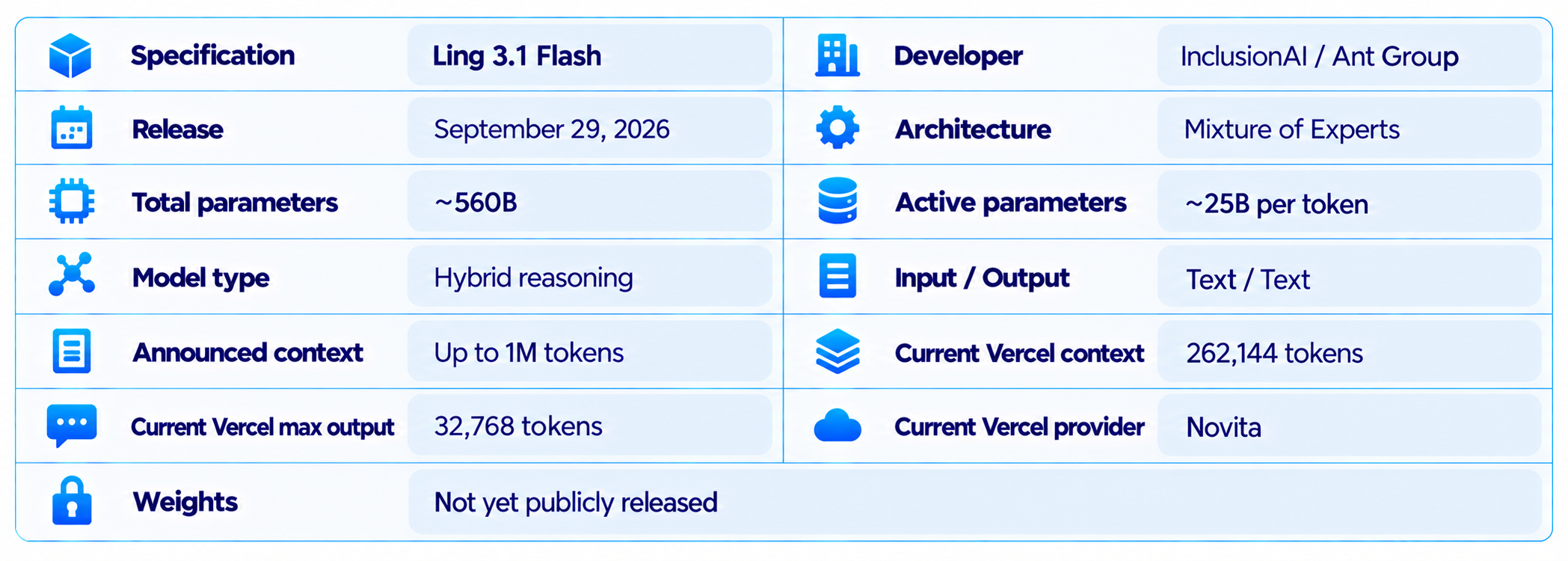
Ling 3.1 Flash is InclusionAI's new large-scale hybrid reasoning model, released on September 29, 2026 and positioned around coding, multi-step analysis and tool-using agents. It is a Mixture-of-Experts system with approximately 560 billion total parameters and about 25 billion active parameters per token. The model is designed for long-context workflows involving code, documents and extended task histories.
The model is a substantial step up in scale from Ling 3.0 Flash. The important detail, however, is that parameter count alone does not tell you how the model behaves. The current public evidence combines provider-published benchmark results with live hosted specifications from Vercel AI Gateway. Those sources show a model with strong published agentic results, useful coding scores, a 262K-token served context on Vercel, and promotional access through October 13, 2026.
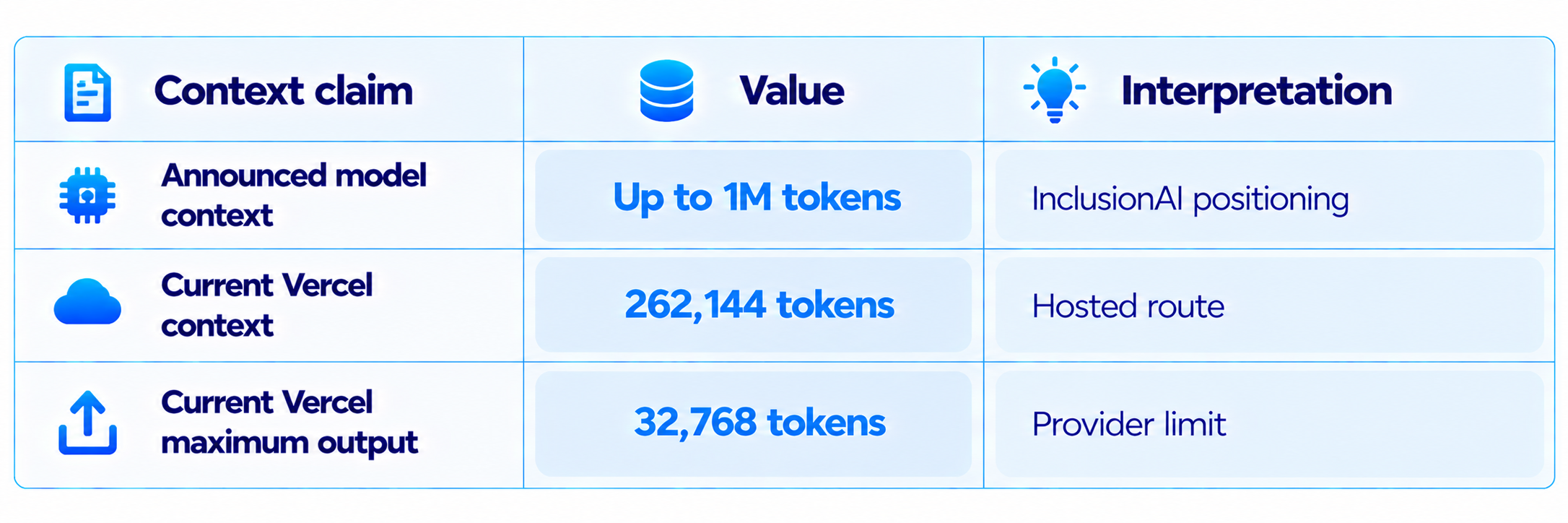
There is also an important distinction between the model's announced design target and the currently served configuration. InclusionAI's launch material describes a context window of up to 1 million tokens, while the current Vercel AI Gateway route exposes 262,144 tokens and up to 32,768 output tokens. That difference matters when planning production deployments.
QUICK ANSWER
Ling 3.1 Flash is a 560B-total-parameter, approximately 25B-active-per-token hybrid reasoning model from InclusionAI. It is built for coding, multi-step analysis and tool-using AI agents. Vercel AI Gateway currently serves it with a 262K-token context window and up to 32,768 output tokens, while InclusionAI's announced model design targets up to 1M context.
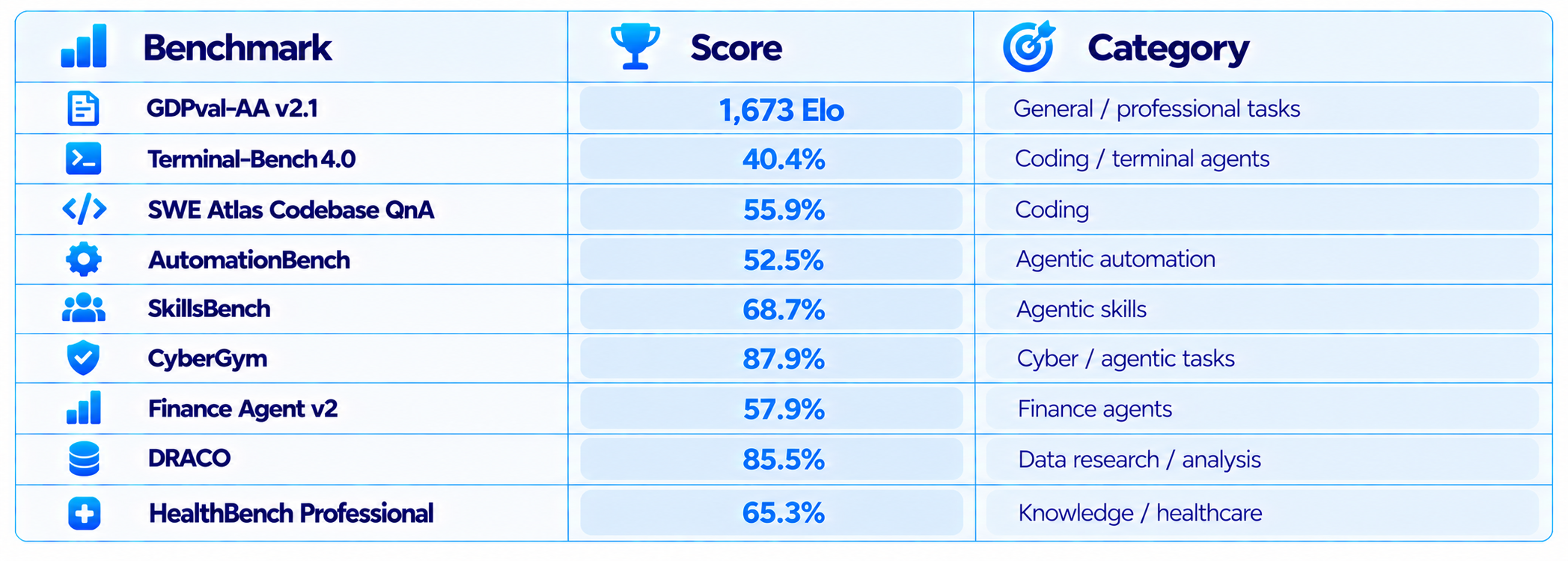
The published benchmark profile is strongest in agentic workloads. The available benchmark record includes 52.5% on AutomationBench, 68.7% on SkillsBench, 87.9% on CyberGym, 57.9% on Finance Agent v2 and 85.5% on DRACO. For coding, the published figures include 40.4% on Terminal-Bench 4 and 55.9% on SWE Atlas Codebase QnA. HealthBench Professional is listed at 65.3%. These figures come from InclusionAI's launch benchmark material and are provider-reported.
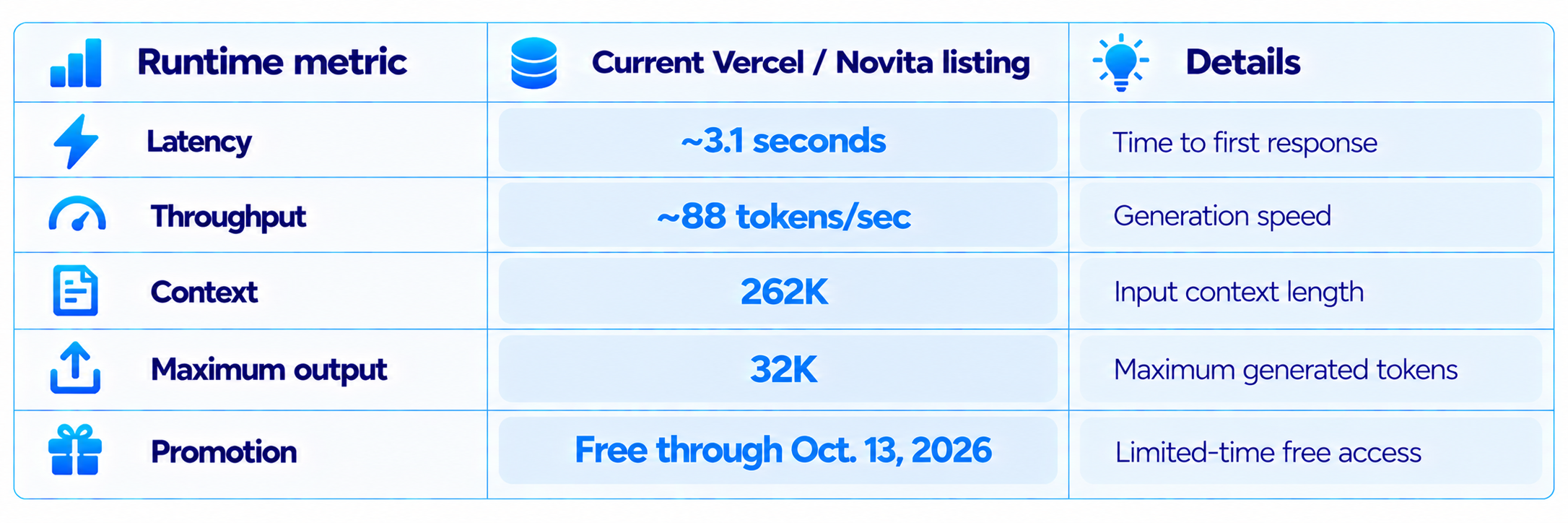
On availability, Vercel AI Gateway currently offers Ling 3.1 Flash through Novita, with promotional free access through October 13, 2026. The standard model ID is inclusionai/ling-3.1-flash, while the free promotional route is inclusionai/ling-3.1-flash-free. Vercel lists roughly 3.1 seconds latency and 88 tokens per second throughput for its current Novita route.
My verdict: 8.9/10 overall for the current hosted experience. Ling 3.1 Flash is especially interesting for agentic coding, multi-step workflows and long-context tasks. Before production, verify the exact provider price, context limit and task-level quality on your workload.
1. What Is Ling 3.1 Flash?
Ling 3.1 Flash is the latest fast-tier model in InclusionAI's Ling family. InclusionAI is associated with Ant Group and has previously released Ling models as open-source or downloadable systems. Ling 3.1 Flash takes the family in a much larger direction, with approximately 560B total parameters and 25B active parameters per token.
The model uses hybrid reasoning rather than treating every request as a simple direct completion. That makes it suitable for tasks where the model needs to plan, reason across multiple steps, inspect information and use tools.
The current model is particularly relevant to coding agents because its stated target workloads include repositories, long code contexts, tool use and extended task histories. Vercel's AI Gateway documentation explicitly describes Ling 3.1 Flash as a model for coding, multi-step analysis and tool-using agents.
2. Ling 3.1 Flash Specifications
The most important specifications are its sparse architecture, large total parameter count, active parameter count and long context. The current hosted configuration is also important because it determines what developers can actually use today.
3. Why 560B Parameters Does Not Mean 560B Parameters Per Token
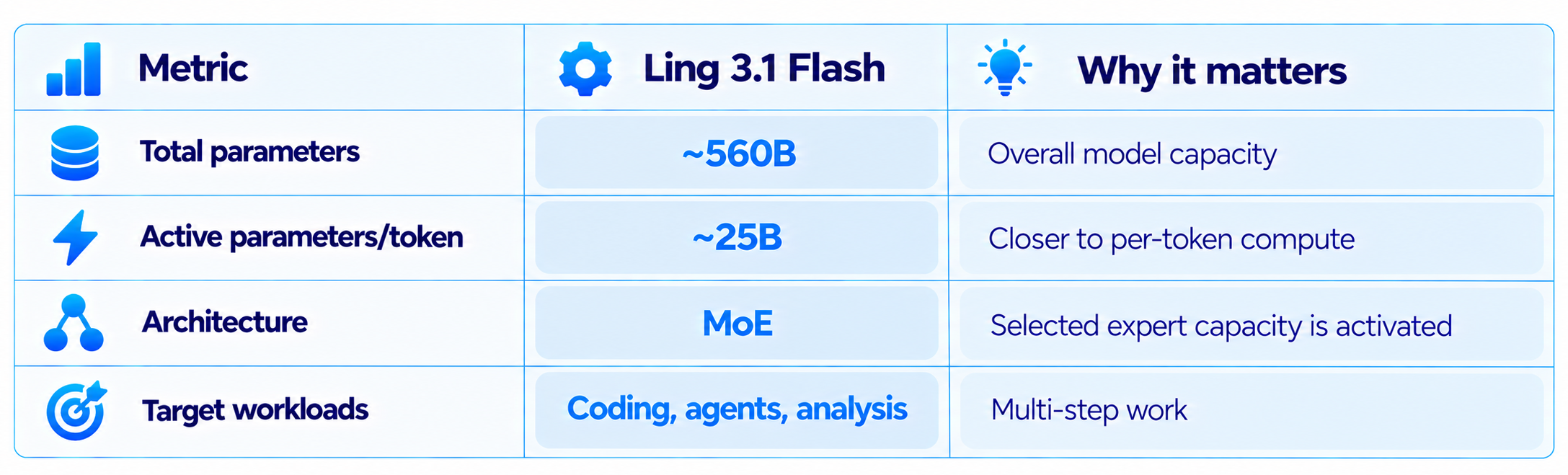
Ling 3.1 Flash is a sparse Mixture-of-Experts model. The headline parameter count is about 560B, but only around 25B parameters are active for each token. This is the key reason the model can be described as a Flash model despite its very large total parameter count.
This is why comparing Ling 3.1 Flash with a dense model solely by parameter count is misleading. Total parameters describe the complete network, while active parameters are much more relevant to per-token compute.
4. Ling 3.1 Flash Benchmark Results
The current published benchmark set covers agentic tasks, coding and one knowledge benchmark. The benchmark values below are reported in InclusionAI's September 30 launch material and are also recorded by BenchLM with their source provenance.
The benchmark picture is strongest around agentic workflows. CyberGym at 87.9% and DRACO at 85.5% are particularly high within the published set, while SkillsBench and AutomationBench show that the model is intended to handle tool-driven tasks rather than only static question answering.
The provenance matters. These are provider-reported benchmark results rather than a single independent leaderboard score. BenchLM currently records eight source-displayable benchmark rows and does not assign Ling 3.1 Flash a site-wide overall rank. That prevents different benchmark suites from being collapsed into an invented overall score.
5. Coding Performance
For developers, Terminal-Bench 4.0 and SWE Atlas Codebase QnA are the most directly relevant published results. Ling 3.1 Flash records 40.4% on Terminal-Bench 4 and 55.9% on SWE Atlas Codebase QnA in the current benchmark record.
Terminal-Bench evaluates terminal-oriented agent behavior, making it more representative of coding agents than a simple code-generation benchmark. SWE Atlas Codebase QnA focuses on understanding real codebases, which is important for agents that must navigate repositories before making changes.
These numbers suggest Ling 3.1 Flash is designed to operate as a repository-aware engineering model, not simply as a code completion model. That distinction becomes important when comparing it with other fast models.
6. Agentic AI Is the Core Strength
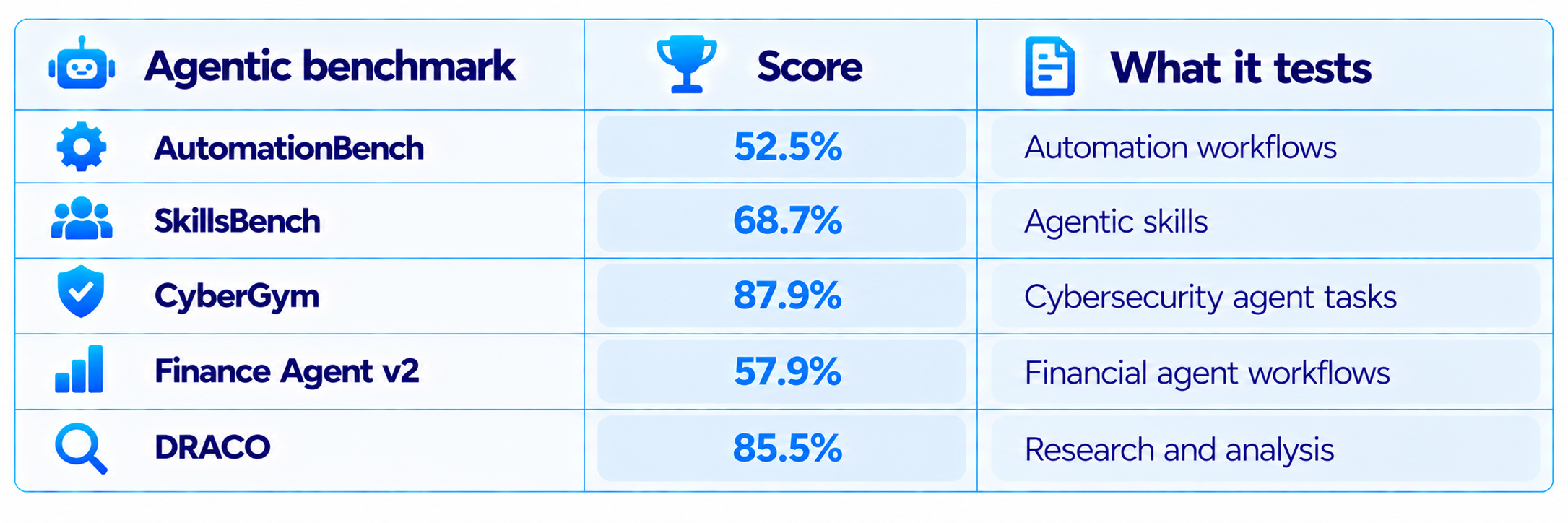
Ling 3.1 Flash's benchmark profile makes its agentic focus particularly clear. AutomationBench, SkillsBench, CyberGym, Finance Agent v2 and DRACO cover different forms of multi-step work where the model has to reason about a task rather than answer one isolated question.
The practical implication is that Ling 3.1 Flash makes the most sense inside an agent architecture. It can be used for planning, repository analysis, tool selection, research, task decomposition and multi-step execution.
This also makes it a natural model to test alongside routing systems. A fast agent model does not have to solve every task alone. It can handle routine work while harder cases are escalated to a more capable model.
7. Context Window: 262K Served vs 1M Announced
Context is one of the most important Ling 3.1 Flash specifications, but it needs careful wording. InclusionAI's announced design describes up to 1 million tokens of context. The current Vercel AI Gateway listing exposes 262,144 tokens for the hosted route.
For practical use, the provider-specific number is the one that matters. If you call Ling 3.1 Flash through Vercel today, plan around the 262K served context rather than assuming that the 1M announced capability is exposed by that route.
Even 262K tokens is enough for substantial repositories, technical documentation, research collections and extended agent histories. That makes Ling 3.1 Flash relevant to context-heavy coding and knowledge workflows.
8. Speed and Latency
Vercel AI Gateway currently lists a Novita route with approximately 3.1 seconds latency and 88 tokens per second throughput for Ling 3.1 Flash. These are provider-route measurements rather than a universal model-level speed guarantee.
For agent loops, time to completed task is more useful than tokens per second alone because tool execution, repository operations and network calls can dominate total latency.
9. Ling 3.1 Flash Pricing and Free Access
There is an important pricing distinction at the current release stage. Vercel AI Gateway lists Ling 3.1 Flash as free through October 13, 2026 during its promotional period. The standard model ID is inclusionai/ling-3.1-flash, while the inclusionai/ling-3.1-flash-free ID is designed to stop serving when the promotion ends rather than unexpectedly becoming a paid model.
The current Ling pricing page lists Ling 3.0 Flash and older models, but not a final Ling 3.1 Flash token rate. Do not copy Ling 3.0 Flash's historical price and present it as Ling 3.1 Flash pricing.
The free Vercel promotion is useful for testing because it removes the initial API cost barrier. For production, verify the exact post-promotion provider rate before building a long-term cost model.
10. Ling 3.1 Flash vs Ling 3.0 Flash
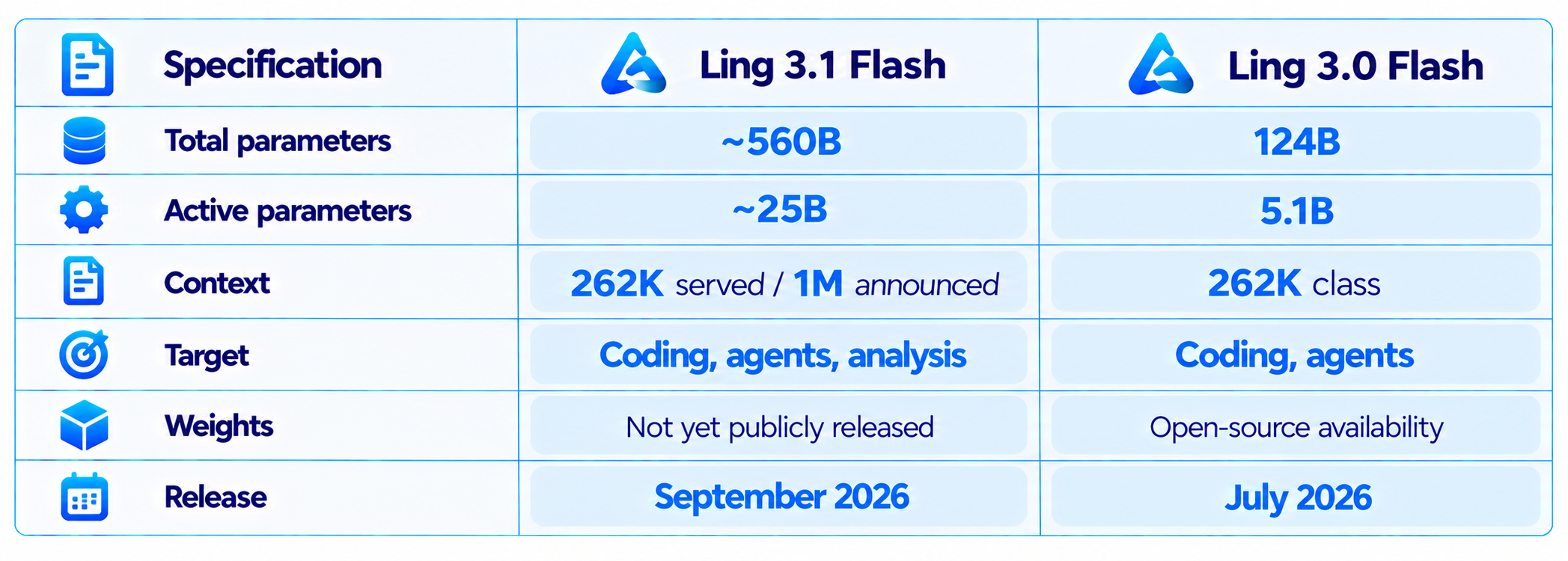
Ling 3.1 Flash is a much larger model than Ling 3.0 Flash. Ling 3.0 Flash has 124B total parameters and 5.1B active parameters per token, while Ling 3.1 Flash is approximately 560B total and 25B active.
The key change is not simply scale. Ling 3.1 Flash is designed as a more capable fast-tier model for complex agentic tasks. The published benchmark set is focused on tool use, automation, coding and professional workflows.
Ling 3.0 Flash remains more attractive when self-hosting and open weights are the priority. Ling 3.1 Flash is currently more interesting as a hosted model.
11. Ling 3.1 Flash vs GLM 5.3 Flash
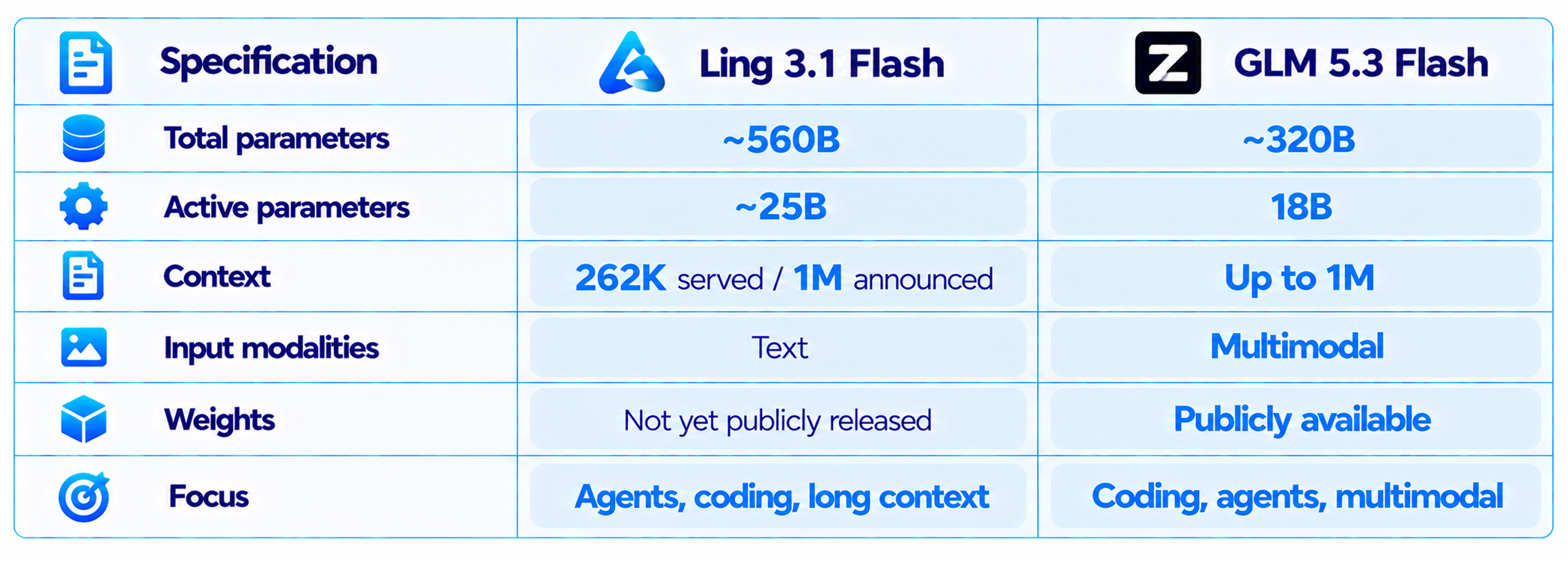
GLM 5.3 Flash and Ling 3.1 Flash occupy a similar part of the market: large sparse models aimed at fast coding and agent workloads. GLM 5.3 Flash has a more established public deployment and benchmark profile, while Ling 3.1 Flash exposes a different benchmark suite.
The comparison should not be reduced to parameter count. GLM 5.3 Flash has published results on benchmarks such as DeepSWE and Terminal-Bench, while Ling 3.1 Flash's published launch set uses Terminal-Bench 4, SWE Atlas and several agent benchmarks. Because the benchmark versions and evaluation configurations differ, a direct numerical ranking would be misleading.
12. Ling 3.1 Flash vs Qwen 3.8 Flash Next
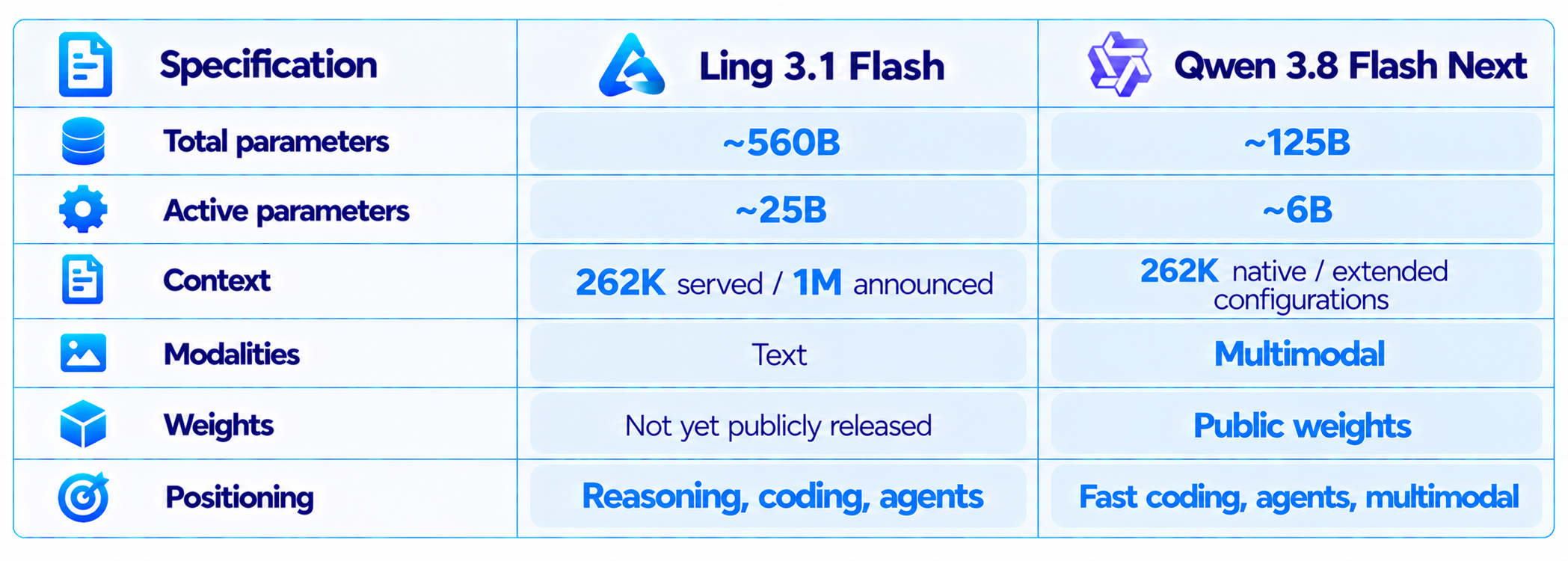
Qwen 3.8 Flash Next is another fast MoE model aimed at coding and agent workflows. It activates fewer parameters per token than Ling 3.1 Flash, making the models an interesting contrast between model scale and compute efficiency.
Qwen 3.8 Flash Next is easier to consider for local or open deployment because public weights are available. Ling 3.1 Flash is currently a hosted-first model. For developers deciding between them, deployment requirements can be as important as benchmark scores.
13. CyberGym and Security Workloads
The 87.9% CyberGym result is one of the most striking published Ling 3.1 Flash figures. Cybersecurity agents need to reason across commands, files, vulnerabilities and task objectives, making the benchmark relevant to tool-using models.
This does not mean the model should be given unrestricted access to production systems. Agentic security workflows require strict permissions, sandboxing, secrets isolation and human approval for sensitive actions.
14. HealthBench Professional
Ling 3.1 Flash is listed at 65.3% on HealthBench Professional in the published benchmark set. The benchmark source notes that the result was evaluated in an AQ environment and that the associated healthcare capabilities are currently available only in AQ.
That qualifier matters. A benchmark result in a specific provider environment should not be interpreted as clinical certification or evidence that the model is suitable for unsupervised medical decision-making. Healthcare applications need domain validation, safety controls and qualified human oversight.
15. Is Ling 3.1 Flash Open Source?
The current Ling 3.1 Flash weights are not publicly available. InclusionAI has indicated that the model will be released, but as of this review there is no confirmed public checkpoint and license for Ling 3.1 Flash.
This is different from Ling 3.0 Flash, for which open model files and deployment resources are available. Developers who need local inference should therefore treat Ling 3.1 Flash as a hosted model until the promised release is actually available.
16. Can You Run Ling 3.1 Flash Locally?
Not with an official public Ling 3.1 Flash checkpoint at the time of this review. The current practical route is hosted inference through supported providers such as Vercel AI Gateway.
Do not assume Ling 3.0 Flash deployment instructions apply unchanged to Ling 3.1 Flash. When a public checkpoint and license arrive, the hardware question will depend on precision, quantization, KV-cache requirements and inference-framework support.
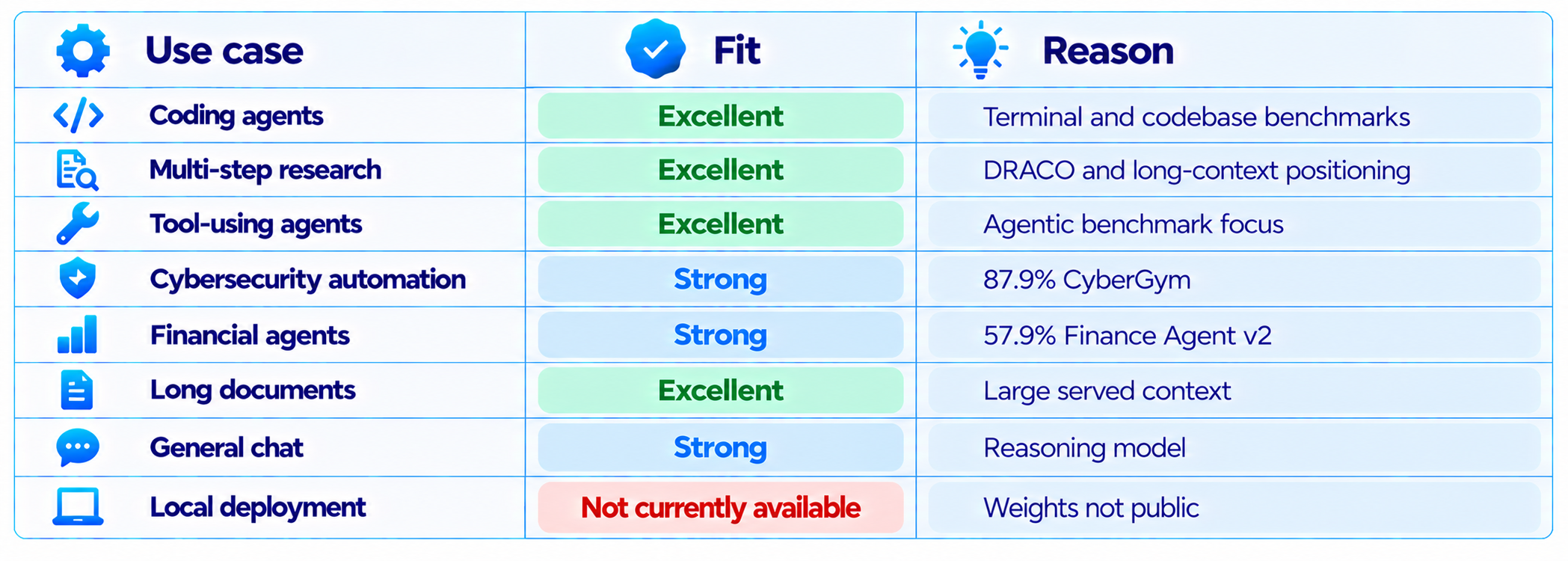
17. Best Use Cases for Ling 3.1 Flash
Ling 3.1 Flash is most compelling when the workflow requires multiple steps, large context and tools rather than one-shot text generation.
18. How to Use Ling 3.1 Flash in a Coding Agent
Ling 3.1 Flash is a natural fit for repository-level agents because its design targets code, multi-step analysis and tool use. A practical workflow is to give the model a clear task boundary, repository context, available tools and explicit completion checks.
19. Ling 3.1 Flash and Model Routing
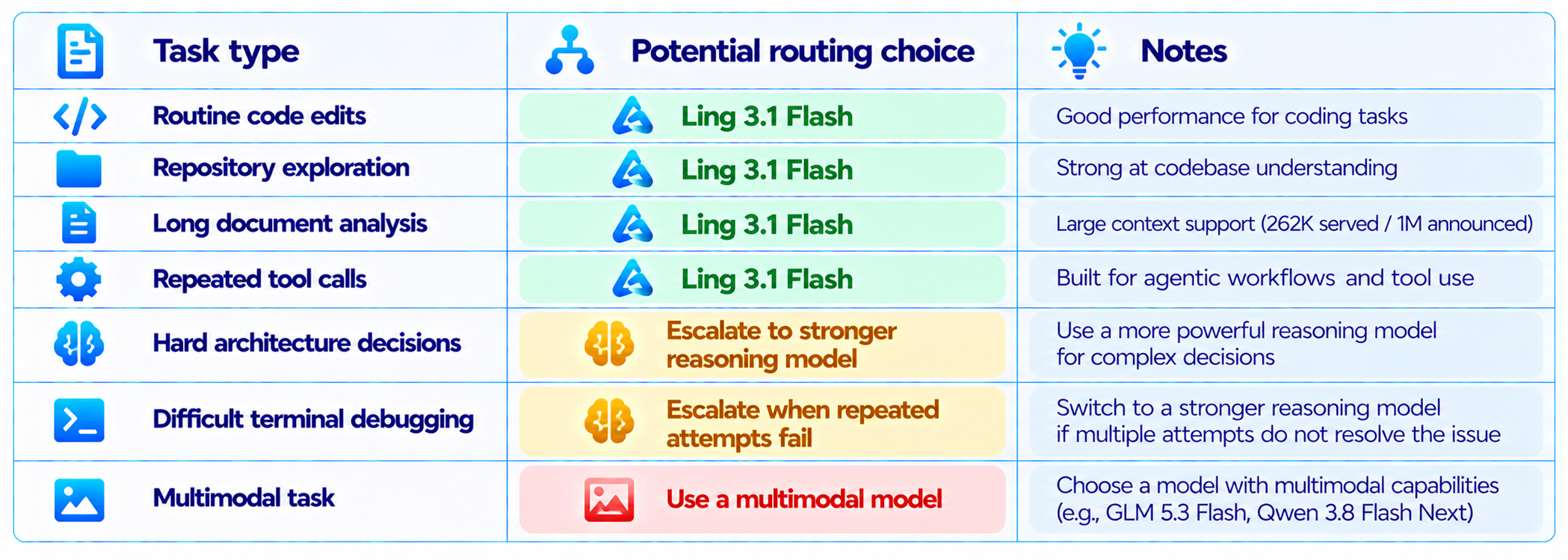
A fast reasoning model is often most useful when it becomes one component of a model-routing system. Ling 3.1 Flash can handle routine repository analysis, research and tool calls, while a stronger model can take over when the task crosses a predefined difficulty threshold.
This approach is often more practical than choosing one model for every request. The right question is which model completes each class of task at acceptable quality, latency and cost.
20. Limitations You Should Know
The current Vercel route serves 262K context, while the announced model capability is up to 1M. Deployment-specific limits matter.
Final Ling 3.1 Flash token pricing is not established in the current provider listings.
The published benchmark set is primarily provider-reported and uses several different evaluation suites.
BenchLM currently does not assign a site-wide overall rank because benchmark coverage is incomplete.
The model weights and license are not yet publicly available.
Current hosted access is primarily text-focused.
Tokens per second and latency vary by provider, hardware, prompt length and reasoning configuration.
Large total parameter count means local deployment would require substantial infrastructure even if weights are released.
21. How to Evaluate Ling 3.1 Flash Yourself
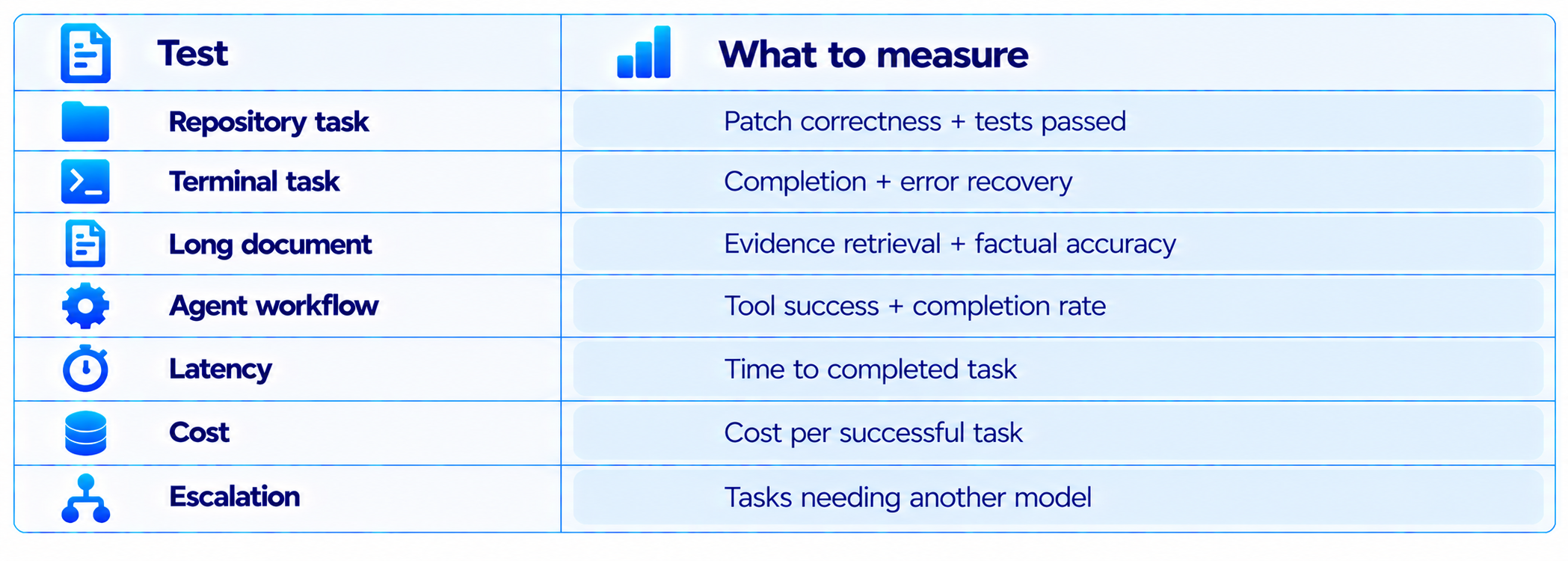
The best way to evaluate Ling 3.1 Flash is to create a small workload-specific benchmark instead of relying on one headline number.
Run the same prompts and tools against Ling 3.1 Flash and your existing production model. Record both successful and failed attempts. For agents, task completion is more meaningful than a raw generation-speed number.
22. Is Ling 3.1 Flash Worth It?
Ling 3.1 Flash is worth testing if your main workloads involve coding agents, tool use, long documents or multi-step research. Its benchmark profile is specifically aligned with those workloads, and its 560B total / 25B active design gives it a very different capacity profile from smaller fast models.
The current Vercel route also makes experimentation easy because promotional access is free through October 13, 2026. That gives developers an opportunity to test repository tasks, agent loops and long-context workflows before committing to a long-term provider.
The decision becomes less straightforward when local deployment, multimodal input or predictable production pricing is required. Ling 3.1 Flash does not currently provide the same public-weight story as Ling 3.0 Flash, and its final standalone API pricing is not yet established in the current pricing documentation.
23. Final Verdict
Ling 3.1 Flash is one of the more interesting fast-tier reasoning models of late September 2026 because it is not actually small. With approximately 560B total parameters and 25B active parameters per token, InclusionAI is using the Flash label to describe a sparse, high-capacity model designed for practical inference rather than a lightweight model in the traditional sense.
The benchmark profile reinforces that positioning. The model records 52.5% on AutomationBench, 68.7% on SkillsBench, 87.9% on CyberGym, 57.9% on Finance Agent v2 and 85.5% on DRACO. Its published coding results include 40.4% on Terminal-Bench 4.0 and 55.9% on SWE Atlas Codebase QnA.
Its context story is also strong, but it needs precise wording. The announced model supports up to 1M tokens, while the current Vercel AI Gateway route exposes 262K. That is still a very large working context for repository and document tasks.
The biggest practical advantage today is the ability to test it cheaply. Vercel AI Gateway currently offers promotional free access through October 13, 2026, making it possible to benchmark Ling 3.1 Flash against your existing coding and agent models without an initial API bill.
My rating: 9.1/10 for agentic workflows, 8.9/10 for coding, 9.2/10 for long-context work, 8.5/10 for deployment flexibility and 8.9/10 overall.
Bottom line: Ling 3.1 Flash is a strong model to test for coding agents, long-context analysis and multi-step tool workflows. Its published agent benchmarks are compelling, its current hosted route is accessible, and its architecture gives it substantial capacity. The final production decision should depend on your own task-completion tests, provider pricing and the eventual public weight release.
Frequently Asked Questions
What is Ling 3.1 Flash?
Ling 3.1 Flash is InclusionAI's hybrid reasoning model for coding, multi-step analysis and tool-using agents, with approximately 560B total parameters and 25B active parameters per token.
When was Ling 3.1 Flash released?
The model was announced and released in late September 2026, with the current release record dated September 29, 2026.
What are the Ling 3.1 Flash benchmarks?
Published results include 40.4% Terminal-Bench 4.0, 55.9% SWE Atlas Codebase QnA, 52.5% AutomationBench, 68.7% SkillsBench, 87.9% CyberGym, 57.9% Finance Agent v2, 85.5% DRACO and 65.3% HealthBench Professional.
How many parameters does Ling 3.1 Flash have?
InclusionAI reports approximately 560 billion total parameters and about 25 billion active parameters per token.
What is the Ling 3.1 Flash context window?
The announced model capability is up to 1 million tokens, while the current Vercel AI Gateway route exposes 262,144 tokens.
How much does Ling 3.1 Flash cost?
Vercel AI Gateway currently provides promotional free access through October 13, 2026. A final general-purpose token price is not listed in the current provider documentation.
Is Ling 3.1 Flash free?
It is currently available free through Vercel AI Gateway during the promotion ending October 13, 2026.
Is Ling 3.1 Flash good for coding?
Yes. Coding is one of its primary target workloads, with published Terminal-Bench 4.0 and SWE Atlas Codebase QnA results.
Is Ling 3.1 Flash good for AI agents?
Yes. Agentic tasks are a major focus, with published AutomationBench, SkillsBench, CyberGym, Finance Agent v2 and DRACO results.
Is Ling 3.1 Flash open source?
Its weights are not yet publicly available. InclusionAI has indicated a future release, but the public checkpoint and license were not confirmed at the time of this review.
Can I run Ling 3.1 Flash locally?
Not from an official public checkpoint currently. Hosted access is the practical option until the weights and deployment instructions are released.
Is Ling 3.1 Flash better than Ling 3.0 Flash?
Ling 3.1 Flash is a much larger model with approximately 560B total and 25B active parameters versus 124B total and 5.1B active for Ling 3.0 Flash. Direct quality comparisons should use the same benchmark and evaluation setup.
Does Ling 3.1 Flash support multimodal input?
The current public hosted documentation describes Ling 3.1 Flash primarily as a text model. Do not assume the multimodal capabilities of other Ling variants apply to this model.
Is Ling 3.1 Flash worth it?
It is particularly worth testing for coding agents, long-context analysis and tool-driven workflows. Production use should be evaluated against your own tasks, provider pricing and latency requirements.
Recommended Blogs
Qwen 3.8 Max 0902 Review: Benchmarks, Price & Is It Worth It? (2026)
Meta Muse Spark 1.3 Review: Coding, Price & Is It Worth It? (2026)
Gemini 3.8 Flash Review: Accuracy, Price & Is It Worth It? (2026)
Mercury 2.5 AI Model Review: Speed, Price & Is It Worth It? (2026)
Resources & Community
Join our community of 70,000+ AI enthusiasts and learn to build powerful AI applications. Whether you're a beginner or an experienced developer, Build Fast with AI helps you understand and implement AI in your projects.
Agentic AI Launchpad 2026
A structured 6-week cohort program that takes you from AI basics to building and deploying real-world agentic AI systems. Includes live sessions, expert mentorship, project reviews and a builder community network.
Ready to go from learning to building? Join the next cohort: Agentic AI Launchpad 2026
Free AI Resources
Access free tools, workshops and micro-learning to keep building.

