



Jev Review: Can an AI Model That Never Writes Text Change How Agents Make Decisions?
Jev is a new kind of AI model from TypeSafe AI, and the easiest way to understand it is to stop thinking of it as a chatbot. Jev does not write an answer, draft an email, generate code or produce a paragraph of reasoning. Instead, you give it a state and a set of typed questions, and it returns a structured decision, a probability distribution and a confidence value.
TypeSafe announced Jev on September 15, 2026 as its first public System One model. The company is trying to move a part of AI decision-making out of free-form generation and into a software-native interface. A normal LLM produces strings that an application has to parse and validate. Jev is designed to return bounded, typed values that software can use directly.
The economics are the other reason Jev is interesting. TypeSafe lists Jev at $0.042 per million input tokens, or $42 per billion input tokens, with output free because Jev does not generate a conventional token-by-token answer. TypeSafe reports 70 to 500 milliseconds of end-to-end latency and claims 20-200x speed and 40-400x cost improvements on decision-shaped workflows. Those multipliers come from vendor-run workflow comparisons, so they should be read as workload-specific results rather than a universal promise.
QUICK ANSWER
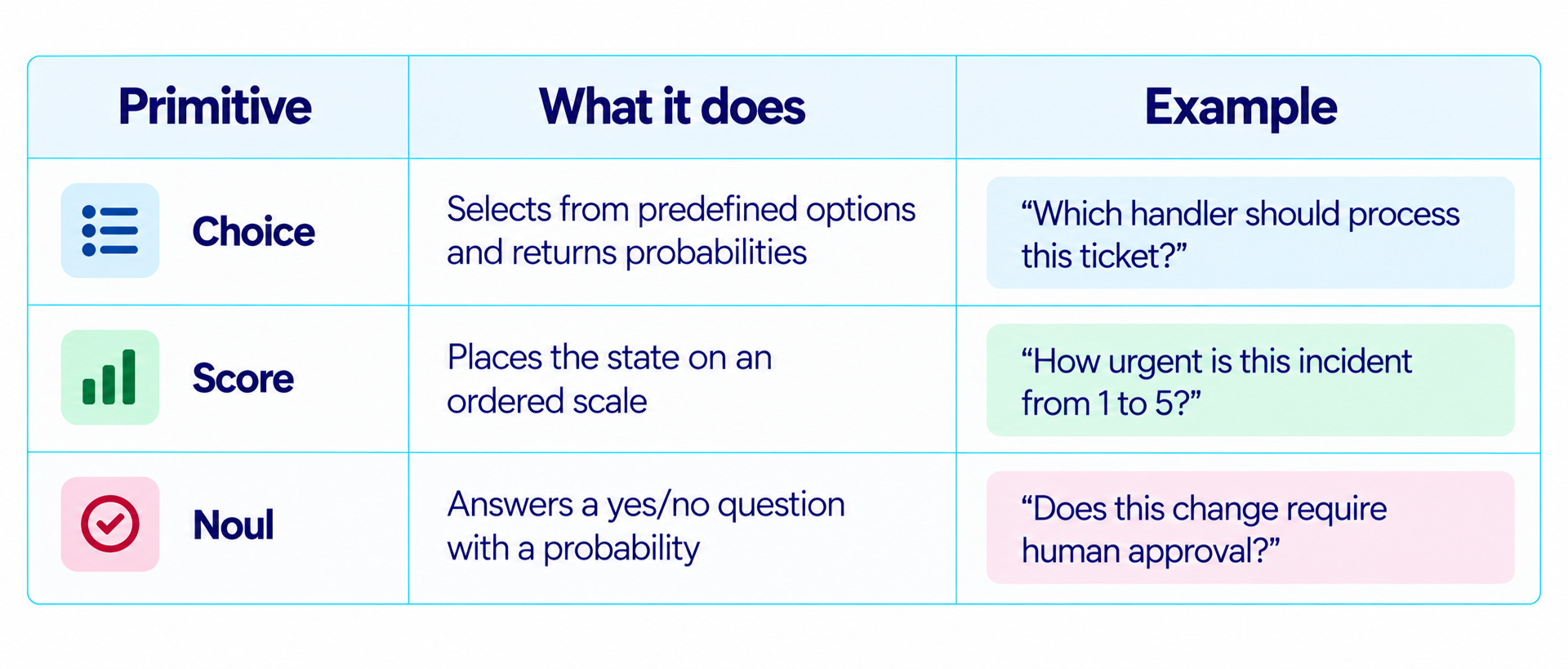
Jev is TypeSafe AI's first System One model, built for fast structured decisions inside software. Instead of generating text, it takes a state plus typed questions and returns one of three decision primitives: Choice, Score or Noul. Choice selects from predefined options, Score evaluates an ordered scale, and Noul answers a yes-or-no question with a probability. A single state can contain multiple questions, which Jev evaluates in parallel.
TypeSafe currently prices Jev at $0.042 per million input tokens, with output free. The company reports 70-500 milliseconds of end-to-end response time. Its biggest public efficiency number, 193.6x faster and 444.6x cheaper, comes from a specific four-workflow evaluation and depends on which frontier model is used as the comparison baseline.
The quality picture is more nuanced. TypeSafe's four workflow evaluations give Jev an average of about 67.8% agreement with a reference generated from GPT-6 Astra and Claude Fable 5.1. That is close to some mid-tier frontier configurations, but below stronger models on several of the same workflows. The reference is model-derived rather than human-labeled ground truth, so this is workflow agreement, not a universal accuracy score.
My verdict: 9.5/10 for speed and cost efficiency, 9.0/10 for software integration, 8.1/10 for general decision quality and 8.7/10 overall. Jev is worth testing when your software needs thousands of small semantic decisions, not when you need another general-purpose writing or coding model.
1. What Is Jev AI?
Jev is TypeSafe AI's first System One model, a model category the company created for machine-facing decisions. The basic idea is to separate generation from judgment. Traditional LLMs are excellent at producing strings for humans, but software often does not need a paragraph. It needs to know whether to route, approve, escalate, score, classify or stop.
Jev changes that interface. The application supplies a block of state, such as a customer conversation, security alert or agent trace, plus a set of questions. Jev returns bounded outputs rather than composing a natural-language answer. TypeSafe describes this as machine-native intelligence.
2. How the Jev Model Works
Every Jev call has two core inputs: state and questions. The state contains the material being judged. The questions define exactly what the application wants to know. This makes the model resemble a semantic decision function instead of a conversational endpoint.
The parallel-question design is a major part of Jev's efficiency story. Several decisions can share the same state, so an application can ask many narrow questions without repeatedly sending the same context through a full generative loop.
3. Why Jev Is Different From JSON Mode
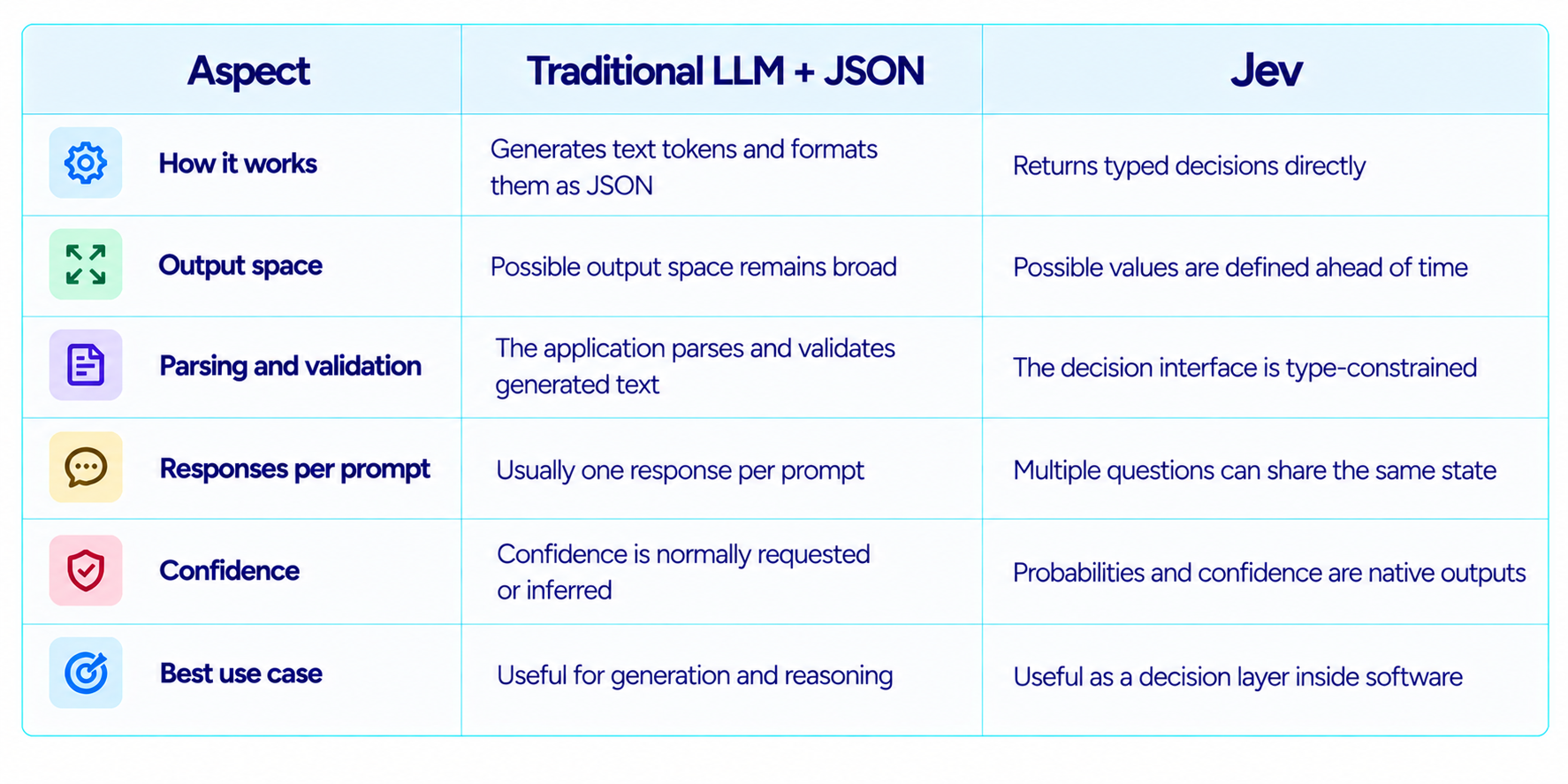
The difference is architectural rather than cosmetic. JSON mode still asks a generative model to produce text that happens to match a schema. Jev is designed around the schema itself. That reduces unnecessary generation when the application only needs a bounded judgment.
4. Choice, Score and Noul Explained
Choice is useful whenever the answer must be one of a known list. A customer support workflow might choose among REFUND, HAND_OFF, CLOSE and REQUEST_INFO. Jev can return the selected option, probabilities for the alternatives and confidence.
Score works for ordered judgments. Instead of asking for a sentence describing risk, the software can define a scale and use the result directly as a threshold, ranking signal or escalation value.
Noul is the binary primitive. A system can ask whether a request contains a security risk, whether the customer requested cancellation, or whether the agent's output is supported by the available record.
These primitives deliberately narrow the model's freedom. That is the feature. The application defines what answers are possible and leaves arithmetic, permissions, side effects and deterministic business rules in normal code.
5. Jev Pricing
TypeSafe currently lists Jev at $0.042 per million input tokens, or $42 per billion input tokens. Output tokens are free because Jev does not generate conventional text output.
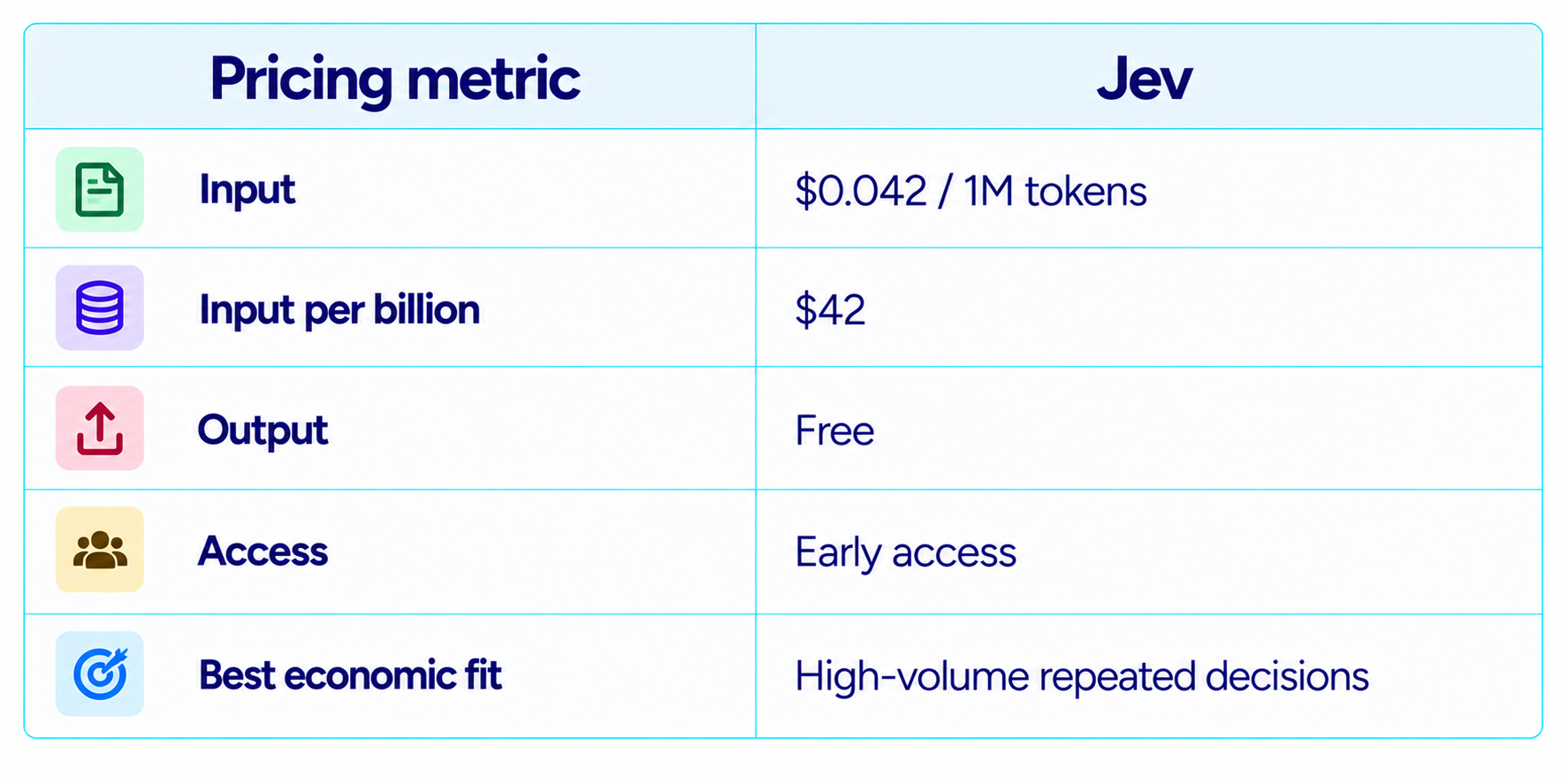
The pricing matters most when a larger AI system needs many small checks. A coding agent may need to decide whether to escalate a task, whether a patch is complete, whether a test failure is blocking, or which model should handle the next step. Those calls are often too small to justify a full reasoning model every time.
The correct metric is still cost per completed workflow. A cheap decision call is not useful if it causes repeated retries, wrong branches or expensive human intervention. Jev's value comes from the whole system, not the token rate alone.
6. Jev Speed and Latency
TypeSafe reports 70-500 milliseconds of end-to-end latency for Jev. Its architecture uses parallel sampling rather than sequential token generation, which removes the long decoding stage that dominates many language-model responses.
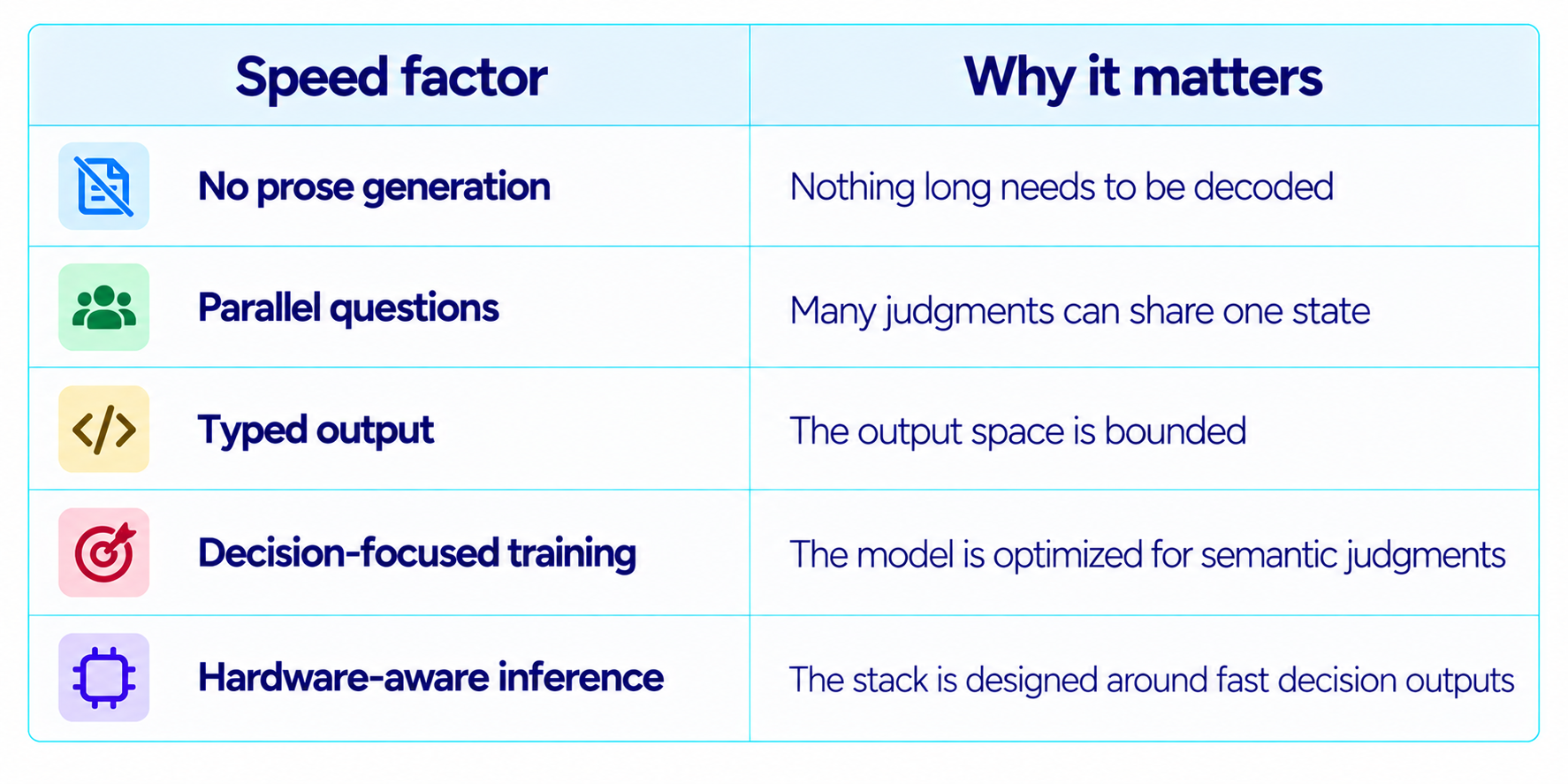
TypeSafe's 193.6x faster and 444.6x cheaper figures come from selected workflow comparisons. TypeSafe also notes that these are likely at the higher end of real-world gains. Treat the 70-500ms latency range as the more general vendor claim and the larger multipliers as specific workflow evidence.
7. What Is RLCD?
Jev is trained using Reinforcement Learning for Calibrated Decisions, or RLCD. TypeSafe's argument is that conventional RLHF and RLVR optimize language models around human preferences or verifiable outputs, while RLCD focuses on making probabilities useful for software decisions.
Calibration matters because software often needs to know when not to act. If a model gives a 55% probability to a decision, the application can send the case to another model or a human. If the probability is high and the threshold has been validated on real data, the workflow can automate the action.
A confidence number generated inside ordinary text is not automatically calibrated. Jev's design makes the probability part of the decision interface, which creates a much cleaner path for thresholding and monitoring.
8. Does Jev Hallucinate?
Jev avoids the classic free-form hallucination problem because it does not produce arbitrary prose. Its answers are constrained by the questions and options defined by the application. That means the model cannot invent an unexpected ninth category in a Choice question.
But structural correctness is not semantic correctness. A valid Choice can still be wrong. A Noul can return 0.97 and still correspond to the wrong real-world conclusion. TypeSafe's own workflow evaluations show meaningful disagreement with its reference answers, and independent analysis makes the same distinction between bounded output and correctness.
The safest description is therefore: Jev removes free-form output errors and type errors, but it still needs validation for decision accuracy. Production systems should use confidence thresholds, labeled test sets and escalation paths.
9. Jev Benchmark Results
TypeSafe publishes four workflow evaluations: Security Incidents, Agent Trace Observability, Invoice Processing and Customer Service. Each workflow turns a business policy into narrow semantic questions plus deterministic code, then runs the same decision graph through multiple models.
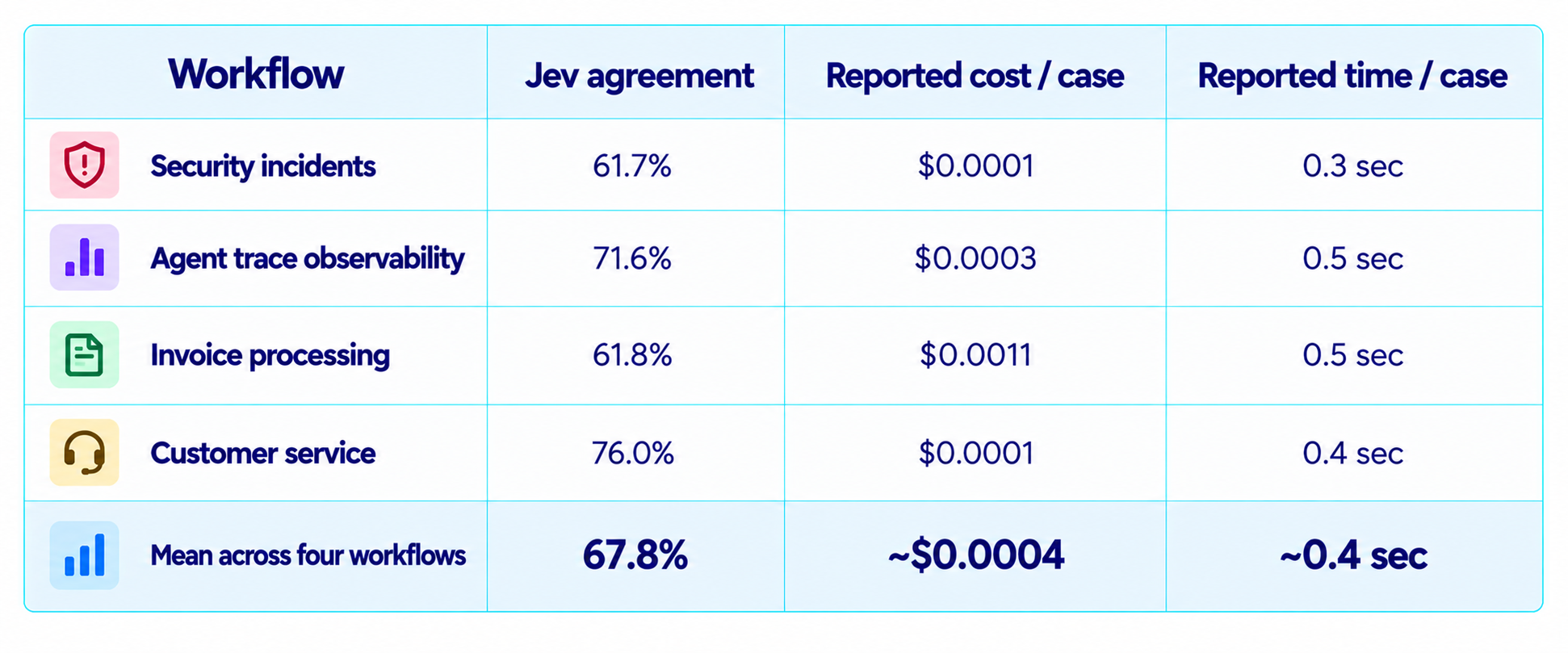
The spread between workflows is important. Jev reaches 76.0% agreement in the customer-service workflow but 61.8% in invoice processing. That is why the model should not be judged by one average alone. Different decision shapes create different difficulty levels.
10. How TypeSafe's Benchmark Should Be Read
TypeSafe says the reference labels for its workflow evaluation are generated from the average responses of GPT-6 Astra and Claude Fable 5.1 at high thinking. Other models run the same workflows at their provider-default reasoning settings.
This makes the evaluation useful for comparing behavior inside a common harness. It does not make the reference equivalent to independently verified ground truth. Independent analysis has highlighted this exact limitation, so the safest wording is 'agreement with the reference policy' rather than 'universal accuracy.'
For teams considering Jev, the benchmark is best used as evidence that a cheap decision model can approach the behavior of larger models on selected workflows. The final validation must come from labeled examples in the actual application.
11. Independent Jev Accuracy Test
A September 18 independent evaluation tested Jev 1.13 on 108 labeled claims across six domains. It reported 96.3% accuracy for Jev, compared with 94.4% for Gemini 3.1 Flash Lite and 93.5% for Claude Haiku 4.5. The study also reported a Jev Brier score of 0.0331 and calibration error of 0.0660.
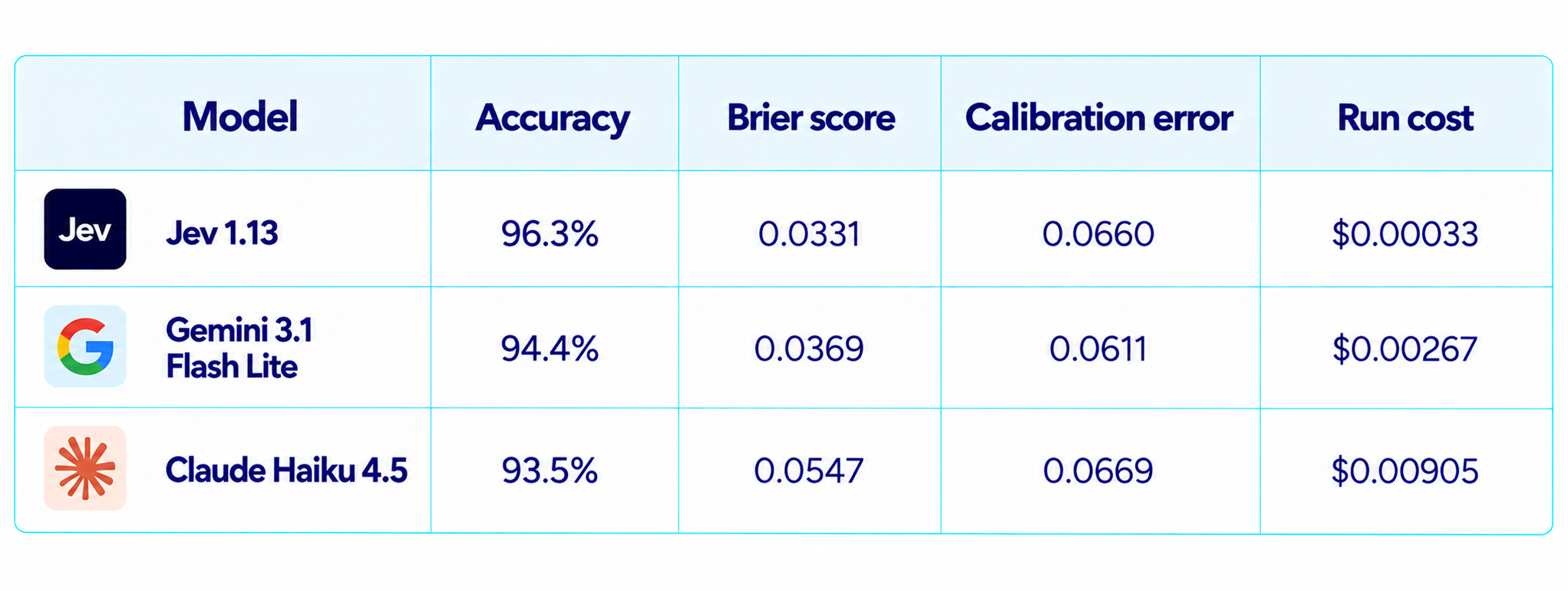
This independent result strengthens the case that Jev can perform well on bounded semantic judgments. It is still one evaluation with 108 claims, so it should be treated as additional evidence rather than a universal Jev accuracy score.
12. Jev for AI Agents
Agent systems are probably the most natural use case for Jev. A general LLM can generate a plan and perform actions, while Jev can make cheap decisions around the agent.
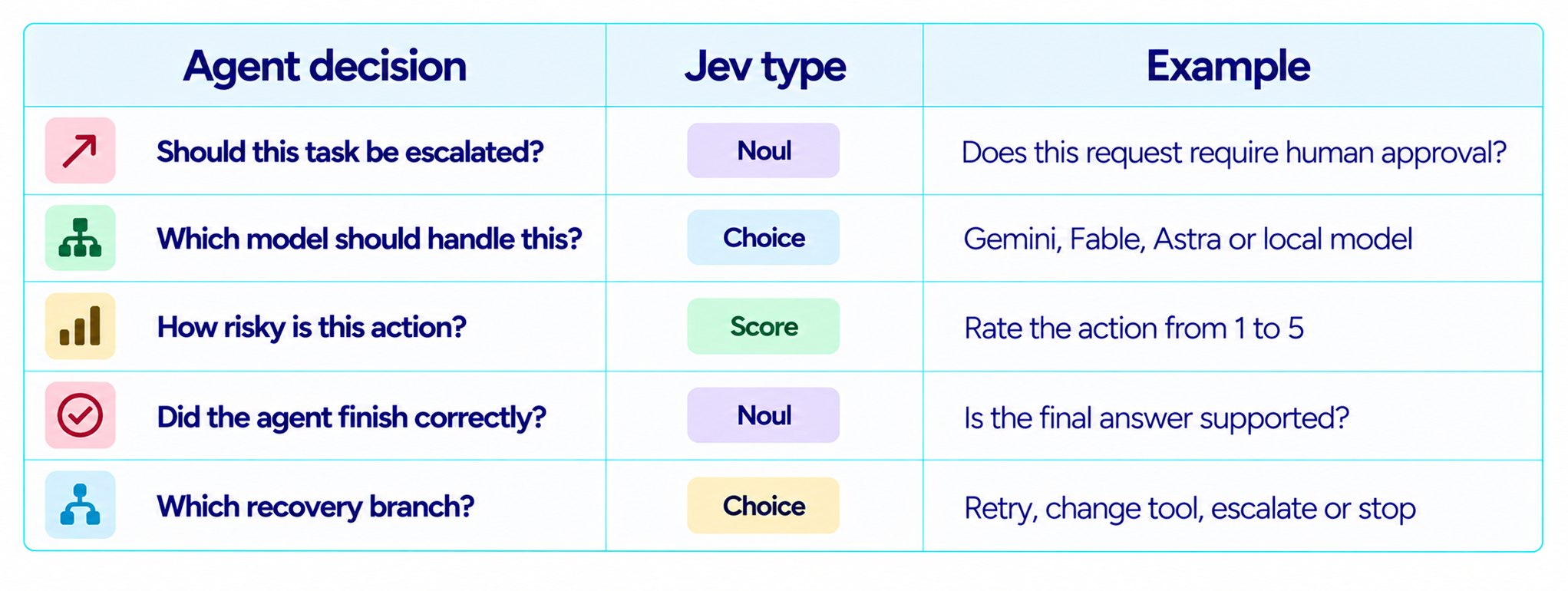
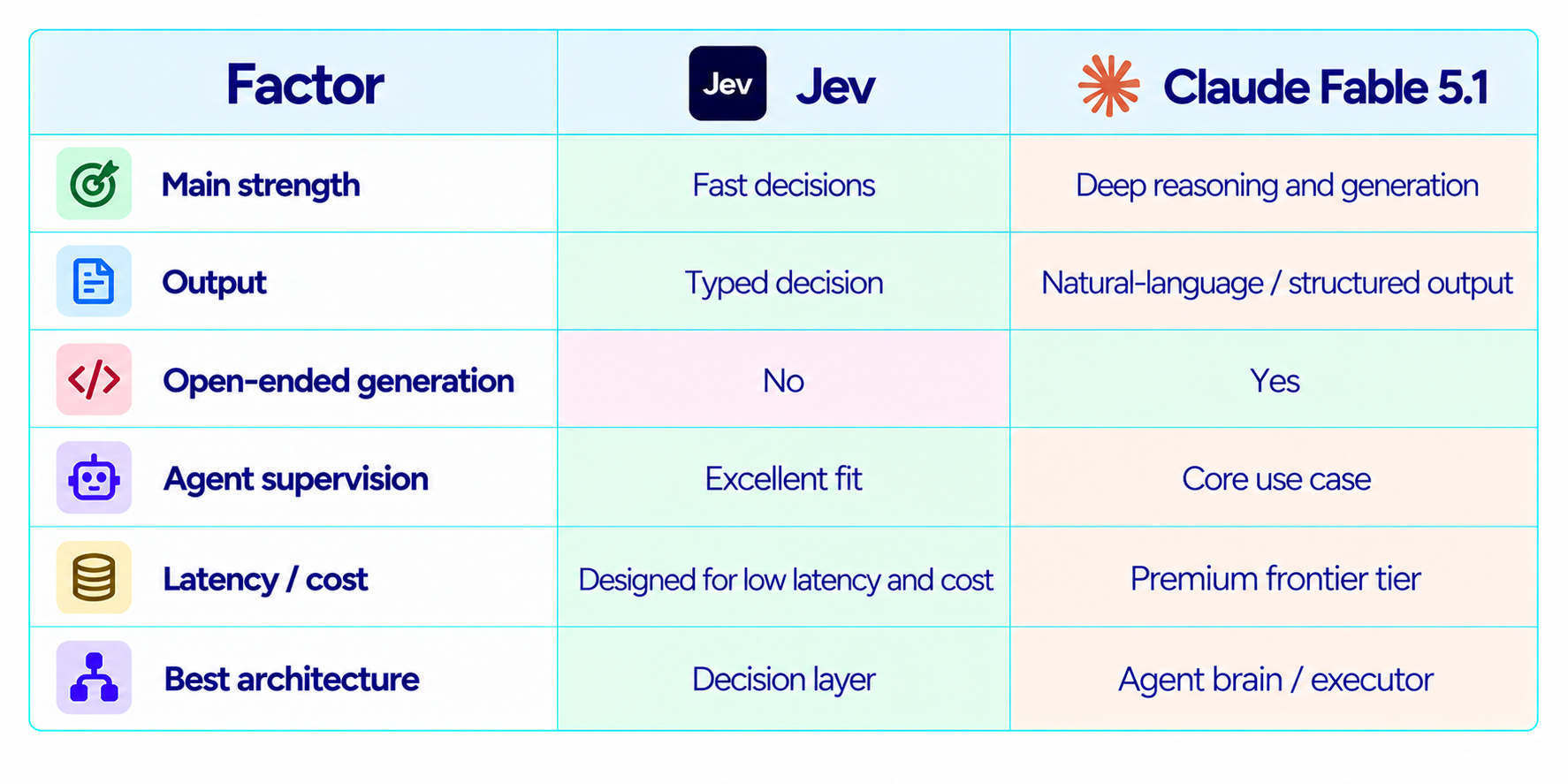
This is where Jev becomes more than a classifier. It can become a control layer around a larger agent. The large model generates and acts; Jev checks, routes, scores or gates.
This fits naturally with our AI Model Routing in 2026 guide, where models are assigned by task profile rather than one model being used for everything.
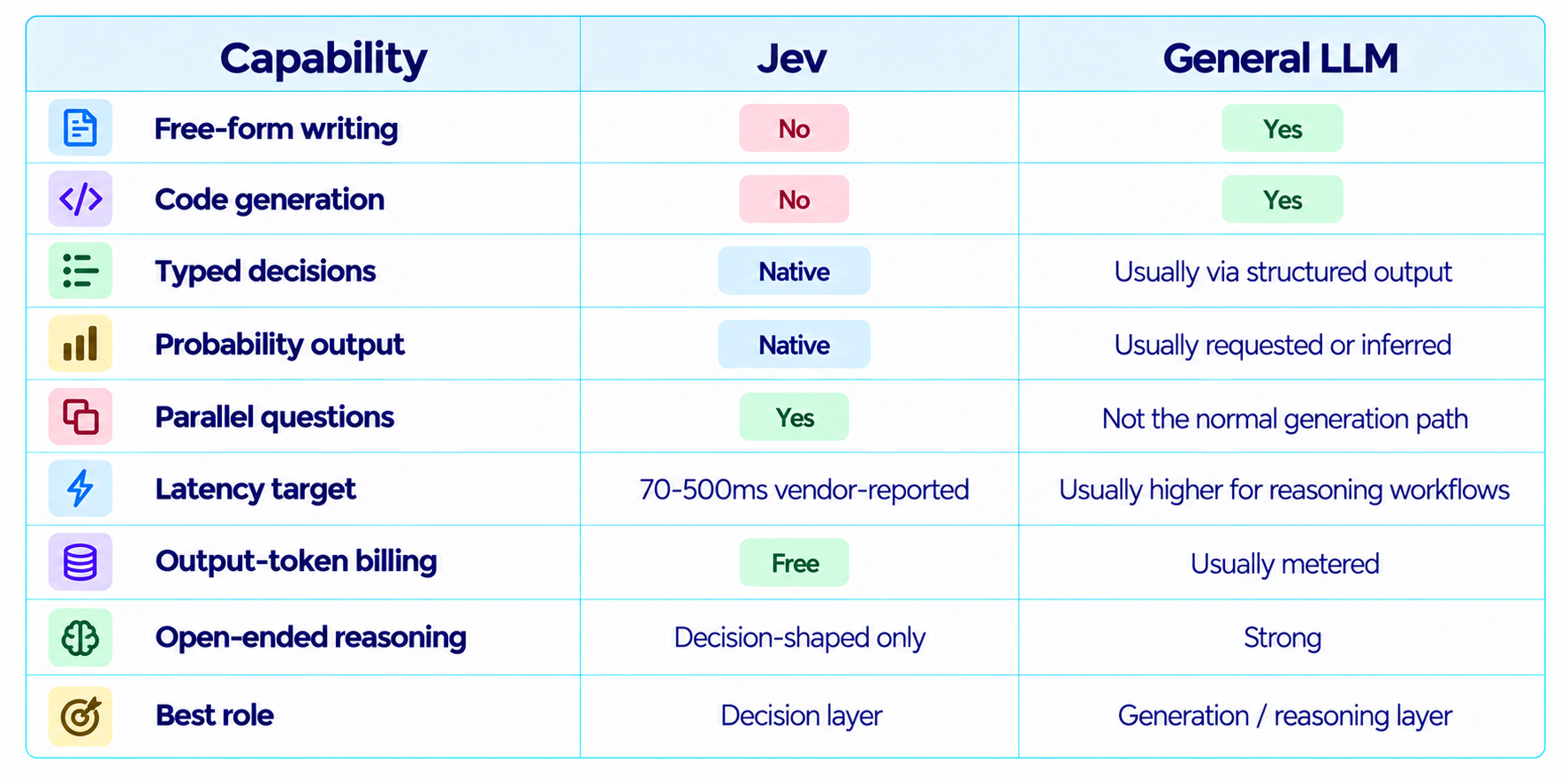
13. Jev vs Traditional LLMs
14. Jev vs GPT-6 Astra
Jev and GPT-6 Astra occupy different parts of the AI stack. Astra is a general frontier model for research, coding, planning and generation. Jev is designed to make bounded decisions around software workflows.
15. Jev vs Claude Fable 5.1
Claude Fable 5.1 is another complementary model rather than a direct replacement. Fable is built for deep reasoning, long-running coding agents and research. Jev is built for fast decision checks around those workflows.
For the full Fable analysis, see our Claude Fable 5.1 Review.
16. Where Jev Works Best
17. Where Jev Does Not Work Well
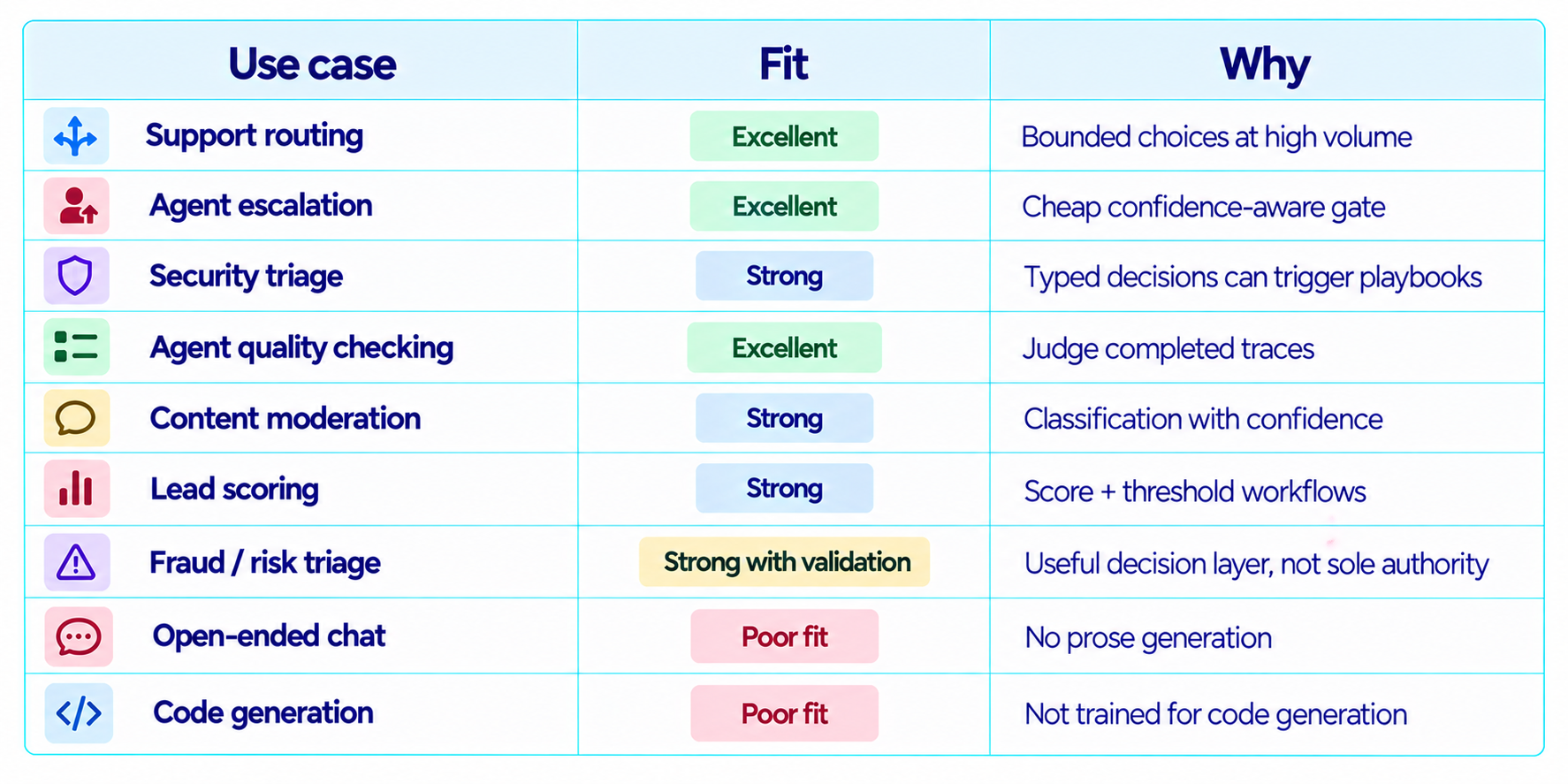
Jev's documentation is unusually clear about its boundaries. Arithmetic, counting and date comparison are better handled in code. Multi-hop chains, double negatives and ambiguous instructions can reduce performance. Jev also expects developers to protect its state from untrusted input rather than treating the model itself as a complete security boundary.
That limitation is actually useful. It encourages a clean division of labor: deterministic code handles calculations and permissions, Jev handles semantic judgment, and a larger generative model handles language and open-ended reasoning.
18. How to Use Jev in Production
- Keep arithmetic, dates, permissions and side effects in deterministic code.
- Define small Choice, Score and Noul questions instead of one giant judgment.
- Use several independent questions against the same state when practical.
- Set confidence thresholds from labeled validation data.
- Escalate low-confidence or high-impact decisions to a human or frontier model.
- Log the state, question, probability, decision and real-world outcome.
- Recalibrate thresholds when the underlying workflow or data changes.
- Keep the model outside the direct permission boundary for irreversible actions.
19. Security and Reliability
A typed decision is not an authorization token. If Jev says an action is safe, the application should still enforce the permission boundary. This is especially important for code execution, production deployments, finance, account changes and security operations.
For coding agents, this fits the least-privilege approach in our AI coding agent security guide.
Jev can reduce the cost of safety checks, but it should not eliminate conventional validation. The strongest design is layered: model judgment, deterministic rules, permissions and human approval for high-impact actions.
20. How to Benchmark Jev Yourself
Because Jev is a decision model, a standard chatbot benchmark is not enough. Build a benchmark around the actual choices your application needs to make.
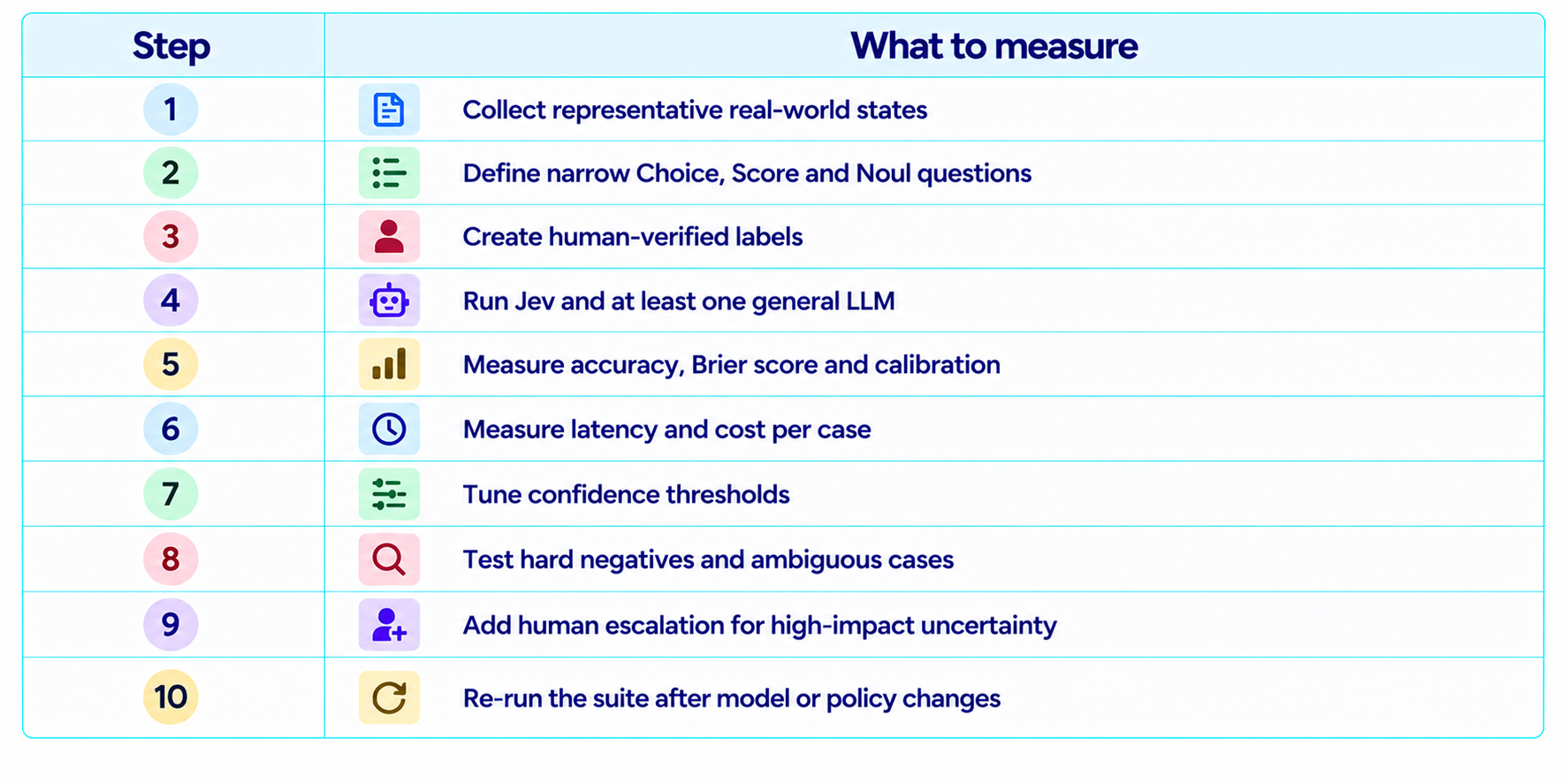
The goal is to learn whether Jev's confidence is useful on your own data. If the confidence threshold reliably separates safe automation from cases that need review, Jev becomes much more valuable than a generic classifier.
21. Is Jev Worth It?
Jev is worth testing when your application makes many small semantic decisions and does not need the model to write anything. Routing, moderation, escalation, agent verification, support triage and workflow branching are all natural matches.
The pricing makes that more practical. At $0.042 per million input tokens with free output, Jev is cheap enough to use repeatedly inside an agent loop. The vendor-reported sub-second latency makes the decision layer suitable for interactive systems as well.
The accuracy story is workload-specific. TypeSafe's four-workflow benchmark averages 67.8% agreement with a model-derived reference, while an independent 108-claim evaluation reported 96.3% accuracy on its own labeled dataset. Those numbers are not directly comparable, which is exactly why production teams should create their own evaluation set.
22. Final Verdict
Jev is one of the most unusual AI releases of September 2026 because it is not trying to become another ChatGPT, Claude or Gemini. TypeSafe built it around a different idea: software often needs judgment, not language.
The efficiency numbers are equally compelling. TypeSafe lists $0.042 per million input tokens, free output and 70-500ms end-to-end latency. Its largest workflow claim, 193.6x faster and 444.6x cheaper, is based on a specific comparison set and should be treated as a workload result rather than a universal performance guarantee.
The quality case is promising but more measured. Jev can be competitive with general LLMs on selected decision workflows, but it is not a universal frontier model. Its success depends on whether your task can be decomposed into narrow semantic questions and whether your thresholds are calibrated against real data.
My rating: 9.5/10 for speed and cost, 9.0/10 for software integration, 8.1/10 for general decision quality and 8.7/10 overall.
Bottom line: Jev is worth using as a decision layer around AI agents and automation, especially where thousands of small judgments are currently being handled by expensive generative models. Keep deterministic code for calculations and permissions, validate Jev against labeled data, and use frontier models for tasks that still require open-ended reasoning and generation.
Frequently Asked Questions
What is Jev AI?
Jev is TypeSafe AI's first System One model, designed for fast typed decisions instead of free-form text generation.
When was Jev released?
TypeSafe announced Jev on September 15, 2026 and made it available through early access.
How much does Jev cost?
TypeSafe lists $0.042 per million input tokens, or $42 per billion input tokens, with output free.
What are Choice, Score and Noul?
Choice selects among predefined options, Score evaluates an ordered scale, and Noul answers a yes/no question with a probability.
How fast is Jev?
TypeSafe reports 70-500 milliseconds of end-to-end latency.
Does Jev generate text?
No. Jev is designed for typed decisions rather than free-form natural-language generation.
Can Jev replace GPT-6 Astra or Claude Fable 5.1?
No. Jev is complementary. It is a decision layer, while general frontier models handle generation, research, coding and open-ended reasoning.
Does Jev hallucinate?
It avoids free-form output hallucinations and type errors, but it can still make a semantically incorrect decision.
What are the Jev benchmark results?
TypeSafe's four-workflow benchmark reports about 67.8% mean agreement with its model-derived reference. An independent 108-claim test reported 96.3% accuracy on its own labeled data.
Is Jev good for AI agents?
Yes. Routing, escalation, verification, moderation and task-completion checks are strong fits.
Can Jev calculate dates or sums?
Those tasks are better handled by deterministic code. Jev is designed for semantic decisions.
Is Jev worth it?
Yes for high-volume decision-shaped workloads where a general LLM is too slow or expensive.
Recommended Blogs
AI Model Routing in 2026: When to Use Fable, Astra, Gemini or Muse
Model Routing for AI Coding Agents: How to Cut Costs Without Losing Quality
Claude Fable 5.1 Review: Benchmarks, Pricing & Is It Worth It? (2026)
How to Secure AI Coding Agents in 2026: Permissions, Sandboxing, MCP & Secrets
Resources & Community
Join our community of 70,000+ AI enthusiasts and learn to build powerful AI applications. Whether you're a beginner or an experienced developer, Build Fast with AI helps you understand and implement AI in your projects.
Agentic AI Launchpad 2026
A structured 6-week cohort program that takes you from AI basics to building and deploying real-world agentic AI systems. Includes live sessions, expert mentorship, project reviews and a builder community network.
Ready to go from learning to building? Join the next cohort: Agentic AI Launchpad 2026
Free AI Resources
Access free tools, workshops and micro-learning to keep building.

