



Grok Voice 3.0 Review: Does xAI Now Have the Best Real-Time Voice Agent?
Voice AI is moving beyond speech recognition and spoken answers. The models that matter now have to listen while people speak naturally, understand what they mean, handle interruptions, call tools, complete a task and respond without making the conversation feel like a slow sequence of API calls. That is the problem Grok Voice 3.0 is built to solve.
Released on October 14, 2026, Grok Voice 3.0 is xAI's new speech-to-speech model for real-time voice agents. In the company's announcement, the model ranks first on Artificial Analysis's Speech-to-Speech Index with a score of 86.9, ahead of Grok Voice 2.0 at 81.3, GPT-Live-1 (Astra, Medium) at 83.2 and Gemini 3.8 Live with extended thinking at 82.6. The same published evaluation reports 97% on Full Duplex Bench and 98.5% on Big Bench Audio speech reasoning.
These results make Grok Voice 3.0 an important voice AI release to evaluate. They do not mean it wins every conversational test: on Artificial Analysis's Speech Agent Arena leaderboard, its 1070 Elo is behind Gemini 3.1 Flash Live and Gemini 3.8 Live. That distinction matters because an aggregate benchmark index and blind human preference measure different things.
QUICK ANSWER
Grok Voice 3.0 is a real-time speech-to-speech model available through the xAI Voice Agent API. It is designed for conversational agents that need to understand spoken requests, respond naturally, manage turn-taking and use tools. Artificial Analysis's October 13, 2026 snapshot gives it an 86.9 Speech-to-Speech Index score, 98.5% on Big Bench Audio, 97.0% on Full Duplex Bench, 94.8% task success and 1070 Speech Agent Arena Elo.
The API costs $0.08 per minute of audio, equivalent to $4.80 per hour, unchanged from Grok Voice 2.0. The grok-voice-latest alias now points to Grok Voice 3.0, so existing applications using the alias are upgraded automatically; grok-voice-2.0 is deprecated. The API is unchanged, which reduces migration work for current integrations.
Verdict: Grok Voice 3.0 is a strong choice for real-time voice agents, especially when turn-taking, speech reasoning, latency and task completion matter. It is not the undisputed winner on every leaderboard, and teams should test it with their own callers, accents, tools and escalation rules before switching production traffic.
1. What Is Grok Voice 3.0?
Grok Voice 3.0 is a speech-to-speech model, meaning its core interaction is built around incoming and outgoing audio rather than requiring every conversation to pass through a visible text-only pipeline. It is intended for applications where a user speaks, the agent interprets the request and the system responds in real time. Developers can connect tools so the agent can do more than provide spoken explanations.
The model is available through the xAI Voice Agent API, with the documented model identifier grok-voice-3.0. The grok-voice-latest alias now resolves to the new version. xAI's October 14 release notes say the API has not changed and sessions using the alias were upgraded automatically. The previous grok-voice-2.0 model identifier is deprecated.
This is different from a standalone text-to-speech model. Text-to-speech converts prepared text into audio, and speech-to-text transcribes audio into text. A speech-to-speech voice agent has to participate in a live conversation, maintain context, decide when to speak, react to the caller and potentially use tools. Those requirements are why latency, interruptions and task completion are central to this review.
2. Grok Voice 3.0 Specifications
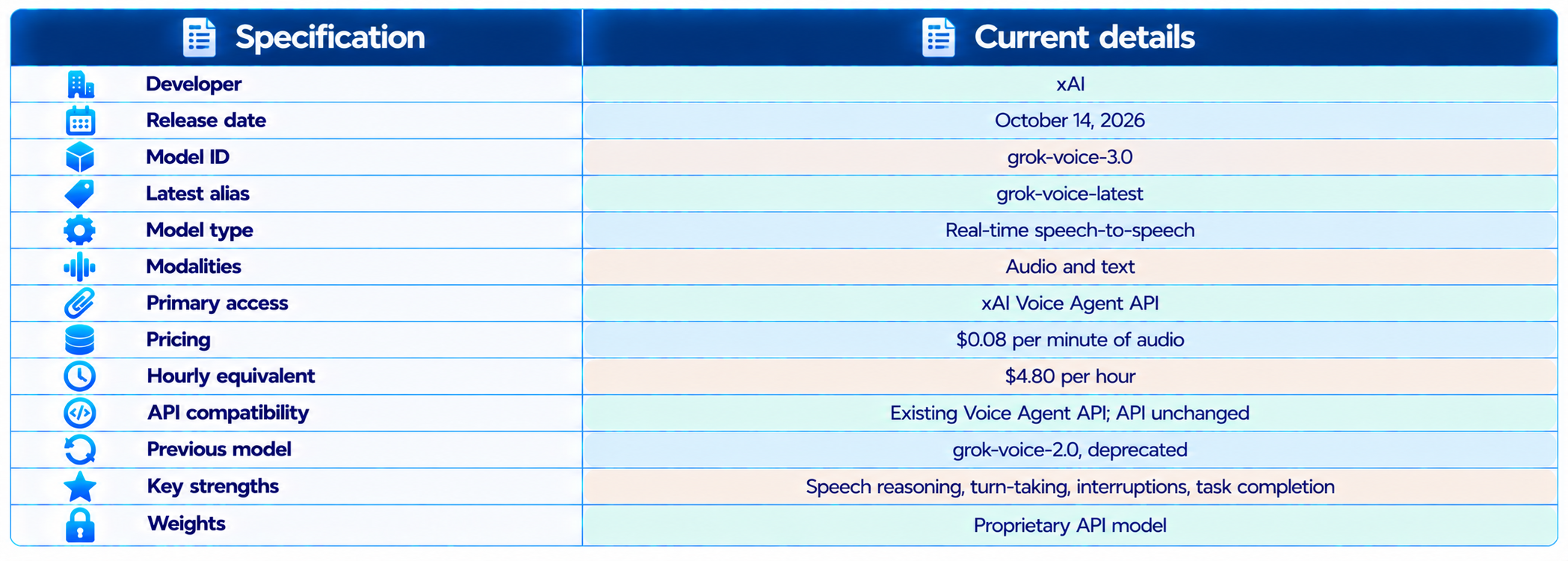
The documented product is an API service rather than a downloadable open-weight model. That makes it convenient for hosted voice-agent deployment, but organizations that require fully self-hosted inference should evaluate alternatives that explicitly provide model weights.
3. Grok Voice 3.0 Benchmark Results
The most useful benchmark evidence is the comparison published with the October 14 launch and credited to Artificial Analysis, using results dated October 13, 2026. The numbers show different aspects of voice-agent quality rather than one generic accuracy score.
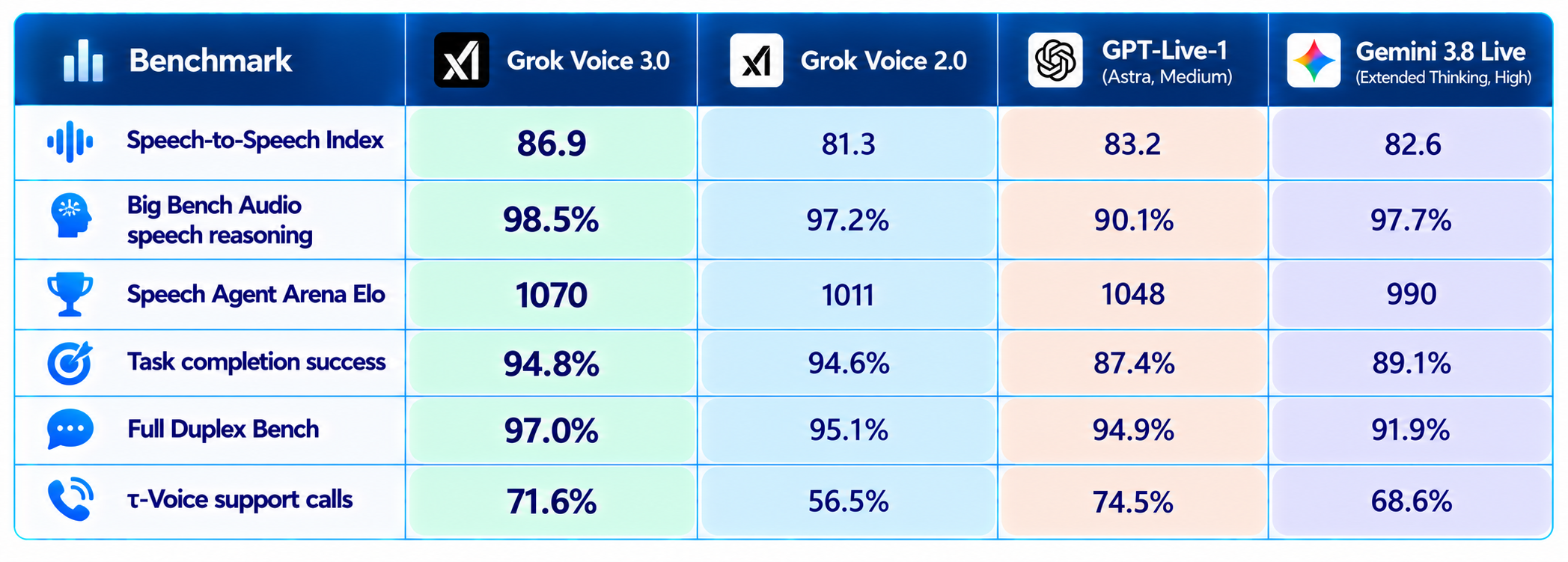
The overall pattern is strong. Grok Voice 3.0 leads the listed comparison on the Speech-to-Speech Index, Big Bench Audio, Speech Agent Arena Elo, task completion and Full Duplex Bench. However, GPT-Live-1 scores higher on τ-Voice support calls at 74.5% versus Grok's 71.6%. A model can lead on the aggregate index and still lose a specific workload-focused evaluation.
Benchmark scores are useful for screening models, but they do not guarantee the same performance for every industry, language, call duration or tool stack. A support center should test its own scenarios, including authentication, policy exceptions, background noise and handoff to a human.
4. Why the #1 Speech-to-Speech Index Matters
Artificial Analysis's Speech-to-Speech Index combines multiple dimensions of voice-agent performance, including speech reasoning, τ-Voice results, preference and task success from blind head-to-head calls. Grok Voice 3.0's 86.9 score places it first in the comparison presented by xAI at launch. It improves on Grok Voice 2.0's 81.3 and edges the cited GPT-Live-1 and Gemini 3.8 Live configurations.
For developers, a combined index reduces the temptation to optimize for one attractive score. A voice model needs to understand a spoken request, decide what matters, respond at an appropriate time and keep the interaction moving. A model that reasons well but constantly interrupts the user can still make a poor assistant. Likewise, a natural-sounding model that cannot finish tasks is not sufficient for customer service.
5. Full Duplex Bench: Pauses, Interruptions and Turn-Taking
Grok Voice 3.0 scores 97.0% on Full Duplex Bench in the launch comparison, up from 95.1% for Grok Voice 2.0. The benchmark focuses on conversational dynamics such as pauses, turn-taking and interruptions. These details sound small until you use a voice agent in a real conversation.
People do not speak in perfectly separated blocks. They hesitate, correct themselves, add a detail halfway through a sentence, interrupt an answer or say 'wait, that's not what I meant.' A voice agent that cannot recognize these moments may answer too early, talk over the user or continue down the wrong path. Strong full-duplex behavior makes the conversation feel more responsive and reduces repeated corrections.
The score is evidence of strong benchmark performance, not proof that interruptions will never fail. Test the model with long pauses, quick backchannels, self-corrections, multiple speakers and noisy environments. Measure how often it interrupts incorrectly, how quickly it yields the floor and whether it resumes with the right context.
6. Speech Reasoning and Task Completion
Grok Voice 3.0 records 98.5% on Big Bench Audio speech reasoning in the published comparison, compared with 97.2% for version 2.0, 90.1% for GPT-Live-1 Astra Medium and 97.7% for Gemini 3.8 Live Extended Thinking High. It also reports 94.8% task success, above the two other configurations in this particular comparison and slightly higher than version 2.0's 94.6%.
Speech reasoning evaluates whether a model can solve problems presented through audio. Task success asks a more practical question: did the agent accomplish the requested task? In a business setting, that might mean finding an order, checking an account, answering a policy question or initiating a workflow with the correct tool call.
7. Customer Support: τ-Voice and EVA-Bench
The launch material reports 71.6% on τ-Voice, which evaluates support-call handling across accents, background noise and interruptions. The cited GPT-Live-1 Astra configuration scores 74.5%, so Grok Voice 3.0 does not lead this particular comparison. xAI says Grok achieves comparable performance with 40% lower latency, although teams should validate the latency comparison against their own deployment conditions.
On ServiceNow's EVA-Bench, xAI reports a 74% accuracy score and says Grok Voice 3.0 is the strongest model when accuracy and customer experience are scored jointly across more than 200 realistic enterprise scenarios. EVA-Bench is relevant to businesses because it focuses on enterprise voice-agent behavior, not simply speech generation.
These results make Grok Voice 3.0 worth evaluating for customer support, sales qualification, appointment changes and troubleshooting. A successful benchmark call is not the same as an approved autonomous workflow. Real deployments need identity verification, access control, explicit limits on refunds or account changes, logging, escalation criteria and clear disclosure that the caller is speaking with an AI agent.
8. Grok Voice 3.0 Pricing
The xAI announcement lists Grok Voice 3.0 at $0.08 per minute of audio, or $4.80 per hour, the same price as Grok Voice 2.0. This makes the upgrade straightforward for existing users because the company says the API is unchanged and the new model does not require a different pricing tier.
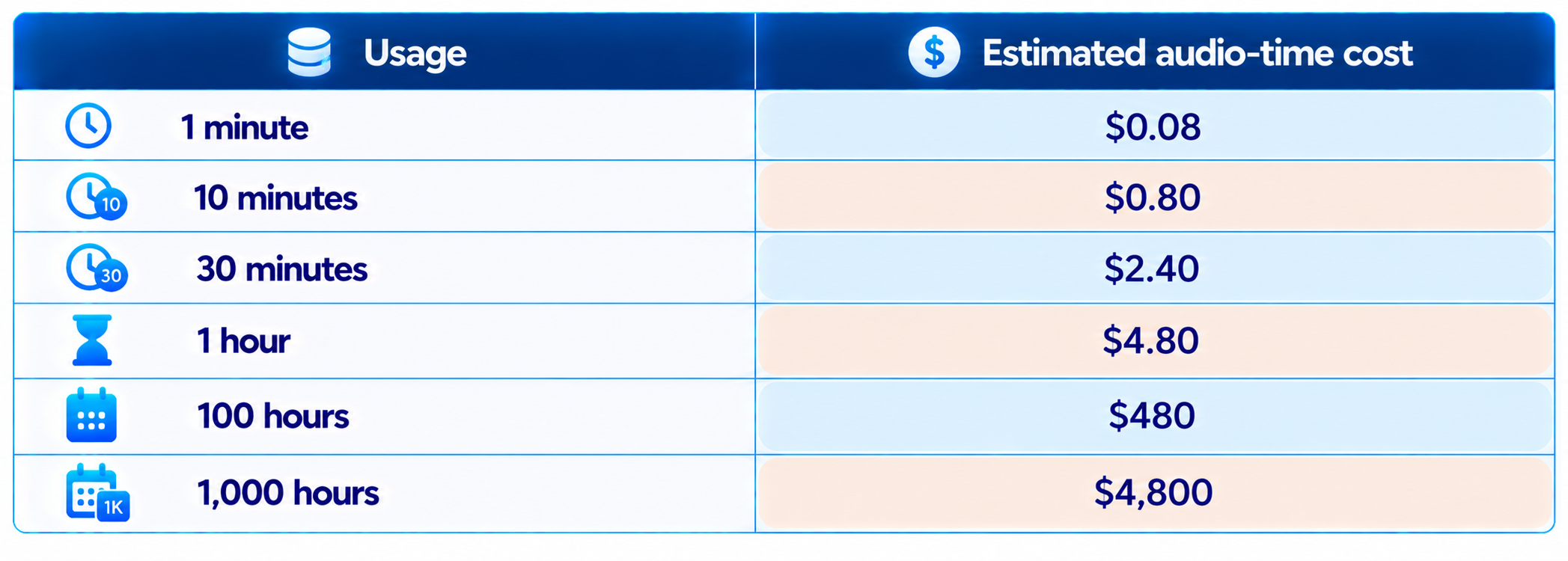
These figures are simple audio-duration calculations based on the published rate. They are not a complete operating budget. A production voice agent may also incur costs for telephony, orchestration, tools, storage, monitoring and human escalation. Confirm the current billing definition in the official API documentation before estimating a large deployment.
Artificial Analysis's Big Bench Audio comparison also reports per-task costs, with Grok Voice 3.0 below GPT-Live-1 Astra Medium and GPT-Realtime-2.1 High in that test. Per-task benchmark cost and per-minute API pricing are different measures, so do not substitute one for the other.
9. Grok Voice 3.0 vs Grok Voice 2.0
For existing developers, the upgrade story is one of the model's clearest advantages. xAI says the API is unchanged, grok-voice-latest now points to version 3.0, and sessions using that alias were upgraded automatically. The old grok-voice-2.0 identifier is deprecated.
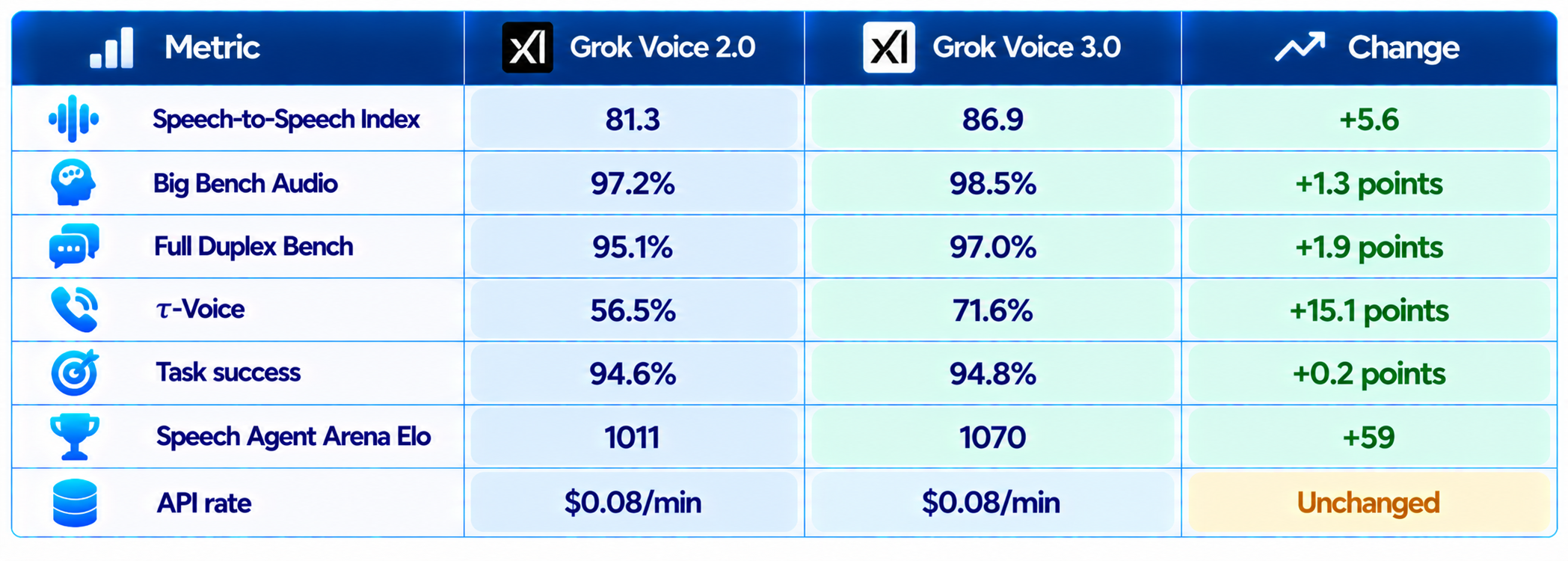
The largest gain in this comparison is τ-Voice, where the score rises from 56.5% to 71.6%. The smaller task-success increase suggests the overall success rate was already high on the reported sample, leaving less room for a large absolute gain. These are benchmark deltas, not a guarantee of the same improvement on every custom agent.
10. Grok Voice 3.0 vs Gemini 3.8 Live
In xAI's published comparison, Grok Voice 3.0 leads Gemini 3.8 Live Extended Thinking High on the Speech-to-Speech Index, 86.9 to 82.6. It also leads on Full Duplex Bench, 97.0% to 91.9%, task success, 94.8% to 89.1%, and the displayed Speech Agent Arena Elo, 1070 to 990. Grok also leads on Big Bench Audio, 98.5% to 97.7%.
However, Artificial Analysis's live Speech Agent Arena leaderboard currently places Gemini 3.8 Live above Grok Voice 3.0 by Elo in its current snapshot. This is a reminder that configuration, sample count, benchmark date and leaderboard methodology matter. A launch comparison table and a live arena can tell different stories because they do not necessarily measure the same thing under identical conditions.
For product teams, the practical choice should come down to the task. Test natural conversational flow, latency, speech recognition under noise, tool execution, interruption behavior and the success criteria your application needs. Avoid declaring a universal winner from one table.
Gemini 3.8 Flash TTS and Flash-Lite TTS Review
11. Grok Voice 3.0 vs GPT-Live-1
Grok Voice 3.0 scores 86.9 on the published Speech-to-Speech Index compared with 83.2 for GPT-Live-1 Astra Medium. It also leads the cited comparison on Full Duplex Bench, 97.0% versus 94.9%, and Big Bench Audio, 98.5% versus 90.1%. The difference is not uniform across every evaluation: GPT-Live-1 records 74.5% on τ-Voice compared with Grok's 71.6%.
That makes this comparison more nuanced than 'Grok wins everything.' Grok's results make it a strong candidate for interactive voice agents where fast turn-taking and speech reasoning are priorities. GPT-Live-1 may still be competitive or preferable for specific support-call scenarios, depending on the configuration and application.
A fair evaluation should run both models on the same scripted and unscripted scenarios, with the same tools and backend services. Score task success, interruptions, incorrect actions, customer experience, latency and cost per resolved request. A model that sounds slightly better but fails more transactions may be the worse business choice.
12. Best Use Cases for Grok Voice 3.0
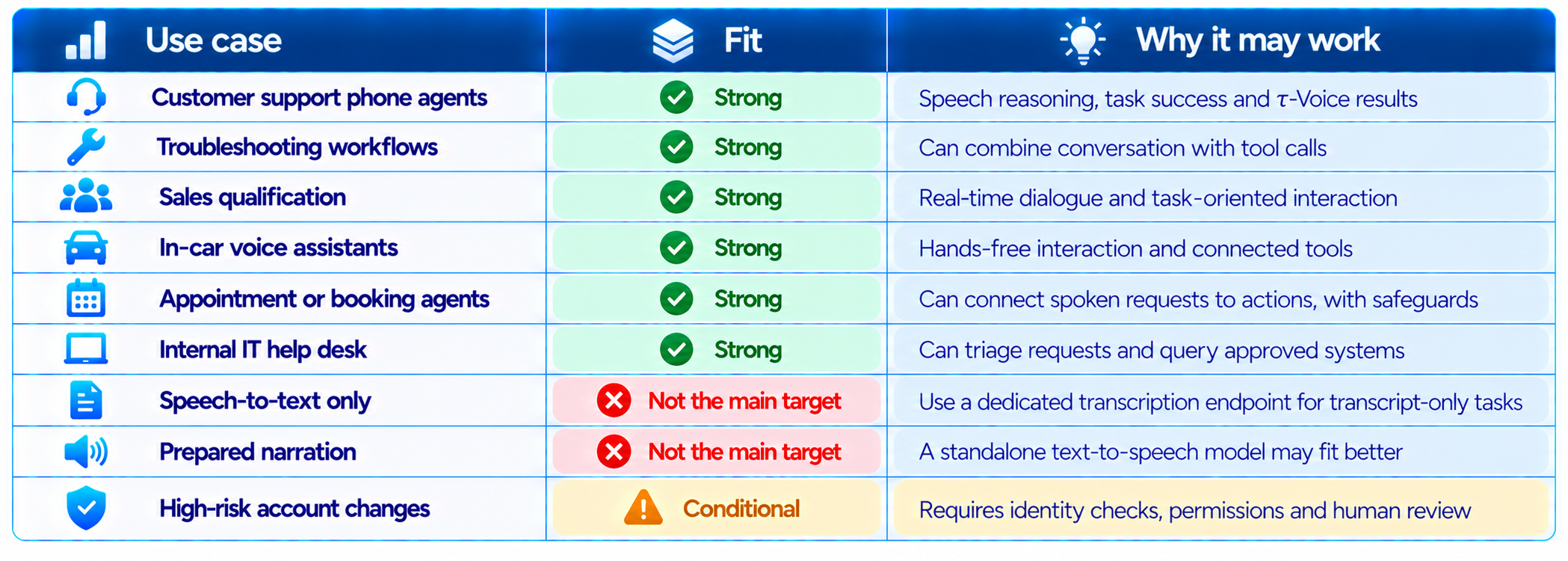
The strongest fit is an agent that must listen and act, not simply generate a voice. For simple transcription, prepared narration or batch speech synthesis, compare dedicated speech-to-text and text-to-speech endpoints rather than paying for a real-time speech-to-speech interaction.
13. Developer Integration and API Migration
The migration path is simple for current Grok Voice users. xAI's release notes say the Voice Agent API is unchanged and the grok-voice-latest alias now selects Grok Voice 3.0. If your application is pinned to grok-voice-2.0, update the model identifier to grok-voice-3.0 or use the latest alias if automatic upgrades are acceptable.
- Check whether your production configuration uses a fixed model ID or the latest alias.
- Run regression tests for interruption handling, tool calls, end-of-call behavior and fallback logic.
- Confirm that the agent still follows your system instructions and escalation policy.
- Measure cost per resolved request, not only minutes of audio.
- Test real microphones, phone audio, background noise and the accents of your users.
- Keep API keys server-side and use short-lived client credentials where the official integration supports them.
- Log tool actions and final task state while limiting retention of sensitive audio and transcripts.
14. Limitations and Risks
- Leaderboard position varies by metric. Grok leads the published Speech-to-Speech Index comparison, but the live Speech Agent Arena currently ranks Gemini 3.8 Live above it by Elo.
- τ-Voice is not a clean sweep: the cited GPT-Live-1 Astra Medium configuration scores 74.5%, higher than Grok Voice 3.0 at 71.6%.
- Benchmark success does not guarantee success on your own callers, accents, domain vocabulary or tool stack.
- An API-only model does not offer the same deployment control as downloadable open weights.
- Per-minute audio pricing is only one part of the total cost of running a production voice agent.
- Autonomous actions create operational risk. Account changes, refunds, purchases and personal-data access need permission boundaries and audit logs.
- Company-reported deployment volumes and resolution rates should be distinguished from independent benchmark results.
- Voice systems can mishear names, numbers, addresses or intent. High-impact details should be confirmed before irreversible actions.
15. Is Grok Voice 3.0 Worth It?
Yes, for developers building real-time speech-to-speech agents that need to listen, reason and act. The published results are compelling: an 86.9 Speech-to-Speech Index score, 97% Full Duplex Bench, 98.5% Big Bench Audio and 94.8% task success. Its $0.08-per-minute rate is unchanged from the previous model, and existing applications using grok-voice-latest receive the new version without a code change.
The strongest reasons to evaluate it are conversational dynamics and end-to-end task behavior. Those are central to customer support, hands-free assistants and interactive agents. The τ-Voice result is less dominant than the aggregate ranking, and the live Speech Agent Arena currently shows Gemini 3.8 Live ahead on Elo. That means the correct decision is workload-specific.
For teams already on Grok Voice 2.0, the upgrade is especially attractive because the API and price remain the same. Still, run a controlled regression suite before rolling out changes to sensitive workflows. A model upgrade can change response style and behavior even when the interface remains stable.
16. Final Verdict
Grok Voice 3.0 is one of the strongest real-time voice AI models available in October 2026. It leads the launch comparison on Artificial Analysis's Speech-to-Speech Index with 86.9, improves meaningfully over Grok Voice 2.0 on Full Duplex Bench and τ-Voice, and records 94.8% task success in the cited evaluation. The model is built for agents that do more than talk: it is designed to handle live conversation while using tools to complete requests.
The pricing and migration story are attractive. At $0.08 per minute, Grok Voice 3.0 keeps the previous version's rate. The grok-voice-latest alias now points to version 3.0, and xAI says the API is unchanged. For existing deployments, that makes testing the new version relatively straightforward.
There are important caveats. Grok does not lead every benchmark, and the live Speech Agent Arena ranking currently puts Gemini 3.8 Live above it by Elo. GPT-Live-1 also scores higher on the cited τ-Voice support-call evaluation. Organizations should compare models on their own call types, languages, policies, tools and customer-experience targets.
Verdict: 9.1/10 for conversational dynamics, 9.0/10 for speech reasoning, 8.8/10 for cost and 9.0/10 overall. Grok Voice 3.0 deserves a place on the shortlist for real-time customer support, sales, in-car and tool-using voice agents. Its benchmark lead is meaningful, but the winning model for a business is the one that resolves the right tasks safely, quickly and consistently.
Frequently Asked Questions
What is Grok Voice 3.0?
It is xAI's real-time speech-to-speech model for voice agents, released on October 14, 2026.
Does Grok Voice 3.0 rank number one?
It ranks first in the published Artificial Analysis Speech-to-Speech Index comparison at 86.9. It does not rank first on every voice leaderboard; the live Speech Agent Arena currently places Gemini 3.8 Live above it by Elo.
What are its benchmark scores?
The published comparison reports 86.9 on the Speech-to-Speech Index, 98.5% on Big Bench Audio, 97.0% on Full Duplex Bench and 94.8% task success.
How much does Grok Voice 3.0 cost?
The Voice Agent API rate is $0.08 per minute of audio, or $4.80 per hour.
What is the model ID?
Use grok-voice-3.0. The grok-voice-latest alias now points to version 3.0.
Do existing API users need to migrate?
Users on grok-voice-latest are upgraded automatically according to xAI. Applications pinned to grok-voice-2.0 should update the model identifier because version 2.0 is deprecated.
Is it better than Gemini 3.8 Live?
It leads the launch comparison on the Speech-to-Speech Index and several component metrics, but the current Speech Agent Arena leaderboard ranks Gemini 3.8 Live higher by Elo. The best choice depends on the task.
Is it better than GPT-Live-1?
It leads on the published aggregate index, Full Duplex Bench and Big Bench Audio. GPT-Live-1 Astra Medium scores higher on the cited τ-Voice support-call evaluation.
Can it handle customer support calls?
It is designed for voice agents, and xAI reports its use in Starlink support. Businesses should test identity checks, tool calls, escalation and policy compliance before deployment.
Is it open source?
No. It is offered as a proprietary API model.
Is it worth it?
It is worth evaluating for real-time voice agents where natural turn-taking, speech reasoning and task completion are important.
Recommended Blogs
Quasar 438B Review: Benchmarks, Speed, Price & Is It Worth It? (2026)
Mercury 2.5 AI Model Review: Speed, Price & Is It Worth It? (2026)
Resources & Community
Join our community of 70,000+ AI enthusiasts and learn to build powerful AI applications. Whether you're a beginner or an experienced developer, Build Fast with AI helps you understand and implement AI in your projects.
Agentic AI Launchpad 2026
A structured 6-week cohort program that takes you from AI basics to building and deploying real-world agentic AI systems. Includes live sessions, expert mentorship, project reviews and a builder community network.
Join Agentic AI Launchpad 2026
Free AI Resources
Access free tools, workshops and micro-learning to keep building.

