



The AI model race is starting to split into specialists, and GLM-Legal is one of the clearest examples yet. Launched on October 12, 2026, by China's Z.ai, it is not a general chatbot but a model trained specifically for legal work, contract review, evidence analysis, compliance, and drafting, with an agent scaffold tuned for how law firms actually operate. This review covers what GLM-Legal is, how it was built, what its headline benchmark really means, how to get access, and whether a domain-specific legal model is worth it over a general frontier model.
The short version is that GLM-Legal is a serious, focused attempt at legal AI, strongest where it was trained and backed by a notable benchmark result, but wrapped in the usual early-release caveats: the numbers are vendor-reported, access is gated, and the weights are not open. For legal teams evaluating AI, it is worth understanding in detail, so let me walk through it.
What Is GLM-Legal?
GLM-Legal is a legal-specialized large language model from Z.ai, the Chinese AI company behind the GLM model family. Unlike a general-purpose model that happens to answer legal questions, GLM-Legal was purpose-built and trained for legal workflows: reviewing contracts, analysing evidence, checking compliance, and drafting and negotiating legal and regulatory documents. It is aimed at law firms and in-house legal teams rather than consumers.
The key design choice is that Z.ai trained not just the model weights but also the agent scaffold, the layer that decides how the model plans, uses tools, and carries out multi-step legal tasks, specifically for legal work. That matters, because real legal tasks are rarely one prompt; they are multi-step workflows with documents, checks, and revisions. For the general models in the same family, see our GLM-5.3 review.
Built on GLM-5.3-Flash
GLM-Legal is built on Z.ai's GLM-5.3-Flash, the efficient model in its current lineup, and then specialised for law. Architecturally it is reported as a large mixture-of-experts system: around 320 billion total parameters with about 18 billion active per token, and a 1 million token context window. That large context is genuinely useful for legal work, where you often need the model to hold entire contracts, case files, or regulatory texts in view at once.
The training approach is what sets it apart. Z.ai combined legal mid-training (continued training on legal material) with reinforcement learning across tens of thousands of legal environments, tuning the model and its scaffold together so the whole system learns how to carry out legal tasks, not just recite legal facts. This is the difference between a model that knows law and one trained to do legal work, and it is the central claim of the release. For the base model's efficiency tier, see our GLM-5.3 Flash review.
What GLM-Legal Does
GLM-Legal targets the core, repetitive, high-volume tasks that fill a lawyer's day, the work where AI can save the most time. Its stated use cases are concrete and practical rather than vague.
- Contract review: reading contracts, flagging risks, and checking clauses against requirements.
- Evidence analysis: working through case material and documents to surface what matters.
- Compliance checks: assessing documents and actions against relevant rules, with country-specific awareness.
- Drafting: producing first drafts of contracts and regulatory documents.
- Negotiation support: helping shape and respond to terms.
The emphasis on contract review and compliance is telling, these are the highest-volume, most structured legal tasks, and the ones where a specialised model's consistency can matter most. Z.ai also highlights country-specific compliance, which is important because law is jurisdictional and a generic model often blurs those lines. The honest framing is that these are the intended uses; how well it performs each in the real world still needs independent testing, and legal output always needs a qualified human to review it.
The Harvey LAB Benchmark
The headline number for GLM-Legal is a 19.2 percent all-pass rate on Harvey's Legal Agent Benchmark (LAB), reported as a 12.5 percentage point improvement over Z.ai's previous model. Harvey's LAB is a meaningful benchmark because it evaluates real-world law-firm workflows across 24 practice areas, rather than abstract legal trivia, so it is closer to measuring useful legal work than a simple question-and-answer test.
Two things need context, though. First, a 19.2 percent all-pass rate sounds low in isolation, and it is, because Harvey LAB is a hard, strict benchmark where a task only counts if every part passes; the point is the relative gain and the comparison to other models, not the absolute figure. Z.ai says GLM-Legal can match frontier general-purpose models on mainstream legal benchmarks, and one report claims it outscored GPT-6 Astra and Claude Fable 5 on Harvey's LAB while costing far less per task. Second, and most important, all of these numbers are vendor-reported. Independent results on benchmarks like LegalBench are still pending, and the cost comparisons in particular should be treated as unverified until third parties test them.
Access & Pricing
Here is where expectations need managing. GLM-Legal is not generally available: access is by application only, and Z.ai has not published a price for it. It is also not open-weight, Z.ai has not released the weights, and access is through an application for the API, despite one headline incorrectly calling it open-weight (the body of that same article contradicts the headline). Z.ai also plans to bring GLM-Legal to its AutoClaw desktop agent.
For legal teams, this means GLM-Legal is currently something to apply for and evaluate, not something you can simply sign up and use today, and you will need to discuss pricing directly with Z.ai. The gated rollout is common for professional AI tools, where the vendor wants to control early use in a high-stakes domain, but it does mean you cannot yet do a quick, independent hands-on test the way you can with an open or openly-priced model. Factor that into any evaluation timeline.
Strengths & Limitations
Here is the honest balance for GLM-Legal.
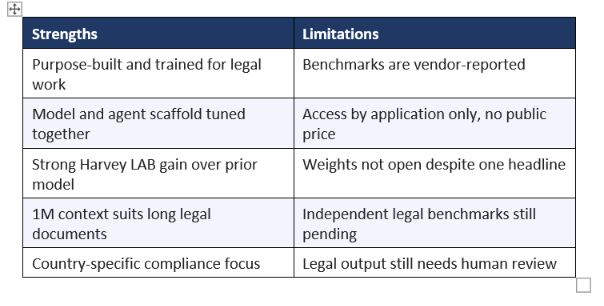
The strengths are real and specific: this is a model shaped for legal work end to end, not a general model with a legal prompt. The limitations are mostly about verification and access rather than the concept, which is sound. The one that never goes away is human oversight, in law, AI output is a draft and an aid, not a final answer, regardless of how good the model gets.
GLM-Legal vs General AI for Legal Work
The real question GLM-Legal raises is whether a specialised legal model beats a strong general model prompted well. There are honest arguments on both sides.
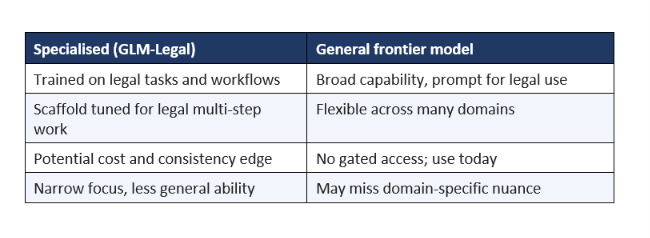
The case for GLM-Legal is consistency and cost on repetitive legal tasks, plus a scaffold built for the domain. The case for a general model is availability, flexibility, and the sheer capability of the top frontier systems, which, prompted and equipped well, handle a lot of legal work already. For most teams in 2026 the realistic answer is to test both on your actual tasks, since the right choice depends heavily on your jurisdiction, your workflows, and your risk tolerance. For the general leaders, see our best AI models 2026 ranked analysis.
The Rise of Domain-Specific AI
GLM-Legal is part of a bigger shift worth understanding, because it tells you where AI is heading. For the last few years the race was about general models that could do everything reasonably well. Now that the best general models are extremely capable, the next frontier is depth in specific professional domains: law, medicine, finance, and other fields where the work is high-value, highly structured, and expensive to get wrong. GLM-Legal is one of the first serious examples of a model and its surrounding system trained end to end for one profession.
The logic is straightforward. A general model knows a little about everything, but a specialised model can be trained on the exact tasks, documents, and multi-step workflows of a single field, and its surrounding scaffold can be tuned to how that profession actually works. In theory this buys more consistency, fewer domain mistakes, and lower cost per task than prompting a general giant. The open question, which GLM-Legal will help answer, is whether that specialisation beats simply using the strongest general model with good tools and prompts. If it does, expect a wave of domain-specific models across professional fields, and legal is a natural first target because so much of the work is document-heavy and repeatable.
For legal teams, the practical signal is that AI built specifically for law is now a real category to evaluate, not a future promise. Whether GLM-Legal itself wins is less important than the trend it represents: the era of one-model-fits-all is giving way to specialists, and the firms that learn to evaluate and adopt them well will have an edge.
Who Should Use It
GLM-Legal is aimed at a clear audience.
- Law firms with high volumes of contract review and compliance work.
- In-house legal teams looking to speed up drafting and document analysis.
- Legal-tech builders evaluating a domain-specific model for a product.
- Teams that can commit to an application-based evaluation rather than instant access.
It is not for casual or consumer use, and it is not for anyone who needs to self-host or start today without an application. If you are a legal professional whose work is dominated by the tasks it was built for, GLM-Legal is worth applying to evaluate; if you need general AI or immediate access, a general frontier model is the more practical route for now.
How to Evaluate GLM-Legal for Your Firm
Because the benchmarks are vendor-reported and access is gated, the only way to know if GLM-Legal fits your firm is a structured evaluation on your own work. Here is a practical way to run one once you have access.
- Pick real, representative tasks. Use actual contracts, compliance checks, and drafts from your practice, not toy examples, covering your real jurisdictions.
- Benchmark against your current approach. Run the same tasks through a strong general model and, where relevant, your existing process, so you compare like for like.
- Score for accuracy and risk, not just speed. In law a fast wrong answer is worse than a slow right one, so weight correctness and missed risks heavily.
- Keep a lawyer in the loop. Have qualified professionals review every output and log where the model helped and where it erred.
- Check cost per real task. Measure the true cost on your workload, since vendor cost claims are unverified and your mix of tasks is what matters.
The goal of the evaluation is a clear, evidence-based answer to one question: does GLM-Legal do your firm's actual work better, safer, or cheaper than your current tools? Treat the vendor benchmarks as a reason to test it, not as proof, and let your own results decide. This disciplined approach also prepares your team to evaluate the wave of specialised models that will follow.
My Verdict
GLM-Legal is one of the more convincing domain-specific AI releases of 2026, because Z.ai did the harder thing: it trained the model and its agent scaffold together for real legal workflows rather than slapping a legal prompt on a general model. The Harvey LAB result is a meaningful relative gain, and the focus on contract review, compliance, and country-specific work targets exactly where legal AI can save the most time. As a signal that specialised, workflow-trained models are coming for professional domains, it is important.
The caveats keep it from being a clear buy today: the benchmarks are vendor-reported, access is gated with no public price, the weights are not open, and legal work always needs human review. My recommendation for legal teams is to apply, evaluate it on your own real tasks, and compare it head-to-head with a strong general model before committing. GLM-Legal is a serious entrant worth watching closely, and a sign of where professional AI is heading, but wait for independent results before treating its claims as settled.
Frequently Asked Questions
What is GLM-Legal?
GLM-Legal is a legal-specialized AI model from Z.ai, launched on October 12, 2026, and built on its GLM-5.3-Flash model. It is trained specifically for legal work, contract review, evidence analysis, compliance, and drafting and negotiation, with an agent scaffold tuned for law-firm workflows. It targets law firms and in-house legal teams rather than general consumers.
Who makes GLM-Legal?
GLM-Legal is made by Z.ai, the Chinese AI company behind the GLM family of models. It is built on Z.ai's GLM-5.3-Flash and specialised for legal workflows through legal mid-training and reinforcement learning across tens of thousands of legal environments, tuning both the model and its agent scaffold for legal tasks.
Is GLM-Legal open-weight?
No. Despite one headline calling it open-weight, Z.ai has not released GLM-Legal's weights, and the body of that same article contradicts the headline. Access is through an application for the API only, with no published price. So GLM-Legal is a gated, closed model at launch, not an open-weight release you can download and self-host.
What is the Harvey LAB benchmark score for GLM-Legal?
GLM-Legal reportedly achieved a 19.2 percent all-pass rate on Harvey's Legal Agent Benchmark (LAB), described as a 12.5 percentage point gain over Z.ai's previous model. Harvey LAB tests real law-firm workflows across 24 practice areas, so the figure reflects strict, real-world legal tasks. The number is vendor-reported, and independent verification is still pending.
How do I access GLM-Legal?
Access to GLM-Legal is by application only. Z.ai has not published a price, and the weights are not open, so you cannot simply sign up or download it. Z.ai also plans to bring GLM-Legal to its AutoClaw desktop agent. Legal teams interested in it should apply through Z.ai and discuss pricing and evaluation directly.
Is GLM-Legal better than a general model like GPT-6 Astra for legal work?
Z.ai reports that GLM-Legal outscored GPT-6 Astra and Claude Fable 5 on Harvey's LAB while costing far less per task, but those figures are vendor-reported and unverified. A specialised model can offer consistency and cost advantages on repetitive legal tasks, while a general model offers availability and flexibility. The honest answer is to test both on your real workflows before deciding.
Can GLM-Legal replace a lawyer?
No. GLM-Legal is built to assist legal work, contract review, drafting, compliance checks, not to replace qualified legal judgment. Its output is a draft and an aid that a qualified professional must review, especially given that its benchmarks are vendor-reported and law is high-stakes and jurisdiction-specific. Treat it as a productivity tool for legal teams, not a substitute for a lawyer.
Does GLM-Legal work for jurisdictions outside China?
Z.ai emphasises country-specific compliance, which suggests GLM-Legal is designed to handle more than one jurisdiction, but how well it performs for any specific country's law is not yet independently verified. Law is deeply jurisdictional, so any firm outside China should test the model carefully on its own local legal tasks and rules before relying on it, rather than assuming broad cross-border coverage.
Is it safe to use GLM-Legal for confidential documents?
That depends on Z.ai's data and privacy terms, which legal teams must review carefully before uploading any confidential or privileged material. Because access is gated and the model runs on Z.ai's systems, understand where your data goes, how it is stored, and whether it is used for training. For sensitive legal work, confirm the contractual and security terms first, and treat data handling as a core part of your evaluation.
Recommended Blogs
- GLM-5.3 Review (2026)
- GLM-5.3 Flash Review: Benchmarks, Price, Worth It?
- GLM-5.2 Review (2026)
- Best AI Models 2026: Full Ranked Analysis & Benchmarks
- The Best AI Model Per Task (2026)
References
- Chinese company launches legal-specific LLM (Artificial Lawyer)
- Z.ai unveils law-focused AI GLM-Legal (Digital Today)
Z.ai opens gated access to GLM-Legal, its 320B legal AI (AlphaSignal)

