



Grok 4.7 Review: Is xAI's New Model Finally a Serious Coding and Agent Workhorse?
Grok 4.7 is xAI's newest frontier model for coding, agentic tasks and knowledge work, released on September 21, 2026. The upgrade is built around longer-running tasks rather than a simple increase in chatbot quality. xAI says it uses a larger base model than Grok 4.6, a longer reinforcement-learning run, and training weighted toward problems that can take hours to complete.
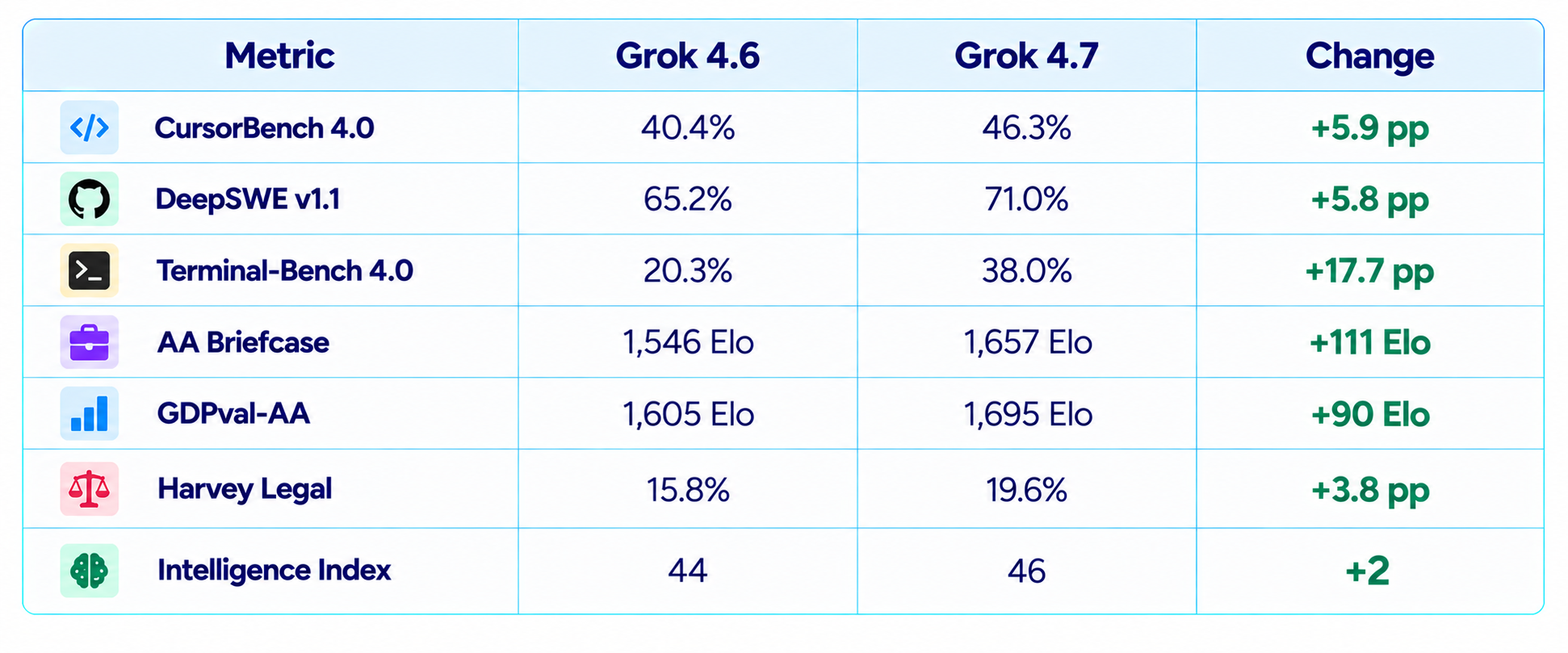
The benchmark jump is concentrated exactly where coding-agent users care most. xAI reports CursorBench 4.0 at 46.3%, up from 40.4% for Grok 4.6; DeepSWE v1.1 at 71.0% at high effort, up from 65.2%; and Terminal-Bench 4.0 at 38.0%, compared with 20.3% for Grok 4.6. Independent Artificial Analysis also gives Grok 4.7 a 46 Intelligence Index score and a 56 Coding Agent Index score when evaluated with Grok Build.
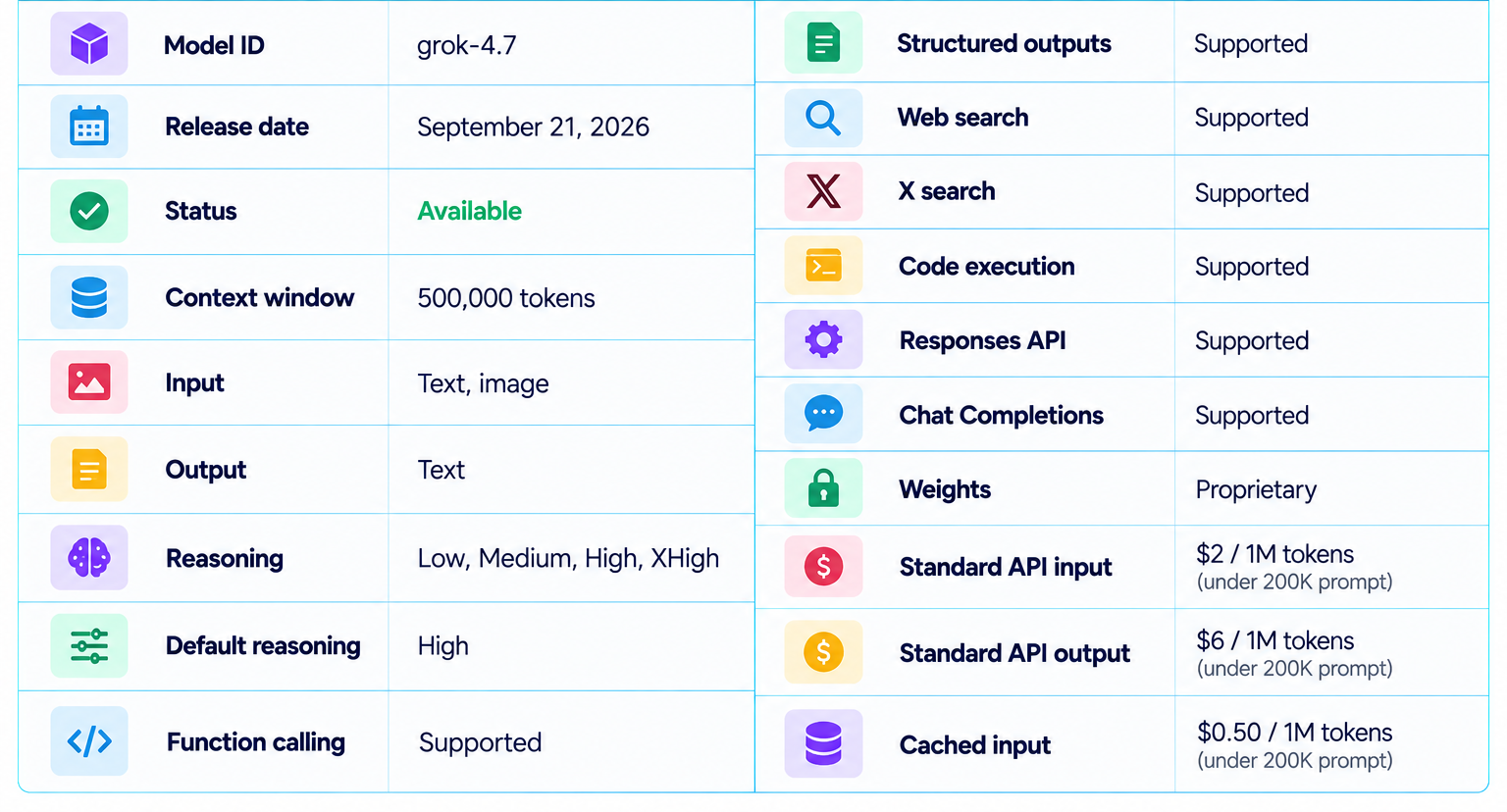
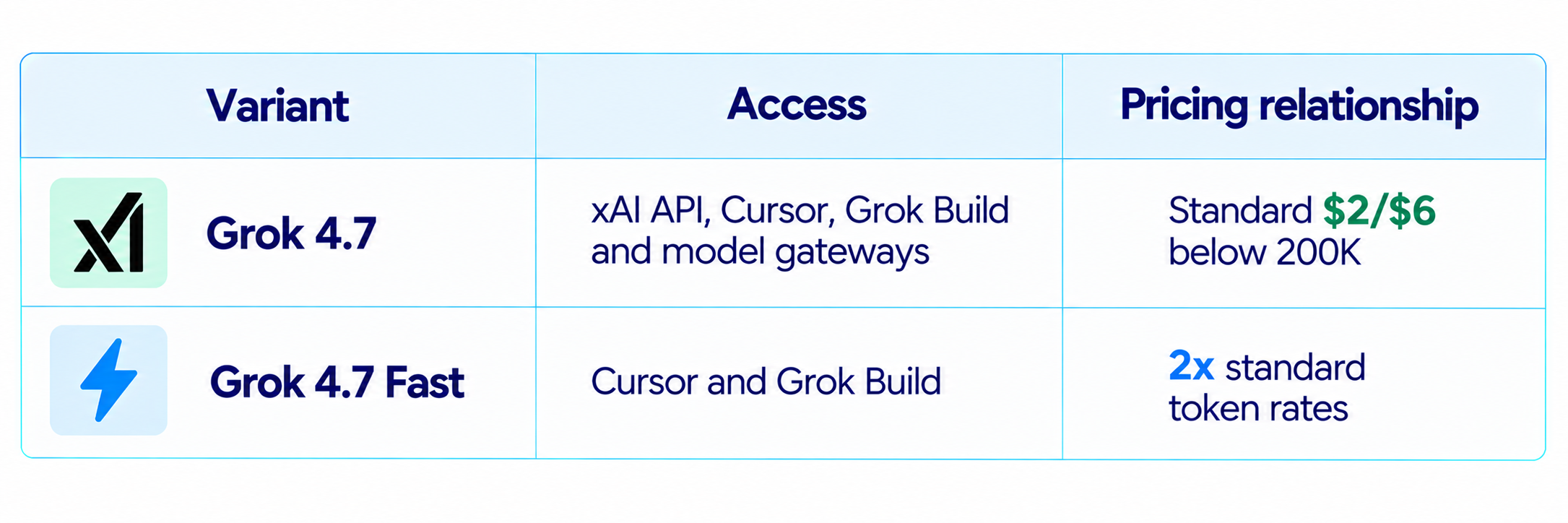
The other important part is price. Grok 4.7 costs $2 per million input tokens and $6 per million output tokens below 200K prompt tokens, with cached input at $0.50. Above 200K, xAI lists $4 input and $12 output per million tokens. The model has a 500K context window and low-to-xhigh reasoning.
QUICK ANSWER
Grok 4.7 is a meaningful upgrade to Grok 4.6, especially for coding agents, long-running knowledge work and multi-step tool use. xAI reports 46.3% on CursorBench 4.0, 71.0% on DeepSWE v1.1 at high effort, 38.0% on Terminal-Bench 4.0, 1,657 Elo on AA Briefcase v1.1 and 19.6% on the Harvey Legal Agent Benchmark.
Artificial Analysis independently scores Grok 4.7 at 46 on its Intelligence Index. Its Coding Agent Index score is 56 when Grok 4.7 is paired with Grok Build, up nine points from Grok 4.6, with component results of 73% on DeepSWE v1.1, 33% on Terminal-Bench 4.0 and 63% on SWE-Atlas-QnA.
The price is $2 per million input tokens and $6 per million output tokens below the 200K prompt threshold, with $0.50 cached-input pricing. Above 200K prompt tokens, xAI lists $4 input and $12 output per million tokens. Grok 4.7 has a 500K context window, text and image input, text output, function calling, structured outputs, web search, X search and code execution.
My verdict: 9.2/10 overall. Grok 4.7 is one of the strongest price-performance models for coding agents in September 2026. It does not beat every frontier model, and its xhigh mode can consume a very large amount of output tokens, but the combination of agent gains, 500K context and $2/$6 standard pricing makes it unusually practical.
1. What Is Grok 4.7?
Grok 4.7 is xAI's successor to Grok 4.6 and the company's frontier model for coding, agentic tasks and knowledge work. xAI says the new model uses a larger base model and a longer reinforcement-learning run focused on difficult tasks that can take many hours to complete. It was also trained to verify its own work more carefully and manage longer context more effectively.
The model is available through the xAI API as grok-4.7, through Grok Build as its default model, and in Cursor. It is also available through several model gateways. The public API supports text and image inputs with text output and exposes low, medium, high and xhigh reasoning levels.
Grok 4.7 is therefore not just a chatbot upgrade. It is an infrastructure model for agent loops, where a single user request may turn into dozens of tool calls, code edits, searches and verification steps.
2. Grok 4.7 Specifications
3. Grok 4.7 Benchmarks
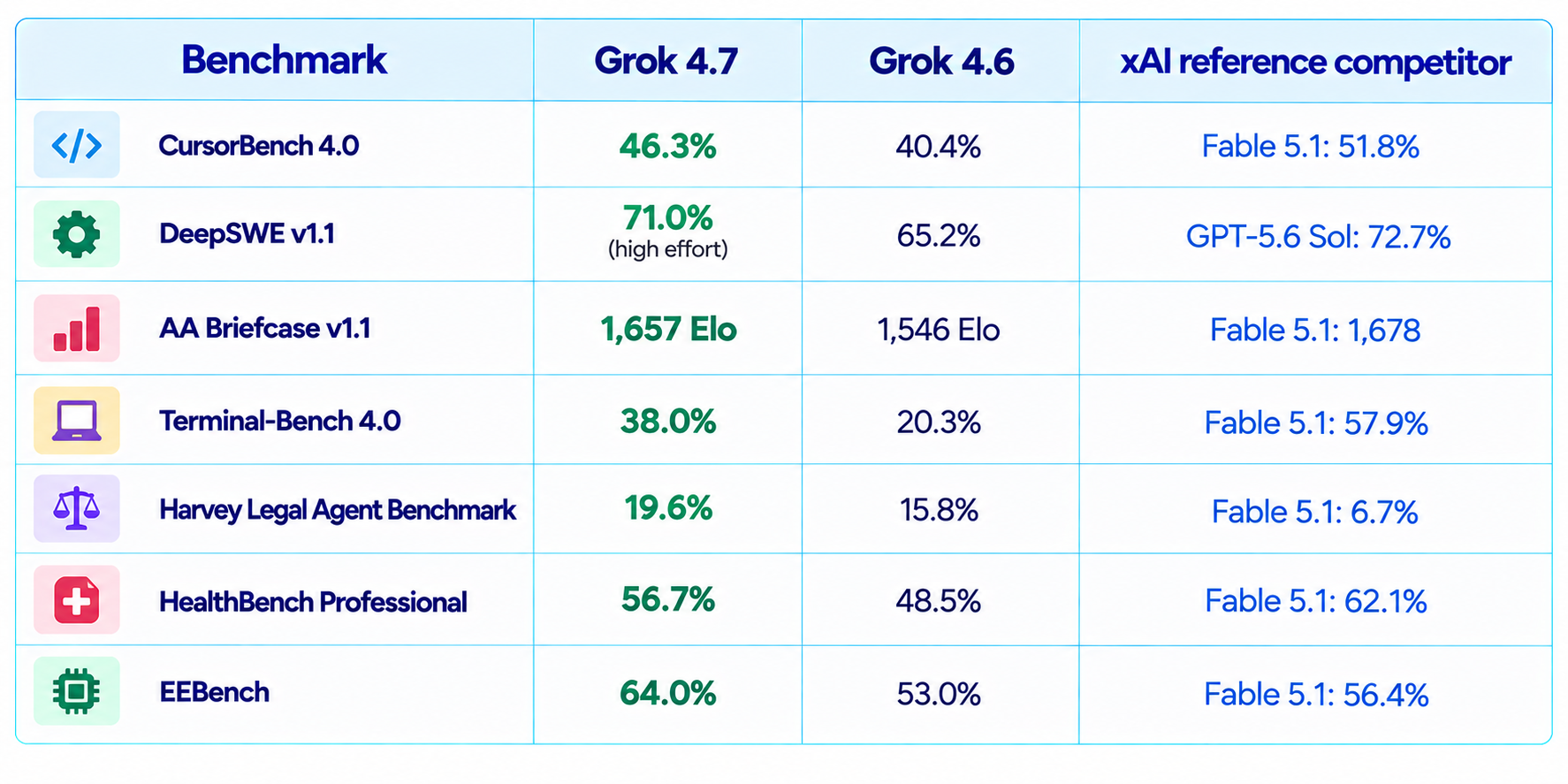
The release is strongest when the evaluation reflects long-running work. xAI's launch table covers software engineering, office work, terminal work, legal work, clinical reasoning and electrical engineering.
4. Artificial Analysis Intelligence Index
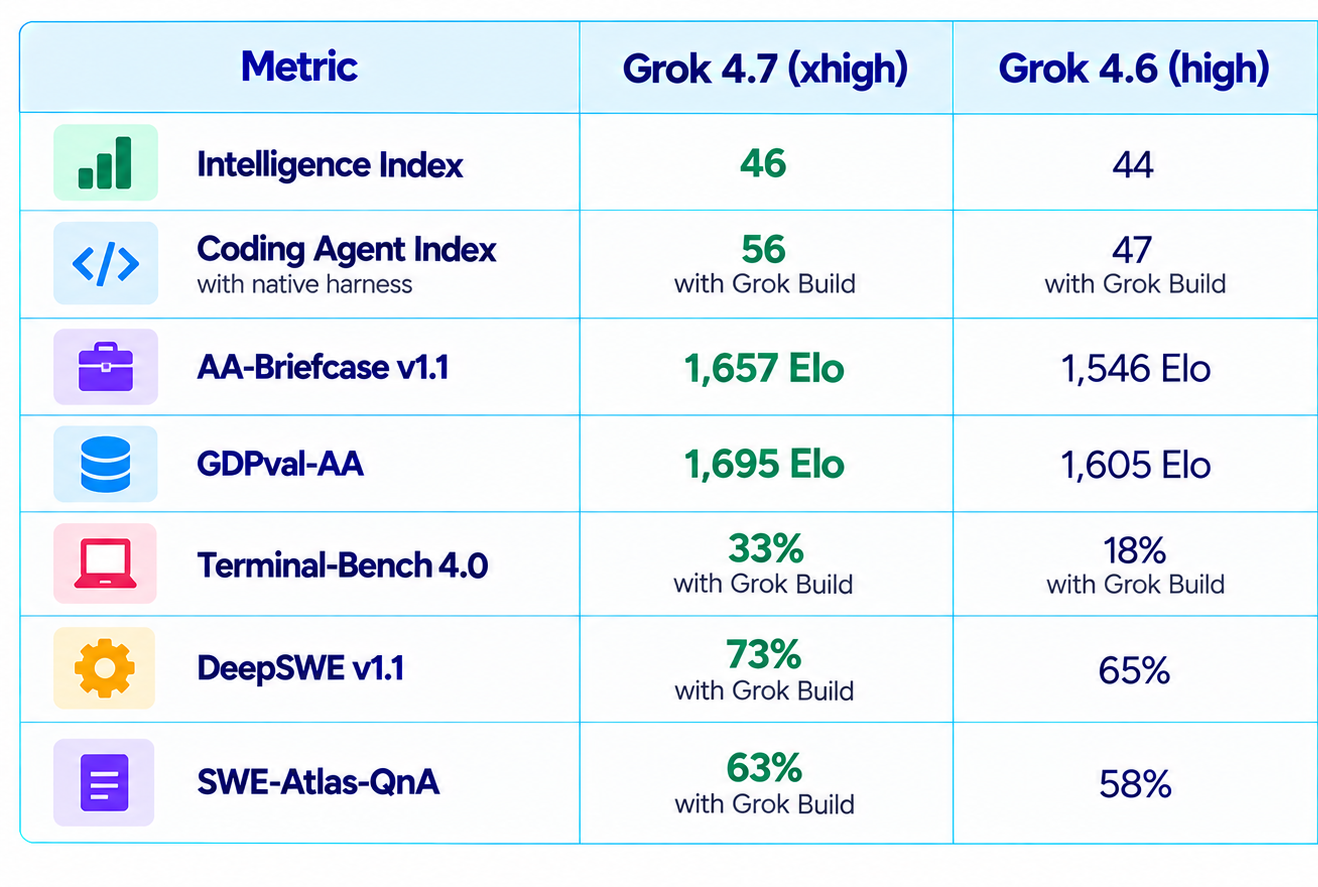
Artificial Analysis independently evaluates Grok 4.7 at xhigh and high reasoning. Both currently score 46 on the Intelligence Index. The xhigh configuration is used in the detailed Coding Agent Index comparison.
5. Coding Performance: CursorBench, DeepSWE and Terminal-Bench
Coding is the largest practical improvement in Grok 4.7. CursorBench 4.0 moves from 40.4% for Grok 4.6 to 46.3% for Grok 4.7, while DeepSWE rises from 65.2% to 71.0% in xAI's published comparison. Terminal-Bench 4.0 is the more dramatic change, climbing from 20.3% to 38.0%.
Artificial Analysis reports a similar direction in the native Grok Build harness, where the Coding Agent Index rises from 47 to 56. The component results improve across DeepSWE, Terminal-Bench and SWE-Atlas-QnA.
This is exactly the type of upgrade that matters for coding agents. A developer does not only need code generation. The agent must search a repository, modify files, invoke terminal tools, interpret failures and keep going until tests pass. Grok 4.7's largest gains occur on benchmarks designed around those longer loops.
6. Agentic Knowledge Work
Grok 4.7 also improves outside software engineering. Artificial Analysis reports 1,657 Elo on AA-Briefcase v1.1, up 111 Elo from Grok 4.6, and 1,695 on GDPval-AA, up 90 Elo. These tests focus on practical work products rather than simple question answering.
The AA-Briefcase improvement is especially notable because the benchmark checks whether an agent completes requested work products and meets task requirements. Artificial Analysis reports stronger analytical quality for Grok 4.7, with 1,994 Elo compared with 1,690 for Grok 4.6, while presentation quality is broadly similar.
That makes Grok 4.7 relevant for workflows involving documents, spreadsheets, presentations, analysis and other professional deliverables, not only coding.
7. Legal, Science and Engineering Benchmarks
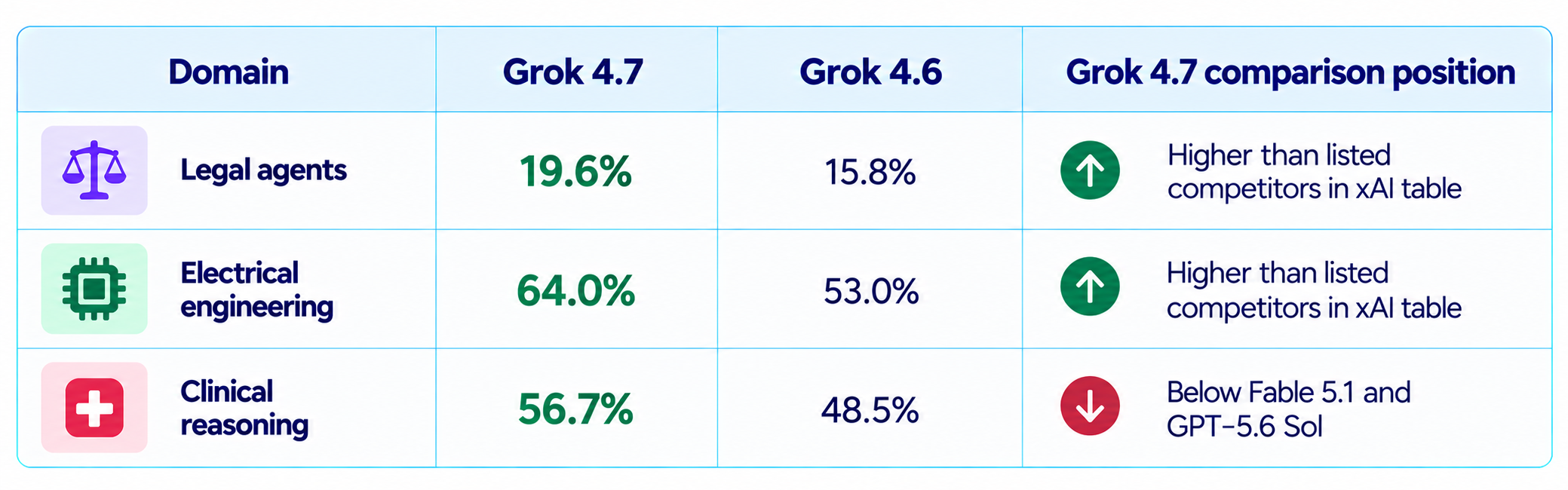
8. Grok 4.7 Speed and Token Usage
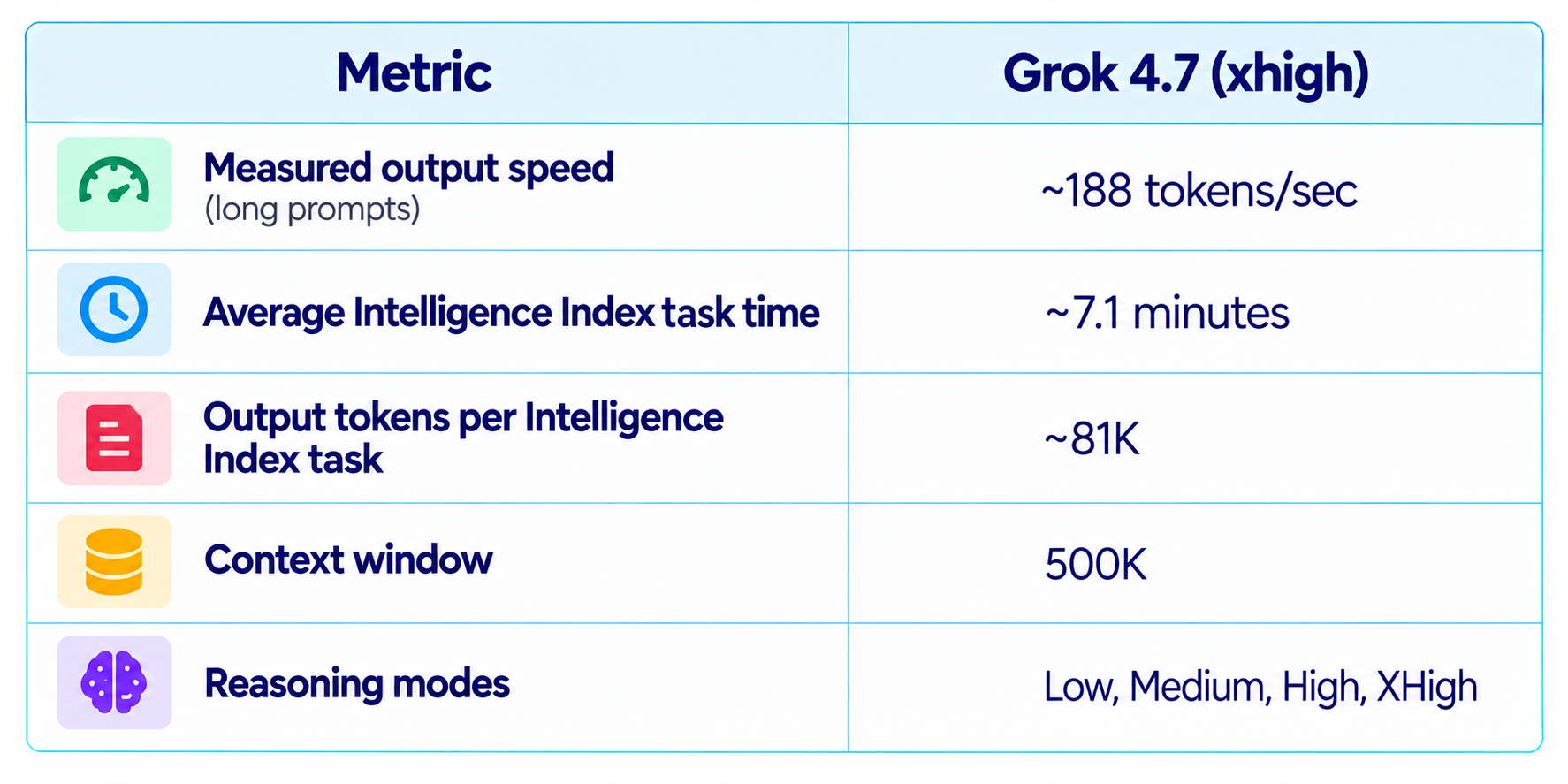
Speed is more complicated than the token price suggests. Artificial Analysis measures Grok 4.7 at roughly 188 output tokens per second for long prompts, while its standardized Intelligence Index evaluation averages about 7.1 minutes per task. The high reasoning configuration is powerful but can spend a large number of tokens thinking through the problem.
Artificial Analysis reports approximately 81,000 output tokens per Intelligence Index task for Grok 4.7 xhigh, versus 36,000 for Grok 4.6 high and 27,000 for GPT-6 Astra max. That is a 125% increase over Grok 4.6 and roughly three times the Astra figure in the same analysis.
This has a direct cost implication. Grok 4.7 is cheap per token, but xhigh can use many tokens. The right production metric is therefore dollars per completed task rather than the advertised token rate alone.
9. Grok 4.7 Pricing
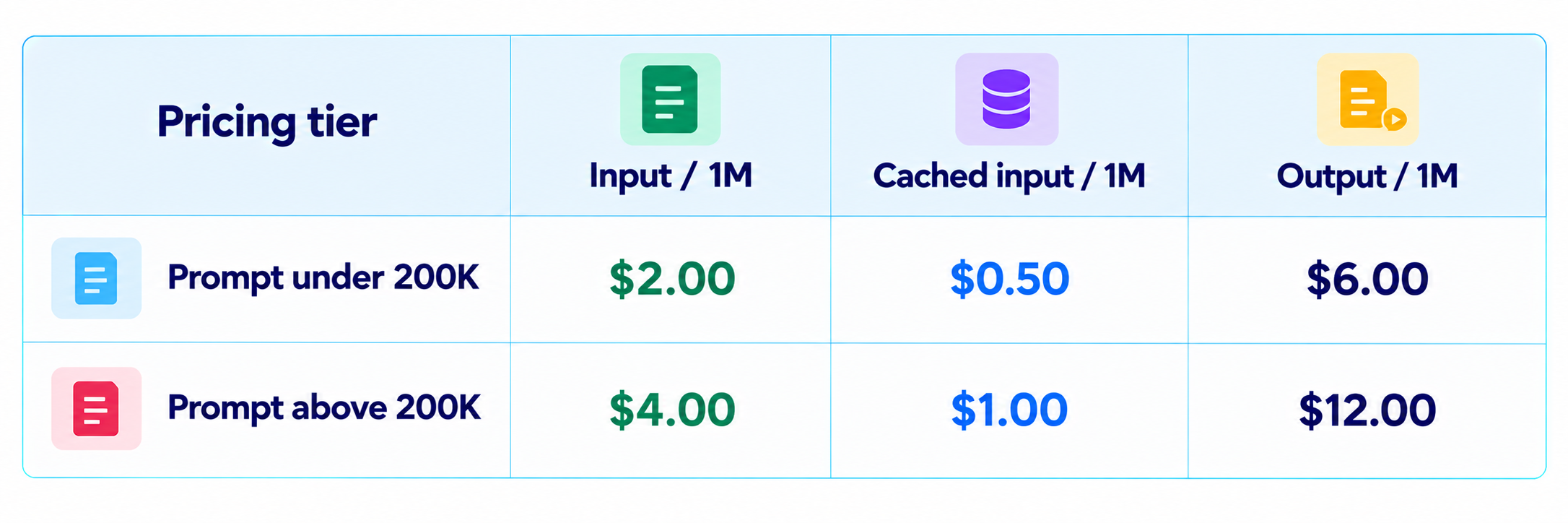
10. Grok 4.7 Context Window
Grok 4.7 has a 500,000-token context window, unchanged from Grok 4.6. That is large enough for substantial repository context, long documents and multi-step agent sessions while avoiding the higher cost of pushing every task into an enormous context by default.
The model also supports context compaction for long agent loops, according to xAI's developer documentation. xAI recommends using context compaction for tool-heavy workloads so the agent can preserve useful state without continually carrying every historical token.
This is an important practical detail. A large context window gives an agent room to work, but good context engineering determines whether the model actually uses that space effectively.
11. Grok 4.7 Reasoning Modes
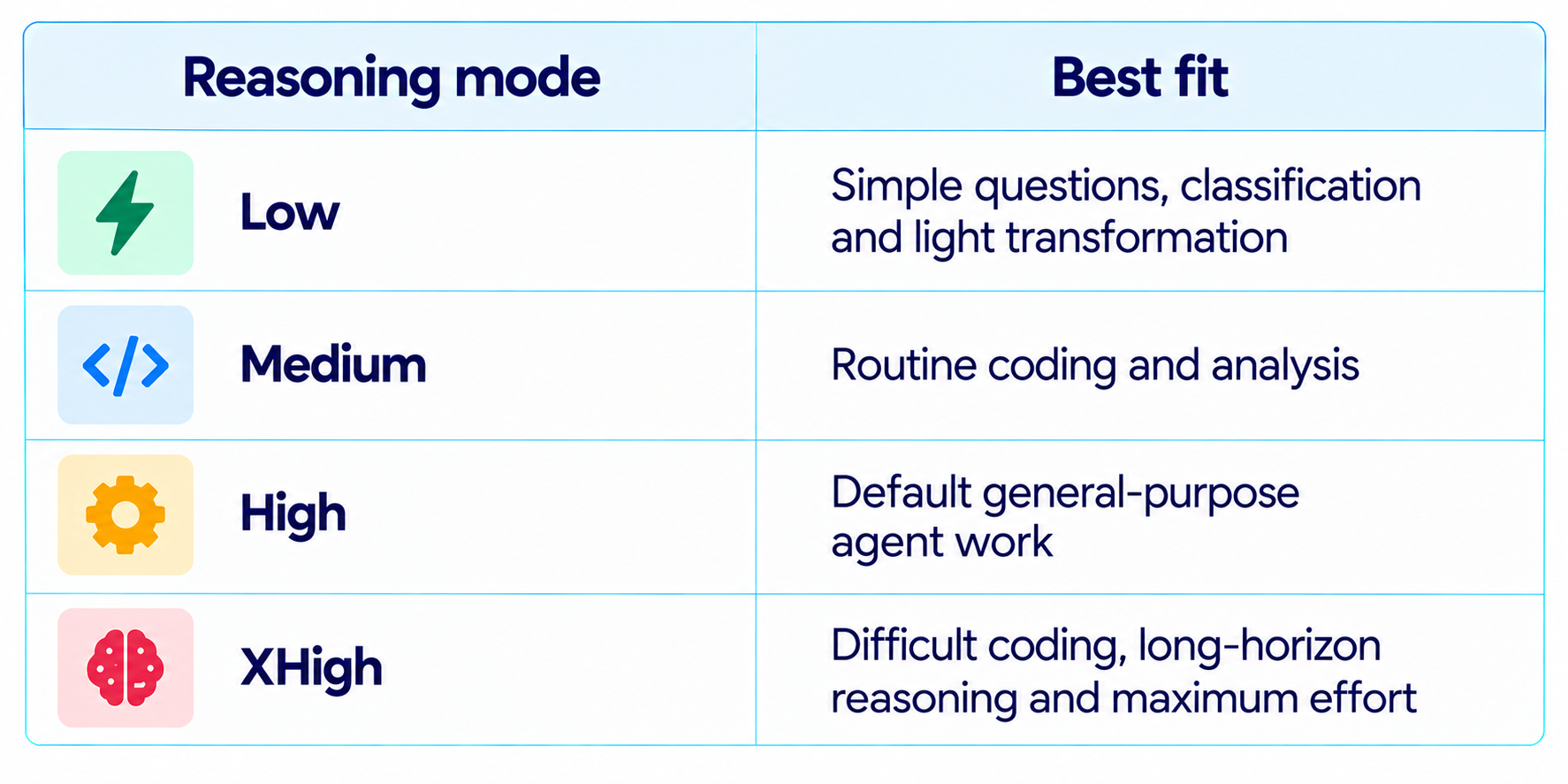
12. Grok 4.7 Fast
13. Grok 4.7 vs Grok 4.6
14. Grok 4.7 vs Claude Fable 5.1
15. Grok 4.7 vs GPT-5.6 Sol
16. Tool Use and Agent Workflows
Grok 4.7 supports function calling, structured outputs, web search, X search and code execution. xAI also recommends context compaction for long tool-heavy loops, and its Responses API preserves encrypted reasoning across multi-turn calls.
That makes Grok 4.7 a natural fit for agents that need to search, inspect data, execute code and maintain state over time. The model's benchmark gains reinforce that positioning because Terminal-Bench and AA Briefcase both improve substantially over Grok 4.6.
18. Limitations You Should Know
Grok 4.7 uses a large amount of output reasoning tokens at xhigh, which can increase cost and completion time.
Terminal-Bench 4.0 remains far below Claude Fable 5.1 in xAI's published comparison.
The model is proprietary and cannot be downloaded for local deployment.
The 500K context is smaller than some 1M-context frontier models, although it remains large.
Requests above 200K prompt tokens are billed at higher input and output rates.
Grok 4.7 Fast is not available on the public xAI API.
Benchmark comparisons use different harnesses, reasoning settings and providers, so individual scores should not be read as a universal overall ranking.
19. Best Use Cases
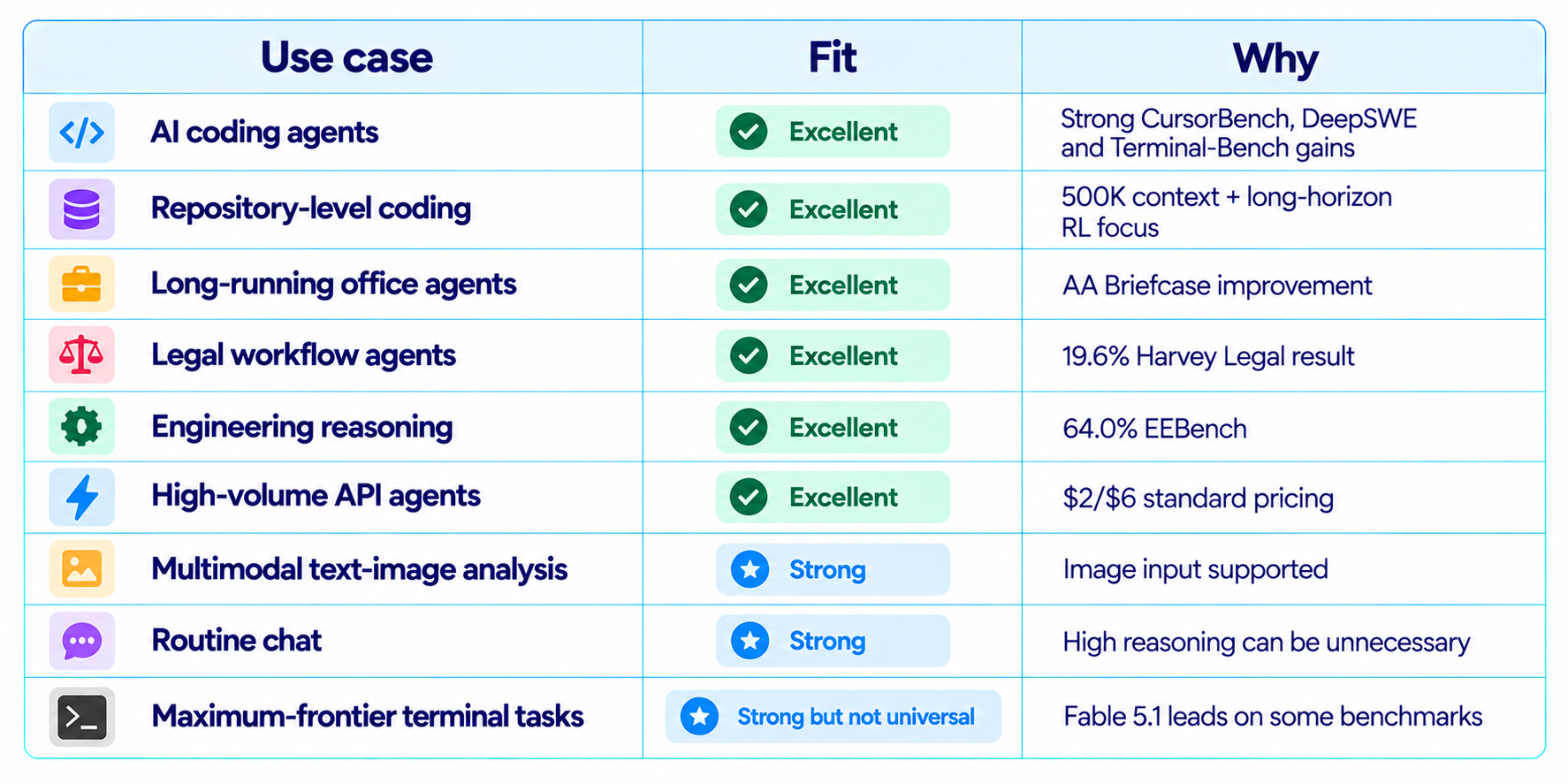
20. Recommended Production Workflow
Grok 4.7 is most useful when its reasoning and tool capabilities are matched to the task instead of leaving xhigh enabled for everything.
Use low reasoning for simple transformations and straightforward requests.
Use medium for routine coding and structured analysis.
Keep high as the default for normal agent workloads.
Use xhigh for difficult repository tasks, complex research and long-horizon engineering.
Enable caching and a stable prompt cache key for long conversations.
Use context compaction for long tool-heavy agent loops.
Escalate only the tasks where Grok 4.7 does not complete the job reliably.
21. How to Evaluate Grok 4.7 Yourself
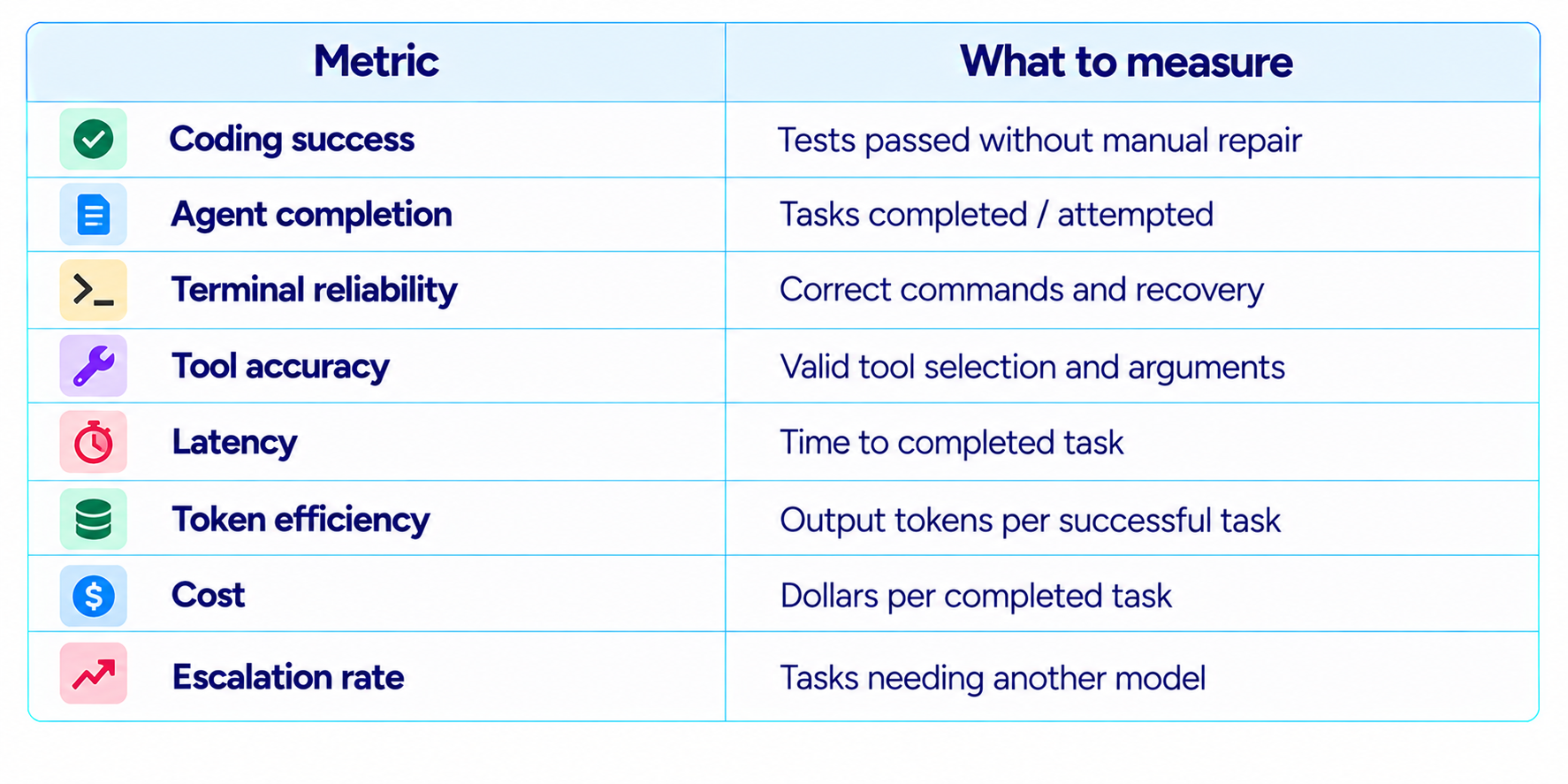
Public benchmarks tell you where the model has improved, but your own workload determines whether the price-performance case is real.
Run the same evaluation on Grok 4.6, Grok 4.7 high, Grok 4.7 xhigh and your current production model. This gives you a clean quality-versus-cost curve and shows whether xhigh is actually worth its extra token consumption.
22. Is Grok 4.7 Worth It?
Yes, especially for developers running coding agents and enterprise automation. Grok 4.7 combines a 46 Intelligence Index score with a strong coding-agent profile, a 500K context window and $2/$6 standard API pricing.
The most compelling improvement over Grok 4.6 is agent completion. Terminal-Bench nearly doubles in xAI's benchmark table, and AA Briefcase rises by 111 Elo. Those are exactly the kinds of improvements that can reduce human supervision in real agent workflows.
The main reason not to route every task to Grok 4.7 is token usage. xhigh consumed about 81,000 output tokens per Artificial Analysis Intelligence Index task, more than twice Grok 4.6 high.
That makes model routing useful. Use Grok 4.7 where long reasoning and agent completion matter, but avoid paying xhigh token costs for work that a smaller model can already complete.
23. Final Verdict
Grok 4.7 is one of xAI's most important releases because it improves the part of AI that developers increasingly care about: completing work rather than simply generating answers.
The benchmark evidence is strong. CursorBench rises to 46.3%, DeepSWE reaches 71.0% at high effort, Terminal-Bench reaches 38.0%, and AA Briefcase rises to 1,657 Elo. Artificial Analysis independently gives the model a 46 Intelligence Index and a 56 Coding Agent Index when Grok Build is used.
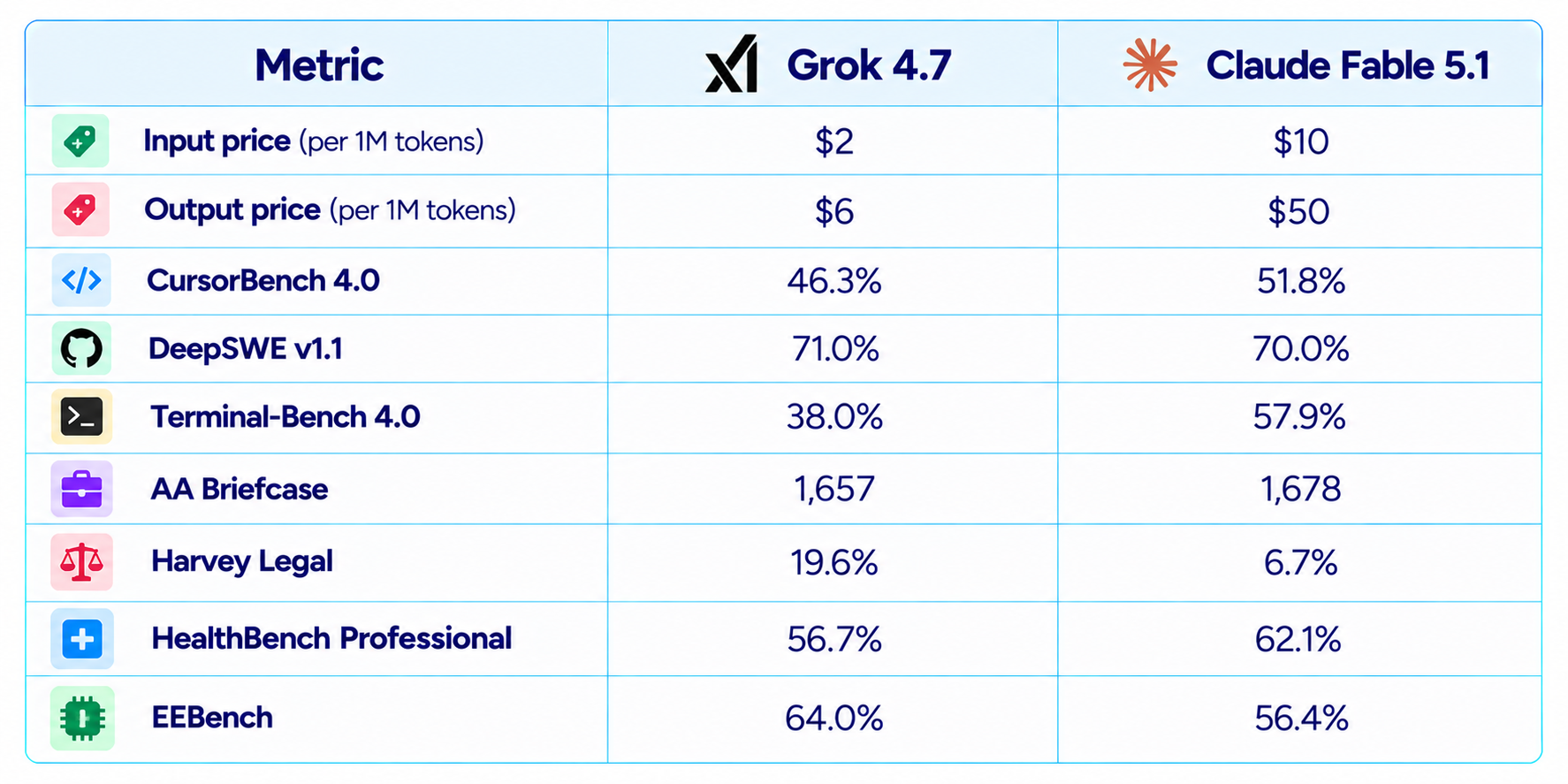
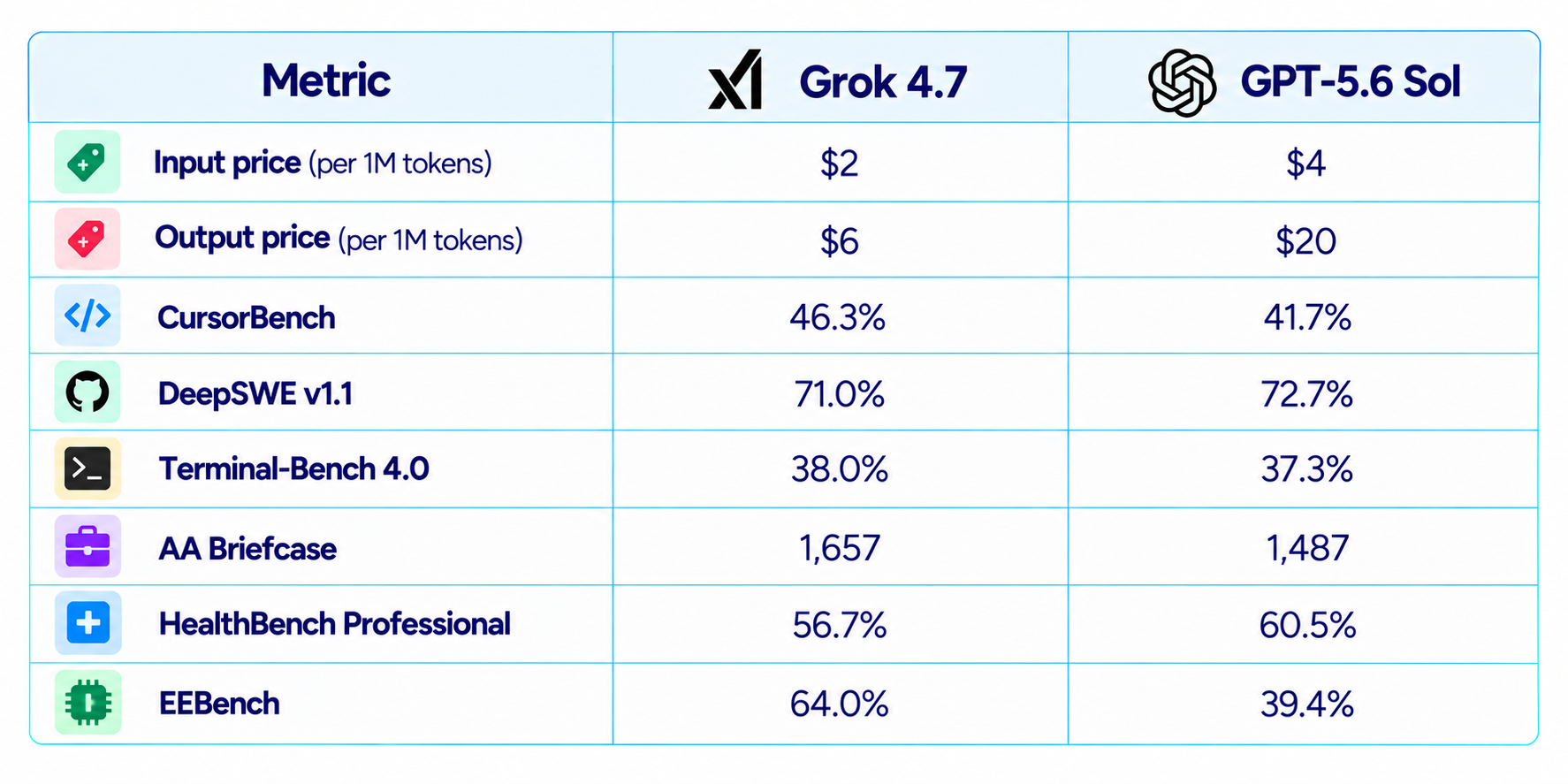
The economics are equally important. Standard API pricing is $2 per million input tokens and $6 per million output tokens below 200K prompt tokens, with cached input at $0.50. That is far below the $10/$50 pricing of Claude Fable 5.1 and below GPT-5.6 Sol's $4/$20 rates in xAI's comparison table.
The tradeoffs are clear. Grok 4.7 can consume a large number of output tokens at xhigh, its 500K context is smaller than some 1M-context competitors, and Fable 5.1 remains stronger on several hard terminal and coding benchmarks. But Grok 4.7 closes enough of that gap while costing much less that it becomes a compelling default for many agent workloads.
My rating: 9.5/10 for coding agents, 9.3/10 for price-to-performance, 9.1/10 for agentic knowledge work, 8.7/10 for reasoning efficiency and 9.2/10 overall.
Bottom line: Grok 4.7 is worth using when you want a serious coding and agent model without paying premium-frontier prices for every request. Start with high reasoning, reserve xhigh for difficult tasks, use caching and context compaction, and measure cost per completed task rather than token price alone.
Grok 4.7 improves over Grok 4.6 across every benchmark in xAI's comparison. Its largest move is on Terminal-Bench, while Fable 5.1 remains ahead on CursorBench, Briefcase, Terminal-Bench and HealthBench.
Artificial Analysis separates the standardized Intelligence Index from the native-harness coding evaluation. That distinction matters. The 56 Coding Agent Index score includes Grok Build, while the 46 Intelligence Index score uses the standardized evaluation harness.
This pricing is one of the biggest reasons to consider Grok 4.7. xAI's launch comparison places it at half the input price and roughly one-fifth the output price of Claude Fable 5.1. GPT-5.6 Sol is listed at $4/$20 in the same vendor table. For agent workloads, cached input is especially useful because the same system instructions, tools, repository information and conversation state can appear repeatedly.
This makes Grok 4.7 Fast more of a product-level latency option than a separate model. Developers building directly on the API should treat standard Grok 4.7 as the public baseline.
Terminal-Bench is the biggest improvement and the clearest evidence that Grok 4.7 is designed for longer-running tool use. The Intelligence Index moves only two points, so the release is better understood as a targeted agent upgrade than a universal intelligence jump.
Fable 5.1 therefore remains the stronger option on several hard frontier-agent workloads, but Grok 4.7 is dramatically cheaper. The practical choice depends on whether the extra capability changes the task-completion rate enough to justify the higher token cost.
This is one of Grok 4.7's strongest comparisons. Sol has a small edge on DeepSWE and clinical reasoning, but Grok 4.7 is materially cheaper and stronger on several agentic knowledge-work measures in xAI's published table.
Run the same evaluation on Grok 4.6, Grok 4.7 high, Grok 4.7 xhigh and your current production model. This gives you a clean quality-versus-cost curve and shows whether xhigh is actually worth its extra token consumption.
Frequently Asked Questions
What is Grok 4.7?
Grok 4.7 is xAI's September 2026 frontier model for coding, agentic tasks and knowledge work, with text and image input, text output and a 500K context window.
When was Grok 4.7 released?
xAI released Grok 4.7 on September 21, 2026.
What are the Grok 4.7 benchmark scores?
xAI reports 46.3% CursorBench 4.0, 71.0% DeepSWE v1.1 at high effort, 38.0% Terminal-Bench 4.0 and 1,657 Elo on AA Briefcase. Artificial Analysis scores it 46 on the Intelligence Index.
How much does Grok 4.7 cost?
The standard xAI API price below 200K prompt tokens is $2 per million input, $0.50 per million cached input and $6 per million output. Above 200K prompt tokens, the rates are $4/$1/$12.
What is the Grok 4.7 context window?
The official xAI documentation lists a 500,000-token context window.
What reasoning modes does Grok 4.7 support?
Low, medium, high and xhigh, with high as the default.
Is Grok 4.7 good for coding?
Yes. Coding is one of its strongest use cases, with large gains on CursorBench, DeepSWE and Terminal-Bench compared with Grok 4.6.
Is Grok 4.7 available in Cursor?
Yes. Cursor announced Grok 4.7 availability at launch.
What is Grok 4.7 Fast?
It is the same model served on faster infrastructure at twice the standard token rates, currently available in Cursor and Grok Build rather than the public xAI API.
Is Grok 4.7 better than Claude Fable 5.1?
Not universally. Fable 5.1 leads on several coding and agent benchmarks, while Grok 4.7 is much cheaper and wins some legal and engineering evaluations in xAI's comparison.
Is Grok 4.7 better than GPT-5.6 Sol?
The results are mixed. Grok 4.7 is cheaper and performs strongly on CursorBench, Terminal-Bench, AA Briefcase and EEBench, while GPT-5.6 Sol leads on DeepSWE and HealthBench in xAI's published comparison.
Is Grok 4.7 worth it?
Yes, especially for high-volume coding agents, long-running knowledge work and enterprise automation where price-performance matters.
Recommended Blogs
GPT-6 Astra Review: Benchmarks, Price & Is It Worth It? (2026)
Claude Fable 5.1 Review: Benchmarks, Pricing & Is It Worth It? (2026)
Meta Muse Spark 1.3 Review: Coding, Price & Is It Worth It? (2026)
Gemini 3.8 Flash Review: Accuracy, Price & Is It Worth It? (2026)
Qwen 3.8 Max 0902 Review: Benchmarks, Price & Is It Worth It? (2026)
AI Model Routing in 2026: When to Use Fable, Astra, Gemini or Muse
Model Routing for AI Coding Agents: How to Cut Costs Without Losing Quality
Replit's AI Model Routing Is Here: How Intelligent Routing Cuts Costs (2026)
24GB VRAM AI Models: What Can You Actually Run Locally in 2026?
Resources & Community
Join our community of 70,000+ AI enthusiasts and learn to build powerful AI applications. Whether you're a beginner or an experienced developer, Build Fast with AI helps you understand and implement AI in your projects.
Agentic AI Launchpad 2026
A structured 6-week cohort program that takes you from AI basics to building and deploying real-world agentic AI systems. Includes live sessions, expert mentorship, project reviews and a builder community network.
Ready to go from learning to building? Join the next cohort: Agentic AI Launchpad 2026
Free AI Resources
Access free tools, workshops and micro-learning to keep building.

