



GLM 5.3 FlashX Review: Is Z.AI's New 200 Tokens/s Model Worth the Premium?
GLM 5.3 FlashX is the new high-speed serving tier for Z.AI's GLM-5.3-Flash family, and its purpose is unusually clear. Z.AI is not introducing another model with a different intelligence target. It is taking the existing GLM-5.3 Flash capability and putting more infrastructure and inference optimization behind it so developers can get answers much faster.
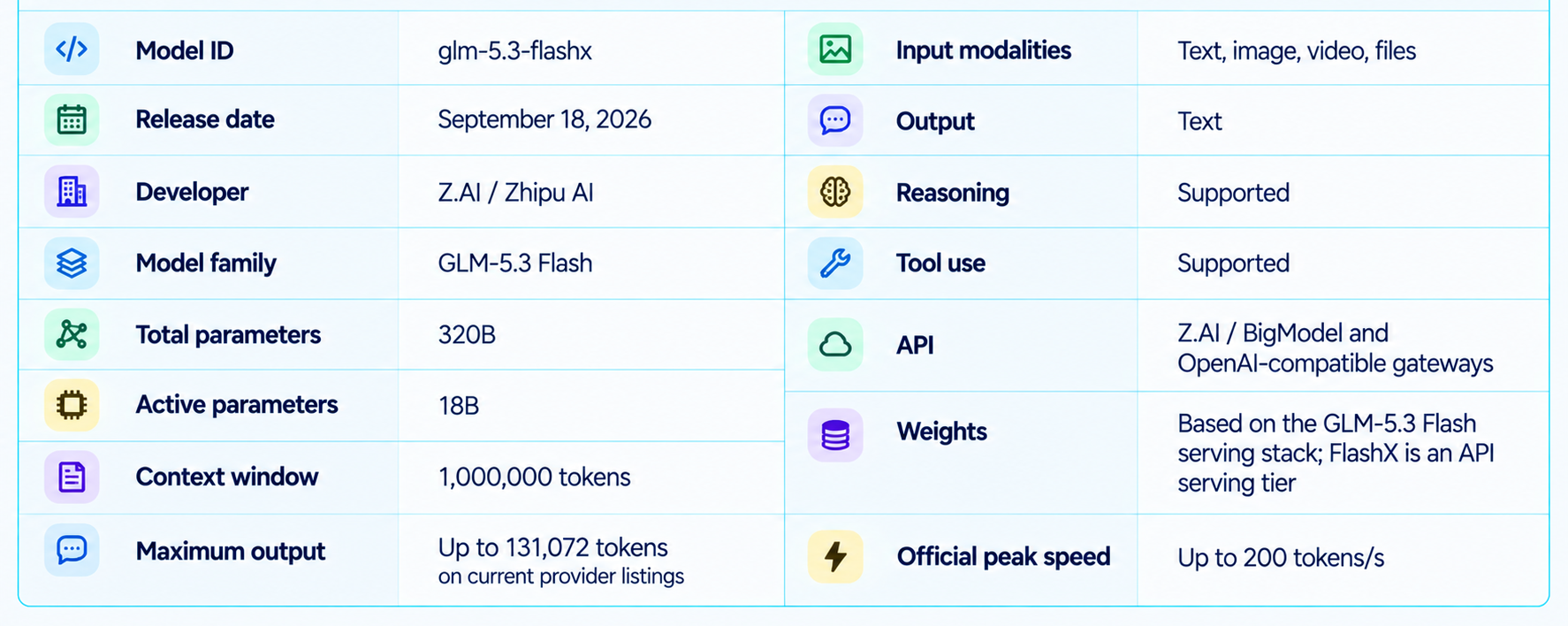
Z.AI released GLM-5.3-FlashX on September 18, 2026 with a new API model key, glm-5.3-flashx. The company says the model can reach up to 200 tokens per second, while current Z.AI listings and provider telemetry place the serving tier around the same range. The model keeps the Flash family's 1M-token context and multimodal input across text, images, video and files.
The important question is not whether FlashX is faster. It is. The question is whether the extra price buys enough latency reduction to change the economics of your application. Current global gateway pricing is about $0.37 per million input tokens and $1.25 per million output tokens, compared with $0.15 and $0.50 for standard GLM-5.3 Flash. In China's BigModel rate card, the same relationship is 2 yuan input and 7 yuan output for FlashX versus 0.8 yuan and 2.8 yuan for Flash.

QUICK ANSWER
GLM 5.3 FlashX is Z.AI's speed-optimized serving variant of GLM-5.3 Flash. The underlying capability stack stays in the same family, including 320B total parameters, 18B active parameters, native multimodal input and a 1M-token context. The change is primarily inference infrastructure and serving speed, not a new model checkpoint.
The headline figure is 200 tokens per second. Vercel AI Gateway currently reports roughly 198-208 tokens per second depending on its current provider telemetry, while a direct third-party API test published on September 18 measured a 283.8 token-per-second median for FlashX versus 94.8 for standard Flash under that specific six-run test. The same test found time to first token falling from 2.35 seconds to 1.52 seconds and total completion time from 24.92 seconds to 8.96 seconds.
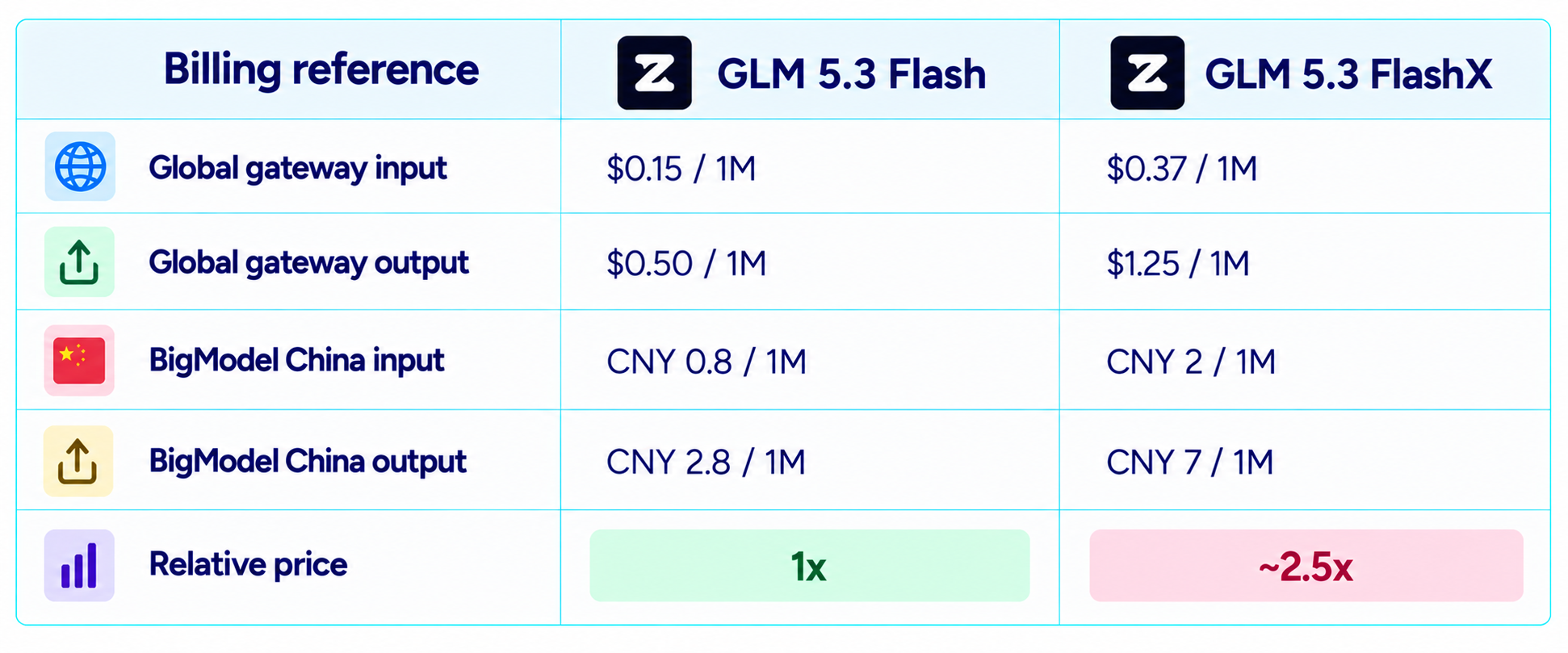
The price premium is substantial but not extreme. Global gateway pricing is currently $0.37 per million input tokens and $1.25 per million output tokens, versus $0.15 and $0.50 for standard Flash. The Chinese BigModel list is 2 yuan and 7 yuan versus 0.8 yuan and 2.8 yuan. In both billing systems, FlashX is about 2.5 times the standard Flash price.
My verdict: 9.3/10 for speed, 9.0/10 for real-time agent workflows, 8.6/10 for price-to-performance and 9.1/10 overall. FlashX is worth the premium when latency directly affects user experience or the number of agent turns you can complete per minute. For offline batch work, standard Flash is usually the more economical choice.
1. What Is GLM 5.3 FlashX?
GLM 5.3 FlashX is not a new flagship model sitting above GLM-5.3. It is a high-speed serving option built from the GLM-5.3 Flash stack. Z.AI's September 18 announcement describes it as an inference-optimized version for enterprise and developer workloads that need faster response and smoother interaction.
That makes the product strategy easy to understand. Standard GLM-5.3 Flash is the value tier. FlashX is the latency tier. The underlying model family remains focused on coding, agents, visual programming, document work and multimodal reasoning.
The distinction is important for buyers because a serving SKU can improve throughput without changing the model's benchmark intelligence. FlashX should therefore be evaluated mainly on latency, throughput, concurrency, cost per completed task and operational behavior rather than expecting a fresh benchmark leap.
2. GLM 5.3 FlashX Specifications
3. Why Z.AI Released FlashX
The problem FlashX solves is not model intelligence. It is waiting time. GLM-5.3 Flash already had a strong capability profile and low pricing, but standard serving throughput could become a bottleneck in interactive applications. When an agent has to make several calls in one task, every extra second compounds.
Z.AI says the FlashX rollout follows increased demand for GLM-5.3 Flash and further inference optimization on an infrastructure base of more than 100,000 domestic AI chips. The company describes the result as a balance of intelligence, price and speed rather than a new foundation-model release.
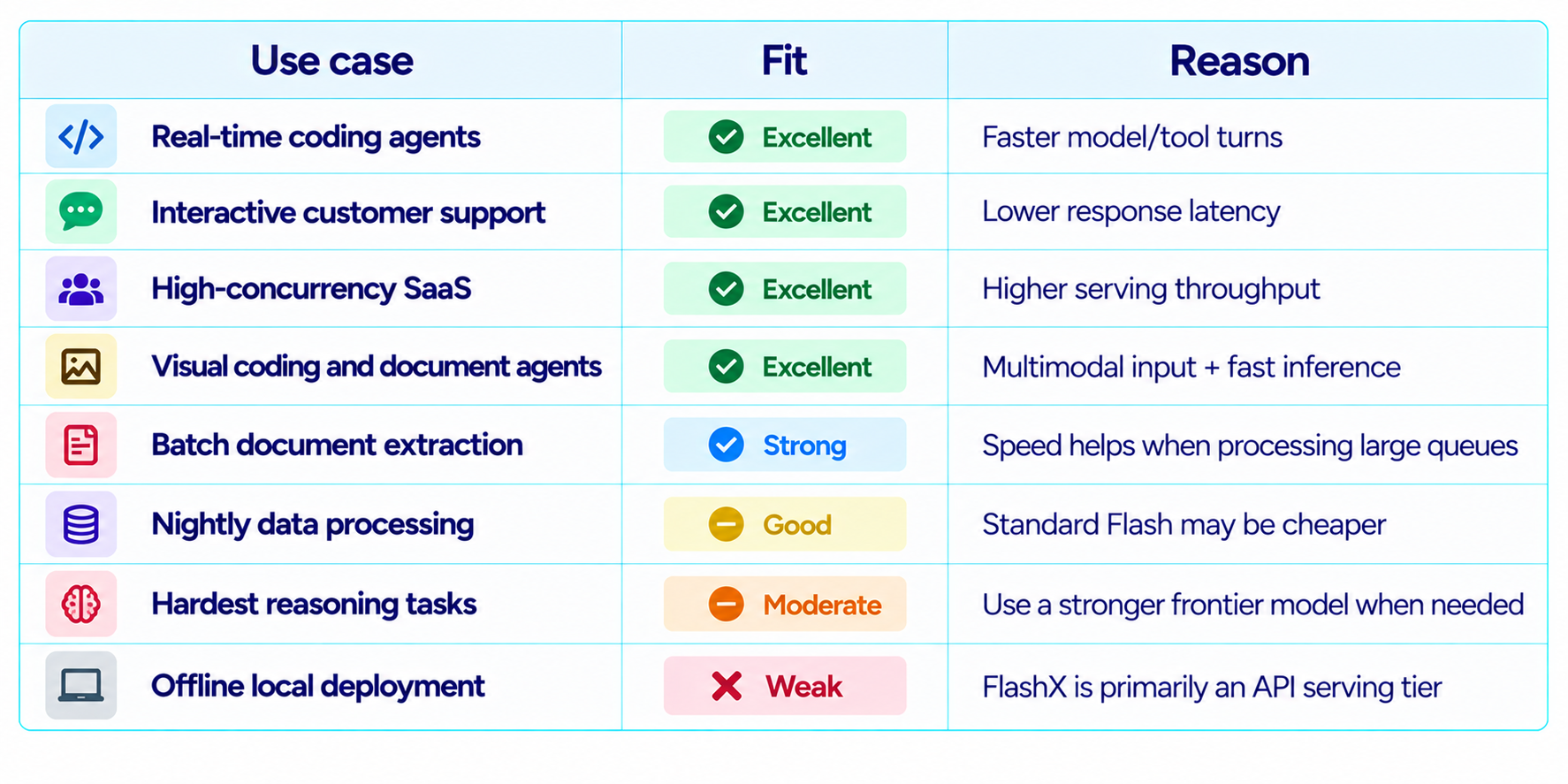
This is also why FlashX makes more sense for interactive applications than for simple batch jobs. If a user is waiting for an answer, lower latency has a direct product value. If a background process is already running without a human waiting, the price premium is harder to justify.
4. GLM 5.3 FlashX Speed
The official headline is up to 200 tokens per second, which is roughly five times the throughput Z.AI cites for standard GLM-5.3 Flash. Current Vercel provider telemetry sits around 198 to 208 tokens per second depending on the snapshot, making the official peak plausible as a serving target.
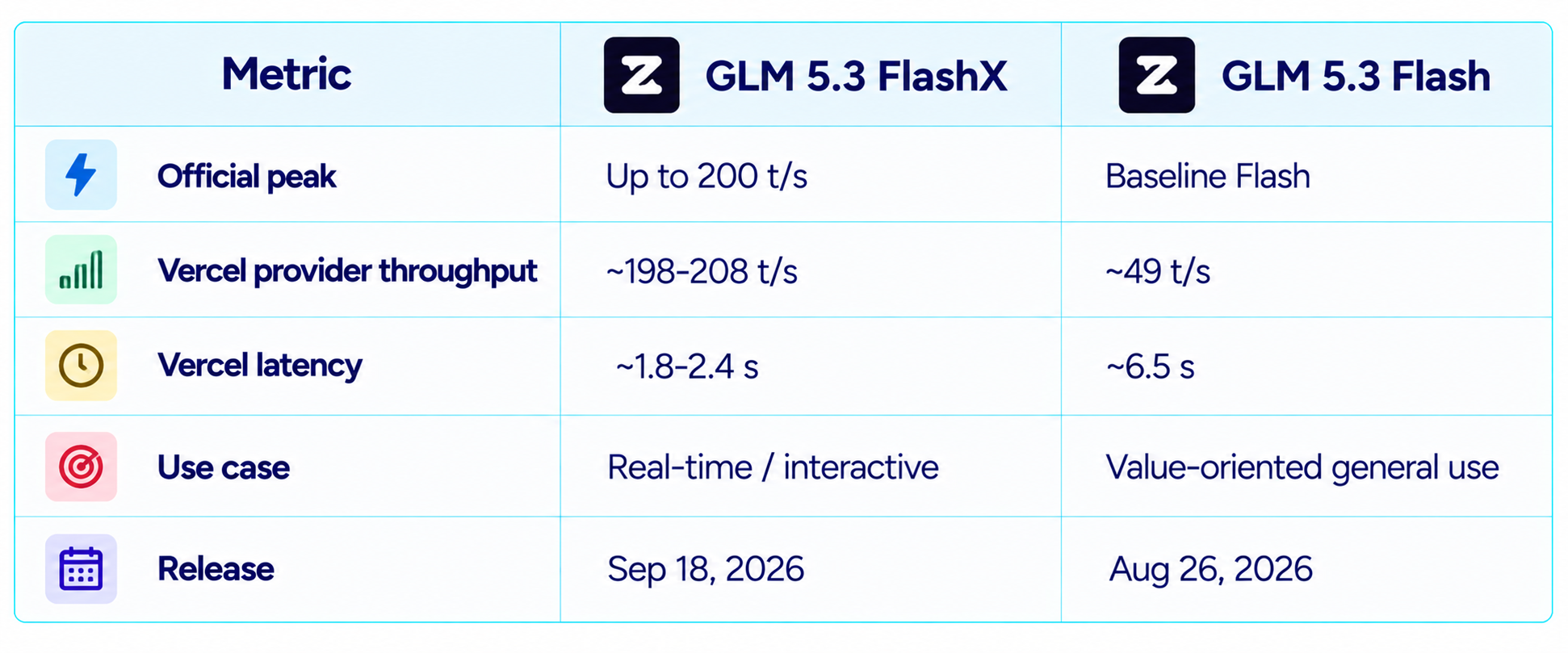
The most useful independent check comes from Labmemo's same-prompt API test. Over six runs per model, it recorded a median 283.8 tokens per second for FlashX and 94.8 for standard Flash, a 2.99x generation-speed difference. It also recorded 1.52 seconds versus 2.35 seconds to first token and 8.96 seconds versus 24.92 seconds to full completion. These numbers are specific to that API test and should not be treated as universal hardware-independent rates.
5. GLM 5.3 FlashX Pricing
FlashX is more expensive than the standard Flash tier because Z.AI is selling speed as a separate service level. Current global Vercel AI Gateway pricing lists $0.37 per million input tokens and $1.25 per million output tokens for GLM 5.3 FlashX. Standard GLM-5.3 Flash is currently listed at $0.15 and $0.50.
On the Chinese BigModel price sheet reported with the launch, FlashX is 2 yuan per million input tokens and 7 yuan per million output tokens, compared with 0.8 yuan and 2.8 yuan for standard Flash. Both pricing systems therefore preserve roughly the same 2.5x relationship, even though currency and provider billing differ.
For high-value interactive tasks, that premium can be reasonable. For asynchronous document indexing, nightly batch jobs or background classification, standard Flash is the more obvious default.
6. GLM 5.3 FlashX Multimodal Capabilities
FlashX retains the multimodal input capabilities of GLM-5.3 Flash. Current provider listings show text and image input, while Z.AI's launch materials list text, images, video and files for the Flash and FlashX family. The model's output remains text.
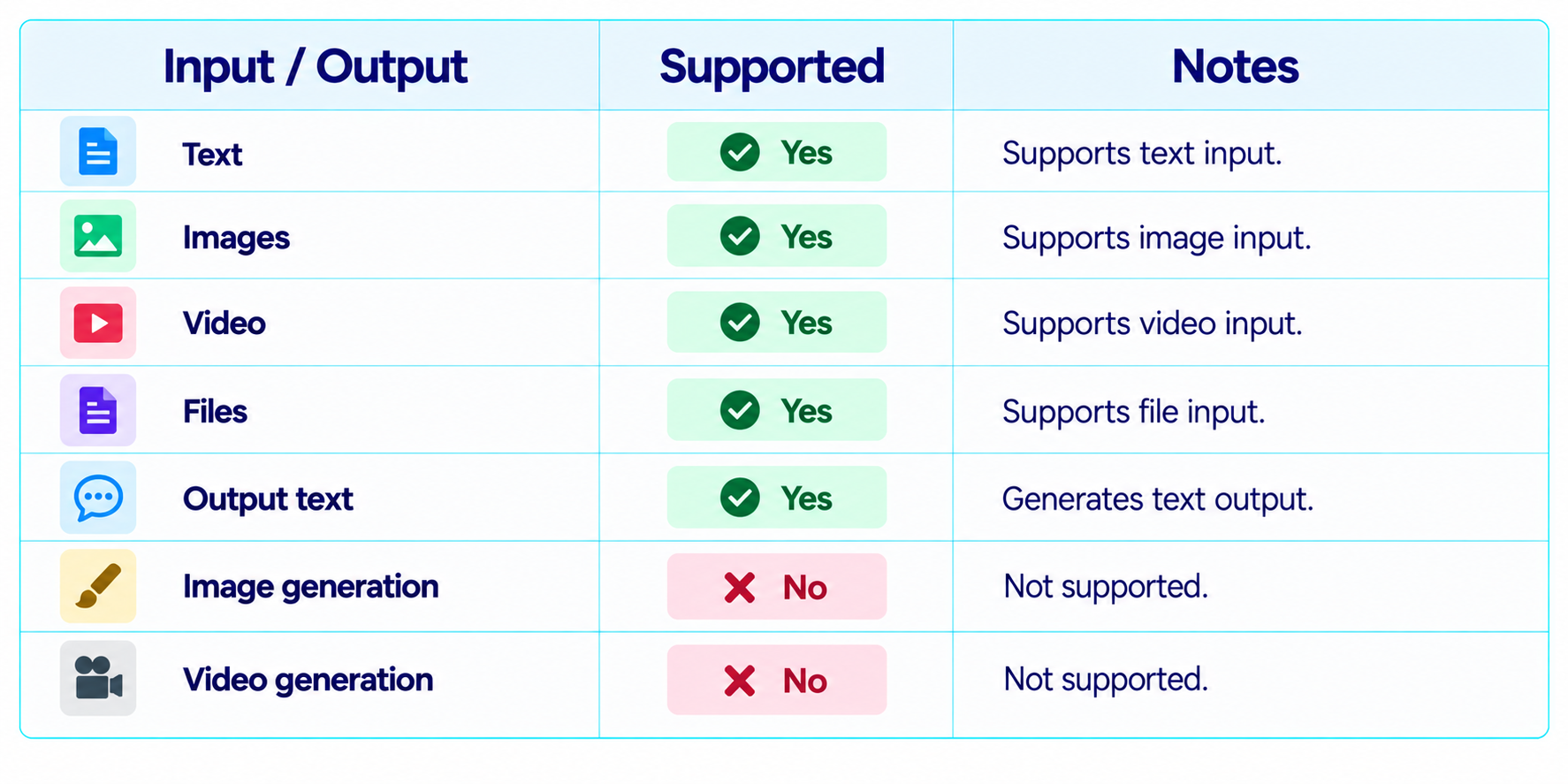
This makes FlashX useful for visual coding, screenshot analysis, document processing and multimodal agent workflows. The important distinction is that FlashX is still a reasoning and orchestration model. It interprets media rather than generating new images or video.
7. GLM 5.3 FlashX for Coding
Coding is one of the strongest reasons to buy the speed tier. The underlying GLM-5.3 Flash model was already positioned around coding, agents and visual programming. FlashX gives the same family a faster serving profile, which matters when a coding agent needs repeated model calls.
A typical coding-agent loop can contain repository inspection, planning, code generation, test execution, error analysis and another patch. Faster streaming shortens every model-generated step in that sequence.
FlashX should not be described as a separate coding benchmark winner. Its advantage is execution speed. The most defensible comparison is therefore standard Flash versus FlashX on task completion, latency and cost.
8. GLM 5.3 FlashX for AI Agents
Agent systems are where FlashX's economics become most interesting. The model supports tool use and structured outputs, and current provider documentation supports reasoning alongside function-call workflows.
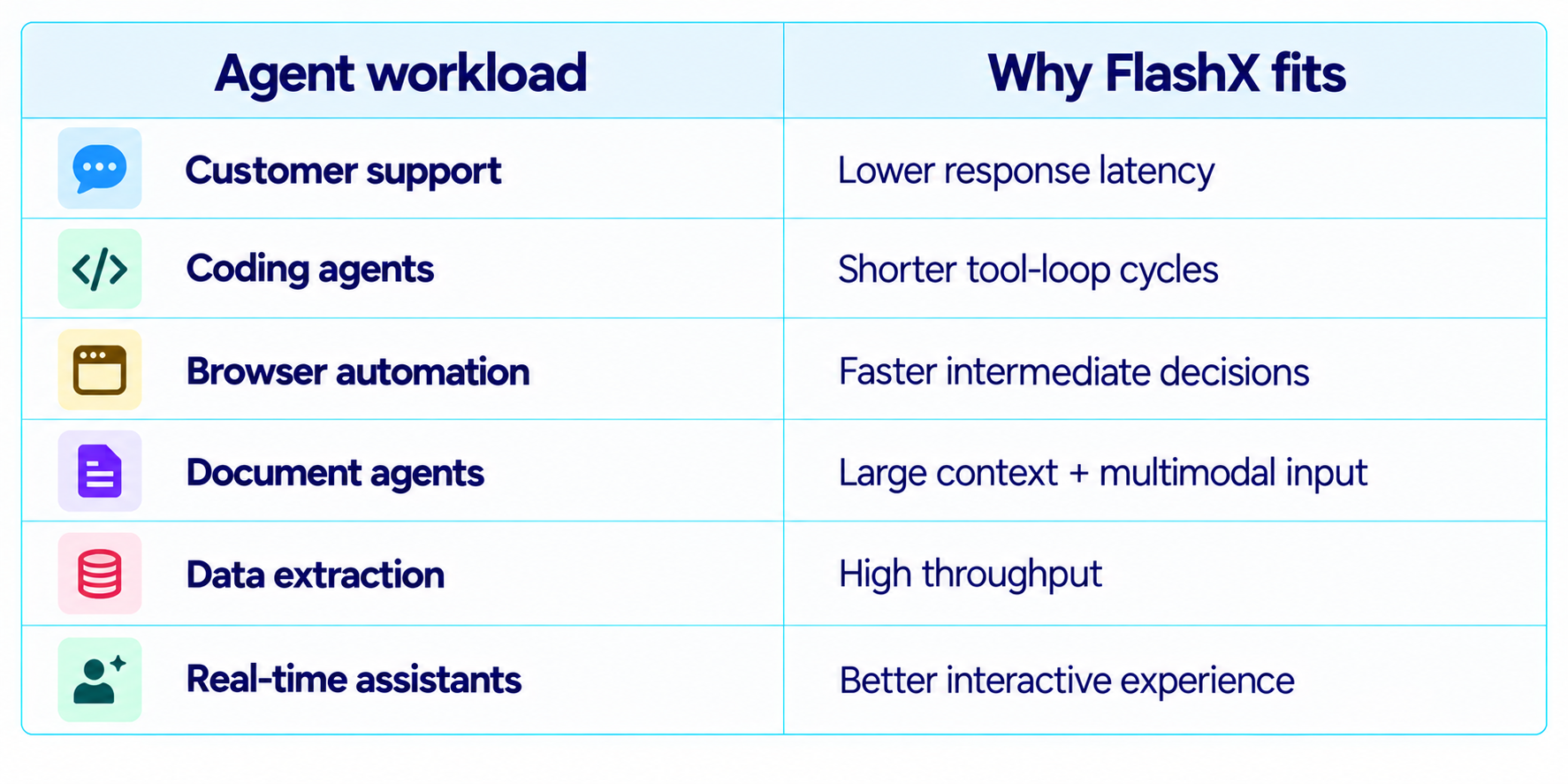
The most important production measurement is time-to-task-completion. A model that streams twice as fast but spends more time reasoning may not halve end-to-end latency. Run your own agent traces before moving all traffic to the higher-priced tier.
9. GLM 5.3 FlashX Context Window
FlashX keeps the GLM-5.3 Flash family's 1 million-token context window. Current provider listings also show a maximum output of about 131K tokens.
A 1M-token window is useful for repositories, long documents, video transcripts, specifications and multi-step agent state. It means FlashX can remain relevant even when the user needs to pass a very large amount of supporting information.
Context size should still be treated as capacity rather than guaranteed retrieval quality. The model needs relevant material, good context organization and clear output constraints to make the large window useful.
10. GLM 5.3 FlashX vs GLM 5.3 Flash
This is the comparison that matters most. FlashX does not replace Flash. It creates a second serving tier for teams that value latency more than minimum token cost.
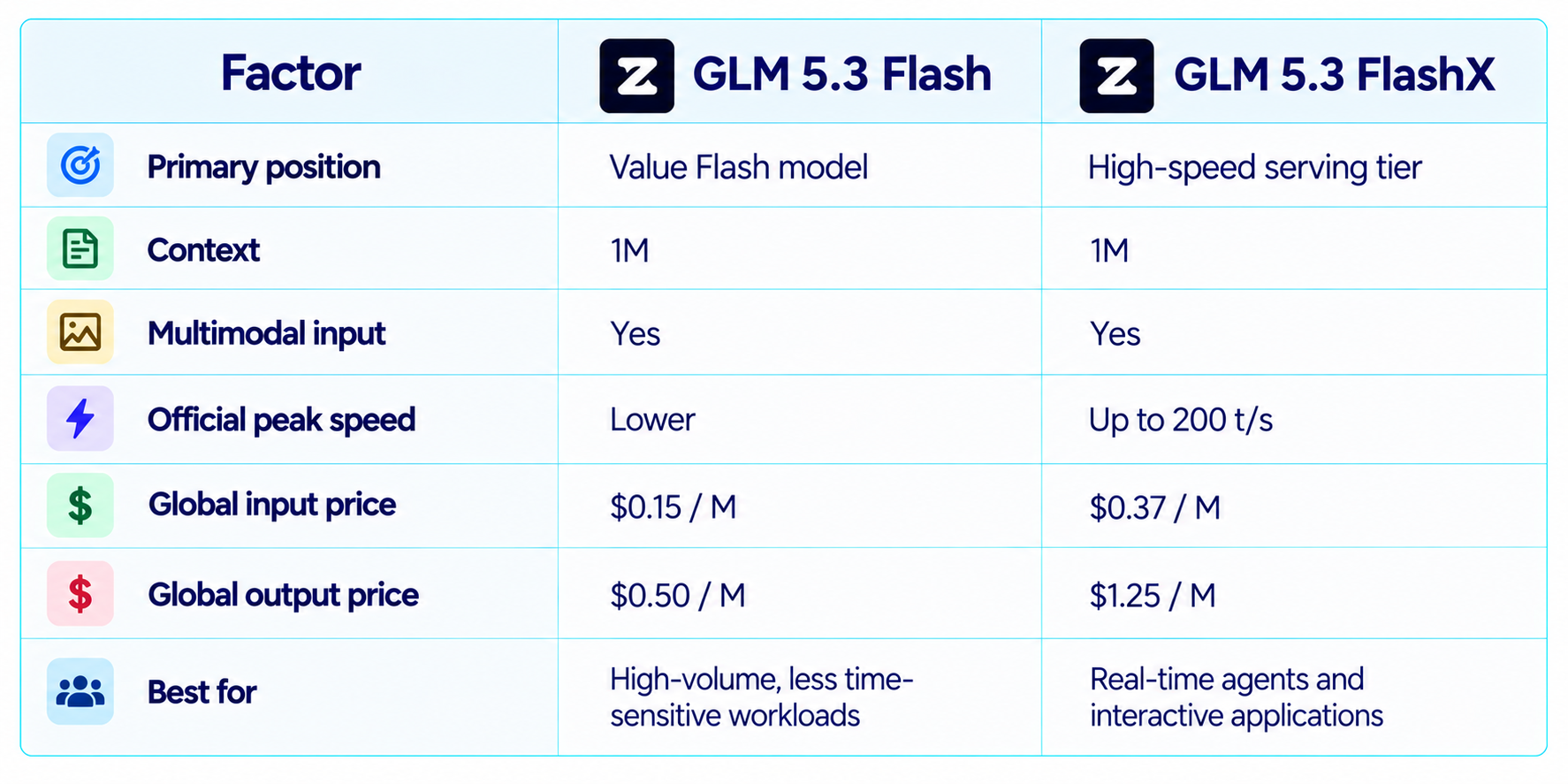
Choose Flash when the model call can run in the background. Choose FlashX when a person is waiting, an agent is blocked on the next step, or throughput is limiting how many requests your system can handle.
11. GLM 5.3 FlashX vs Claude Opus 4.8
The comparison should focus on economics and latency rather than treating FlashX as a new benchmark competitor. The standard GLM-5.3 Flash model launched with a vendor-reported Artificial Analysis Intelligence Index of 57, matching Claude Opus 4.8 in that launch comparison, but later Artificial Analysis revisions show different scores under updated evaluation versions. FlashX is the serving-speed variant of that same Flash family, so its central value proposition is not a new intelligence score.
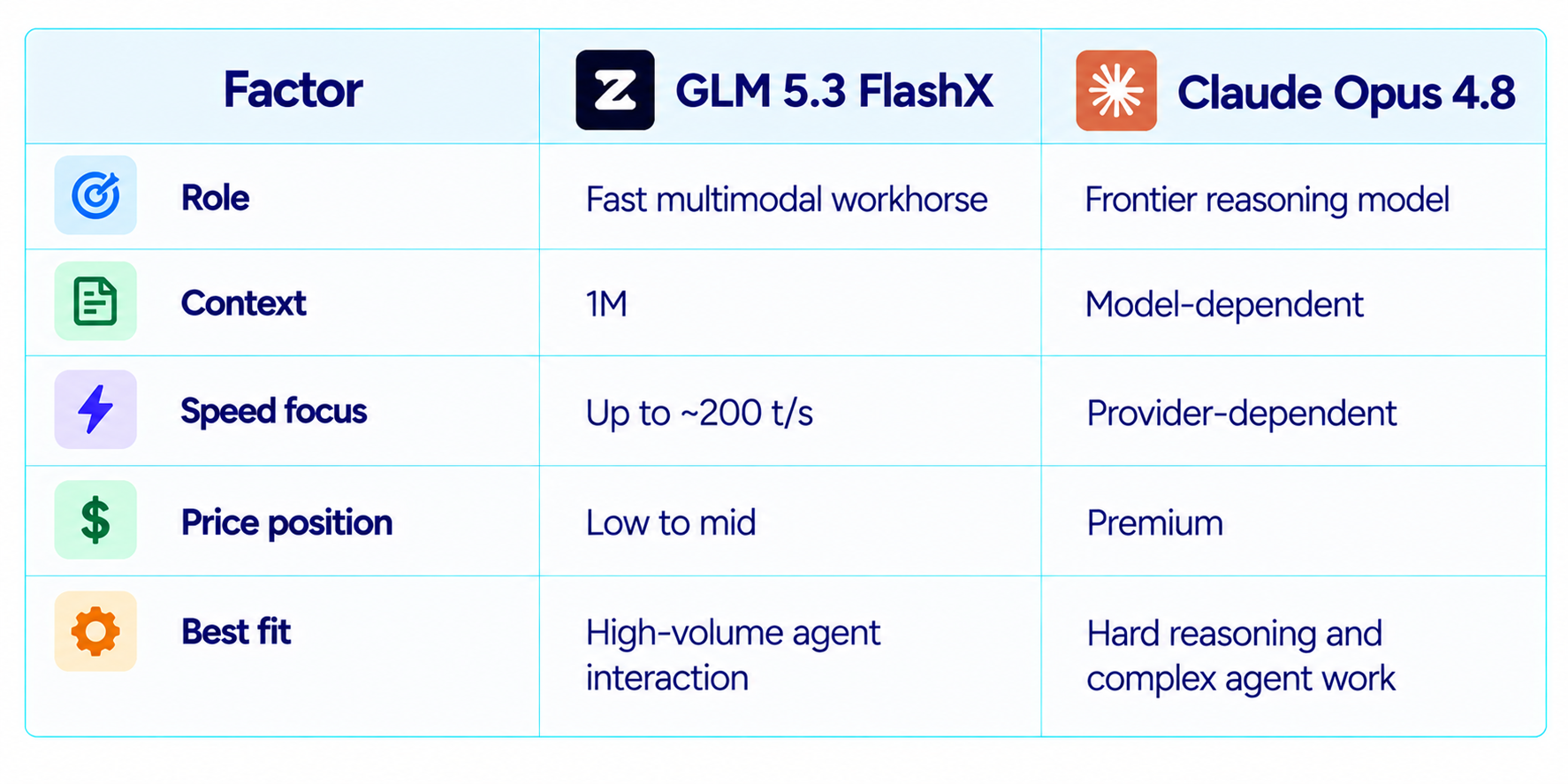
For a cost-sensitive agent, FlashX can be attractive because the extra speed is priced much lower than premium frontier models. For the hardest reasoning tasks, a more capable flagship model still makes sense.
12. GLM 5.3 FlashX vs Gemini 3.8 Flash
Both models target fast, high-volume agentic workloads, but they come from different serving strategies. Gemini 3.8 Flash emphasizes reasoning, coding and Google's broader tool ecosystem, while GLM 5.3 FlashX differentiates itself around serving speed within the GLM-5.3 Flash multimodal stack.
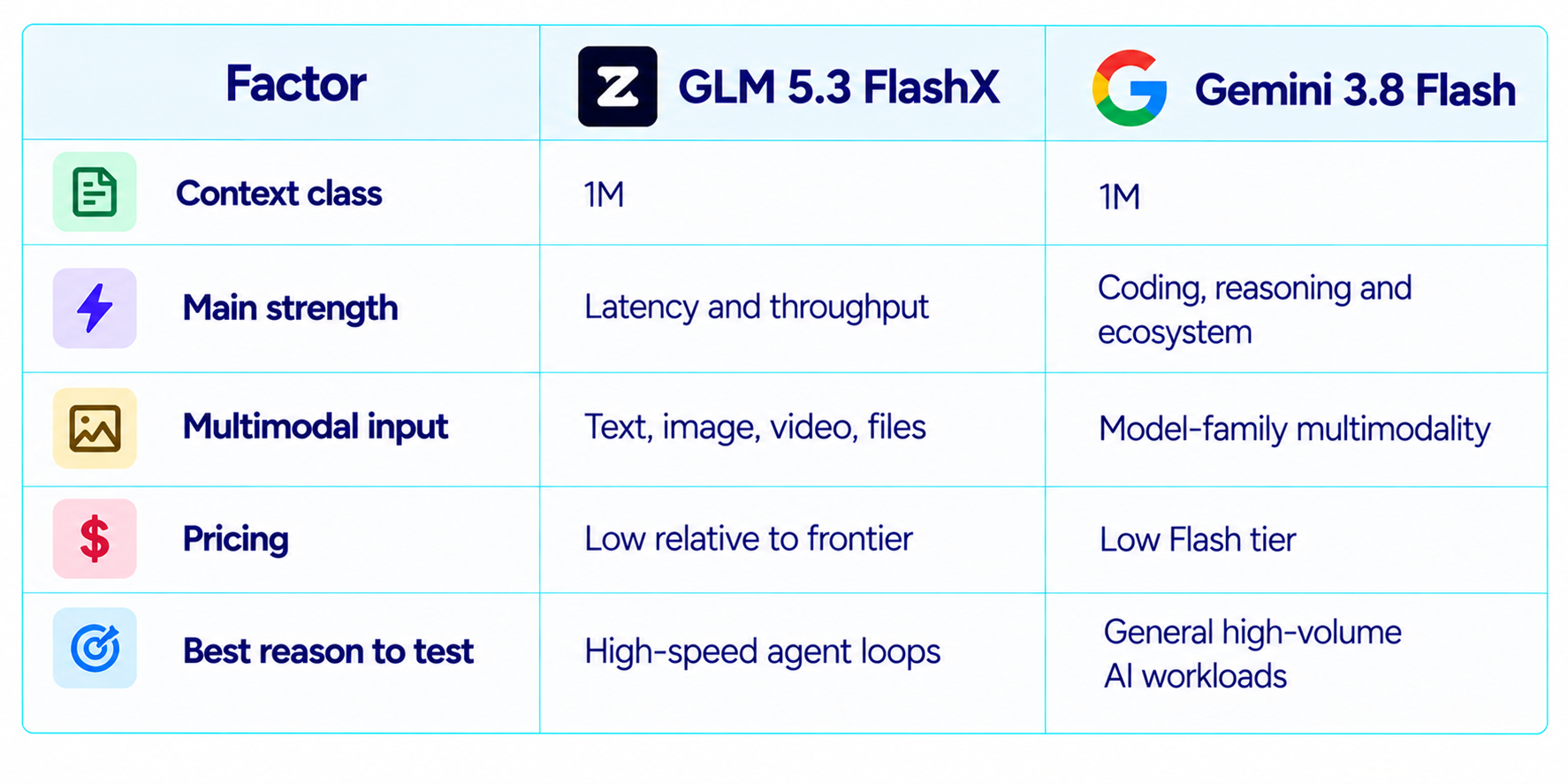
The practical winner depends on your trace data. Compare successful task completion, first-token latency, total latency, output rate, tool-call errors and cost per completed task rather than choosing from the model names alone.
13. GLM 5.3 FlashX API and Availability
The GLM-5.3-FlashX API is live with model key glm-5.3-flashx. BigModel's chat-completions endpoint supports streaming and tool calls, and the current documentation exposes reasoning content and structured message fields.
Third-party gateways such as Vercel AI Gateway also list the model and provide OpenAI-compatible access. That makes FlashX relatively easy to add to an existing model router without rebuilding the application layer.
14. Coding Plan Availability
There is an important current access distinction. A September 18 direct API test found that GLM-5.3 FlashX worked through the normal API but returned HTTP 429 with error code 1311 through the GLM Coding Plan endpoint, meaning the tested plan did not yet include FlashX access.
That is an operational limitation, not a statement that FlashX can never be added to the Coding Plan. It means developers should verify their contract, endpoint and entitlement instead of assuming that changing the model name in an existing Coding Plan integration is enough.
15. Limitations You Should Know
- FlashX is primarily a serving-speed variant, so it does not bring a new benchmark intelligence profile of its own.
- The official 200 tokens/s number is a peak or target figure, not a universal response speed.
- Provider throughput varies by route, load, request size and concurrency.
- FlashX costs about 2.5x the standard GLM-5.3 Flash price.
- The current Coding Plan may not include FlashX access, based on a September 18 direct test.
- The model remains an API serving tier, not a new open-weight checkpoint.
- Multimodal support is input-focused. FlashX is not an image or video generation model.
16. Best Use Cases
17. Recommended Production Workflow
The strongest architecture is to route traffic between GLM-5.3 Flash and FlashX instead of forcing the premium speed tier onto every request.
- Use standard GLM-5.3 Flash for asynchronous and cost-sensitive workloads.
- Use FlashX for interactive requests where latency directly affects user experience.
- Use FlashX inside coding agents when multiple model calls create visible wait time.
- Track P50 and P95 time to first token and time to completed task.
- Measure cost per successful task, not only per token.
- Keep a premium reasoning model available for the hardest edge cases.
This is exactly where Model Routing for AI Coding Agents becomes useful.
18. How to Evaluate GLM 5.3 FlashX Yourself
A useful FlashX evaluation should compare it with standard GLM-5.3 Flash under the same provider, prompts and workloads.
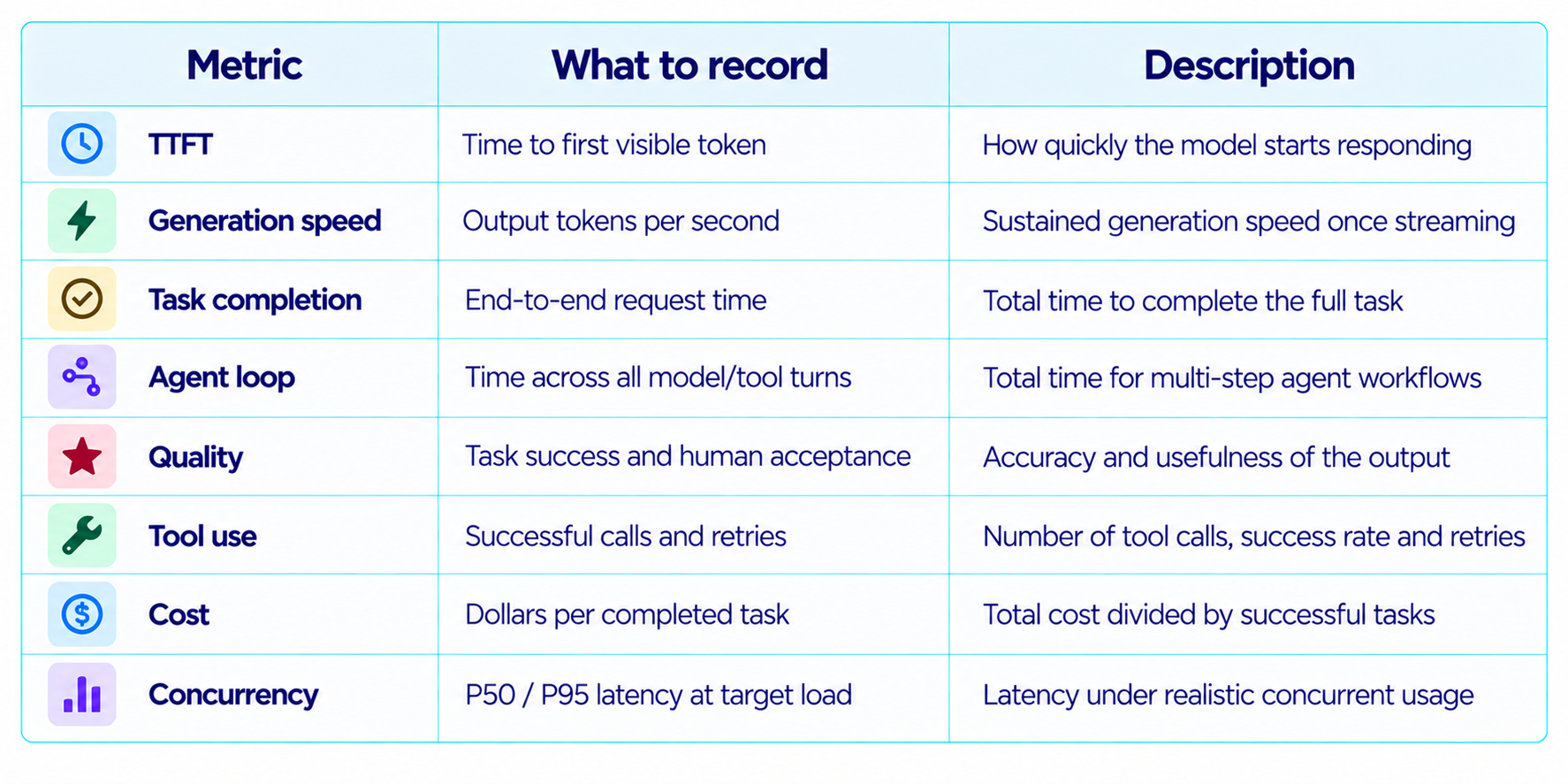
A model that is 2.5x more expensive but cuts a ten-turn agent workflow from 25 seconds to 9 seconds may be cheaper in practice if the application is interactive. A model that runs overnight should usually be evaluated differently.
19. Is GLM 5.3 FlashX Worth It?
Yes, when speed has direct product value. FlashX is a sensible upgrade for coding agents, customer-facing assistants, real-time research tools and high-concurrency applications where waiting for another model call is the main bottleneck.
For background processing, the standard Flash model is still the more economical option. The two tiers are complementary, and the new FlashX release makes model routing more useful rather than making the original Flash obsolete.
The strongest reason to adopt FlashX is therefore not a new leaderboard score. It is the ability to buy a materially lower latency profile while keeping the same broad multimodal Flash capability and 1M context.
20. Final Verdict
GLM 5.3 FlashX is a smart infrastructure release from Z.AI because it treats inference speed as a product tier. Instead of replacing GLM-5.3 Flash, Z.AI has created a faster serving path for developers who are willing to pay more for lower latency.
The core facts are clear. FlashX launched on September 18, 2026, keeps the Flash family's 320B total and 18B active parameter profile, retains the 1M-token context and multimodal inputs, and advertises speeds of up to 200 tokens per second.
The economics are equally clear. Global gateway rates are currently around $0.37 input and $1.25 output per million tokens, while the standard Flash tier is around $0.15 and $0.50. On the Chinese BigModel rate card, the relationship is 2 versus 0.8 yuan for input and 7 versus 2.8 yuan for output.
Real-world API testing adds useful evidence. One September 18 comparison reported roughly 3x median generation throughput and 64% lower completion time versus standard Flash under the same test setup, although access to FlashX through the Coding Plan was not yet available in that test.
My rating: 9.4/10 for speed, 9.2/10 for interactive agents, 8.6/10 for price-to-performance and 9.1/10 overall.
Bottom line: GLM 5.3 FlashX is worth using when latency matters enough to justify a roughly 2.5x token-price premium. Use standard Flash for cheaper background workloads, FlashX for real-time and high-concurrency tasks, and route the hardest reasoning problems to a stronger frontier model.
Frequently Asked Questions
What is GLM 5.3 FlashX?
GLM 5.3 FlashX is Z.AI's high-speed serving variant of GLM-5.3 Flash, designed to reduce inference latency while keeping the same broad multimodal Flash capability.
When was GLM 5.3 FlashX released?
Z.AI launched GLM-5.3-FlashX on September 18, 2026.
How fast is GLM 5.3 FlashX?
Z.AI advertises up to 200 tokens per second. Current provider telemetry is around 198-208 tokens per second, depending on the gateway snapshot.
Is FlashX faster than GLM 5.3 Flash?
Yes. A September 18 direct API test measured 283.8 median tokens per second for FlashX versus 94.8 for standard Flash on that test configuration.
How much does GLM 5.3 FlashX cost?
Current global gateway pricing is about $0.37 per million input tokens and $1.25 per million output tokens. The BigModel China rate is 2 yuan input and 7 yuan output per million tokens.
What is the context window?
The current listings show a 1 million-token context window.
Does GLM 5.3 FlashX support images and video?
Yes. The Flash family supports multimodal input including text, images, video and files. FlashX returns text.
Is GLM 5.3 FlashX good for coding agents?
Yes. Its primary advantage is faster model turns inside coding and tool-using agent loops.
Is GLM 5.3 FlashX worth it?
Yes when lower latency directly improves user experience or agent throughput. Standard Flash is usually better for background and cost-first workloads.
Recommended Blogs
GLM 5.3 Review: Benchmarks, Pricing & Is It Worth It? (2026)
Meta Muse Spark 1.3 Review: Coding, Price & Is It Worth It? (2026)
Gemini 3.8 Flash Review: Accuracy, Price & Is It Worth It? (2026)
Quasar 438B Review: Benchmarks, Speed, Price & Is It Worth It? (2026)
Qwen 3.8 Max 0902 Review: Benchmarks, Price & Is It Worth It? (2026)
Mercury 2.5 AI Model Review: Speed, Price & Is It Worth It? (2026)
Model Routing for AI Coding Agents: How to Cut Costs Without Losing Quality
How to Secure AI Coding Agents: Permissions, Sandboxing, MCP & Secrets
Resources & Community
Join our community of 70,000+ AI enthusiasts and learn to build powerful AI applications. Whether you're a beginner or an experienced developer, Build Fast with AI helps you understand and implement AI in your projects.
Agentic AI Launchpad 2026
A structured 6-week cohort program that takes you from AI basics to building and deploying real-world agentic AI systems. Includes live sessions, expert mentorship, project reviews and a builder community network.
Ready to go from learning to building? Join the next cohort: Agentic AI Launchpad 2026
Free AI Resources
Access free tools, workshops and micro-learning to keep building.

