



GLM-5.3 Explained: Is Z.ai's New Open-Weights Coding Model Ready for Serious Agentic Engineering?
GLM-5.3 is Z.ai's August 2026 flagship model, but its most important story is not a new pretraining run. GLM-5.3 uses the same base model as GLM-5.2 and gets its gains from post-training focused on complex software engineering, long-horizon agents, automation and cybersecurity. That makes it a useful case study in how reinforcement learning can turn an already capable model into a much stronger coding agent.
The coding numbers are the headline. Z.ai's published benchmark table reports 28.3 on Terminal-Bench 3.0 versus 4.6 for GLM-5.2, 66.9 on DeepSWE v1.1 versus 46.2, 42.5 on SWE-Marathon versus 19.4, and 48.2 on AutomationBench versus 26.2. CyberGym rises from 77.2 to 84.5. On Z.ai's internal Code Bench, the Max configuration reaches 34.5%, compared with 23.4% for GLM-5.2.
GLM-5.3 is also an open-weights model. The official Hugging Face repository contains the model files, Transformers instructions and the GLM-5.3 license. At the API layer, Z.ai exposes the model as glm-5.3, while third-party providers offer alternative inference infrastructure. That gives developers three very different deployment choices: use a managed API, use the coding subscription, or operate the open weights yourself.
QUICK ANSWER
GLM-5.3 is Z.ai's coding-first post-training upgrade to GLM-5.2. The official model card says the base model remains the same and the capability gains come from post-training. Z.ai specifically reports stronger coding, agentic software engineering and emergent cybersecurity capability.
The model scores 28.3 on Terminal-Bench 3.0, 66.9 on DeepSWE v1.1, 42.5 on SWE-Marathon v1.1, 48.2 on AutomationBench and 84.5 on CyberGym. On Terminal-Bench 2.1, it records 88.2 in Z.ai's published comparison.
Current API pricing is $1.40 per million input tokens, $0.26 per million cached input tokens and $4.40 per million output tokens. Current provider documentation lists a 1M-token context and up to 128K output.
You can access GLM-5.3 through Z.ai's API, the GLM Coding Plan, third-party inference providers, or the public weights on Hugging Face. Hugging Face currently lists a verified Inference Endpoint configuration using eight H200 GPUs.
My verdict: 9.2/10 overall. GLM-5.3 is one of the strongest open-weights options for coding agents and long-horizon software work, especially when self-hosting, model control or API flexibility matters.
1. What Is GLM-5.3?
GLM-5.3 is Z.ai's flagship open-weights reasoning and coding model released on August 14, 2026. The most important technical fact is that it does not replace the GLM-5.2 base model. Z.ai uses the same base and performs substantially more post-training on agentic coding environments.
This makes GLM-5.3 different from a conventional version upgrade. The model's larger gains are concentrated in tasks that require sustained interaction with a software environment: inspecting repositories, editing files, running commands, interpreting failures and continuing until a task is finished.
That is the foundation of Z.ai's phrase 'agentic engineering'. The model is being optimized for software tasks that look more like a real engineer's workday than a single prompt-and-response exchange.
2. GLM-5.3 Specifications
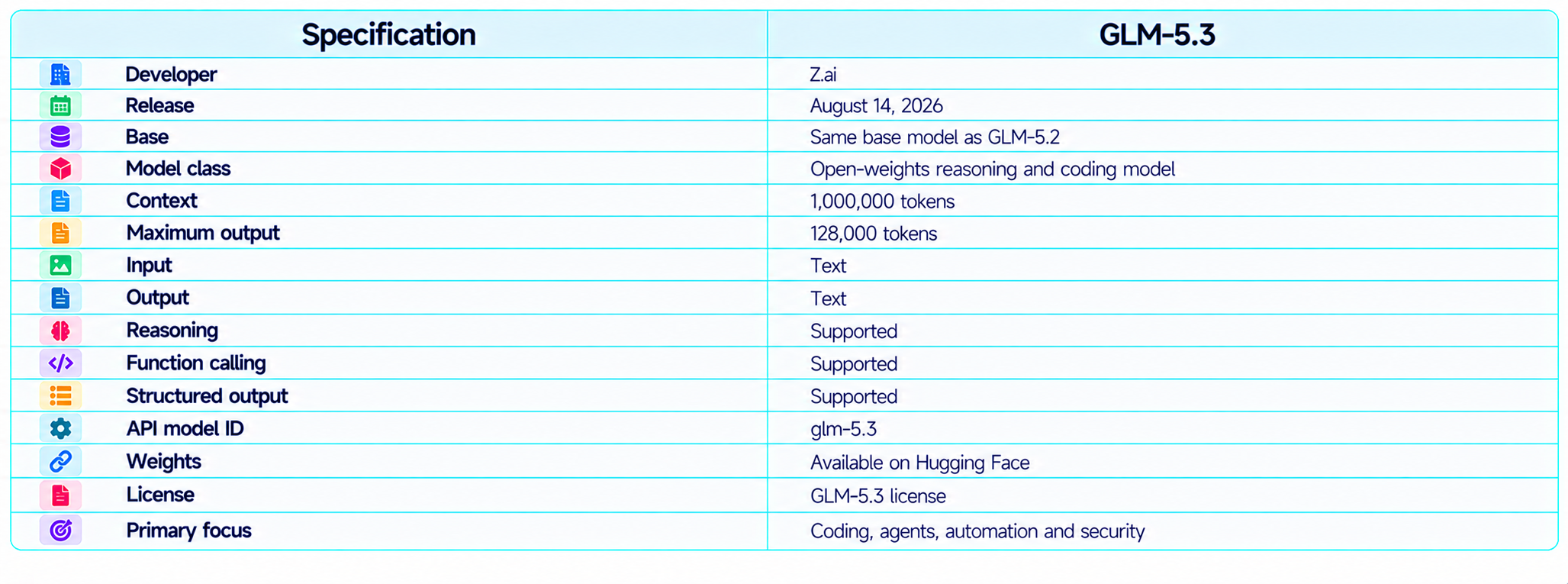
The current Hugging Face repository is a full model release rather than a small adapter. The repository lists 756 GB of model data, which gives a realistic picture of the infrastructure required for full local deployment.
3. What Changed From GLM-5.2?
GLM-5.3 keeps the GLM-5.2 base and changes the post-training recipe. Z.ai says the new model was trained more heavily on long-horizon software environments and autonomous agent interactions.
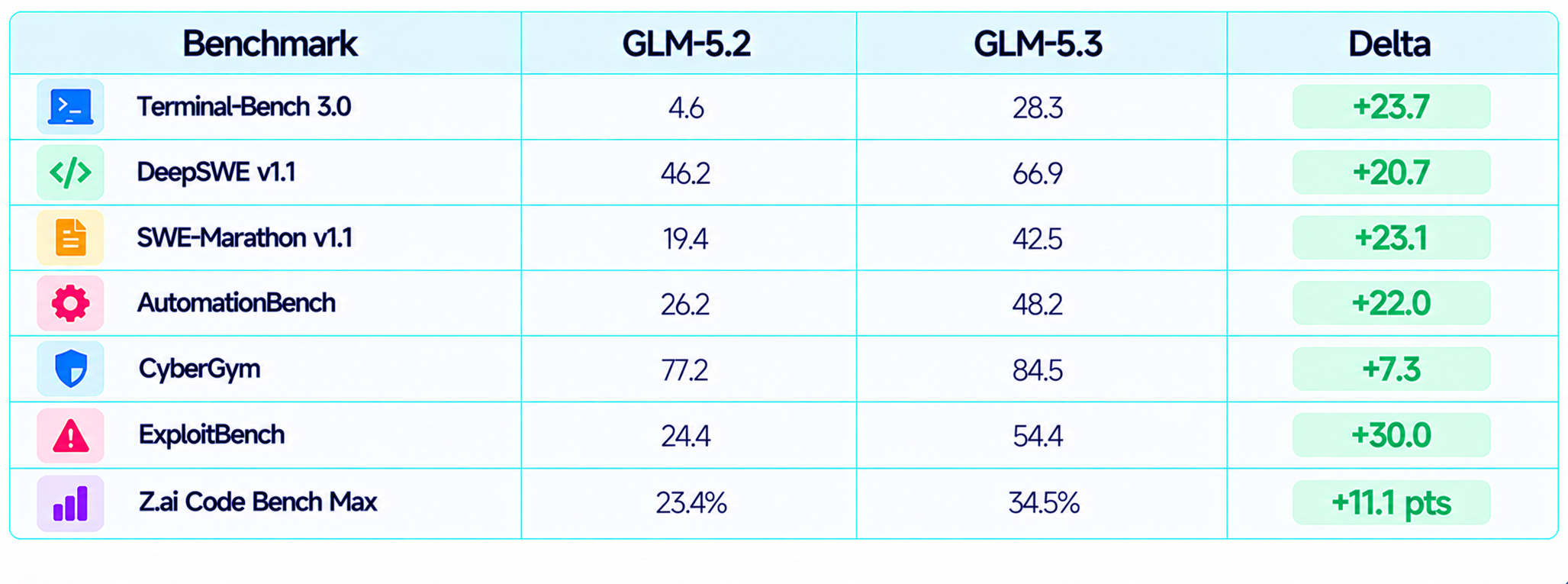
The pattern is consistent. GLM-5.3 improves most on tasks where the model has to act for a long time, use tools and recover from intermediate failures. That is exactly where a coding agent either becomes useful or becomes a source of repeated manual intervention.
4. Terminal-Bench 3.0
Terminal-Bench 3.0 is one of the strongest reasons to take GLM-5.3 seriously as an agentic coding model. The score rises from 4.6 on GLM-5.2 to 28.3 on GLM-5.3. Z.ai's comparison puts GLM-5.3 above Opus 4.8 at 21.1 and below Fable 5 at 33.7 and GPT-5.6 Sol at 34.6.
Unlike a short code-generation test, terminal benchmarks require a model to operate inside an environment. It must inspect files, run commands, understand tool output and make multiple decisions. That makes the result highly relevant to tools such as coding agents, repository assistants and automated development systems.
The jump also shows why version numbers alone can be misleading. The base model did not change, yet the benchmark moved dramatically. The practical improvement came from teaching the model how to operate better in the environment.
5. DeepSWE, SWE-Marathon and Agentic Coding
GLM-5.3 scores 66.9 on DeepSWE v1.1 and 42.5 on SWE-Marathon v1.1. In Z.ai's published comparison, Kimi K3 reaches 67.5 on DeepSWE, GPT-5.6 Sol reaches 72.7 and Opus 4.8 reaches 58.0. On SWE-Marathon, GLM-5.3 is close to GPT-5.6 Sol at 42.5 and behind Opus 4.8 at 48.8.
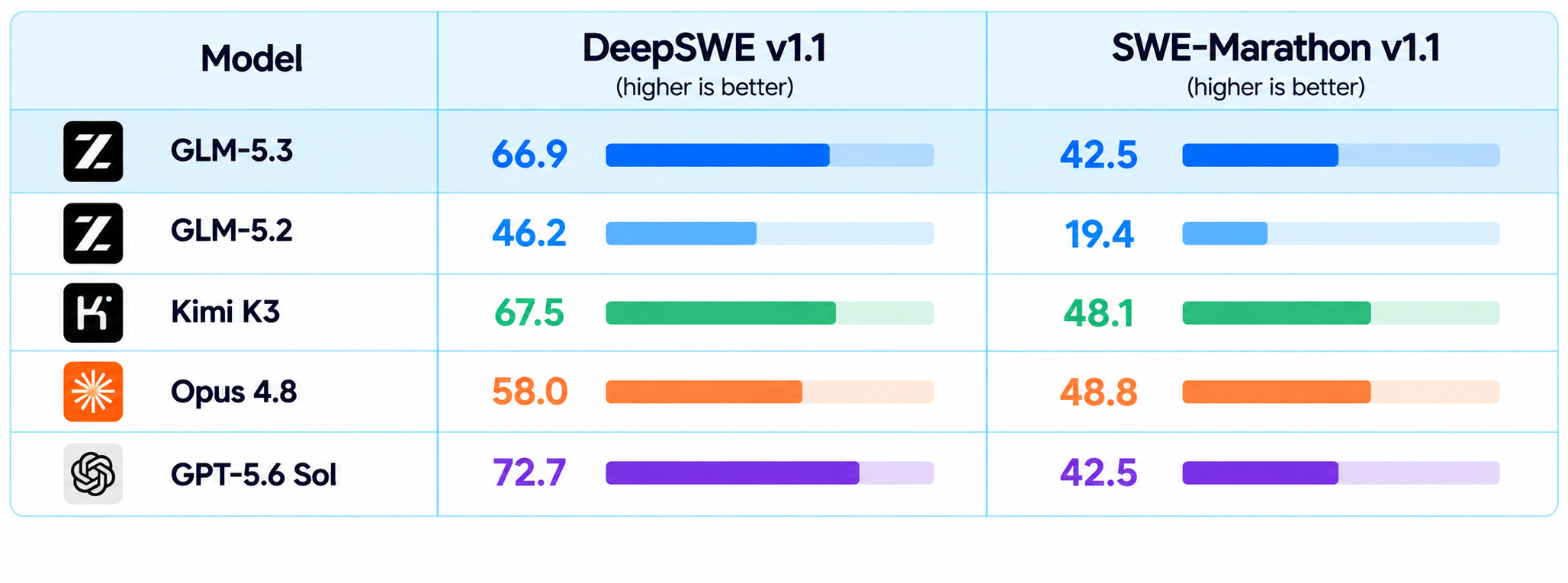
The result is a model that sits close to the top of the published open and closed comparison set on several long-horizon coding tasks. It does not win every benchmark, but it is clearly more than a conventional code-completion model.
6. AutomationBench and Agent Work
AutomationBench rises from 26.2 for GLM-5.2 to 48.2 for GLM-5.3. That jump matters because automation tasks require models to reason through workflows instead of just writing a final answer.
For enterprise AI, this is a useful signal. An internal agent might have to read a ticket, inspect an account, query a system, update a record, verify the result and produce a report. The best model is not necessarily the one that writes the most elegant text. It is the one that can sustain the workflow with fewer mistakes.
GLM-5.3's training focus makes this kind of use case central rather than incidental.
7. Cybersecurity Capability
Z.ai reports 84.5 on CyberGym for GLM-5.3, up from 77.2 on GLM-5.2, and 54.4 on ExploitBench, up from 24.4. The model card describes this as an emergent capability from the scale of post-training.
The results make GLM-5.3 relevant to defensive security research, secure-code review, vulnerability triage and controlled red-team work. They do not mean the model should be given unrestricted access to production systems. Security agents still need scope boundaries, isolated environments, logging and human review.
For secure agent design, see
For secure agent design, see How to Secure AI Coding Agents: Permissions, Sandboxing, MCP & Secrets.
8. GLM-5.3 Context Window
GLM-5.3 supports a 1M-token context window and up to 128K output in current API references.
That is particularly useful for repository-scale coding. A large project can contain source code, configuration, documentation, issue history and test output across hundreds or thousands of files. A large context window gives an agent more room to keep relevant project state visible.
Context size is not the same as context quality. Developers still need a sensible context-engineering layer to decide which files, tools and previous results belong in the model's active working set.
Our Context Engineering guide covers that workflow in more detail.
9. GLM-5.3 Pricing
Z.ai's public GLM-5.3 API pricing is $1.40 per million input tokens, $0.26 per million cached input tokens and $4.40 per million output tokens. The same rate card is reported for GLM-5.2.
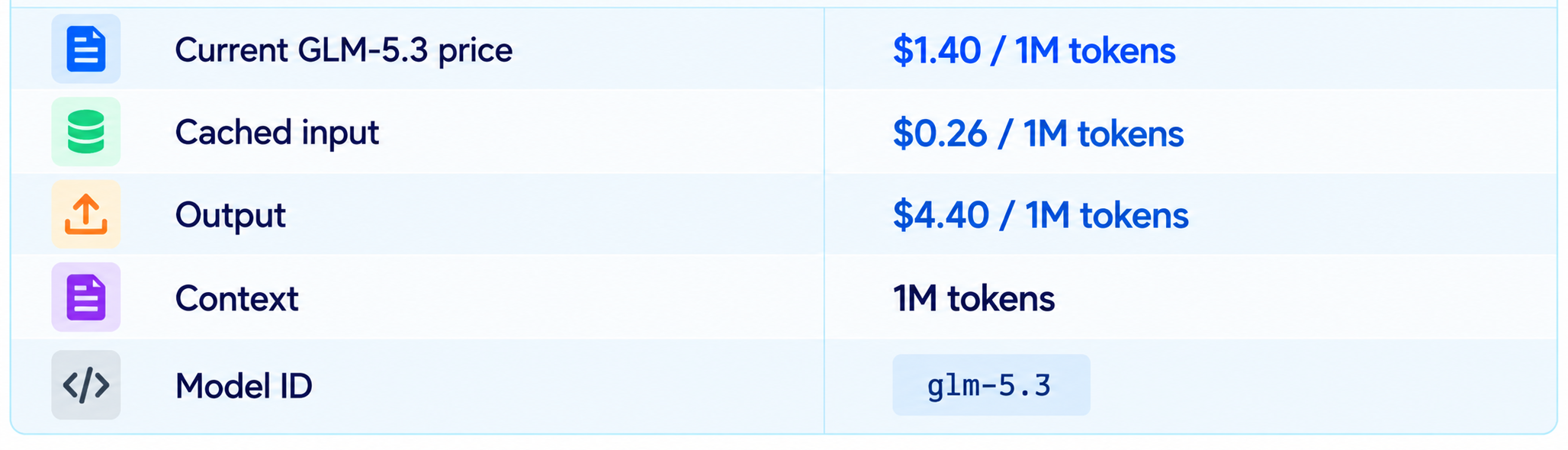
This puts GLM-5.3 below many premium reasoning models on raw API pricing. The practical comparison is still cost per completed task because reasoning models can consume different numbers of tokens to finish the same job.
For developers who primarily want an interactive coding assistant, the GLM Coding Plan is a separate option. ZCode currently displays Lite, Pro and Max tiers, with the page showing $12.60, $56 and $117.60 monthly offers respectively.
10. How to Access GLM-5.3
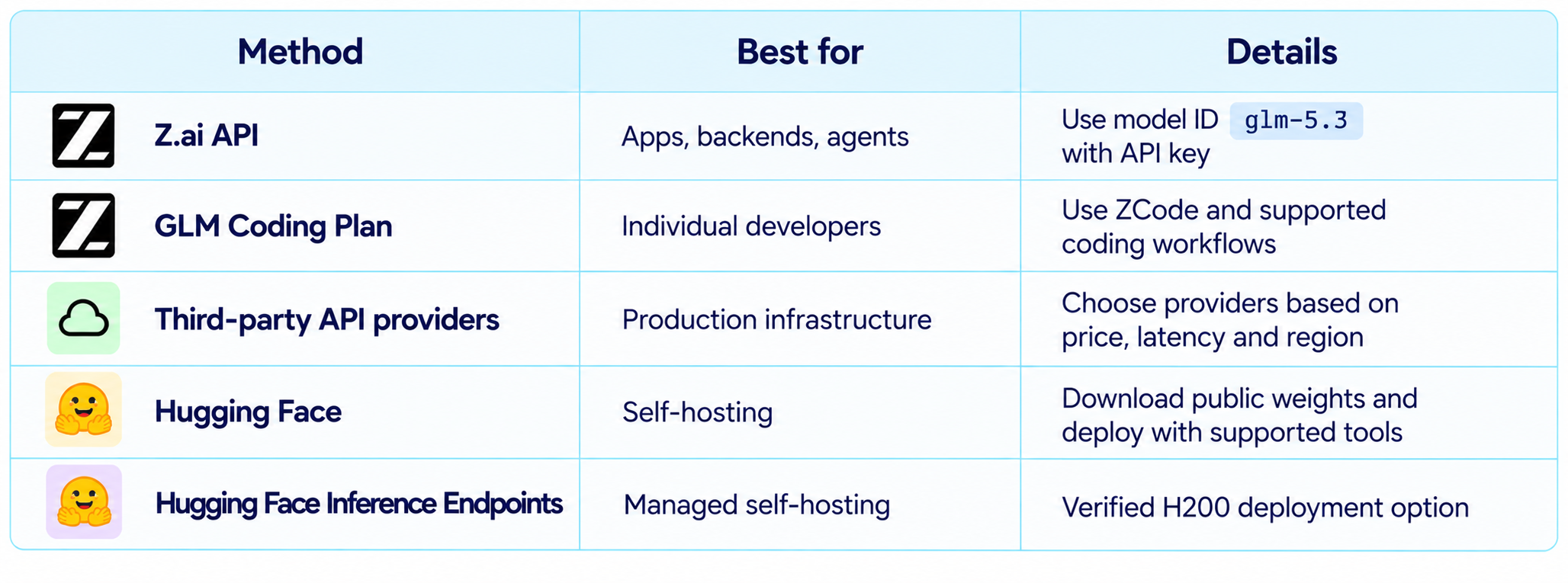
Artificial Analysis currently tracks GLM-5.3 across 16 providers. It reports substantial provider variation: Inco FAST and Nebius FP4 are around 384 tokens per second, while some providers are much slower. Blended pricing also ranges widely, so the provider can materially change the economics.
11. Can You Download GLM-5.3?
Yes. Z.ai's public Hugging Face repository contains the GLM-5.3 weights and model files. The repository currently measures hundreds of gigabytes, so downloading the complete checkpoint requires substantial storage and bandwidth.
The model card includes examples for Transformers, vLLM, Hugging Face inference providers, notebooks and local applications. That makes the release practical for developers who want to build their own serving layer rather than depend entirely on Z.ai's API.
A useful distinction is between downloading the weights and running them efficiently. The first is a storage problem. The second is an inference-infrastructure problem involving multi-GPU execution, quantization, memory management and high-throughput serving.
12. GLM-5.3 Local Deployment
Local deployment is possible, but it is not a laptop-scale model. The Hugging Face repository shows a very large checkpoint, and Hugging Face's verified Inference Endpoint configuration uses eight H200 GPUs for a managed deployment.
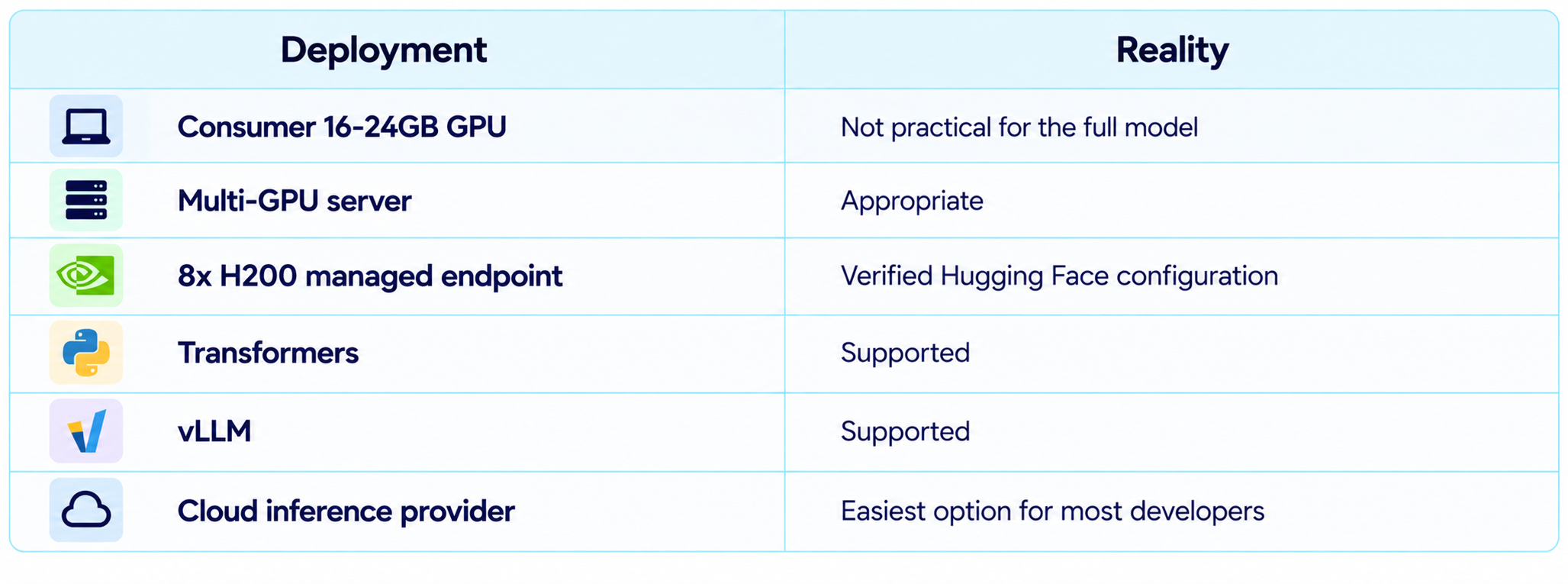
For most individual developers, the API or Coding Plan is the sensible first step. Self-hosting becomes attractive when you need model ownership, predictable infrastructure, private deployment or large-scale usage that justifies the hardware.
13. GLM-5.3 Open-Weights License
The official Hugging Face license grants broad rights to use, copy, modify, publish, distribute, sublicense and sell the software, subject to the license terms and applicable law.
That open distribution is one of GLM-5.3's most important advantages over closed frontier models. A company can evaluate the model on its own infrastructure, customize the serving stack and maintain more control over deployment.
Open weights do not remove operational responsibilities. Teams still need to review the license, secure the serving environment, control access to tools and data, patch the inference stack and monitor model behavior.
14. API Compatibility and Coding Tools
Current API references describe OpenAI Chat Completions, OpenAI Responses and Anthropic Messages-compatible interfaces. The model supports reasoning controls, tool calling and structured outputs.
That compatibility is important for coding agents because developers can integrate GLM-5.3 into existing toolchains rather than building a new agent runtime from scratch. It can also sit behind a model router alongside Claude, Gemini, GPT or other models.
This fits naturally with Model Routing for AI Coding Agents.
15. GLM-5.3 Coding Plan and ZCode
ZCode is Z.ai's coding environment around GLM models. The current Coding Plan page positions Lite, Pro and Max for progressively larger repositories and heavier development workloads, with support for multiple agent tools.
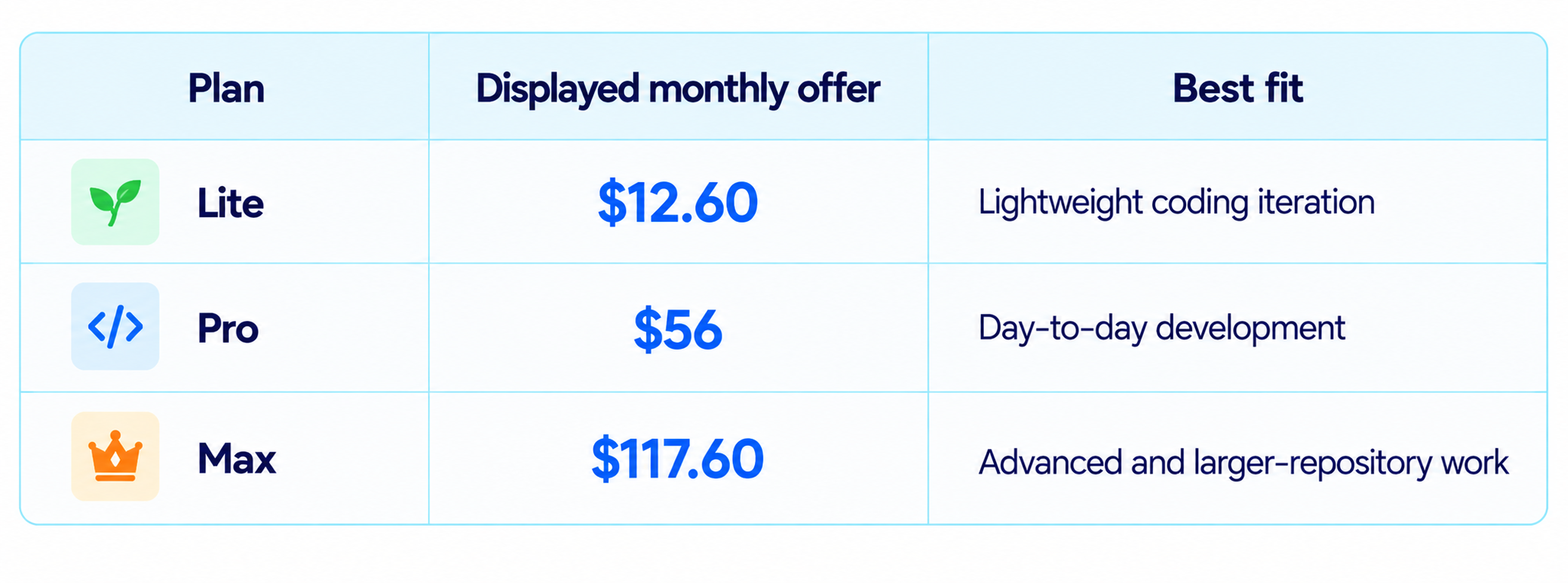
The Coding Plan is different from API billing. The API is metered by tokens. The Coding Plan is a subscription with credits and bundled access. Individual developers should compare the allowance against their actual coding-agent usage instead of assuming the monthly fee is automatically cheaper.
16. GLM-5.3 vs GLM-5.2
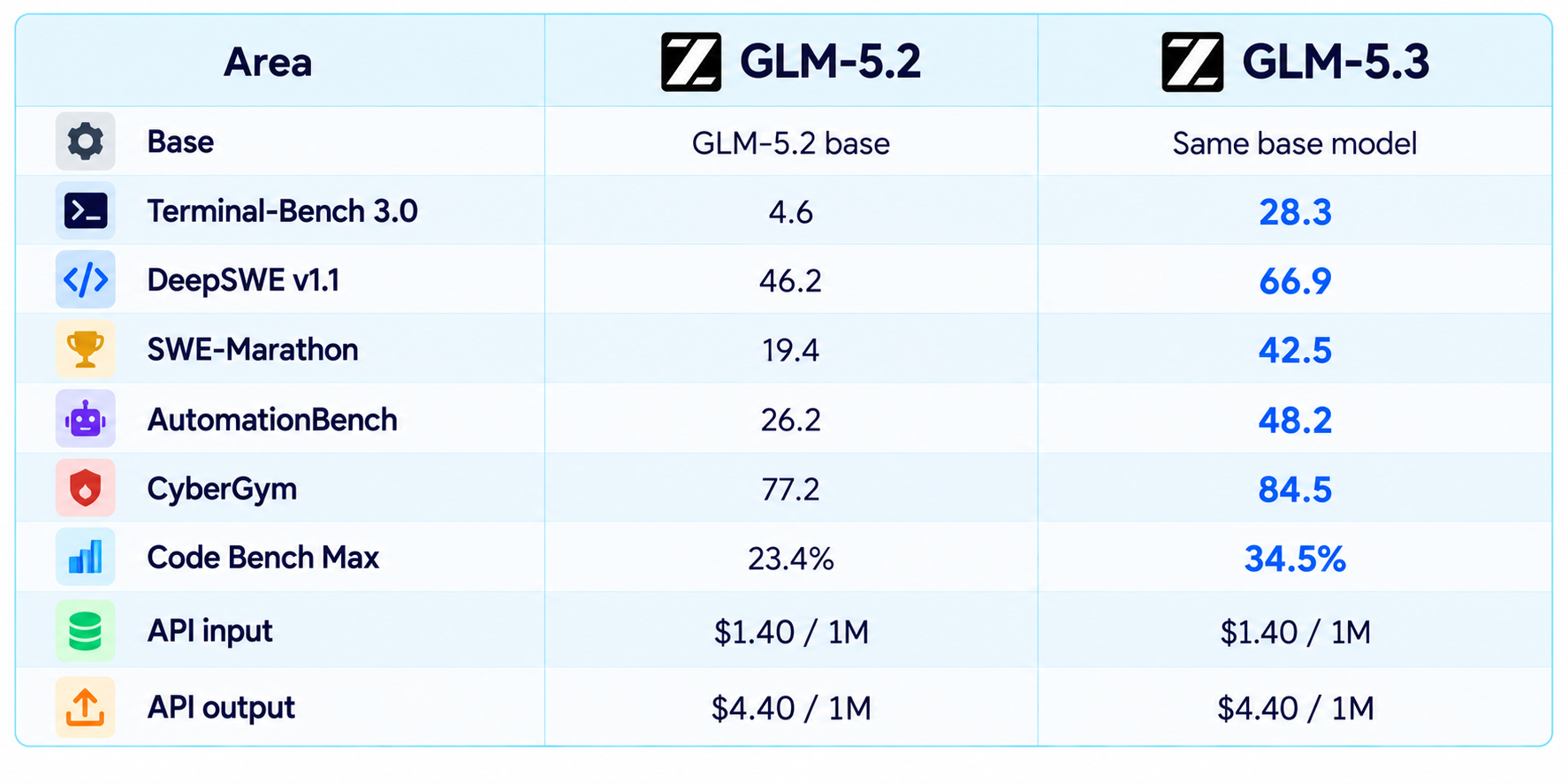
GLM-5.3 is therefore a post-training upgrade rather than a new pretraining generation. The same base receives a much stronger agentic training phase, which is why the gains cluster around long-horizon software tasks.
17. GLM-5.3 vs Other Coding Models
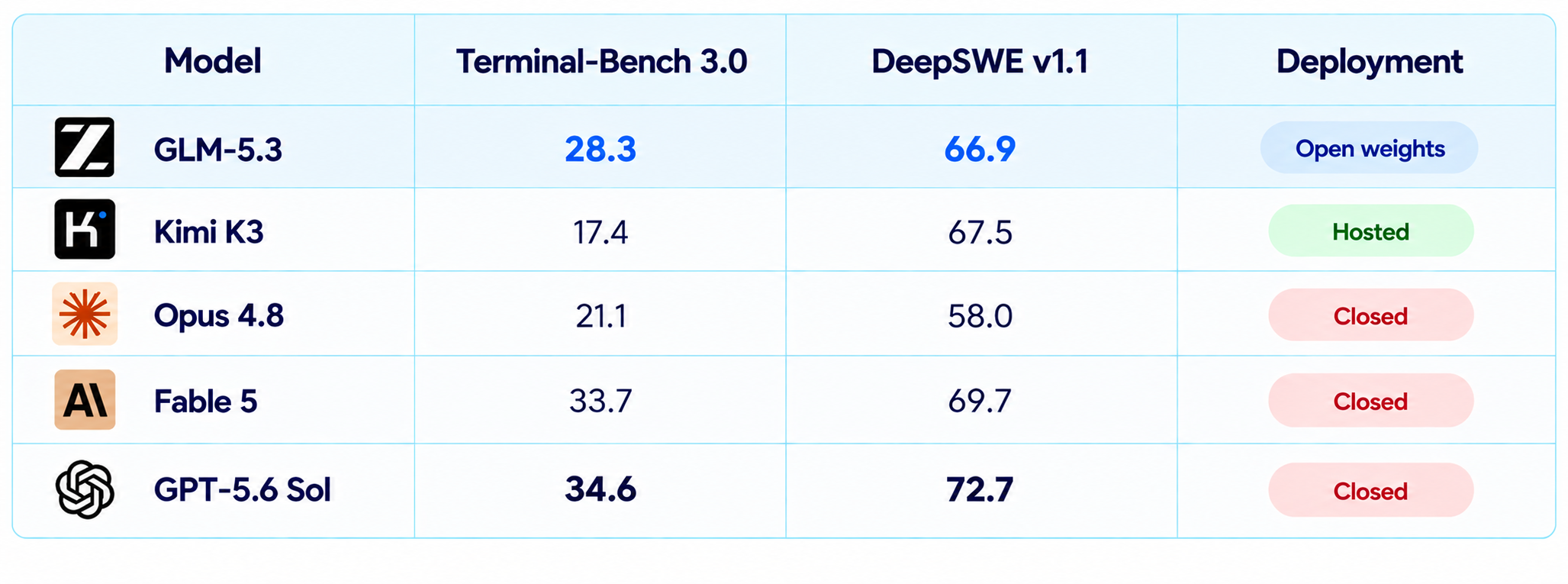
GLM-5.3 is not the highest score on every published coding test. Its differentiation comes from combining competitive coding results with open weights, a 1M context window and multiple deployment routes. That makes the model particularly interesting for organizations that want control over the stack as well as capability.
Compare it with our Qwen 3.8 Max 0902 review and Gemini 3.8 Flash review.
18. Best Use Cases
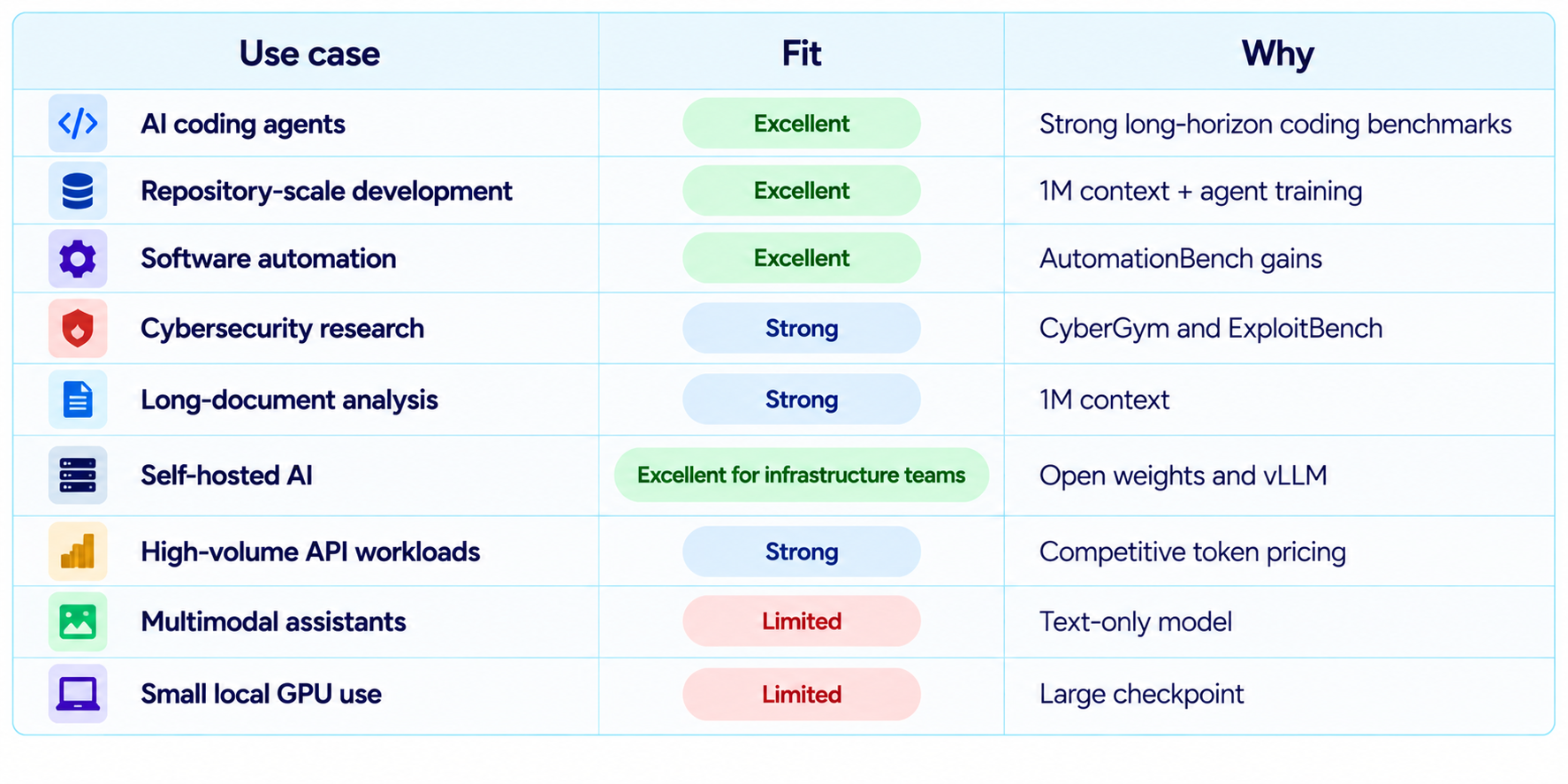
19. Limitations You Should Know
- GLM-5.3 is not the top model on every benchmark.
- Some benchmark results come from Z.ai's own evaluation table and should be read with its stated methodology.
- Full self-hosting requires substantial compute and storage.
- The current model profile is text-only.
- API billing and Coding Plan billing are separate systems.
- Third-party provider performance varies significantly.
- Open weights shift security, scaling and maintenance responsibilities to the deployer.
20. Recommended Production Workflow
The strongest production setup is a routed agent architecture in which GLM-5.3 handles a large share of coding and automation work while stronger models remain available for difficult escalations.
- Use GLM-5.3 for repository analysis, implementation and multi-step debugging.
- Use a cheaper Flash model for simple extraction or repetitive classification when quality permits.
- Use the 1M context selectively and organize inputs with context engineering.
- Give tools explicit schemas and enforce permission boundaries.
- Run tests and validation after meaningful coding steps.
- Escalate complex computer-use or unusually difficult reasoning tasks when evaluation shows a gap.
- Track cost per completed task rather than only token price.
21. How to Evaluate GLM-5.3 Yourself
Run a fixed set of tasks against GLM-5.3 and your current coding model. Keep prompts, repository access and tools consistent.
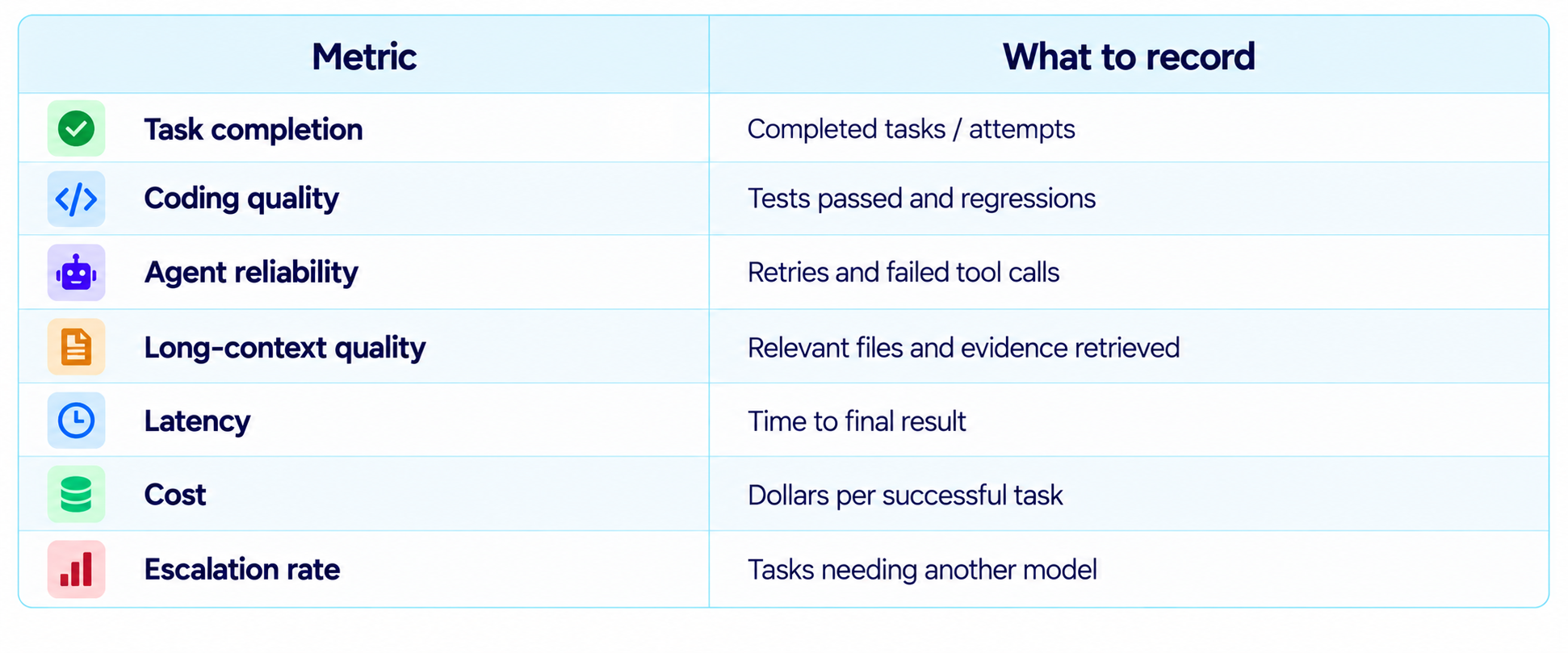
For production, this evaluation is more useful than a benchmark screenshot because it tells you how much work GLM-5.3 can complete for your actual system budget.
22. Is GLM-5.3 Worth It?
Yes. GLM-5.3 is worth testing if you build coding agents, repository automation, security tooling or self-hosted AI infrastructure. Its public benchmarks show a substantial improvement over GLM-5.2, and its open-weights status gives developers more deployment freedom than closed frontier models.
The API is also reasonably priced for a flagship reasoning model at $1.40 per million input tokens and $4.40 per million output tokens. The Coding Plan offers another route for individuals who want a ready-made development environment.
The main cost is infrastructure complexity. Running the full weights locally is a serious engineering project, so most users should start with the API or Coding Plan and move to self-hosting only when control, privacy or scale justifies the hardware.
23. Final Verdict
GLM-5.3 is one of the most significant open-weights coding releases of 2026 because it demonstrates what aggressive post-training can do to an already capable base model. Z.ai kept the GLM-5.2 base and focused the training process on agentic software environments, which produced large gains across Terminal-Bench, DeepSWE, SWE-Marathon and AutomationBench.
The benchmark improvements are substantial: Terminal-Bench 3.0 moves from 4.6 to 28.3, DeepSWE from 46.2 to 66.9, SWE-Marathon from 19.4 to 42.5, AutomationBench from 26.2 to 48.2 and CyberGym from 77.2 to 84.5.
The deployment story is equally important. GLM-5.3 has a 1M context window, 128K output, public weights, OpenAI and Anthropic-compatible API patterns, and a $1.40/$4.40 API price card. Developers can choose a managed API, Coding Plan, third-party host or self-hosted deployment.
It does not dominate every coding benchmark. Some closed models still score higher on specific evaluations. The difference is that GLM-5.3 gives developers a strong coding and agent model without giving up control over the weights.
My rating: 9.4/10 for coding, 9.2/10 for agentic engineering, 9.1/10 for open-weights flexibility, 8.4/10 for local deployment ease and 9.2/10 overall.
Bottom line: GLM-5.3 is worth using when you need serious coding-agent capability, 1M context and deployment flexibility. Start with the API or Coding Plan for convenience, then move to Hugging Face and vLLM when your infrastructure can support the full open-weights model.
Frequently Asked Questions
What is GLM-5.3?
GLM-5.3 is Z.ai's August 2026 coding and agentic reasoning model. It uses the same base model as GLM-5.2 and gains its improvements primarily through post-training.
What are the main GLM-5.3 benchmarks?
The published results include 28.3 on Terminal-Bench 3.0, 66.9 on DeepSWE v1.1, 42.5 on SWE-Marathon, 48.2 on AutomationBench and 84.5 on CyberGym.
How much does GLM-5.3 cost?
Z.ai lists $1.40 per million input tokens, $0.26 cached input and $4.40 per million output tokens.
What is the GLM-5.3 context window?
Current API references list a 1M-token context window with up to 128K output.
How do I access GLM-5.3?
Use the Z.ai API, GLM Coding Plan, third-party providers or the public Hugging Face weights.
Can I run GLM-5.3 locally?
Yes, but the full checkpoint is extremely large. Serious multi-GPU infrastructure is recommended.
Is GLM-5.3 open source?
It is distributed as an open-weights model under the GLM-5.3 license. Review the complete license before commercial use.
Does GLM-5.3 support tools?
Yes. Current API references list function calling and structured outputs.
Does GLM-5.3 support images?
The current model profile is text input and text output.
What is the GLM Coding Plan?
It is Z.ai's subscription-based coding environment around GLM models, with Lite, Pro and Max tiers.
Is GLM-5.3 good for coding agents?
Yes. Long-horizon software engineering and agentic coding are central use cases.
Is GLM-5.3 worth it?
Yes, especially when open weights, coding capability, long context and deployment control matter.
Recommended Blogs
Meta Muse Spark 1.3 Review: Coding, Price & Is It Worth It? (2026)
Gemini 3.8 Flash Review: Accuracy, Price & Is It Worth It? (2026)
Qwen 3.8 Max 0902 Review: Benchmarks, Price & Is It Worth It? (2026)
Replit's AI Model Routing Is Here: How Intelligent Routing Cuts Costs (2026)
How to Secure AI Coding Agents: Permissions, Sandboxing, MCP & Secrets
Resources & Community
Join our community of 70,000+ AI enthusiasts and learn to build powerful AI applications. Whether you're a beginner or an experienced developer, Build Fast with AI helps you understand and implement AI in your projects.
Agentic AI Launchpad 2026
A structured 6-week cohort program that takes you from AI basics to building and deploying real-world agentic AI systems. Includes live sessions, expert mentorship, project reviews and a builder community network.
Ready to go from learning to building? Join the next cohort: Agentic AI Launchpad 2026
Free AI Resources
Access free tools, workshops and micro-learning to keep building.

