




Wan 3.0 Review: Accuracy, Price & Is It Worth It? (2026)
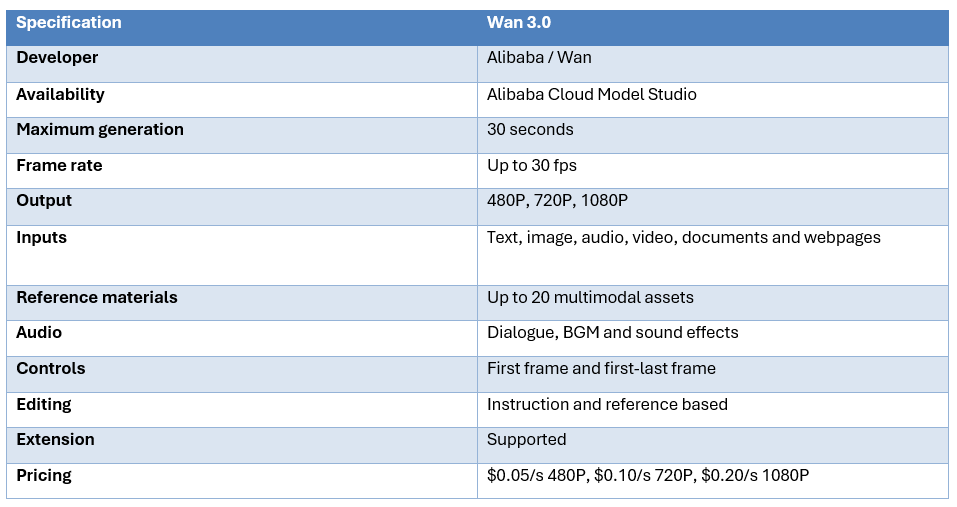
Wan 3.0 is Alibaba's latest all-in-one AI video model, and its pitch is different from the usual 'better text-to-video' release. The model is built around longer single-shot generation, multimodal references, built-in editing and native audio. It can generate up to 30 seconds in one pass at up to 30 fps, accept text, images, audio, video and documents, and use up to 20 reference materials in a request.
The pricing is straightforward. Alibaba Cloud lists Wan 3.0 at $0.05 per second for 480P, $0.10 for 720P and $0.20 for 1080P, which works out to $1.50, $3 and $6 for a 30-second generation. As of August 29, the Model Studio console is advertising a temporary 30% discount through September 24, reducing those effective rates to about $1.05, $2.10 and $4.20 for 30 seconds.
The bigger question is accuracy, and for video that means more than pixel sharpness. It means prompt adherence, identity consistency, motion, physics, camera control, audio sync and whether the model preserves the reference rather than quietly inventing something else. Current independent testing is encouraging: a 49-case same-seed comparison against Seedance 2.0 and Wan 2.7 found Wan 3.0 stronger on faithfulness, identity consistency and physics, while Seedance remained stronger on multi-subject interaction, surreal instructions and some stylized work.
QUICK ANSWER
Wan 3.0 is worth testing and, for the right workflow, worth using. Its biggest strengths are not a single benchmark score but the combination of 30-second generation, reference consistency, native dialogue and sound, document-to-video input, built-in editing and simple per-second pricing.
The honest downside is that Wan 3.0 is not the universal quality winner. Independent tests show uncommanded camera cuts and weaker performance on some surreal or multi-subject prompts. Another review found lip-sync to be a notable weakness. That makes Wan 3.0 a particularly strong workhorse for controlled shots rather than an automatic choice for every cinematic brief.
1. What Is Wan 3.0?
Wan 3.0 is Alibaba's current generation video-generation system available through Alibaba Cloud Model Studio. Alibaba positions it as an all-in-one model rather than a narrow text-to-video engine. It combines video generation with multimodal references, video editing, video extension and native audio generation.
2. Why 30 Seconds Matters
Thirty seconds sounds like a duration upgrade, but it changes the workflow. Short generations force creators to think in disconnected clips. Every time you cut from one generation to another, the model has another chance to change a face, costume, environment or camera language.
With a 30-second generation, you can ask for a complete visual event: a subject enters, performs an action, reacts, and leaves the frame without an artificial generation boundary. The benefit is continuity rather than merely length. Alibaba explicitly makes 30 seconds a central Wan 3.0 capability.
The catch is that a longer generation also gives the model more opportunities to fail. A brief five-second clip can hide weak motion by ending quickly. A 30-second clip has to maintain consistency for much longer. Atlas Cloud's same-seed testing found identity stable across its nine 30-second runs, but also found unrequested camera cuts that appeared often enough to become one of the model's main weaknesses.
3. Accuracy: What Does 'Accurate' Mean for Video?
There is no single WER-style accuracy number for generative video. A useful Wan 3.0 accuracy framework has at least six dimensions: source-frame fidelity, prompt adherence, identity consistency, temporal stability, physics and camera behavior.
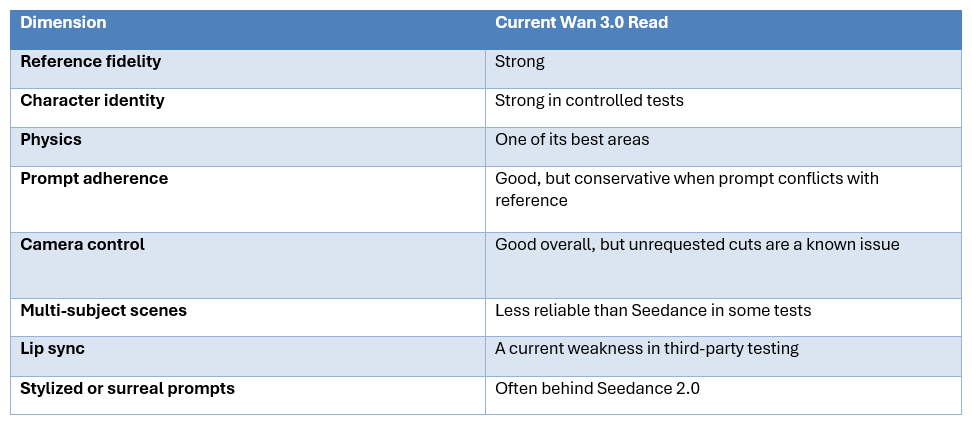
The most interesting finding from Atlas Cloud's 49 same-seed cases is that Wan 3.0 appears to prefer preserving the source image. In tests where the prompt conflicts with the reference image, Wan tends to protect the original visual identity and soften the instruction. Seedance 2.0 is more willing to execute the instruction even if that means rebuilding parts of the source. Neither behavior is universally correct. It depends on whether you value fidelity or transformation.
4. Wan 3.0 vs Wan 2.7: Is the Upgrade Real?
Yes. Wan 3.0 is a meaningful upgrade rather than a minor model refresh. Alibaba expands the generation ceiling to 30 seconds, adds document inputs, broadens reference handling, increases multimodal controls and strengthens editing and audiovisual generation.
Atlas Cloud's controlled comparison is useful here because it ran Wan 3.0 and Wan 2.7 against the same first frame, prompt and seed. Its conclusion was that Wan 3.0 is a visible step beyond Wan 2.7 in faithfulness, identity stability and physics. The improvement is therefore not just a product-specification claim. It is visible in repeated generation tests.
5. Wan 3.0 Pricing
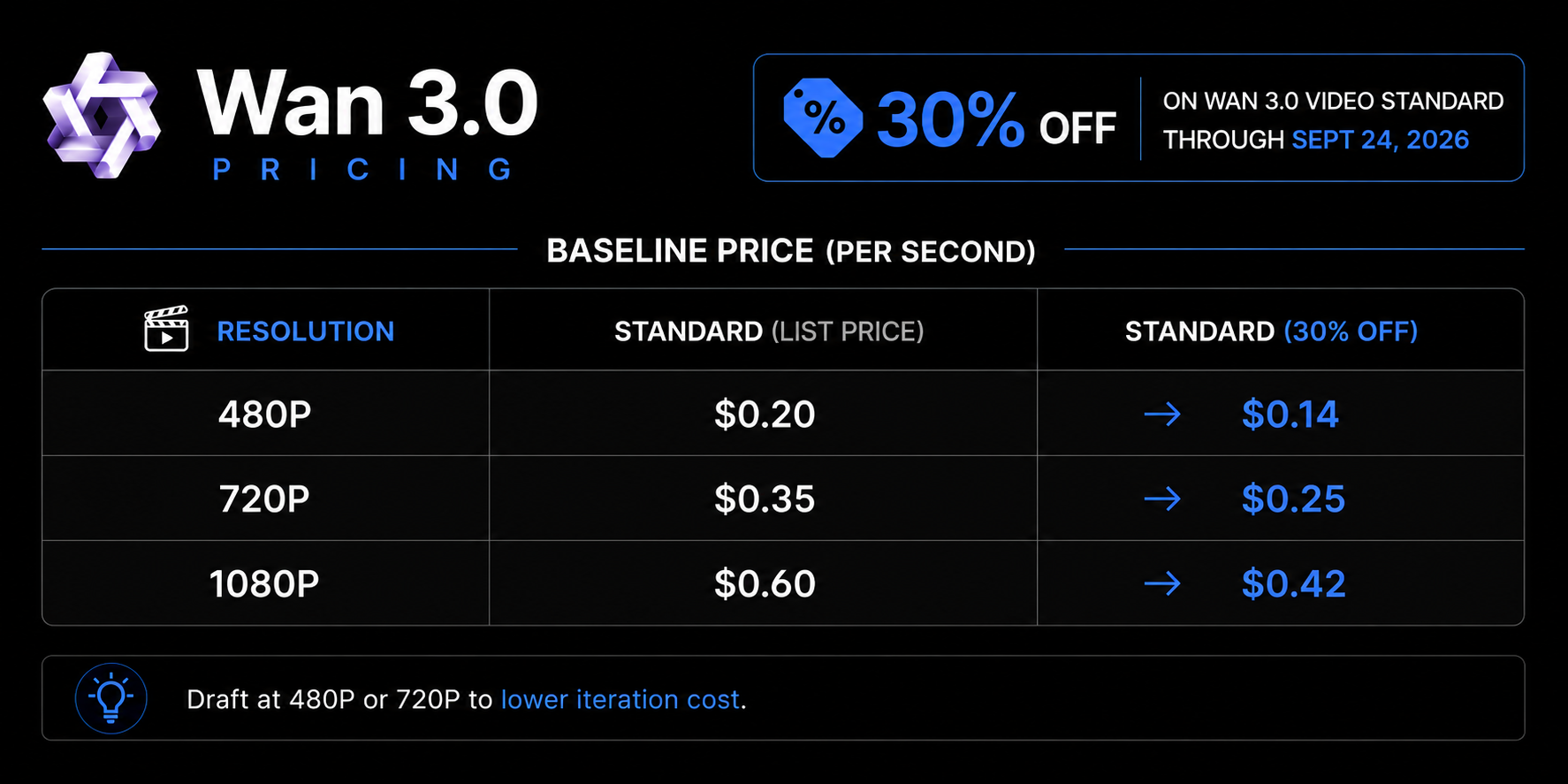
Alibaba's public documentation lists the baseline per-second rates, while its current Model Studio console shows Wan 3.0 Video Standard at 30% off through September 24, 2026. The console notes that final pricing is subject to the live service, so the temporary offer should not be treated as a permanent rate.
The important business metric is cost per usable shot, not cost per generated shot. Suppose a team needs eight attempts to approve one 30-second 1080P clip. At list pricing that is $48 in generation spend before any other costs. Drafting at 480P or 720P can dramatically lower iteration cost, which is why the resolution ladder matters.
6. Is Wan 3.0 Cheap Compared With Competitors?
Wan 3.0's public price is aggressive, but third-party platforms can display very different rates because they add credits, markups, priority inference or access to different model variants. One recent same-prompt comparison of Wan 3.0 and Seedance 2.5 reported a large difference in platform credit consumption, concluding that Seedance's quality gap did not clearly justify its much higher cost for every shot.
That does not mean Wan is always cheaper everywhere. It means the underlying model price is only one part of the economics. Compare the actual API or platform invoice for the exact resolution, duration, audio mode and priority tier you will use.
7. Native Audio: Big Feature, Not Yet a Perfect One
Wan 3.0 can generate dialogue, background music and sound effects as part of the video workflow. That is important because synchronized audiovisual generation removes an entire class of post-production steps for many social, advertising and prototype workflows.
But this is also one of the areas where the model still needs work. Alibaba says audio texture is being improved, and third-party testing has found lip-sync problems in performance-heavy scenes. Curious Refuge, for example, reported that Wan 3.0 struggled to accurately align mouth movement with supplied music, while Seedance 2.0 produced the stronger lip-sync result in that specific test.
For ordinary background sound or quick social clips, native audio is a major convenience. For dialogue-driven commercials, music videos or talking-head content, treat it as a feature to benchmark rather than a reason to remove your dedicated audio workflow immediately.
8. Everything to Video: Documents as Inputs
One of Wan 3.0's most differentiated features is document input. Alibaba says the model can read DOC, XLS, PPT, PDF, TXT, KEY, Pages, Numbers and Markdown, plus public webpage references. The documented limit is one file or link up to 100 MB and 50 pages.
This is strategically important for business users. A marketing team can start from a product deck. A course creator can start from a lesson document. A research team can start from a report. Instead of converting every source into a creative prompt manually, the source material itself becomes part of the generation input.
The feature is particularly useful when the document already contains the structure of the intended story. It is much less useful when a 50-page document contains contradictory or irrelevant material. The model can read more, but that does not mean it should read everything.
9. Up to 20 Multimodal References
Wan 3.0 supports up to 20 reference materials per request across images, videos, audio, documents and webpages. It also supports first-frame and first-last-frame control.
This is a major workflow advantage for branded content. You can provide a product image, a location reference, a character reference, an audio cue and additional visual references rather than trying to encode every detail into prose.
More references are not automatically better. The system still needs a clear hierarchy. If one image says a person is wearing a black jacket while another says red, the model has to resolve the conflict. Good reference engineering means specifying which elements are fixed and which elements can vary.
10. Character Consistency and Physics
Character consistency is one of Wan 3.0's strongest areas in current independent testing. Atlas Cloud's same-seed evaluation reported no face, outfit or set swaps across its nine 30-second runs and found Wan 3.0 stronger than Seedance 2.0 on identity consistency. It also found Wan stronger on physical events such as shattering glass and billiards, with cleaner fracture patterns and collision transfer.
That makes Wan particularly attractive for product demonstrations, action shots and reference-heavy scenes where the exact object matters more than the model inventing something surprising.
11. The Biggest Weakness: Unrequested Camera Cuts
This is the failure mode I would pay attention to. Atlas Cloud found that Wan 3.0 sometimes cuts to a new camera angle even when the prompt asks for one continuous shot. The issue appeared frequently enough across standard and 30-second tests to be treated as a real model behavior rather than a one-off glitch.
That matters because many commercial prompts depend on exact camera language. A product advertisement might require a slow locked shot. A tutorial may need a fixed composition. A film brief may explicitly say one continuous take. An unexpected cut can ruin an otherwise excellent generation.
The practical workaround is to make camera constraints explicit, reduce unnecessary action changes and test with the actual prompt format you plan to use. But until the behavior improves, Wan 3.0 should not be assumed to interpret 'single shot' perfectly every time.
12. Wan 3.0 vs Seedance 2.0
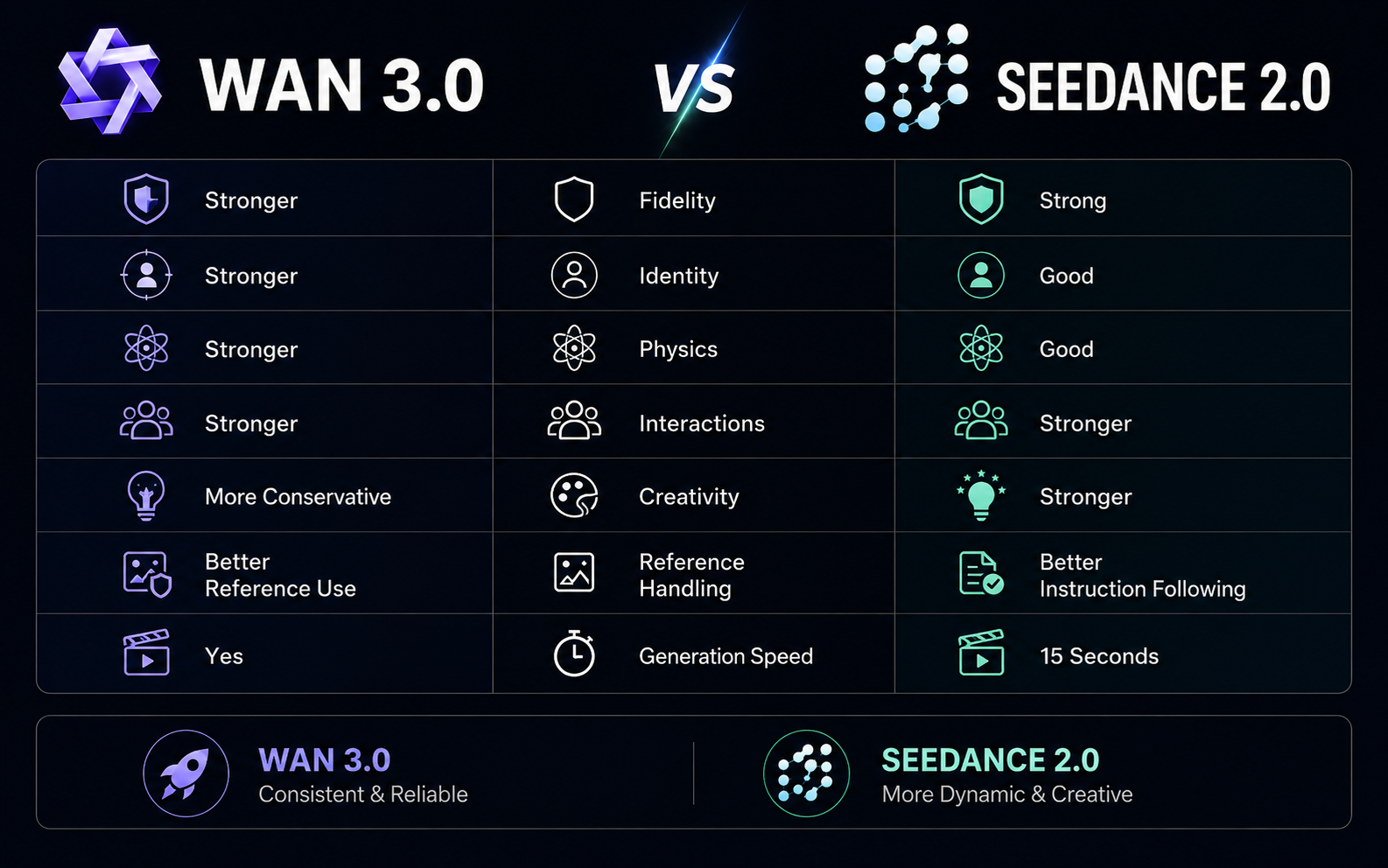
That is a useful split rather than a simple winner. Choose Wan when you need fidelity, stable identity and physical plausibility. Choose Seedance when the brief depends on multiple interacting subjects, aggressive transformations or more surreal creative interpretation. Atlas Cloud's controlled test supports this task-specific distinction.
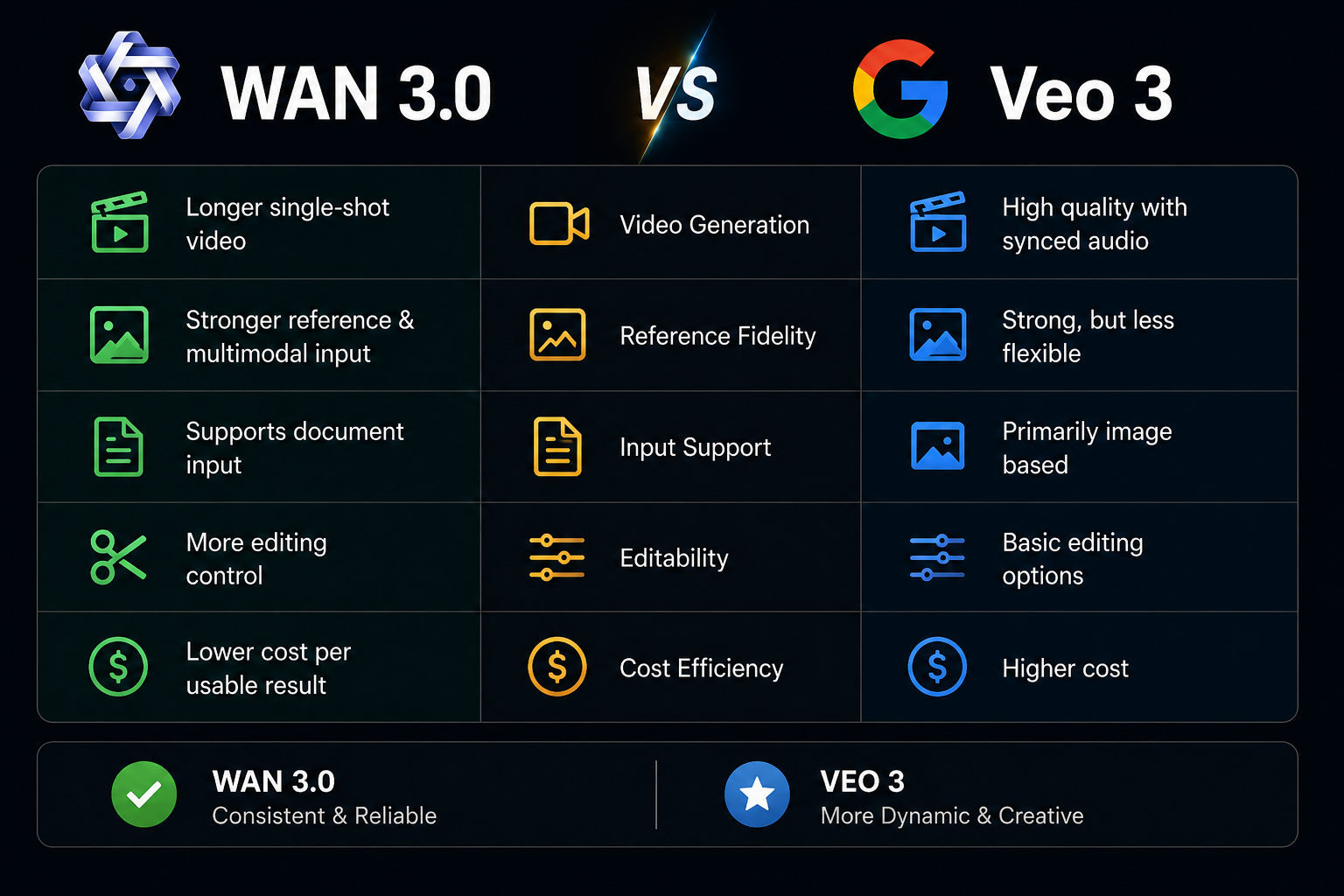
13. Wan 3.0 vs Veo 3
Veo 3 is a logical benchmark because Google's system is also built around generating video with synchronized audio. Wan 3.0 differentiates itself by putting more emphasis on long single-shot generation, multimodal references, document input and editing.
The comparison should be made by workflow, not by random showcase clips. Use identical source images, the same duration, the same resolution and the same acceptance criteria. Compare reference fidelity, motion, audio sync, text rendering, editability and cost per usable result. A cinematic demo chosen by each vendor tells you very little.
14. What About On-Screen Text?
Generated text remains an awkward category for AI video. Wan 3.0 can preserve and animate designed interfaces and documents better than older systems, but Alibaba still identifies on-screen text rendering as an area that needs improvement. That means a product launch video with exact UI labels or legal copy should not assume the model will reproduce every character correctly.
For production graphics, the safer workflow is to generate the motion and composition with Wan, then add exact typography in a deterministic editing step. Do not rely on a generative model for pixel-perfect compliance text when the content actually matters.
15. Is Wan 3.0 Open Source?
This point needs careful wording. Alibaba has an official Wan 3.0 GitHub repository, but the current Wan 3.0 product is exposed primarily through Alibaba Cloud Model Studio. The existence of a source repository should not be interpreted as proof that the exact Wan 3.0 model checkpoint is available for unrestricted local inference.
That is different from earlier open-weight Wan releases. For this review, the practical assumption is API-first unless Alibaba explicitly supplies the exact 3.0 weights and deployment terms your use case requires.
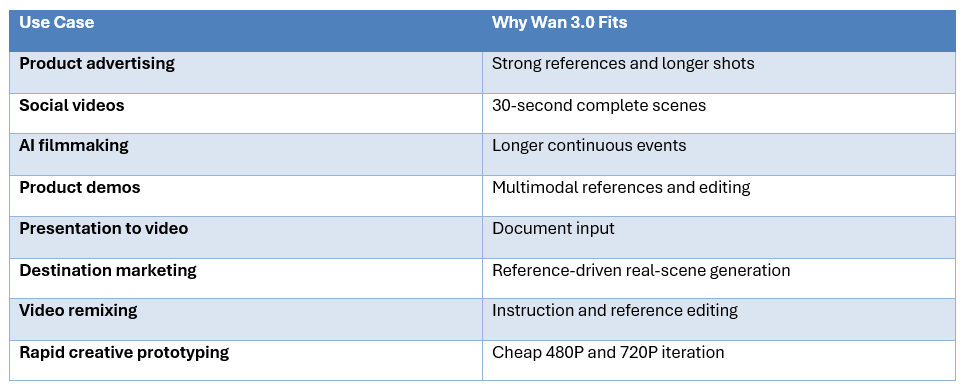
16. Best Use Cases
17. Recommended Production Workflow
The most efficient way to use Wan 3.0 is to separate exploration from final rendering. Generate the concept at lower resolution, verify identity, composition and motion, then spend on the final 1080P version. This reduces the cost of failed high-resolution attempts.
- Define the subject, environment, action and camera before writing the final prompt.
- Choose only the references that actually need to remain stable.
- Draft at 480P or 720P.
- Watch the entire clip, not only the first few seconds.
- Use editing for targeted corrections where possible.
- Generate final approved shots at 1080P.
- Replace or refine native audio when lip-sync or sound design is critical.
For ready-to-use video prompting ideas, see our 100 Best Veo 3 Prompts 2026.
18. Is Wan 3.0 Worth It?
For most creators working on reference-heavy video, yes. The product solves several real problems at once: it can generate a longer scene, preserve reference details, add sound, accept source documents and edit generated footage without requiring a completely separate production stack.
The value becomes especially strong when cost matters. The $1.50 480P, $3 720P and $6 1080P list prices for a full 30-second generation are reasonable for commercial experimentation, and the current temporary 30% discount makes them lower for now.
But the model is not a replacement for human direction. Unexpected camera cuts, imperfect lip-sync, weak on-screen text and some failures on surreal multi-subject prompts mean you still need a review loop. If your process cannot tolerate retries, no generative video model should be treated as a one-click production system.
19. Final Verdict
Wan 3.0 is a meaningful step forward for AI video, and its most important advantage is workflow breadth. It is not just text-to-video. It can take multimodal references and documents, generate up to 30 seconds, add audio, and support editing and extension.
On accuracy, the right conclusion is nuanced. Current same-seed testing shows strong reference fidelity, character consistency and physics, but also exposes unrequested camera cuts. Other testing points to weaker lip-sync and less adventurous behavior on some creative prompts.
On price, the model is compelling. $0.05 per second at 480P, $0.10 at 720P and $0.20 at 1080P are easy to understand, and the temporary 30% discount makes iteration even cheaper through September 24, 2026.
My rating: 9/10 for workflow breadth, 8.5/10 for reference consistency, 8/10 for pricing and 7.5/10 for current overall polish.
Bottom line: Wan 3.0 is worth using when your priority is controlled, reference-heavy video that needs to run longer than a typical short clip. It is less compelling when the brief depends on perfect dialogue lip-sync, exact on-screen text or highly surreal multi-character creativity. For everything in between, it is one of the strongest practical AI video workhorses available in late August 2026.
Frequently Asked Questions
What is Wan 3.0?
Wan 3.0 is Alibaba's all-in-one AI video model available through Alibaba Cloud Model Studio. It supports text, image, audio, video and document inputs and can generate up to 30 seconds per request.
How accurate is Wan 3.0?
There is no single video accuracy score. Current same-seed testing shows strong reference fidelity, identity consistency and physics, while also finding unrequested camera cuts. Other tests have identified lip-sync and text-rendering weaknesses.
How much does Wan 3.0 cost?
The listed rates are $0.05 per second at 480P, $0.10 at 720P and $0.20 at 1080P. A 30-second generation therefore costs about $1.50, $3 or $6 before temporary discounts.
Is Wan 3.0 discounted?
Alibaba Cloud Model Studio currently advertises Wan 3.0 Video Standard at 30% off through September 24, 2026, bringing the advertised rates to $0.035, $0.07 and $0.14 per second.
Can Wan 3.0 generate 30-second videos?
Yes. Alibaba's documentation says Wan 3.0 supports up to 30 seconds per generation at up to 30 fps.
Does Wan 3.0 generate audio?
Yes. It can natively generate dialogue, background music and sound effects.
Can Wan 3.0 use documents?
Yes. Alibaba says it supports DOC, XLS, PPT, PDF, TXT, KEY, Pages, Numbers and Markdown, plus webpage inputs, with a one-file-or-link limit of 100 MB and 50 pages.
Is Wan 3.0 better than Seedance 2.0?
Not universally. Wan tends to win on reference fidelity, identity consistency and physics, while Seedance can be better for surreal creativity and some multi-subject scenes.
Is Wan 3.0 better than Veo 3?
There is no defensible universal winner. Compare the two on the same prompt and references, then measure quality, audio sync, consistency, editability and total cost per usable shot.
Is Wan 3.0 open source?
Alibaba has an official repository, but the current Wan 3.0 product is primarily an Alibaba Cloud API. Do not assume the exact model weights are freely available for local inference.
Is Wan 3.0 worth it?
Yes for reference-heavy video, longer shots, document-to-video and rapid audiovisual content. It is less ideal when perfect lip-sync, exact text or highly surreal multi-subject generation is the main requirement.
Recommended Blogs
- 100 Best Veo 3 Prompts 2026 (Copy-Paste)
- Gemini 3.5 Transcribe Review: Accuracy, Price & Is It Worth It? (2026)
- Qwen3.8-Flash-Next Review: Benchmarks, Cost & Is It Worth It? (2026)
- GLM-5.3-Flash Review: Benchmarks, Price & Is It Worth It? (2026)
- Best Open Source AI Models August 2026: Full Collection
Resources & Community
Join our community of 70,000+ AI enthusiasts and learn to build powerful AI applications. Whether you're a beginner or an experienced developer, Build Fast with AI helps you understand and implement AI in your projects.
- Website - buildfastwithai.com
- LinkedIn - Build Fast with AI
- Instagram - @buildfastwithai
- Founder Twitter - @satvikps
- Twitter - @BuildFastWithAI
Agentic AI Launchpad 2026
A structured 6-week cohort program that takes you from AI basics to building and deploying real-world agentic AI systems. Includes live sessions, expert mentorship, project reviews and a builder community network.
Ready to go from learning to building? Join the next cohort: Agentic AI Launchpad 2026
Free AI Resources
Access free tools, workshops and micro-learning to keep building.
- AI Workshops - Free resources, upcoming events and past recordings
- Unrot - Learn AI in 5 minutes a day