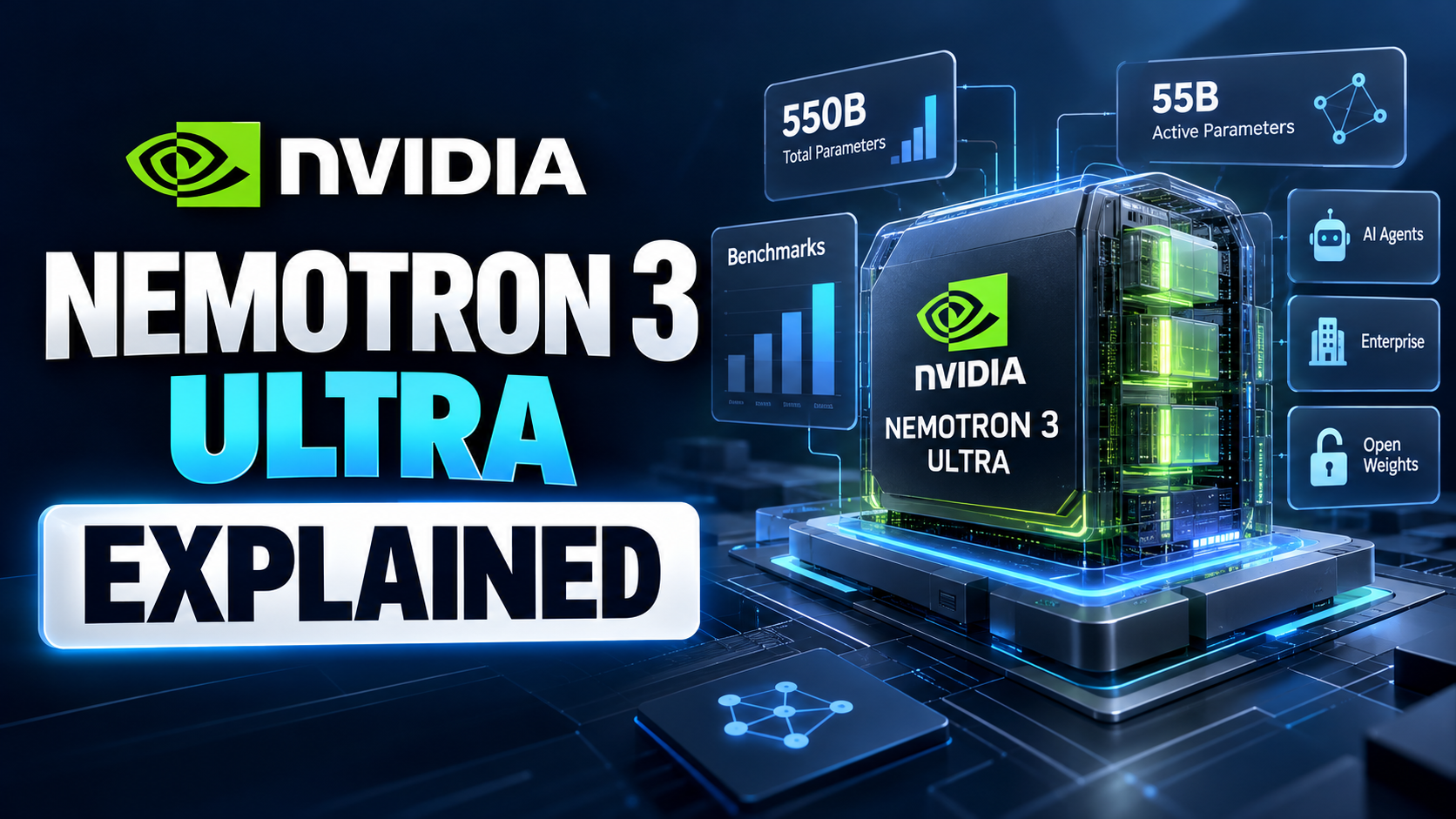
Nemotron 3 Ultra Explained: What NVIDIA's 550B Model Is Built to Do
NVIDIA Nemotron 3 Ultra is a large open-weight reasoning model designed for demanding agentic systems, coding workflows and long-running enterprise tasks. Released on June 4, 2026, it is the largest and most capable member of NVIDIA's Nemotron 3 family, with 550 billion total parameters and 55 billion active parameters. Its purpose is not simply to answer isolated chat questions. It is built for systems that plan, call tools, inspect results, revise their approach and continue working across many steps.
The distinction between total and active parameters matters. Nemotron 3 Ultra uses a mixture-of-experts design, so a token does not require every parameter to be active at once. NVIDIA combines a hybrid Mamba-attention architecture with LatentMoE routing, multi-token prediction and an NVFP4-oriented training and inference strategy. Together, these choices aim to increase useful reasoning capacity while keeping serving throughput practical.
Published evaluations give the model a concrete profile. Artificial Analysis reported an Intelligence Index score of 47.7 in its June release analysis using NVIDIA's recommended NVFP4 weights, with BF16 scoring 48.2 in the same evaluation. NVIDIA's model card separately publishes results for coding and agent tasks, including SWE-Bench Verified and Terminal-Bench 2.1. These scores come from different test suites and precision settings, so they should not be combined into one universal ranking.
Nemotron 3 Ultra is most relevant to AI infrastructure teams, developers building long-running agents, organizations that need open weights, and teams capable of serving a very large model. It is not a lightweight laptop model. The real decision is whether its reasoning, controllability and deployment flexibility justify the hardware and operational effort for your specific workload.
QUICK ANSWER
NVIDIA Nemotron 3 Ultra is a 550-billion-parameter open-weight reasoning model with 55 billion active parameters. It uses a hybrid Mamba-attention mixture-of-experts architecture, LatentMoE, multi-token prediction and an NVFP4 training recipe. NVIDIA positions it for agentic reasoning, coding and long-running enterprise workflows, where the model must do more than produce a single response.
The model is available under NVIDIA's OpenMDW License Agreement, version 1.1, and is described as suitable for commercial and non-commercial use under that license. It supports text-based workflows and a broad set of languages, including English, French, Spanish, Italian, German, Japanese, Korean, Hindi, Brazilian Portuguese and Chinese. Deployment is a serious infrastructure project because the model has 550B total parameters, even though only 55B are active for a token.
The key takeaway: Nemotron 3 Ultra is for teams building and operating AI systems, not for casual local experimentation on a consumer GPU. Evaluate it when open weights, high-throughput reasoning and agent orchestration matter. Compare actual task completion, latency, hardware cost and reliability before selecting it over a smaller model or a hosted frontier API.
1. What Is NVIDIA Nemotron 3 Ultra?
Nemotron 3 Ultra is the flagship model in NVIDIA's Nemotron 3 family. The family includes smaller models aimed at different efficiency and capability tradeoffs, while Ultra targets complex reasoning and longer agent workflows. NVIDIA describes it as a model for long-running agentic systems, including workflows that repeatedly call tools, read outputs and decide what to do next.
That focus separates it from a conventional assistant benchmark story. A chatbot can be judged on a single answer. An agentic model must maintain a goal, select actions, interpret tool results, recover from errors and stop when the job is complete. Small mistakes compound over many steps, so speed, instruction following, tool-use reliability and reasoning efficiency all affect the final outcome.
Nemotron 3 Ultra provides open weights, which gives organizations more control over deployment than a closed API-only model. Open weights do not automatically mean every part of the training pipeline or dataset is public, and they do not remove license obligations. Teams should read the actual license and model documentation before redistribution or commercial deployment.
2. Nemotron 3 Ultra Specifications
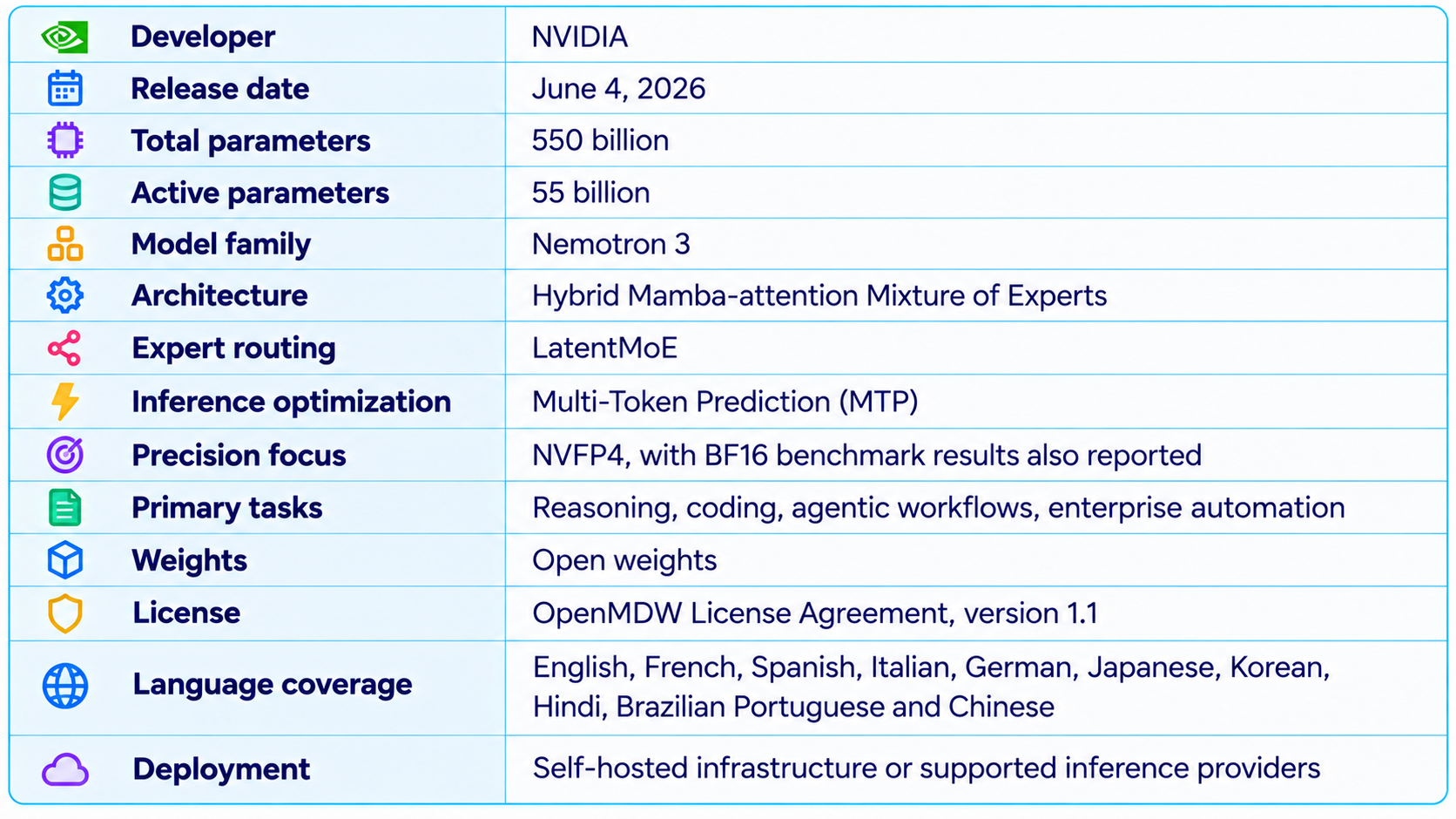
One practical note about context length: a model's advertised context capability and a provider's deployed context limit are not always identical. Confirm the maximum input and output tokens supported by the specific checkpoint, inference engine and serving endpoint you intend to use.
3. Why 550B Total Parameters and 55B Active Parameters Matter
The 550B figure describes the model's total parameter capacity, while 55B active parameters describes the approximate amount activated per token through the mixture-of-experts path. This is a key distinction for understanding Nemotron 3 Ultra. A dense 550B model would generally require computation across its full parameter set for each token. A sparse MoE model routes tokens through selected experts, reducing per-token computation relative to activating every parameter.
Sparse activation does not make the model small in memory. The full set of weights still has to be available across the serving system, whether distributed across GPUs or represented in a supported compressed precision. Memory requirements depend on precision, quantization, runtime overhead, context length, batching and parallelism. Active parameters are therefore not a shortcut for estimating whether the model fits on a single GPU.
For infrastructure planning, think in three separate numbers: total model weight memory, runtime and KV-cache memory, and the compute required to serve a target throughput. Long contexts and concurrent requests can increase memory demand substantially. Measure the actual deployment rather than relying on the active-parameter number alone.
4. The Hybrid Mamba-Attention Architecture
Nemotron 3 Ultra combines Mamba-style sequence modeling with attention layers. The high-level motivation is to balance efficient processing of long sequences with attention's ability to connect information across different parts of a prompt. NVIDIA's model documentation describes the model as a hybrid Mamba-attention MoE architecture rather than a conventional dense Transformer.
For long-running agents, architecture matters because the model may repeatedly consume tool outputs, code, logs, plans and summaries. Efficient sequence processing can help manage the cost of these repeated calls, while attention remains useful for relationships that require direct interaction between distant pieces of context. The hybrid design is intended to balance those demands.
The architecture alone does not guarantee that every long-context task will work. Retrieval quality, prompt structure, context management, serving configuration and the task itself still matter. Teams should test long-document synthesis, repository exploration and tool-result interpretation using their own workloads.
5. What Is LatentMoE?
LatentMoE is NVIDIA's expert-routing approach used in Nemotron 3 Ultra. In a mixture-of-experts model, different expert subnetworks specialize in processing different token patterns. A routing mechanism selects which experts participate for a given token, allowing the model to contain substantial total capacity without activating all experts on every step.
The goal is to improve the quality and efficiency of expert selection. In practice, the benefits depend on the model's learned routing behavior and the serving implementation. A model can have a large parameter count and still be inefficient if routing, memory movement or GPU utilization is poor. That is one reason model architecture and inference engineering must be evaluated together.
For teams deploying Nemotron 3 Ultra, the useful question is not whether MoE is inherently better than a dense model. It is whether the resulting quality-throughput tradeoff performs well on the team's specific tasks and infrastructure budget.
6. Multi-Token Prediction and Inference Speed
Nemotron 3 Ultra includes Multi-Token Prediction layers. NVIDIA describes MTP as a way to accelerate text generation through native speculative decoding. Instead of treating every output token as an isolated generation step, the serving system can use additional prediction structure to improve generation throughput when the implementation supports it.
Speed claims must be read with their measurement conditions. Artificial Analysis reported more than 400 output tokens per second for a pre-release deployment on BlackBox AI in its June analysis. Later provider measurements differ: its provider page reports distinct throughput and latency figures for services such as Nebius, CoreWeave and Fireworks. These are serving results, not an immutable speed of the model independent of hardware.
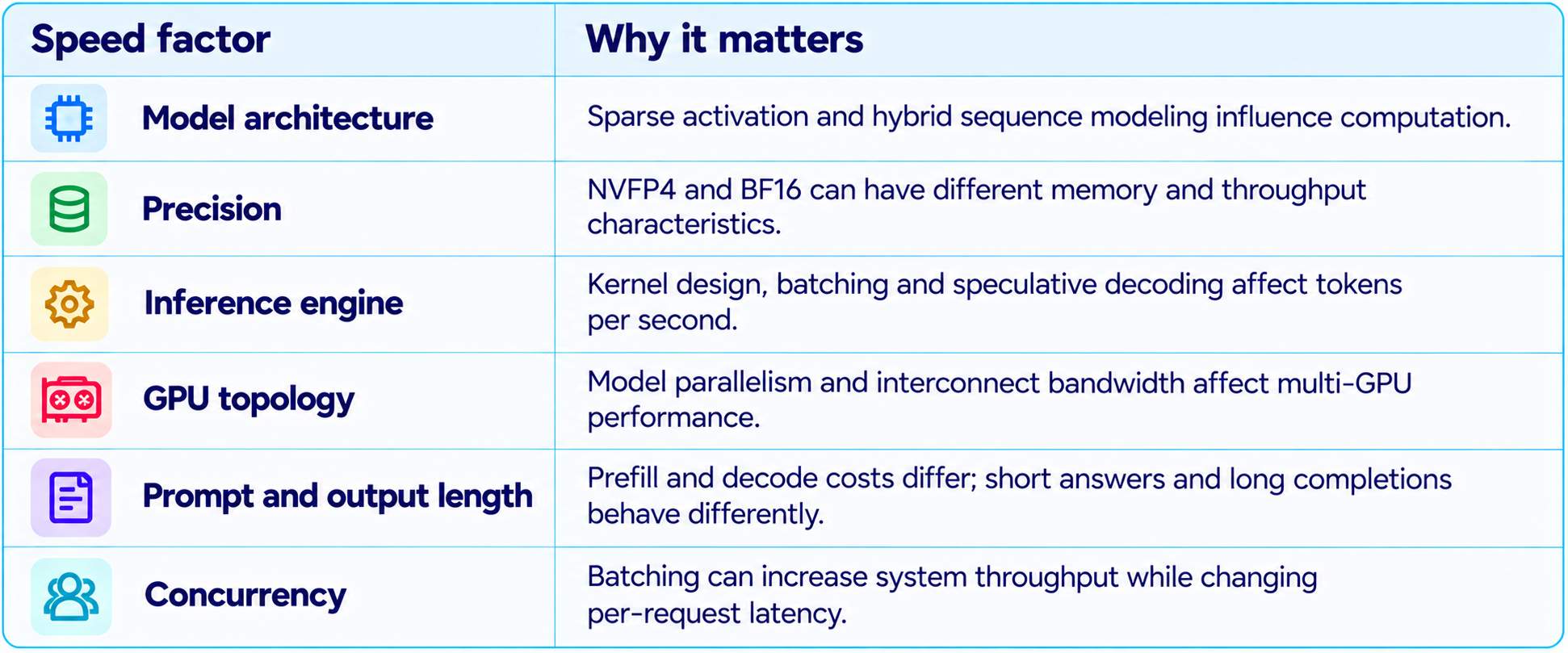
For a production decision, record time to first token, output tokens per second, end-to-end completion time and cost per successfully completed task. Tokens per second alone do not tell you whether an agent is completing useful work faster.
7. Nemotron 3 Ultra Benchmarks
Artificial Analysis evaluated the model ahead of its public release and reported an Intelligence Index score of 47.7 for the recommended NVFP4 weights. Its BF16 result was 48.2 in the same analysis, indicating a small difference in that evaluation. The same report emphasized the model's speed relative to its intelligence and evaluated agentic task performance under turn limits.
NVIDIA's model card reports benchmark results for both BF16 and NVFP4. The results below are copied from the published model card and should be interpreted within their respective benchmark definitions and evaluation setups.
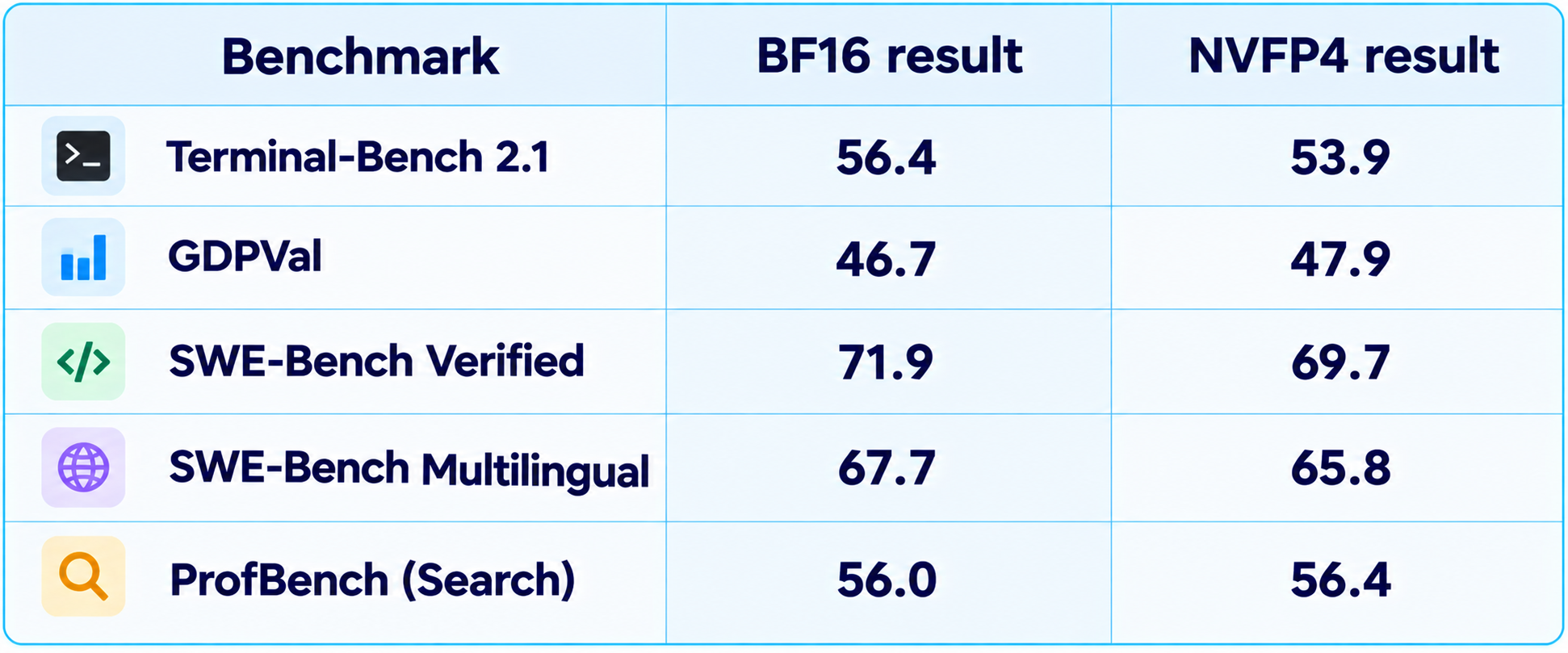
The figures illustrate why precision and evaluation settings should be reported. NVFP4 is designed to improve compute efficiency, but results can vary by benchmark. The table is not a universal ranking against every competing model, and different labs may use different harnesses, prompts, sampling settings or scoring procedures.
Artificial Analysis later added a broader evaluation set that includes agentic knowledge work, long-context reasoning and other intelligence measures. Its live model page should be consulted for the current index version and exact evaluation details. Benchmark indexes change as the evaluation suite evolves, so do not compare scores from different index versions as though they were measured identically.
8. What the Benchmarks Tell You
Terminal-Bench and SWE-Bench target different parts of coding work. Terminal-Bench evaluates tasks carried out in a terminal environment, where an agent must interact with tools and make progress through a sequence of actions. SWE-Bench Verified evaluates issue resolution in real software repositories, with success determined by tests. A model that performs well on one is not automatically best at every form of software engineering.
GDPVal focuses on professional work tasks, while ProfBench (Search) measures research-style tasks. These are relevant to enterprise systems because many agents do not just generate code. They retrieve information, prepare reports, investigate issues and execute structured workflows.
Artificial Analysis also highlighted a 71% result on its AA-Omniscience Non-Hallucination measure in the release analysis. This metric reflects the model's tendency not to answer factual questions when it does not know the answer, under that evaluation's setup. It should not be interpreted as a guarantee that 71% of all real-world responses are hallucination-free.
The best benchmark takeaway is that Nemotron 3 Ultra was evaluated across reasoning, coding, knowledge and agentic behavior, with throughput as a central part of its positioning. For a real deployment, run a small benchmark suite based on your own tools, data and failure conditions.
9. Is Nemotron 3 Ultra Open Source?
Nemotron 3 Ultra is described as an open-weight model, and NVIDIA's model card says it is governed by the OpenMDW License Agreement, version 1.1. The model card states that it is ready for commercial and non-commercial use under those terms. The precise distinction matters: open weights mean the model parameters can be obtained under the applicable license, but this is not identical to a fully open-source release of every training dataset, pipeline and component.
Before using the model commercially, read the license directly and check obligations that may apply to redistribution, derivatives, attribution, acceptable use or downstream products. Legal requirements can depend on the way the weights are used and distributed, so this article is a technical overview rather than legal advice.
Open weights can be valuable when an organization needs control over deployment location, inference configuration, data boundaries or model customization. They also shift more responsibility to the team operating the system: hardware, security, monitoring, upgrades and evaluation become part of the deployment.
10. Can You Run Nemotron 3 Ultra Locally?
Yes, through an appropriately provisioned self-hosted inference setup, but 'locally' should not be confused with running it on a typical consumer laptop. At 550B total parameters, Nemotron 3 Ultra is a large multi-GPU serving workload. A consumer GPU with 24GB of VRAM is not enough to hold the complete model weights in a normal deployment.
The hardware requirement depends on the weight format, runtime, tensor and pipeline parallelism, context length, concurrency and target speed. NVFP4 can reduce weight-memory requirements relative to higher precision, but it does not make the full deployment trivial. You also need memory for runtime state, KV cache and intermediate buffers.
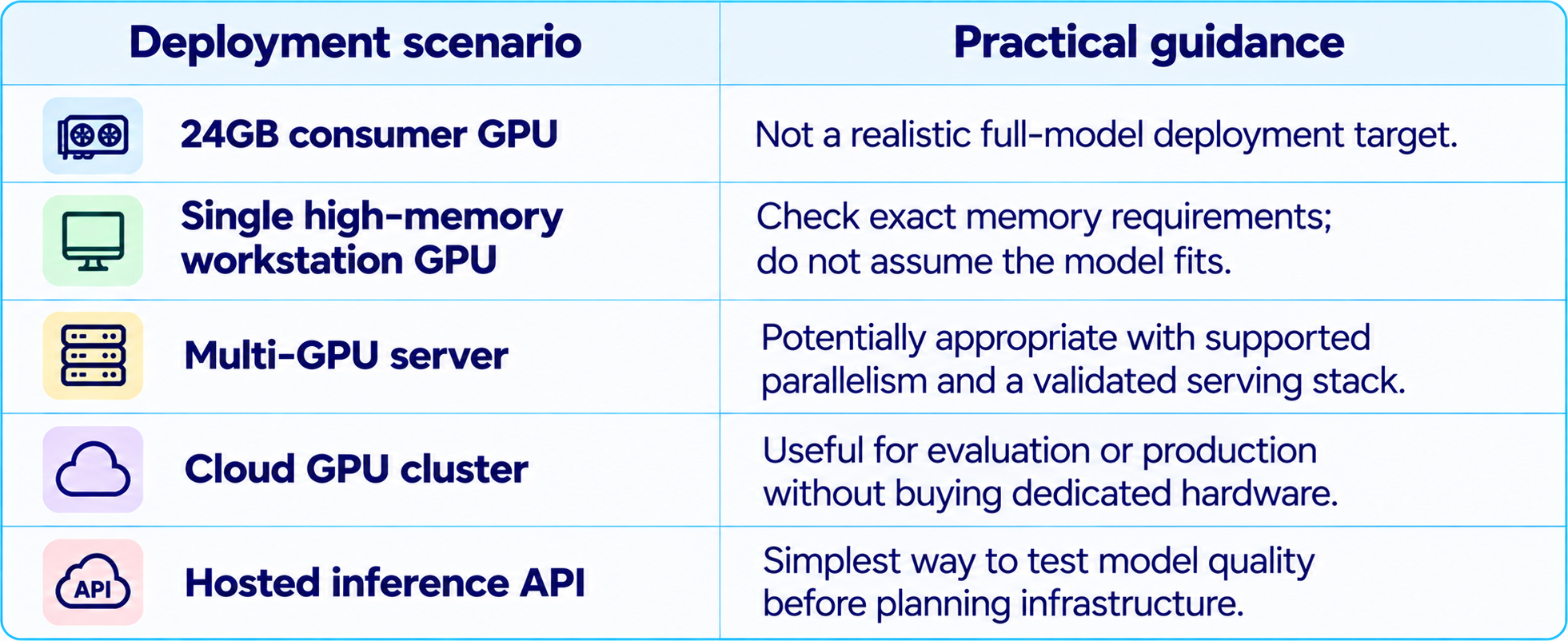
If your goal is to run models on a desktop with 24GB VRAM, start with smaller open-weight models and use Nemotron 3 Ultra through a hosted endpoint for comparison. Our 24GB VRAM AI models guide explains how to match model size and quantization to consumer hardware.
11. What Is the Context Window?
Nemotron 3 Ultra is designed for long-context and agentic workloads, but the exact context limit should be confirmed against the current checkpoint documentation and serving provider. An inference endpoint can expose a different maximum than the model's theoretical or documented capability, and maximum context can be affected by memory constraints.
Long context is useful for large repositories, lengthy technical documentation, multi-document research and agent workflows that accumulate tool results. But a large window is not a substitute for context engineering. Irrelevant material can distract the model, increase latency and raise memory use. Keep the active context focused, summarize completed steps and retrieve evidence relevant to the current decision.
For a deeper explanation of context selection, memory and prompt structure, see our Context Engineering Complete Guide.
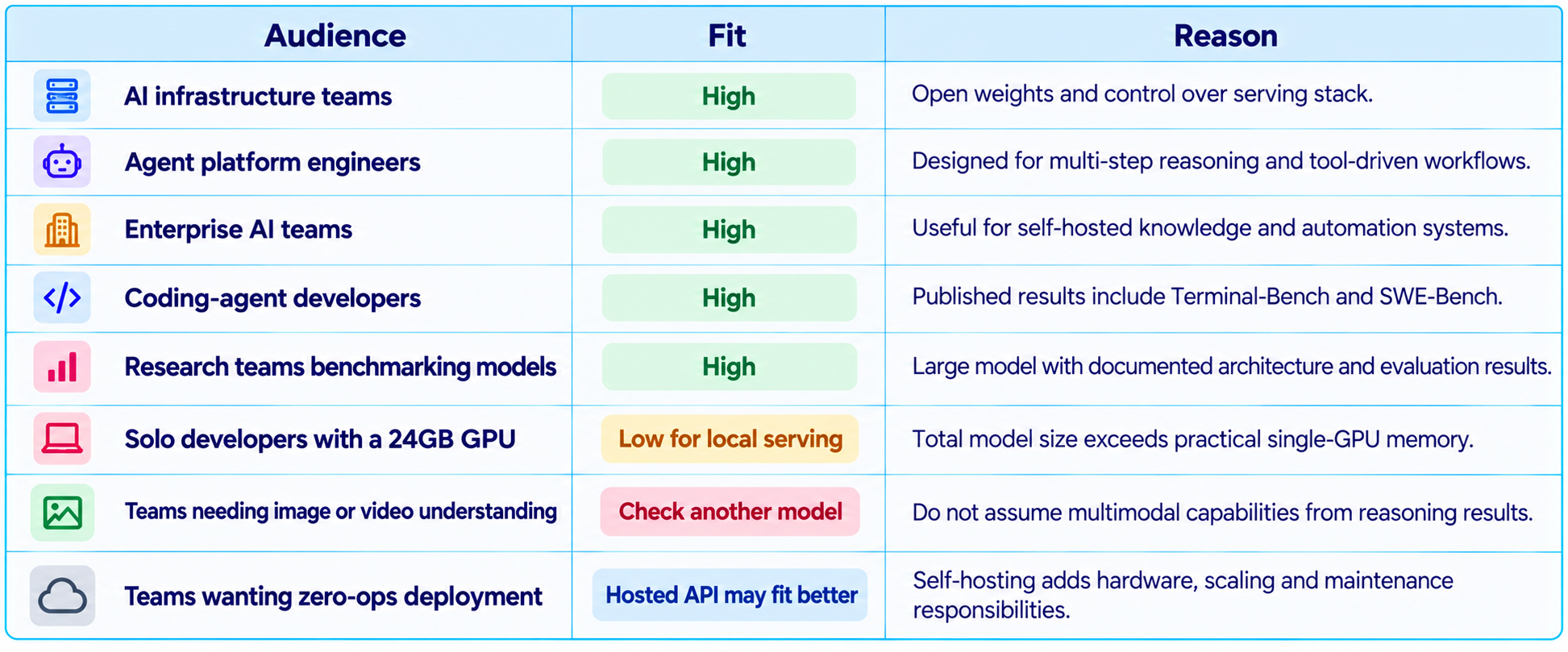
12. Who Is Nemotron 3 Ultra For?
13. Best Use Cases
Long-running AI agents
Nemotron 3 Ultra is designed for workflows where the model repeatedly plans, calls tools, checks outputs and continues. Examples include software maintenance agents, IT operations, research assistants and enterprise process automation. Evaluate whether it can complete the whole workflow with fewer retries, not just whether its individual answers look good.
Coding and repository work
Coding agents need to inspect a repository, understand issue context, edit files, run tests and respond to failures. Nemotron 3 Ultra's published SWE-Bench and Terminal-Bench results make this a relevant evaluation area. Your own tests should include realistic repositories, hidden tests, tool errors and requirements that can be misunderstood.
Enterprise research and document analysis
Long-context reasoning can help an agent synthesize policies, technical documents, logs and internal knowledge. Keep source provenance and evidence extraction in the workflow so users can verify conclusions.
Self-hosted AI platforms
Open weights may suit organizations that want to control where inference happens and how requests are logged. The tradeoff is that infrastructure teams become responsible for uptime, capacity planning, security and model updates.
High-throughput reasoning services
Multi-token prediction and optimized inference are relevant when an application serves many requests or needs to keep an agent loop responsive. Measure throughput under expected concurrency instead of extrapolating from a single benchmark run.
14. Nemotron 3 Ultra vs Nemotron 3 Super
Nemotron 3 Super is the smaller sibling in the same model family, while Ultra is the larger flagship with 550B total and 55B active parameters. Ultra is intended for more demanding reasoning and agentic workloads. Super can be more practical when hardware capacity, cost or throughput at a given deployment size is the main constraint.
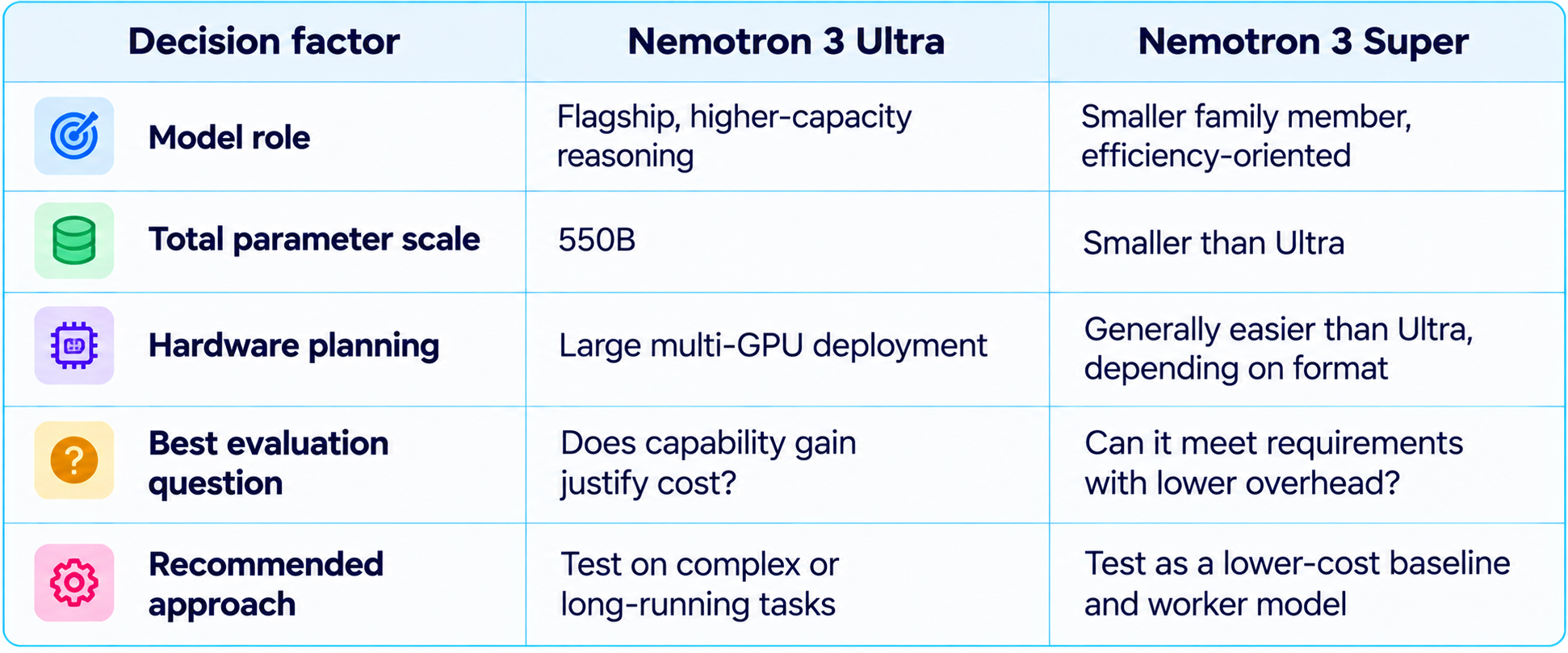
Avoid choosing based on model size alone. Benchmark both on your actual workload and compare cost per successful task, latency, tool-call reliability and recovery from errors.
15. Nemotron 3 Ultra vs Other Open-Weight Models
Nemotron 3 Ultra competes in a crowded open-weight landscape that includes models optimized for coding, general reasoning, long context and efficient serving. No single model is automatically best across all of those dimensions. A model that scores higher on an aggregate intelligence index may be slower, harder to serve or more expensive for a particular agent workflow.
Our Best Open-Source AI Models guide maps the broader field, while the Qwen 3.8 Max 0902 review covers a different model profile with its own reasoning, coding and API tradeoffs. For a very large model focused on enterprise agents, also see our Quasar 438B review.
For coding workloads, use a controlled comparison: same issue, same repository state, same tools, same test suite and a defined token or time budget. For agentic workflows, include tool-use errors, recovery, stopping conditions and human approval. For long-context work, test whether the model can find and correctly use evidence placed at different points in the context.
16. Deployment and Serving Considerations
Before deploying Nemotron 3 Ultra, decide whether you need self-hosting or whether a managed endpoint is sufficient. Self-hosting gives more control over the runtime and deployment environment, but it requires hardware procurement or cloud capacity, observability, scaling, security and ongoing performance tuning.
- Start with a hosted evaluation endpoint or a small controlled test before committing to hardware.
- Build a task set from real agent requests, including successful cases, edge cases and known failure modes.
- Record the exact checkpoint, precision, inference engine, context limit and decoding settings.
- Measure end-to-end latency, not only output tokens per second.
- Track GPU memory, utilization, queue time, concurrency and failure rates.
- Compare cost per completed task across model and serving configurations.
- Add logging, access controls, timeouts and a safe fallback path before exposing the model to production users.
NVIDIA's Dynamo documentation includes a Nemotron 3 Ultra serving recipe with benchmark profiles. Use the current official recipe and deployment documentation rather than copying hardware assumptions from an unrelated model or provider.
17. Security and Reliability for Agent Workflows
An open-weight model can be run in a controlled environment, but open weights do not automatically make an agent secure. If the model can access a shell, source repository, browser, database or internal API, the surrounding application must enforce permissions independently of model instructions.
- Give each tool the minimum permissions needed for its task.
- Require approval before destructive operations, production changes or sensitive data exports.
- Validate tool arguments against strict schemas before execution.
- Keep secrets out of prompts and restrict which processes can read credentials.
- Use timeouts, retry limits and explicit stop conditions to prevent runaway loops.
- Log tool calls and important state transitions without unnecessarily storing sensitive data.
- Test prompt injection and malicious content in documents that the agent may inspect.
Our guide on securing AI coding agents covers permission boundaries, sandboxing, MCP tools and secrets. For multi-agent orchestration patterns, see How to Use LangGraph for Multi-Agent Systems.
18. A Practical Evaluation Checklist
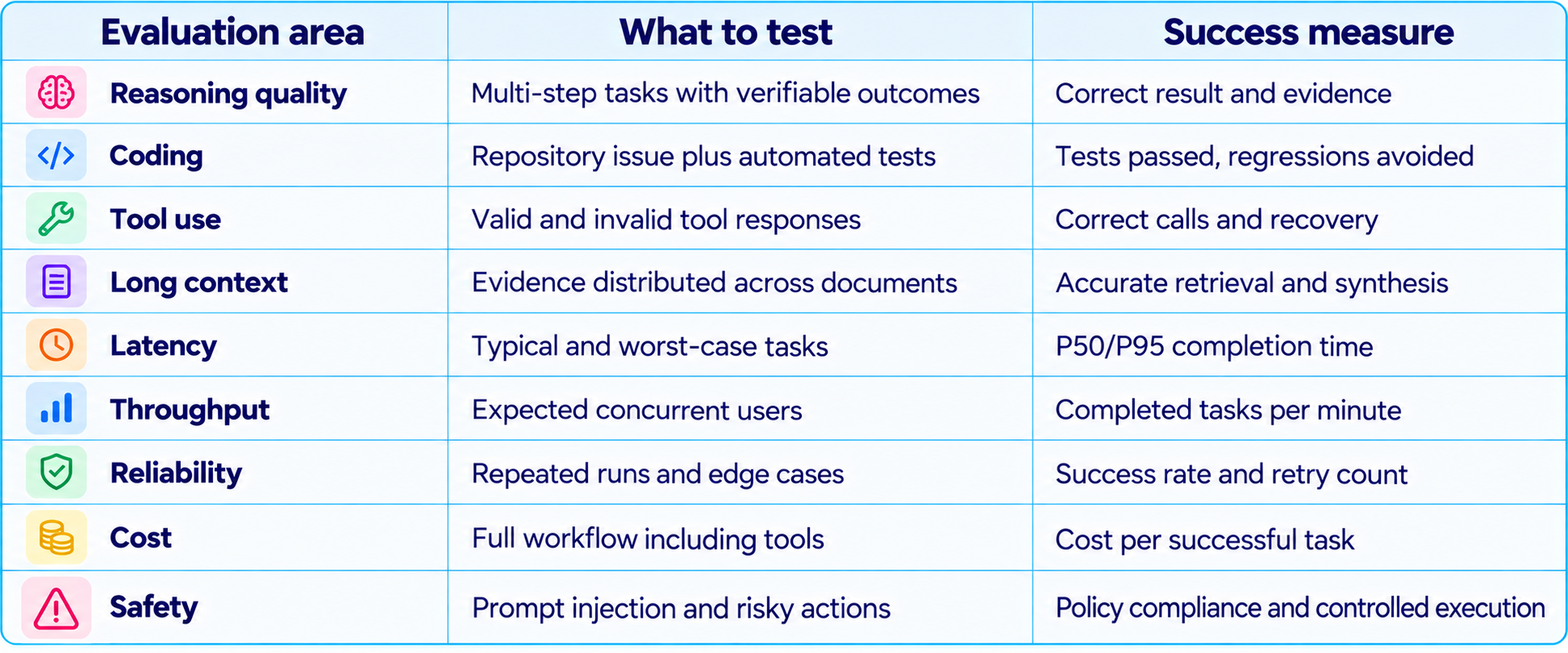
Run the same test set against at least one smaller open-weight model and one hosted model. This helps identify whether Nemotron 3 Ultra's capability profile is necessary or whether a smaller model can meet the requirement at lower operational cost.
19. Common Misconceptions
“55B active parameters means it fits on a 55B-sized GPU budget.”
Not necessarily. The full expert weights must be available to the serving system. Active parameters describe per-token activation, not the complete memory footprint.
“Open weights means fully open source.”
Open weights and open-source software are not interchangeable terms. Read the model's license and check what components are actually released.
“More tokens per second means the agent is better.”
Throughput matters, but a fast model that needs repeated retries may be slower and more expensive per completed task than a slower model that succeeds on the first attempt.
“A benchmark score predicts every production workload.”
Benchmarks are useful signals, not guarantees. Task distribution, prompts, tools, precision and inference setup affect results.
“A million-token context means every task should use the full window.”
Use the smallest relevant context that preserves the evidence needed for the task. Context engineering improves focus, latency and cost.
20. Is Nemotron 3 Ultra Worth Evaluating?
Nemotron 3 Ultra is worth evaluating when you need an open-weight model for demanding reasoning, coding and agentic workloads, and you have the infrastructure to serve it. Its hybrid architecture, 550B total and 55B active parameters, MTP acceleration and published benchmark results make it a substantial model-engineering effort rather than a lightweight drop-in chatbot.
Its strongest case is not that it should replace every other model. It is that organizations can inspect and control the deployment more directly while targeting long-running agent tasks and high-throughput inference. Whether that translates into better economics depends on task completion rate, serving costs, reliability and the level of operational control your organization needs.
For teams without the hardware or operations capacity, a hosted endpoint is a sensible way to test the model before planning self-hosting. For developers working on a consumer GPU, a smaller model will usually be the more practical local starting point.
21. Final Takeaway
NVIDIA Nemotron 3 Ultra is a 550B-total, 55B-active open-weight reasoning model built for agentic systems, coding and long-running enterprise workflows. Its hybrid Mamba-attention MoE design, LatentMoE routing, multi-token prediction and NVFP4-focused approach target a combination of reasoning capacity and inference efficiency.
The published evidence includes an Artificial Analysis Intelligence Index score of 47.7 for the recommended NVFP4 weights in its June release evaluation, along with NVIDIA-reported results for Terminal-Bench 2.1, SWE-Bench Verified, SWE-Bench Multilingual and other tasks. These results provide useful starting points, but precision, benchmark harness and serving provider must be kept clear when comparing scores.
The practical barrier is deployment. Nemotron 3 Ultra is not a realistic single-GPU model for a typical 24GB consumer card. Teams should evaluate it through a hosted endpoint or multi-GPU infrastructure, measure the full agent workflow and compare cost per completed task with smaller alternatives.
Bottom line: Nemotron 3 Ultra is aimed at builders who need open weights, advanced reasoning and agent-oriented throughput, and who can support a large-model serving stack. Choose it based on measured task performance and operational fit, not parameter count or a single leaderboard.
Frequently Asked Questions
What is Nemotron 3 Ultra?
It is NVIDIA's 550B-total, 55B-active open-weight reasoning model for coding, agentic systems and enterprise workflows.
When was Nemotron 3 Ultra released?
NVIDIA published the model on June 4, 2026.
Is Nemotron 3 Ultra open source?
It is an open-weight model distributed under the OpenMDW License Agreement, version 1.1. Open weights do not necessarily mean every training component is open source.
How many parameters does it have?
It has 550 billion total parameters and 55 billion active parameters.
What architecture does it use?
A hybrid Mamba-attention mixture-of-experts architecture with LatentMoE routing.
What is NVFP4?
It is a low-precision numerical format NVIDIA uses in its model training and inference strategy to improve compute efficiency.
Is Nemotron 3 Ultra good for coding?
NVIDIA reports results on SWE-Bench Verified, SWE-Bench Multilingual and Terminal-Bench 2.1. Evaluate it on your repository and test suite before selecting it.
Can I run Nemotron 3 Ultra on a 24GB GPU?
A 24GB GPU is not a practical target for serving the complete 550B model. Use a supported multi-GPU setup or hosted endpoint.
What is its context window?
Check the current model documentation and specific serving endpoint for the exact supported context limit.
Does it support multiple languages?
NVIDIA lists English, French, Spanish, Italian, German, Japanese, Korean, Hindi, Brazilian Portuguese and Chinese.
Who should use Nemotron 3 Ultra?
AI infrastructure teams, enterprise developers and agent-platform builders with access to substantial serving capacity.
Should I choose Nemotron 3 Ultra over a smaller model?
Only if your evaluation shows that its capability or deployment control improves task success enough to justify the additional serving complexity and cost.
Recommended Blogs
Explore these related Build Fast with AI guides to compare open-weight models, understand agent architecture and plan real deployments.
24GB VRAM AI Models: What Can You Actually Run Locally in 2026?
Qwen 3.8 Max 0902 Review: Benchmarks, Price & Is It Worth It? (2026)
Quasar 438B Review: Benchmarks, Speed, Price & Is It Worth It? (2026)
How to Secure AI Coding Agents: Permissions, Sandboxing, MCP & Secrets
Resources & Community
Join our community of 70,000+ AI enthusiasts and learn to build practical AI applications, agents and automation workflows.
Agentic AI Launchpad 2026
A structured six-week cohort program focused on building and deploying real-world agentic AI systems, with live sessions, mentorship, project reviews and a builder community.
Explore Agentic AI Launchpad 2026
Free AI Resources
Access workshops and short-form AI learning resources to keep building.