
Mercury 3 Review: Can Inception's Diffusion LLM Make Real-Time AI Agents Faster?
Mercury 3 is Inception's newest diffusion-based large language model, announced on October 19, 2026. Its central promise is straightforward: scale up model capability without giving up the unusually fast generation that made the Mercury family interesting. Inception says Mercury 3 is more than 40 times larger than Mercury 1, runs at 1,068 output tokens per second on NVIDIA GPUs, and expands the context window to one million tokens.
The release is relevant because latency is not just a benchmark statistic for AI agents. A browser agent may need to plan, click, inspect a page, summarize what changed and decide what to do next. A coding agent may run tests, inspect logs, patch a file and repeat. When every model response is a bottleneck, lower latency can make the entire workflow feel more responsive.
There is an important distinction between what is documented and what is claimed. Inception has published numeric results for selected benchmarks and makes a comparative quality claim against speed-optimized models such as GPT-6 Luna and Claude Haiku 5.5. However, the release does not provide a complete independent benchmark suite proving Mercury 3 is better at every task. The right review is therefore to examine the published evidence, the pricing and the model's likely fit for real workloads.
QUICK ANSWER
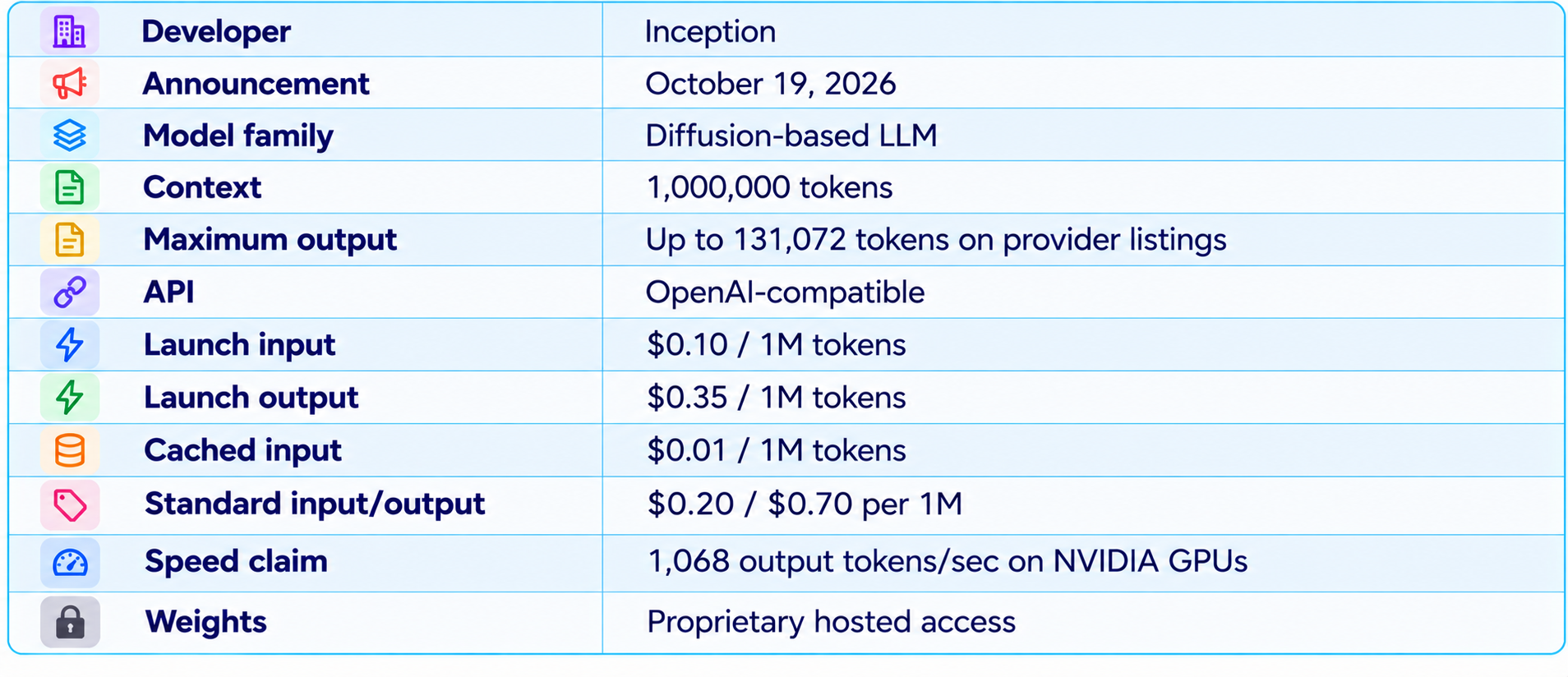
Mercury 3 is a proprietary diffusion-based language model from Inception, designed for fast responses in agentic and real-time applications. It has a 1M-token context window, supports up to 131,072 output tokens according to current provider listings, and is accessible through an OpenAI-compatible API.
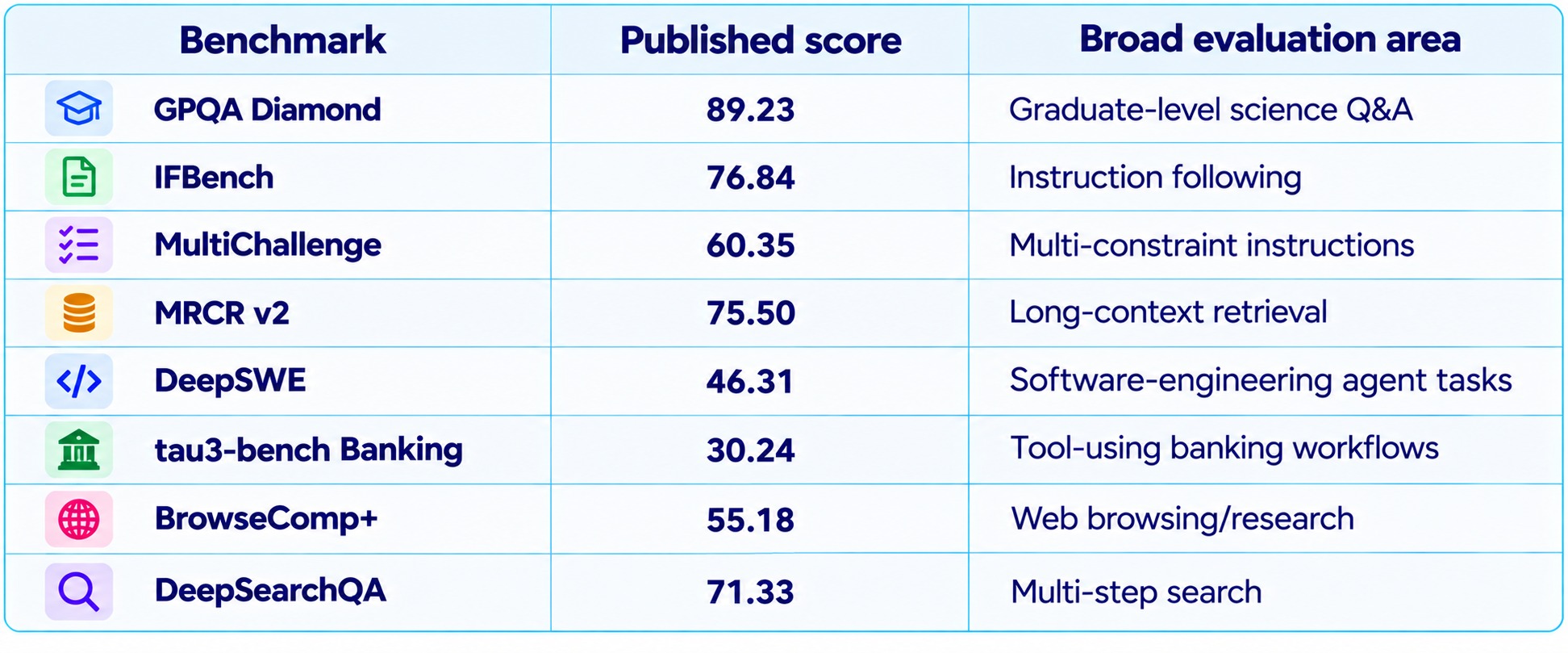
Inception reports 1,068 output tokens per second on NVIDIA GPUs and says Mercury 3 performs on par with or better than speed-optimized models such as GPT-6 Luna and Claude Haiku 5.5 across a range of benchmarks. The launch announcement includes scores for GPQA Diamond (89.23), IFBench (76.84), MultiChallenge (60.35), MRCR v2 (75.50), DeepSWE (46.31), tau3-bench Banking (30.24), BrowseComp+ (55.18) and DeepSearchQA (71.33). These are provider-reported figures, and the announcement does not specify every evaluation harness detail.
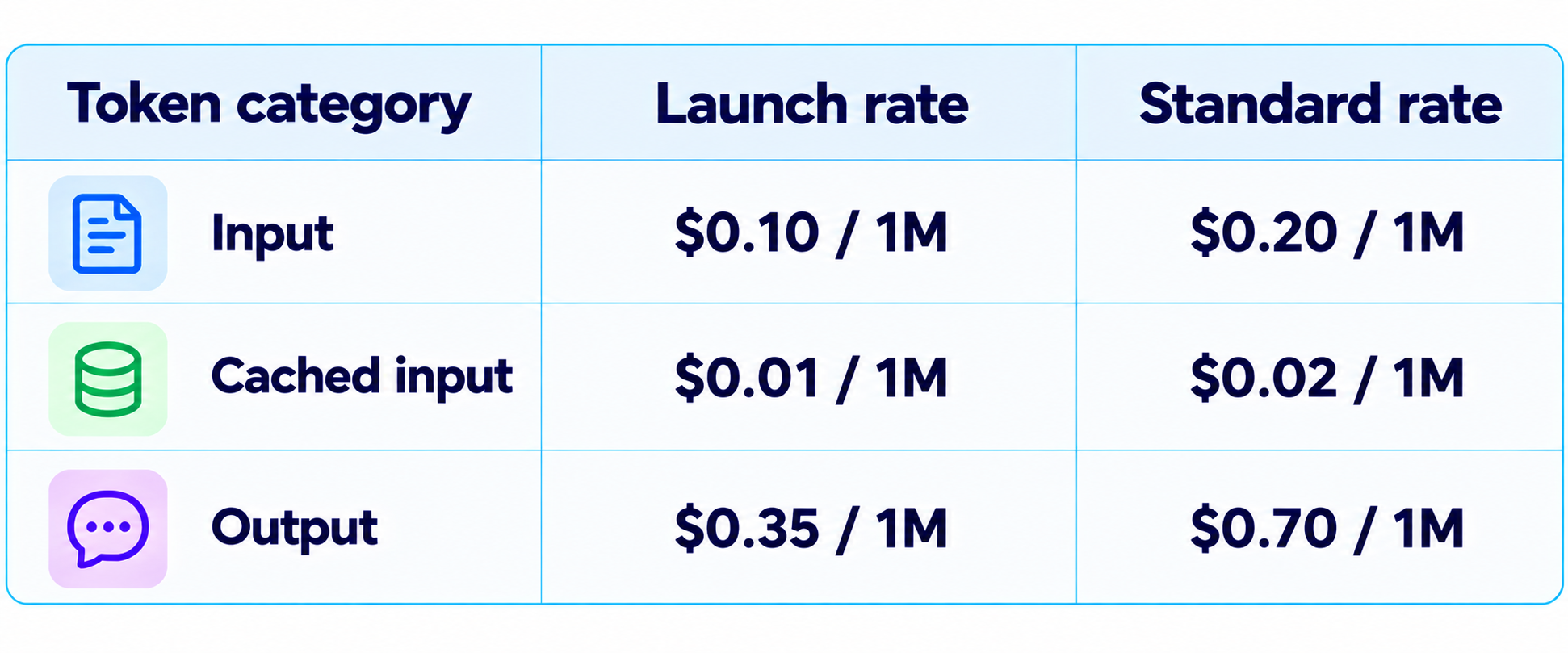
Launch pricing is $0.10 per million input tokens, $0.35 per million output tokens and $0.01 per million cached input tokens, representing a 50% launch discount against standard prices of $0.20 input and $0.70 output. Inception has not stated an end date for the launch offer in the reviewed pricing material.
Verdict: Mercury 3 is worth testing when latency, long context and high-volume agent calls matter. Its strongest differentiator is the combination of diffusion-based generation, a 1M context window and low launch pricing. Before making it your default model, run your own coding, tool-use, instruction-following and production-latency evaluations.
1. What Is Mercury 3?
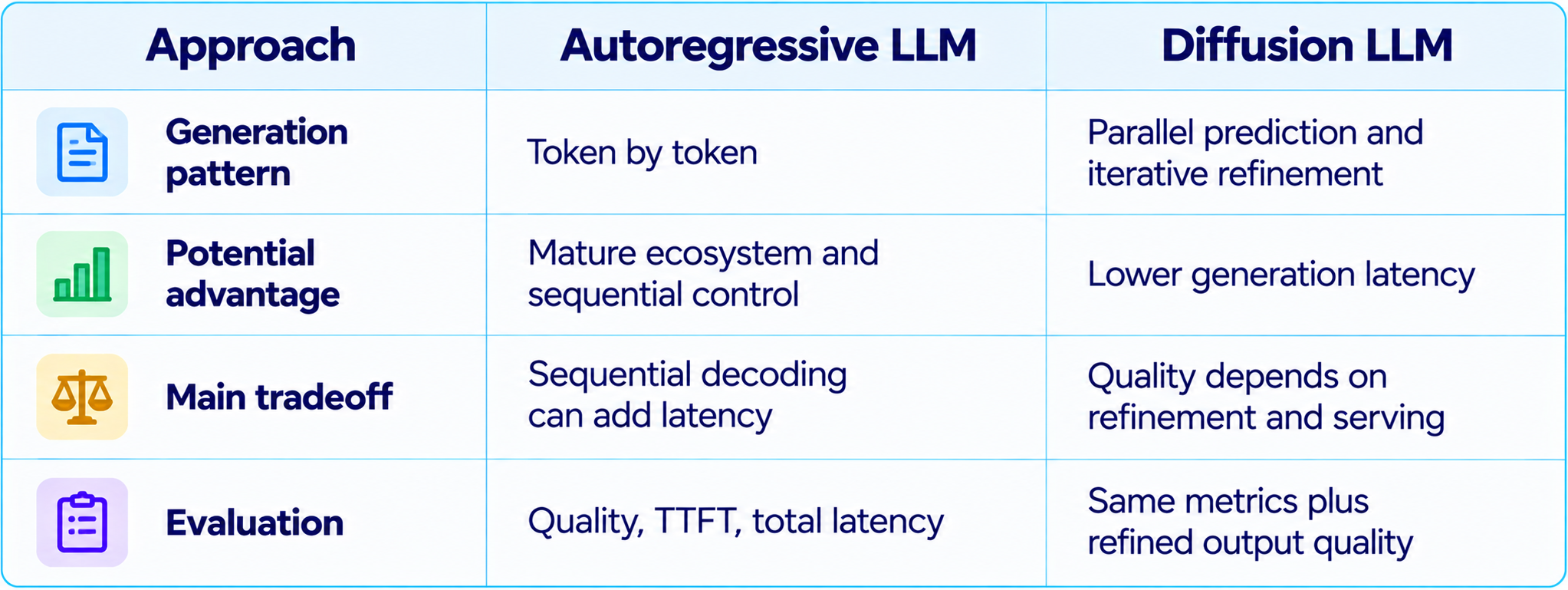
Mercury 3 is the flagship model in Inception's diffusion language-model family. Unlike conventional autoregressive LLMs, which generate text sequentially from left to right, diffusion LLMs generate and refine groups of tokens in parallel. The approach is intended to reduce the sequential work required to produce a response.
Mercury 3 is not simply Mercury 2.5 with a larger context limit. Inception describes it as more than 40 times larger than Mercury 1 and says its intelligence has increased substantially across the family while retaining generation speeds above 1,000 tokens per second on NVIDIA GPUs. The company presents the release as evidence that diffusion models can scale beyond lightweight or narrowly specialized tasks.
2. Mercury 3 Specifications
Mercury 3 has a published one-million-token context window and is listed by providers with output capacity up to 131,072 tokens. The model is proprietary and offered through hosted APIs rather than a downloadable checkpoint. Public launch materials do not disclose an exact parameter count or a full training recipe, so neither should be guessed from the company's scaling description.
The API is OpenAI-compatible, and the launch announcement names Inception's platform alongside OpenRouter, Baseten and Vercel. Compatibility reduces migration work, but developers should still verify model IDs, output limits, tool-call behavior, structured-output support, streaming, error handling and provider-specific terms.
3. How Diffusion LLMs Work
Most familiar language models use autoregressive decoding. The model predicts a next token, appends it to the output and then predicts another token using the growing sequence. This process is powerful, but it creates a sequential dependency: later tokens wait for earlier ones.
A diffusion language model takes a different route. It begins from a partially masked or incomplete representation and iteratively predicts or refines multiple token positions. Since the model can work on groups of positions in parallel, it can potentially produce a finished response with fewer sequential generation steps.
4. Mercury 3 Benchmarks: What Has Been Published?
Inception's launch materials include numeric scores across reasoning, instruction following, long-context retrieval, coding and agent benchmarks. These results give developers concrete starting points for evaluation, but they should be labeled as provider-reported unless a separate evaluation reproduces the exact setup.
The range of tasks is more informative than any one score. GPQA Diamond provides a signal for difficult science questions; IFBench and MultiChallenge address instruction adherence; MRCR v2 relates to long-context retrieval; DeepSWE and tau3-bench examine agent-like tasks; BrowseComp+ and DeepSearchQA focus on research and browsing.
The launch page does not provide all the information needed for a fully reproducible comparison, including every harness revision, sample count, tool budget and run configuration. Treat the numbers as the published launch snapshot, not as a universal ranking across all models or use cases.
5. Does Mercury 3 Beat GPT-6 Luna and Claude Haiku 5.5?
Inception says Mercury 3 performs on par with or better than speed-optimized models such as GPT-6 Luna and Claude Haiku 5.5 across a range of benchmarks, while running four to eight times faster. This is the headline competitive claim, but 'across a range' does not mean Mercury 3 wins every benchmark, prompt type or production workload.
A useful evaluation should compare the exact task. For a coding subagent, run the same repository issues, tool definitions and test suites. For browsing, use the same pages and success criteria. For customer support, test policy compliance, factual accuracy, refusal behavior and escalation. Broad model comparisons are useful for screening, but task-specific evaluation should determine deployment.
6. Speed: Understanding the 1,068 Tokens-per-Second Claim
Inception's headline number is 1,068 output tokens per second on NVIDIA GPUs. That is an impressive throughput claim, but it should not be confused with the complete time a user waits. Tokens per second measures generation throughput under a particular serving configuration. End-to-end latency also includes queueing, prompt processing, reasoning, tool calls, network transfer and application overhead.
For your own test, record time to first token, time to final response, output tokens per second, number of tool calls, successful task completion and total cost. A model with a spectacular throughput figure is valuable only when the full workflow becomes faster without a material loss in accuracy.
7. Mercury 3 Pricing: Launch Discount and Standard Rates
Inception's published launch price is $0.10 per million input tokens and $0.35 per million output tokens. Cached input is listed at $0.01 per million tokens. The standard rates shown alongside the promotion are $0.20 input and $0.70 output per million tokens, so the launch discount cuts those two rates by 50%.
At launch pricing, one million input tokens plus one million output tokens costs $0.45 before any other charges or platform-specific terms. At the listed standard rates, the same mix costs $0.90. Real workloads often use different input/output ratios, so estimate cost from actual token logs rather than relying on a blended headline.
Inception's reviewed launch materials do not state a fixed end date for the discount. Budget conservatively by checking the live pricing page before production deployment and modelling spend at standard rates as well as the promotional rate.
8. The 1M-Token Context Window
Mercury 3 expands the Mercury 2.5 context window from 260,000 tokens to one million tokens. That gives it more room for large document collections, repository context, conversation histories, policy manuals and research material in a single request.
A large context window is useful when the task requires connections across many pieces of information. An enterprise assistant may need to compare a support ticket with product documentation, internal policy and previous incident notes. A coding agent may need several files, test output and project instructions at once.
9. Coding and Software Engineering
Mercury 3's published DeepSWE result gives developers a starting point for assessing software-engineering potential. The benchmark is relevant to agent workflows, but a single score cannot tell you how the model will behave in your repository, language stack or tool environment.
The best use case to test first is as a coding subagent: have it inspect a task, propose a minimal patch, run or interpret tests, and summarize remaining risks. Keep repository permissions limited and require tests before merging. Fast generation can make repeated debugging cycles more responsive, but speed does not remove the need for validation.
The important metric is cost per accepted change, not tokens per second alone. Count successful tasks, retries, regressions, review time and failures that require a stronger model. For model selection across different task types, model routing can be more efficient than forcing one model to handle every request.
10. Browser Agents, Search and Real-Time Workflows
Inception specifically highlights browser-use agents, real-time search agents and web navigation as target applications. These workflows can involve many model decisions in sequence: choose a search, inspect a result, extract evidence, decide whether more research is needed, and produce a grounded answer.
Mercury 3's reported BrowseComp+ and DeepSearchQA results provide relevant launch evidence for this category. The one-million-token context may also help when the agent must consolidate results from many sources. Still, browsing quality depends on the browser tools, search index, page access, source ranking and the model's ability to distinguish evidence from inference.
A reliable research agent should cite the source of each major claim, mark missing evidence and stop when additional searches are unlikely to change the answer. Fast browsing is valuable only when it produces accurate, useful research rather than quickly collecting irrelevant pages.
11. Customer Support, Voice and Interactive Tutoring
Inception says early-access partners are using Mercury 3 for voice and chat support, interactive education, real-time search and browser agents. These use cases share one requirement: the model needs to respond quickly enough to keep a conversation or workflow moving.
For customer support, throughput is only one part of quality. A support agent must follow policy, use account data correctly, avoid inventing refunds or commitments, and escalate when evidence is insufficient. For tutoring, it should adapt explanations to the learner and check understanding instead of merely producing a fast answer.
12. Mercury 3 vs Mercury 2.5
Mercury 3 is the clear upgrade in context capacity and the scale of Inception's capability claims. Mercury 2.5 has a 260K context window, while Mercury 3 offers 1M. Mercury 3's launch pricing is higher than some promotional third-party rates that have been listed for Mercury 2.5, so the newer model is not automatically the cheaper option per token.
Do not transfer Mercury 2.5 latency or throughput numbers to Mercury 3. They are separate model releases and may run on different infrastructure. Compare both through the same provider, with the same prompt set and settings, before deciding whether the upgrade is worth the price difference.
13. Mercury 3 vs Other Fast Models
The most relevant comparison is not simply 'which model is smartest?' It is which model delivers sufficient quality at the latency and cost your application can tolerate. Mercury 3's published price and speed profile make it worth testing alongside low-latency general-purpose models, while a stronger reasoning model may still be preferable for difficult or high-risk work.
Mercury 3 is a candidate when low latency, large context and frequent agent calls matter. Mercury 2.5 may remain sensible where an existing application already works well or a provider offers a lower rate. Premium reasoning models can be preferable when the task is complex, expensive to get wrong or hard to verify. Open-weight models may be better where self-hosting and data control are priorities.
14. API Integration and Developer Experience
Inception describes Mercury 3 as OpenAI API-compatible and shows availability through its own API, OpenRouter, Baseten and Vercel. That makes it easier to test in applications already built around chat completions, although each provider may expose different settings, routing behavior, logging, rate limits and commercial terms.
Before shipping, verify the exact model identifier, output limits, streaming behavior, tool-calling support, structured-output behavior, retries and error semantics with the provider you select. Do not assume every gateway implements every API feature identically just because the base interface is compatible.
15. Limitations and Risks
The 1,068 tokens-per-second figure is an Inception-reported NVIDIA GPU result, not a universal end-to-end latency guarantee. The launch benchmark figures are provider-reported, and the public announcement does not specify every harness revision, sample size or tool budget.
The public material does not disclose a precise parameter count or a complete training recipe. Mercury 3 is proprietary hosted access, not a downloadable open-weight model. High throughput does not guarantee correct tool use, factual answers or successful task completion.
Provider routing and gateway implementations can produce different latency, availability and pricing outcomes. The launch discount may change, so production budgets should include standard rates. Text-token speed does not directly measure the responsiveness of a complete speech or voice pipeline.
16. How to Evaluate Mercury 3 Before Production
Use a representative evaluation set rather than relying on the launch benchmark list alone. The aim is to determine whether Mercury 3 makes your own application faster without increasing retries, failures or downstream verification work.
Measure instruction following, coding correctness, tool choice, long-context retrieval, research evidence quality, time to first token, time to completed task, cost per successful task and recovery from malformed outputs. The final decision should be based on real workload performance.
17. Recommended Production Workflow
Start with low-risk, latency-sensitive tasks such as summarization, extraction or internal search. Use structured output when the response feeds another service, and validate the schema before acting on it.
Keep tool permissions narrow and require human approval for external or irreversible actions. Use a stronger model as a fallback for ambiguous, high-impact or repeatedly failing tasks. Track time to final result, not only tokens per second.
Budget using standard prices as well as launch rates. Re-run the evaluation set whenever the provider, model version or serving route changes. A dependable agent needs clear stopping conditions, retries and an escalation path, not just a fast language model.
18. Is Mercury 3 Worth It?
Its value is most obvious in agent loops, browser research, interactive support and coding subagents where the model repeatedly decides what to do next. In those settings, small reductions in per-call latency can compound across the workflow. The 1M context can also reduce the need to split some large tasks into many separate prompts, although context quality still needs testing.
19. Final Verdict
Mercury 3 is a meaningful step for Inception's diffusion LLM approach. The release combines a 1M-token context window with published scores across science reasoning, instruction following, long-context retrieval, coding and agent benchmarks. Inception's headline throughput claim is 1,068 output tokens per second on NVIDIA GPUs, and its launch API pricing is $0.10 per million input tokens and $0.35 per million output tokens.
The model's most convincing use case is not every possible chatbot task. It is a latency-sensitive system that makes repeated model calls: browser agents, real-time research, customer support, tutoring and coding subagents. In those environments, speed can improve the whole product rather than merely making text appear faster.
The evidence should be interpreted carefully. The benchmark figures are provider-reported, and speed depends on serving conditions. Mercury 3 should be compared with alternatives on the exact prompts, tools and success criteria used in production. Do not assume that a fast output stream means the agent is correct or that every task will complete four to eight times faster.
Overall verdict: Mercury 3 is a strong candidate for low-latency AI applications, especially where long context and frequent agent interactions matter. Start with a controlled trial, verify tool reliability and budget against standard pricing before making it the default model.
For model selection across task types, our guide to model routing for AI coding agents explains why the cheapest successful model can be more useful than choosing one model for every task.
For readers new to tool-using systems, our guide to what an AI agent is and how it works explains how models, tools, state and feedback combine in an agent loop.
For the previous generation, read our Mercury 2.5 review before deciding whether the newer model's larger context and capability claims justify a switch.
For a different balance of coding capability and API economics, see our Qwen 3.8 Max 0902 review.
Frequently Asked Questions
What is Mercury 3?
Mercury 3 is Inception's diffusion-based language model for low-latency agentic and real-time applications.
When was Mercury 3 released?
Inception announced Mercury 3 on October 19, 2026.
How fast is Mercury 3?
Inception reports 1,068 output tokens per second on NVIDIA GPUs. Actual speed depends on provider, workload and serving setup.
What is Mercury 3's context window?
Mercury 3 has a published context window of 1 million tokens.
How much does Mercury 3 cost?
Launch prices are $0.10 per million input tokens, $0.35 per million output tokens and $0.01 per million cached input tokens. Listed standard rates are $0.20 input and $0.70 output.
What benchmarks has Mercury 3 published?
The launch material lists scores for GPQA Diamond, IFBench, MultiChallenge, MRCR v2, DeepSWE, tau3-bench Banking, BrowseComp+ and DeepSearchQA.
Is Mercury 3 better than GPT-6 Luna?
Inception says Mercury 3 is on par with or better than speed-optimized models such as GPT-6 Luna across a range of benchmarks. Validate the claim on your workload before switching.
Is Mercury 3 good for coding?
It is worth testing as a coding subagent. The published DeepSWE score is one signal, but repository tests and tool reliability should determine suitability.
Is Mercury 3 open source?
No public downloadable weights are listed. Mercury 3 is available through hosted API providers.
How is Mercury 3 different from Mercury 2.5?
Mercury 3 expands context from 260K to 1M tokens and is presented as a more capable model. Compare pricing and runtime through the same provider.
Does Mercury 3 support tool calling?
Current provider listings report function calling and structured JSON output. Confirm exact behavior with your chosen gateway.
Is Mercury 3 worth using in production?
It is worth piloting for latency-sensitive workflows after testing quality, task completion, cost and failure handling.
Recommended Blogs
Mercury 2.5 AI Model Review: Speed, Price & Is It Worth It? (2026)
Qwen 3.8 Max 0902 Review: Benchmarks, Price & Is It Worth It? (2026)
Meta Muse Spark 1.3 Review: Coding, Price & Is It Worth It? (2026)
Gemini 3.8 Flash Review: Accuracy, Price & Is It Worth It? (2026)
Model Routing for AI Coding Agents: How to Cut Costs Without Sacrificing Quality
How to Secure AI Coding Agents: Permissions, Sandboxing, MCP & Secrets
Resources & Community
Join our community of 70,000+ AI enthusiasts and learn to build powerful AI applications. Build Fast with AI helps developers, creators and teams understand and implement practical AI.
Agentic AI Launchpad 2026
A structured six-week cohort program focused on building and deploying real-world agentic AI systems, with live sessions, mentorship, project reviews and a builder community.
Explore the program: Agentic AI Launchpad 2026
Free AI Resources
Access free learning resources, workshops and practical AI material.