JST-2 Review: Can Viggle's Physics-Native World Model Change How AI Builds 3D Worlds?
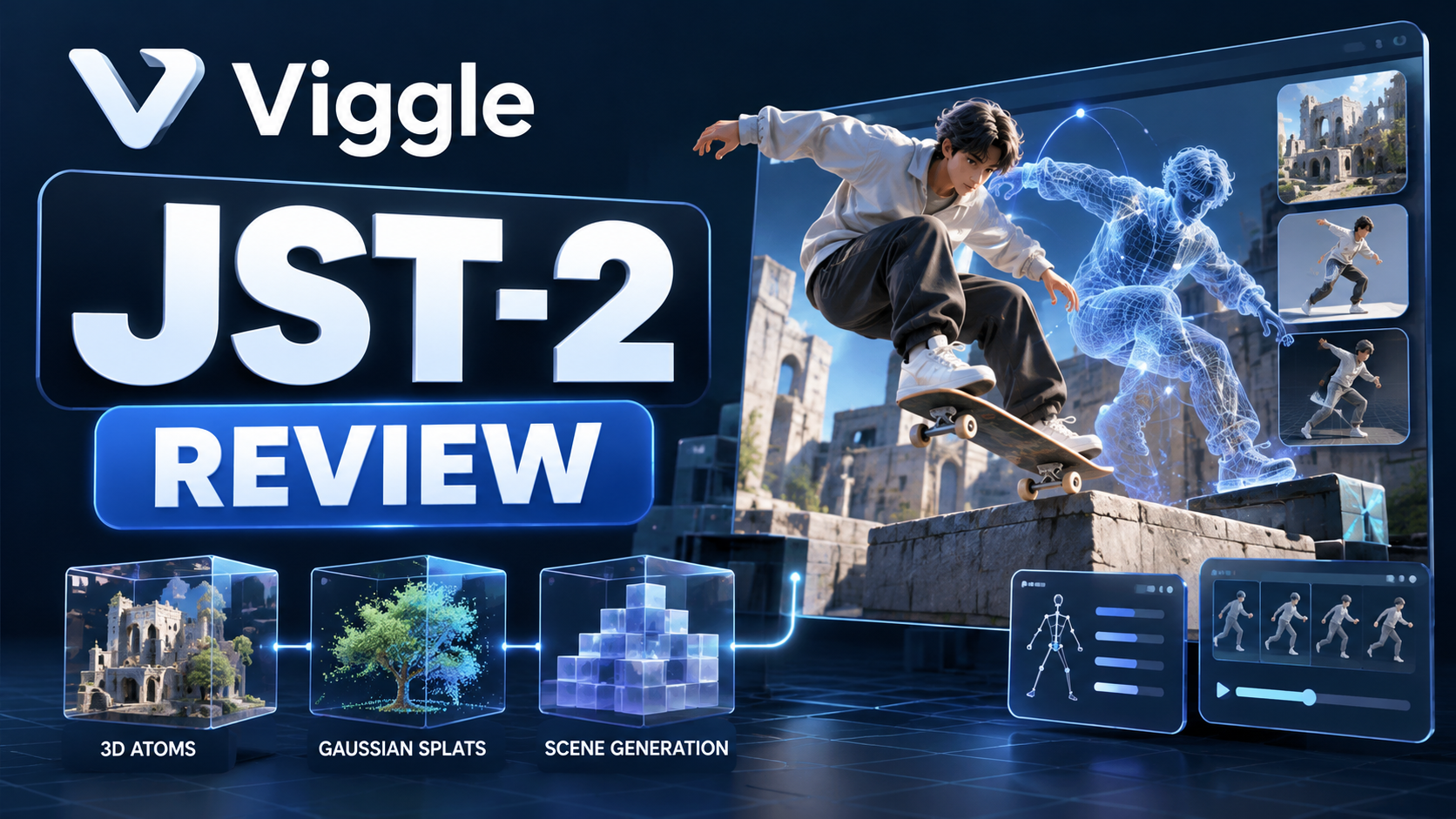
JST-2 is Viggle's Joint Space-Time model, a spatial AI system designed to generate and represent characters, motion and scenes in a shared 3D space. Viggle describes it as a full-stack, physics-native world foundation model. The important distinction is that JST-2 is not simply another text-to-video model: its representation is built around persistent elements in 3D space, with explicit positions and learned attributes and dynamics, rather than treating every frame as an isolated arrangement of pixels.
That design is aimed at a broader set of jobs than making a convincing clip. JST-2 can generate a 3D character from an image, create motion from text or video, and build explorable scenes that can be viewed from different camera positions. Viggle's stated direction is to connect spatial content generation with an eventual experience engine for physical AI, where simulated environments can help train or test systems that need to reason and act in the world.
The clearest published evaluation is Viggle's character-generation research. In blind comparisons against Meshy 7.1 and Tripo H3.1, JST-2 performs strongly on character quality and animation readiness, including hand articulation and deformation. It also has meaningful limits: some joints can show Gaussian-splat artefacts, and the company says object interactions still rely on rule-based physics in JST-2.
QUICK ANSWER
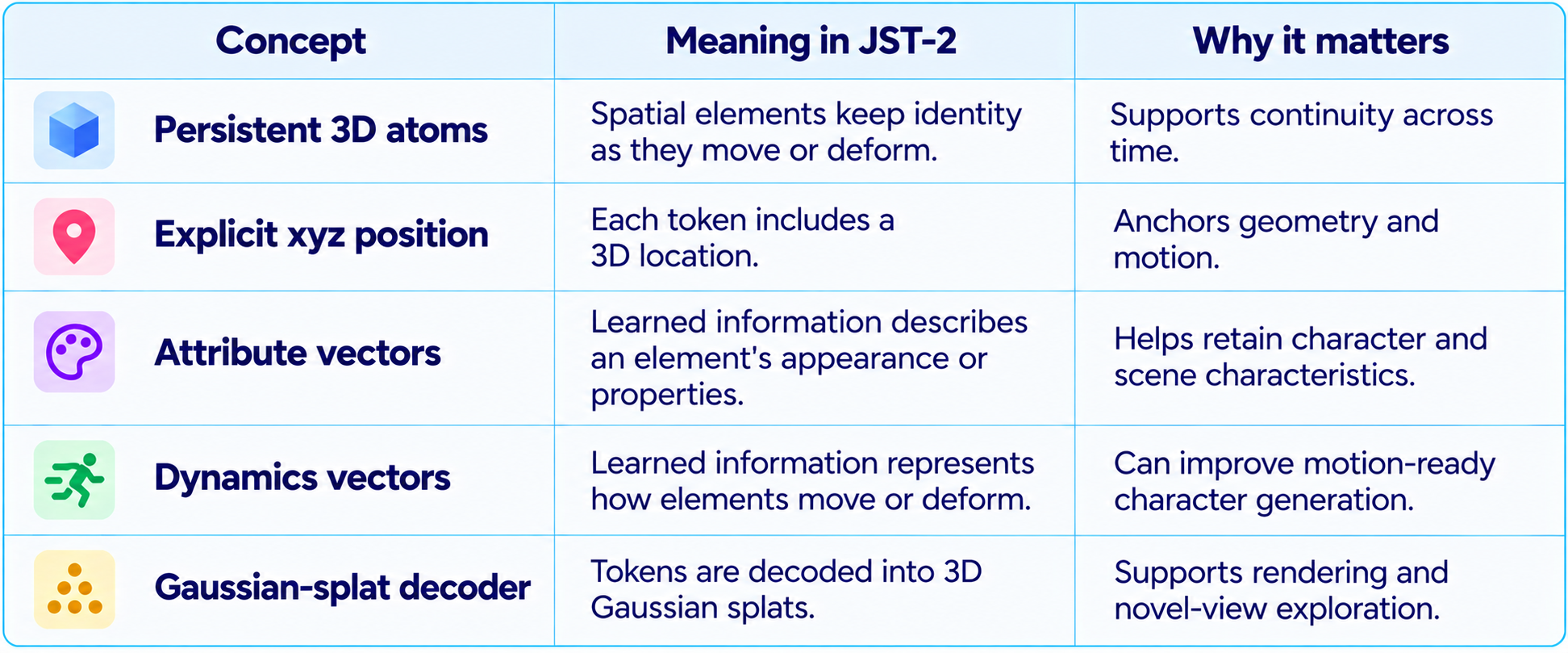
JST-2 is Viggle's Joint Space-Time world model for spatial generation. It represents a scene as persistent 3D atoms encoded as Physics-Native Tokens, each carrying an explicit xyz position and learned vectors for appearance and dynamics. A decoder converts these tokens into 3D Gaussian splats, allowing the system to create characters, motion and scenes in a shared spatial representation.
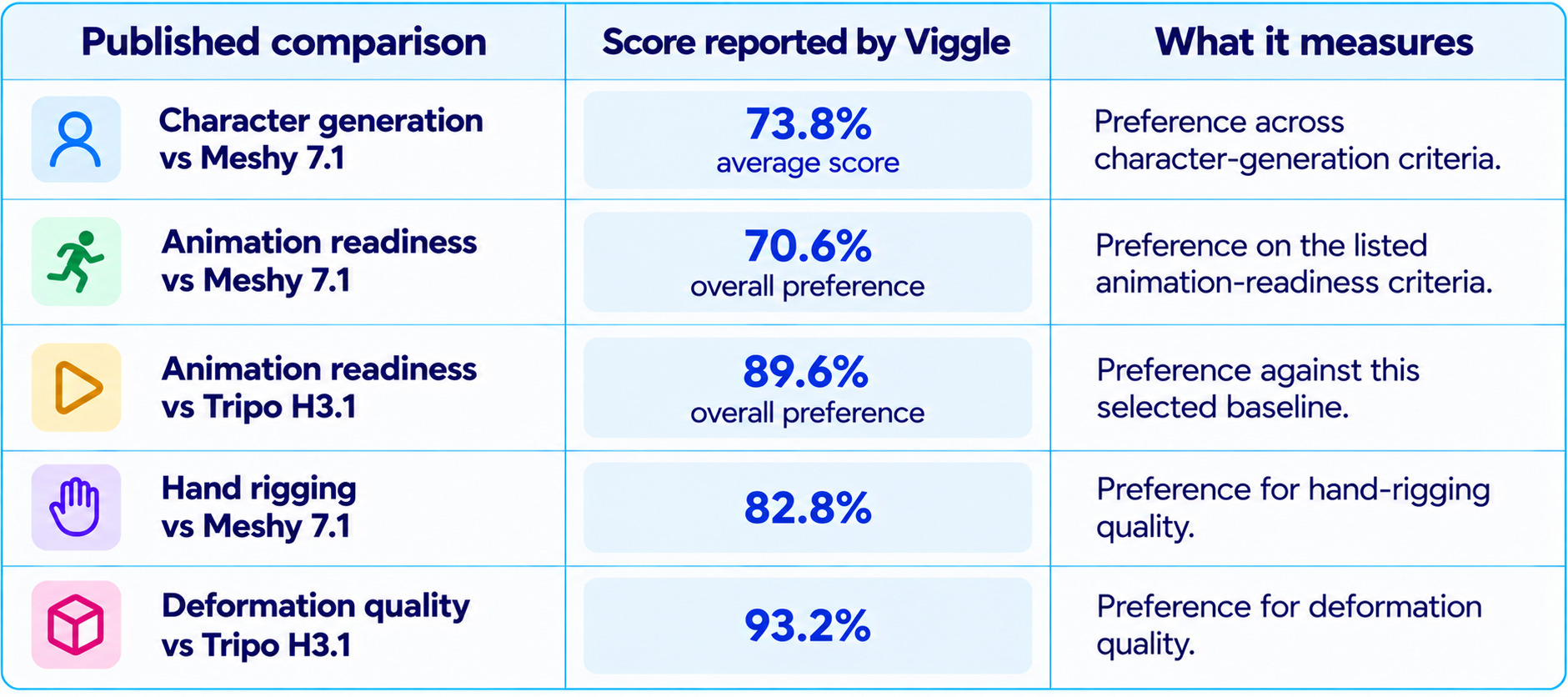
Its most practical strengths are image-to-3D character generation with motion dynamics built in, text-to-motion and video-to-motion workflows, and explorable 3D scene generation. In Viggle's published blind character tests, JST-2 achieved a 70.6% overall preference score against Meshy 7.1 and 89.6% against Tripo H3.1 for animation readiness. These are provider-published preference results, not universal accuracy scores across every 3D task.
The key limitation is the meaning of physics-native. JST-2 uses a 3D representation and learned character dynamics, but that does not mean every interaction is governed by a learned physical simulator. Viggle says scene collisions and object interactions still rely on rule-based physics, while extending learned dynamics to object interactions is a future direction.
Verdict: JST-2 is worth exploring for creators, game teams, spatial-computing developers and physical-AI researchers who need reusable 3D assets rather than fixed video frames. Validate output quality, interaction behavior and export compatibility against your production pipeline before committing.
1. What Is JST-2?
JST stands for Joint Space-Time. Viggle uses the name for a model family built around the idea that the world should be represented as a persistent spatial system, not just a sequence of images. JST-2 extends that approach across characters, motion and scenes. The model is part of Viggle's broader Spatial GenAI direction, which aims to generate content that remains coherent as it moves through time and is viewed from different positions.
This is a different target from conventional image or video generation. A video model can create a visually convincing sequence while leaving the underlying geometry implicit. A spatial model needs a representation that supports a character's body, the motion of its parts and a scene's structure. That can make downstream operations such as animation, viewpoint changes and reuse more natural, although the quality of each operation still depends on the model's outputs.
Viggle presents JST-2 as a full-stack system because the approach covers representation, architecture and generation. The phrase 'world foundation model' describes the intended scope; it should not be read as proof that JST-2 can accurately simulate every physical environment or replace a general-purpose physics engine today.
2. What Does Physics-Native Mean?
Physics-native means the model's internal representation is designed around spatial entities and their properties over time. Instead of predicting only how the next frame should look, JST represents persistent atoms in 3D space. Each atom has an explicit xyz position plus learned vectors that encode attributes and dynamics. Viggle calls these Physics-Native Tokens.
The term does not mean every token is a fully accurate physical object with complete mass, friction, elasticity and collision properties. Viggle distinguishes learned character dynamics from scene interactions, which still use rule-based physics. That distinction is central to judging JST-2 fairly.
3. JST-2 Specifications and Capabilities
JST-2 is a Joint Space-Time model developed by Viggle. Its core approach uses Physics-Native Tokens representing persistent 3D atoms, decoded into 3D Gaussian splats. Viggle describes character generation from images, motion generation from text or video, and spatial scene workflows as part of its broader system.
Not every Viggle product workflow is necessarily one JST-2 endpoint. The developer platform includes multiple models and operations, including character creation, motion, scene generation and video workflows. When building an application, check the exact endpoint and output format rather than assuming every capability is exposed through one request.
4. How JST-2 Generates 3D Characters
The character workflow starts from an image and produces a complete 3D character with motion dynamics built in. That is valuable because a conventional production pipeline may require separate steps for mesh preparation, rig creation, skinning, weight adjustment and animation testing. JST-2 aims to combine character creation and a motion-aware representation into one generation.
Viggle also describes completion from partial or occluded inputs. A source image may crop the body, hide the hands or show the subject from an awkward angle. The model attempts to infer a complete body whose proportions and structure remain coherent. This matters for user-generated content, where images rarely arrive in controlled studio conditions.
The output is based on Gaussian splats rather than a conventional polygon mesh. A splat representation can be useful for rendering and visual exploration, but it is not automatically interchangeable with a clean, topology-controlled mesh expected by every game engine or DCC tool. Confirm the supported export route and whether conversion or cleanup is needed.
5. Motion Built Into the Character
The most distinctive character claim is that JST-2 builds motion dynamics into the generated representation. Viggle says this can reduce the need for separate rigging and skinning steps. In practical terms, the model attempts to create not only a still 3D appearance but also a structure that can deform when driven by motion.
That can reduce setup work for avatars, interactive characters, game prototypes, virtual experiences and rapid previsualization. It may also make iteration easier because creators can test motion earlier rather than waiting until a separate rigging stage is complete.
Animation-ready does not mean every character will be production-perfect. Rig usability, joint alignment, hand articulation, clothing deformation and surface quality remain separate criteria. Viggle's research acknowledges artefacts around limb joints and limitations in unusual body proportions. Test extreme poses, close-up shots, fast movement and accessories before using generated characters in final sequences.
6. JST-2 Benchmark Results: Character Generation
Viggle's character research compares JST-2 with Meshy 7.1 and Tripo H3.1 through blind human evaluations. The company describes a shared-input setup in which each system receives the same images and outputs are generated through the respective vendor APIs. The test set covers photorealistic, stylized, cartoon, anime and science-fiction styles, plus difficult inputs such as occlusion, unusual poses, off-axis views, low resolution and busy backgrounds.
These percentages need careful interpretation. Viggle defines Average Score as the equal-weight mean across criteria, including overall preference, with draws counted as half a win. A 73.8% score is therefore not the same as 73.8% technical accuracy, nor is it a universal benchmark score that can be compared directly with a different paper's metric. The evidence answers a specific question: how human evaluators prefer the generated characters and their animation readiness against selected baselines.
7. Animation Readiness: Where JST-2 Stands Out
The published evaluation highlights hand articulation, rig usability and deformation quality. These are meaningful production criteria. A character can look attractive in a static render but become unusable once its arms bend, its fingers move or its clothing follows the body.
The results suggest JST-2 is designed around motion quality rather than static appearance alone. For animation teams, this could save time in the first pass. It does not remove the need for validation: a production team still needs to inspect joint behavior, silhouette changes, hand poses and deformation under the exact motions the character will perform.
8. Scene Generation and Novel Viewpoints
JST-2 sits within Viggle's wider spatial model direction, which includes generating explorable 3D scenes. Viggle's scene workflow can start from a text prompt or a 360-degree panorama and return a Gaussian-splat scene. The scene can then be viewed from new camera poses, with additional views generated and the scene reconstructed as the workflow progresses.
This is different from creating a single 2D image or fixed-camera video. A scene representation can support viewpoint changes, spatial inspection and interactive experiences. For game prototyping, virtual production or digital-world experiments, the ability to move a camera around a generated environment is more useful than a beautiful frame that cannot be explored.
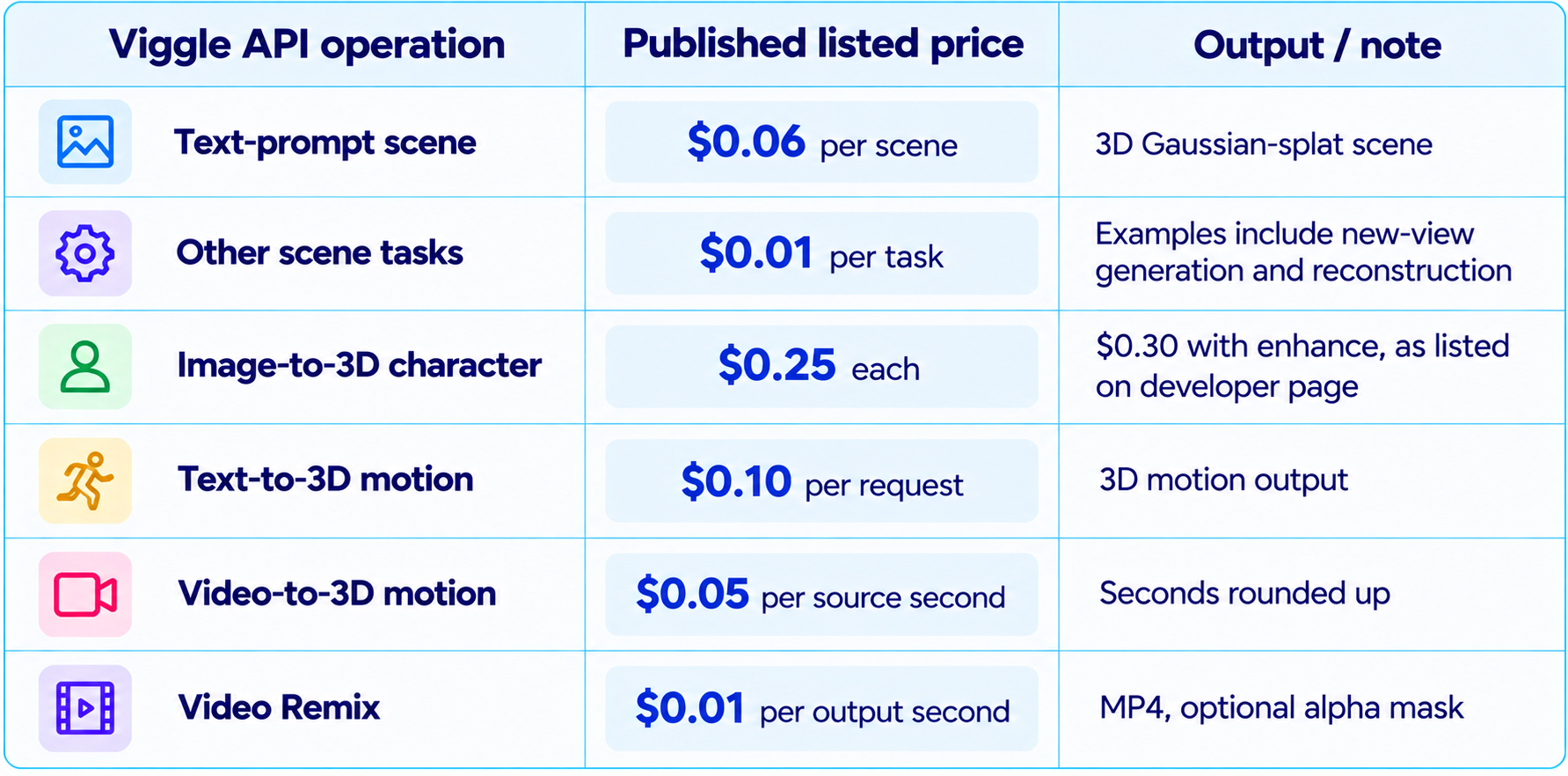
Viggle's developer page lists $0.06 for a text-prompt scene and $0.01 for other scene tasks such as panorama-based processing, novel-view generation and reconstruction. These are listed prices for the Scene Model API operations, not a guarantee that every JST-2 research capability has the same billing or latency.
9. Speed and Cost: What Can Be Said Reliably?
Public discussion of JST-2 highlights fast scene generation, including claims around roughly one second of model inference and a cost below one cent per scene. Inference time should not be confused with total workflow time. Uploads, queueing, scene reconstruction, polling, downloading and rendering can add latency.
For a production estimate, price the exact operation. Viggle's developer platform lists separate costs for image-to-3D character creation, text-to-motion, video-to-motion, scene generation, video remix and image generation. These are not interchangeable tasks, and one application may incur several of them. Check the current API page before committing to a budget.
10. JST-2 vs Conventional Video Models
A video model is optimized to produce a sequence of frames. A spatial world model aims to preserve a representation that can support geometry, motion and viewpoint changes. The distinction is not that video models cannot learn physics or that a spatial model automatically understands reality. The difference is the representation and the operations each system is designed to support.
For teams primarily making marketing clips, music videos or social posts, a video generator may remain the faster path. Our Best AI Video Models 2026 guide compares tools for that kind of output. JST-2 becomes more interesting when the output needs to behave like a reusable spatial asset rather than a finished video file.
11. JST-2 vs Meshy 7.1 and Tripo H3.1
The direct public comparisons in Viggle's character research are against Meshy 7.1 and Tripo H3.1. Those comparisons focus on generated character quality and animation readiness. In Viggle's reported blind tests, JST-2 leads on the listed preference measures, with particularly strong results for hand rigging and deformation.
The right conclusion is specific: JST-2 looks competitive for generating characters that are intended to move, not just appear in a still render. The results do not establish that it beats Meshy or Tripo on every object category, mesh topology requirement, texture workflow or export format. A studio that mainly needs static props may care about different metrics from a team generating characters for animation.
Before choosing, test the same difficult inputs across tools: full-body photos, cropped subjects, occluded hands, unusual proportions, stylized characters and close-up facial detail. Compare not only the render, but also how much cleanup is needed before the asset is usable in your engine or animation package.
12. JST-2 and Robotics: Why World Models Matter
World models are attracting attention because physical AI systems need more than object recognition. A robot or embodied agent must reason about how an environment is arranged, how objects persist when the camera moves, and what may happen after an action. A spatial model that reconstructs environments from sparse observations could eventually help create simulations and training environments from real locations.
Viggle positions its spatial model work as a path toward physical AI, but JST-2 should not be treated as a turnkey robotics simulator. The current character model has learned dynamics for character motion, while scene collisions and object interactions still use rule-based physics. A robotics deployment would need to validate geometry, contact behavior, state transitions and simulation-to-reality transfer for the exact task.
The term 'world foundation model' is therefore a direction of travel rather than a blanket capability guarantee. JST-2 offers a spatial representation and generation stack that could be useful in physical-AI workflows, but safe robot control requires task-specific testing and appropriate simulation or real-world validation.
13. What JST-2 Does Not Yet Solve
Viggle's own research identifies several limitations. Gaussian-splat artefacts can appear around limb joints, including the shoulder-to-torso connection, armpits and gaps between fingers. Fine surface detail can soften when the camera moves close to hair, clothing or materials. Unusual body proportions can lead to inaccurate joint placement or deformation.
Clothing, hair and accessories are driven by learned character dynamics but are not fully simulated for inertia and collisions. Scene collisions and object interactions still rely on rule-based physics rather than a fully learned interaction model. A Gaussian-splat output is also not automatically a conventional clean polygon mesh for every 3D production tool.
These limitations do not erase the value of JST-2. They define where human review, cleanup, a conventional simulator or a different asset-generation workflow may still be required.
- Gaussian-splat artefacts can appear around joints, armpits and gaps between fingers.
- Fine surface detail may soften in close-up views.
- Unusual body proportions can lead to inaccurate joints or deformation.
- Clothing, hair and accessories are not fully simulated for inertia and collisions.
- Scene collisions and object interactions still use rule-based physics.
- Gaussian splats may need conversion or cleanup for conventional 3D pipelines.
- Published blind-test scores are vendor-reported comparisons against selected baselines.
14. Best Use Cases for JST-2
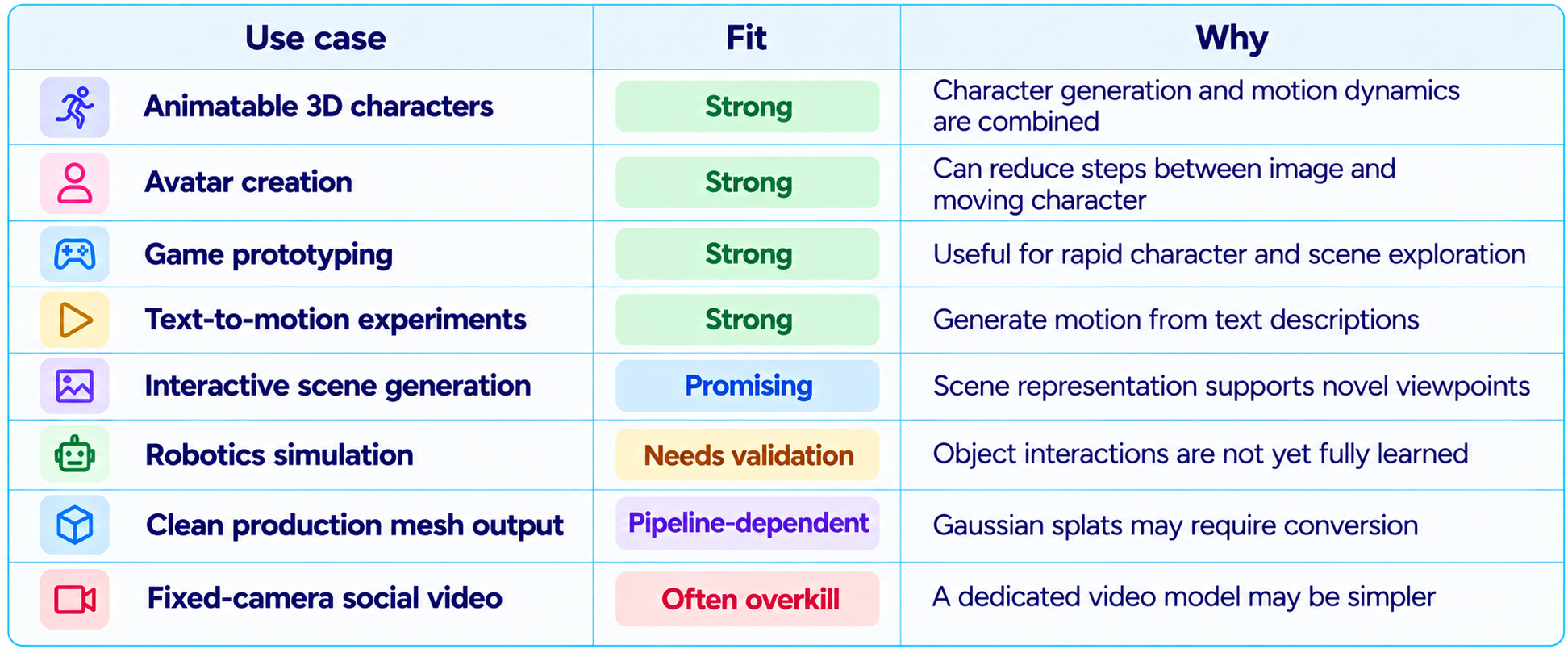
JST-2 is a strong candidate for animatable characters from images, avatar creation, game prototyping, virtual production, text-to-motion experiments, video-to-motion reconstruction and interactive scene generation. It is less immediately suitable as a guarantee of physically accurate robotics simulation or a source of clean production meshes without validation. For a fixed-camera social video, a dedicated video generator may be simpler.
15. Recommended JST-2 Evaluation Workflow
The best way to evaluate JST-2 is to test the full asset pipeline, not just the first render. A character that looks excellent in a preview may still require significant work before it can be used in a game, animation or interactive experience.
- Create a test set covering photorealistic, stylized, cartoon and anime characters.
- Include cropped bodies, occluded hands, unusual poses, low resolution and busy backgrounds.
- Inspect joint alignment, hand articulation, clothing deformation and surface stability during motion.
- Confirm whether the output format fits your engine or needs conversion.
- Test typical and extreme movements, including turns and fast actions.
- For scenes, move the camera to viewpoints not present in the original input.
- Measure inference time separately from upload, queueing, reconstruction, download and rendering.
- Track cost per accepted asset, including retries and cleanup time.
- For physical-AI experiments, validate collisions and object interactions in the target simulator.
If the final workflow uses agents to plan, generate and verify assets, our What Is an AI Agent? guide explains the building blocks. Keep generation, validation and acceptance as separate steps.
16. How JST-2 Fits Into Spatial GenAI
Spatial GenAI is broader than text-to-3D. It includes scene reconstruction, 3D characters, motion, camera-conditioned generation and systems that preserve a shared representation over time. JST-2 is notable because Viggle is attempting to place several capabilities in one architecture instead of stitching together unrelated tools at every stage.
A unified representation could make assets more reusable. A character can be generated, animated and placed into a scene; a scene can be explored from new viewpoints; motion can be produced from text or reconstructed from video. The practical advantage depends on how well the interfaces work together and whether outputs retain enough quality for the target application.
The broader industry is exploring world models from different starting points. Some learn predictive representations from video, while others focus on video generation, action conditioning or 3D geometry. WorldBench, for example, evaluates whether video models preserve physical concepts such as motion, object permanence, support relations and perspective. These benchmarks remind us that visual plausibility and physical correctness are related but distinct goals.
17. Is JST-2 Open Source? How Can You Access It?
JST-2 is presented through Viggle's product and research ecosystem. The public materials describe capabilities and evaluations, while the Viggle developer platform offers APIs for related operations such as character generation, motion, scene creation and video workflows. Do not assume that every research component, checkpoint or training detail is available as open-source software.
For developers, identify the exact operation: image-to-3D character, text-to-motion, video-to-motion or scene generation. Check supported inputs, output format, API availability, rate limits, price and retention behavior. A multi-step workflow should be costed as a pipeline rather than as one generic JST-2 request.
For creators who only want to experiment, start with the available Viggle product experience and use the API when you need repeatable, programmatic generation. For studios, the main procurement questions are asset rights, commercial usage, data handling, output retention, export compatibility and service reliability.
18. JST-2 vs a Traditional 3D Pipeline
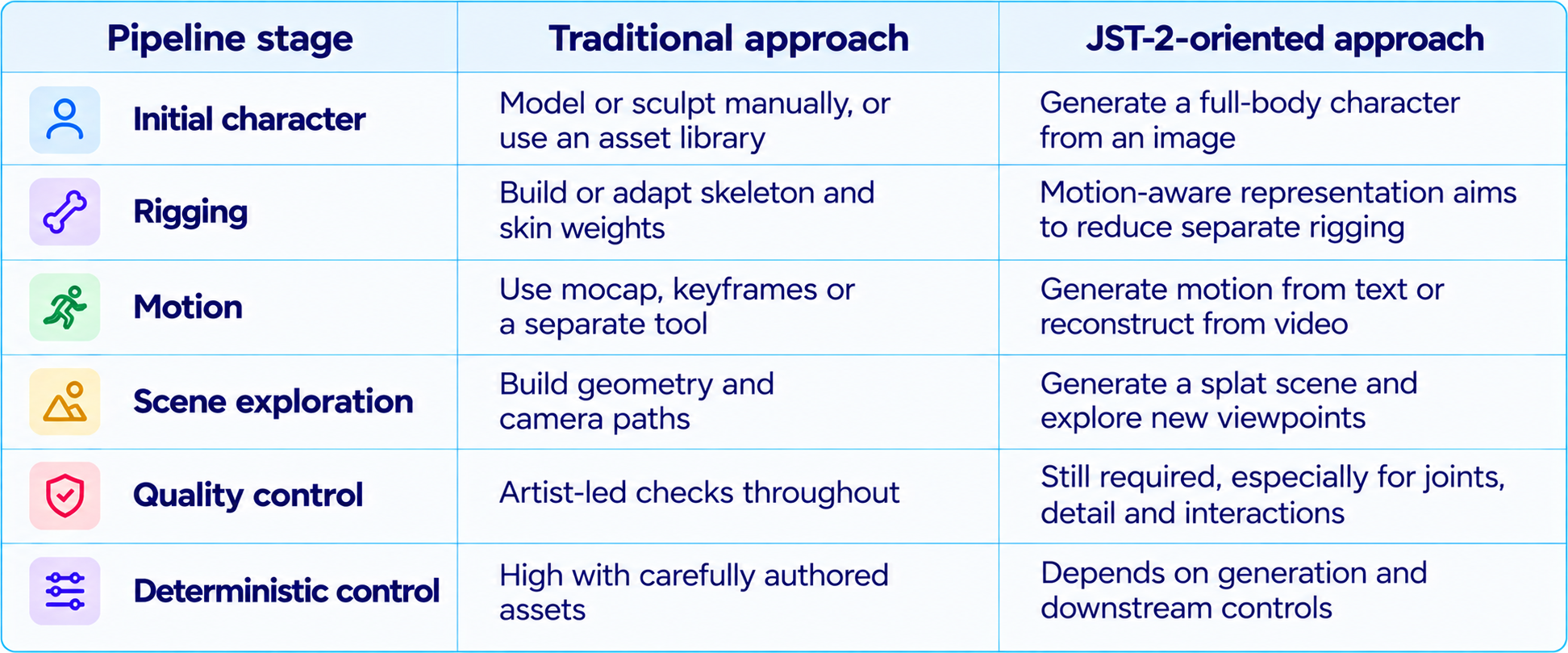
Traditional character production gives artists explicit control over topology, rigging, skin weights and materials, but it takes time. JST-2 aims to automate more of the path from a reference image to an animatable character. The tradeoff is control: generated output can be fast to create, yet still require correction when the brief calls for exact geometry or highly specific deformation.
JST-2 is best viewed as a way to accelerate selected stages, not as proof that professional 3D production no longer needs artists, technical directors or simulation tools. It can compress the first-draft and iteration cycle while leaving precise delivery requirements to the existing pipeline.
19. Is JST-2 Worth It?
JST-2 is worth evaluating if your work depends on characters that need to move, spatial scenes that can be explored, or motion that must be reused outside a fixed video. Its clearest value proposition is the attempt to unify character appearance, motion dynamics and scene representation under a spatial model.
The strongest evidence is the published blind character evaluation. JST-2 scores 70.6% on overall preference against Meshy 7.1 and 89.6% against Tripo H3.1 in Viggle's animation-readiness comparison. The reported results for hand rigging and deformation are relevant to production use, but they should not be treated as universal accuracy numbers.
The main reasons to be cautious are also clear. Some joints and fingers can show artefacts, surface detail softens at close range, unusual body shapes are harder, and object interactions are still based on rule-driven physics. If your requirement is physically accurate interaction or a clean conventional mesh with strict topology, test those needs directly before choosing JST-2.
The cost story depends on the exact workflow. Viggle lists separate prices for scene generation, character generation and motion operations, which can be attractive for experimentation. Total cost should also include retries, conversion, manual cleanup and integration work.
20. Final Verdict
JST-2 is an important direction for spatial AI because it treats characters, motion and scenes as parts of a shared 3D world representation. Its Physics-Native Tokens carry explicit spatial positions and learned attributes and dynamics, while a Gaussian-splat decoder provides the rendered representation. This is a different design goal from generating a fixed sequence of video frames.
For character creation and animation readiness, the available evidence is encouraging. Viggle's blind comparisons report strong preference scores against Meshy 7.1 and Tripo H3.1, including 82.8% for hand rigging against Meshy and 93.2% for deformation quality against Tripo. The results support testing JST-2 in workflows where motion-ready characters are more valuable than static 3D assets.
The physics-native label needs a precise reading. JST-2 does not yet learn every physical interaction. Viggle says object interactions and scene collisions still rely on rule-based physics, and its research describes learned object dynamics as a future step. JST-2 is a compelling spatial generation system, not a complete substitute for physics engines or validated robotics simulators.
My verdict: JST-2 is worth exploring for character animation, spatial content creation, interactive 3D scenes and early physical-AI research. Its biggest opportunity is reducing the gap between a visual idea and a reusable spatial asset. Its biggest test is whether generated assets survive the detailed requirements of real production.
Frequently Asked Questions
What is JST-2?
JST-2 is Viggle's Joint Space-Time model, a spatial AI system for generating characters, motion and scenes using a physics-native 3D representation.
What does physics-native mean?
It means the model represents persistent 3D atoms with explicit positions and learned attribute and dynamics vectors, rather than representing the world only as pixels across video frames.
What are Physics-Native Tokens?
They are JST's representation units. Each token corresponds to a persistent spatial element with an xyz position and learned information about its attributes and dynamics.
Can JST-2 generate 3D characters from images?
Yes. Viggle describes generating a full-body 3D character with motion dynamics built in from an image, including some cropped or occluded inputs.
Does JST-2 support text-to-motion?
Viggle describes text-to-motion and video-to-motion capabilities in its JST/spatial workflow. Check the exact product or API endpoint for output formats.
What are JST-2's benchmark results?
Viggle's blind character evaluation reports 70.6% overall preference against Meshy 7.1 and 89.6% against Tripo H3.1 in the animation-readiness comparison. These are preference metrics defined by Viggle.
Can JST-2 simulate real physics?
Not completely. Viggle says character motion uses learned dynamics, but scene collisions and object interactions still rely on rule-based physics in JST-2.
Does JST-2 use Gaussian splatting?
Yes. Viggle says the JST decoder turns Physics-Native Tokens into 3D Gaussian splats.
Is JST-2 better than Meshy or Tripo?
In Viggle's published blind character tests, JST-2 scores strongly against Meshy 7.1 and Tripo H3.1 on the tested character and animation-readiness criteria, not every asset category.
Is JST-2 open source?
The public materials cited here do not establish that the full model weights and training stack are open source. Check Viggle's current product and developer documentation.
How much does JST-2 cost?
Viggle lists separate prices for API operations such as scene generation, image-to-3D characters and motion. These are workflow-specific rates, not one universal JST-2 price.
Who should use JST-2?
3D creators, game developers, avatar platforms, animation teams and spatial-AI researchers may find it useful, provided they validate output quality and downstream compatibility.
Recommended Blogs
Best AI Video Models 2026: Ranked by Quality, Speed, Price & Use Case
Gemini Omni 1.1 Flash Review: Accuracy, Price & Is It Worth It? (2026)
Resources & Community
Join our community of 70,000+ AI enthusiasts and learn to build powerful AI applications. Build Fast with AI helps creators, developers and teams understand practical AI and apply it to real projects.
Agentic AI Launchpad 2026
A structured 6-week cohort program for learning to build and deploy real-world agentic AI systems, with live sessions, mentorship, project reviews and a builder community.
Explore the program: Agentic AI Launchpad 2026
Free AI Resources
Access free tools, workshops and micro-learning to keep building.