


How to Learn AI From Scratch for Free in India: The 6-Month Roadmap for 2026
You do not need to spend ₹50,000, ₹1 lakh or more on a bootcamp to start learning AI in India in 2026. A large amount of high-quality AI education is available at no cost, including university-backed material, government-supported learning, big-tech courses, practical notebooks, open-source documentation and project platforms. The difficult part is not finding resources. It is choosing the right order.
A beginner can easily jump from a Python tutorial to prompt engineering, then to LangChain, then to an LLM API, then to machine learning theory, and end up knowing many tool names without being able to build anything. A better AI learning roadmap starts with fundamentals, moves into machine learning, then adds deep learning and generative AI, and finishes with projects that prove you can apply what you learned.
This roadmap is designed specifically for learners in India, including college students, working professionals, career switchers and beginners who want to learn AI without paying for a course. It combines free resources from NPTEL, SWAYAM Plus, IndiaAI, Google, Microsoft, AWS, Kaggle, Hugging Face and Harvard, then turns them into a six-month schedule with projects, checkpoints and portfolio milestones.
QUICK ANSWER
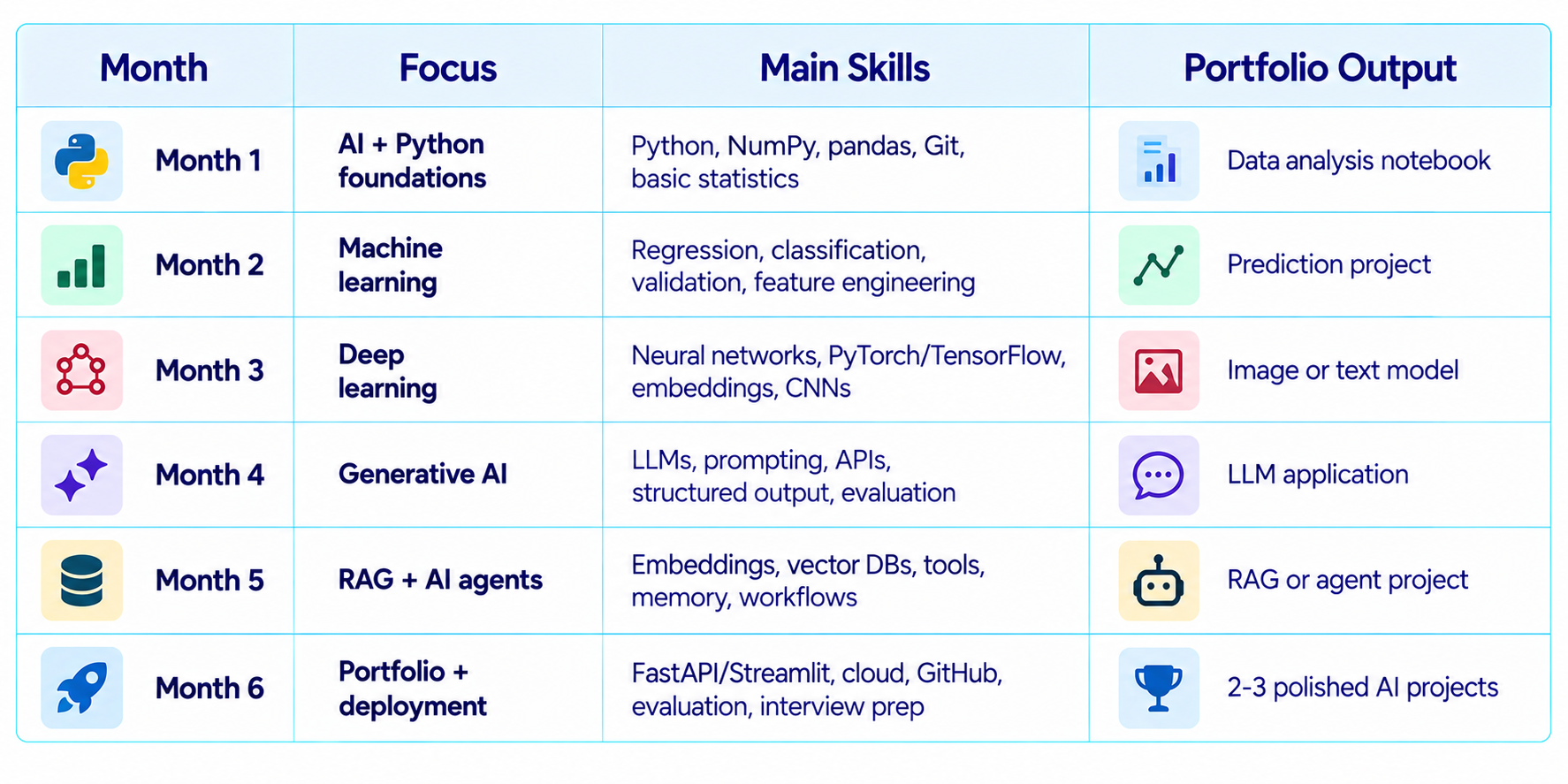
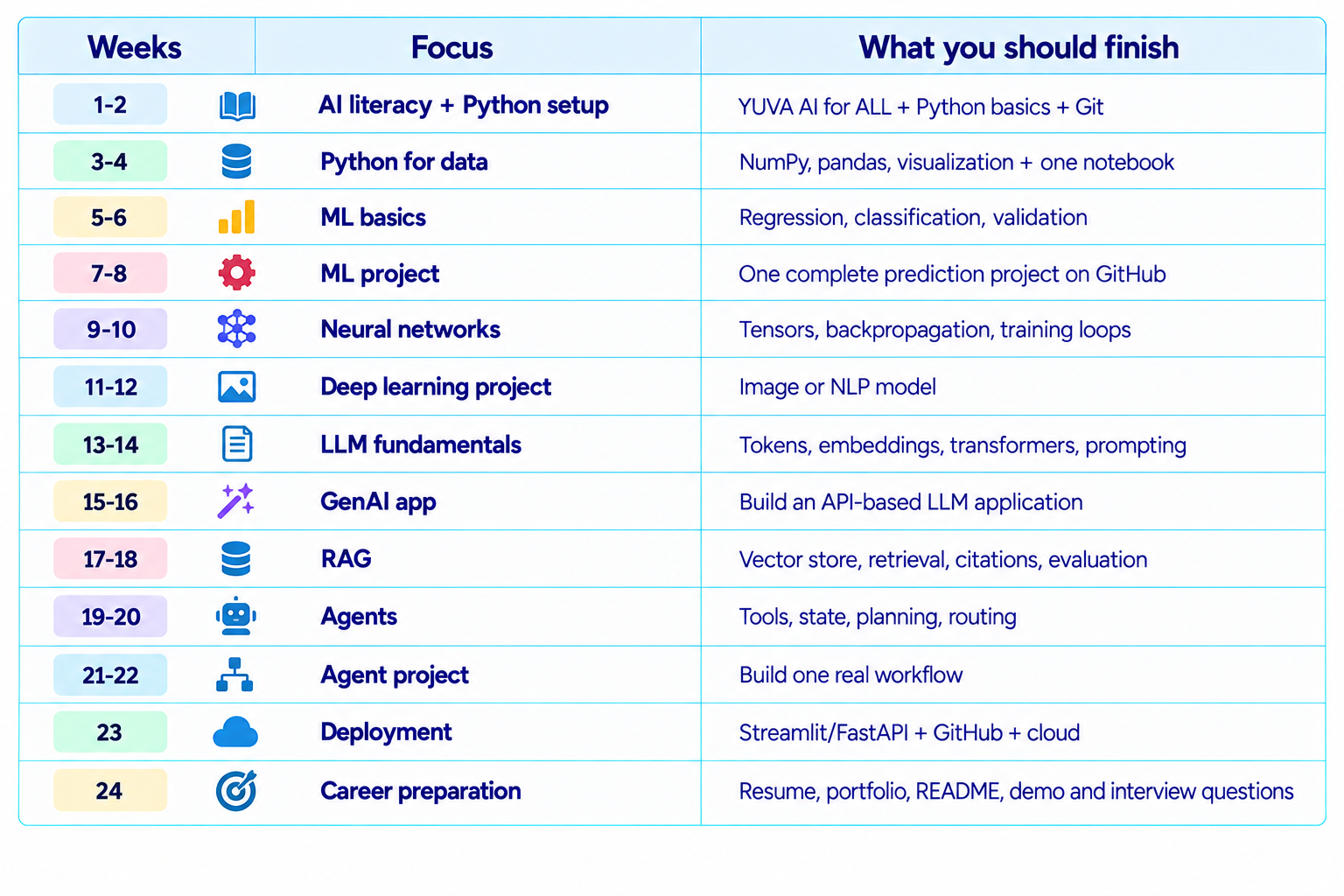
The fastest way to learn AI for free in India is not to collect certificates. Build the fundamentals first, practise every week and turn each learning stage into a working project. A strong six-month path is: Month 1 Python and data basics, Month 2 machine learning, Month 3 deep learning, Month 4 generative AI and LLMs, Month 5 RAG and AI agents, and Month 6 portfolio projects, deployment and interview preparation.
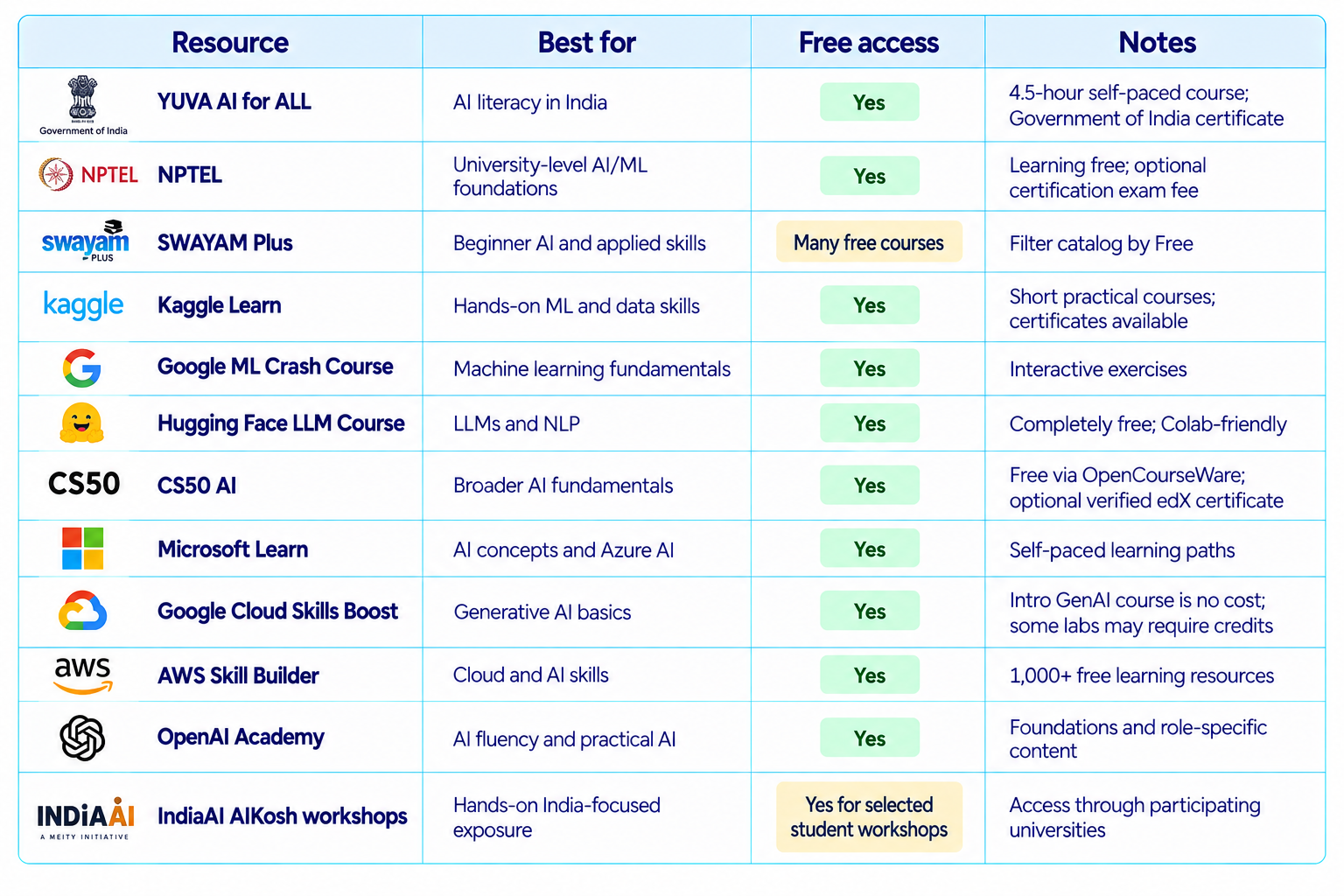
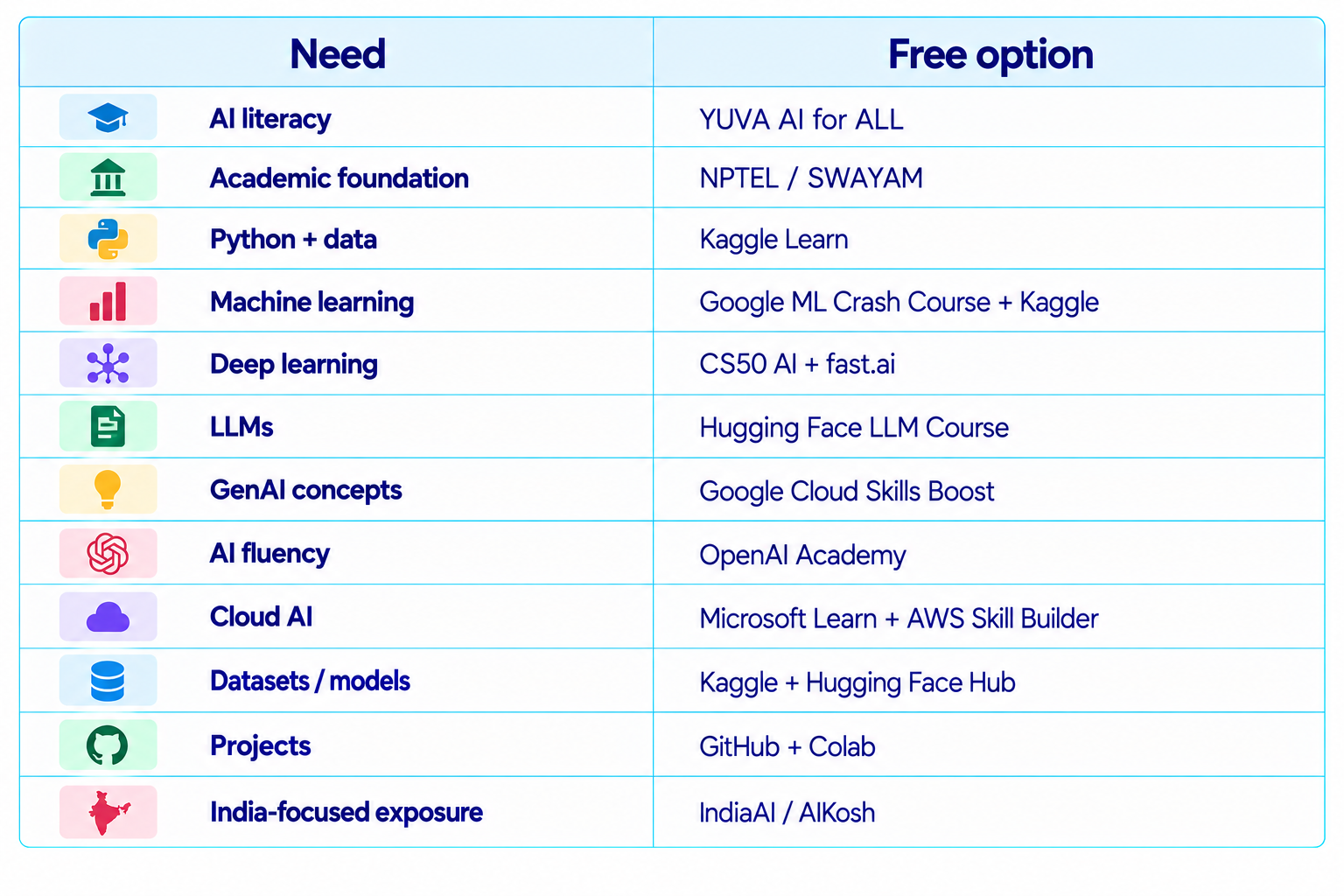
For free learning, start with Government of India's YUVA AI for ALL for AI literacy, NPTEL for university-level foundations, Kaggle Learn for short hands-on machine learning exercises, Google's Machine Learning Crash Course for practical ML, Hugging Face's free LLM Course for modern NLP and LLM development, and Harvard's CS50 AI for a deeper AI foundation. Microsoft Learn, AWS Skill Builder and Google Cloud Skills Boost add free AI and cloud learning.
The career rule is simple: every major topic should produce something you can show. Finish Python by building a data project. Finish machine learning by deploying a prediction model. Finish generative AI by building an LLM application. Finish agents by building a tool-using agent. By the end of the roadmap, your portfolio should demonstrate skills rather than only course completion.
1. Can You Really Learn AI for Free in India?
Yes, but free learning does not mean zero effort and it does not mean every certificate is free. The learning content itself can be free while a proctored certification exam, verified credential or optional subscription costs money.
NPTEL is a particularly useful example. Its official site says the online courses are free to enroll in and learn from, with course videos, assignments and discussion access available without a course fee. The optional certification examination carries a separate fee.
The same distinction applies to many global platforms. Kaggle Learn states that its courses are available at no cost and now offer certificates. Harvard CS50's AI course can be taken for free through its OpenCourseWare, while a verified edX certificate is optional.
So the goal of a free AI education should be to minimize unnecessary spending, not to chase a word like 'free' at the expense of quality.
2. The 6-Month AI Roadmap at a Glance
3. Start With AI Literacy Before Machine Learning
Your first week should answer basic questions: what is AI, what is machine learning, what is deep learning, what is generative AI, how do large language models work at a high level, and what are the risks of using AI systems.
YUVA AI for ALL is a strong India-first starting point. The Government of India describes it as a free 4.5-hour self-paced course for students, professionals and curious learners. It covers AI basics, Indian use cases, safe and responsible use and future opportunities, and the programme provides a Government of India certificate on completion.
YUVA AI for ALL - Government-backed free AI literacy course
IndiaAI also runs hands-on learning initiatives through AIKosh. Its University Engagement Programme provides selected university students with access to datasets, models, tools, workshops and challenge opportunities, and the programme is free for students through participating universities.
Do not spend a month here. AI literacy is your orientation stage. Once you understand the vocabulary, move to building.
4. Month 1: Learn Python for AI
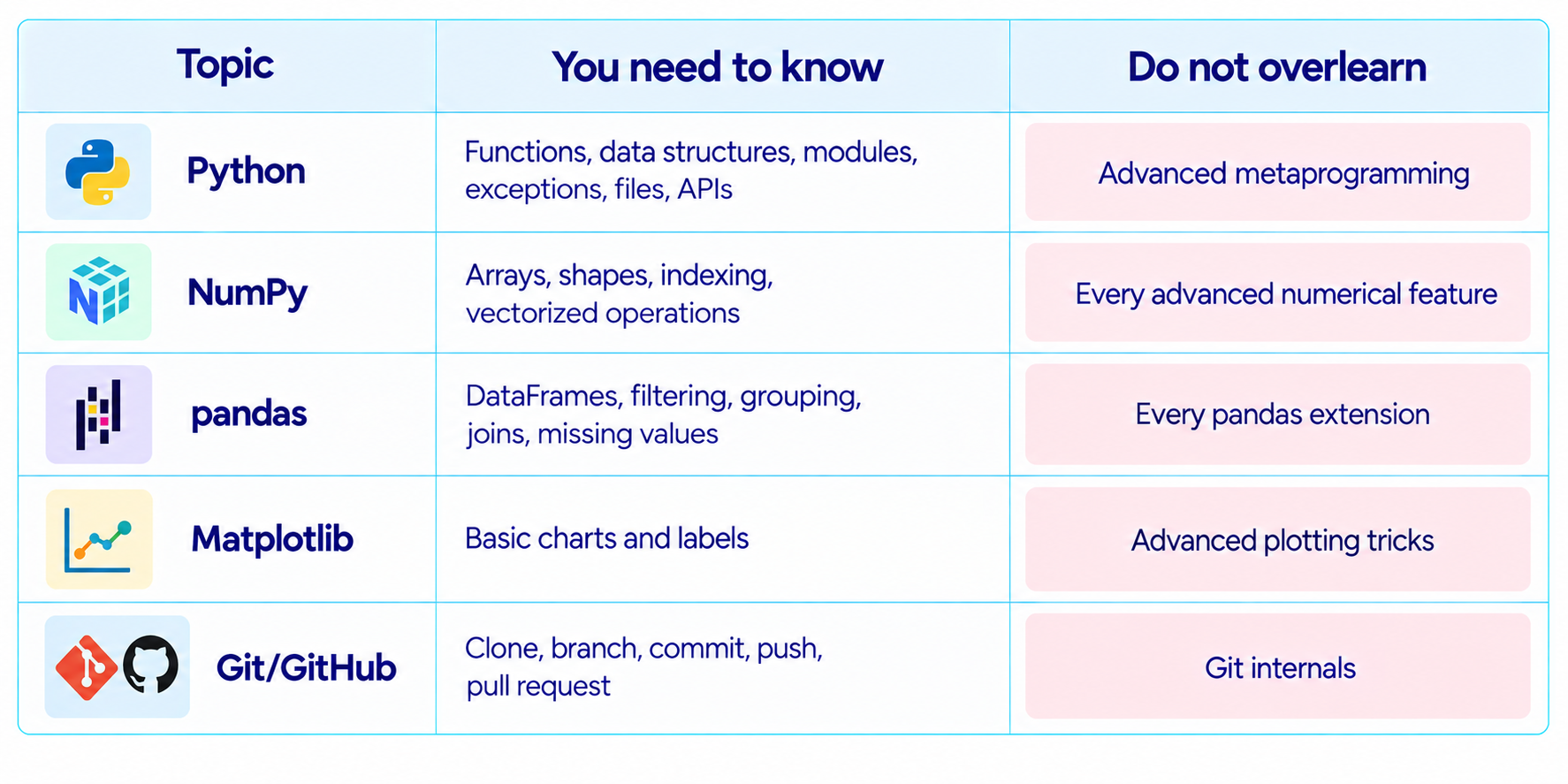
Python is the practical starting language for an AI learner. You do not need to master every part of Python before touching machine learning. Learn the parts that appear constantly in AI workflows: variables, functions, lists and dictionaries, loops, modules, file handling, exceptions, virtual environments, basic classes and working with APIs.
Then learn NumPy and pandas well enough to load data, clean it, transform it and inspect it. Add matplotlib for basic visualisation and Git/GitHub for version control.
Kaggle's free learning catalogue is useful here because it has short practical courses rather than semester-long theory. Its Intro to Machine Learning course moves from basic model concepts into exercises, validation, underfitting, overfitting and random forests. Kaggle states that its Learn courses are no cost.
For a deeper academic track, pair practical Kaggle lessons with free NPTEL learning instead of paying for an introductory bootcamp.
5. Month 2: Learn Machine Learning
Machine learning is where AI becomes a technical discipline rather than a collection of tools. Learn supervised learning first, then unsupervised learning and model evaluation.
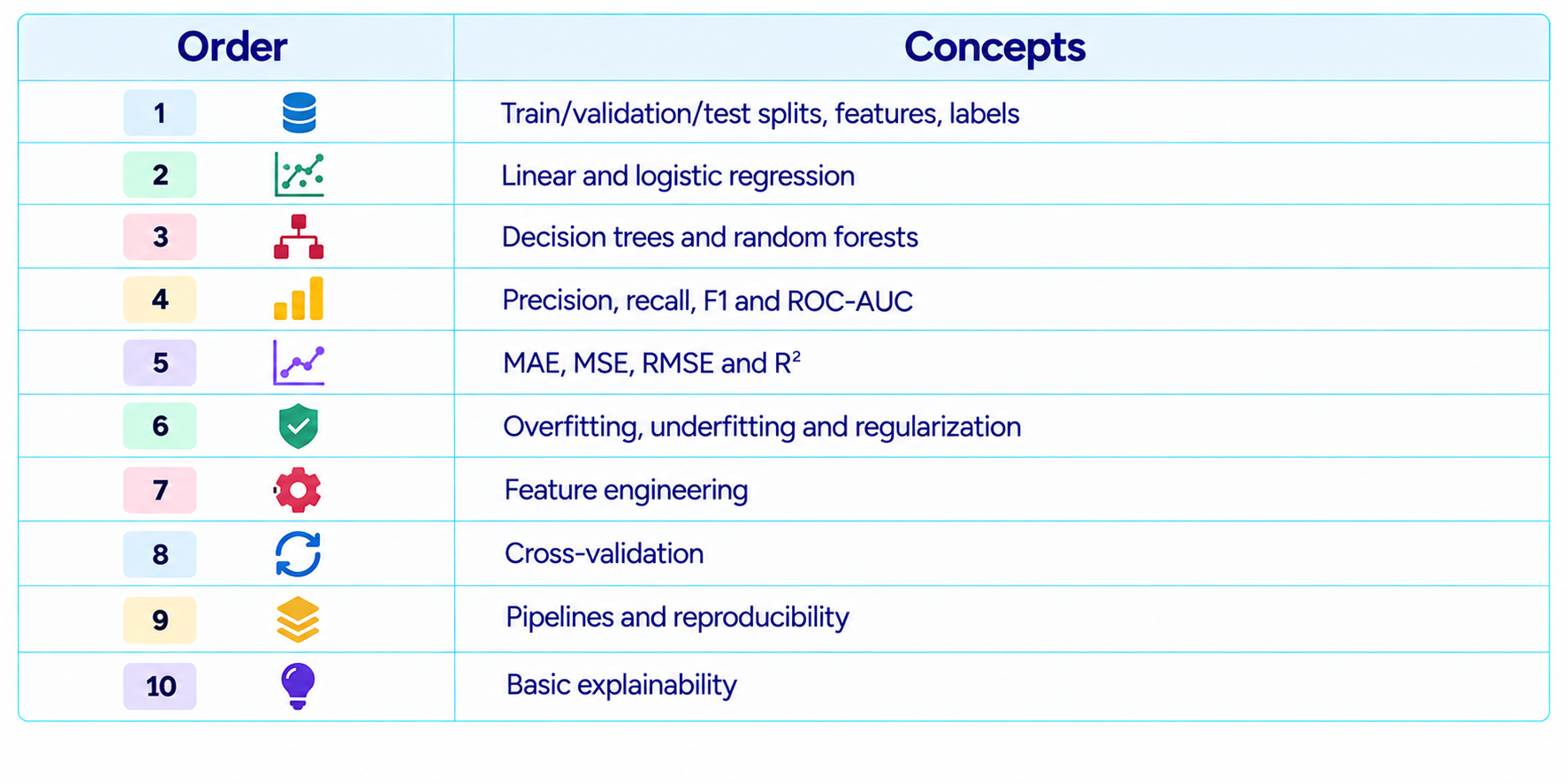
Google's Machine Learning Crash Course is a strong free resource for this stage. Google describes it as a practical introduction using videos, interactive visualizations and hands-on exercises, with modules that can be taken in sequence or selectively.
Google Machine Learning Crash Course
Kaggle's Intro to Machine Learning course works well as the project-oriented companion. Together they give you both concepts and repetition through code.
6. Your First AI Project Should Be Small
Do not wait until you finish every AI course before building. Your first project should be deliberately small.
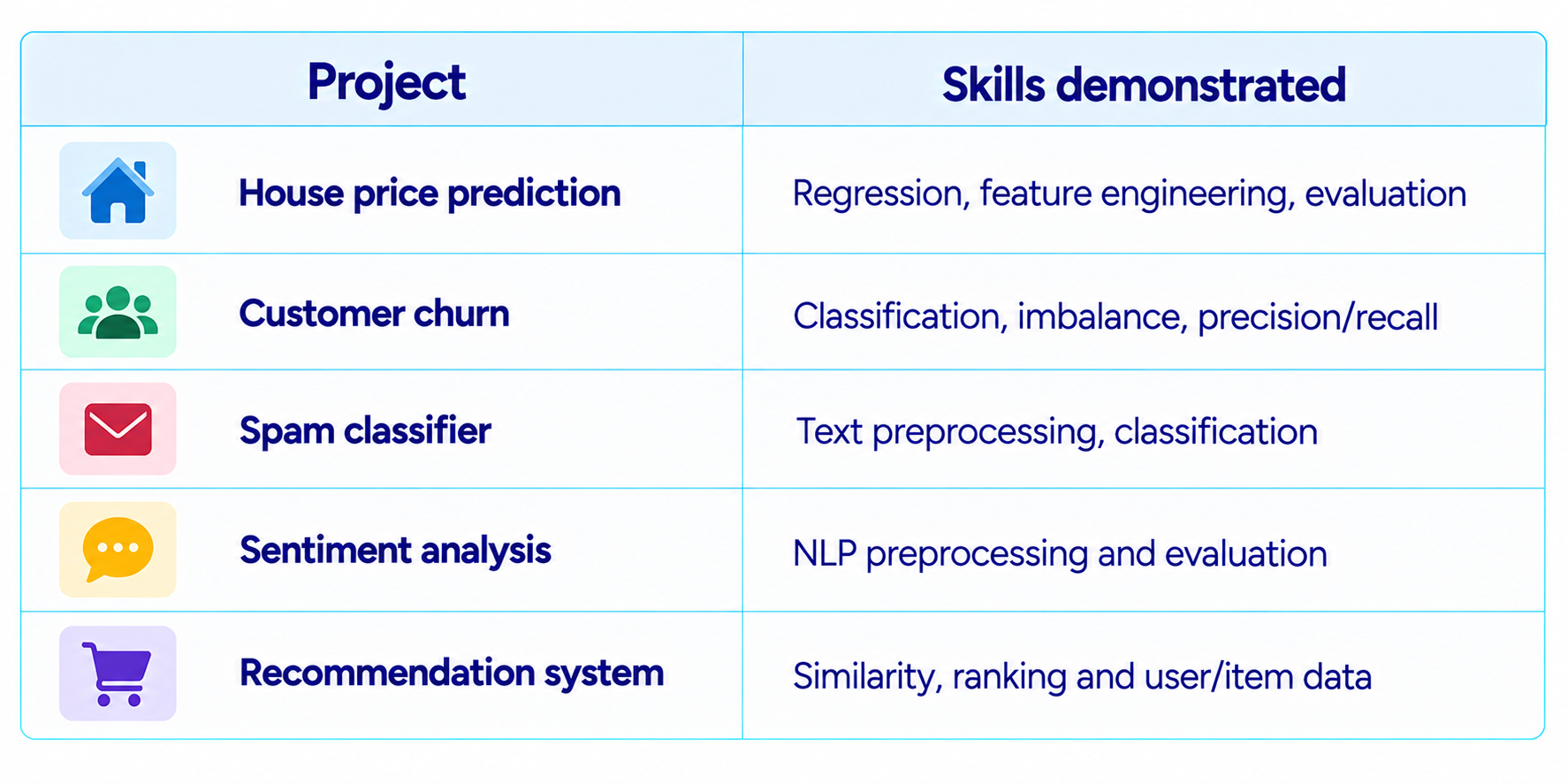
Put the project in GitHub. Include a README, dataset source, problem statement, setup instructions, evaluation metrics, screenshots and a clear explanation of what you would improve next. A small finished project is more useful to your portfolio than another certificate with no code.
7. Month 3: Learn Deep Learning
Once traditional ML makes sense, learn neural networks. Understand tensors, forward passes, loss functions, gradients, backpropagation, optimization, batches, epochs, validation and overfitting.
Choose one primary framework. PyTorch is a strong choice for learners who want to move toward modern AI engineering and research. TensorFlow and Keras are also useful when a course or employer stack uses them.
Harvard's CS50's Introduction to Artificial Intelligence with Python is a deeper bridge into AI fundamentals and can be taken free through OpenCourseWare. The course covers seven weeks of material and uses projects to reinforce learning.
CS50's Introduction to Artificial Intelligence with Python
8. Month 4: Move Into Generative AI
Generative AI is the point where many 2026 learners want to jump immediately. The better route is to arrive with basic ML knowledge so terms such as embeddings, inference, fine-tuning, tokenization and evaluation have somewhere to attach.
Start with large language model fundamentals: tokens, context windows, embeddings, transformers at a high level, prompting, structured outputs, tool calling and model evaluation.
Hugging Face's LLM Course is completely free and teaches LLMs and NLP using Transformers, Datasets, Tokenizers, Accelerate and the Hugging Face Hub. The course recommends Google Colab for beginners so learners can practise without setting up a local environment.
Google Cloud Skills Boost also offers a no-cost introductory Generative AI course covering what generative AI is, how it works, model types and common applications.
Google Cloud - Introduction to Generative AI
OpenAI Academy also has a beginner AI Foundations course. It takes about 70 minutes and covers AI, language models, prompting, context, review and responsible use.
OpenAI Academy - AI Foundations
9. Learn Prompt Engineering, But Do Not Stop There
Prompt engineering is useful, but a prompt-only roadmap is too narrow for an AI engineering career. Learn how to specify a role, task, context, constraints, examples and output format. Then learn to evaluate the result instead of assuming a polished answer is correct.
A reusable prompt structure is: role + task + context + constraints + output format + verification. For complex work, ask the model to state assumptions, identify uncertainty and validate the result.
For practical examples, see our AI Prompts library and 20 Best AI Prompts for SEO & Content Writing.
10. Month 5: Learn RAG and Context Engineering
Retrieval-Augmented Generation is one of the most practical bridges between AI models and business applications. Learn embeddings, vector search, chunking, metadata, retrieval, reranking, prompt assembly and evaluation.
Then move beyond basic RAG into context engineering. Modern AI systems combine retrieved documents, conversation history, tool definitions, memory, application state and permissions. Your job is to decide what information reaches the model at each step.
Our Context Engineering: Complete Guide explains the broader system around prompts, retrieval, memory and tools.
Build one practical RAG project, such as a PDF question-answering system, college-notes assistant, policy-search assistant or company-document bot. Add citations to retrieved sources and test it with a fixed evaluation set.
11. Month 5 to 6: Learn AI Agents
After RAG, learn agents. An AI agent combines a model with a goal, tools, state, memory and a loop that lets it observe results and continue working.
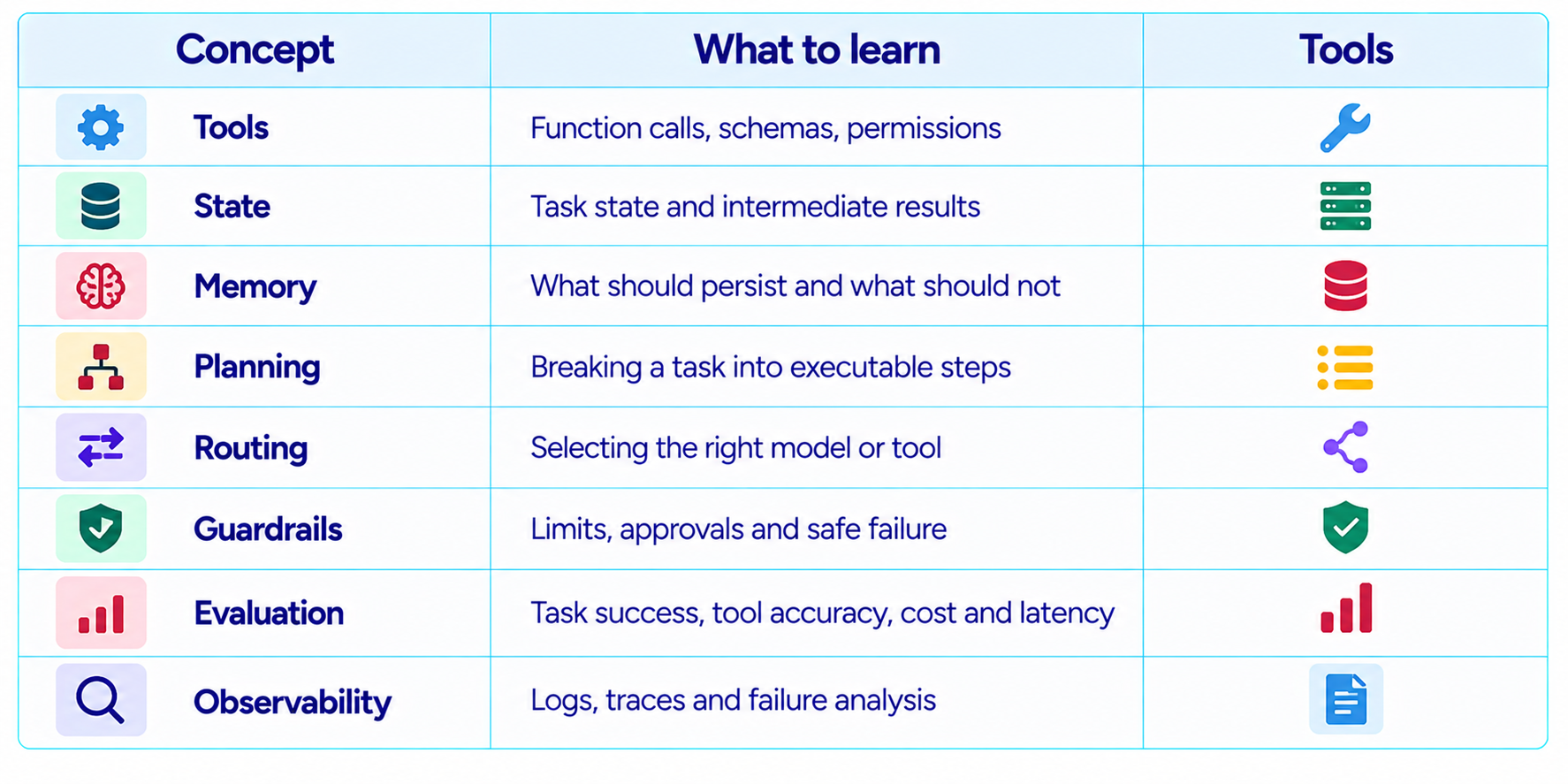
Start with our What Is Agentic AI? Complete Beginner's Guide, then move into a framework such as LangGraph or Pydantic AI.
You can also read our LangGraph multi-agent guide and Pydantic AI guide.
12. Learn AI Coding Agents
If your goal is AI engineering, learning to work with coding agents can multiply your output. Tools such as Claude Code, Codex, Cursor and other agentic coding environments can inspect repositories, modify files, execute tests and iterate.
Build Fast with AI's AI Coding Tools collection covers the broader landscape.
Do not treat autonomous coding as unrestricted shell access. Learn permissions, sandboxing, secrets management, network controls and human approval for high-impact actions.
For that, see How to Secure AI Coding Agents in 2026.
13. Best Free AI Learning Resources in India and Globally
14. Your 24-Week AI Roadmap
15. How to Study AI for 1-2 Hours a Day
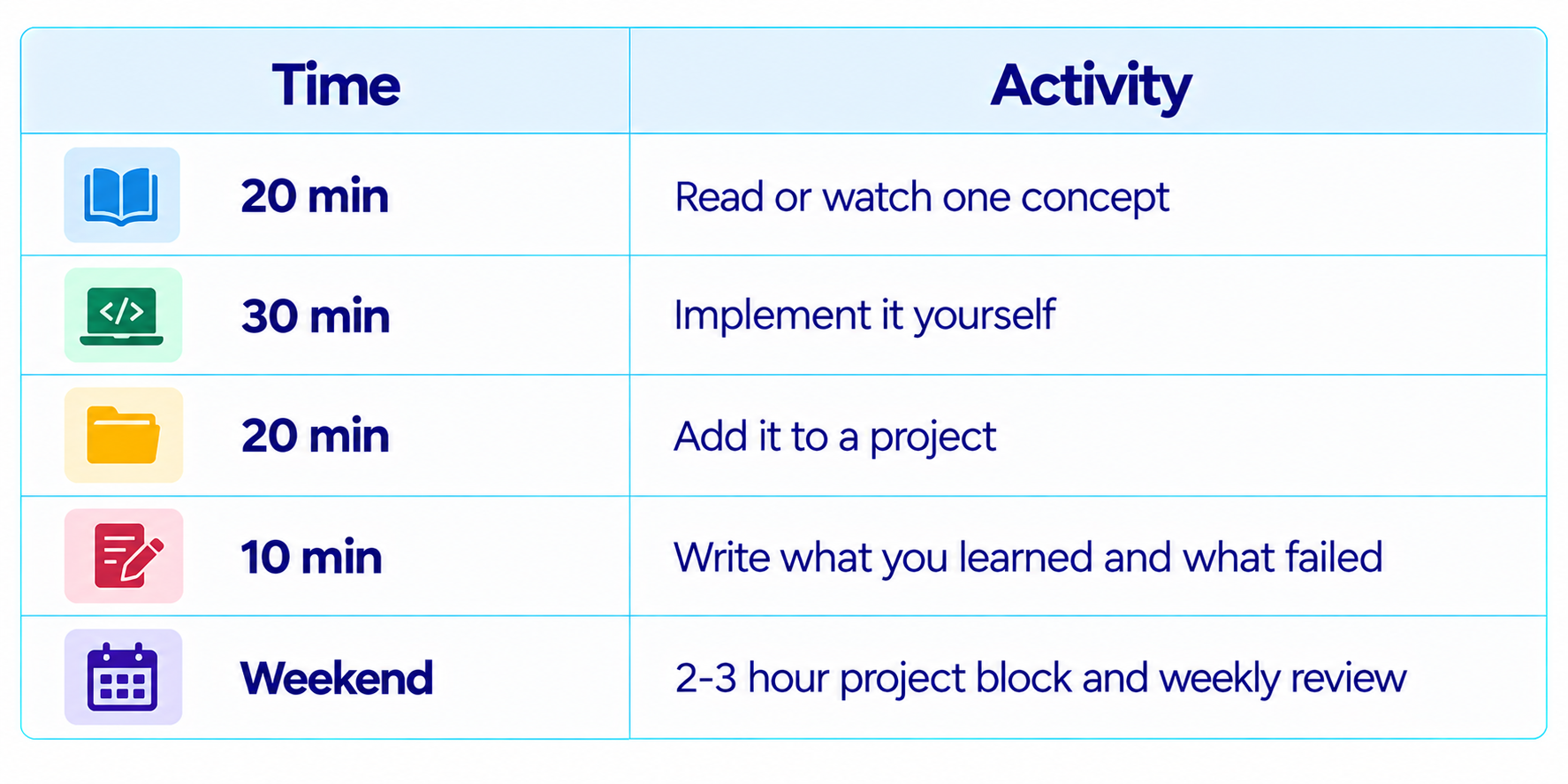
You do not need eight hours a day. Consistency matters more than intensity. A useful weekday routine is 20 minutes of theory, 30 minutes of coding, 20 minutes of project work and 10 minutes of notes or review.
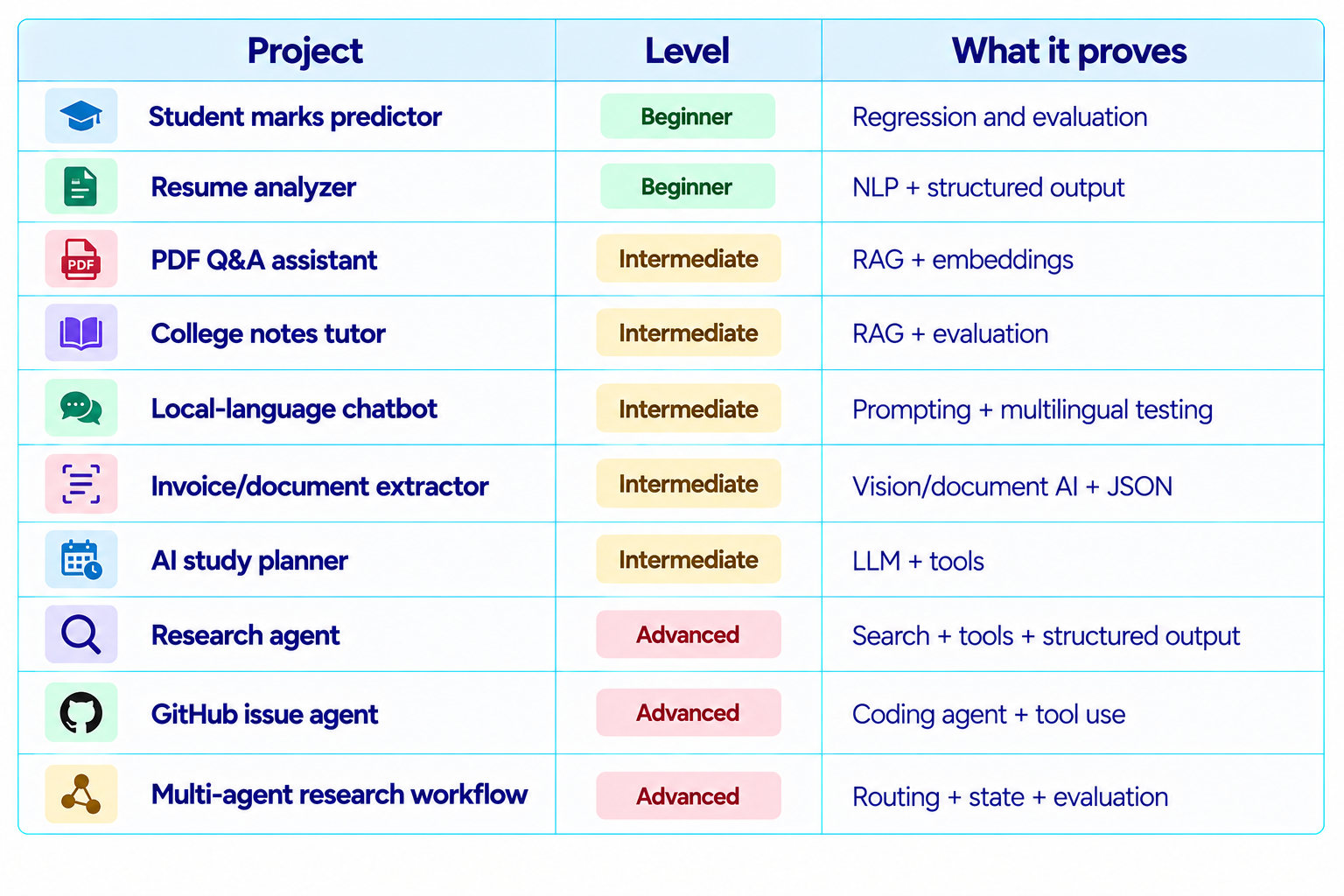
16. 10 Free AI Projects You Can Build in India
17. How to Build an AI Portfolio That Actually Helps
A portfolio does not need ten unfinished repositories. Aim for three strong projects that demonstrate increasing technical depth.
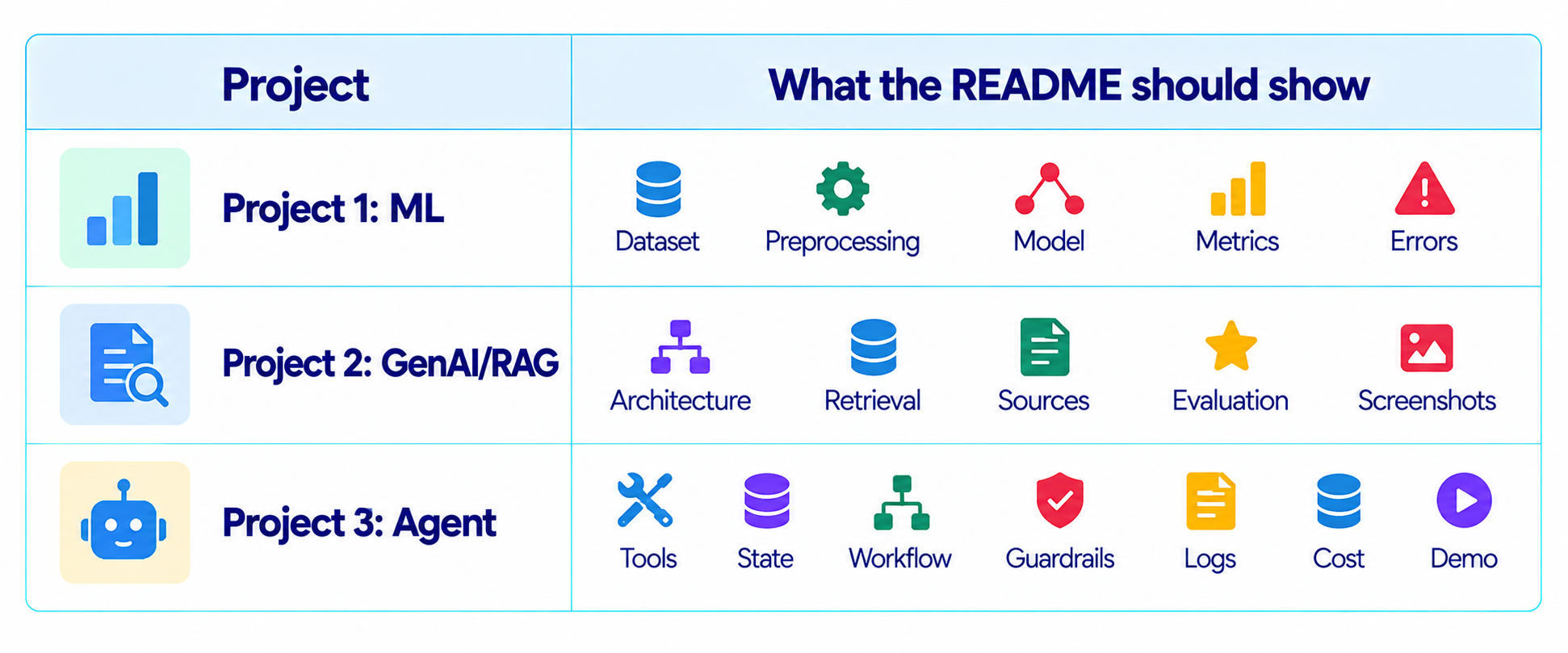
Each project should include a short demo, architecture diagram, setup steps, limitations and what you would improve next. Do not copy a tutorial and rename the repository. Change the problem, add an evaluation layer and explain your decisions.
18. Do You Need AI Certificates?
Certificates can document structured learning, but they should not be the main product of your roadmap. A GitHub repository with working code, a clear README and a short demo usually communicates more technical evidence than a long list of completion badges.
Use free certificates strategically. YUVA AI for ALL provides a Government of India certificate; Kaggle Learn courses provide certificates; CS50 AI offers a free CS50 certificate after completing its requirements. NPTEL learning is free, but its optional proctored certification exam is separately paid.
When a credential costs money, ask what it proves. If the same learning can be demonstrated through an open project, do not assume the paid certificate is the best use of your budget.
19. Choose Your AI Career Path After the Foundations
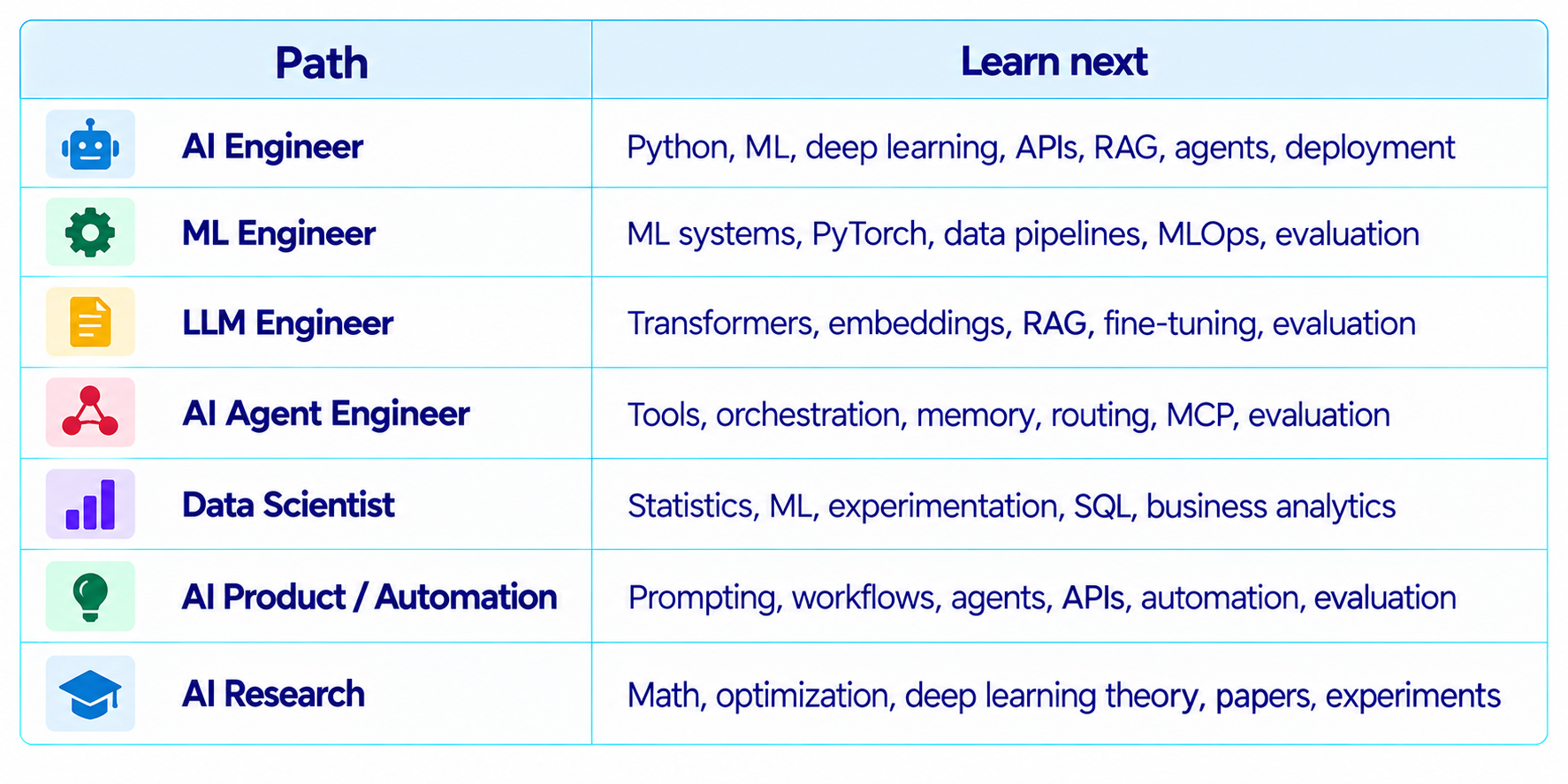
You do not have to decide the final role in Month 1. Build a broad foundation first, then use your projects and interests to specialize.
20. Common Mistakes When Learning AI for Free
- Collecting courses instead of building projects.
- Trying to learn every framework before understanding the fundamentals.
- Starting with advanced LLM agents without knowing Python and APIs.
- Watching tutorials without reproducing the code.
- Using a giant context window as a substitute for good retrieval.
- Putting 'AI expert' on a resume without measurable project evidence.
- Chasing every new model release instead of building one stable application.
- Copying GitHub projects without understanding the architecture.
- Paying for a certificate before checking whether the learning content is already free.
- Stopping after the first project instead of deploying and evaluating it.
21. The Free AI Learning Stack I Would Use in 2026
22. What Should You Do This Week?
Do not try to execute the entire six-month plan today. Start with one week.
- Complete YUVA AI for ALL.
- Create a GitHub repository called ai-learning-2026.
- Finish the first Python/data lessons on Kaggle Learn.
- Set up Google Colab and practise without local GPU hardware.
- Build one small notebook using a public dataset.
- Write a one-page README explaining what you learned.
- Schedule the next seven days before you finish today's session.
After the first week, repeat the same cycle: learn one concept, implement it, put it into a project and document the result. That loop is what turns free content into an actual AI skill.
23. Final Verdict: Can You Learn AI for Free in India?
Yes. The barrier in 2026 is less about access to AI education and more about learning discipline. India has a strong mix of free university content, government-backed AI literacy, big-tech learning platforms, hands-on coding environments and open-source education.
A good roadmap does not require dozens of paid certificates. It requires a sequence: fundamentals, Python, machine learning, deep learning, generative AI, RAG, agents, projects and deployment. The resources are the easy part. The valuable part is doing the work between lessons.
The best outcome after six months is not a folder full of course certificates. It is a GitHub profile with two or three credible AI projects, a clear understanding of the fundamentals, the ability to explain your architecture and the confidence to build something without following a tutorial line by line.
If you are starting today, begin with YUVA AI for ALL, then move to Python and machine learning, and let projects determine what you specialize in. That route keeps the cost close to zero while still giving you a serious path into AI engineering, LLM development, AI agents and modern machine learning.
Frequently Asked Questions
Can I learn AI for free in India?
Yes. You can use free resources from IndiaAI, NPTEL, SWAYAM Plus, Kaggle, Google, Hugging Face, Microsoft, AWS, Harvard and OpenAI Academy. Some optional certification exams or premium labs may cost money.
What is the best free AI course in India for beginners?
YUVA AI for ALL is a strong starting point for AI literacy because it is free, self-paced and designed for learners across India. For technical foundations, NPTEL, Kaggle and Google's ML Crash Course are strong next steps.
Is NPTEL AI learning free?
Yes. NPTEL says enrollment and learning are free. Its optional proctored certification exam is separately paid.
Where can I learn machine learning for free?
Google's Machine Learning Crash Course and Kaggle Learn are two practical starting points. NPTEL also offers free university-level learning across many AI-related topics.
Can I learn generative AI for free?
Yes. Hugging Face's LLM Course, Google Cloud Skills Boost's introductory Generative AI course and OpenAI Academy provide free learning options.
Do I need a computer science degree to learn AI?
No. You can start with Python and mathematics and gradually move into machine learning, deep learning and AI applications. Some advanced courses have prerequisites, so choose resources that match your level.
How long does it take to learn AI?
A solid beginner foundation can be built in a few months with consistent practice, while job-ready AI engineering requires deeper project work and continued learning.
What should I learn first for AI: Python or machine learning?
Learn basic Python first. You do not need advanced Python, but you should be comfortable writing functions, working with data and using libraries before serious ML practice.
How can I get an AI job without paying for a course?
Build a project portfolio, contribute to GitHub, complete a few credible free courses, practise coding and ML fundamentals, and document real AI applications with measurable results.
Are free AI certificates valuable?
They can show structured learning, but the strongest career evidence is usually a combination of projects, skills, explanations and practical results.
How do I learn AI agents for free?
Start with Python, APIs and LLM basics, then learn tools, state, memory, routing and evaluation. After that, build a small agent using a framework such as LangGraph or Pydantic AI.
Can I learn AI without a GPU?
Yes. Use Google Colab and other hosted notebooks for learning. You can build many ML and LLM applications without owning a high-end GPU.
What AI skills are useful in 2026?
Core Python and ML still matter, while modern application skills include LLM APIs, evaluation, RAG, context engineering, tool calling, agents and deployment.
Recommended Blogs
How to Secure AI Coding Agents in 2026: Permissions, Sandboxing, MCP & Secrets
20 Best AI Prompts for SEO & Content Writing 2026 (Copy-Paste)
Resources & Community
Join our community of 70,000+ AI enthusiasts and learn to build powerful AI applications. Whether you're a beginner or an experienced developer, Build Fast with AI helps you understand and implement AI in your projects.
Agentic AI Launchpad 2026
A structured 6-week cohort program that takes you from AI basics to building and deploying real-world agentic AI systems. Includes live sessions, expert mentorship, project reviews and a builder community network.
Ready to go from learning to building? Join the next cohort: Agentic AI Launchpad 2026
Free AI Resources
Access free tools, workshops and micro-learning to keep building.

