



A US startup just put a 501 billion parameter model on the table and promised to give the weights away under one of the most permissive licenses there is. Reflection Beam, announced on October 5, 2026, is a direct answer to the strong open models coming out of China, and it is aimed squarely at developers who want to self-host, fine-tune, and build on a frontier-class model without being locked into a closed API. This review is a technical look from that angle: the license, the hardware you would need, fine-tuning, coding ability, and the real question, whether an open model like this can rival closed frontier systems.
A note up front that shapes everything here: at the time of writing, Beam's weights had not been publicly released yet, and every benchmark number comes from Reflection itself. So this is an informed early review based on the published specs and vendor benchmarks, not independent testing. I will be clear about what is claimed versus confirmed throughout, because for an open-weight model those details matter a great deal.
What Is Reflection Beam?
Reflection Beam is a large open-weight language model built by Reflection AI for coding, reasoning, and agentic workloads. Architecturally it is a sparse mixture-of-experts (MoE) model: it has 501 billion total parameters, but only about 23 billion are active for any given token. That design is the key to its pitch, you get the knowledge capacity of a very large model while paying inference compute closer to a 23 billion parameter one, because most experts stay idle on each token.
The model is text-only, carries a 1 million token context window (pretrained at 256K and extended to 1 million in later training), and is served today through a hosted API with the model ID Beam-501B-A23B while access is gated by a waitlist. The bigger event is still to come: Reflection plans to publish the weights under Apache 2.0, along with a technical report, model card, and tooling for running, evaluating, and fine-tuning the model. That is what turns Beam from another API into a genuine open-weight option. For context on the category, see our guide to open-source LLMs.
Key Specs at a Glance
Here is Beam in one view.
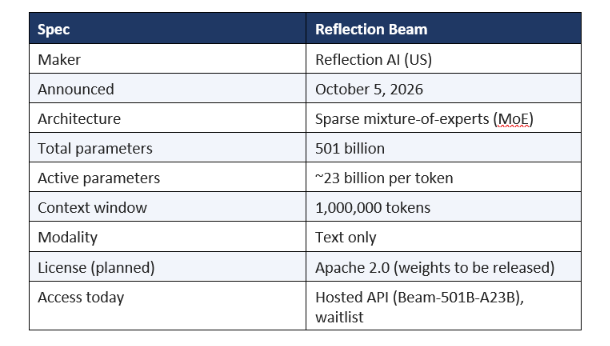
The combination that defines Beam is large total capacity, small active compute, and a permissive license. If the weights ship as promised under Apache 2.0, that mix is exactly what self-hosting teams have been asking for from a US-built model.
Benchmarks & Performance
All of the numbers below are reported by Reflection, so treat them as the vendor's best case until independent results arrive. With that caveat, the picture is of a strong but not class-leading model.
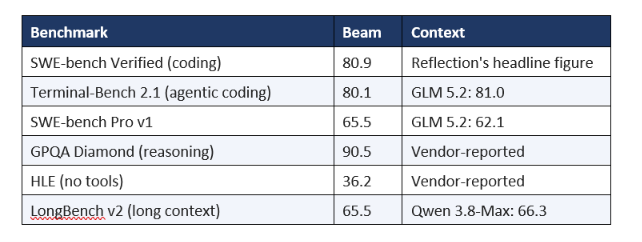
On its own table, Beam looks competitive with Z.ai's GLM-5.2 on several reasoning and coding tests, and it even edges GLM on SWE-bench Pro. But the same table shows the honest limits: against the leading open models Kimi K3 and DeepSeek V4.1 Flash, Beam trails on agentic coding, scoring 80.1 on Terminal-Bench 2.1 versus their 88.3 and 90.6, and 44.4 on DeepSWE v1.1 versus 68.0 and 74.2. By Reflection's own numbers, Beam loses to Kimi K3 on most shared rows. So it is strong, but it is not the new open-weight champion on raw benchmarks. For one of those rivals, see our DeepSeek V4.1 review.
Coding & Agentic Capabilities
Coding and agentic work are Beam's intended home turf, and on the vendor benchmarks it is genuinely capable there. An 80.9 on SWE-bench Verified is a strong score, and the model is positioned for the kind of multi-step, tool-using work that agents need. If you are building coding agents and want an open-weight model you can host and shape yourself, Beam is clearly in the conversation.
The honest framing, though, is that on agentic coding specifically, the current open leaders are ahead. Kimi K3 and DeepSeek V4.1 Flash post higher Terminal-Bench and DeepSWE numbers in Reflection's own comparison. So the pitch for Beam over those models is not that it tops the charts, it is the combination of competitive coding, a permissive US-origin license, and lower inference compute. Whether that bundle wins for you depends on how much you value self-hosting and the license versus the last few points of benchmark performance. For the leading challenger, see our Kimi K3 review.
Self-Hosting & Hardware Requirements
This is the section that matters most for an open-weight model, and it comes with a caveat: since the weights were not yet public at the time of writing, exact memory figures will firm up once they ship. But the architecture tells you the shape of what to expect. Beam has 501 billion total parameters, so even though only 23 billion activate per token, you still have to store all the experts in memory to serve the model. That makes it a multi-GPU, server-class deployment, not something you run on a single consumer card.
- Storage: the full 501B weights are large; expect a multi-GPU server or node to hold them, even in a compressed format.
- Compute: because only ~23B parameters activate per token, inference compute per token is closer to a mid-size model, which is the efficiency upside.
- Quantisation will matter: lower-precision formats will cut the memory footprint and bring self-hosting within reach of more teams.
- Serving stack: plan for a modern inference server that supports large MoE models and long context.
The practical takeaway is that Beam is self-hostable in the sense that a well-resourced team or cloud GPU setup can run it, which is exactly the point of the Apache 2.0 release, but it is not a lightweight local model. The MoE design softens the running cost once it is loaded, since active compute is modest, but the memory to hold the full model is the real barrier. Budget for a multi-GPU deployment and watch for quantised releases that lower that bar.
Fine-Tuning & the Apache 2.0 License
The Apache 2.0 license is the heart of Beam's appeal. It is one of the most permissive open licenses available: it allows commercial use, modification, redistribution, and, importantly, fine-tuning on your own data, with no copyleft obligation to open-source your changes. For companies that want to own their AI stack, adapt a model to their domain, and avoid depending on a closed vendor's API and pricing, that is a big deal, and a US-origin model under this license answers a specific concern some organisations have about where their open models come from.
Reflection says the release will include tooling for running, evaluating, and fine-tuning the model, which is the right scope, weights alone are not enough to make fine-tuning practical. For teams with a clear domain and the data to specialise a model, Beam could become a strong base to build on: start from a capable general model, fine-tune it to your task, and host it yourself with no per-token API bill. That workflow is the real argument for Beam over a closed API, more than any single benchmark. The caveat, again, is that this all depends on the weights and tooling shipping as promised.
The Efficiency Pitch
Reflection's core marketing claim is efficiency: that Beam reaches reasoning scores comparable to GLM-5.2 while using three to four times less inference compute. The mechanism is the MoE design, with only about 23 billion of 501 billion parameters active per token, the compute spent generating each token is far lower than a dense model of similar capability would need.
It is worth reading that claim carefully. Reflection estimates compute roughly as active parameters times generated tokens, which leaves out prompt prefill, attention, and serving overhead, so the real-world efficiency gain will be smaller than the headline three-to-four-times figure. The direction is right, sparse MoE models genuinely are cheaper to run per token than dense models of comparable ability, but treat the exact multiple as a vendor estimate rather than a measured result. For high-volume inference, even a more modest efficiency edge matters, so this is a real advantage, just not quite as large as advertised.
Does It Rival Closed Frontier Models?
This is the question the release is really asking, and the honest answer is: it is close on some axes and a step behind on others, with the caveat that we only have vendor numbers. On reasoning and some coding benchmarks, Beam's reported scores are in frontier territory, a GPQA Diamond around 90 and an 80.9 on SWE-bench Verified are serious numbers. For a model you can self-host and fine-tune, getting that close to closed frontier systems would be a genuine achievement.
But rivalling the closed frontier means matching the best, and Beam does not clearly do that yet. It trails the leading open models on agentic coding, let alone the strongest closed systems, and independent testing has not confirmed its numbers. The fairer framing is that Beam narrows the gap between open and closed, especially for teams that value self-hosting and a permissive license, rather than closing it outright. If you need the absolute best raw capability, closed flagships still lead; if you want a frontier-class model you can own and shape, Beam is one of the more compelling US-built options to watch. For the full comparison of the top systems, see our best AI models 2026 ranked analysis.
Beam vs Other Open Models
Here is how Beam sits against the open models it is really competing with, on the vendor-reported numbers.
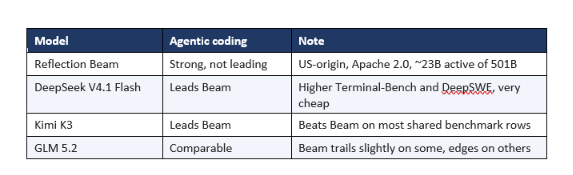
The takeaway is that on raw benchmarks, the current open leaders edge Beam. Its differentiators are the US origin, the Apache 2.0 license, and the efficiency design, not a clean performance win. For many teams those differentiators matter as much as a few benchmark points, but it is important to choose Beam for the right reasons. For the broader open category, see our open-source LLMs guide.
My Verdict
Reflection Beam is one of the most interesting open-weight releases of 2026, less for topping benchmarks, which it does not, than for what it represents: a serious, US-built, frontier-class model that Reflection plans to put under Apache 2.0 so teams can self-host and fine-tune it. On the vendor numbers it is strong on reasoning and competitive on coding, while trailing the best open models on agentic tasks, and its efficiency pitch, though overstated in exact terms, points in a genuinely useful direction.
My recommendation is to watch it closely and test it the moment the weights ship, especially if self-hosting, fine-tuning, and license terms matter to you more than the last few benchmark points. For pure performance per rupee on agentic coding, the leading open rivals currently look stronger. But as an own-your-stack, fine-tune-it-yourself foundation from a US lab, Beam is a compelling bet, provided the open-weight release lands as promised and independent testing backs up the claims.
Frequently Asked Questions
What is Reflection Beam?
Reflection Beam is a 501 billion parameter open-weight model from Reflection AI, announced on October 5, 2026, for coding, reasoning, and agentic work. It is a sparse mixture-of-experts design with about 23 billion active parameters per token and a 1 million token context, and Reflection plans to release the weights under the permissive Apache 2.0 license.
Is Reflection Beam open source?
It is open-weight. Reflection plans to publish Beam's weights under Apache 2.0, a permissive license that allows commercial use, modification, self-hosting, and fine-tuning, along with a technical report, model card, and tooling. At the time of writing the weights had not yet been released publicly, so the open-weight launch was still pending, with API access gated by a waitlist.
What hardware do you need to run Reflection Beam?
Expect a multi-GPU, server-class setup. Although only about 23 billion of its 501 billion parameters activate per token, all the experts must be stored in memory, so the full model is large to host. The mixture-of-experts design keeps compute per token modest once it is loaded, and quantised releases should lower the memory bar, but it is not a single-consumer-GPU local model.
Reflection Beam vs DeepSeek: which is better?
On Reflection's own benchmarks, DeepSeek V4.1 Flash leads Beam on agentic coding, for example higher Terminal-Bench and DeepSWE scores. Beam's advantages are its US origin, the planned Apache 2.0 license, and its efficiency design rather than a benchmark win. If raw open-model performance is the priority, DeepSeek looks stronger; if US-origin weights and the license matter, Beam is attractive.
Can you fine-tune Reflection Beam?
Yes, that is a core part of its appeal. Under the planned Apache 2.0 license, you can fine-tune Beam on your own data for commercial use without a copyleft obligation, and Reflection says the release will include tooling for running, evaluating, and fine-tuning. For teams with a clear domain and training data, that makes Beam a strong base to specialise and self-host once the weights ship.
Are Reflection Beam's benchmarks reliable?
Treat them cautiously for now. Every benchmark figure published so far comes from Reflection itself, and independent testing had not happened at the time of writing. The scores suggest a strong model, but on Reflection's own table Beam loses to Kimi K3 on most shared rows, so wait for third-party results before taking any single number as settled, especially the efficiency claim.
Is Reflection Beam good for coding?
On vendor benchmarks, yes, it is genuinely capable, with an 80.9 on SWE-bench Verified. For agentic coding specifically, the leading open models Kimi K3 and DeepSeek V4.1 Flash currently report higher scores. So Beam is a solid coding model, but not the top open option on raw numbers; its edge is self-hosting, the license, and efficiency rather than a clear benchmark lead.
When will Reflection Beam's weights be released?
Reflection said it planned to release the weights under Apache 2.0 later in October 2026, along with a technical report, model card, and tooling. At the time of writing that release had not yet happened, and access was through a hosted API by waitlist, so check Reflection's own announcements for the confirmed open-weight launch date before planning a deployment.
Recommended Blogs
- DeepSeek V4.1 Review (2026)
- Kimi K3 Review (2026)
- Best Open-Source AI Models (2026)
- Open-Source LLMs: A Practical Guide
- Best AI Models 2026: Full Ranked Analysis & Benchmarks

