



NVIDIA Nemotron 3.5 Super VL Review: Can a 120B Open Model Handle Vision, Video and Real Agent Work?
NVIDIA Nemotron 3.5 Super VL is an open-weight multimodal reasoning model built for workloads where an AI system must do more than answer a text prompt. It can interpret text, images, documents, charts and video, follow instructions, use tools and work through multi-step tasks. NVIDIA announced the model on October 15, 2026, positioning it as a high-throughput option for specialized enterprise agents.
Its most important design choice is the balance between total size and active computation. Nemotron 3.5 Super VL has 120 billion total parameters but activates about 12 billion per token through a mixture-of-experts architecture. That does not make it a small model, and it does not mean it will fit into a 24GB gaming GPU at full precision. It means the model can draw on a large parameter pool while limiting how many parameters are active for each token.
The benchmark picture is substantial, with official model-card results across coding, science, reasoning, long-context, tool-use and multimodal tasks. The practical question is whether that breadth translates into a useful deployment: one model that can read a report, interpret its charts, inspect a video, call a tool and produce a structured answer without switching between separate systems.
QUICK ANSWER
NVIDIA Nemotron 3.5 Super VL is a 120B-total / 12B-active open-weight mixture-of-experts vision-language model for multimodal reasoning and agentic workflows. It accepts text, images, documents and video, supports tool use, and is designed for customization with NVIDIA NeMo and deployment through supported NVIDIA hardware and inference stacks.
The official BF16 model card reports 71.10% on SWE-bench Verified, 51.78% on SWE-bench Pro, 66.70% on Terminal-Bench 2.1, 88.22 on LiveCodeBench v6, 89.52 on GPQA Diamond, 68.62 on AA-LCR v1.1, and 78 on BrowseComp. On chart reasoning, NVIDIA reports 80.8% on CharXiv, rising to 84% with Python code interpretation. These numbers come from different benchmarks and evaluation setups, so they should not be treated as one universal accuracy score.
The model is worth evaluating if you need an open-weight multimodal agent that can handle documents, visual data and coding workflows in one stack. Its main tradeoffs are deployment complexity, substantial memory requirements, and the need to validate performance on your own data. NVIDIA has not published a universal per-token price for self-hosting; hosted API rates depend on the provider and serving configuration.
1. What Is NVIDIA Nemotron 3.5 Super VL?
Nemotron 3.5 Super VL is NVIDIA's open, customizable multimodal model for specialized agents. The VL label indicates vision-language capability, but the model's scope extends beyond image question answering. NVIDIA describes a single system that combines reasoning, instruction following, tool use, text understanding, document interpretation and video understanding.
That combination matters for enterprise workflows. A support agent might read a customer's screenshot, inspect a PDF invoice, compare it with a policy document, query an internal system and return a structured resolution. A coding agent might inspect a visual bug report, navigate a repository, execute tests and summarize what changed. A separate vision model and text model can support such workflows, but every handoff introduces integration overhead and another place for context to be lost.
Nemotron 3.5 Super VL is designed to consolidate more of that work in one model. It is not automatically the best choice for every task, but its broad input support and tool-use focus make it different from a text-only reasoning model.
2. Specifications at a Glance
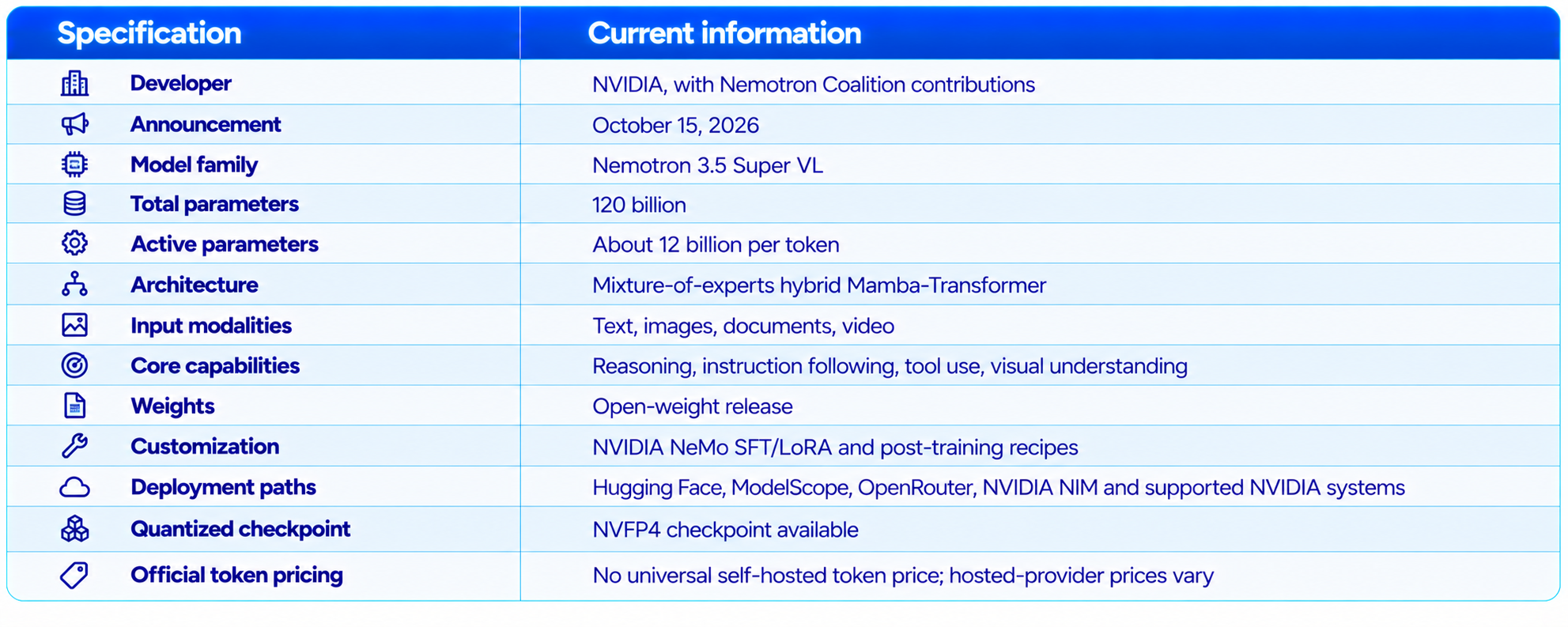
The parameter count deserves careful interpretation. The 120B figure is the total model capacity, while the 12B-active figure describes the parameters activated for a token. Memory use still depends on the checkpoint, quantization, runtime, context length, vision components and serving setup. Active parameter count is not a substitute for a VRAM estimate.
3. Architecture: 120B Total, 12B Active
NVIDIA describes Nemotron 3.5 Super as a hybrid Mamba-Transformer mixture-of-experts model with native multi-token prediction. The hybrid design combines different sequence-processing approaches, while the expert system activates a subset of the model for each token. The goal is to maintain a large capacity without paying the full dense-model compute cost for every generated token.
The Super VL release builds on Nemotron 3 Super and adds multimodal capabilities through supervised fine-tuning, reinforcement-learning-based verification, specialist teachers and multi-teacher on-policy distillation. NVIDIA's training recipe explains that the initial model is text-pretrained, then adapted into a vision-language model and post-trained as a multimodal agent.
This training pipeline is relevant because visual reasoning is not only about recognizing objects. A useful agent must interpret visual evidence, connect it with textual instructions, decide whether to use a tool and produce a result that follows the task's constraints. Distillation from specialist teachers is intended to transfer these different skills into one deployable model.
4. Official Benchmark Results
NVIDIA's model card publishes separate results for BF16 and NVFP4. BF16 is the higher-precision reference checkpoint; NVFP4 is a lower-precision format intended to reduce memory and improve serving efficiency. The scores below are the official model-card values, not a single independently controlled comparison across every model.
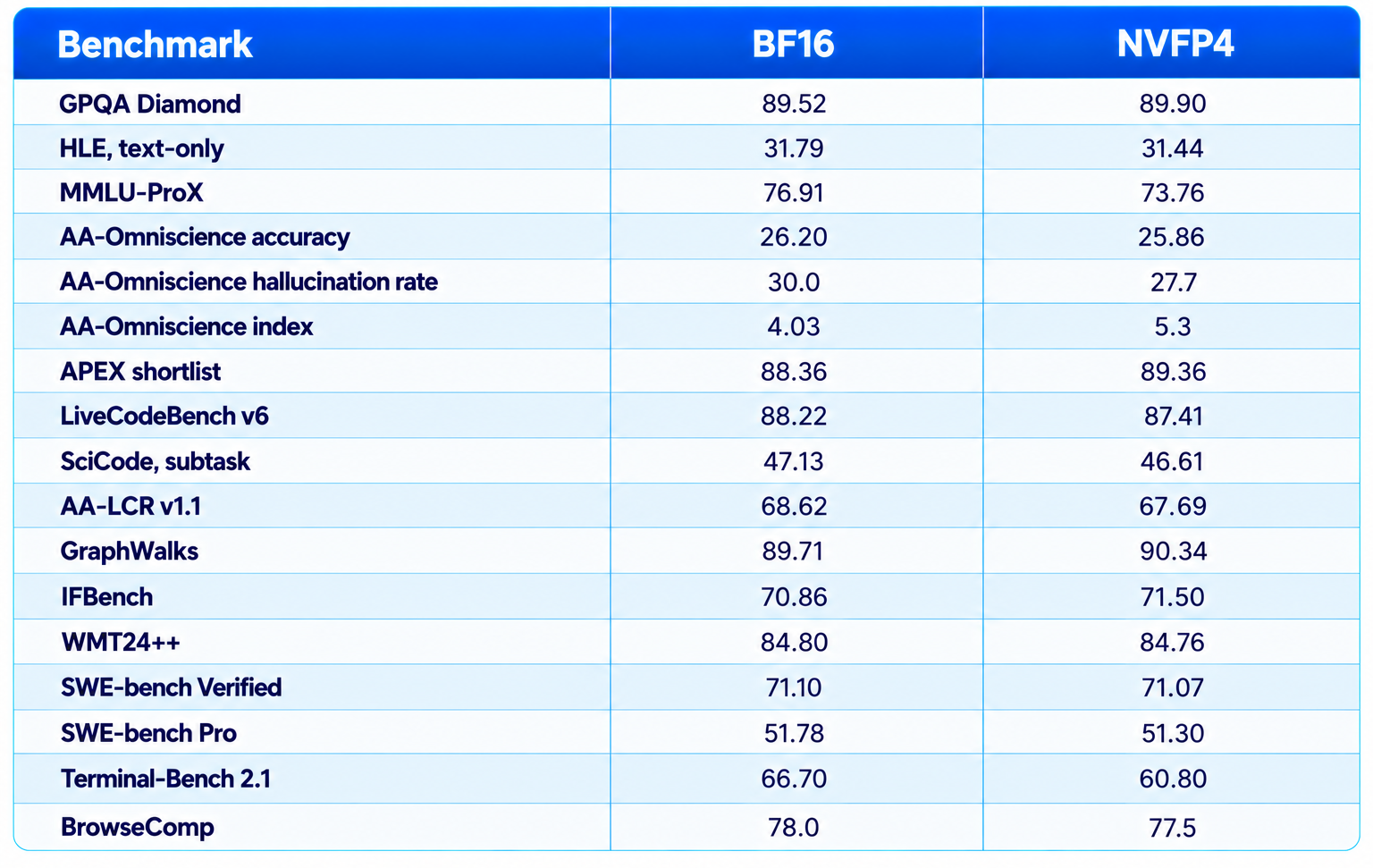
The table shows why the model should be evaluated by workload rather than one headline score. It has strong published coding results, solid science and reasoning scores, and support for visual inputs. NVFP4 preserves many benchmark results closely, but some tasks show a larger drop, notably Terminal-Bench 2.1. Teams should validate the exact checkpoint they plan to deploy instead of assuming quantization has no effect.
5. Coding and Software Engineering
The official model card reports 71.10% on SWE-bench Verified and 51.78% on SWE-bench Pro for BF16, alongside 66.70 on Terminal-Bench 2.1 and 88.22 on LiveCodeBench v6. These evaluations test different aspects of software work: resolving repository issues, handling more demanding software engineering tasks, operating in terminal environments and solving coding problems.
The model is therefore a serious candidate for coding-agent experiments, especially when the task also involves screenshots, diagrams, documents or visual application state. For example, a bug report may include an error message, a screenshot and a reproduction video. A multimodal model can interpret those inputs before moving into code investigation.
A benchmark score is not a guarantee that the model will reliably modify a real production repository. The result depends on the agent harness, tool permissions, context management, test feedback and how completion is verified. Use a sandbox, restrict secrets, require tests and inspect changes before merging.
For the security side of agentic coding, read How to Secure AI Coding Agents: Permissions, Sandboxing, MCP & Secrets.
6. Vision, Documents and OCR
Super VL's practical advantage is that it can combine visual input with reasoning and tool use. NVIDIA describes training for charts, tables, OCR, multipage documents and other visual tasks. That opens use cases such as extracting figures from invoices, comparing a chart with its caption, answering questions about a report, reading a screenshot of a software error, or finding discrepancies between a table and narrative text.
OCR is not simply transcription. Document understanding requires layout, reading order, table structure and relationships between labels and values. A model can recognize the words in a scanned page and still misunderstand which column a number belongs to. For production document AI, evaluate field-level accuracy, table reconstruction, page references and how the system handles blurry or rotated scans.
NVIDIA also reports that Nemotron 3.5 Super VL is among the top open models on OCRBench v2. The release's breadth makes it attractive for document intelligence, but benchmark position should be checked against the specific document types, languages and scan quality in your own environment.
7. Chart Reasoning: CharXiv Results
NVIDIA's technical blog reports 80.8% on CharXiv for chart reasoning, increasing to 84% when Python code interpretation is used. This is a useful example of how tool use can improve multimodal reasoning. The model interprets a chart, forms a hypothesis about the values or trend, and uses code to check calculations rather than relying only on visual estimation.
For business intelligence, this can support chart explanation, KPI review, anomaly investigation and report drafting. It can also make errors: a model may misread axes, miss a logarithmic scale, confuse stacked series or infer causation from a correlation chart. The best workflow keeps the source data available and uses code or a deterministic calculation step to validate numbers.
8. Video Understanding
Nemotron 3.5 Super VL includes video understanding in its multimodal scope. This is useful when a task depends on a sequence of events rather than one still image: reviewing a product demonstration, summarizing a recorded process, identifying steps in a support video, or connecting an event in a clip with a written procedure.
Video analysis quality depends on frame selection, temporal coverage, resolution, clip length and whether the model can distinguish what happened first from what happened later. Do not assume that support for video means every deployment accepts arbitrary-length footage without preprocessing. Check the runtime's supported input format and limits, then test clips representative of your application.
For safety, compliance or incident review, treat model output as an analysis aid rather than an authoritative record. Preserve timestamps, retain source video and require human review for consequential decisions.
9. Tool Use and Agentic Workflows
NVIDIA positions Super VL for specialized agents that must follow instructions, use tools and complete multi-step business workflows. Its official technical blog reports 63.44% on Hermes Bench and 87.05% on LangChain evaluations, higher than Nemotron 3 Ultra's 56.33% and 84.3% respectively in the cited comparison.
This matters because an agent can fail even when its language output looks convincing. It may call the wrong tool, omit a required parameter, stop early, repeat an action or claim that a task is finished without checking the result. Agent benchmarks help measure behavior beyond isolated question answering, although performance still varies by harness and task definition.
A practical deployment should define tool schemas, validate arguments, restrict permissions, log actions and use explicit stop conditions. For actions that modify customer records, send messages, change infrastructure or spend money, insert human approval before execution.
For a practical foundation, see What Is an AI Agent? Beginner Guide With Examples (2026).
10. Inference Speed and Throughput
NVIDIA says Nemotron 3.5 Super VL delivers up to five times higher throughput than the next-best model in its class on a single GPU for the tested agentic workloads. Its technical blog also reports more than 600 output tokens per second on a Baseten endpoint for the Artificial Analysis Intelligence Index agentic workload. Those figures are workload- and infrastructure-specific, not a guarantee that every user will see 600 tokens per second.
Throughput and task completion time are different measurements. A fast decoder may still spend time on reasoning, tool calls, image preprocessing and network round trips. NVIDIA's agentic evaluation emphasizes task completion across long workflows, where token efficiency and fewer repeated steps can matter as much as raw generation speed.
For multi-user production systems, NVIDIA Dynamo adds serving optimizations such as KV-cache-aware routing and cache management. NVIDIA reports that a specific 16-B200 setup can serve up to eight times as many users while reducing first-token latency by 85% at a target of 50 tokens per second per user. This is a deployment result for that configuration, not a hardware-independent property of the model.
11. BF16 vs NVFP4: Which Checkpoint Should You Use?
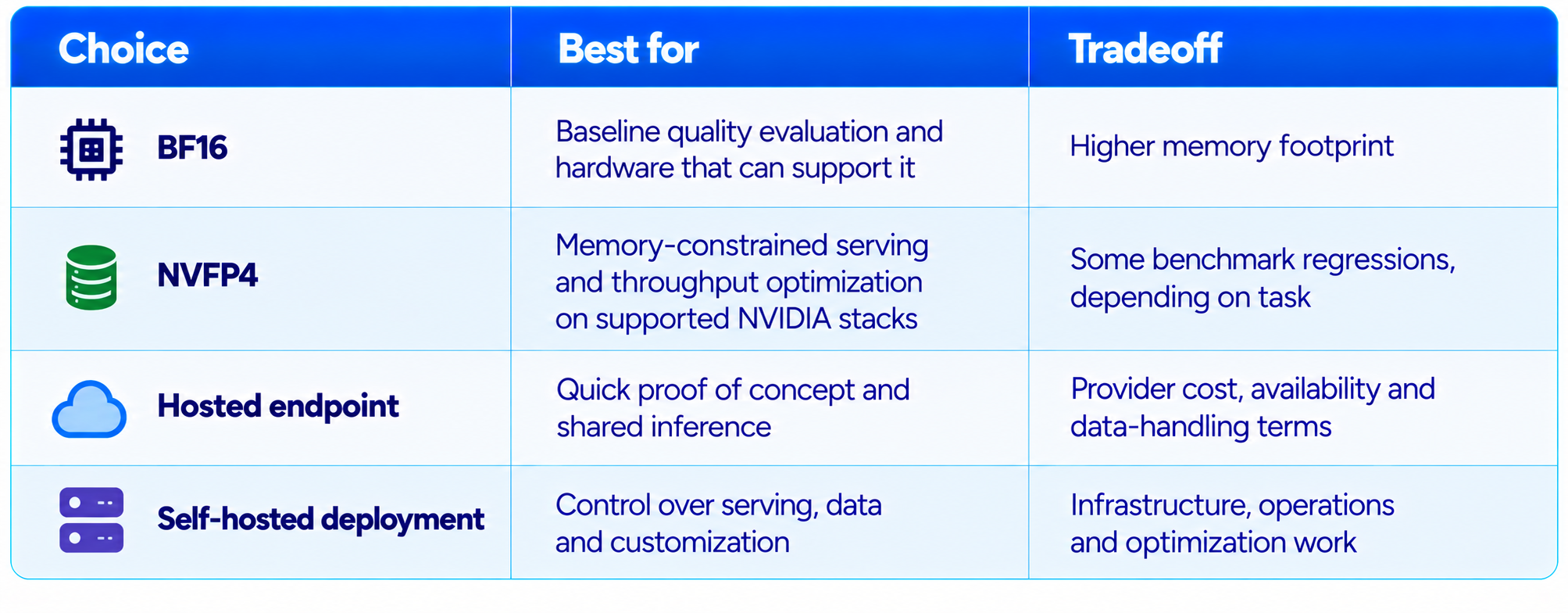
The model card shows that NVFP4 retains results close to BF16 on several benchmarks, including SWE-bench Verified, BrowseComp and GPQA Diamond. The Terminal-Bench difference is larger, with 60.80 for NVFP4 versus 66.70 for BF16. That is a reminder to test the precision mode against your target tasks before selecting a production checkpoint.
12. Hardware and Local Deployment
Nemotron 3.5 Super VL is not a lightweight download for an ordinary laptop. The 120B total parameter count means the full checkpoint requires substantial memory, and real inference needs additional capacity for runtime overhead, context, visual inputs, KV cache and concurrent requests. The 12B active parameter figure reduces compute per token but does not mean only 12B parameters need to be stored.
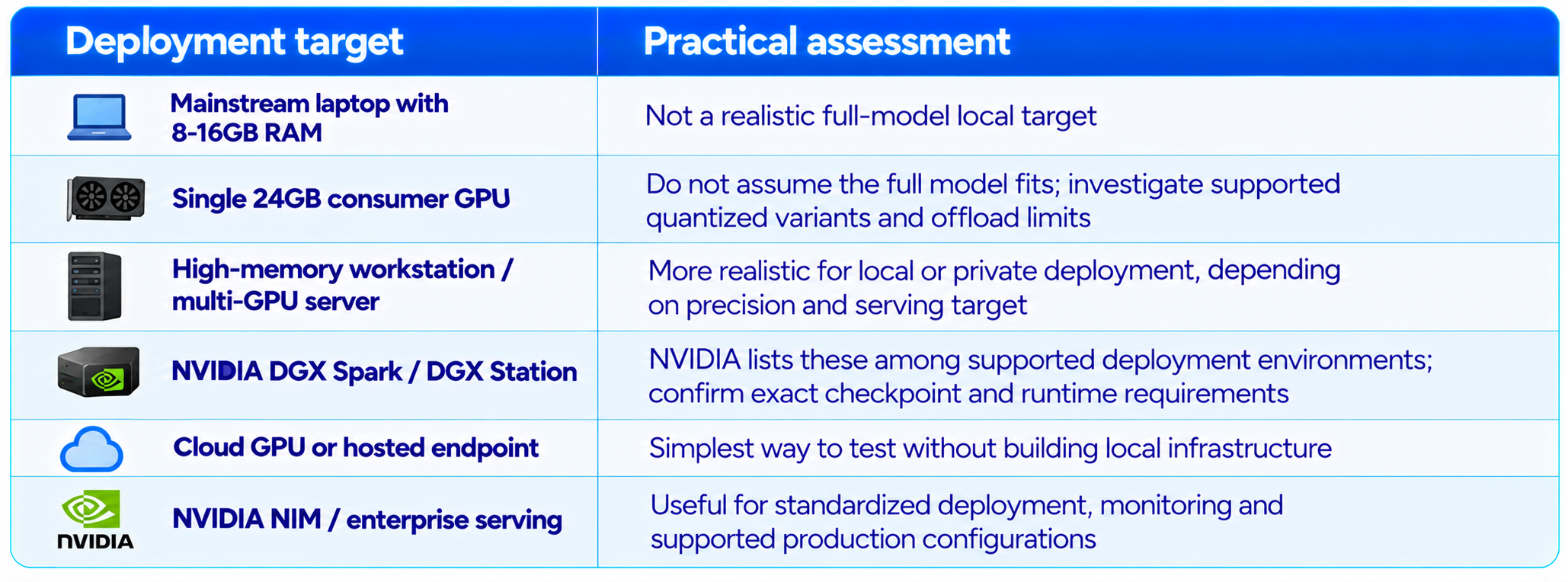
Before choosing a local model, compare the hardware requirements with our 24GB VRAM AI Models guide.
13. Pricing and API Access
Because Nemotron 3.5 Super VL is released as open weights, there is no single universal per-token price for using the model. Self-hosting shifts the cost to GPUs, electricity, storage, engineering and operations. Hosted access through a provider such as OpenRouter or a managed NVIDIA service may be billed differently, and rates can change by endpoint, quantization, region and service level.
For an honest cost comparison, calculate the cost per completed task rather than comparing token rates alone. Include prompt tokens, generated tokens, reasoning overhead, image or video processing, retries, tool calls and idle GPU time. A model with lower latency may also serve more concurrent users, which changes the economics of a production deployment.
14. Customization and Fine-Tuning
Customization is one of the main reasons to consider an open-weight model. NVIDIA describes supervised fine-tuning and LoRA workflows through NeMo, along with post-training recipes for specialized behavior. Teams can adapt the model to internal document formats, company-specific tools, output schemas, support procedures and domain terminology.
Fine-tuning is not the right first step for every problem. If the model lacks current information, retrieval may be more appropriate. If it needs to call a new API, tool integration and examples may solve the issue. Fine-tuning is more useful when the desired behavior is repeated, measurable and difficult to obtain consistently through prompts alone.
NVIDIA's training documentation also notes that not every dataset or component used in the training pipeline is available as a public release. Open weights and a public training recipe do not automatically mean every training artifact is open. Review the exact license and release contents before planning a reproducible training project.
15. Nemotron 3.5 Super VL vs Nemotron 3 Ultra
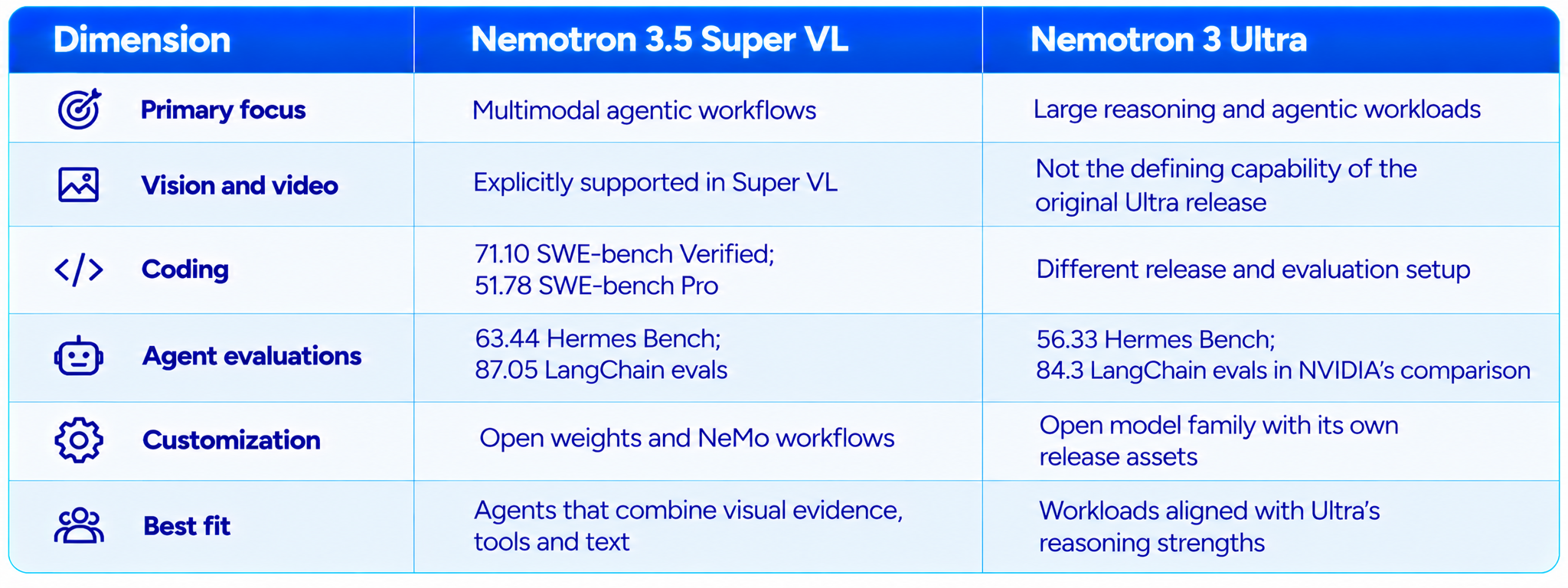
The strongest reason to choose Super VL is not that it replaces Ultra in every task. It is that the VL version brings vision, document and video understanding into the agent workflow while improving the cited Hermes Bench and LangChain evaluation results. Select the model based on whether the workload needs multimodal inputs, and test both on the same agent harness.
16. Best Use Cases
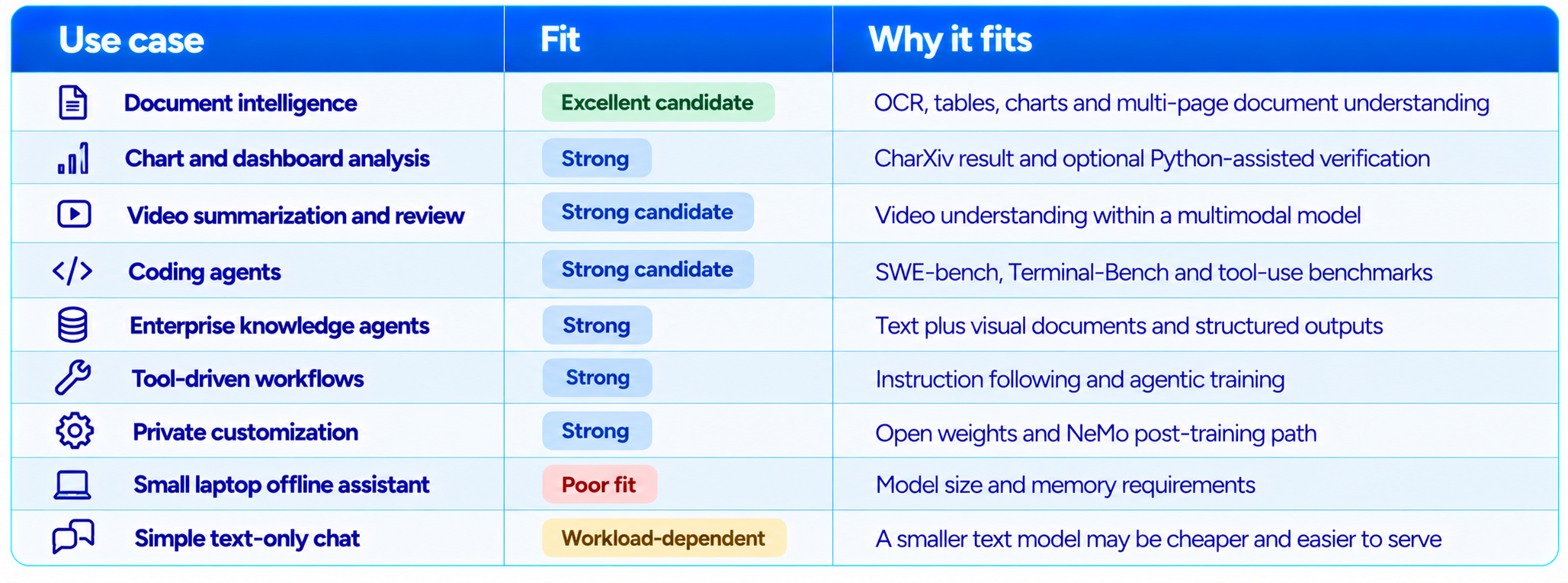
17. Limitations You Should Know
- 120B total parameters still make this a large deployment, despite the 12B-active MoE design.
- Benchmark results come from different datasets and harnesses; they are not interchangeable measures of general intelligence.
- NVFP4 does not match BF16 on every evaluation, with a noticeable gap on Terminal-Bench 2.1 in the published model card.
- Video support does not remove the need to check clip-length, frame-sampling and runtime limits.
- Open weights do not automatically mean unrestricted commercial use; read the license and model terms.
- Self-hosting requires GPU capacity, inference engineering, monitoring and security controls.
- Model outputs can still misread charts, tables, visual text or event order. Validate important conclusions against source evidence.
- The training recipe notes that some SFT and reinforcement-learning data are not yet published, so full end-to-end reproducibility is limited.
18. A Practical Evaluation Workflow
Use a task set that resembles the work you intend to automate. A useful first evaluation includes:
- Twenty document questions requiring text extraction, table interpretation and page-level evidence.
- Ten chart questions with known numeric answers, including misleading axes and multi-series charts.
- Five video summaries where event order and timestamps matter.
- Ten repository tasks with tests, including a few that require terminal commands.
- Ten tool-use tasks with valid, invalid and ambiguous arguments.
- A small adversarial set with low-quality scans, missing context and conflicting instructions.
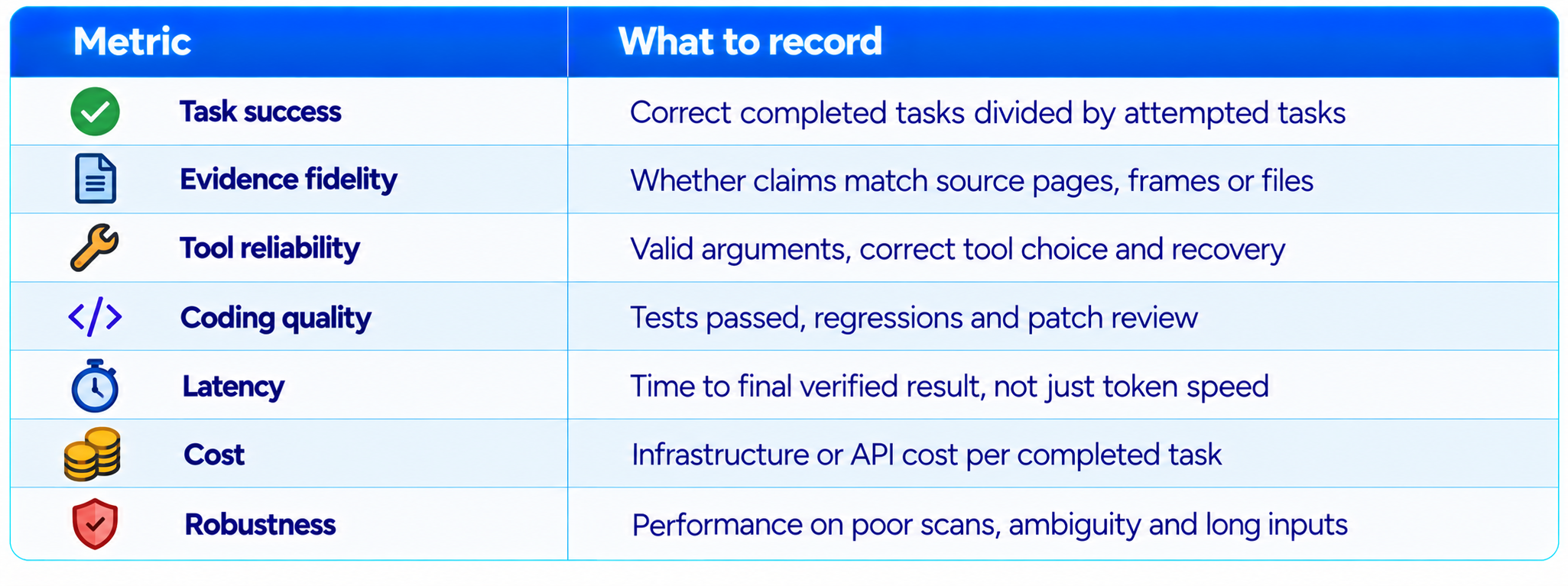
Run the same tests on BF16 and NVFP4 if both are candidates for deployment. Keep the model, prompt, tools and evaluation harness fixed, and repeat runs when the task has meaningful variability. That is the best way to decide whether the faster or smaller checkpoint preserves enough quality for your business.
19. Is NVIDIA Nemotron 3.5 Super VL Worth It?
Yes, if you need an open-weight multimodal model for agentic workflows and have the infrastructure to deploy it. The strongest case is consolidation: a single model can reason over text, images, documents and video, use tools and participate in longer workflows. That can simplify architecture and reduce context handoffs between separate models.
The official benchmarks support serious evaluation rather than casual experimentation. The model reports 71.10 on SWE-bench Verified, 51.78 on SWE-bench Pro, 66.70 on Terminal-Bench 2.1 and 89.52 on GPQA Diamond in BF16, alongside 80.8% on CharXiv in NVIDIA's technical blog. Its open-weight release and customization path make it relevant to teams that need more control than a closed API provides.
It is less compelling if you need a small local model, do not have GPU capacity, or only need routine text chat. In those cases, a smaller model or managed API may be a better operational choice. The right comparison is the cost and reliability of completing your actual workflow, not the largest benchmark number on the page.
20. Final Verdict
NVIDIA Nemotron 3.5 Super VL is one of the more consequential open multimodal model releases for developers building enterprise agents. Its 120B-total / 12B-active architecture combines reasoning, visual understanding and tool use, with official results spanning coding, science, long-context tasks, browsing and agent benchmarks.
Its most practical advantage is breadth. It can read documents, interpret charts, analyze video and work with tools without requiring every modality to be handled by a separate model. NVIDIA's reported CharXiv result of 80.8%, the official SWE-bench and Terminal-Bench scores, and improved Hermes Bench and LangChain evaluation results make it a credible candidate for real agent testing.
The tradeoff is deployment. A 120B model is not a casual laptop download, and active parameter count should not be confused with memory footprint. Quantization can make serving more practical, but the model card shows that precision choices can affect task scores. Teams should benchmark the exact checkpoint, hardware and harness they plan to ship.
Verdict: 9/10 for multimodal agent potential, 8.5/10 for coding-agent use, 9/10 for customization, and 8.5/10 for ease of deployment. Overall: 8.8/10 for teams with suitable NVIDIA infrastructure and a clear multimodal workflow.
Bottom line: Nemotron 3.5 Super VL is worth testing when your agent needs to connect visual evidence with reasoning and tool use. Its strongest value is not a single benchmark, but the possibility of building a more unified, customizable multimodal agent stack.
Frequently Asked Questions
What is NVIDIA Nemotron 3.5 Super VL?
It is an open-weight 120B-total / 12B-active multimodal reasoning model designed for vision-language understanding and agentic workflows.
When was Nemotron 3.5 Super VL released?
NVIDIA announced it on October 15, 2026.
What are its main benchmark scores?
The official BF16 model card reports 71.10 on SWE-bench Verified, 51.78 on SWE-bench Pro, 66.70 on Terminal-Bench 2.1, 88.22 on LiveCodeBench v6 and 89.52 on GPQA Diamond.
Can it understand video?
Yes. NVIDIA lists video understanding among the model's multimodal capabilities. Check the chosen runtime for supported video formats and input limits.
Can it read PDFs and charts?
It is designed for document and chart understanding, including OCR, tables and multi-page documents. Validate critical extraction against source pages.
Is Nemotron 3.5 Super VL open source?
NVIDIA describes it as an open-weight model. Check the license and release assets for the exact rights and components available.
Can it run on a 24GB GPU?
Do not assume the full model fits in 24GB. Total parameter count, quantization, runtime overhead and context all affect memory use.
Does it have a fixed API price?
There is no single universal price for self-hosting open weights. Hosted providers set their own rates and terms.
Is it good for coding agents?
It is a credible candidate, with published results on SWE-bench Verified, SWE-bench Pro, LiveCodeBench and Terminal-Bench 2.1.
What is the difference between BF16 and NVFP4?
BF16 is the higher-precision checkpoint; NVFP4 reduces precision to improve memory and serving efficiency, but some benchmark scores differ.
Can developers fine-tune it?
NVIDIA documents NeMo workflows including supervised fine-tuning and LoRA, plus additional post-training recipes.
Who should use Nemotron 3.5 Super VL?
Teams building multimodal agents, document intelligence, chart analysis, video workflows and tool-using enterprise systems with suitable deployment infrastructure.
Recommended Blogs
NVIDIA Nemotron 3 Ultra Review: Benchmarks, Architecture & Real-World Performance (2026)
24GB VRAM AI Models: What Can You Actually Run Locally in 2026?
How to Secure AI Coding Agents: Permissions, Sandboxing, MCP & Secrets
Resources & Community
Join our community of 70,000+ AI enthusiasts and learn to build powerful AI applications. Build Fast with AI helps creators, developers and teams understand and implement practical AI.
Agentic AI Launchpad 2026
A structured 6-week cohort program focused on building and deploying real-world agentic AI systems, with live sessions, mentorship, project reviews and a builder community.
Explore the cohort: Agentic AI Launchpad 2026
Free AI Resources
Access free tools, workshops and micro-learning to keep building.

