


Is an AI Certification Worth It? What Employers Check (2026)
An AI certification can help your job search, but it rarely does the whole job for you. Its value depends on what the credential actually assesses, whether it matches the role you want, and whether you can demonstrate the skills behind the badge. A certificate that proves you can use a cloud AI service or complete a practical assessment sends a different signal from a course-completion badge earned by watching videos.
Employers are paying closer attention to demonstrable skills. The National Association of Colleges and Employers reported in its January 2026 Job Outlook survey that 70% of participating employers used skills-based hiring, up from 65% the previous year. NACE also found that employers commonly assess skills during interviews and screening.
AI credentials are also becoming more relevant as organizations try to close gaps in AI, machine learning, cybersecurity and cloud skills. Pearson's 2026 Value of IT Certification Employer Report said 78% of surveyed organizations chose professional certification as a leading upskilling investment. That shows employer interest in structured credentials, not that every certificate guarantees an interview or higher salary.
The practical conclusion is simple: choose a certification because it validates a skill your target role needs, not because you hope a badge will replace experience. Pair it with a project, a clear explanation of your decisions, and evidence that you can use AI responsibly.
QUICK ANSWER
Yes, an AI certification can be worth it in 2026 when it is recognized by employers in your target field, teaches job-relevant skills, includes meaningful assessment, and helps you build something you can demonstrate. It is especially useful for beginners who need structure, professionals moving into AI-related responsibilities, and candidates applying for roles that name a specific platform or credential.
It is usually not worth paying a high fee for a generic certificate that only proves course completion, especially if you have no practical project to show. Employers may use a credential as a screening signal, but they still want to know what you can build, analyze, automate, explain and maintain.
A useful priority order is: learn the fundamentals, build a relevant project, document the result, and then earn a certification that validates a skill the job posting actually requests. For technical roles, a working repository, tests, deployment notes and an honest explanation of limitations can make the credential much more persuasive.
Bottom line: an AI certification is a supporting signal, not a substitute for capability. The best return comes from a credential that maps to a job requirement and gives you evidence you can discuss in an interview.
1. What Does an AI Certification Actually Prove?
The word certification is used loosely online. Some programs require a timed exam, some grade practical work, and others issue a certificate when you finish a series of lessons. These are not equivalent signals to a recruiter.
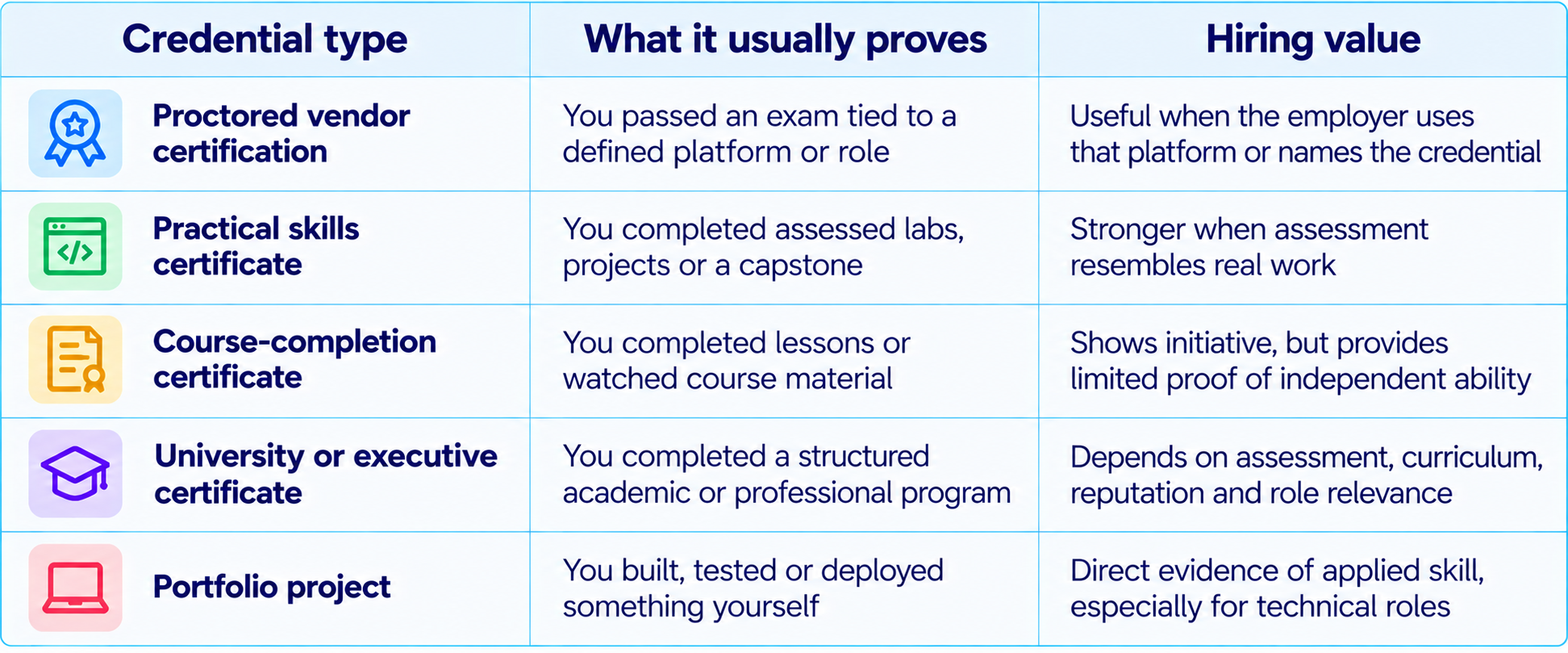
A credential should help an employer answer a narrow question: has this candidate studied and demonstrated the skills the role requires? It cannot prove every part of job readiness. A foundational generative AI certificate, for example, does not automatically prove someone can train a model, build a production RAG system, debug a Python service or design a secure agent architecture.
Microsoft describes its role-based certifications as aligned with industry-defined roles and the skills needed to perform them. Use that as a test for any program: look for a published skills outline and compare it with the work you want to do.
2. What Employers Actually Check
A hiring manager does not evaluate a candidate from one badge alone. The exact process varies by company, country and role, but these are the signals worth preparing for.
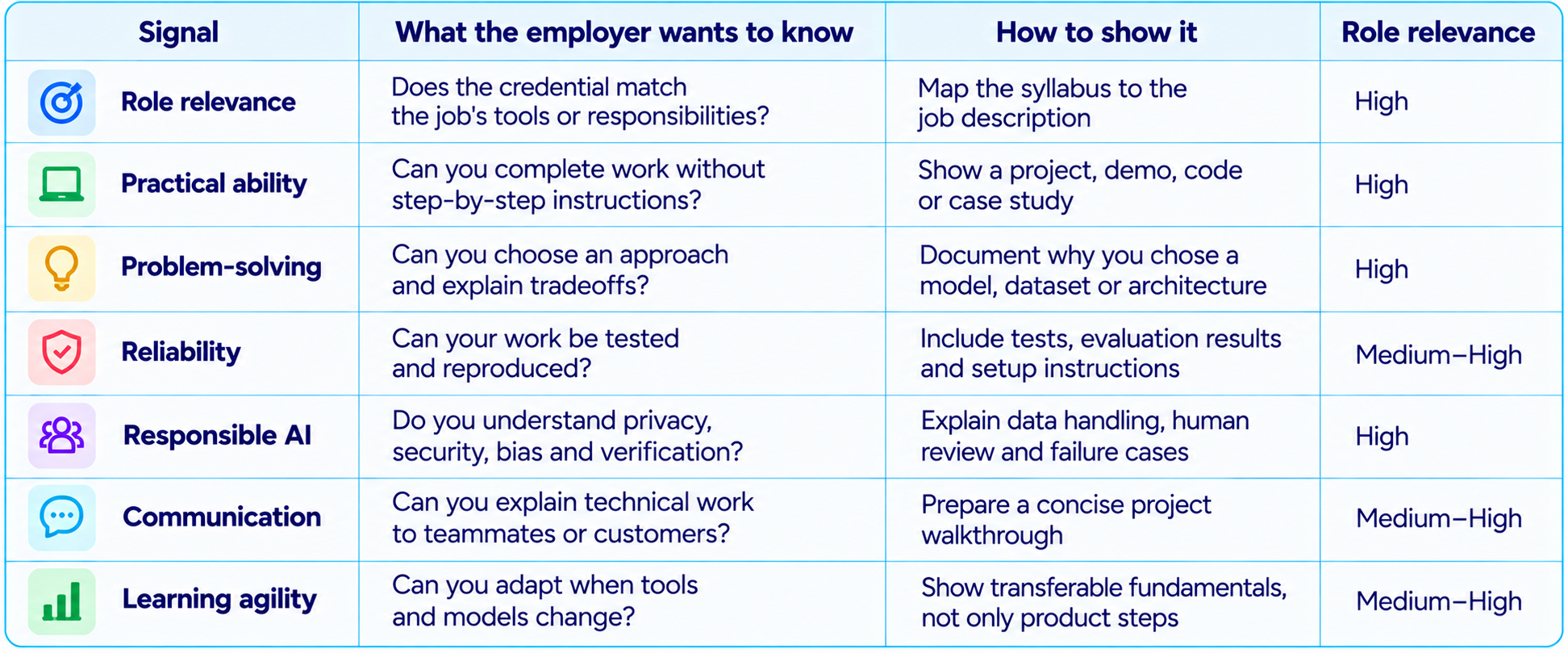
This matches the direction of skills-based hiring. NACE's 2026 survey found that 70% of participating employers used skills-based hiring and that demonstrated proficiency in key competencies remained important to hiring decisions. The implication is not that degrees or credentials no longer matter; it is that employers increasingly want evidence of what candidates can do.
3. Why AI Certifications Are Getting More Attention in 2026
AI is moving from experimentation into everyday workflows. Teams use AI to research, summarize, draft, analyze data, assist with coding, automate support and connect business systems. That creates demand for people who can use AI tools effectively, recognize their limits and connect them to real work.
The 2026 Corporate Recruiters Survey from the Graduate Management Admission Council identified AI-tool skills, data analysis and other technology skills among the areas increasing in value. It also highlighted problem-solving, communication and strategic thinking as important skills. AI proficiency is not isolated from the rest of a job: employers need people who can apply it to a business or technical objective.
In India, Deloitte India's August 2026 campus workforce release reported that 86% of surveyed organizations said AI or agentic AI was transforming recruitment processes, while 35% reported AI adoption creating new entry-level roles or skill requirements. These are findings from surveyed organizations, not a guarantee that every employer uses the same process. They still make a strong case for preparing practical, demonstrable digital skills.
Certification is one way to organize learning and signal commitment. The opportunity is strongest when a program teaches a skill employers can recognize and gives you a credible way to demonstrate it.
4. When an AI Certification Is Worth It
You are new to AI and need a learning path
A structured certification can help you learn terminology, core concepts, responsible use and platform basics in a sensible order. It is most valuable when you complete the exercises instead of rushing to the badge.
Your target job names a credential or platform
If several job postings ask for a particular cloud platform, data tool or vendor certification, earning that credential can make your resume more relevant and help you prepare for interviews.
You are moving into AI responsibilities from another field
A marketer, analyst, project manager or operations specialist may benefit from a certificate that teaches practical AI workflows relevant to their existing expertise.
Your employer will pay for it
When the fee is reimbursed and the learning applies to current projects, the financial downside is smaller. Confirm whether the program is recognized internally and whether you will get time to practice.
The certification includes meaningful assessment
An exam, graded lab or project provides a stronger signal than attendance alone, especially when the assessment reflects actual tasks.
It helps you build a portfolio project
The strongest programs leave you with something you can show: a dashboard, AI workflow, evaluated chatbot, retrieval system, automation or documented case study.
5. When an AI Certification Is Not Worth It
You expect the badge to guarantee a job
No credential can promise a job offer. Hiring depends on role fit, experience, communication, location, interview performance and business needs.
The syllabus is generic and outdated
AI tools change quickly. Check the curriculum date, learning objectives, labs and exam guide before paying.
It does not match your target role
A general AI literacy certificate may help a business user, but it will not prove the engineering skills needed for an ML engineer position.
There is no assessment or practical work
A certificate based only on course completion may be useful for learning, but it is weak proof of independent technical competence.
You already have stronger evidence
If you have deployed relevant systems and can show outcomes, another introductory certificate may add less value than improving the project or learning a missing skill.
The cost would delay higher-value work
If the fee or study time prevents you from building a portfolio, applying for jobs or preparing for interviews, compare those alternatives before enrolling.
6. AI Certificate vs AI Certification vs Portfolio
These terms are often mixed together, but they serve different purposes. A certificate may show completion of a course; a certification usually refers to a credential awarded after an exam or defined assessment; a portfolio shows applied work. Naming conventions differ across providers, so inspect the actual assessment rather than relying on the label.
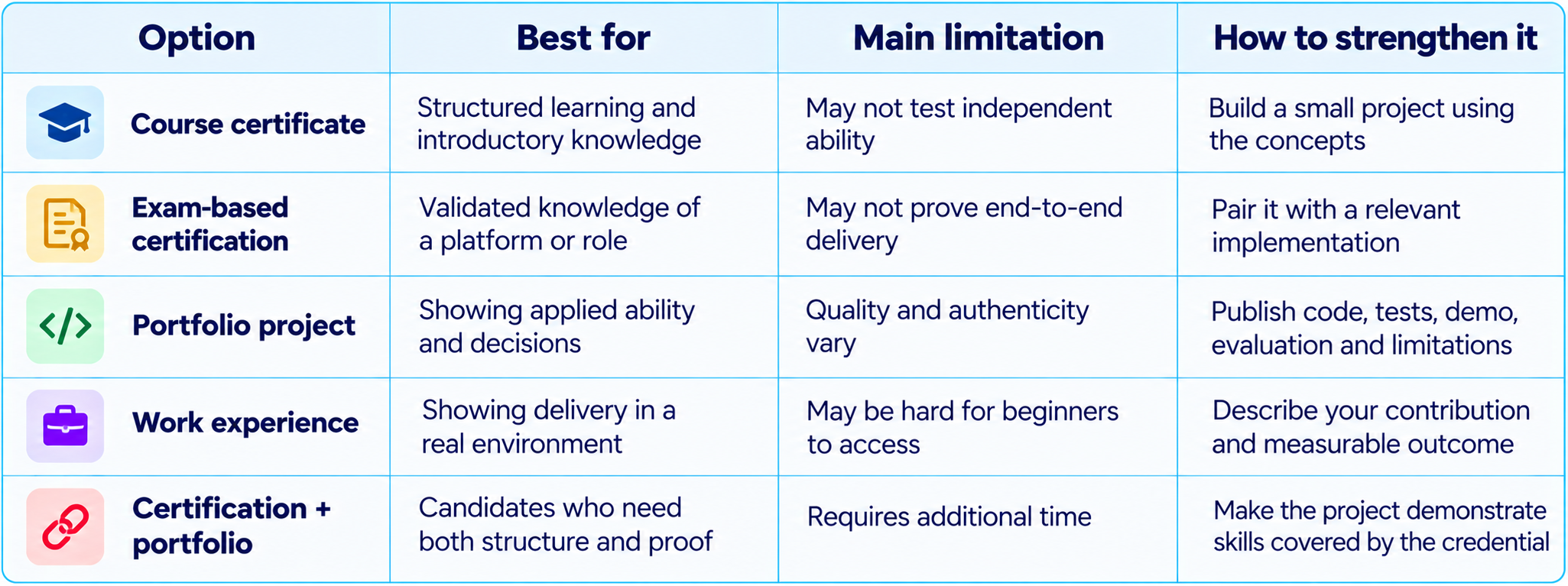
For most beginners, the strongest route is not to choose between certification and projects. Use the course or exam to structure learning, then build something that proves you understood it. A project also gives you specific material to discuss when interviewers ask what you learned.
7. Which AI Certification Should You Choose?
There is no single best AI certification for everyone. Choose based on the role you want, the tools named in relevant job postings and the skills the credential actually assesses. The examples below are starting points, not a universal ranking. Check the provider's current exam guide, cost, eligibility and renewal policy before registering.
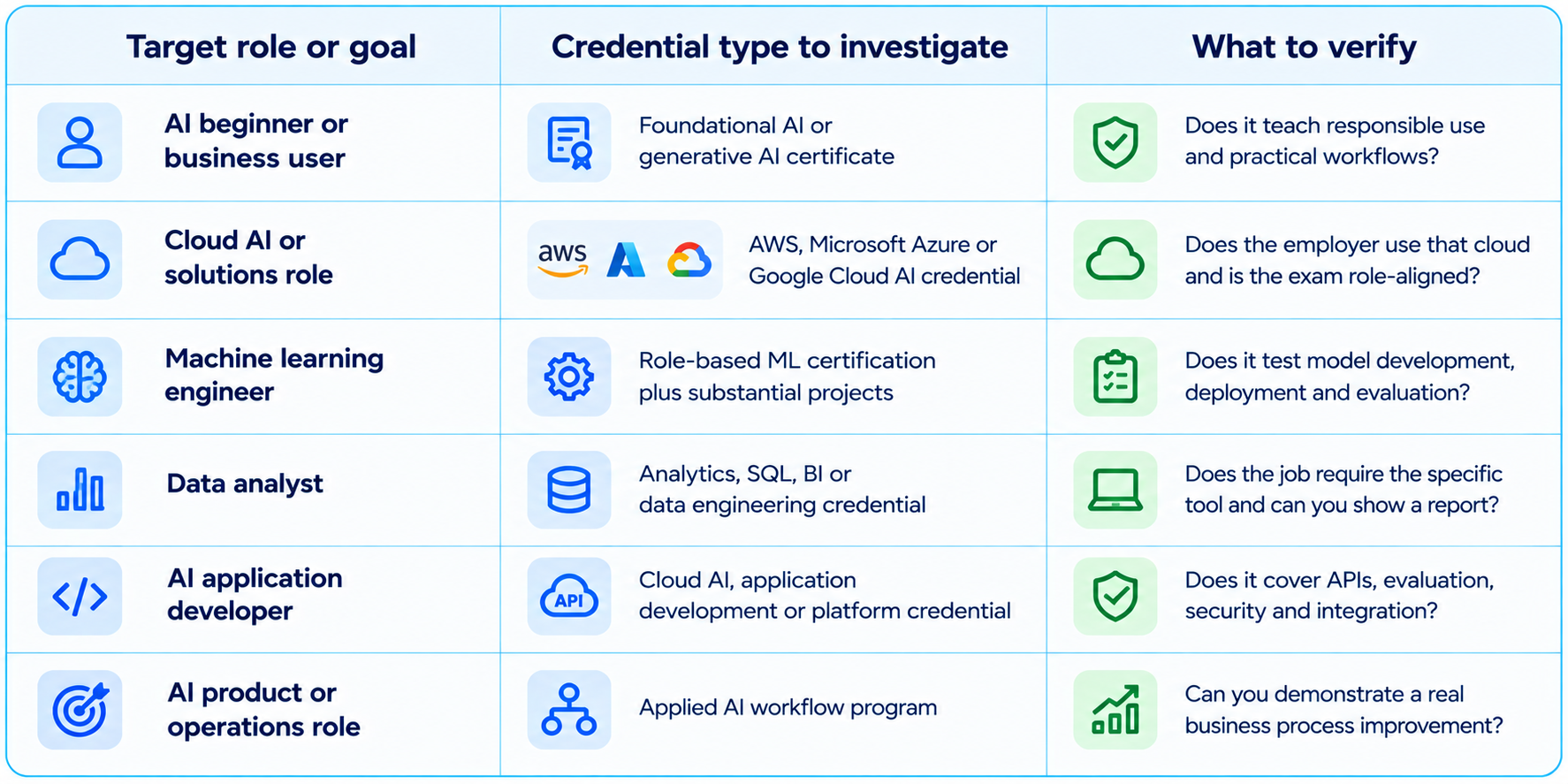
Google's AI Professional Certificate, announced in 2026, focuses on practical use cases such as research, communication, data analysis, content creation, planning and building simple applications. Google says it developed the program with input from employers and skills organizations. This makes it relevant to applied workplace AI, but candidates should distinguish practical AI fluency from deep machine-learning engineering.
AWS Certified AI Practitioner is an example of a foundational credential for understanding AI and AWS AI services; it is not a substitute for advanced model-building experience. Microsoft and Google Cloud offer their own AI learning and credential paths. Use the official exam guide to see what is in scope and avoid choosing a credential only because it is popular on social media.
8. Best AI Certification for Beginners
Beginners should usually start with a credential that matches the work they want to do rather than jumping directly to an advanced machine-learning exam. If you want to use AI at work, focus on AI literacy, prompting, data privacy, verification and workflow design. If you want to build AI applications, add Python, APIs, data handling, evaluation and deployment. If you want to become a machine-learning engineer, you will need mathematics, statistics, programming, model evaluation and practical ML projects beyond an introductory AI certificate.
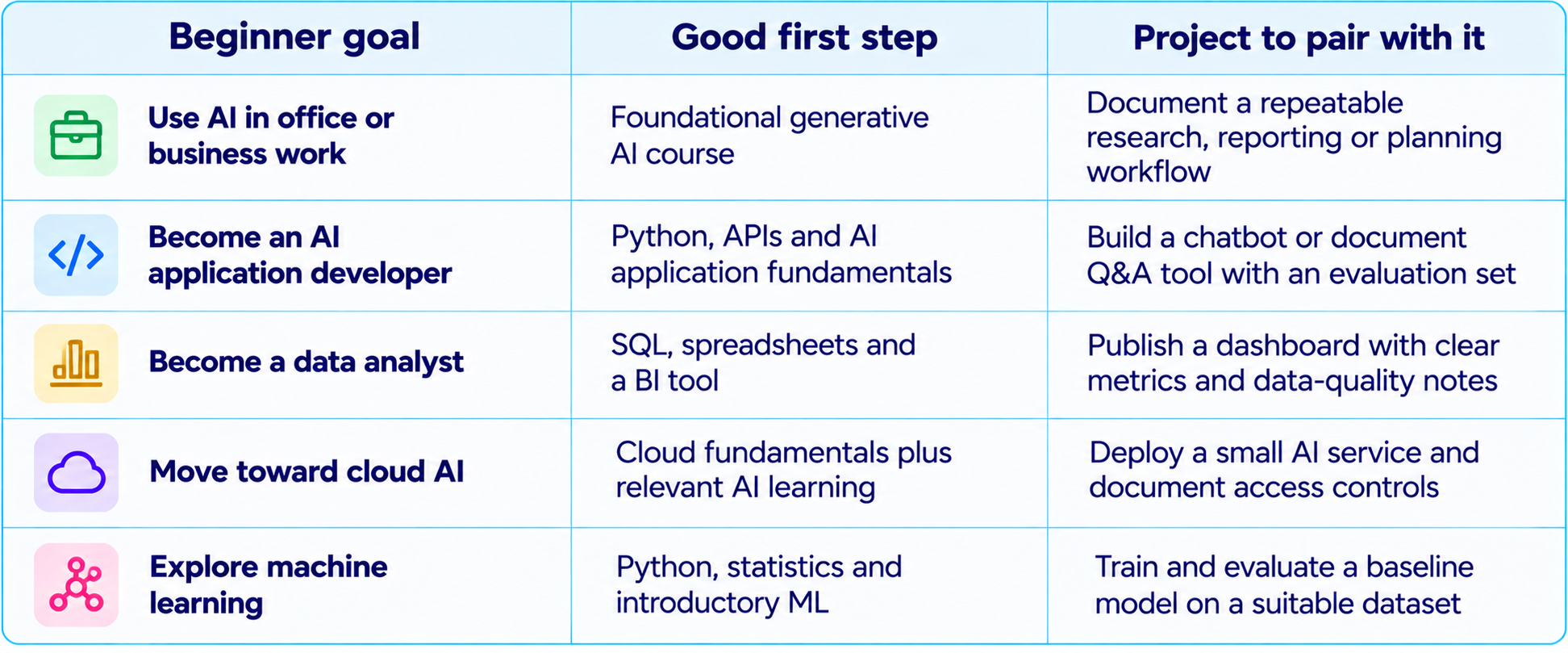
Avoid collecting several introductory certificates that teach nearly the same material. One relevant credential plus a strong project usually tells a clearer story than a long list of unrelated badges.
9. What Employers Check on Your Resume
A recruiter may notice the credential name, issuer, date and relevance to the vacancy. A technical interviewer may go further and ask what you built while preparing for it. Your resume should make the connection between learning and applied work obvious.
- Use the official credential name and issuer.
- Include the issue date when relevant, and list expiry or renewal dates if the credential has them.
- Add a verification link or credential ID when the provider supplies one.
- Place the credential under Certifications or Professional Development, not in a way that implies a degree.
- Add a project bullet that demonstrates the skill in action.
- Do not claim production expertise based only on a beginner course.
- Be prepared to explain what the certification did not cover.
A useful resume entry is specific. Instead of writing 'AI expert, certified in AI,' say what you studied and connect it to evidence. For example: 'Completed a cloud AI certification and built a document Q&A prototype with source citations, an evaluation set and access controls.' Only use that wording if it accurately describes your work.
10. How to Turn a Certification Into a Portfolio Project
The portfolio project does not need to be large. It needs to demonstrate a real problem, sensible implementation choices and a way to judge whether it works. A small, complete project is usually easier to evaluate than an ambitious demo with no testing or documentation.
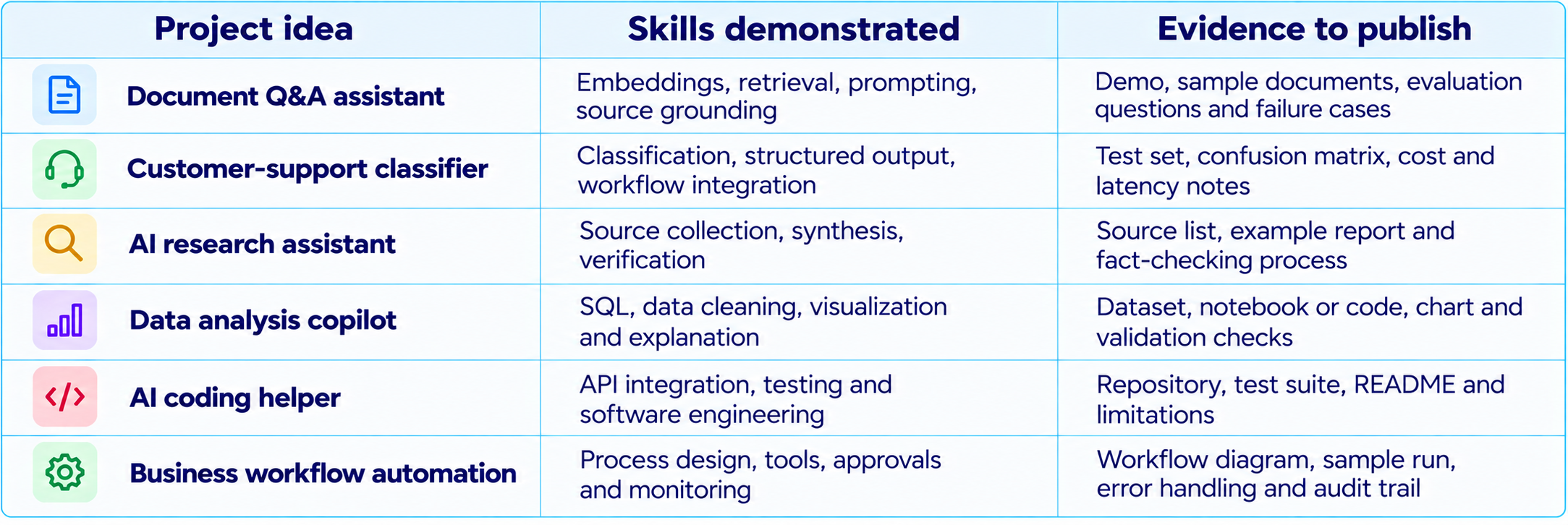
Explain the problem, your architecture, why you selected the model or platform, how you evaluated the output, what failed, and what you would improve next. That turns a tutorial exercise into useful evidence of judgment.
11. How to Measure Whether the Certification Was Worth the Money
Before enrolling, calculate more than the course fee. Include exam charges, subscriptions, preparation time and the opportunity cost of the hours you could have spent on projects or applications. Then define the outcome you expect.
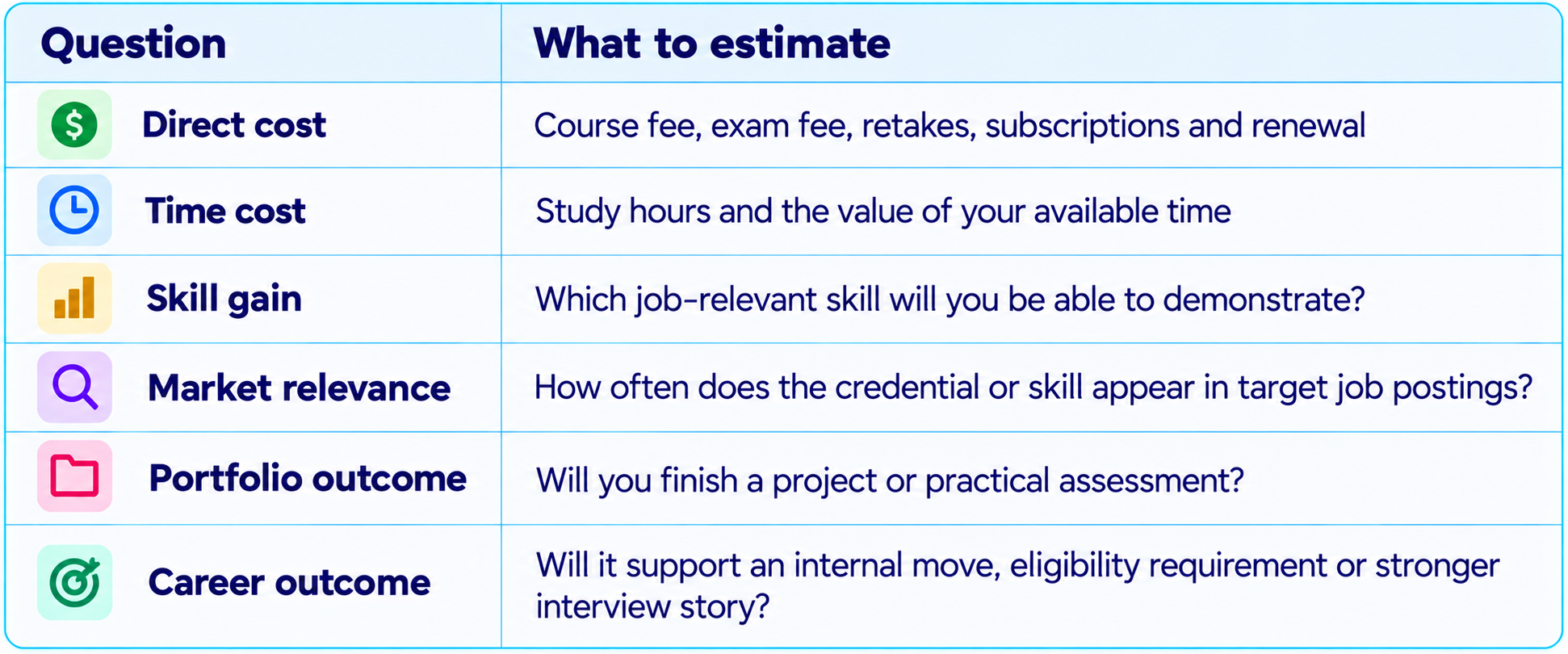
Do not assume a certification automatically creates a salary premium. Compensation depends on role, employer, market, experience and demonstrated performance. A credential can contribute to a promotion or job change, but attributing a pay increase to the certificate alone is difficult without evidence specific to your situation.
Pearson's 2026 employer report indicates that organizations invest in certification as one way to address skills gaps. That supports the case for relevant professional credentials, especially when an employer sponsors the learning. It is not a guarantee of personal financial return.
12. A Practical 30-Day Plan: Certification Plus Proof of Work
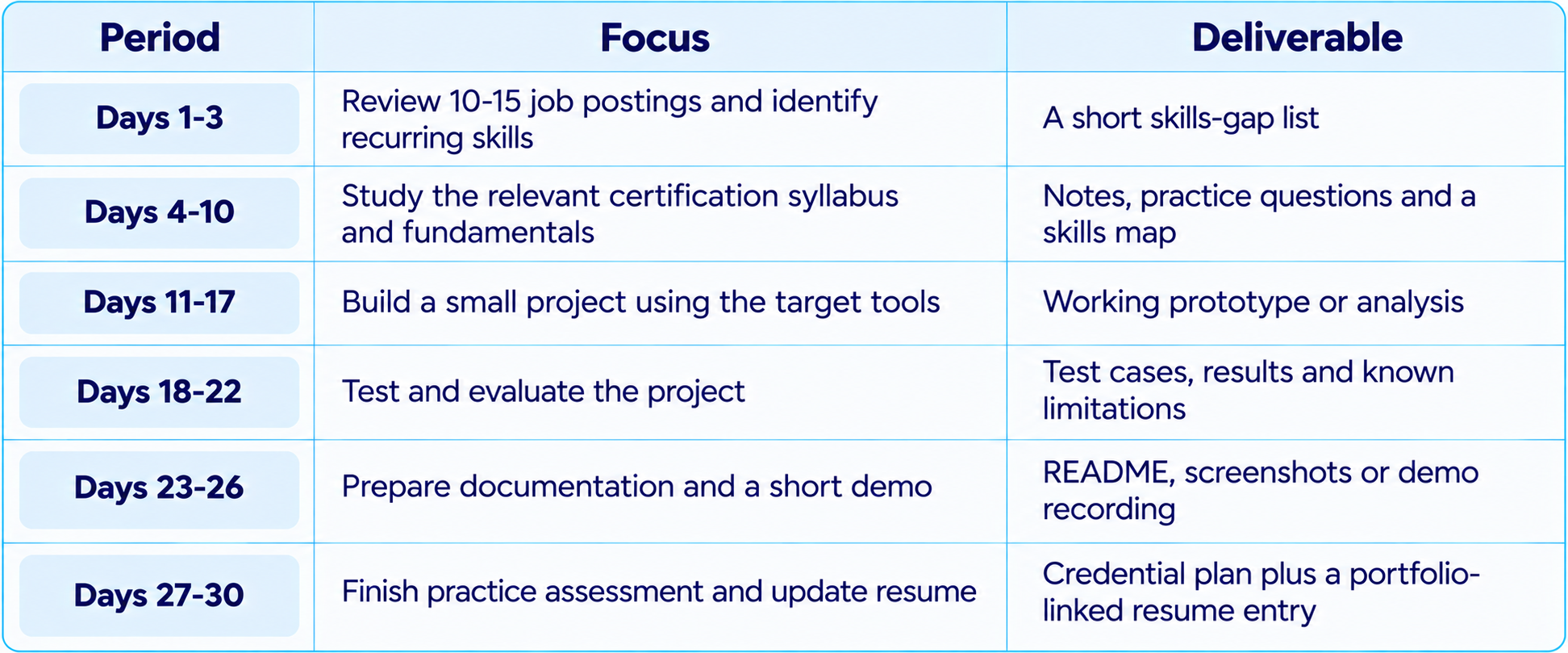
This schedule is a template, not a promise that every certification can be completed in 30 days. A demanding professional exam may require longer. The point is to keep learning connected to practical output instead of postponing all project work until after the exam.
13. How to Choose Based on Your Career Stage
Students and freshers
Prioritize fundamentals, one credible credential and two or three projects that match the jobs you want. A certificate can show initiative, but a project walkthrough helps interviewers understand how you think. Include what you personally built and avoid overstating group contributions.
Working professionals
Choose a credential that supports a current responsibility or a realistic internal move. Ask your manager which skills matter, whether the employer reimburses the cost and whether you can apply the learning to a real project.
Career changers
Use certification to structure a transition, not to skip the foundations of the new field. A non-technical professional moving into AI operations may need workflow design and governance; someone targeting ML engineering needs programming, statistics and model evaluation as well.
Experienced developers
Avoid repeating introductory content you already know. Select a certification only if it validates a platform skill required by target employers or fills a clear gap. A production-quality AI application, evaluation suite or deployment project may be a better use of your time.
14. Common Mistakes That Reduce Certification Value
- Collecting badges without choosing a target role.
- Using a course-completion certificate as evidence of advanced engineering skill.
- Listing a credential without linking it to a project or job requirement.
- Memorizing exam answers without understanding the underlying concepts.
- Using a portfolio demo that cannot be reproduced or tested.
- Claiming AI expertise without discussing accuracy, privacy, security or limitations.
- Paying for an expensive program before checking the syllabus and job-market relevance.
- Assuming a credential will remain current indefinitely in a fast-changing technical field.
15. Final Verdict: Is an AI Certification Worth It in 2026?
An AI certification is worth considering when it has a clear purpose. It can give beginners a structured path, help professionals demonstrate platform knowledge, support an internal skills transition and make a resume more relevant when a job posting names the credential. Employer interest in skills-based hiring and AI upskilling makes relevant credentials useful signals, particularly when backed by meaningful assessment.
But a certificate is not a shortcut around practical ability. Employers want to know whether you can solve problems, make sound decisions, communicate clearly and apply AI responsibly. A generic badge without assessment or applied work is a weak substitute for a portfolio, internship or real project.
The best strategy is to work backward from your target role. Review job descriptions, identify the tools and skills that recur, choose a credential that tests those skills, and build a project that demonstrates them. Keep the project small enough to finish and rigorous enough to explain.
My recommendation: earn one relevant certification, build at least one substantial project alongside it, and be ready to discuss the evaluation, tradeoffs and limitations. Do not optimize for the number of certificates on your profile. Optimize for credible evidence that you can do the job.
Bottom line: an AI certification can help open the conversation, but your demonstrated skills are what make the conversation convincing.
Frequently Asked Questions
Is an AI certification worth it in 2026?
Yes, when it is relevant to your target role, includes credible assessment and helps you demonstrate job-ready skills. It is much less valuable as a standalone badge.
Do employers care about AI certifications?
Some do, especially when a role names a vendor or platform. Employers also increasingly assess practical skills, projects and problem-solving, so certification should support rather than replace proof of work.
Can an AI certificate get me a job?
It can strengthen your application, but it cannot guarantee a job. Role fit, practical ability, communication, experience and interview performance still matter.
What is the best AI certification for beginners?
The best option depends on your goal. Start with a foundational AI credential for workplace use, a cloud AI path for cloud roles, or programming and ML fundamentals for engineering roles.
Is a certificate better than a portfolio?
They serve different purposes. A certificate shows structured learning or assessment; a portfolio demonstrates applied work. For technical roles, combining them is often stronger.
Are free AI certificates worth it?
They can be valuable for learning and showing initiative. Check whether they include assessment and whether employers in your target field recognize the provider.
Do AI certifications increase salary?
Not automatically. Pay depends on role, experience, employer and market conditions. A certification may support a move or promotion when it validates skills the employer needs.
How many AI certifications should I have?
There is no ideal number. One or two relevant credentials plus strong projects are usually clearer than a long list of unrelated certificates.
Should students get AI certifications?
Yes, if the credential supports a career goal and leaves enough time to build projects, practice coding or gain internship experience.
What should I put on my resume after certification?
List the official credential name, issuer, date and verification link if available. Add a project bullet showing how you applied the skills, without overstating your experience.
Are AI certifications the same as machine learning certifications?
No. AI literacy credentials may focus on using AI tools and understanding concepts. Machine learning credentials may cover data, model training, evaluation and deployment.
How do I know whether a certification is credible?
Review its issuer, assessment method, exam guide, renewal rules, practical requirements and whether the credential appears in relevant job postings.
Recommended Blogs
Resources & Community
Join our community of 70,000+ AI enthusiasts and learn to build practical AI applications. Build Fast with AI helps developers, students, creators and teams move from learning AI concepts to implementing real projects.
Agentic AI Launchpad 2026
A structured 6-week cohort program focused on building and deploying real-world agentic AI systems through practical work, mentorship and project reviews.
Explore the program: Agentic AI Launchpad 2026
Free AI Resources
Use free learning resources to keep building practical skills.

